Media Representation of Diabetes: Impact on Knowledge and Awareness

Verified

Added on  2023/06/15

|5
|694
|361
Report
AI Summary
This report explores how media represents diabetes, focusing on its impact on public knowledge and awareness. It discusses the role of media in enhancing the profile of diabetes, spreading knowledge, and attracting resources for research and care. The report contrasts various media representations, noting that some media overemphasize sugar as the primary cause of diabetes, while the reality is more complex, especially for type 1 diabetes, which is caused by immune system destruction of insulin-producing cells. For type 2 diabetes, the report clarifies that while sugar intake can contribute to weight gain and increase the risk, it is not the sole cause. The analysis concludes that media plays a crucial role in shaping public perception and understanding of diabetes, highlighting the need for accurate and balanced reporting.
Document Page
MEDIA
REPRESENTATION
ON HEALTH
tabler-icon-diamond-filled.svg

Paraphrase This Document

Need a fresh take? Get an instant paraphrase of this document with our AI Paraphraser
Document Page
Table of Contents
INTRODUCTION...........................................................................................................................1
MAIN BODY...................................................................................................................................1
CONCLUSION................................................................................................................................2
REFERENCES................................................................................................................................3
Document Page
INTRODUCTION
Diabetes is defined as a disease within blood glucose, also known as high blood sugar. In
this, blood glucose is also called the primary source of energy received from the food which will
be eaten (Upadhyay and et al., 2021). Moreover, insulin acts as a hormone made to maintain the
sugar level. It is usually secreted from the pancreas, which helps glucose from the food get into
the ATP used for energy. In this report, the media represent the various aspects of the program to
produce the quality of knowledge based on Diabetes. The people used to follow the trend which
is shared by the media. The media represent Diabetes as a standard but a chronic disease that
may create life-threatening issues.
MAIN BODY
The media can play an essential role in enhancing the profile for Diabetes and spreading
knowledge and understanding based on disease, and attracting the additional resource diabetes
based on research and care. It is essential for those involved adequately with Diabetes, which is
based on several media types, including medical and lay, specialist and the general, national and
local. Taking the contrast of media, they represent various information associated with Diabetes.
In this, some media usually reflect additional evidence to some populations. Moreover, the
media's representation followed that sugar is the leading cause of Diabetes.
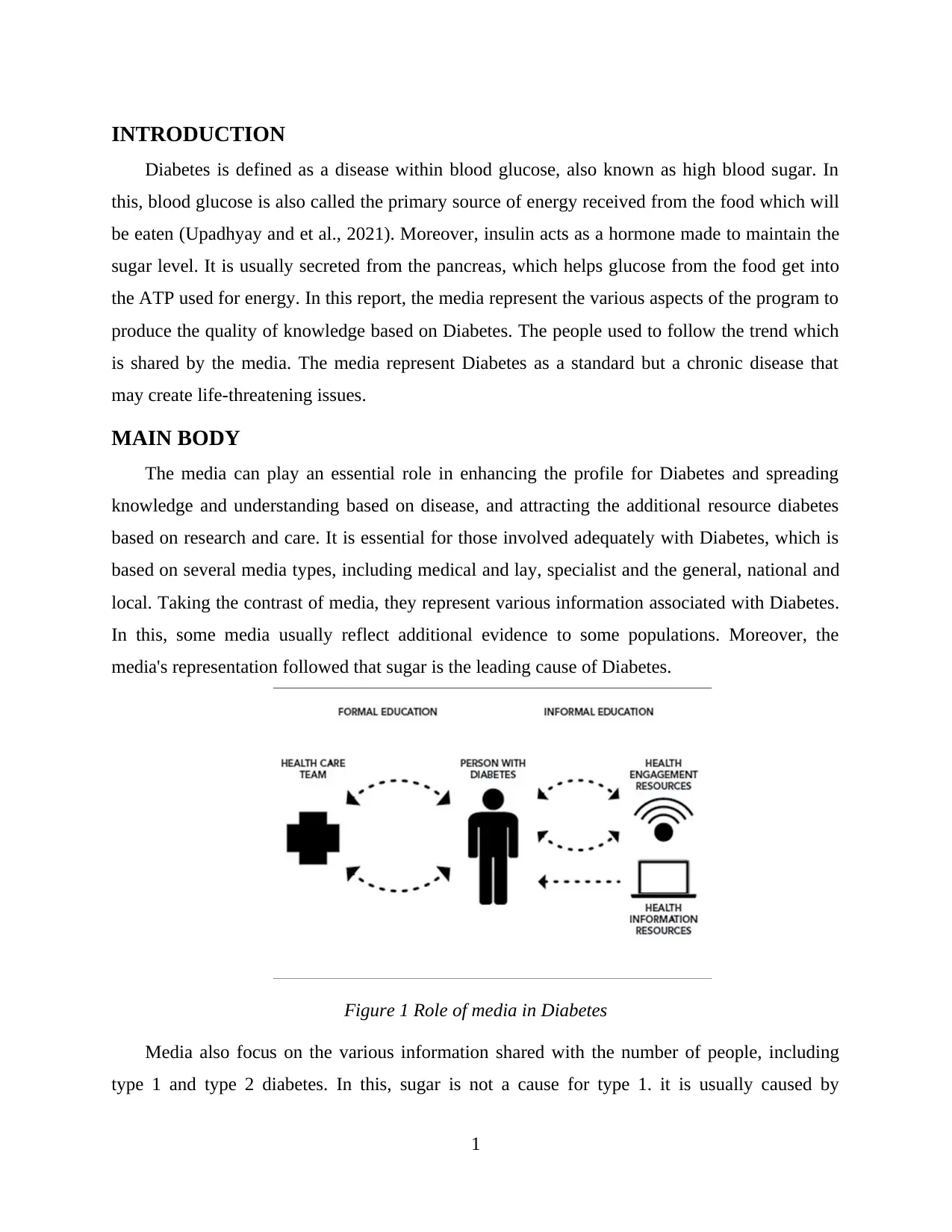
Figure 1 Role of media in Diabetes
Media also focus on the various information shared with the number of people, including
type 1 and type 2 diabetes. In this, sugar is not a cause for type 1. it is usually caused by
1
Document Page
producing the cell destroyed by the immune system. In addition to this, the answer becomes
complex while taking the aspect of type two Diabetes. In this, it is not directly causing the rising
cases of Diabetes. Moreover, the main reason for having Diabetes in overweight. While taking
the context of sugar, the dietary intake associated with sugary contain may create the issue of
having Diabetes. So, this is analyzed that sugar is a significant cause of raising the issue of
Diabetes by enhancing the weight that increases the risk of type 2 diabetes (Horie et al., 2018).
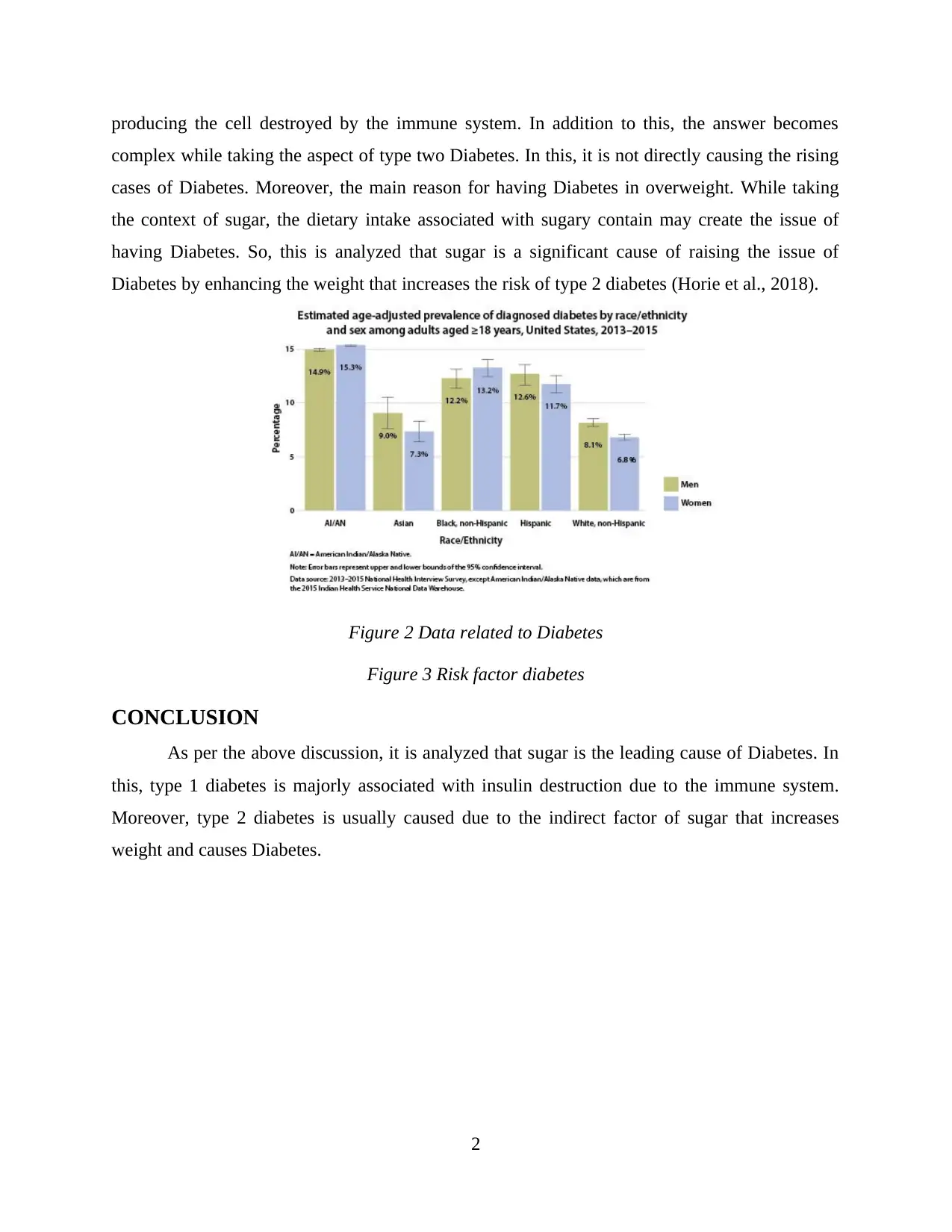
Figure 2 Data related to Diabetes
Figure 3 Risk factor diabetes
CONCLUSION
As per the above discussion, it is analyzed that sugar is the leading cause of Diabetes. In
this, type 1 diabetes is majorly associated with insulin destruction due to the immune system.
Moreover, type 2 diabetes is usually caused due to the indirect factor of sugar that increases
weight and causes Diabetes.
2
tabler-icon-diamond-filled.svg

Paraphrase This Document

Need a fresh take? Get an instant paraphrase of this document with our AI Paraphraser
Document Page
REFERENCES
Books and Journals
Barrientos-Gutierrez, and et. al., 2017. Expected population weight and diabetes impact of the 1-
peso-per-litre tax to sugar sweetened beverages in Mexico. PloS one, 12(5), p.e0176336.
El-Sayed and et. al., 2018. Sugar intake in Sudanese individuals was associated with some
features of the metabolic syndrome: population based study. Diabetes & Metabolic
Syndrome: Clinical Research & Reviews, 12(3), pp.245-250.
Horie and et. al., 2018. Increased sugar intake as a form of compensatory hyperphagia in patients
with type 2 diabetes under dapagliflozin treatment. diabetes research and clinical
practice, 135, pp.178-184.
Meng and et. al., 2019. Effects and mechanisms of tea for the prevention and management of
diabetes mellitus and diabetic complications: An updated review. Antioxidants, 8(6),
p.170.
Upadhyay and et. al., 2021. The Impact of Resistanceand Aerobic Exerciseson Blood Sugar
Level in Type 2 Diabetes Mellitus: Apilot Study. Medico Legal Update, 21(2), pp.697-
701.
3
chevron_up_icon
1 out of 5
circle_padding
hide_on_mobile
zoom_out_icon
[object Object]