An Examination of Media's Negative Effects on Women's Self-Perception
VerifiedAdded on 2019/09/30
|6
|2325
|218
Essay
AI Summary
This essay examines the pervasive negative impacts of media's representation of women, arguing that unrealistic beauty standards promoted through advertising and media outlets contribute significantly to body image dissatisfaction and the rise of eating disorders. The essay draws on research to highlight the disparity between the idealized, excessively thin female body presented in media and the average woman's physical characteristics. It explores how this discrepancy leads to feelings of inadequacy, lowered self-worth, and a culture that prioritizes appearance over other qualities. The essay further discusses the correlation between media exposure, body image dissatisfaction, and the development of eating disorders like anorexia and bulimia. It concludes by emphasizing the importance of media literacy and critical thinking to counteract the negative effects of these unrealistic standards, fostering a more balanced and healthy self-perception.
Student Last Name 1
Student Name
Instructor Name
Course Title
Assignment Title
Date
Negative Effects of Media's Representation of Women
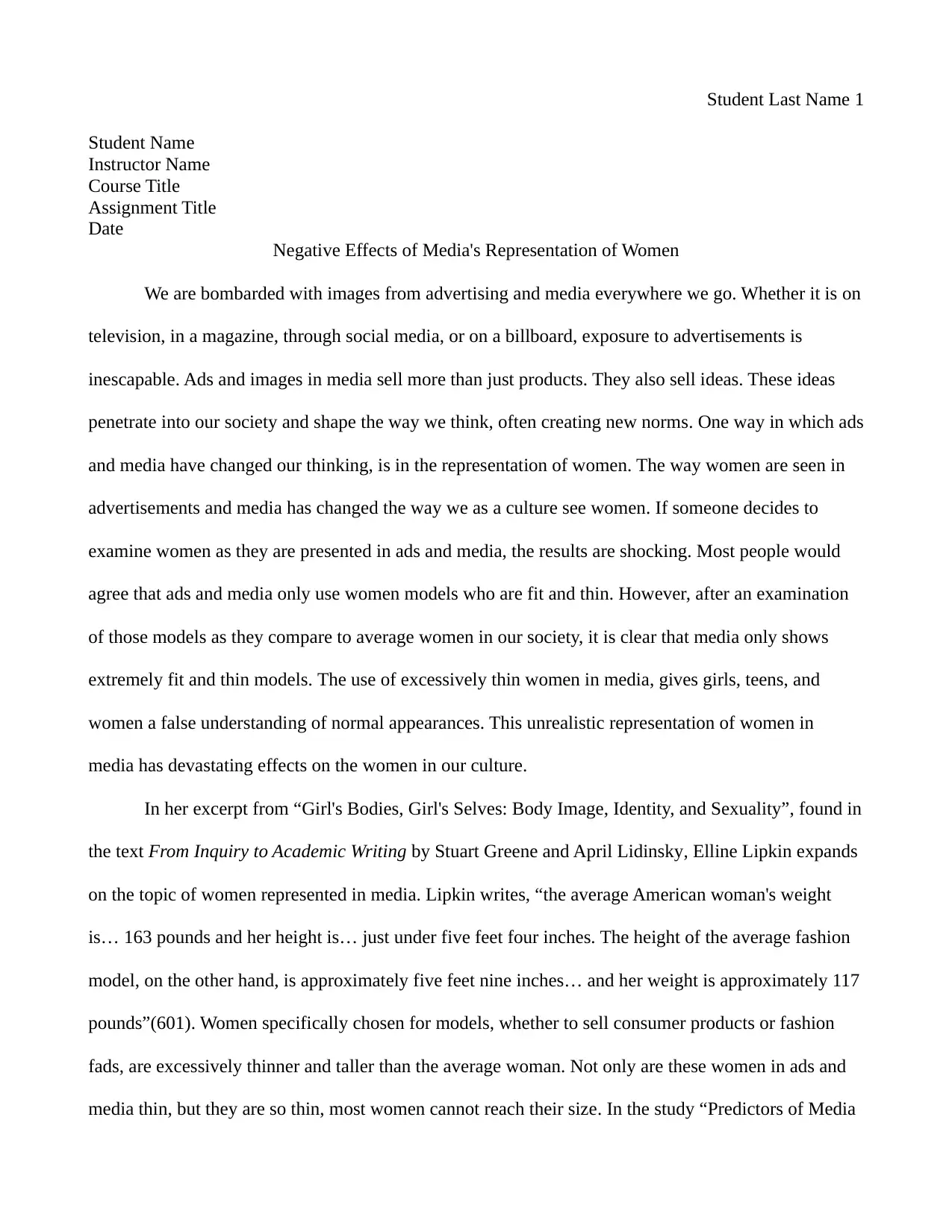
We are bombarded with images from advertising and media everywhere we go. Whether it is on
television, in a magazine, through social media, or on a billboard, exposure to advertisements is
inescapable. Ads and images in media sell more than just products. They also sell ideas. These ideas
penetrate into our society and shape the way we think, often creating new norms. One way in which ads
and media have changed our thinking, is in the representation of women. The way women are seen in
advertisements and media has changed the way we as a culture see women. If someone decides to
examine women as they are presented in ads and media, the results are shocking. Most people would
agree that ads and media only use women models who are fit and thin. However, after an examination
of those models as they compare to average women in our society, it is clear that media only shows
extremely fit and thin models. The use of excessively thin women in media, gives girls, teens, and
women a false understanding of normal appearances. This unrealistic representation of women in
media has devastating effects on the women in our culture.
In her excerpt from “Girl's Bodies, Girl's Selves: Body Image, Identity, and Sexuality”, found in
the text From Inquiry to Academic Writing by Stuart Greene and April Lidinsky, Elline Lipkin expands
on the topic of women represented in media. Lipkin writes, “the average American woman's weight
is… 163 pounds and her height is… just under five feet four inches. The height of the average fashion
model, on the other hand, is approximately five feet nine inches… and her weight is approximately 117
pounds”(601). Women specifically chosen for models, whether to sell consumer products or fashion
fads, are excessively thinner and taller than the average woman. Not only are these women in ads and
media thin, but they are so thin, most women cannot reach their size. In the study “Predictors of Media
Student Name
Instructor Name
Course Title
Assignment Title
Date
Negative Effects of Media's Representation of Women
We are bombarded with images from advertising and media everywhere we go. Whether it is on
television, in a magazine, through social media, or on a billboard, exposure to advertisements is
inescapable. Ads and images in media sell more than just products. They also sell ideas. These ideas
penetrate into our society and shape the way we think, often creating new norms. One way in which ads
and media have changed our thinking, is in the representation of women. The way women are seen in
advertisements and media has changed the way we as a culture see women. If someone decides to
examine women as they are presented in ads and media, the results are shocking. Most people would
agree that ads and media only use women models who are fit and thin. However, after an examination
of those models as they compare to average women in our society, it is clear that media only shows
extremely fit and thin models. The use of excessively thin women in media, gives girls, teens, and
women a false understanding of normal appearances. This unrealistic representation of women in
media has devastating effects on the women in our culture.
In her excerpt from “Girl's Bodies, Girl's Selves: Body Image, Identity, and Sexuality”, found in
the text From Inquiry to Academic Writing by Stuart Greene and April Lidinsky, Elline Lipkin expands
on the topic of women represented in media. Lipkin writes, “the average American woman's weight
is… 163 pounds and her height is… just under five feet four inches. The height of the average fashion
model, on the other hand, is approximately five feet nine inches… and her weight is approximately 117
pounds”(601). Women specifically chosen for models, whether to sell consumer products or fashion
fads, are excessively thinner and taller than the average woman. Not only are these women in ads and
media thin, but they are so thin, most women cannot reach their size. In the study “Predictors of Media

Paraphrase This Document
Need a fresh take? Get an instant paraphrase of this document with our AI Paraphraser
Student Last Name 2
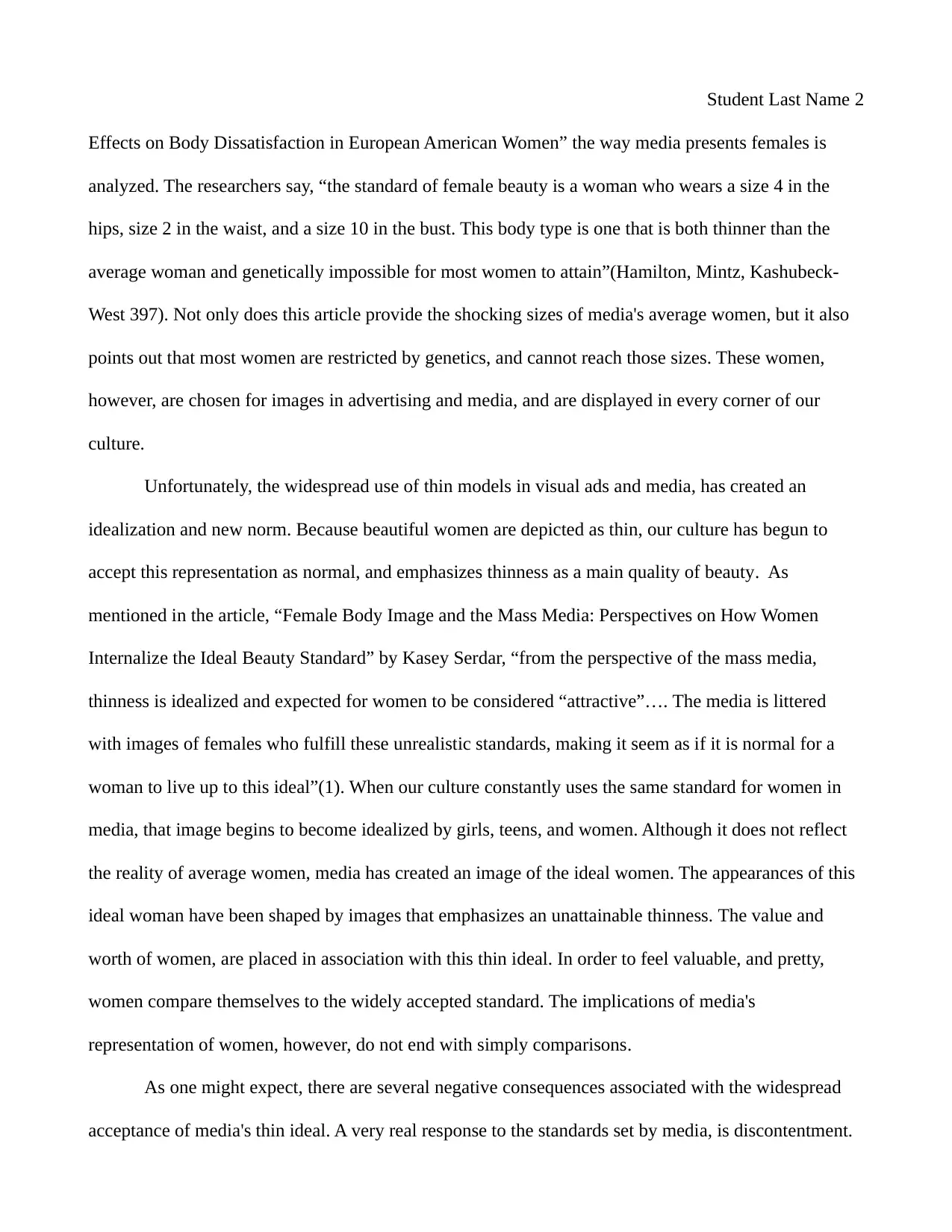
Effects on Body Dissatisfaction in European American Women” the way media presents females is
analyzed. The researchers say, “the standard of female beauty is a woman who wears a size 4 in the
hips, size 2 in the waist, and a size 10 in the bust. This body type is one that is both thinner than the
average woman and genetically impossible for most women to attain”(Hamilton, Mintz, Kashubeck-
West 397). Not only does this article provide the shocking sizes of media's average women, but it also
points out that most women are restricted by genetics, and cannot reach those sizes. These women,
however, are chosen for images in advertising and media, and are displayed in every corner of our
culture.
Unfortunately, the widespread use of thin models in visual ads and media, has created an
idealization and new norm. Because beautiful women are depicted as thin, our culture has begun to
accept this representation as normal, and emphasizes thinness as a main quality of beauty. As
mentioned in the article, “Female Body Image and the Mass Media: Perspectives on How Women
Internalize the Ideal Beauty Standard” by Kasey Serdar, “from the perspective of the mass media,
thinness is idealized and expected for women to be considered “attractive”…. The media is littered
with images of females who fulfill these unrealistic standards, making it seem as if it is normal for a
woman to live up to this ideal”(1). When our culture constantly uses the same standard for women in
media, that image begins to become idealized by girls, teens, and women. Although it does not reflect
the reality of average women, media has created an image of the ideal women. The appearances of this
ideal woman have been shaped by images that emphasizes an unattainable thinness. The value and
worth of women, are placed in association with this thin ideal. In order to feel valuable, and pretty,
women compare themselves to the widely accepted standard. The implications of media's
representation of women, however, do not end with simply comparisons.
As one might expect, there are several negative consequences associated with the widespread
acceptance of media's thin ideal. A very real response to the standards set by media, is discontentment.
Effects on Body Dissatisfaction in European American Women” the way media presents females is
analyzed. The researchers say, “the standard of female beauty is a woman who wears a size 4 in the
hips, size 2 in the waist, and a size 10 in the bust. This body type is one that is both thinner than the
average woman and genetically impossible for most women to attain”(Hamilton, Mintz, Kashubeck-
West 397). Not only does this article provide the shocking sizes of media's average women, but it also
points out that most women are restricted by genetics, and cannot reach those sizes. These women,
however, are chosen for images in advertising and media, and are displayed in every corner of our
culture.
Unfortunately, the widespread use of thin models in visual ads and media, has created an
idealization and new norm. Because beautiful women are depicted as thin, our culture has begun to
accept this representation as normal, and emphasizes thinness as a main quality of beauty. As
mentioned in the article, “Female Body Image and the Mass Media: Perspectives on How Women
Internalize the Ideal Beauty Standard” by Kasey Serdar, “from the perspective of the mass media,
thinness is idealized and expected for women to be considered “attractive”…. The media is littered
with images of females who fulfill these unrealistic standards, making it seem as if it is normal for a
woman to live up to this ideal”(1). When our culture constantly uses the same standard for women in
media, that image begins to become idealized by girls, teens, and women. Although it does not reflect
the reality of average women, media has created an image of the ideal women. The appearances of this
ideal woman have been shaped by images that emphasizes an unattainable thinness. The value and
worth of women, are placed in association with this thin ideal. In order to feel valuable, and pretty,
women compare themselves to the widely accepted standard. The implications of media's
representation of women, however, do not end with simply comparisons.
As one might expect, there are several negative consequences associated with the widespread
acceptance of media's thin ideal. A very real response to the standards set by media, is discontentment.
Student Last Name 3
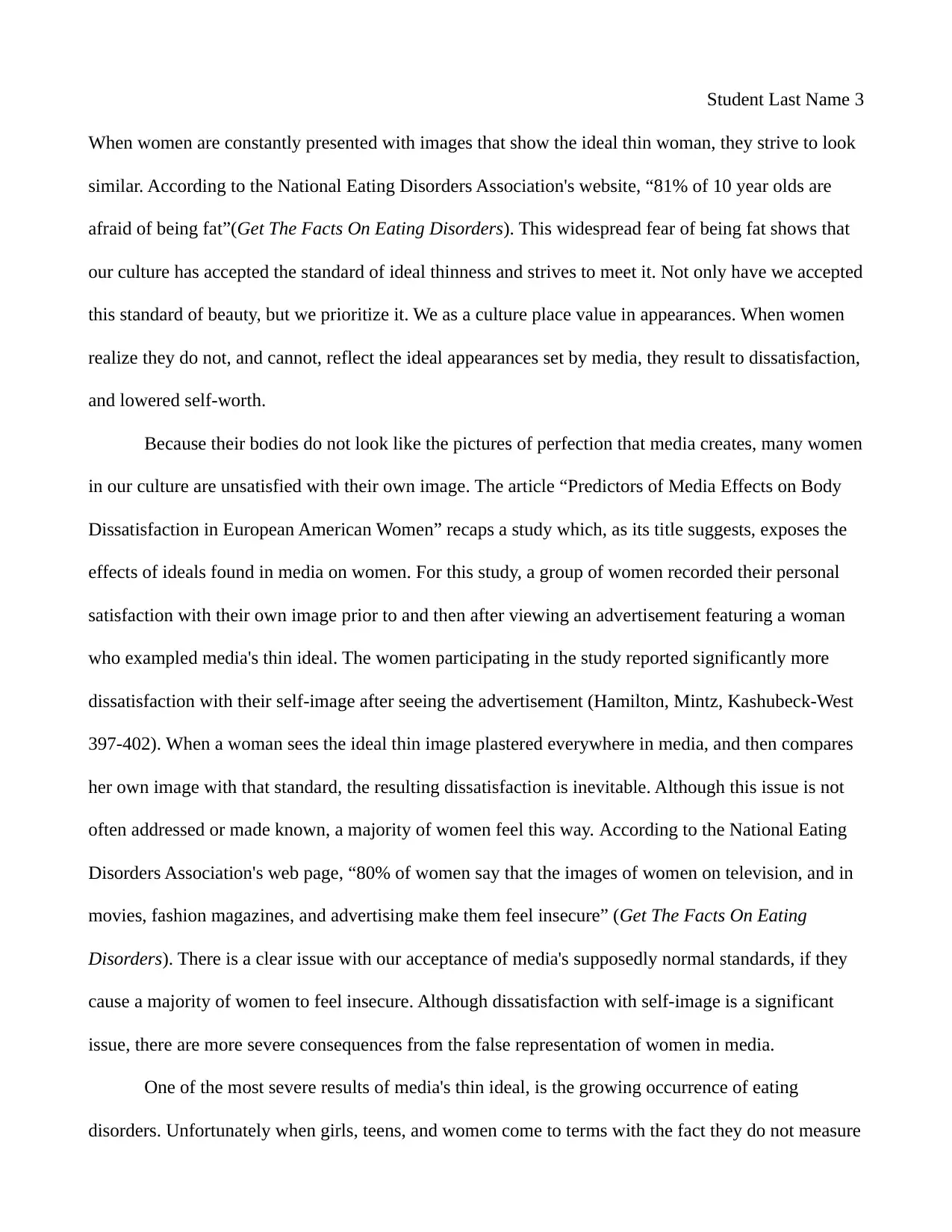
When women are constantly presented with images that show the ideal thin woman, they strive to look
similar. According to the National Eating Disorders Association's website, “81% of 10 year olds are
afraid of being fat”(Get The Facts On Eating Disorders). This widespread fear of being fat shows that
our culture has accepted the standard of ideal thinness and strives to meet it. Not only have we accepted
this standard of beauty, but we prioritize it. We as a culture place value in appearances. When women
realize they do not, and cannot, reflect the ideal appearances set by media, they result to dissatisfaction,
and lowered self-worth.
Because their bodies do not look like the pictures of perfection that media creates, many women
in our culture are unsatisfied with their own image. The article “Predictors of Media Effects on Body
Dissatisfaction in European American Women” recaps a study which, as its title suggests, exposes the
effects of ideals found in media on women. For this study, a group of women recorded their personal
satisfaction with their own image prior to and then after viewing an advertisement featuring a woman
who exampled media's thin ideal. The women participating in the study reported significantly more
dissatisfaction with their self-image after seeing the advertisement (Hamilton, Mintz, Kashubeck-West
397-402). When a woman sees the ideal thin image plastered everywhere in media, and then compares
her own image with that standard, the resulting dissatisfaction is inevitable. Although this issue is not
often addressed or made known, a majority of women feel this way. According to the National Eating
Disorders Association's web page, “80% of women say that the images of women on television, and in
movies, fashion magazines, and advertising make them feel insecure” (Get The Facts On Eating
Disorders). There is a clear issue with our acceptance of media's supposedly normal standards, if they
cause a majority of women to feel insecure. Although dissatisfaction with self-image is a significant
issue, there are more severe consequences from the false representation of women in media.
One of the most severe results of media's thin ideal, is the growing occurrence of eating
disorders. Unfortunately when girls, teens, and women come to terms with the fact they do not measure
When women are constantly presented with images that show the ideal thin woman, they strive to look
similar. According to the National Eating Disorders Association's website, “81% of 10 year olds are
afraid of being fat”(Get The Facts On Eating Disorders). This widespread fear of being fat shows that
our culture has accepted the standard of ideal thinness and strives to meet it. Not only have we accepted
this standard of beauty, but we prioritize it. We as a culture place value in appearances. When women
realize they do not, and cannot, reflect the ideal appearances set by media, they result to dissatisfaction,
and lowered self-worth.
Because their bodies do not look like the pictures of perfection that media creates, many women
in our culture are unsatisfied with their own image. The article “Predictors of Media Effects on Body
Dissatisfaction in European American Women” recaps a study which, as its title suggests, exposes the
effects of ideals found in media on women. For this study, a group of women recorded their personal
satisfaction with their own image prior to and then after viewing an advertisement featuring a woman
who exampled media's thin ideal. The women participating in the study reported significantly more
dissatisfaction with their self-image after seeing the advertisement (Hamilton, Mintz, Kashubeck-West
397-402). When a woman sees the ideal thin image plastered everywhere in media, and then compares
her own image with that standard, the resulting dissatisfaction is inevitable. Although this issue is not
often addressed or made known, a majority of women feel this way. According to the National Eating
Disorders Association's web page, “80% of women say that the images of women on television, and in
movies, fashion magazines, and advertising make them feel insecure” (Get The Facts On Eating
Disorders). There is a clear issue with our acceptance of media's supposedly normal standards, if they
cause a majority of women to feel insecure. Although dissatisfaction with self-image is a significant
issue, there are more severe consequences from the false representation of women in media.
One of the most severe results of media's thin ideal, is the growing occurrence of eating
disorders. Unfortunately when girls, teens, and women come to terms with the fact they do not measure
⊘ This is a preview!⊘
Do you want full access?
Subscribe today to unlock all pages.

Trusted by 1+ million students worldwide
Student Last Name 4
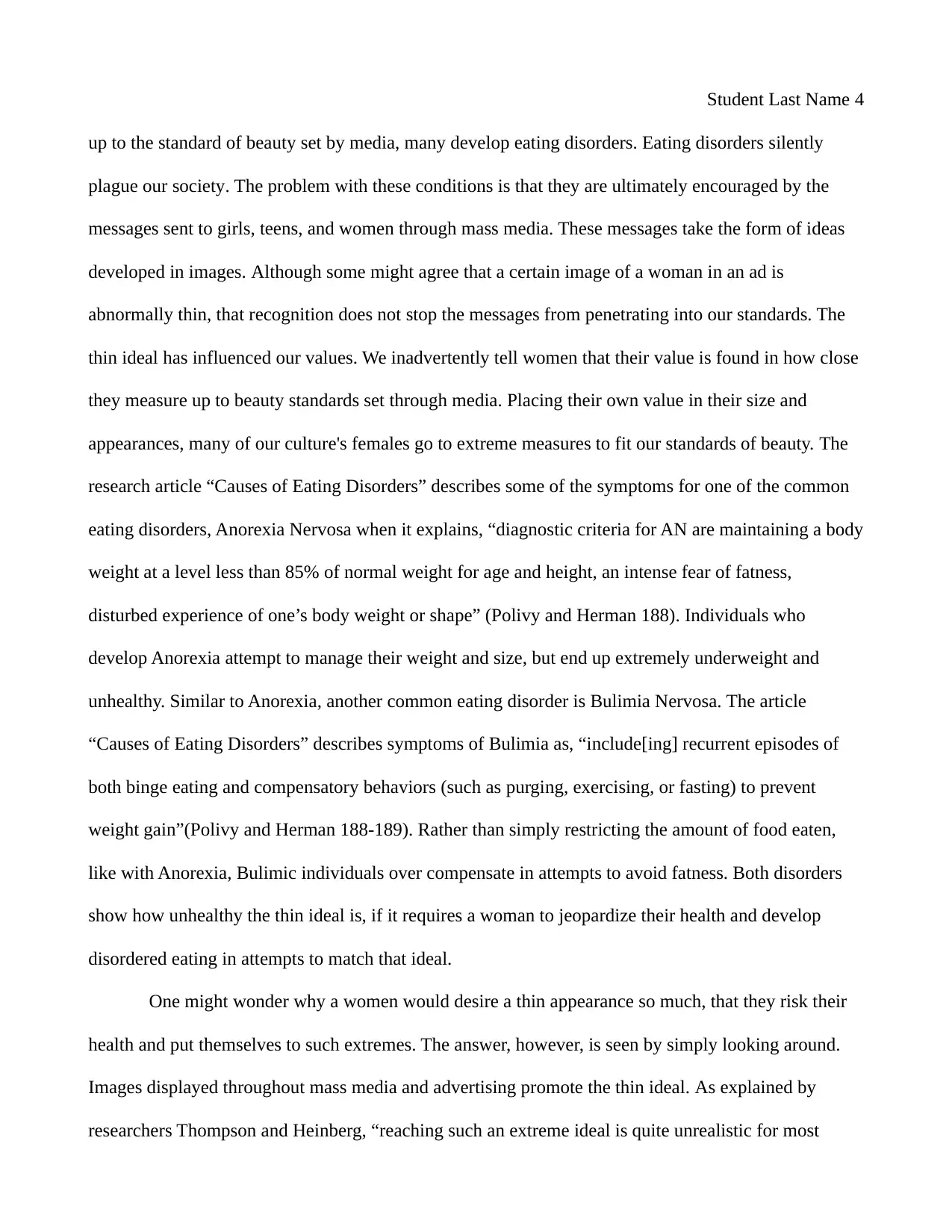
up to the standard of beauty set by media, many develop eating disorders. Eating disorders silently
plague our society. The problem with these conditions is that they are ultimately encouraged by the
messages sent to girls, teens, and women through mass media. These messages take the form of ideas
developed in images. Although some might agree that a certain image of a woman in an ad is
abnormally thin, that recognition does not stop the messages from penetrating into our standards. The
thin ideal has influenced our values. We inadvertently tell women that their value is found in how close
they measure up to beauty standards set through media. Placing their own value in their size and
appearances, many of our culture's females go to extreme measures to fit our standards of beauty. The
research article “Causes of Eating Disorders” describes some of the symptoms for one of the common
eating disorders, Anorexia Nervosa when it explains, “diagnostic criteria for AN are maintaining a body
weight at a level less than 85% of normal weight for age and height, an intense fear of fatness,
disturbed experience of one’s body weight or shape” (Polivy and Herman 188). Individuals who
develop Anorexia attempt to manage their weight and size, but end up extremely underweight and
unhealthy. Similar to Anorexia, another common eating disorder is Bulimia Nervosa. The article
“Causes of Eating Disorders” describes symptoms of Bulimia as, “include[ing] recurrent episodes of
both binge eating and compensatory behaviors (such as purging, exercising, or fasting) to prevent
weight gain”(Polivy and Herman 188-189). Rather than simply restricting the amount of food eaten,
like with Anorexia, Bulimic individuals over compensate in attempts to avoid fatness. Both disorders
show how unhealthy the thin ideal is, if it requires a woman to jeopardize their health and develop
disordered eating in attempts to match that ideal.
One might wonder why a women would desire a thin appearance so much, that they risk their
health and put themselves to such extremes. The answer, however, is seen by simply looking around.
Images displayed throughout mass media and advertising promote the thin ideal. As explained by
researchers Thompson and Heinberg, “reaching such an extreme ideal is quite unrealistic for most
up to the standard of beauty set by media, many develop eating disorders. Eating disorders silently
plague our society. The problem with these conditions is that they are ultimately encouraged by the
messages sent to girls, teens, and women through mass media. These messages take the form of ideas
developed in images. Although some might agree that a certain image of a woman in an ad is
abnormally thin, that recognition does not stop the messages from penetrating into our standards. The
thin ideal has influenced our values. We inadvertently tell women that their value is found in how close
they measure up to beauty standards set through media. Placing their own value in their size and
appearances, many of our culture's females go to extreme measures to fit our standards of beauty. The
research article “Causes of Eating Disorders” describes some of the symptoms for one of the common
eating disorders, Anorexia Nervosa when it explains, “diagnostic criteria for AN are maintaining a body
weight at a level less than 85% of normal weight for age and height, an intense fear of fatness,
disturbed experience of one’s body weight or shape” (Polivy and Herman 188). Individuals who
develop Anorexia attempt to manage their weight and size, but end up extremely underweight and
unhealthy. Similar to Anorexia, another common eating disorder is Bulimia Nervosa. The article
“Causes of Eating Disorders” describes symptoms of Bulimia as, “include[ing] recurrent episodes of
both binge eating and compensatory behaviors (such as purging, exercising, or fasting) to prevent
weight gain”(Polivy and Herman 188-189). Rather than simply restricting the amount of food eaten,
like with Anorexia, Bulimic individuals over compensate in attempts to avoid fatness. Both disorders
show how unhealthy the thin ideal is, if it requires a woman to jeopardize their health and develop
disordered eating in attempts to match that ideal.
One might wonder why a women would desire a thin appearance so much, that they risk their
health and put themselves to such extremes. The answer, however, is seen by simply looking around.
Images displayed throughout mass media and advertising promote the thin ideal. As explained by
researchers Thompson and Heinberg, “reaching such an extreme ideal is quite unrealistic for most
Paraphrase This Document
Need a fresh take? Get an instant paraphrase of this document with our AI Paraphraser
Student Last Name 5
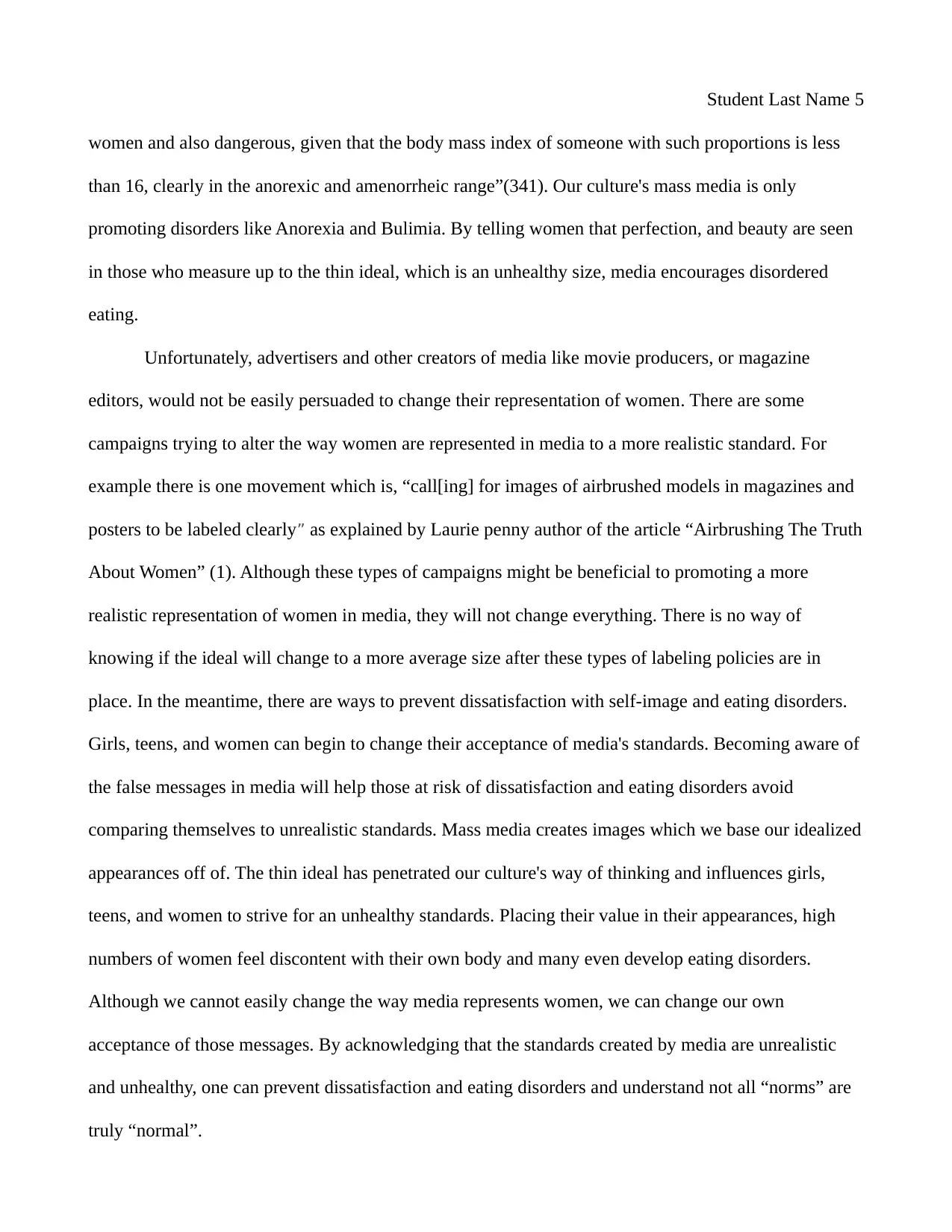
women and also dangerous, given that the body mass index of someone with such proportions is less
than 16, clearly in the anorexic and amenorrheic range”(341). Our culture's mass media is only
promoting disorders like Anorexia and Bulimia. By telling women that perfection, and beauty are seen
in those who measure up to the thin ideal, which is an unhealthy size, media encourages disordered
eating.
Unfortunately, advertisers and other creators of media like movie producers, or magazine
editors, would not be easily persuaded to change their representation of women. There are some
campaigns trying to alter the way women are represented in media to a more realistic standard. For
example there is one movement which is, “call[ing] for images of airbrushed models in magazines and
posters to be labeled clearly” as explained by Laurie penny author of the article “Airbrushing The Truth
About Women” (1). Although these types of campaigns might be beneficial to promoting a more
realistic representation of women in media, they will not change everything. There is no way of
knowing if the ideal will change to a more average size after these types of labeling policies are in
place. In the meantime, there are ways to prevent dissatisfaction with self-image and eating disorders.
Girls, teens, and women can begin to change their acceptance of media's standards. Becoming aware of
the false messages in media will help those at risk of dissatisfaction and eating disorders avoid
comparing themselves to unrealistic standards. Mass media creates images which we base our idealized
appearances off of. The thin ideal has penetrated our culture's way of thinking and influences girls,
teens, and women to strive for an unhealthy standards. Placing their value in their appearances, high
numbers of women feel discontent with their own body and many even develop eating disorders.
Although we cannot easily change the way media represents women, we can change our own
acceptance of those messages. By acknowledging that the standards created by media are unrealistic
and unhealthy, one can prevent dissatisfaction and eating disorders and understand not all “norms” are
truly “normal”.
women and also dangerous, given that the body mass index of someone with such proportions is less
than 16, clearly in the anorexic and amenorrheic range”(341). Our culture's mass media is only
promoting disorders like Anorexia and Bulimia. By telling women that perfection, and beauty are seen
in those who measure up to the thin ideal, which is an unhealthy size, media encourages disordered
eating.
Unfortunately, advertisers and other creators of media like movie producers, or magazine
editors, would not be easily persuaded to change their representation of women. There are some
campaigns trying to alter the way women are represented in media to a more realistic standard. For
example there is one movement which is, “call[ing] for images of airbrushed models in magazines and
posters to be labeled clearly” as explained by Laurie penny author of the article “Airbrushing The Truth
About Women” (1). Although these types of campaigns might be beneficial to promoting a more
realistic representation of women in media, they will not change everything. There is no way of
knowing if the ideal will change to a more average size after these types of labeling policies are in
place. In the meantime, there are ways to prevent dissatisfaction with self-image and eating disorders.
Girls, teens, and women can begin to change their acceptance of media's standards. Becoming aware of
the false messages in media will help those at risk of dissatisfaction and eating disorders avoid
comparing themselves to unrealistic standards. Mass media creates images which we base our idealized
appearances off of. The thin ideal has penetrated our culture's way of thinking and influences girls,
teens, and women to strive for an unhealthy standards. Placing their value in their appearances, high
numbers of women feel discontent with their own body and many even develop eating disorders.
Although we cannot easily change the way media represents women, we can change our own
acceptance of those messages. By acknowledging that the standards created by media are unrealistic
and unhealthy, one can prevent dissatisfaction and eating disorders and understand not all “norms” are
truly “normal”.
Student Last Name 6
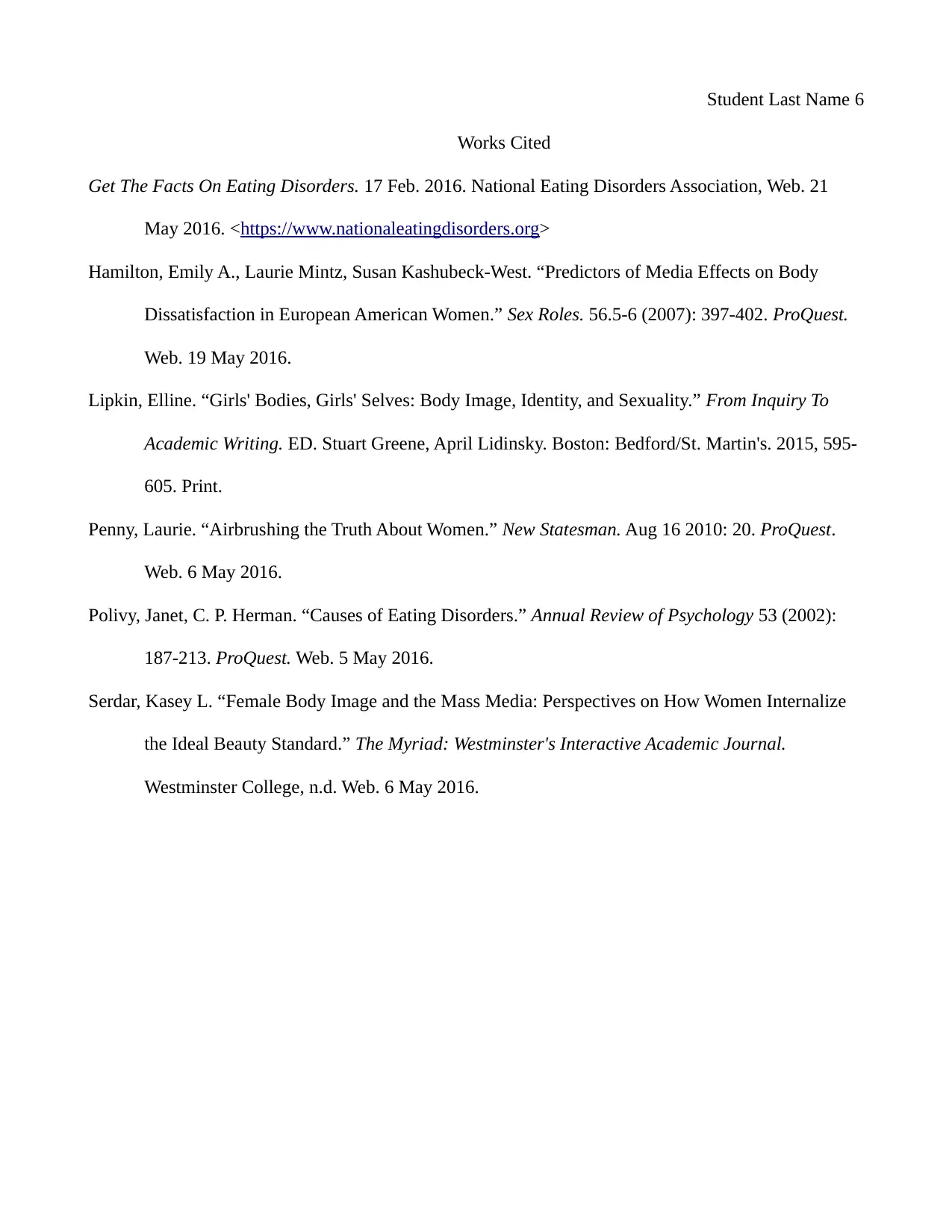
Works Cited
Get The Facts On Eating Disorders. 17 Feb. 2016. National Eating Disorders Association, Web. 21
May 2016. <https://www.nationaleatingdisorders.org>
Hamilton, Emily A., Laurie Mintz, Susan Kashubeck-West. “Predictors of Media Effects on Body
Dissatisfaction in European American Women.” Sex Roles. 56.5-6 (2007): 397-402. ProQuest.
Web. 19 May 2016.
Lipkin, Elline. “Girls' Bodies, Girls' Selves: Body Image, Identity, and Sexuality.” From Inquiry To
Academic Writing. ED. Stuart Greene, April Lidinsky. Boston: Bedford/St. Martin's. 2015, 595-
605. Print.
Penny, Laurie. “Airbrushing the Truth About Women.” New Statesman. Aug 16 2010: 20. ProQuest.
Web. 6 May 2016.
Polivy, Janet, C. P. Herman. “Causes of Eating Disorders.” Annual Review of Psychology 53 (2002):
187-213. ProQuest. Web. 5 May 2016.
Serdar, Kasey L. “Female Body Image and the Mass Media: Perspectives on How Women Internalize
the Ideal Beauty Standard.” The Myriad: Westminster's Interactive Academic Journal.
Westminster College, n.d. Web. 6 May 2016.
Works Cited
Get The Facts On Eating Disorders. 17 Feb. 2016. National Eating Disorders Association, Web. 21
May 2016. <https://www.nationaleatingdisorders.org>
Hamilton, Emily A., Laurie Mintz, Susan Kashubeck-West. “Predictors of Media Effects on Body
Dissatisfaction in European American Women.” Sex Roles. 56.5-6 (2007): 397-402. ProQuest.
Web. 19 May 2016.
Lipkin, Elline. “Girls' Bodies, Girls' Selves: Body Image, Identity, and Sexuality.” From Inquiry To
Academic Writing. ED. Stuart Greene, April Lidinsky. Boston: Bedford/St. Martin's. 2015, 595-
605. Print.
Penny, Laurie. “Airbrushing the Truth About Women.” New Statesman. Aug 16 2010: 20. ProQuest.
Web. 6 May 2016.
Polivy, Janet, C. P. Herman. “Causes of Eating Disorders.” Annual Review of Psychology 53 (2002):
187-213. ProQuest. Web. 5 May 2016.
Serdar, Kasey L. “Female Body Image and the Mass Media: Perspectives on How Women Internalize
the Ideal Beauty Standard.” The Myriad: Westminster's Interactive Academic Journal.
Westminster College, n.d. Web. 6 May 2016.
⊘ This is a preview!⊘
Do you want full access?
Subscribe today to unlock all pages.
Trusted by 1+ million students worldwide

1 out of 6


Your All-in-One AI-Powered Toolkit for Academic Success.
+13062052269
info@desklib.com
Available 24*7 on WhatsApp / Email
![[object Object]](/_next/static/media/star-bottom.7253800d.svg)
Unlock your academic potential
Copyright © 2020–2026 A2Z Services. All Rights Reserved. Developed and managed by ZUCOL.