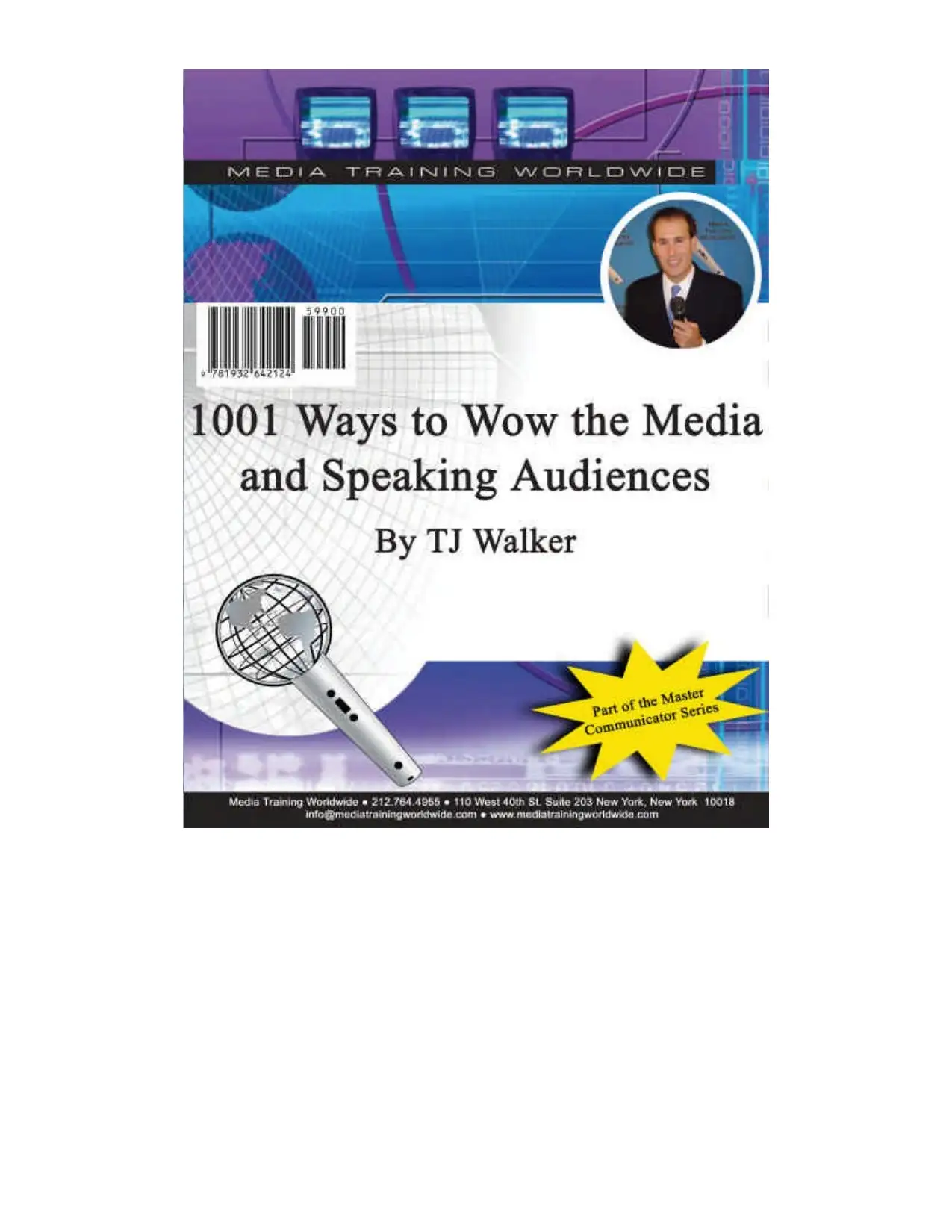
Report: Mastering Media & Speaking with TJ Walker's 1001 Ways
VerifiedAdded on 2023/06/19
|72
|28024
|357
Report
AI Summary
This report provides a summary of TJ Walker's '1001 Ways to Wow the Media and Speaking Audiences,' a guide designed for busy executives seeking to improve their communication skills for media appearances and public speaking engagements. The book is structured for quick reference, allowing readers to focus on specific areas such as delivering key messages, handling speeches, managing Q&A sessions, and navigating media interviews across various platforms including television, radio, and print. Key principles emphasized include focusing on three core messages, using positive language, avoiding jargon, and tailoring communication to the audience. The guide also offers practical advice on speech preparation, microphone usage, and techniques for maintaining audience engagement, as well as strategies for effective crisis communication and dressing appropriately for television. The report highlights Walker's emphasis on practice, message refinement, and adaptability to different communication scenarios, aiming to equip professionals with the tools to make a lasting impact in their media and speaking endeavors.

Paraphrase This Document
Need a fresh take? Get an instant paraphrase of this document with our AI Paraphraser
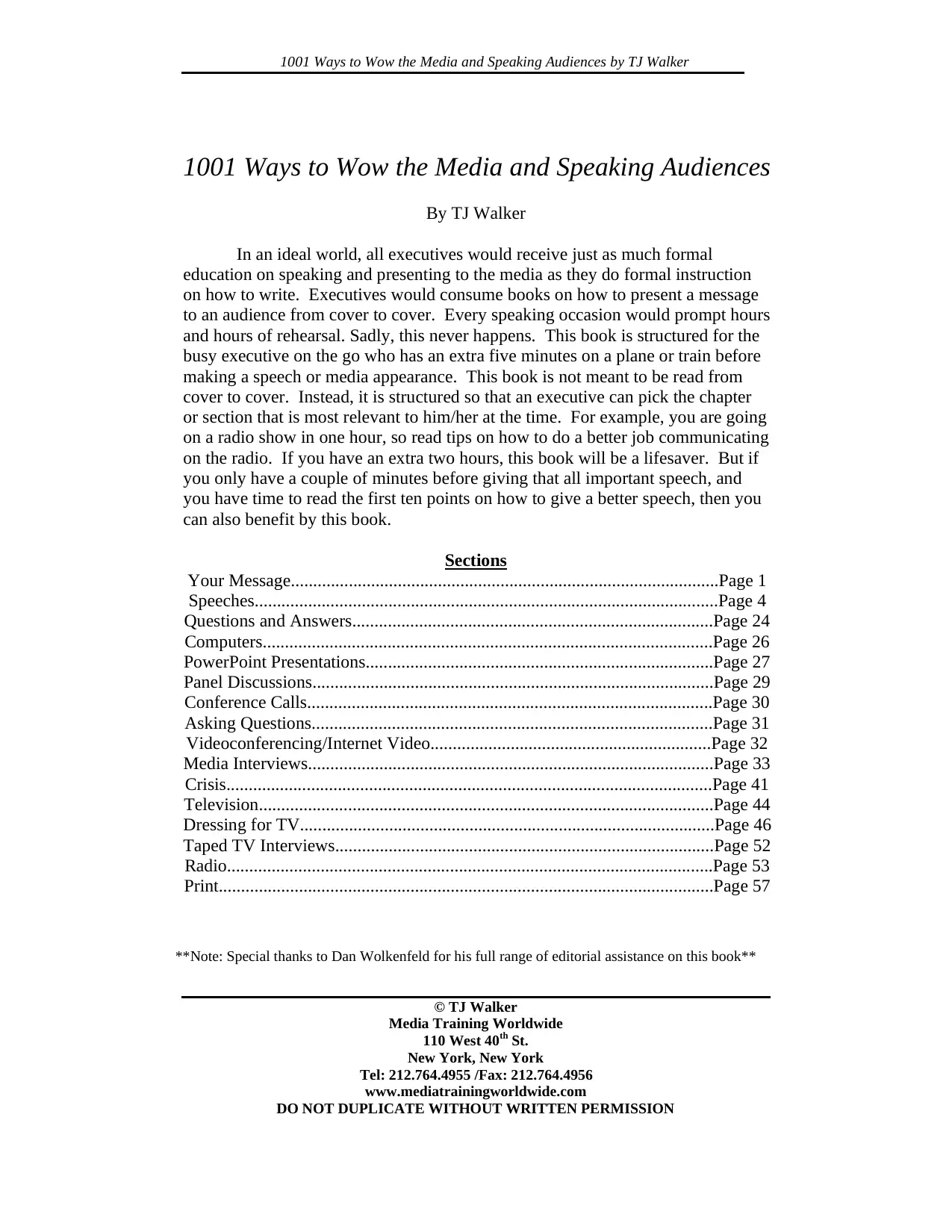
1001 Ways to Wow the Media and Speaking Audiences by TJ Walker
© TJ Walker
Media Training Worldwide
110 West 40th St.
New York, New York
Tel: 212.764.4955 /Fax: 212.764.4956
www.mediatrainingworldwide.com
DO NOT DUPLICATE WITHOUT WRITTEN PERMISSION
1001 Ways to Wow the Media and Speaking Audiences
By TJ Walker
In an ideal world, all executives would receive just as much formal
education on speaking and presenting to the media as they do formal instruction
on how to write. Executives would consume books on how to present a message
to an audience from cover to cover. Every speaking occasion would prompt hours
and hours of rehearsal. Sadly, this never happens. This book is structured for the
busy executive on the go who has an extra five minutes on a plane or train before
making a speech or media appearance. This book is not meant to be read from
cover to cover. Instead, it is structured so that an executive can pick the chapter
or section that is most relevant to him/her at the time. For example, you are going
on a radio show in one hour, so read tips on how to do a better job communicating
on the radio. If you have an extra two hours, this book will be a lifesaver. But if
you only have a couple of minutes before giving that all important speech, and
you have time to read the first ten points on how to give a better speech, then you
can also benefit by this book.
Sections
Your Message................................................................................................Page 1
Speeches........................................................................................................Page 4
Questions and Answers.................................................................................Page 24
Computers.....................................................................................................Page 26
PowerPoint Presentations..............................................................................Page 27
Panel Discussions..........................................................................................Page 29
Conference Calls...........................................................................................Page 30
Asking Questions..........................................................................................Page 31
Videoconferencing/Internet Video...............................................................Page 32
Media Interviews...........................................................................................Page 33
Crisis.............................................................................................................Page 41
Television......................................................................................................Page 44
Dressing for TV.............................................................................................Page 46
Taped TV Interviews.....................................................................................Page 52
Radio.............................................................................................................Page 53
Print...............................................................................................................Page 57
**Note: Special thanks to Dan Wolkenfeld for his full range of editorial assistance on this book**
© TJ Walker
Media Training Worldwide
110 West 40th St.
New York, New York
Tel: 212.764.4955 /Fax: 212.764.4956
www.mediatrainingworldwide.com
DO NOT DUPLICATE WITHOUT WRITTEN PERMISSION
1001 Ways to Wow the Media and Speaking Audiences
By TJ Walker
In an ideal world, all executives would receive just as much formal
education on speaking and presenting to the media as they do formal instruction
on how to write. Executives would consume books on how to present a message
to an audience from cover to cover. Every speaking occasion would prompt hours
and hours of rehearsal. Sadly, this never happens. This book is structured for the
busy executive on the go who has an extra five minutes on a plane or train before
making a speech or media appearance. This book is not meant to be read from
cover to cover. Instead, it is structured so that an executive can pick the chapter
or section that is most relevant to him/her at the time. For example, you are going
on a radio show in one hour, so read tips on how to do a better job communicating
on the radio. If you have an extra two hours, this book will be a lifesaver. But if
you only have a couple of minutes before giving that all important speech, and
you have time to read the first ten points on how to give a better speech, then you
can also benefit by this book.
Sections
Your Message................................................................................................Page 1
Speeches........................................................................................................Page 4
Questions and Answers.................................................................................Page 24
Computers.....................................................................................................Page 26
PowerPoint Presentations..............................................................................Page 27
Panel Discussions..........................................................................................Page 29
Conference Calls...........................................................................................Page 30
Asking Questions..........................................................................................Page 31
Videoconferencing/Internet Video...............................................................Page 32
Media Interviews...........................................................................................Page 33
Crisis.............................................................................................................Page 41
Television......................................................................................................Page 44
Dressing for TV.............................................................................................Page 46
Taped TV Interviews.....................................................................................Page 52
Radio.............................................................................................................Page 53
Print...............................................................................................................Page 57
**Note: Special thanks to Dan Wolkenfeld for his full range of editorial assistance on this book**
1001 Ways to Wow the Media and Speaking Audiences by TJ Walker Page 1
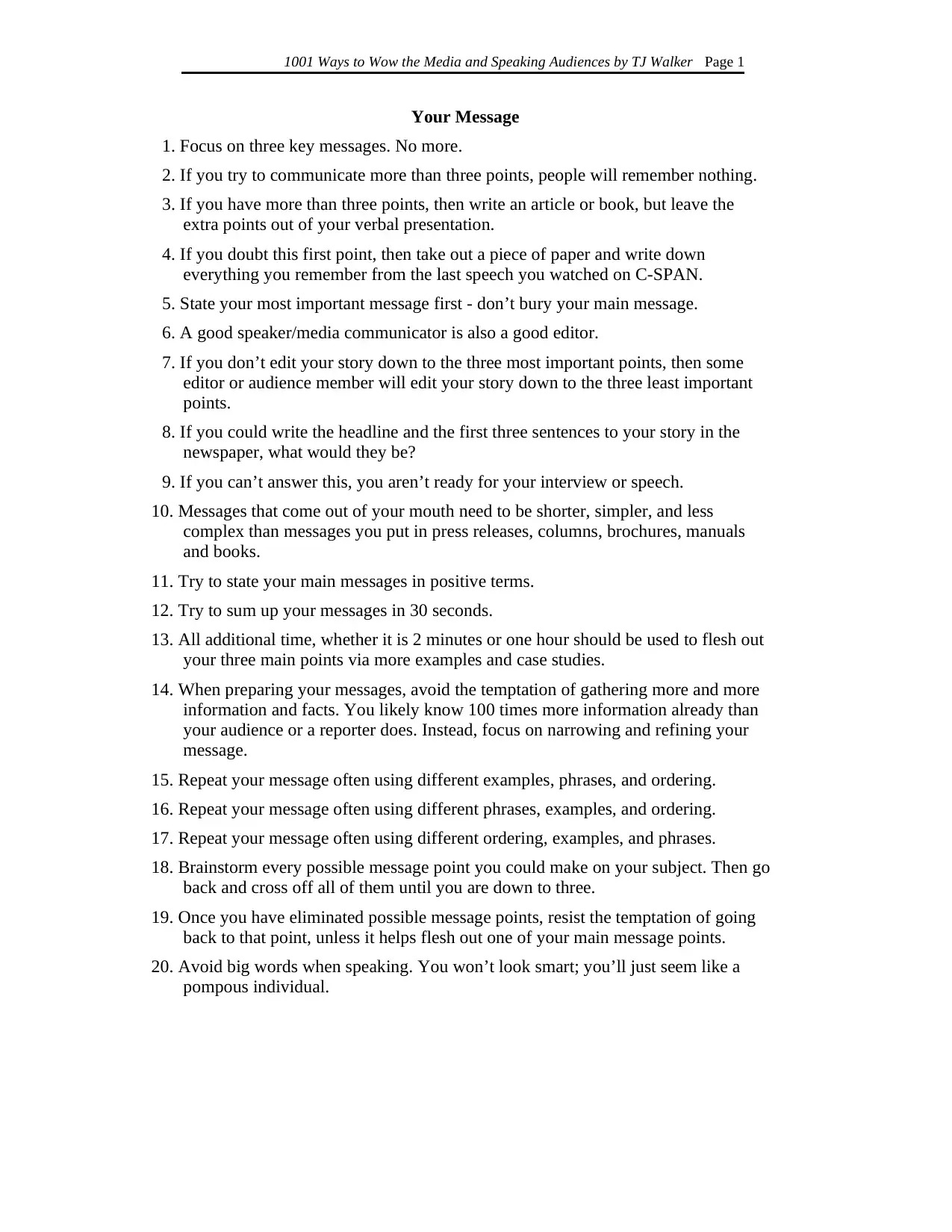
Your Message
1. Focus on three key messages. No more.
2. If you try to communicate more than three points, people will remember nothing.
3. If you have more than three points, then write an article or book, but leave the
extra points out of your verbal presentation.
4. If you doubt this first point, then take out a piece of paper and write down
everything you remember from the last speech you watched on C-SPAN.
5. State your most important message first - don’t bury your main message.
6. A good speaker/media communicator is also a good editor.
7. If you don’t edit your story down to the three most important points, then some
editor or audience member will edit your story down to the three least important
points.
8. If you could write the headline and the first three sentences to your story in the
newspaper, what would they be?
9. If you can’t answer this, you aren’t ready for your interview or speech.
10. Messages that come out of your mouth need to be shorter, simpler, and less
complex than messages you put in press releases, columns, brochures, manuals
and books.
11. Try to state your main messages in positive terms.
12. Try to sum up your messages in 30 seconds.
13. All additional time, whether it is 2 minutes or one hour should be used to flesh out
your three main points via more examples and case studies.
14. When preparing your messages, avoid the temptation of gathering more and more
information and facts. You likely know 100 times more information already than
your audience or a reporter does. Instead, focus on narrowing and refining your
message.
15. Repeat your message often using different examples, phrases, and ordering.
16. Repeat your message often using different phrases, examples, and ordering.
17. Repeat your message often using different ordering, examples, and phrases.
18. Brainstorm every possible message point you could make on your subject. Then go
back and cross off all of them until you are down to three.
19. Once you have eliminated possible message points, resist the temptation of going
back to that point, unless it helps flesh out one of your main message points.
20. Avoid big words when speaking. You won’t look smart; you’ll just seem like a
pompous individual.
Your Message
1. Focus on three key messages. No more.
2. If you try to communicate more than three points, people will remember nothing.
3. If you have more than three points, then write an article or book, but leave the
extra points out of your verbal presentation.
4. If you doubt this first point, then take out a piece of paper and write down
everything you remember from the last speech you watched on C-SPAN.
5. State your most important message first - don’t bury your main message.
6. A good speaker/media communicator is also a good editor.
7. If you don’t edit your story down to the three most important points, then some
editor or audience member will edit your story down to the three least important
points.
8. If you could write the headline and the first three sentences to your story in the
newspaper, what would they be?
9. If you can’t answer this, you aren’t ready for your interview or speech.
10. Messages that come out of your mouth need to be shorter, simpler, and less
complex than messages you put in press releases, columns, brochures, manuals
and books.
11. Try to state your main messages in positive terms.
12. Try to sum up your messages in 30 seconds.
13. All additional time, whether it is 2 minutes or one hour should be used to flesh out
your three main points via more examples and case studies.
14. When preparing your messages, avoid the temptation of gathering more and more
information and facts. You likely know 100 times more information already than
your audience or a reporter does. Instead, focus on narrowing and refining your
message.
15. Repeat your message often using different examples, phrases, and ordering.
16. Repeat your message often using different phrases, examples, and ordering.
17. Repeat your message often using different ordering, examples, and phrases.
18. Brainstorm every possible message point you could make on your subject. Then go
back and cross off all of them until you are down to three.
19. Once you have eliminated possible message points, resist the temptation of going
back to that point, unless it helps flesh out one of your main message points.
20. Avoid big words when speaking. You won’t look smart; you’ll just seem like a
pompous individual.
⊘ This is a preview!⊘
Do you want full access?
Subscribe today to unlock all pages.

Trusted by 1+ million students worldwide
1001 Ways to Wow the Media and Speaking Audiences by TJ Walker Page 2
© TJ Walker
Media Training Worldwide
110 West 40th St.
New York, New York
Tel: 212.764.4955 /Fax: 212.764.4956
www.mediatrainingworldwide.com
DO NOT DUPLICATE WITHOUT WRITTEN PERMISSION
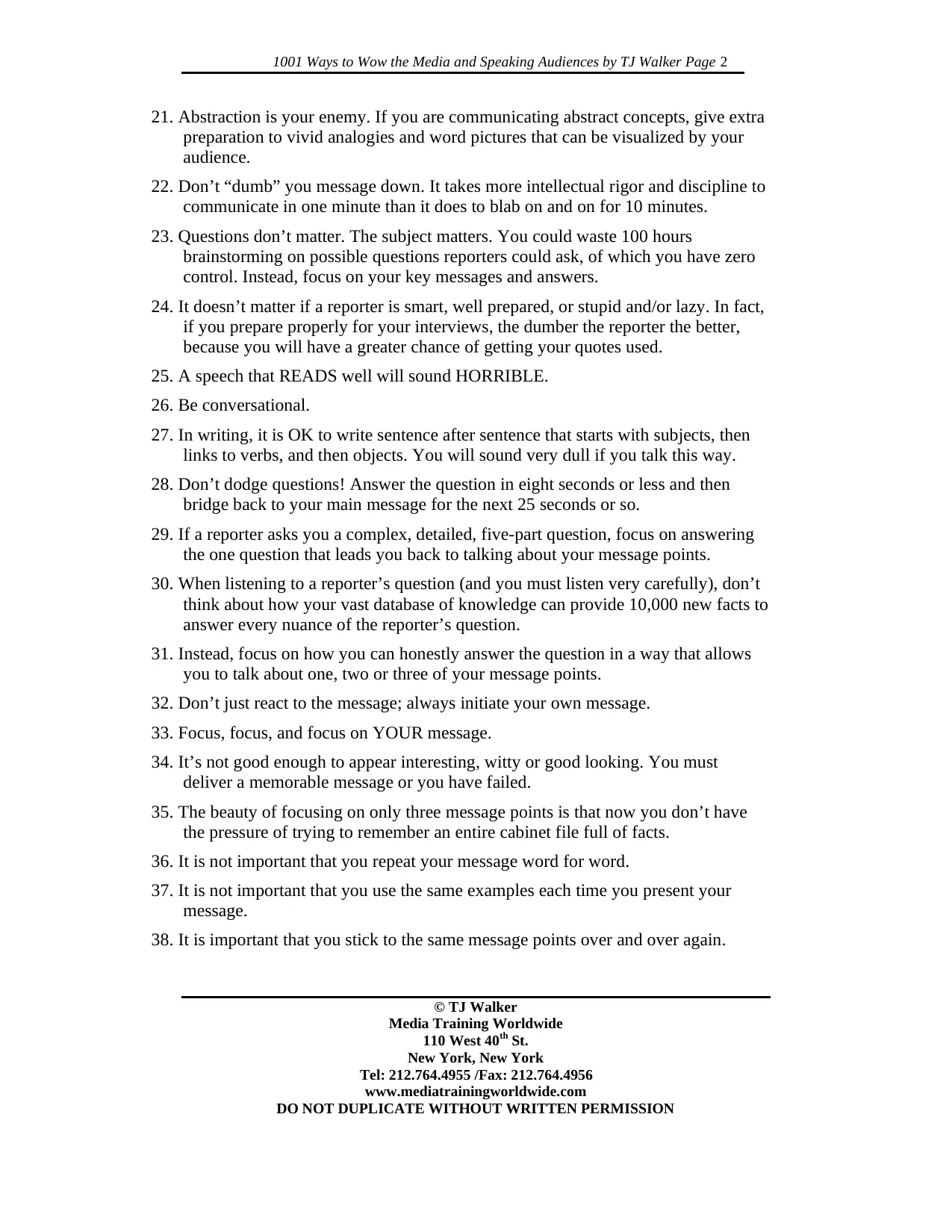
21. Abstraction is your enemy. If you are communicating abstract concepts, give extra
preparation to vivid analogies and word pictures that can be visualized by your
audience.
22. Don’t “dumb” you message down. It takes more intellectual rigor and discipline to
communicate in one minute than it does to blab on and on for 10 minutes.
23. Questions don’t matter. The subject matters. You could waste 100 hours
brainstorming on possible questions reporters could ask, of which you have zero
control. Instead, focus on your key messages and answers.
24. It doesn’t matter if a reporter is smart, well prepared, or stupid and/or lazy. In fact,
if you prepare properly for your interviews, the dumber the reporter the better,
because you will have a greater chance of getting your quotes used.
25. A speech that READS well will sound HORRIBLE.
26. Be conversational.
27. In writing, it is OK to write sentence after sentence that starts with subjects, then
links to verbs, and then objects. You will sound very dull if you talk this way.
28. Don’t dodge questions! Answer the question in eight seconds or less and then
bridge back to your main message for the next 25 seconds or so.
29. If a reporter asks you a complex, detailed, five-part question, focus on answering
the one question that leads you back to talking about your message points.
30. When listening to a reporter’s question (and you must listen very carefully), don’t
think about how your vast database of knowledge can provide 10,000 new facts to
answer every nuance of the reporter’s question.
31. Instead, focus on how you can honestly answer the question in a way that allows
you to talk about one, two or three of your message points.
32. Don’t just react to the message; always initiate your own message.
33. Focus, focus, and focus on YOUR message.
34. It’s not good enough to appear interesting, witty or good looking. You must
deliver a memorable message or you have failed.
35. The beauty of focusing on only three message points is that now you don’t have
the pressure of trying to remember an entire cabinet file full of facts.
36. It is not important that you repeat your message word for word.
37. It is not important that you use the same examples each time you present your
message.
38. It is important that you stick to the same message points over and over again.
© TJ Walker
Media Training Worldwide
110 West 40th St.
New York, New York
Tel: 212.764.4955 /Fax: 212.764.4956
www.mediatrainingworldwide.com
DO NOT DUPLICATE WITHOUT WRITTEN PERMISSION
21. Abstraction is your enemy. If you are communicating abstract concepts, give extra
preparation to vivid analogies and word pictures that can be visualized by your
audience.
22. Don’t “dumb” you message down. It takes more intellectual rigor and discipline to
communicate in one minute than it does to blab on and on for 10 minutes.
23. Questions don’t matter. The subject matters. You could waste 100 hours
brainstorming on possible questions reporters could ask, of which you have zero
control. Instead, focus on your key messages and answers.
24. It doesn’t matter if a reporter is smart, well prepared, or stupid and/or lazy. In fact,
if you prepare properly for your interviews, the dumber the reporter the better,
because you will have a greater chance of getting your quotes used.
25. A speech that READS well will sound HORRIBLE.
26. Be conversational.
27. In writing, it is OK to write sentence after sentence that starts with subjects, then
links to verbs, and then objects. You will sound very dull if you talk this way.
28. Don’t dodge questions! Answer the question in eight seconds or less and then
bridge back to your main message for the next 25 seconds or so.
29. If a reporter asks you a complex, detailed, five-part question, focus on answering
the one question that leads you back to talking about your message points.
30. When listening to a reporter’s question (and you must listen very carefully), don’t
think about how your vast database of knowledge can provide 10,000 new facts to
answer every nuance of the reporter’s question.
31. Instead, focus on how you can honestly answer the question in a way that allows
you to talk about one, two or three of your message points.
32. Don’t just react to the message; always initiate your own message.
33. Focus, focus, and focus on YOUR message.
34. It’s not good enough to appear interesting, witty or good looking. You must
deliver a memorable message or you have failed.
35. The beauty of focusing on only three message points is that now you don’t have
the pressure of trying to remember an entire cabinet file full of facts.
36. It is not important that you repeat your message word for word.
37. It is not important that you use the same examples each time you present your
message.
38. It is important that you stick to the same message points over and over again.
Paraphrase This Document
Need a fresh take? Get an instant paraphrase of this document with our AI Paraphraser
1001 Ways to Wow the Media and Speaking Audiences by TJ Walker Page 3
© TJ Walker
Media Training Worldwide
110 West 40th St.
New York, New York
Tel: 212.764.4955 /Fax: 212.764.4956
www.mediatrainingworldwide.com
DO NOT DUPLICATE WITHOUT WRITTEN PERMISSION
39. When appropriate, call members of your audience in advance to get their
viewpoints on issues you wish to address.
40. Incorporate these views into your message.
41. Don’t guess.
42. If you are unsure, don’t say it.
© TJ Walker
Media Training Worldwide
110 West 40th St.
New York, New York
Tel: 212.764.4955 /Fax: 212.764.4956
www.mediatrainingworldwide.com
DO NOT DUPLICATE WITHOUT WRITTEN PERMISSION
39. When appropriate, call members of your audience in advance to get their
viewpoints on issues you wish to address.
40. Incorporate these views into your message.
41. Don’t guess.
42. If you are unsure, don’t say it.
Speeches
43. Don't lean on the lectern.
44. Learn the difference between a lectern and a podium.
45. A podium is what you stand on.
46. Don’t picture your audience naked, as you may have heard or read about to deal
with anxiety. Don’t picture your audience. Instead, focus on one person at a time.
47. Visualize your audience giving you a standing ovation.
48. Have a series of one-on-one conversations with people in your audience, whether
it is three people or three thousand.
49. Don’t eye surf-don't have your eyes dart quickly across the room.
50. Learning how to give a good speech is even simpler that learning how to ride a
bike, because you already know how to do everything needed in speaking.
51. Never give a 15-30 minute SPEECH. Instead, give a series of three minute stories
that make a point. Each story should have a setting, dialogue, questions, a
problem, a resolution and a point.
52. Always use a teleprompter - if you are like the President of the United States and
have to give three speeches a day and have no time to rehearse.
53. If you are not the President, then NEVER USE A TELEPROMPTER. It will make
you sound stiff, boring, monotone and robotic - and it will give you false
confidence and make you less inclined to practice.
54. Always read a speech from a fully-prepared text - if you are like the Chairman of
the Federal Reserve and any misplaced nuance may cause markets changes.
55. Never read a speech if you are anyone other than the Chairman of the Federal
Reserve. If you do read a speech, you will sound boring, dull, flat, and insecure.
Your audience may dislike you for boring them and implying that they are too
stupid to know how to read. Better to pass out the written text.
56. Never start a speech by thanking the person introducing you. If the first thing out
of your mouth is boring and utterly predictable, you are sending a message to
your audience that now would be a good time for them to tune out.
57. Thank people after the speech before you take questions.
58. Don’t start by saying, “Today I’m going to talk to you about.”
59. Good speakers occasionally use notes.
60. Great speakers never use notes.
61. Horrible speakers usually use prepared full texts.
62. Do not commit a speech to memory. If you sound like you are reading a speech
from the teleprompter in your brain, you will sound just as canned and phony as if
you had the script in front of you.
43. Don't lean on the lectern.
44. Learn the difference between a lectern and a podium.
45. A podium is what you stand on.
46. Don’t picture your audience naked, as you may have heard or read about to deal
with anxiety. Don’t picture your audience. Instead, focus on one person at a time.
47. Visualize your audience giving you a standing ovation.
48. Have a series of one-on-one conversations with people in your audience, whether
it is three people or three thousand.
49. Don’t eye surf-don't have your eyes dart quickly across the room.
50. Learning how to give a good speech is even simpler that learning how to ride a
bike, because you already know how to do everything needed in speaking.
51. Never give a 15-30 minute SPEECH. Instead, give a series of three minute stories
that make a point. Each story should have a setting, dialogue, questions, a
problem, a resolution and a point.
52. Always use a teleprompter - if you are like the President of the United States and
have to give three speeches a day and have no time to rehearse.
53. If you are not the President, then NEVER USE A TELEPROMPTER. It will make
you sound stiff, boring, monotone and robotic - and it will give you false
confidence and make you less inclined to practice.
54. Always read a speech from a fully-prepared text - if you are like the Chairman of
the Federal Reserve and any misplaced nuance may cause markets changes.
55. Never read a speech if you are anyone other than the Chairman of the Federal
Reserve. If you do read a speech, you will sound boring, dull, flat, and insecure.
Your audience may dislike you for boring them and implying that they are too
stupid to know how to read. Better to pass out the written text.
56. Never start a speech by thanking the person introducing you. If the first thing out
of your mouth is boring and utterly predictable, you are sending a message to
your audience that now would be a good time for them to tune out.
57. Thank people after the speech before you take questions.
58. Don’t start by saying, “Today I’m going to talk to you about.”
59. Good speakers occasionally use notes.
60. Great speakers never use notes.
61. Horrible speakers usually use prepared full texts.
62. Do not commit a speech to memory. If you sound like you are reading a speech
from the teleprompter in your brain, you will sound just as canned and phony as if
you had the script in front of you.
⊘ This is a preview!⊘
Do you want full access?
Subscribe today to unlock all pages.
Trusted by 1+ million students worldwide
1001 Ways to Wow the Media and Speaking Audiences by TJ Walker Page 5
© TJ Walker
Media Training Worldwide
110 West 40th St.
New York, New York
Tel: 212.764.4955 /Fax: 212.764.4956
www.mediatrainingworldwide.com
DO NOT DUPLICATE WITHOUT WRITTEN PERMISSION
63. Never YELL at your audience if you have a microphone.
64. Always use a microphone if you are speaking to more than 10 people.
65. Lecterns are for cowards, don’t use them.
66. After you have risen to speak, and before you have started, pause for three long
beats while gazing out at the audience with a look of total confidence and ease.
67. Variety is your friend.
68. Vary the length of your sentences.
69. Vary your sentence structure - sometimes ask rhetorical questions.
70. Vary your speed, go faster, then slower.
71. Pause.
72. Vary the distance between each word.
73. Be conversational.
74. Don’t say “um,” “uh,” or “er,” to fill up space between words or sentences. This is
not like first grade where you have to color every inch of the paper or you receive
a frown from your teacher.
75. Instead of saying “um,” “uh,” or “er,” simply pause. Silence can be golden.
76. If you persist in saying “uh” while speaking, then type the word “uh” and write a
read “no” symbol slash through it. Place one of these on your computer screen,
one on your bathroom mirror and one on the “12” on your watch. Leave them
there for a week. After a week, you should be able to catch yourself before the
“uhs” pop out of your mouth.
77. You wouldn’t send out a letter to an important client that hadn’t been spell-
checked, edited and reviewed, so don’t be so cavalier with your spoken word.
Videotape your speech in advance and then review it sentence by sentence. Get
rid of the stuff you don’t like and doesn’t address your key messages.
78. If you don’t have time to do a video rehearsal of your speech, then create an audio
recording and listen to it.
79. If you don’t have time to do an audio rehearsal, then stand in front of a mirror and
do a rehearsal.
80. If you don’t have time to do any rehearsal, then you don’t have time to do a
speech, so don’t do it.
81. The best way not to be nervous is to speak at every opportunity you can - at every
meeting, at the dinner table, a toast at a wedding.
82. If you are an interesting speaker, a 5 hour speech can seem too short.
© TJ Walker
Media Training Worldwide
110 West 40th St.
New York, New York
Tel: 212.764.4955 /Fax: 212.764.4956
www.mediatrainingworldwide.com
DO NOT DUPLICATE WITHOUT WRITTEN PERMISSION
63. Never YELL at your audience if you have a microphone.
64. Always use a microphone if you are speaking to more than 10 people.
65. Lecterns are for cowards, don’t use them.
66. After you have risen to speak, and before you have started, pause for three long
beats while gazing out at the audience with a look of total confidence and ease.
67. Variety is your friend.
68. Vary the length of your sentences.
69. Vary your sentence structure - sometimes ask rhetorical questions.
70. Vary your speed, go faster, then slower.
71. Pause.
72. Vary the distance between each word.
73. Be conversational.
74. Don’t say “um,” “uh,” or “er,” to fill up space between words or sentences. This is
not like first grade where you have to color every inch of the paper or you receive
a frown from your teacher.
75. Instead of saying “um,” “uh,” or “er,” simply pause. Silence can be golden.
76. If you persist in saying “uh” while speaking, then type the word “uh” and write a
read “no” symbol slash through it. Place one of these on your computer screen,
one on your bathroom mirror and one on the “12” on your watch. Leave them
there for a week. After a week, you should be able to catch yourself before the
“uhs” pop out of your mouth.
77. You wouldn’t send out a letter to an important client that hadn’t been spell-
checked, edited and reviewed, so don’t be so cavalier with your spoken word.
Videotape your speech in advance and then review it sentence by sentence. Get
rid of the stuff you don’t like and doesn’t address your key messages.
78. If you don’t have time to do a video rehearsal of your speech, then create an audio
recording and listen to it.
79. If you don’t have time to do an audio rehearsal, then stand in front of a mirror and
do a rehearsal.
80. If you don’t have time to do any rehearsal, then you don’t have time to do a
speech, so don’t do it.
81. The best way not to be nervous is to speak at every opportunity you can - at every
meeting, at the dinner table, a toast at a wedding.
82. If you are an interesting speaker, a 5 hour speech can seem too short.
Paraphrase This Document
Need a fresh take? Get an instant paraphrase of this document with our AI Paraphraser
1001 Ways to Wow the Media and Speaking Audiences by TJ Walker Page 6
© TJ Walker
Media Training Worldwide
110 West 40th St.
New York, New York
Tel: 212.764.4955 /Fax: 212.764.4956
www.mediatrainingworldwide.com
DO NOT DUPLICATE WITHOUT WRITTEN PERMISSION
83. If you are a boring speaker, a 2-minute speech can seem too long.
84. No, you do not have to start a speech by telling a funny story.
85. Don’t tell “jokes.”
86. If you do tell a joke, don't announce it by saying things like “here's a funny
story...”
87. Don’t start by saying “a funny thing happened on the way over here tonight”
unless it really happened, and it was funny.
88. Don’t use humor from some book you checked out at the library.
89. If you are naturally funny, incorporate your natural humor into your presentation.
90. If you have told a personal story that tells something about you to friends, and they
all laughed, you may wish to incorporate this into a presentation if it helps make a
point.
91. If your humor doesn’t have a point to it, then you are just trying to be a comedian
and people will compare you to Jerry Seinfeld and other famous comedians - and
you won’t seem very funny in comparison.
92. Only use humor if it makes a point.
93. If you aren’t a funny person with your friends and family, then don’t try to be
funny for the first time when giving a speech.
94. If you are trying to use humor, timing is everything.
95. Timing is most often a function of pausing properly.
96. Avoid carbonated drinks before speaking - they will make you belch.
97. Don’t start speaking until everyone has stopped speaking.
98. Don’t be afraid to ask people to leave the room if they need to talk.
99. When speaking to smaller audiences let people ask questions throughout the
presentation, don’t force people to wait until the end
100. Move your face. (your eyebrows, mouth, and forehead)
101. Move your hands.
102. Move your head.
103. Move your feet.
104. Don’t rock back and forth in a consistent manner-you’ll seem nervous.
105. Don’t put your hands in your pockets.
106. Don’t rest your hands on a lectern.
© TJ Walker
Media Training Worldwide
110 West 40th St.
New York, New York
Tel: 212.764.4955 /Fax: 212.764.4956
www.mediatrainingworldwide.com
DO NOT DUPLICATE WITHOUT WRITTEN PERMISSION
83. If you are a boring speaker, a 2-minute speech can seem too long.
84. No, you do not have to start a speech by telling a funny story.
85. Don’t tell “jokes.”
86. If you do tell a joke, don't announce it by saying things like “here's a funny
story...”
87. Don’t start by saying “a funny thing happened on the way over here tonight”
unless it really happened, and it was funny.
88. Don’t use humor from some book you checked out at the library.
89. If you are naturally funny, incorporate your natural humor into your presentation.
90. If you have told a personal story that tells something about you to friends, and they
all laughed, you may wish to incorporate this into a presentation if it helps make a
point.
91. If your humor doesn’t have a point to it, then you are just trying to be a comedian
and people will compare you to Jerry Seinfeld and other famous comedians - and
you won’t seem very funny in comparison.
92. Only use humor if it makes a point.
93. If you aren’t a funny person with your friends and family, then don’t try to be
funny for the first time when giving a speech.
94. If you are trying to use humor, timing is everything.
95. Timing is most often a function of pausing properly.
96. Avoid carbonated drinks before speaking - they will make you belch.
97. Don’t start speaking until everyone has stopped speaking.
98. Don’t be afraid to ask people to leave the room if they need to talk.
99. When speaking to smaller audiences let people ask questions throughout the
presentation, don’t force people to wait until the end
100. Move your face. (your eyebrows, mouth, and forehead)
101. Move your hands.
102. Move your head.
103. Move your feet.
104. Don’t rock back and forth in a consistent manner-you’ll seem nervous.
105. Don’t put your hands in your pockets.
106. Don’t rest your hands on a lectern.
1001 Ways to Wow the Media and Speaking Audiences by TJ Walker Page 7
© TJ Walker
Media Training Worldwide
110 West 40th St.
New York, New York
Tel: 212.764.4955 /Fax: 212.764.4956
www.mediatrainingworldwide.com
DO NOT DUPLICATE WITHOUT WRITTEN PERMISSION
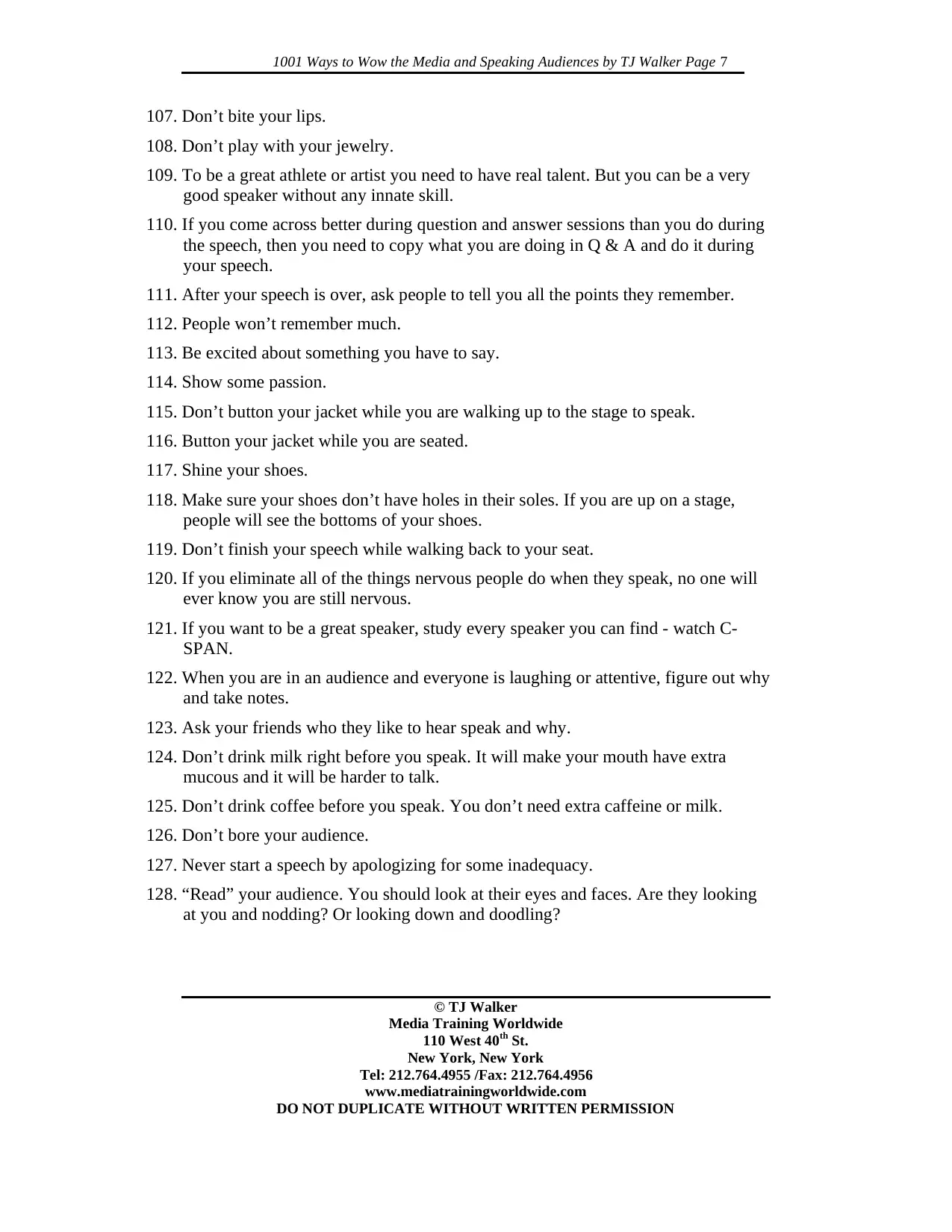
107. Don’t bite your lips.
108. Don’t play with your jewelry.
109. To be a great athlete or artist you need to have real talent. But you can be a very
good speaker without any innate skill.
110. If you come across better during question and answer sessions than you do during
the speech, then you need to copy what you are doing in Q & A and do it during
your speech.
111. After your speech is over, ask people to tell you all the points they remember.
112. People won’t remember much.
113. Be excited about something you have to say.
114. Show some passion.
115. Don’t button your jacket while you are walking up to the stage to speak.
116. Button your jacket while you are seated.
117. Shine your shoes.
118. Make sure your shoes don’t have holes in their soles. If you are up on a stage,
people will see the bottoms of your shoes.
119. Don’t finish your speech while walking back to your seat.
120. If you eliminate all of the things nervous people do when they speak, no one will
ever know you are still nervous.
121. If you want to be a great speaker, study every speaker you can find - watch C-
SPAN.
122. When you are in an audience and everyone is laughing or attentive, figure out why
and take notes.
123. Ask your friends who they like to hear speak and why.
124. Don’t drink milk right before you speak. It will make your mouth have extra
mucous and it will be harder to talk.
125. Don’t drink coffee before you speak. You don’t need extra caffeine or milk.
126. Don’t bore your audience.
127. Never start a speech by apologizing for some inadequacy.
128. “Read” your audience. You should look at their eyes and faces. Are they looking
at you and nodding? Or looking down and doodling?
© TJ Walker
Media Training Worldwide
110 West 40th St.
New York, New York
Tel: 212.764.4955 /Fax: 212.764.4956
www.mediatrainingworldwide.com
DO NOT DUPLICATE WITHOUT WRITTEN PERMISSION
107. Don’t bite your lips.
108. Don’t play with your jewelry.
109. To be a great athlete or artist you need to have real talent. But you can be a very
good speaker without any innate skill.
110. If you come across better during question and answer sessions than you do during
the speech, then you need to copy what you are doing in Q & A and do it during
your speech.
111. After your speech is over, ask people to tell you all the points they remember.
112. People won’t remember much.
113. Be excited about something you have to say.
114. Show some passion.
115. Don’t button your jacket while you are walking up to the stage to speak.
116. Button your jacket while you are seated.
117. Shine your shoes.
118. Make sure your shoes don’t have holes in their soles. If you are up on a stage,
people will see the bottoms of your shoes.
119. Don’t finish your speech while walking back to your seat.
120. If you eliminate all of the things nervous people do when they speak, no one will
ever know you are still nervous.
121. If you want to be a great speaker, study every speaker you can find - watch C-
SPAN.
122. When you are in an audience and everyone is laughing or attentive, figure out why
and take notes.
123. Ask your friends who they like to hear speak and why.
124. Don’t drink milk right before you speak. It will make your mouth have extra
mucous and it will be harder to talk.
125. Don’t drink coffee before you speak. You don’t need extra caffeine or milk.
126. Don’t bore your audience.
127. Never start a speech by apologizing for some inadequacy.
128. “Read” your audience. You should look at their eyes and faces. Are they looking
at you and nodding? Or looking down and doodling?
⊘ This is a preview!⊘
Do you want full access?
Subscribe today to unlock all pages.
Trusted by 1+ million students worldwide
1001 Ways to Wow the Media and Speaking Audiences by TJ Walker Page 8
© TJ Walker
Media Training Worldwide
110 West 40th St.
New York, New York
Tel: 212.764.4955 /Fax: 212.764.4956
www.mediatrainingworldwide.com
DO NOT DUPLICATE WITHOUT WRITTEN PERMISSION
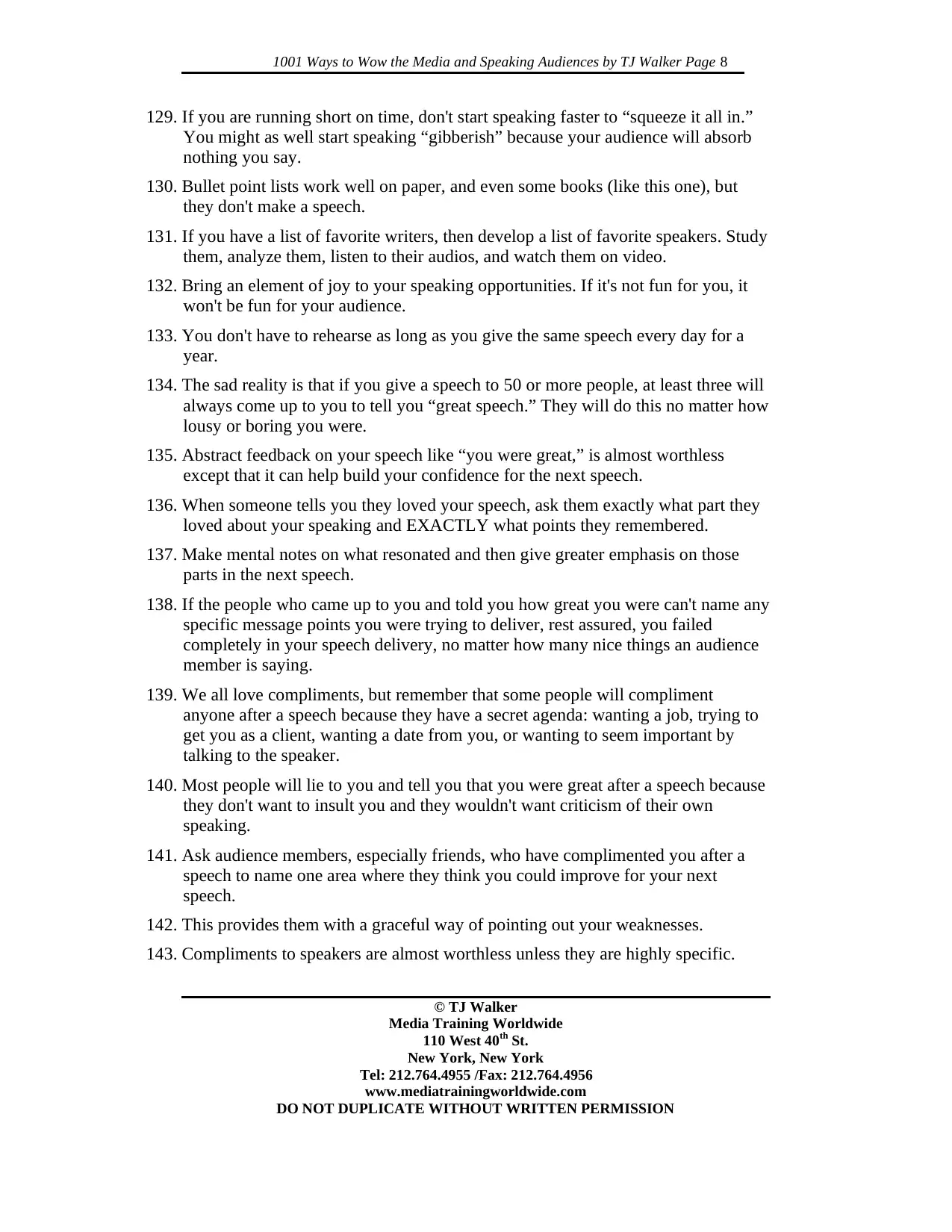
129. If you are running short on time, don't start speaking faster to “squeeze it all in.”
You might as well start speaking “gibberish” because your audience will absorb
nothing you say.
130. Bullet point lists work well on paper, and even some books (like this one), but
they don't make a speech.
131. If you have a list of favorite writers, then develop a list of favorite speakers. Study
them, analyze them, listen to their audios, and watch them on video.
132. Bring an element of joy to your speaking opportunities. If it's not fun for you, it
won't be fun for your audience.
133. You don't have to rehearse as long as you give the same speech every day for a
year.
134. The sad reality is that if you give a speech to 50 or more people, at least three will
always come up to you to tell you “great speech.” They will do this no matter how
lousy or boring you were.
135. Abstract feedback on your speech like “you were great,” is almost worthless
except that it can help build your confidence for the next speech.
136. When someone tells you they loved your speech, ask them exactly what part they
loved about your speaking and EXACTLY what points they remembered.
137. Make mental notes on what resonated and then give greater emphasis on those
parts in the next speech.
138. If the people who came up to you and told you how great you were can't name any
specific message points you were trying to deliver, rest assured, you failed
completely in your speech delivery, no matter how many nice things an audience
member is saying.
139. We all love compliments, but remember that some people will compliment
anyone after a speech because they have a secret agenda: wanting a job, trying to
get you as a client, wanting a date from you, or wanting to seem important by
talking to the speaker.
140. Most people will lie to you and tell you that you were great after a speech because
they don't want to insult you and they wouldn't want criticism of their own
speaking.
141. Ask audience members, especially friends, who have complimented you after a
speech to name one area where they think you could improve for your next
speech.
142. This provides them with a graceful way of pointing out your weaknesses.
143. Compliments to speakers are almost worthless unless they are highly specific.
© TJ Walker
Media Training Worldwide
110 West 40th St.
New York, New York
Tel: 212.764.4955 /Fax: 212.764.4956
www.mediatrainingworldwide.com
DO NOT DUPLICATE WITHOUT WRITTEN PERMISSION
129. If you are running short on time, don't start speaking faster to “squeeze it all in.”
You might as well start speaking “gibberish” because your audience will absorb
nothing you say.
130. Bullet point lists work well on paper, and even some books (like this one), but
they don't make a speech.
131. If you have a list of favorite writers, then develop a list of favorite speakers. Study
them, analyze them, listen to their audios, and watch them on video.
132. Bring an element of joy to your speaking opportunities. If it's not fun for you, it
won't be fun for your audience.
133. You don't have to rehearse as long as you give the same speech every day for a
year.
134. The sad reality is that if you give a speech to 50 or more people, at least three will
always come up to you to tell you “great speech.” They will do this no matter how
lousy or boring you were.
135. Abstract feedback on your speech like “you were great,” is almost worthless
except that it can help build your confidence for the next speech.
136. When someone tells you they loved your speech, ask them exactly what part they
loved about your speaking and EXACTLY what points they remembered.
137. Make mental notes on what resonated and then give greater emphasis on those
parts in the next speech.
138. If the people who came up to you and told you how great you were can't name any
specific message points you were trying to deliver, rest assured, you failed
completely in your speech delivery, no matter how many nice things an audience
member is saying.
139. We all love compliments, but remember that some people will compliment
anyone after a speech because they have a secret agenda: wanting a job, trying to
get you as a client, wanting a date from you, or wanting to seem important by
talking to the speaker.
140. Most people will lie to you and tell you that you were great after a speech because
they don't want to insult you and they wouldn't want criticism of their own
speaking.
141. Ask audience members, especially friends, who have complimented you after a
speech to name one area where they think you could improve for your next
speech.
142. This provides them with a graceful way of pointing out your weaknesses.
143. Compliments to speakers are almost worthless unless they are highly specific.
Paraphrase This Document
Need a fresh take? Get an instant paraphrase of this document with our AI Paraphraser
1001 Ways to Wow the Media and Speaking Audiences by TJ Walker Page 9
© TJ Walker
Media Training Worldwide
110 West 40th St.
New York, New York
Tel: 212.764.4955 /Fax: 212.764.4956
www.mediatrainingworldwide.com
DO NOT DUPLICATE WITHOUT WRITTEN PERMISSION
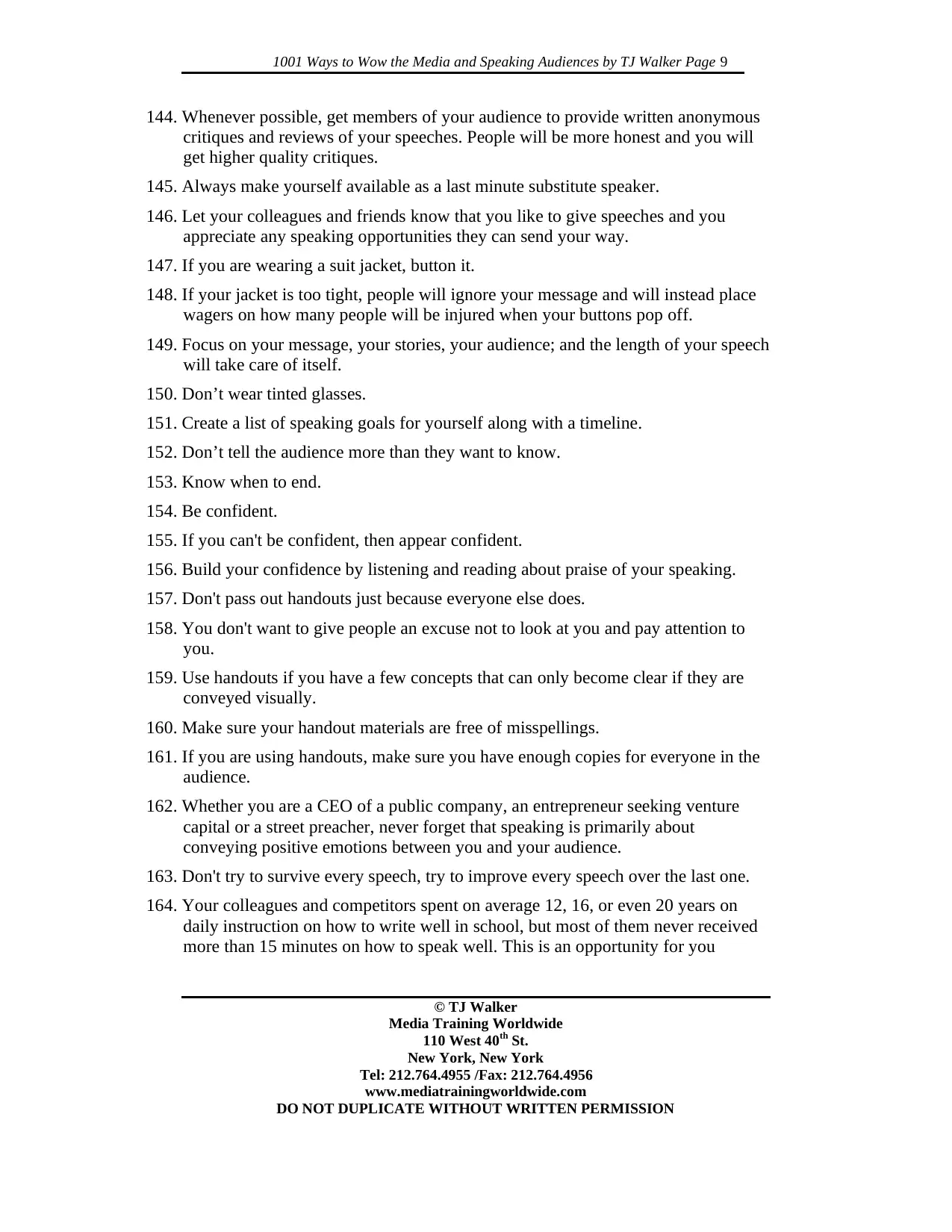
144. Whenever possible, get members of your audience to provide written anonymous
critiques and reviews of your speeches. People will be more honest and you will
get higher quality critiques.
145. Always make yourself available as a last minute substitute speaker.
146. Let your colleagues and friends know that you like to give speeches and you
appreciate any speaking opportunities they can send your way.
147. If you are wearing a suit jacket, button it.
148. If your jacket is too tight, people will ignore your message and will instead place
wagers on how many people will be injured when your buttons pop off.
149. Focus on your message, your stories, your audience; and the length of your speech
will take care of itself.
150. Don’t wear tinted glasses.
151. Create a list of speaking goals for yourself along with a timeline.
152. Don’t tell the audience more than they want to know.
153. Know when to end.
154. Be confident.
155. If you can't be confident, then appear confident.
156. Build your confidence by listening and reading about praise of your speaking.
157. Don't pass out handouts just because everyone else does.
158. You don't want to give people an excuse not to look at you and pay attention to
you.
159. Use handouts if you have a few concepts that can only become clear if they are
conveyed visually.
160. Make sure your handout materials are free of misspellings.
161. If you are using handouts, make sure you have enough copies for everyone in the
audience.
162. Whether you are a CEO of a public company, an entrepreneur seeking venture
capital or a street preacher, never forget that speaking is primarily about
conveying positive emotions between you and your audience.
163. Don't try to survive every speech, try to improve every speech over the last one.
164. Your colleagues and competitors spent on average 12, 16, or even 20 years on
daily instruction on how to write well in school, but most of them never received
more than 15 minutes on how to speak well. This is an opportunity for you
© TJ Walker
Media Training Worldwide
110 West 40th St.
New York, New York
Tel: 212.764.4955 /Fax: 212.764.4956
www.mediatrainingworldwide.com
DO NOT DUPLICATE WITHOUT WRITTEN PERMISSION
144. Whenever possible, get members of your audience to provide written anonymous
critiques and reviews of your speeches. People will be more honest and you will
get higher quality critiques.
145. Always make yourself available as a last minute substitute speaker.
146. Let your colleagues and friends know that you like to give speeches and you
appreciate any speaking opportunities they can send your way.
147. If you are wearing a suit jacket, button it.
148. If your jacket is too tight, people will ignore your message and will instead place
wagers on how many people will be injured when your buttons pop off.
149. Focus on your message, your stories, your audience; and the length of your speech
will take care of itself.
150. Don’t wear tinted glasses.
151. Create a list of speaking goals for yourself along with a timeline.
152. Don’t tell the audience more than they want to know.
153. Know when to end.
154. Be confident.
155. If you can't be confident, then appear confident.
156. Build your confidence by listening and reading about praise of your speaking.
157. Don't pass out handouts just because everyone else does.
158. You don't want to give people an excuse not to look at you and pay attention to
you.
159. Use handouts if you have a few concepts that can only become clear if they are
conveyed visually.
160. Make sure your handout materials are free of misspellings.
161. If you are using handouts, make sure you have enough copies for everyone in the
audience.
162. Whether you are a CEO of a public company, an entrepreneur seeking venture
capital or a street preacher, never forget that speaking is primarily about
conveying positive emotions between you and your audience.
163. Don't try to survive every speech, try to improve every speech over the last one.
164. Your colleagues and competitors spent on average 12, 16, or even 20 years on
daily instruction on how to write well in school, but most of them never received
more than 15 minutes on how to speak well. This is an opportunity for you
1001 Ways to Wow the Media and Speaking Audiences by TJ Walker Page 10
© TJ Walker
Media Training Worldwide
110 West 40th St.
New York, New York
Tel: 212.764.4955 /Fax: 212.764.4956
www.mediatrainingworldwide.com
DO NOT DUPLICATE WITHOUT WRITTEN PERMISSION
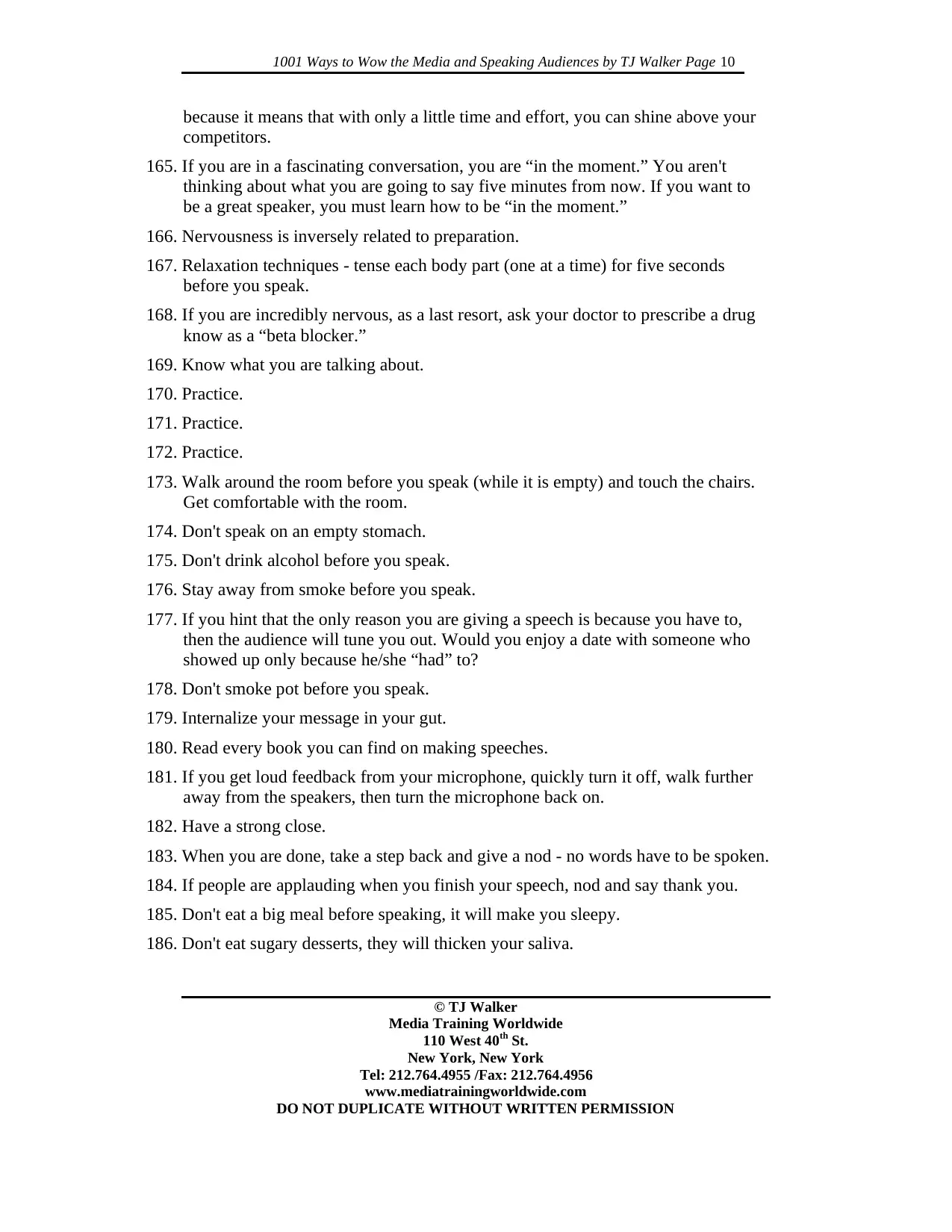
because it means that with only a little time and effort, you can shine above your
competitors.
165. If you are in a fascinating conversation, you are “in the moment.” You aren't
thinking about what you are going to say five minutes from now. If you want to
be a great speaker, you must learn how to be “in the moment.”
166. Nervousness is inversely related to preparation.
167. Relaxation techniques - tense each body part (one at a time) for five seconds
before you speak.
168. If you are incredibly nervous, as a last resort, ask your doctor to prescribe a drug
know as a “beta blocker.”
169. Know what you are talking about.
170. Practice.
171. Practice.
172. Practice.
173. Walk around the room before you speak (while it is empty) and touch the chairs.
Get comfortable with the room.
174. Don't speak on an empty stomach.
175. Don't drink alcohol before you speak.
176. Stay away from smoke before you speak.
177. If you hint that the only reason you are giving a speech is because you have to,
then the audience will tune you out. Would you enjoy a date with someone who
showed up only because he/she “had” to?
178. Don't smoke pot before you speak.
179. Internalize your message in your gut.
180. Read every book you can find on making speeches.
181. If you get loud feedback from your microphone, quickly turn it off, walk further
away from the speakers, then turn the microphone back on.
182. Have a strong close.
183. When you are done, take a step back and give a nod - no words have to be spoken.
184. If people are applauding when you finish your speech, nod and say thank you.
185. Don't eat a big meal before speaking, it will make you sleepy.
186. Don't eat sugary desserts, they will thicken your saliva.
© TJ Walker
Media Training Worldwide
110 West 40th St.
New York, New York
Tel: 212.764.4955 /Fax: 212.764.4956
www.mediatrainingworldwide.com
DO NOT DUPLICATE WITHOUT WRITTEN PERMISSION
because it means that with only a little time and effort, you can shine above your
competitors.
165. If you are in a fascinating conversation, you are “in the moment.” You aren't
thinking about what you are going to say five minutes from now. If you want to
be a great speaker, you must learn how to be “in the moment.”
166. Nervousness is inversely related to preparation.
167. Relaxation techniques - tense each body part (one at a time) for five seconds
before you speak.
168. If you are incredibly nervous, as a last resort, ask your doctor to prescribe a drug
know as a “beta blocker.”
169. Know what you are talking about.
170. Practice.
171. Practice.
172. Practice.
173. Walk around the room before you speak (while it is empty) and touch the chairs.
Get comfortable with the room.
174. Don't speak on an empty stomach.
175. Don't drink alcohol before you speak.
176. Stay away from smoke before you speak.
177. If you hint that the only reason you are giving a speech is because you have to,
then the audience will tune you out. Would you enjoy a date with someone who
showed up only because he/she “had” to?
178. Don't smoke pot before you speak.
179. Internalize your message in your gut.
180. Read every book you can find on making speeches.
181. If you get loud feedback from your microphone, quickly turn it off, walk further
away from the speakers, then turn the microphone back on.
182. Have a strong close.
183. When you are done, take a step back and give a nod - no words have to be spoken.
184. If people are applauding when you finish your speech, nod and say thank you.
185. Don't eat a big meal before speaking, it will make you sleepy.
186. Don't eat sugary desserts, they will thicken your saliva.
⊘ This is a preview!⊘
Do you want full access?
Subscribe today to unlock all pages.
Trusted by 1+ million students worldwide

1 out of 72


Your All-in-One AI-Powered Toolkit for Academic Success.
+13062052269
info@desklib.com
Available 24*7 on WhatsApp / Email
![[object Object]](/_next/static/media/star-bottom.7253800d.svg)
Unlock your academic potential
Copyright © 2020–2026 A2Z Services. All Rights Reserved. Developed and managed by ZUCOL.