VU21917: Mastering Conflict Resolution & Mediation in Justice Sector
VerifiedAdded on 2023/06/17
|7
|1471
|291
Homework Assignment
AI Summary
This assignment provides a detailed exploration of conflict resolution and mediation processes within justice environments. It covers essential aspects such as non-verbal cues indicating escalation, techniques for de-escalating heated situations, and necessary support when de-escalation is challenging. The assignment also addresses communication barriers that may arise during mediation sessions, the importance of self-care for mediators, and the differences between assertive and aggressive behavior. Furthermore, it emphasizes the significance of demonstrating awareness of background diversity and client complexity, ethical guidelines for mediators, and the purpose of regulatory requirements. References to relevant books and journals are included to support the analysis and findings. Desklib provides access to this and other solved assignments.
Knowledge Questions
Paraphrase This Document
Need a fresh take? Get an instant paraphrase of this document with our AI Paraphraser

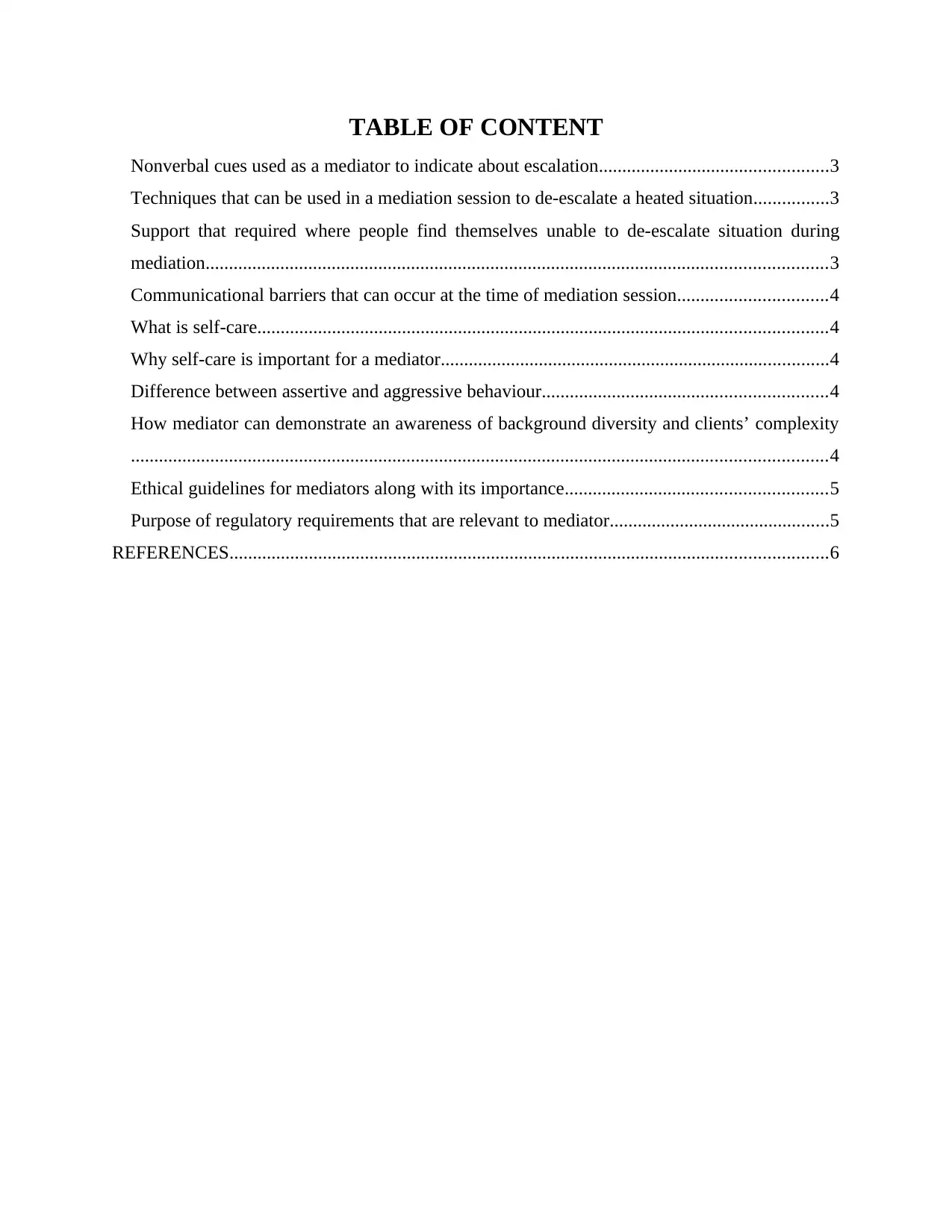
TABLE OF CONTENT
Nonverbal cues used as a mediator to indicate about escalation.................................................3
Techniques that can be used in a mediation session to de-escalate a heated situation................3
Support that required where people find themselves unable to de-escalate situation during
mediation.....................................................................................................................................3
Communicational barriers that can occur at the time of mediation session................................4
What is self-care..........................................................................................................................4
Why self-care is important for a mediator...................................................................................4
Difference between assertive and aggressive behaviour.............................................................4
How mediator can demonstrate an awareness of background diversity and clients’ complexity
.....................................................................................................................................................4
Ethical guidelines for mediators along with its importance........................................................5
Purpose of regulatory requirements that are relevant to mediator...............................................5
REFERENCES................................................................................................................................6
Nonverbal cues used as a mediator to indicate about escalation.................................................3
Techniques that can be used in a mediation session to de-escalate a heated situation................3
Support that required where people find themselves unable to de-escalate situation during
mediation.....................................................................................................................................3
Communicational barriers that can occur at the time of mediation session................................4
What is self-care..........................................................................................................................4
Why self-care is important for a mediator...................................................................................4
Difference between assertive and aggressive behaviour.............................................................4
How mediator can demonstrate an awareness of background diversity and clients’ complexity
.....................................................................................................................................................4
Ethical guidelines for mediators along with its importance........................................................5
Purpose of regulatory requirements that are relevant to mediator...............................................5
REFERENCES................................................................................................................................6

⊘ This is a preview!⊘
Do you want full access?
Subscribe today to unlock all pages.

Trusted by 1+ million students worldwide

Nonverbal cues used as a mediator to indicate about escalation
It is important for mediator to improve communication and for dealing with different
behaviour of people, influencing them and engaging them in conflict resolution process,
mediator needs to make use of both verbal and non0verbal communication (Li, 2019). Some
non-verbal cues that can be used by mediator in order to indicate about seriousness to all
involved parties include: Facial expression: Facial expression with moved eyebrows and
showing angriness and other feelings, mediator can indicate involved parties about seriousness or
escalation. Gesture, body movements are some other non-verbal cues that may also be used by
mediator at the time of escalation.
Techniques that can be used in a mediation session to de-escalate a heated situation
In mediation session or while disputing conflicts, parties become aggressive many of the
time that may affect decision process. There are some ways by which all involved parties in
mediation session can de-escalate heated situation such as: first calm yourself and thinking
before talking. Using a dull tone of voice and becoming defensive is other effective way. It is
important for people to develop an active listening skill as it can help them out in understanding
other party and de-escalating heating situation.
Support that required where people find themselves unable to de-escalate situation during
mediation
Sometimes it becomes difficult for both of the parties and mediators to solve conflicts situations
and de-escalate heating situations but there are number of resources and support available that
might help them out in this type of situations.
Critical analysis of situation: By asking support from seniors and 2-3 random people who
does not have any relation with involved party in mediation process, mediator can de-escalate
situation. By asking suggestions from random selected people in front of involved parties, they
can be made able in understanding importance of de-escalation (Reinhoudt‐den Boer, van
Wijngaarden and Huijsman, 2021).
Willingness to compromise: It may be asked from involved parties as if they really want
to compromise or not and if they do not want then mediator should ask reasons. On the basis of
their reasons, mediator needs to give some advantages of de-escalation of situation and benefits
that both parties can get by agreeing on one mutual thing.
It is important for mediator to improve communication and for dealing with different
behaviour of people, influencing them and engaging them in conflict resolution process,
mediator needs to make use of both verbal and non0verbal communication (Li, 2019). Some
non-verbal cues that can be used by mediator in order to indicate about seriousness to all
involved parties include: Facial expression: Facial expression with moved eyebrows and
showing angriness and other feelings, mediator can indicate involved parties about seriousness or
escalation. Gesture, body movements are some other non-verbal cues that may also be used by
mediator at the time of escalation.
Techniques that can be used in a mediation session to de-escalate a heated situation
In mediation session or while disputing conflicts, parties become aggressive many of the
time that may affect decision process. There are some ways by which all involved parties in
mediation session can de-escalate heated situation such as: first calm yourself and thinking
before talking. Using a dull tone of voice and becoming defensive is other effective way. It is
important for people to develop an active listening skill as it can help them out in understanding
other party and de-escalating heating situation.
Support that required where people find themselves unable to de-escalate situation during
mediation
Sometimes it becomes difficult for both of the parties and mediators to solve conflicts situations
and de-escalate heating situations but there are number of resources and support available that
might help them out in this type of situations.
Critical analysis of situation: By asking support from seniors and 2-3 random people who
does not have any relation with involved party in mediation process, mediator can de-escalate
situation. By asking suggestions from random selected people in front of involved parties, they
can be made able in understanding importance of de-escalation (Reinhoudt‐den Boer, van
Wijngaarden and Huijsman, 2021).
Willingness to compromise: It may be asked from involved parties as if they really want
to compromise or not and if they do not want then mediator should ask reasons. On the basis of
their reasons, mediator needs to give some advantages of de-escalation of situation and benefits
that both parties can get by agreeing on one mutual thing.
Paraphrase This Document
Need a fresh take? Get an instant paraphrase of this document with our AI Paraphraser

Communicational barriers that can occur at the time of mediation session
Language difference: Parties involved in mediation process may belong to different
cultures so, language difference may create communicational problems.
Uses of Jargon: Using complicated, technical and non-familiar words can make it
difficult for parties, involved in mediation to understand situation and reasons of de-escalation
(Li, Zhao and Han, 2020).
Lack of active listening skill: In the process of mediation, people do not listen other
parties as they focus on speaking and presenting their views. But lack of active listening can
create communicational barrier as both parties might face problem in understanding views of
others.
What is self-care
As per the WHO, it can be said that self-care can be defined as an ability of families,
communities and people to promote health and preventing disease without any help of healthcare
provider.
Why self-care is important for a mediator
The main task and aim of mediator is to interact with others and making them able by
which they can solve conflicts and heating situations with other. For this purpose, mediator need
to have an effective communication and personality and for this reason, mediator needs to focus
on self-care. By self-care, they can connect with others in an effective manner and can treat
disputants in an equal manner (Kotera and et.al., 2021).
Difference between assertive and aggressive behaviour
There is huge difference between assertive and aggressive behaviour. Assertive behaviour
shows respect towards others and for yourself as well. Whereas, aggressive behaviour or
communication disrespect and insult other parties. This behaviour increases feeling of guilt and
angry. It is also known as hostile behaviour in which people have intention of inflicting damage.
whereas, in assertive type, people shows honesty and do not have intention to hurt others.
How mediator can demonstrate an awareness of background diversity and clients’ complexity
It is important for mediators to promote diversity and aware everyone about diversity
background and for this, they need to have knowledge about cross-cultural communication.
While working with complex clients or clients of different cultural background, it is important to
respect value of their culture. There are some cultures in which maintaining eye contact is
Language difference: Parties involved in mediation process may belong to different
cultures so, language difference may create communicational problems.
Uses of Jargon: Using complicated, technical and non-familiar words can make it
difficult for parties, involved in mediation to understand situation and reasons of de-escalation
(Li, Zhao and Han, 2020).
Lack of active listening skill: In the process of mediation, people do not listen other
parties as they focus on speaking and presenting their views. But lack of active listening can
create communicational barrier as both parties might face problem in understanding views of
others.
What is self-care
As per the WHO, it can be said that self-care can be defined as an ability of families,
communities and people to promote health and preventing disease without any help of healthcare
provider.
Why self-care is important for a mediator
The main task and aim of mediator is to interact with others and making them able by
which they can solve conflicts and heating situations with other. For this purpose, mediator need
to have an effective communication and personality and for this reason, mediator needs to focus
on self-care. By self-care, they can connect with others in an effective manner and can treat
disputants in an equal manner (Kotera and et.al., 2021).
Difference between assertive and aggressive behaviour
There is huge difference between assertive and aggressive behaviour. Assertive behaviour
shows respect towards others and for yourself as well. Whereas, aggressive behaviour or
communication disrespect and insult other parties. This behaviour increases feeling of guilt and
angry. It is also known as hostile behaviour in which people have intention of inflicting damage.
whereas, in assertive type, people shows honesty and do not have intention to hurt others.
How mediator can demonstrate an awareness of background diversity and clients’ complexity
It is important for mediators to promote diversity and aware everyone about diversity
background and for this, they need to have knowledge about cross-cultural communication.
While working with complex clients or clients of different cultural background, it is important to
respect value of their culture. There are some cultures in which maintaining eye contact is

considered as aggressive behaviour while in other culture, failure to make eye contact is viewed
as suspicious (Gray and Chivukula, 2019). So, it is important for mediator to research about
different cultures and before involving parties in mediation process, need to gain knowledge
about it.
Ethical guidelines for mediators along with its importance
There are some guidelines for mediators that can make them able in improving decision
making and mediation process. As per the guidelines, mediator needs to follow main 3 functions
such as:
Serving as a guide for the conduct of mediator.
Informing mediating parties about mediation process.
Promoting public confidence for resolving disputes.
By providing information to parties, mediator can help parties in identifying their real concerns
as well as other options that might resolve conflicts. In addition, it is also known that mediator
cannot personally ensure that each party has made informed decision while reaching an
agreement. So, it is important for mediator to make aware to both parties about importance of
consulting other professionals if they are not satisfied and want to do because the main aim of
mediator is to satisfy both parties and solving disputes. Mediator also need to address instances
of fraud, deceit and misleading statements for making better settlement.
Purpose of regulatory requirements that are relevant to mediator
The main reason or purpose of following all regulatory requirements is to decrease biased
behaviour while making decision in mediation process.
To provide fair decision to all involved parties in mediation process and informing them
about importance of mediation process or settlement (Jaganathan, Ravindran and Dhanasekaran,
2018)
as suspicious (Gray and Chivukula, 2019). So, it is important for mediator to research about
different cultures and before involving parties in mediation process, need to gain knowledge
about it.
Ethical guidelines for mediators along with its importance
There are some guidelines for mediators that can make them able in improving decision
making and mediation process. As per the guidelines, mediator needs to follow main 3 functions
such as:
Serving as a guide for the conduct of mediator.
Informing mediating parties about mediation process.
Promoting public confidence for resolving disputes.
By providing information to parties, mediator can help parties in identifying their real concerns
as well as other options that might resolve conflicts. In addition, it is also known that mediator
cannot personally ensure that each party has made informed decision while reaching an
agreement. So, it is important for mediator to make aware to both parties about importance of
consulting other professionals if they are not satisfied and want to do because the main aim of
mediator is to satisfy both parties and solving disputes. Mediator also need to address instances
of fraud, deceit and misleading statements for making better settlement.
Purpose of regulatory requirements that are relevant to mediator
The main reason or purpose of following all regulatory requirements is to decrease biased
behaviour while making decision in mediation process.
To provide fair decision to all involved parties in mediation process and informing them
about importance of mediation process or settlement (Jaganathan, Ravindran and Dhanasekaran,
2018)
⊘ This is a preview!⊘
Do you want full access?
Subscribe today to unlock all pages.

Trusted by 1+ million students worldwide

REFERENCES
Books and journals
Gray, C.M. and Chivukula, S.S., 2019, May. Ethical mediation in UX practice. In Proceedings of
the 2019 CHI Conference on Human Factors in Computing Systems (pp. 1-11).
Jaganathan, R., Ravindran, R. and Dhanasekaran, S., 2018. Emerging role of adipocytokines in
type 2 diabetes as mediators of insulin resistance and cardiovascular disease. Canadian
journal of diabetes. 42(4). pp.446-456.
Kotera, Y. and et.al., 2021. Mental health shame, self‐compassion and sleep in UK nursing
students: Complete mediation of self‐compassion in sleep and mental health. Nursing
Open. 8(3). pp.1325-1335.
Li, J., 2019. Mediators’ strategies for a successful mediation: a literature review of conflict
mediation (Doctoral dissertation).
Li, J., Zhao, Y. and Han, X., 2020. Would you work abroad? The effect of English proficiency
on Chinese employees’ willingness to accept international assignments. International
Business Review, 29(2), p.101669.
Reinhoudt‐den Boer, L., van Wijngaarden, J. and Huijsman, R., 2021. Coproducing care and
support delivery in healthcare triads: Dutch case managers for people with dementia at
home using strategies to handle conflict in the healthcare triad. Health & Social Care
in the Community.
Books and journals
Gray, C.M. and Chivukula, S.S., 2019, May. Ethical mediation in UX practice. In Proceedings of
the 2019 CHI Conference on Human Factors in Computing Systems (pp. 1-11).
Jaganathan, R., Ravindran, R. and Dhanasekaran, S., 2018. Emerging role of adipocytokines in
type 2 diabetes as mediators of insulin resistance and cardiovascular disease. Canadian
journal of diabetes. 42(4). pp.446-456.
Kotera, Y. and et.al., 2021. Mental health shame, self‐compassion and sleep in UK nursing
students: Complete mediation of self‐compassion in sleep and mental health. Nursing
Open. 8(3). pp.1325-1335.
Li, J., 2019. Mediators’ strategies for a successful mediation: a literature review of conflict
mediation (Doctoral dissertation).
Li, J., Zhao, Y. and Han, X., 2020. Would you work abroad? The effect of English proficiency
on Chinese employees’ willingness to accept international assignments. International
Business Review, 29(2), p.101669.
Reinhoudt‐den Boer, L., van Wijngaarden, J. and Huijsman, R., 2021. Coproducing care and
support delivery in healthcare triads: Dutch case managers for people with dementia at
home using strategies to handle conflict in the healthcare triad. Health & Social Care
in the Community.
1 out of 7
Related Documents
Your All-in-One AI-Powered Toolkit for Academic Success.
+13062052269
info@desklib.com
Available 24*7 on WhatsApp / Email
Unlock your academic potential
Copyright © 2020–2025 A2Z Services. All Rights Reserved. Developed and managed by ZUCOL.