Comprehensive Analysis of Testing Instruments and Attitude Assessment
VerifiedAdded on 2022/11/11
|14
|5654
|2
Report
AI Summary
This report provides a comprehensive analysis of various testing instruments and methods used in medical education to assess students' knowledge, skills, and attitudes. The report begins by exploring the use of long essay formats, multiple-choice questions (MCQs), and oral examinations, discussing their advantages, disadvantages, and appropriate contexts for use. It then delves into recent trends in medical education, focusing on workplace-based assessments (WPBAs), including direct observation of procedural skills (DOPS) and their role in evaluating clinical competence. The report also examines the objective structured clinical examination (OSCE) as a tool for assessing practical skills and clinical attitudes, detailing its design, implementation, and evaluation. The report provides a detailed analysis of the different types of assessment tools, their strengths, and weaknesses, and the circumstances in which each method is most suitable, providing valuable insights for medical educators and students alike.
RUNNING HEAD: TESTING INSTRUMENTS AND ACCESSING ATTITUDES 0
Testing Instruments and Accessing Attitudes
Testing Instruments and Accessing Attitudes

Paraphrase This Document
Need a fresh take? Get an instant paraphrase of this document with our AI Paraphraser
TESTING INSTRUMENTS AND ACCESSING ATTITUDES 1
Table of Contents
Part A - Test Instruments.......................................................................................................................2
1.1......................................................................................................................................................2
1.2......................................................................................................................................................3
Part B - OSCE.......................................................................................................................................5
2.1......................................................................................................................................................5
2.2......................................................................................................................................................5
2.3......................................................................................................................................................7
Part C - Assessing Attitudes...................................................................................................................8
3.1......................................................................................................................................................8
3.2......................................................................................................................................................9
Bibliography.........................................................................................................................................10
Table of Contents
Part A - Test Instruments.......................................................................................................................2
1.1......................................................................................................................................................2
1.2......................................................................................................................................................3
Part B - OSCE.......................................................................................................................................5
2.1......................................................................................................................................................5
2.2......................................................................................................................................................5
2.3......................................................................................................................................................7
Part C - Assessing Attitudes...................................................................................................................8
3.1......................................................................................................................................................8
3.2......................................................................................................................................................9
Bibliography.........................................................................................................................................10
TESTING INSTRUMENTS AND ACCESSING ATTITUDES 2
Part A - Test Instruments
1.1
Developing the required skills and testing of different types of comprehensive
knowledge of cognitive skills is the main motive of medical students that leads to problem
based learning. These are different types of tools and techniques which relates to long essay
formative questions, conducting oral examinations and multiple type of questions that are
designed to test these skills. The main goal of the exam is accurately to evaluate the learning
of the students. The literature tends to favour MCQ questions as these are less reliable when
they are guess but these are easy way to calculate the results as well as easy to answers
(Beullens, Struyf, & Damme, 2019). The time needs to answer multiple choice questions is
very less. So, when there are more question in a paper it will designed to answer more
questions in number of questions.
In some places, it is suggested that guessing the answers should be discouraged
because when there is guessing it is least partial on student knowledge with relevant courses
of the content. The main weakness of all the stated essay questions by many authors is that
this requires grading of the subjects and those results in various unrelated factors of answers
that are impacting exam scores. Lukhele et al. examines that all the essay questions become
helpful as when measure with their learning’s, if students were allotted to select the variant of
long essay type of questions in whichever topic they have learned. Students learn differently
and deeply in preparing their long essay type questions which are access by higher level of
cognitive processing’s (Poetker, 2019).
The main disadvantages of essay type questions is that it uses less and it is most time
consuming method and used less in medical schools. There is problem of reliability and it is
most traditional way that relates to the long type of essay questions. It is difficult to be more
consistent in its scoring when this is to be access. Each essay question is being prepared with
lots of care and then it goes for testing for its reliability. In extended responsive questions, it
allows the candidates to write what facts they think are best suitable and their opinion to
choose the required formats. However, Grounlund states that restricted responsive questions
are less effective when other have to integrate ideas, select which is the unique purpose to
conclude in the essay test (Ornstein, 2019).
Oral examinations is an assessment tool used to evaluate in all the levels of surgical
trainings and this goes in term from student to board eligible surgeons. They provide rich
opportunities for its testing and it is most important part of clinical practices. To identify all
the testing competencies as critical thinking, communications and decisiveness are not well
addressed in other assessment tools of its operations. This provides improving in the
efficiency and subjectivity to minimise the rich assessment tools. The main advantages of
oral examinations are (Hill, 2016).
Part A - Test Instruments
1.1
Developing the required skills and testing of different types of comprehensive
knowledge of cognitive skills is the main motive of medical students that leads to problem
based learning. These are different types of tools and techniques which relates to long essay
formative questions, conducting oral examinations and multiple type of questions that are
designed to test these skills. The main goal of the exam is accurately to evaluate the learning
of the students. The literature tends to favour MCQ questions as these are less reliable when
they are guess but these are easy way to calculate the results as well as easy to answers
(Beullens, Struyf, & Damme, 2019). The time needs to answer multiple choice questions is
very less. So, when there are more question in a paper it will designed to answer more
questions in number of questions.
In some places, it is suggested that guessing the answers should be discouraged
because when there is guessing it is least partial on student knowledge with relevant courses
of the content. The main weakness of all the stated essay questions by many authors is that
this requires grading of the subjects and those results in various unrelated factors of answers
that are impacting exam scores. Lukhele et al. examines that all the essay questions become
helpful as when measure with their learning’s, if students were allotted to select the variant of
long essay type of questions in whichever topic they have learned. Students learn differently
and deeply in preparing their long essay type questions which are access by higher level of
cognitive processing’s (Poetker, 2019).
The main disadvantages of essay type questions is that it uses less and it is most time
consuming method and used less in medical schools. There is problem of reliability and it is
most traditional way that relates to the long type of essay questions. It is difficult to be more
consistent in its scoring when this is to be access. Each essay question is being prepared with
lots of care and then it goes for testing for its reliability. In extended responsive questions, it
allows the candidates to write what facts they think are best suitable and their opinion to
choose the required formats. However, Grounlund states that restricted responsive questions
are less effective when other have to integrate ideas, select which is the unique purpose to
conclude in the essay test (Ornstein, 2019).
Oral examinations is an assessment tool used to evaluate in all the levels of surgical
trainings and this goes in term from student to board eligible surgeons. They provide rich
opportunities for its testing and it is most important part of clinical practices. To identify all
the testing competencies as critical thinking, communications and decisiveness are not well
addressed in other assessment tools of its operations. This provides improving in the
efficiency and subjectivity to minimise the rich assessment tools. The main advantages of
oral examinations are (Hill, 2016).
⊘ This is a preview!⊘
Do you want full access?
Subscribe today to unlock all pages.

Trusted by 1+ million students worldwide
TESTING INSTRUMENTS AND ACCESSING ATTITUDES 3
This is the simplest common procedure where one person is asking the relevant
question and other is speaking to it. Board that are used in oral examinations differs
they favour with less structure.
Candidates when preparing themselves for oral examinations responds orally with the
series of stimuli and it relates with face to face interaction with more number of
examiners.
The rationale underpinning to choose from all these type of formats, the long essay
type of essay format is suitable to generate more ideas and more objectivity for the
concern topics. It is more concerned with relevancy of the information in long brief types.
Even though it has disadvantage but it is most suitable form of formats and examiner can
easily access the thinking and attributes of the candidate.
1.2
Recent trends are moving rapidly with medical education and that gains a certain
marks with number in high stakes examinations that achieve towards more gathering of
clinical competence and behaviours of professionals in clinical environments. The
introduction of workplace based assessments are been developed with assessment of the
workplace based learning programs. In Millar framework, the assessments of clinical
competence are working on various works placed based methods that are collected by
doctor’s performances in their all practices in day to day life. The various methods are
direct observation of Procedural skills, case based discussions and mini cex methods are
common used methods of workplace based assessments ( Kichu, Parvathy, Wilson,
Smith, & Murphy, 2015).
The direct observation of procedural skills method is designed for providing feedback
on all its procedural skills which are essential part for provision of good clinical care in
the process. Each DOPS should present different procedures and that is normally being
completed in opportunity during every day work of performances. The assessment of
direct observations involves assessor that observe the performances of trainee in practical
procedure within the structure of workplace. There is a construction of formal checklist
which is designed to give proper guidance’s for the assessors (Direct observation of
procedural skills (DOPS), 2019).
The main assessment involves no longer timing of 15-20 minutes and feedback
consists of normally about five minutes. This is a certainly important and mandatory
procedure which is covered for all the trainees in different stages of training in the
medical. For example, this is a practice for newly qualified trainers and first year
residents that have to go with the venepuncture, urinary catheterisation and blood
sampling is also there. The main behaviours which are observed in DOPS include
(Bindal, Goodyear, Bindal, & Wall, 2019).
1. Demonstrating and understanding the indications that have more relevance
anatomy and techniques to be followed in the process.
2. There should be obtaining of informed consent and ability of the technical
procedures that have appropriate analgesia or safe sedations.
This is the simplest common procedure where one person is asking the relevant
question and other is speaking to it. Board that are used in oral examinations differs
they favour with less structure.
Candidates when preparing themselves for oral examinations responds orally with the
series of stimuli and it relates with face to face interaction with more number of
examiners.
The rationale underpinning to choose from all these type of formats, the long essay
type of essay format is suitable to generate more ideas and more objectivity for the
concern topics. It is more concerned with relevancy of the information in long brief types.
Even though it has disadvantage but it is most suitable form of formats and examiner can
easily access the thinking and attributes of the candidate.
1.2
Recent trends are moving rapidly with medical education and that gains a certain
marks with number in high stakes examinations that achieve towards more gathering of
clinical competence and behaviours of professionals in clinical environments. The
introduction of workplace based assessments are been developed with assessment of the
workplace based learning programs. In Millar framework, the assessments of clinical
competence are working on various works placed based methods that are collected by
doctor’s performances in their all practices in day to day life. The various methods are
direct observation of Procedural skills, case based discussions and mini cex methods are
common used methods of workplace based assessments ( Kichu, Parvathy, Wilson,
Smith, & Murphy, 2015).
The direct observation of procedural skills method is designed for providing feedback
on all its procedural skills which are essential part for provision of good clinical care in
the process. Each DOPS should present different procedures and that is normally being
completed in opportunity during every day work of performances. The assessment of
direct observations involves assessor that observe the performances of trainee in practical
procedure within the structure of workplace. There is a construction of formal checklist
which is designed to give proper guidance’s for the assessors (Direct observation of
procedural skills (DOPS), 2019).
The main assessment involves no longer timing of 15-20 minutes and feedback
consists of normally about five minutes. This is a certainly important and mandatory
procedure which is covered for all the trainees in different stages of training in the
medical. For example, this is a practice for newly qualified trainers and first year
residents that have to go with the venepuncture, urinary catheterisation and blood
sampling is also there. The main behaviours which are observed in DOPS include
(Bindal, Goodyear, Bindal, & Wall, 2019).
1. Demonstrating and understanding the indications that have more relevance
anatomy and techniques to be followed in the process.
2. There should be obtaining of informed consent and ability of the technical
procedures that have appropriate analgesia or safe sedations.
Paraphrase This Document
Need a fresh take? Get an instant paraphrase of this document with our AI Paraphraser
TESTING INSTRUMENTS AND ACCESSING ATTITUDES 4
3. The use of aseptic technique if it is appropriate to use in its process and best
use of communication skills to cover all the problems observed.
Experts believe that there is a reflection of assessments of its actual prices and they
are done in testing conditions of methods. The following are the stated advantages of direct
observation of procedural skills and help to access valid assessment tools in its formation
(Liu, 2012).
Many trainees will requires further development so when they receive
feedback from other, their strength and weakness are more highlighted and all
the trainee are continuously working on them and in later date this can be
assessed.
The trainee is assessed in everyday work which they perform in procedure in
real basis events of real patients.
There is need of the check on all doctors that have procedural skills and are
retained using appropriate context of regular practice; DOPS is the assessment
tool for this purpose.
This method also have its limitations like time constraint, training of faculty members
and that need huge cost for its operations, prior sensitization and training of faculty members
need huge costs and practices, but it can be easily access in postgraduate teaching curriculum
for better training of all the students. Workplace based assessments are the structured
program of teaching that are designed for all the practices of doctors in training and when
each clinical placement, there is a teaching program constitute for induction, systematic
teaching which is based on its curriculum, the assessment of workplace based training, on-
going feedback and encouragement of holistic approach that reflects the practice and lifelong
learning’s (Kumar, Singh , Rudra, & Pathak, 2017).
The challenges which are encountered in WPBA is feasible samples are achieved in
reliable inferences and most of the global judgements are prone to bias system. There is
problem of valid instruments that are designed and most of them are suited for the situations
that are being assessed. There is a lack of time in WPBA process for both trainees and
trainers. The main scheduling of WPBA to an end has been the common practices and is not
scheduled during the courses. There is big challenge of data protection and confidentiality,
weather it may be based on paper work or electronic based (Challenges and Strategies ,
2018).
Part B - OSCE
2.1
Designing of OSCE exam begins with the need of the assessment program which is to
be conducted in institutions. The involvement of the faculty and trainees is most important
part as it accesses the requirements from regulating agencies. In program phase of
development, the main key elements are identified and evaluated with specific goals and
targets. In designing and implementation phase of OSCE examination, the tasks is to be
3. The use of aseptic technique if it is appropriate to use in its process and best
use of communication skills to cover all the problems observed.
Experts believe that there is a reflection of assessments of its actual prices and they
are done in testing conditions of methods. The following are the stated advantages of direct
observation of procedural skills and help to access valid assessment tools in its formation
(Liu, 2012).
Many trainees will requires further development so when they receive
feedback from other, their strength and weakness are more highlighted and all
the trainee are continuously working on them and in later date this can be
assessed.
The trainee is assessed in everyday work which they perform in procedure in
real basis events of real patients.
There is need of the check on all doctors that have procedural skills and are
retained using appropriate context of regular practice; DOPS is the assessment
tool for this purpose.
This method also have its limitations like time constraint, training of faculty members
and that need huge cost for its operations, prior sensitization and training of faculty members
need huge costs and practices, but it can be easily access in postgraduate teaching curriculum
for better training of all the students. Workplace based assessments are the structured
program of teaching that are designed for all the practices of doctors in training and when
each clinical placement, there is a teaching program constitute for induction, systematic
teaching which is based on its curriculum, the assessment of workplace based training, on-
going feedback and encouragement of holistic approach that reflects the practice and lifelong
learning’s (Kumar, Singh , Rudra, & Pathak, 2017).
The challenges which are encountered in WPBA is feasible samples are achieved in
reliable inferences and most of the global judgements are prone to bias system. There is
problem of valid instruments that are designed and most of them are suited for the situations
that are being assessed. There is a lack of time in WPBA process for both trainees and
trainers. The main scheduling of WPBA to an end has been the common practices and is not
scheduled during the courses. There is big challenge of data protection and confidentiality,
weather it may be based on paper work or electronic based (Challenges and Strategies ,
2018).
Part B - OSCE
2.1
Designing of OSCE exam begins with the need of the assessment program which is to
be conducted in institutions. The involvement of the faculty and trainees is most important
part as it accesses the requirements from regulating agencies. In program phase of
development, the main key elements are identified and evaluated with specific goals and
targets. In designing and implementation phase of OSCE examination, the tasks is to be
TESTING INSTRUMENTS AND ACCESSING ATTITUDES 5
defined with corresponding scoring sheets, personnel, duration of the objectives, location and
finances are decided in structure clinical examination. In last there is continuous evaluation of
the whole program when it is performed and alteration of the program if needed. It has been
suggested with OSCE to assess practical skills and clinical for its attitudes and factual
knowledge. Designing and implementations need financial effective cost that is designed
especially with standardized patients in clinical. The data should be clearly defined and
evaluated with the concern and all the practices should be evaluated on the basis of those
methods. ( Agarwa, et al., 2019).
2.2
The objective structured clinical examinations are one of the most important common
exams which are used to evaluate and assessing clinical skills. There are various sequential
stations which examine to request clinical task that often involves standardised patients. The
numbers of stations are many and each station is being accessed using checklists and rating of
global scales. These are standard setting of procedures that are non-developed and are often
more time consuming when implemented. The actual scores of each station are taking on an
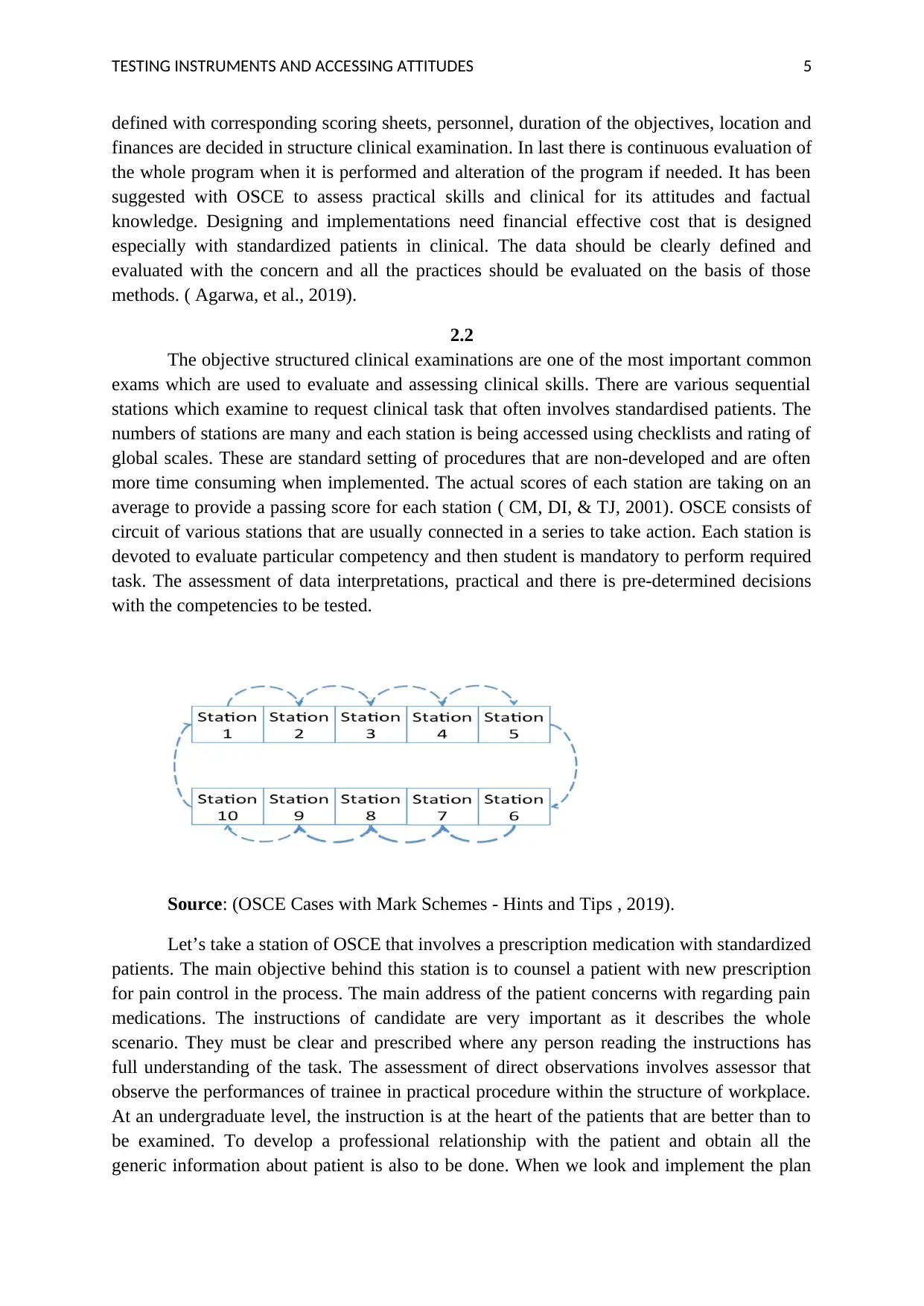
average to provide a passing score for each station ( CM, DI, & TJ, 2001). OSCE consists of
circuit of various stations that are usually connected in a series to take action. Each station is
devoted to evaluate particular competency and then student is mandatory to perform required
task. The assessment of data interpretations, practical and there is pre-determined decisions
with the competencies to be tested.
Source: (OSCE Cases with Mark Schemes - Hints and Tips , 2019).
Let’s take a station of OSCE that involves a prescription medication with standardized
patients. The main objective behind this station is to counsel a patient with new prescription
for pain control in the process. The main address of the patient concerns with regarding pain
medications. The instructions of candidate are very important as it describes the whole
scenario. They must be clear and prescribed where any person reading the instructions has
full understanding of the task. The assessment of direct observations involves assessor that
observe the performances of trainee in practical procedure within the structure of workplace.
At an undergraduate level, the instruction is at the heart of the patients that are better than to
be examined. To develop a professional relationship with the patient and obtain all the
generic information about patient is also to be done. When we look and implement the plan
defined with corresponding scoring sheets, personnel, duration of the objectives, location and
finances are decided in structure clinical examination. In last there is continuous evaluation of
the whole program when it is performed and alteration of the program if needed. It has been
suggested with OSCE to assess practical skills and clinical for its attitudes and factual
knowledge. Designing and implementations need financial effective cost that is designed
especially with standardized patients in clinical. The data should be clearly defined and
evaluated with the concern and all the practices should be evaluated on the basis of those
methods. ( Agarwa, et al., 2019).
2.2
The objective structured clinical examinations are one of the most important common
exams which are used to evaluate and assessing clinical skills. There are various sequential
stations which examine to request clinical task that often involves standardised patients. The
numbers of stations are many and each station is being accessed using checklists and rating of
global scales. These are standard setting of procedures that are non-developed and are often
more time consuming when implemented. The actual scores of each station are taking on an
average to provide a passing score for each station ( CM, DI, & TJ, 2001). OSCE consists of
circuit of various stations that are usually connected in a series to take action. Each station is
devoted to evaluate particular competency and then student is mandatory to perform required
task. The assessment of data interpretations, practical and there is pre-determined decisions
with the competencies to be tested.
Source: (OSCE Cases with Mark Schemes - Hints and Tips , 2019).
Let’s take a station of OSCE that involves a prescription medication with standardized
patients. The main objective behind this station is to counsel a patient with new prescription
for pain control in the process. The main address of the patient concerns with regarding pain
medications. The instructions of candidate are very important as it describes the whole
scenario. They must be clear and prescribed where any person reading the instructions has
full understanding of the task. The assessment of direct observations involves assessor that
observe the performances of trainee in practical procedure within the structure of workplace.
At an undergraduate level, the instruction is at the heart of the patients that are better than to
be examined. To develop a professional relationship with the patient and obtain all the
generic information about patient is also to be done. When we look and implement the plan
⊘ This is a preview!⊘
Do you want full access?
Subscribe today to unlock all pages.
Trusted by 1+ million students worldwide
TESTING INSTRUMENTS AND ACCESSING ATTITUDES 6
with communication that have more competencies and can be tested with clear instructions
for both the tasks that is to be provided. The instructions for the candidate are presented on
one side of laminated A, and this will ensure that instructions are not damaged by stressed
candidate, and they can easily answer such questions ( MOOKHERJEE, CHANG,
BOSCARDIN, & HAUER, 2013).
There are various instructions for the examiner also in each station. With the
introduction of the profile of the stations, the clear statement of the construct being measured
and the instructions which are given for the candidate shall also be provided to the candidate
for the easy conduct of clarifications. The requirement of the importance is interaction and
prompting and should include when to interact and what are the measures to be conducted
with specify modification in scoring.
For example: Full instructions shall be given for marking, for example the one given
below for a postgraduate OSCE:
2.0/2.0 Satisfactory demonstration at required level (specialist/consultant)
1.5/2.0 Borderline quality
1.0/2.0 Unsatisfactory due to a significant error or omission
0.5/2.0 Weak quality for level required
0.0/2.0 Multiple problems due to significant error(s) or omission(s)
Each level are explained in detail with the descriptors that to ensure the candidate is
assessed in the same way and it is particularly important when number of examiner examines
the same thing in stations. This may be varying from two or three different centres. With the
involvement of real patient instructions are also being examined if he or she is present in the
situations. And this consists of background, presentations, past history of the concerned
person, general health, and family history and how to cope up with the real role. All the
particulars are to be stated in the clear way format and that can be access via examiner as well
as candidates (Examining Stations, 2019).
The station designer follows the standards that are agreed upon by all the committee
of examinations. The basic format that should be used and is specified by the committee as
there are various formats available with the checklist The difference in the scoring style is
interested in differentiating performance based on level of mastery. The candidate is rated
across the scale which is satisfactory, weak, problems or borderline. A mark is assigned for
every level in the scale that has help to provide a descriptor for each and every level ( Ware,
El Mardi, Abdulghani , & Siddiqui , 2014).
A list of resources are needed for the stations and that should be prepared by setting
all the guidelines and include furnishings such as desk, wall mounted BP machines and
fundoscope. There is requirement of pre prepared packs in the contents shall also be
with communication that have more competencies and can be tested with clear instructions
for both the tasks that is to be provided. The instructions for the candidate are presented on
one side of laminated A, and this will ensure that instructions are not damaged by stressed
candidate, and they can easily answer such questions ( MOOKHERJEE, CHANG,
BOSCARDIN, & HAUER, 2013).
There are various instructions for the examiner also in each station. With the
introduction of the profile of the stations, the clear statement of the construct being measured
and the instructions which are given for the candidate shall also be provided to the candidate
for the easy conduct of clarifications. The requirement of the importance is interaction and
prompting and should include when to interact and what are the measures to be conducted
with specify modification in scoring.
For example: Full instructions shall be given for marking, for example the one given
below for a postgraduate OSCE:
2.0/2.0 Satisfactory demonstration at required level (specialist/consultant)
1.5/2.0 Borderline quality
1.0/2.0 Unsatisfactory due to a significant error or omission
0.5/2.0 Weak quality for level required
0.0/2.0 Multiple problems due to significant error(s) or omission(s)
Each level are explained in detail with the descriptors that to ensure the candidate is
assessed in the same way and it is particularly important when number of examiner examines
the same thing in stations. This may be varying from two or three different centres. With the
involvement of real patient instructions are also being examined if he or she is present in the
situations. And this consists of background, presentations, past history of the concerned
person, general health, and family history and how to cope up with the real role. All the
particulars are to be stated in the clear way format and that can be access via examiner as well
as candidates (Examining Stations, 2019).
The station designer follows the standards that are agreed upon by all the committee
of examinations. The basic format that should be used and is specified by the committee as
there are various formats available with the checklist The difference in the scoring style is
interested in differentiating performance based on level of mastery. The candidate is rated
across the scale which is satisfactory, weak, problems or borderline. A mark is assigned for
every level in the scale that has help to provide a descriptor for each and every level ( Ware,
El Mardi, Abdulghani , & Siddiqui , 2014).
A list of resources are needed for the stations and that should be prepared by setting
all the guidelines and include furnishings such as desk, wall mounted BP machines and
fundoscope. There is requirement of pre prepared packs in the contents shall also be
Paraphrase This Document
Need a fresh take? Get an instant paraphrase of this document with our AI Paraphraser
TESTING INSTRUMENTS AND ACCESSING ATTITUDES 7
specified. All such equipment’s that are made available prefers at least two weeks before the
scheduled dates of the examinations. An OSCE book is the desirable document that is
favoured with the instructions to present and explain the components of the stations (Connor
& MCgraw, 2019).
2.3
OSCE is an assessment method which is based on the performances of students that
measures the competency of clinical. There is use of standardised patients and introduction of
different medical scenario with patient stations. OSCE is a tool which can easily access for
compete the ability of trainee to expect at a satisfactory level of delivery at certain period of
time in the process or at the completion of the program. To develop an OSCE exam, one must
need to analyse the special services to be provided to the consumers. There is a record of the
grading purposes and instructional purposes in the process (Objective Structured Clinical
Examination, 2019). There is a process that discovers the meetings and step by step guidance
is to provide to quality assured by appropriate steps in the algorithm. The first step starts with
choosing the topic for new stations, choice of station writers, types of stations, choice of an
OSCE station template, station writing, marking guidance, peer review workshops, piloting,
psychometric analysis and then adding of required questions to the bank or the new
development of a new question bank.
There are different types of stations as observed stations, unobserved, technology
enhanced station and linked stations. The examiner role in OSCE is to observe the candidate
performances of candidates at particular task. There is a contribution to the good conduct of
the main examinations. The rating scale is the scale detailing the task to be performed. The
main role is to score according to the marking scheduled. The instructions which are given by
identifying any sort of questions that the examiner want to ask. The main criticism with this
method is that it interprets the results that are more robust understanding and students learn
the skills from them. Secondly, the need for examined optimal consensus among physician
educators regarding checklist items that has less impact. Differences in ambitious forms of
assessment and experiences are the real attainment of goals. It is impossible to perform a test
that satisfies all the criteria of a good test that is being performed. Reliability, feasibility,
objectivity of all the examinations is based on the particular stations, checklist and global
scoring or the accessing numbers to be accessed. The overall scores are very low of the
students and high stakes examination is formative learning exercise. The small sample size
limits the generalizability and affects the score distributions. The main critical of this method
is that there is influence of the format on skills performances, students on the other hand are
influencing by real patients or different models are used in skill assessment. This is based on
retrospective analysis and that is not allowed to determine patterns of individual’s
performance of the students ( Payne, . Bradley, Heald, Maughan, & Corbett,, 2019).
specified. All such equipment’s that are made available prefers at least two weeks before the
scheduled dates of the examinations. An OSCE book is the desirable document that is
favoured with the instructions to present and explain the components of the stations (Connor
& MCgraw, 2019).
2.3
OSCE is an assessment method which is based on the performances of students that
measures the competency of clinical. There is use of standardised patients and introduction of
different medical scenario with patient stations. OSCE is a tool which can easily access for
compete the ability of trainee to expect at a satisfactory level of delivery at certain period of
time in the process or at the completion of the program. To develop an OSCE exam, one must
need to analyse the special services to be provided to the consumers. There is a record of the
grading purposes and instructional purposes in the process (Objective Structured Clinical
Examination, 2019). There is a process that discovers the meetings and step by step guidance
is to provide to quality assured by appropriate steps in the algorithm. The first step starts with
choosing the topic for new stations, choice of station writers, types of stations, choice of an
OSCE station template, station writing, marking guidance, peer review workshops, piloting,
psychometric analysis and then adding of required questions to the bank or the new
development of a new question bank.
There are different types of stations as observed stations, unobserved, technology
enhanced station and linked stations. The examiner role in OSCE is to observe the candidate
performances of candidates at particular task. There is a contribution to the good conduct of
the main examinations. The rating scale is the scale detailing the task to be performed. The
main role is to score according to the marking scheduled. The instructions which are given by
identifying any sort of questions that the examiner want to ask. The main criticism with this
method is that it interprets the results that are more robust understanding and students learn
the skills from them. Secondly, the need for examined optimal consensus among physician
educators regarding checklist items that has less impact. Differences in ambitious forms of
assessment and experiences are the real attainment of goals. It is impossible to perform a test
that satisfies all the criteria of a good test that is being performed. Reliability, feasibility,
objectivity of all the examinations is based on the particular stations, checklist and global
scoring or the accessing numbers to be accessed. The overall scores are very low of the
students and high stakes examination is formative learning exercise. The small sample size
limits the generalizability and affects the score distributions. The main critical of this method
is that there is influence of the format on skills performances, students on the other hand are
influencing by real patients or different models are used in skill assessment. This is based on
retrospective analysis and that is not allowed to determine patterns of individual’s
performance of the students ( Payne, . Bradley, Heald, Maughan, & Corbett,, 2019).
TESTING INSTRUMENTS AND ACCESSING ATTITUDES 8
Part C - Assessing Attitudes
3.1
An attitude refers to a set of behaviours, emotions or belief of a person with the
perception he has set towards the person positivity and negativity. Attitudes are the person
traits that reflect the person personality and experience of upbringing with the powerful
influence over his or her behaviour. With the continuous time, the attitudes towards someone
took time to change but with the regular framework, they are access to be changed. Attitude
defines the personality of human being and this falls under two categories as good or bad.
According to Winston Churchill, Attitude needs to be access by the small things but that
creates the big difference in someone life. If there is willingness to improve the
circumstances, then the look on you to change the perception of attitude in yourself is the
think towards positivity. The best things about the attitude are that it will make you like
winner at the same time. According to the most of the people positive mind-set are the
combinations that are to bet for best attitudes in the way (Hayati, 2019).
I would like to access on the attitude of person who drink alcohol on regular basis and
that affect the health of a person ion continuous manner. In public hospitals, when we see
there are number of patients who provided the services with free treatment or they have to
pay less amount. Even though there are more number of alcoholic person in the hospitals, and
they have to provide fair treatment and best services so they can cure themselves. But when
this happen with the person again and again, there should be fair decisions to be taken for the
improvement in not providing the services which actual or real patients should be provided.
These attitudes and beliefs in the hospital environment should be changed as these are
depicting real problems as the dangerous one.
When we see alcoholic person, we have the perception of the personality as the
person who is drunken alcohol is a weak person and alcoholism is best to be described as a
bad habit rather than illness. The person who drunk on the regular basis, they should be
provided treatment but with strict measure that cure his or her health for long time and
positive attitude can change himself to not drink too much from the situations happened at
that time. Nurse’s attitudes towards caring perception of alcohol drinkers are lacking and
which is accessed by shortened versions of the problems in the alcohol from regular time.
Alcoholism is a specific order where the personality attitudes are measured by influencing
people to adapt the changes scenario of the environment ( Beck, Dietrich, Angermeyer, &
Matschinger, 2019).
Most of studies investigate attitudes towards people who take alcohol on regular
interval of time and there are three forms in the same as individual discrimination, health care
facilities and significance on alcohol dependent in comparison to people with the other
conditions. The people who are suffering or make a habit of these, are not so poor people but
they have less financial resources that they can pay to public hospitals (Alcoholism:signs,
symptoms and treatment, 2019).
Part C - Assessing Attitudes
3.1
An attitude refers to a set of behaviours, emotions or belief of a person with the
perception he has set towards the person positivity and negativity. Attitudes are the person
traits that reflect the person personality and experience of upbringing with the powerful
influence over his or her behaviour. With the continuous time, the attitudes towards someone
took time to change but with the regular framework, they are access to be changed. Attitude
defines the personality of human being and this falls under two categories as good or bad.
According to Winston Churchill, Attitude needs to be access by the small things but that
creates the big difference in someone life. If there is willingness to improve the
circumstances, then the look on you to change the perception of attitude in yourself is the
think towards positivity. The best things about the attitude are that it will make you like
winner at the same time. According to the most of the people positive mind-set are the
combinations that are to bet for best attitudes in the way (Hayati, 2019).
I would like to access on the attitude of person who drink alcohol on regular basis and
that affect the health of a person ion continuous manner. In public hospitals, when we see
there are number of patients who provided the services with free treatment or they have to
pay less amount. Even though there are more number of alcoholic person in the hospitals, and
they have to provide fair treatment and best services so they can cure themselves. But when
this happen with the person again and again, there should be fair decisions to be taken for the
improvement in not providing the services which actual or real patients should be provided.
These attitudes and beliefs in the hospital environment should be changed as these are
depicting real problems as the dangerous one.
When we see alcoholic person, we have the perception of the personality as the
person who is drunken alcohol is a weak person and alcoholism is best to be described as a
bad habit rather than illness. The person who drunk on the regular basis, they should be
provided treatment but with strict measure that cure his or her health for long time and
positive attitude can change himself to not drink too much from the situations happened at
that time. Nurse’s attitudes towards caring perception of alcohol drinkers are lacking and
which is accessed by shortened versions of the problems in the alcohol from regular time.
Alcoholism is a specific order where the personality attitudes are measured by influencing
people to adapt the changes scenario of the environment ( Beck, Dietrich, Angermeyer, &
Matschinger, 2019).
Most of studies investigate attitudes towards people who take alcohol on regular
interval of time and there are three forms in the same as individual discrimination, health care
facilities and significance on alcohol dependent in comparison to people with the other
conditions. The people who are suffering or make a habit of these, are not so poor people but
they have less financial resources that they can pay to public hospitals (Alcoholism:signs,
symptoms and treatment, 2019).
⊘ This is a preview!⊘
Do you want full access?
Subscribe today to unlock all pages.
Trusted by 1+ million students worldwide
TESTING INSTRUMENTS AND ACCESSING ATTITUDES 9
The first step towards main problem of alcoholism is that there is a problem with the
people. The fair and free treatment that why this is the habit of a person or an overwhelming
desire to drink, an ability to stop or control the harmful drinks and pursuing the main
consumptions of alcohol to the exclusion of pleasures alternatives. There should be fair
treatment of the services provided to them and several measures including not drinking
alcohol with regular interval of time. Many studies correlate the consumption of alcohol and
cancer development links together to moderate following types of cancer as head, liver,
breast or colorectal cancer or more. There is a problem of deficient in the crucial vitamins
and people who indulge in alcohol on regular basis may suffer greatly. Decreased vitamin D
and calcium absorption initiates and affects the liver when drink is on regular basis. Liver
damage, depressant, memory losses are all the traits which are showing negative impacts on
heath and their families as well (Ketler, 2016).
3.2
The main difficulties in measuring attitudes of alcohol person define the character of
the personality in whichever he is dealing. Perhaps, the most and best way of finding the
traits about someone attitudes would be directly to ask them or by asking in the community
he lives. However, attitudes of a person are related to the social acceptance and self-image of
the person. These can be accessed by direct or indirect way by asking respondents what is the
cause behind the problem. The most obvious promise to capture attitudes in circumstances
where all people are unwilling to report them accurately in response to ask direct questions.
They are not in state to tell the real consequences behind the problem. The major drawback is
that they can stole the money from other financial resources and buy the needy to drunk on
regular basis and this leads to affect the whole crisis of family. The attitudes of the person are
more concern with the problem they faces and the outcomes they want in their life to pursue
further (Wittenbrink, Krosnick, & Judd, 2019).
Most of studies investigate attitudes towards people who take alcohol on regular
interval of time and there are three forms in the same as individual discrimination, health care
facilities and significance on alcohol dependent in comparison to people with the other
conditions. Alcohol drink on regular interval leads to bad health and their consequences on
personality are also different to the concern. People with chronic drinkers that consume
alcohol are subjective to the issues of heart diseases and it affects its heart and lungs of the
concerned person. The effects of alcohol may be for short or long term and can affects the
whole body, shrink brain, heart damage, dependency, attitude of a person change, cancer
causing, lung infections and stomach distress. The crams in the muscle and complications of
diabetes are the symptoms of drinking alcohol on the daily basis. This can cause death to a
person or infections may be arising when consuming on more interval of time. The people
who are suffering or make a habit of these, are not so poor people but they have less financial
resources that they can pay to public hospitals (Alcoholism:signs, symptoms and treatment,
2019).
To overcome every little or big problem with the person having same perception of
the attitude in his lifestyle, drunk on regular way and want the fair and free treatment in
public hospitals have to face several things in his life. Cravings for alcohol are normal when
The first step towards main problem of alcoholism is that there is a problem with the
people. The fair and free treatment that why this is the habit of a person or an overwhelming
desire to drink, an ability to stop or control the harmful drinks and pursuing the main
consumptions of alcohol to the exclusion of pleasures alternatives. There should be fair
treatment of the services provided to them and several measures including not drinking
alcohol with regular interval of time. Many studies correlate the consumption of alcohol and
cancer development links together to moderate following types of cancer as head, liver,
breast or colorectal cancer or more. There is a problem of deficient in the crucial vitamins
and people who indulge in alcohol on regular basis may suffer greatly. Decreased vitamin D
and calcium absorption initiates and affects the liver when drink is on regular basis. Liver
damage, depressant, memory losses are all the traits which are showing negative impacts on
heath and their families as well (Ketler, 2016).
3.2
The main difficulties in measuring attitudes of alcohol person define the character of
the personality in whichever he is dealing. Perhaps, the most and best way of finding the
traits about someone attitudes would be directly to ask them or by asking in the community
he lives. However, attitudes of a person are related to the social acceptance and self-image of
the person. These can be accessed by direct or indirect way by asking respondents what is the
cause behind the problem. The most obvious promise to capture attitudes in circumstances
where all people are unwilling to report them accurately in response to ask direct questions.
They are not in state to tell the real consequences behind the problem. The major drawback is
that they can stole the money from other financial resources and buy the needy to drunk on
regular basis and this leads to affect the whole crisis of family. The attitudes of the person are
more concern with the problem they faces and the outcomes they want in their life to pursue
further (Wittenbrink, Krosnick, & Judd, 2019).
Most of studies investigate attitudes towards people who take alcohol on regular
interval of time and there are three forms in the same as individual discrimination, health care
facilities and significance on alcohol dependent in comparison to people with the other
conditions. Alcohol drink on regular interval leads to bad health and their consequences on
personality are also different to the concern. People with chronic drinkers that consume
alcohol are subjective to the issues of heart diseases and it affects its heart and lungs of the
concerned person. The effects of alcohol may be for short or long term and can affects the
whole body, shrink brain, heart damage, dependency, attitude of a person change, cancer
causing, lung infections and stomach distress. The crams in the muscle and complications of
diabetes are the symptoms of drinking alcohol on the daily basis. This can cause death to a
person or infections may be arising when consuming on more interval of time. The people
who are suffering or make a habit of these, are not so poor people but they have less financial
resources that they can pay to public hospitals (Alcoholism:signs, symptoms and treatment,
2019).
To overcome every little or big problem with the person having same perception of
the attitude in his lifestyle, drunk on regular way and want the fair and free treatment in
public hospitals have to face several things in his life. Cravings for alcohol are normal when
Paraphrase This Document
Need a fresh take? Get an instant paraphrase of this document with our AI Paraphraser
TESTING INSTRUMENTS AND ACCESSING ATTITUDES 10
you have drunk but this habit for six months after you quit drinking. The treatment prepares
for these challenges, stressful situations and there is a social pressure to drink also.
Consumption of Alcohol is a bad trait and reflects wrong behaviour pattern in the society as
well. Alcohol causes more damage to our nervous system and experience tingling sensations
in feet’s and hands. Self-help books, smartphone apps, supportive groups, meditation and
relaxing for long hours and asking for support can be easy practices which can be follow by
someone who want to get rid of this. Drinking also makes to adapt the circle of long term
memories for your life. To overcome such issues, there should be positivity in everyone
attitude and less consumption of these will survive him more. Connected more with the
people who are suffering may lead them to change anyhow to not consume on regular basis.
Lack of wrong habits and financial health will be increasing from time when someone left
consuming alcohol. There should be practices of such person where he or she should be paid
for such services as hospitals cannot afford him on regular way as he was drunk. The fair
positive attitude should be provided as to overcome the problem in his life by providing him
fair treatment and strictly mention him that it is not good habit and you should left this for
you and for your good health. The family should take care of such measures and involve him
in positive healthy environment in his surroundings. This will took time but in the last the
way attitudes of the person can change anyone, the person who drink alcohol may also be
changed with time (Overcoming Alcohol Addiction , 2019).
you have drunk but this habit for six months after you quit drinking. The treatment prepares
for these challenges, stressful situations and there is a social pressure to drink also.
Consumption of Alcohol is a bad trait and reflects wrong behaviour pattern in the society as
well. Alcohol causes more damage to our nervous system and experience tingling sensations
in feet’s and hands. Self-help books, smartphone apps, supportive groups, meditation and
relaxing for long hours and asking for support can be easy practices which can be follow by
someone who want to get rid of this. Drinking also makes to adapt the circle of long term
memories for your life. To overcome such issues, there should be positivity in everyone
attitude and less consumption of these will survive him more. Connected more with the
people who are suffering may lead them to change anyhow to not consume on regular basis.
Lack of wrong habits and financial health will be increasing from time when someone left
consuming alcohol. There should be practices of such person where he or she should be paid
for such services as hospitals cannot afford him on regular way as he was drunk. The fair
positive attitude should be provided as to overcome the problem in his life by providing him
fair treatment and strictly mention him that it is not good habit and you should left this for
you and for your good health. The family should take care of such measures and involve him
in positive healthy environment in his surroundings. This will took time but in the last the
way attitudes of the person can change anyone, the person who drink alcohol may also be
changed with time (Overcoming Alcohol Addiction , 2019).
TESTING INSTRUMENTS AND ACCESSING ATTITUDES 11
Bibliography
Ware, P. J., El Mardi, P. A., Abdulghani , D. H., & Siddiqui , D. I. (2014, May 26). Objective Structured.
Retrieved from SCHHS:
https://www.scfhs.org.sa/en/Media/OtherPublications/Documents/OSCE%20MANUAL.pdf
Agarwa, A., Batra, B., Sood , A., Ramakantan, R., Bhargava, S. K., & Chidambaranathan, N. (2019, May
26). Objective structured clinical. Retrieved from Sci-Hub: http://sci-hub.tw/10.4103/0971-
3026.63040
Beck, M., Dietrich, S., Angermeyer, M., & Matschinger, H. (2019, May 27). Alcohol and Alcoholism.
Retrieved from Oxford Academic:
https://academic.oup.com/alcalc/article/38/6/602/210151
CM, F., DI, N., & TJ, W. (2001, May 25). Standard setting in an objective structured clinical
examination: use of global ratings of borderline performance to determine the passing score.
Retrieved from NCBI: https://www.ncbi.nlm.nih.gov/pubmed/11703640
Kichu, B., Parvathy, M., Wilson, A., Smith, J., & Murphy, B. (2015, May 26). Workplace-based
assessment; learner. Retrieved from Sci-Hub:
http://sci-hub.tw/https://dx.doi.org/10.2147%2FAMEP.S79968
MOOKHERJEE, S., CHANG, A., BOSCARDIN, C., & HAUER, K. (2013, May 24). How to develop a
competency-based. Retrieved from Sci-Hub:
http://sci-hub.tw/https://doi.org/10.3109/0142159X.2013.809408
Payne, N., . Bradley, E., Heald, E., Maughan, K., & Corbett,, E. (2019, May 27). Sharpening the Eye of
the OSCE with Critical. Retrieved from Sci-Hub:
http://sci-hub.tw/10.1097/ACM.0b013e3181850990
Simon, S. T., Ramsenthaler, C., Bausewein, C., Krischke, N., & Geiss, G. (2019, May 25). Core attitudes
of professionals. Retrieved from Sci- Hub:
http://sci-hub.tw/https://doi.org/10.12968/ijpn.2009.15.8.43800
Singh, T., Dewan, P., & Gupta , P. (2010, May 26). Objective structured clinical examination (OSCE)
revisited. Retrieved from Springer: https://link.springer.com/article/10.1007/s13312-010-
0155-6
. KHAN, K., RAMACHANDRAN, S., GAUNT, K., & PUSHKAR, P. (2013, May 23). The Objective
Structured Clinical Examination (OSCE): AMEE Guide No. 81. Part I: An historical and
theoretical perspective. Retrieved from Taylor and Francis Online:
http://sci-hub.tw/https://doi.org/10.3109/0142159X.2013.818634
Challenges and Strategies . (2018, May 27). Retrieved from Journal of the Postgraduate Institute of
Medicine: file:///C:/Users/SystemJP/Downloads/8183-29583-1-PB.pdf
Bibliography
Ware, P. J., El Mardi, P. A., Abdulghani , D. H., & Siddiqui , D. I. (2014, May 26). Objective Structured.
Retrieved from SCHHS:
https://www.scfhs.org.sa/en/Media/OtherPublications/Documents/OSCE%20MANUAL.pdf
Agarwa, A., Batra, B., Sood , A., Ramakantan, R., Bhargava, S. K., & Chidambaranathan, N. (2019, May
26). Objective structured clinical. Retrieved from Sci-Hub: http://sci-hub.tw/10.4103/0971-
3026.63040
Beck, M., Dietrich, S., Angermeyer, M., & Matschinger, H. (2019, May 27). Alcohol and Alcoholism.
Retrieved from Oxford Academic:
https://academic.oup.com/alcalc/article/38/6/602/210151
CM, F., DI, N., & TJ, W. (2001, May 25). Standard setting in an objective structured clinical
examination: use of global ratings of borderline performance to determine the passing score.
Retrieved from NCBI: https://www.ncbi.nlm.nih.gov/pubmed/11703640
Kichu, B., Parvathy, M., Wilson, A., Smith, J., & Murphy, B. (2015, May 26). Workplace-based
assessment; learner. Retrieved from Sci-Hub:
http://sci-hub.tw/https://dx.doi.org/10.2147%2FAMEP.S79968
MOOKHERJEE, S., CHANG, A., BOSCARDIN, C., & HAUER, K. (2013, May 24). How to develop a
competency-based. Retrieved from Sci-Hub:
http://sci-hub.tw/https://doi.org/10.3109/0142159X.2013.809408
Payne, N., . Bradley, E., Heald, E., Maughan, K., & Corbett,, E. (2019, May 27). Sharpening the Eye of
the OSCE with Critical. Retrieved from Sci-Hub:
http://sci-hub.tw/10.1097/ACM.0b013e3181850990
Simon, S. T., Ramsenthaler, C., Bausewein, C., Krischke, N., & Geiss, G. (2019, May 25). Core attitudes
of professionals. Retrieved from Sci- Hub:
http://sci-hub.tw/https://doi.org/10.12968/ijpn.2009.15.8.43800
Singh, T., Dewan, P., & Gupta , P. (2010, May 26). Objective structured clinical examination (OSCE)
revisited. Retrieved from Springer: https://link.springer.com/article/10.1007/s13312-010-
0155-6
. KHAN, K., RAMACHANDRAN, S., GAUNT, K., & PUSHKAR, P. (2013, May 23). The Objective
Structured Clinical Examination (OSCE): AMEE Guide No. 81. Part I: An historical and
theoretical perspective. Retrieved from Taylor and Francis Online:
http://sci-hub.tw/https://doi.org/10.3109/0142159X.2013.818634
Challenges and Strategies . (2018, May 27). Retrieved from Journal of the Postgraduate Institute of
Medicine: file:///C:/Users/SystemJP/Downloads/8183-29583-1-PB.pdf
⊘ This is a preview!⊘
Do you want full access?
Subscribe today to unlock all pages.
Trusted by 1+ million students worldwide

1 out of 14


Related Documents


Your All-in-One AI-Powered Toolkit for Academic Success.
+13062052269
info@desklib.com
Available 24*7 on WhatsApp / Email
![[object Object]](/_next/static/media/star-bottom.7253800d.svg)
Unlock your academic potential
Copyright © 2020–2026 A2Z Services. All Rights Reserved. Developed and managed by ZUCOL.