Dissertation Proposal on Medical Images and Machine Learning
VerifiedAdded on 2023/01/10
|12
|2835
|67
Report
AI Summary
This dissertation proposal investigates the concept of medical images and machine learning, focusing on their importance and usefulness in the medical field. It explores the application of deep learning techniques, including convolutional neural networks, for image analysis to overcome challenges in tracking the progress of illnesses. The proposal includes an executive summary, background study, aims and objectives, literature review, research methodologies, and a research schedule. The literature review examines the use of medical imaging techniques like MRI and CT scans, and how machine learning aids in diagnosis and treatment monitoring. It also assesses the advantages and disadvantages of Convolutional Neural Networks in computer vision and suggests improvements. The research methodology outlines the research philosophy (positivism), approach (deductive), and method (quantitative) used, along with data collection sources. The proposal aims to provide insights into how medical images and machine learning can improve healthcare outcomes and offer a comprehensive understanding of deep learning applications in medical imaging.

Dissertation Proposal

Paraphrase This Document
Need a fresh take? Get an instant paraphrase of this document with our AI Paraphraser
Table of Contents
Contents
1. Executive Summary.....................................................................................................................3
2. Background of the Study.............................................................................................................1
3. Aim and objectives......................................................................................................................1
3.1. Research Aim...........................................................................................................1
3.2. Research Objectives.................................................................................................1
3.3. Rationale for research topic......................................................................................1
3.4. Research questions...................................................................................................2
4. Literature Review.........................................................................................................................2
4.1.Statement of the problem..................................................................................................2
4.2. Main Body.......................................................................................................................2
5. Research Methodologies..............................................................................................................5
6. Research schedule........................................................................................................................6
REFERENCES................................................................................................................................6
Contents
1. Executive Summary.....................................................................................................................3
2. Background of the Study.............................................................................................................1
3. Aim and objectives......................................................................................................................1
3.1. Research Aim...........................................................................................................1
3.2. Research Objectives.................................................................................................1
3.3. Rationale for research topic......................................................................................1
3.4. Research questions...................................................................................................2
4. Literature Review.........................................................................................................................2
4.1.Statement of the problem..................................................................................................2
4.2. Main Body.......................................................................................................................2
5. Research Methodologies..............................................................................................................5
6. Research schedule........................................................................................................................6
REFERENCES................................................................................................................................6
1. Abstract
The current dissertation is based on Concept of medical images and Machine Learning
along with its importance and usefulness in medical line that is manly associated with
overcoming the issues and challenges faced by doctors and physician while tracking the progress
of an ongoing illness. Thus, to get a better evaluation of current topic use of both primary and
secondary research work would be made. For collecting secondary information use of online
articles and scholarly journals are made where as primary data would be collected through use of
quantitative research method and questionnaire.
The current dissertation is based on Concept of medical images and Machine Learning
along with its importance and usefulness in medical line that is manly associated with
overcoming the issues and challenges faced by doctors and physician while tracking the progress
of an ongoing illness. Thus, to get a better evaluation of current topic use of both primary and
secondary research work would be made. For collecting secondary information use of online
articles and scholarly journals are made where as primary data would be collected through use of
quantitative research method and questionnaire.
⊘ This is a preview!⊘
Do you want full access?
Subscribe today to unlock all pages.

Trusted by 1+ million students worldwide
2. Background of the Study
The term “deep learning in medical imaging” is mainly associated with techniques and
processes that are used to create images of various parts of the human body that offer and lead to
better diagnostic and treatment purposes within digital health (Xing and et. al., 2017). Medical
images consists of various radiological imaging techniques like X-ray radiography, fluoroscopy,
magnetic resonance imaging (MRI), CT scans, etc that offer better monitoring and analysing of
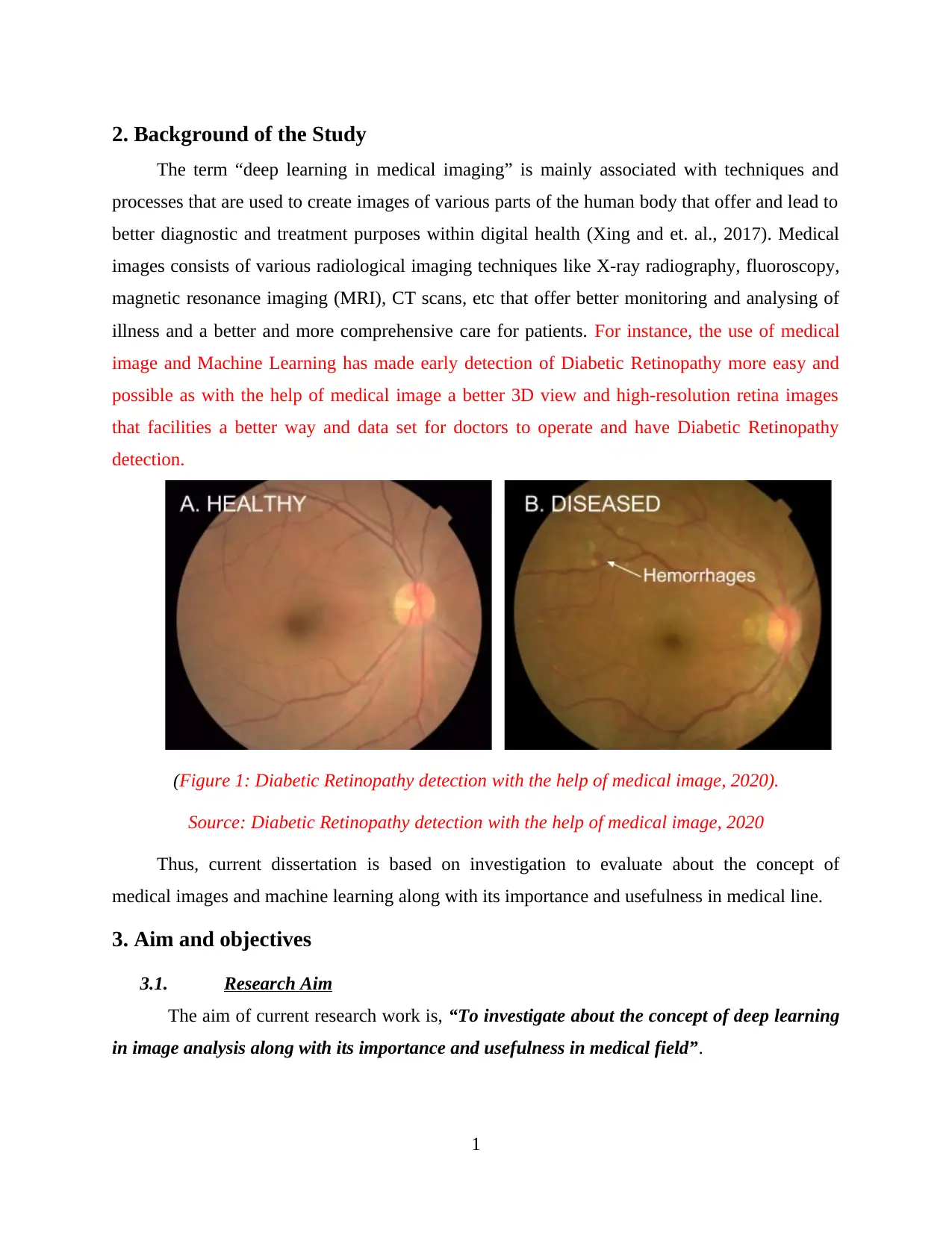
illness and a better and more comprehensive care for patients. For instance, the use of medical
image and Machine Learning has made early detection of Diabetic Retinopathy more easy and
possible as with the help of medical image a better 3D view and high-resolution retina images
that facilities a better way and data set for doctors to operate and have Diabetic Retinopathy
detection.
(Figure 1: Diabetic Retinopathy detection with the help of medical image, 2020).
Source: Diabetic Retinopathy detection with the help of medical image, 2020
Thus, current dissertation is based on investigation to evaluate about the concept of
medical images and machine learning along with its importance and usefulness in medical line.
3. Aim and objectives
3.1. Research Aim
The aim of current research work is, “To investigate about the concept of deep learning
in image analysis along with its importance and usefulness in medical field”.
1
The term “deep learning in medical imaging” is mainly associated with techniques and
processes that are used to create images of various parts of the human body that offer and lead to
better diagnostic and treatment purposes within digital health (Xing and et. al., 2017). Medical
images consists of various radiological imaging techniques like X-ray radiography, fluoroscopy,
magnetic resonance imaging (MRI), CT scans, etc that offer better monitoring and analysing of
illness and a better and more comprehensive care for patients. For instance, the use of medical
image and Machine Learning has made early detection of Diabetic Retinopathy more easy and
possible as with the help of medical image a better 3D view and high-resolution retina images
that facilities a better way and data set for doctors to operate and have Diabetic Retinopathy
detection.
(Figure 1: Diabetic Retinopathy detection with the help of medical image, 2020).
Source: Diabetic Retinopathy detection with the help of medical image, 2020
Thus, current dissertation is based on investigation to evaluate about the concept of
medical images and machine learning along with its importance and usefulness in medical line.
3. Aim and objectives
3.1. Research Aim
The aim of current research work is, “To investigate about the concept of deep learning
in image analysis along with its importance and usefulness in medical field”.
1
Paraphrase This Document
Need a fresh take? Get an instant paraphrase of this document with our AI Paraphraser
3.2. Research Objectives
The main objectives and target set for current investigation are stated as below:
To get a deep insight into the concept of medical images and Machine Learning including
Deep learning for image analysis.
To evaluate about the importance and usefulness of medical images and Machine
Learning in meeting objective of a hospital.
To determine the advantages and disadvantages of Convolutional Neural Networks in
Computer Vision field, along with suggestions for better use of Convolutional neural
networks for deep learning.
3.3. Rationale for research topic
The selection of current research topic is rationale from the professional view point of
researcher as yield solution for the issue and challenge faced during the tracking the progress of
an ongoing illness along with leading better understanding about the concept of medical images
and Machine Learning. Beside this, information about the advantages and disadvantages of
Convolutional Neural Networks is also lead by current investigation that is vital for researcher.
Further, also meet the personal implication of researcher through fulfilling academic and
educational criteria along with ensuring better development of managerial skills and other
competencies.
3.4. Research questions
The research questions that would be evaluated during current investigation are listed as
below:
What is meant by concept of medical images and Machine Learning including Deep
learning for image analysis?
What are the main importance and usefulness associated with use of medical images and
Machine Learning in meeting objective of a hospital?
What are the possible advantages and disadvantages of Convolutional Neural Networks
in Computer Vision field, along with suggestions for better use of Convolutional neural
networks for deep learning?
2
The main objectives and target set for current investigation are stated as below:
To get a deep insight into the concept of medical images and Machine Learning including
Deep learning for image analysis.
To evaluate about the importance and usefulness of medical images and Machine
Learning in meeting objective of a hospital.
To determine the advantages and disadvantages of Convolutional Neural Networks in
Computer Vision field, along with suggestions for better use of Convolutional neural
networks for deep learning.
3.3. Rationale for research topic
The selection of current research topic is rationale from the professional view point of
researcher as yield solution for the issue and challenge faced during the tracking the progress of
an ongoing illness along with leading better understanding about the concept of medical images
and Machine Learning. Beside this, information about the advantages and disadvantages of
Convolutional Neural Networks is also lead by current investigation that is vital for researcher.
Further, also meet the personal implication of researcher through fulfilling academic and
educational criteria along with ensuring better development of managerial skills and other
competencies.
3.4. Research questions
The research questions that would be evaluated during current investigation are listed as
below:
What is meant by concept of medical images and Machine Learning including Deep
learning for image analysis?
What are the main importance and usefulness associated with use of medical images and
Machine Learning in meeting objective of a hospital?
What are the possible advantages and disadvantages of Convolutional Neural Networks
in Computer Vision field, along with suggestions for better use of Convolutional neural
networks for deep learning?
2
4. Literature Review
4.1.Statement of the problem
The problem statement for current dissertation is based on the issues faced by hospitals,
doctors and other physicians while tracking the progress of an ongoing illness, thus deep learning
in medical imaging that consist MRI's and CT scans become vital to aid the diagnosis and
monitor effectiveness of treatment and adjust protocols as necessary to ensure with better and
more comprehensive care.
Literature Review forms a vital part of all dissertation as it a section that is associated with
evaluation and review of various scholarly articles and available resources. Thus, it provide
better evaluation and analysis of current problem and chosen title through leading survey and
review of available literature (Giger, 2018). Following literature review has been conducted in
current research topic based on concept of medical images and Machine Learning including in
order to develop better solution and answer for above stated problem.
4.2. Main Body
To get a deep insight into the concept of medical images and Machine Learning including
Deep learning for image analysis
As per the view point of Sayon Dutta, (2020), Medical imaging basically consists of set
of various processes or techniques that lead to creation of visual representations of the interior
body parts of a patient or human like its organs and tissues to facilitate a better monitoring and
check of health through leading better diagnose of diseases and injuries. Thus, it can be
evaluated that medical images and Machine Learning is mainly associated with use if techniques
like CT scan and MRI to facilities a 3D or better visualisation of infected or ill body part so that
better diagnoses of reasons for illness could be made along with leading significant confirmation
of assessment and documentation of diseases and ailments for future use and better
understanding (Carin and Pencina, 2018).
Beside this, as per the opinion of Ongsulee, P., (2017), the deep learning algorithms are
also being applied by physicians and doctors to generate biological images which are
transforming the analysis and interpretation of imaging data by freestanding radiology and
pathology facilities along with clinics and hospitals to have better visualisation and motoring of
body parts that aid to the diagnosis and better treatment. Thus it can be evaluated that, High
3
4.1.Statement of the problem
The problem statement for current dissertation is based on the issues faced by hospitals,
doctors and other physicians while tracking the progress of an ongoing illness, thus deep learning
in medical imaging that consist MRI's and CT scans become vital to aid the diagnosis and
monitor effectiveness of treatment and adjust protocols as necessary to ensure with better and
more comprehensive care.
Literature Review forms a vital part of all dissertation as it a section that is associated with
evaluation and review of various scholarly articles and available resources. Thus, it provide
better evaluation and analysis of current problem and chosen title through leading survey and
review of available literature (Giger, 2018). Following literature review has been conducted in
current research topic based on concept of medical images and Machine Learning including in
order to develop better solution and answer for above stated problem.
4.2. Main Body
To get a deep insight into the concept of medical images and Machine Learning including
Deep learning for image analysis
As per the view point of Sayon Dutta, (2020), Medical imaging basically consists of set
of various processes or techniques that lead to creation of visual representations of the interior
body parts of a patient or human like its organs and tissues to facilitate a better monitoring and
check of health through leading better diagnose of diseases and injuries. Thus, it can be
evaluated that medical images and Machine Learning is mainly associated with use if techniques
like CT scan and MRI to facilities a 3D or better visualisation of infected or ill body part so that
better diagnoses of reasons for illness could be made along with leading significant confirmation
of assessment and documentation of diseases and ailments for future use and better
understanding (Carin and Pencina, 2018).
Beside this, as per the opinion of Ongsulee, P., (2017), the deep learning algorithms are
also being applied by physicians and doctors to generate biological images which are
transforming the analysis and interpretation of imaging data by freestanding radiology and
pathology facilities along with clinics and hospitals to have better visualisation and motoring of
body parts that aid to the diagnosis and better treatment. Thus it can be evaluated that, High
3
⊘ This is a preview!⊘
Do you want full access?
Subscribe today to unlock all pages.
Trusted by 1+ million students worldwide
quality imaging techniques and deep learning about machine and medical images improves
medical decision making and reduce unnecessary medical procedures through leading better
check and diagnoses of illness (Vasconcelos and Vasconcelos, 2017).
To evaluate the importance and usefulness of medical images and machine learning in
meeting objectives of a hospital.
According to the viewpoints of Erickson and et. al., (2017), Machine Learning is a
prominent technique in order to recognising patterns within medial images. Moreover, it is a very
powerful alternative and tool towards ensuring effective rendering of medical diagnosis.
Moreover, the study explored that there are various metrics in relation to measuring the
performance levels of in relation to the algorithms which are used within machine learning and
medical images. One such alternative which is quite recently being used is Deep learning, which
is a method that provides benefit of not requiring any sort of identification within image feature.
Rather, it implements features as identified parts in context of the learning process (Buduma and
Locascio, 2017).
As per Ker and et. al., (2017), machine learning and medical images have effective
application and usefulness within recent years, which has led to enhancement within electronic
medical records, as well as diagnostic imaging. Moreover, its learning could very well be
evaluated through the fact that these elements allow formulation of various hierarchal
relationships within the information, which could be identified in an algorithmic manner without
any usage associated with laborious hand-crafting within the features. In addition to this, deep
learning has contributed within both machine learning and medical imaging in a manner which
has enhanced the usage associated with medical diagnosis due to accurate and effective results
within aspects like X-rays, CT Scans and MRI evaluations in patients. Moreover, it is highly
reliable as with machine learning; the overall algorithm system holds the potential for effective
development and improvements according to the needs and usage patterns (Druzhkov and
Kustikova, 2016).
To determine the advantages and disadvantages of Convolutional Neural Networks in
Computer Vision field, along with suggestions for better use of Convolutional neural networks
for deep learning.
According to the views of Jin and et. al., (2017), Convolutional Neutral Network refers to
the deep neutral networks within deep learning, which is implemented to analysing the visual
4
medical decision making and reduce unnecessary medical procedures through leading better
check and diagnoses of illness (Vasconcelos and Vasconcelos, 2017).
To evaluate the importance and usefulness of medical images and machine learning in
meeting objectives of a hospital.
According to the viewpoints of Erickson and et. al., (2017), Machine Learning is a
prominent technique in order to recognising patterns within medial images. Moreover, it is a very
powerful alternative and tool towards ensuring effective rendering of medical diagnosis.
Moreover, the study explored that there are various metrics in relation to measuring the
performance levels of in relation to the algorithms which are used within machine learning and
medical images. One such alternative which is quite recently being used is Deep learning, which
is a method that provides benefit of not requiring any sort of identification within image feature.
Rather, it implements features as identified parts in context of the learning process (Buduma and
Locascio, 2017).
As per Ker and et. al., (2017), machine learning and medical images have effective
application and usefulness within recent years, which has led to enhancement within electronic
medical records, as well as diagnostic imaging. Moreover, its learning could very well be
evaluated through the fact that these elements allow formulation of various hierarchal
relationships within the information, which could be identified in an algorithmic manner without
any usage associated with laborious hand-crafting within the features. In addition to this, deep
learning has contributed within both machine learning and medical imaging in a manner which
has enhanced the usage associated with medical diagnosis due to accurate and effective results
within aspects like X-rays, CT Scans and MRI evaluations in patients. Moreover, it is highly
reliable as with machine learning; the overall algorithm system holds the potential for effective
development and improvements according to the needs and usage patterns (Druzhkov and
Kustikova, 2016).
To determine the advantages and disadvantages of Convolutional Neural Networks in
Computer Vision field, along with suggestions for better use of Convolutional neural networks
for deep learning.
According to the views of Jin and et. al., (2017), Convolutional Neutral Network refers to
the deep neutral networks within deep learning, which is implemented to analysing the visual
4
Paraphrase This Document
Need a fresh take? Get an instant paraphrase of this document with our AI Paraphraser
imagery. In addition, usually regularised iterative algorithms have been used by the medical
organisations as a standard approach towards ensuring ill-posed inverse issues within patients.
It is imperative to denote the advantages and disadvantage of Convolutional Neutral
Network within computer vision field. For instance, one of the main advantages in relation to
this aspect is that their accuracy towards image recognition issues is quite effective. In addition
to this, another very prominent advantage which this holds is that it allows the detection of
several crucial features without any sort of human intervention, which enhances the scope of
effectiveness of this method in the future and within the field of computer vision. As for its
disadvantages, it is high costly to be afforded and implemented within majority of healthcare
facilities (Li, 2017). In addition to this, it would be requiring effective GPU towards ensuring
better and effective training to individuals in relation to this technology. Furthermore, their
operational disadvantage is that Convolutional Neutral Network require abundant training data to
operate effectively.
However, there are several ways in which this could perform appropriately in the future. As
per Gu and et. al., (2018), it is important that its layer design is improvised in the future, which
would allow fast computation and optimisation of the data in future. Moreover, within computer
vision, it could have natural language, as well as speech processing, which would allow it to
function with even better control and effectiveness (Xing and et. al., 2017).
5
organisations as a standard approach towards ensuring ill-posed inverse issues within patients.
It is imperative to denote the advantages and disadvantage of Convolutional Neutral
Network within computer vision field. For instance, one of the main advantages in relation to
this aspect is that their accuracy towards image recognition issues is quite effective. In addition
to this, another very prominent advantage which this holds is that it allows the detection of
several crucial features without any sort of human intervention, which enhances the scope of
effectiveness of this method in the future and within the field of computer vision. As for its
disadvantages, it is high costly to be afforded and implemented within majority of healthcare
facilities (Li, 2017). In addition to this, it would be requiring effective GPU towards ensuring
better and effective training to individuals in relation to this technology. Furthermore, their
operational disadvantage is that Convolutional Neutral Network require abundant training data to
operate effectively.
However, there are several ways in which this could perform appropriately in the future. As
per Gu and et. al., (2018), it is important that its layer design is improvised in the future, which
would allow fast computation and optimisation of the data in future. Moreover, within computer
vision, it could have natural language, as well as speech processing, which would allow it to
function with even better control and effectiveness (Xing and et. al., 2017).
5
5. Research Methodologies
It is also a vital part of dissertation that facilitates information about the vital approaches
and methods use if which are made to accomplish and conduct a research work in more effective
and better way (Giger, 2018). A description about the research method used for current
dissertation and resrch project along with associated justification and reasons for their selection
is provided below:
Research philosophy- It is a vital section of any research work that provide structure and
guidance for investigation. It is mainly bifurcated into two main parts i.e. Positivism and
interpretivism out of which use of Positivism is more suitable and appropriate and the reason
behind this selection is based on the fact that positivism philosophy lead to better testing of
hypothesis, objectives and problem statement through leading better evaluation and implication
of quantitative data.
Research approach- This part of research methodology is associated with adopting a
suitable approach as per the nature of investigation that is mainly divided into two main parts i.e.
deductive and inductive. As per the nature of current dissertation that seemed to based on more
quantitative facts adoption of deductive approach is justifiable as it lead to better scanning and
evaluating of numeric set of terms (Carin and Pencina, 2018).
Research method- The most commonly adopted research method consist of qualitative
and quantitative methods. Out of these two the former one is totally based on theoretical data and
complex view point and behaviour of respondents where as quantitative is largely depended on
numeric and statistical terms. Thus, there are valid reasons and justification to make use of
quantitative research method as it facilities easy data collection in numeric or statistical form that
is more efficient and viable to present and reach a measurable conclusion.
Sources of data collection- It represent the origin of data from where information is
actually generated or collected that consists of two main sources i.e. primary and secondary.
With regard to current investigation use of primary as well as secondary sources of information
are made. The main justification for collection of data from primary sources consists the fact that
it is most authentic way to gather information that is up to date and generated directly from the
respondents (Vasconcelos and Vasconcelos, 2017). The reasons for selection of secondary
6
It is also a vital part of dissertation that facilitates information about the vital approaches
and methods use if which are made to accomplish and conduct a research work in more effective
and better way (Giger, 2018). A description about the research method used for current
dissertation and resrch project along with associated justification and reasons for their selection
is provided below:
Research philosophy- It is a vital section of any research work that provide structure and
guidance for investigation. It is mainly bifurcated into two main parts i.e. Positivism and
interpretivism out of which use of Positivism is more suitable and appropriate and the reason
behind this selection is based on the fact that positivism philosophy lead to better testing of
hypothesis, objectives and problem statement through leading better evaluation and implication
of quantitative data.
Research approach- This part of research methodology is associated with adopting a
suitable approach as per the nature of investigation that is mainly divided into two main parts i.e.
deductive and inductive. As per the nature of current dissertation that seemed to based on more
quantitative facts adoption of deductive approach is justifiable as it lead to better scanning and
evaluating of numeric set of terms (Carin and Pencina, 2018).
Research method- The most commonly adopted research method consist of qualitative
and quantitative methods. Out of these two the former one is totally based on theoretical data and
complex view point and behaviour of respondents where as quantitative is largely depended on
numeric and statistical terms. Thus, there are valid reasons and justification to make use of
quantitative research method as it facilities easy data collection in numeric or statistical form that
is more efficient and viable to present and reach a measurable conclusion.
Sources of data collection- It represent the origin of data from where information is
actually generated or collected that consists of two main sources i.e. primary and secondary.
With regard to current investigation use of primary as well as secondary sources of information
are made. The main justification for collection of data from primary sources consists the fact that
it is most authentic way to gather information that is up to date and generated directly from the
respondents (Vasconcelos and Vasconcelos, 2017). The reasons for selection of secondary
6
⊘ This is a preview!⊘
Do you want full access?
Subscribe today to unlock all pages.
Trusted by 1+ million students worldwide
sources is that it facilities better support and framework for conducting and evaluating primary
data.
Research strategy- The use of survey method would be made as research strategy that
consist use of questionnaire for collection of quantitative data.
Sampling method- it is related with conduction of investigation in an efficient manner
through selecting a suitable number of candidates and observation from a wider group or
population. With respect to current investigation a sample size of 35 respondents is selected from
the staff of Hospitals.
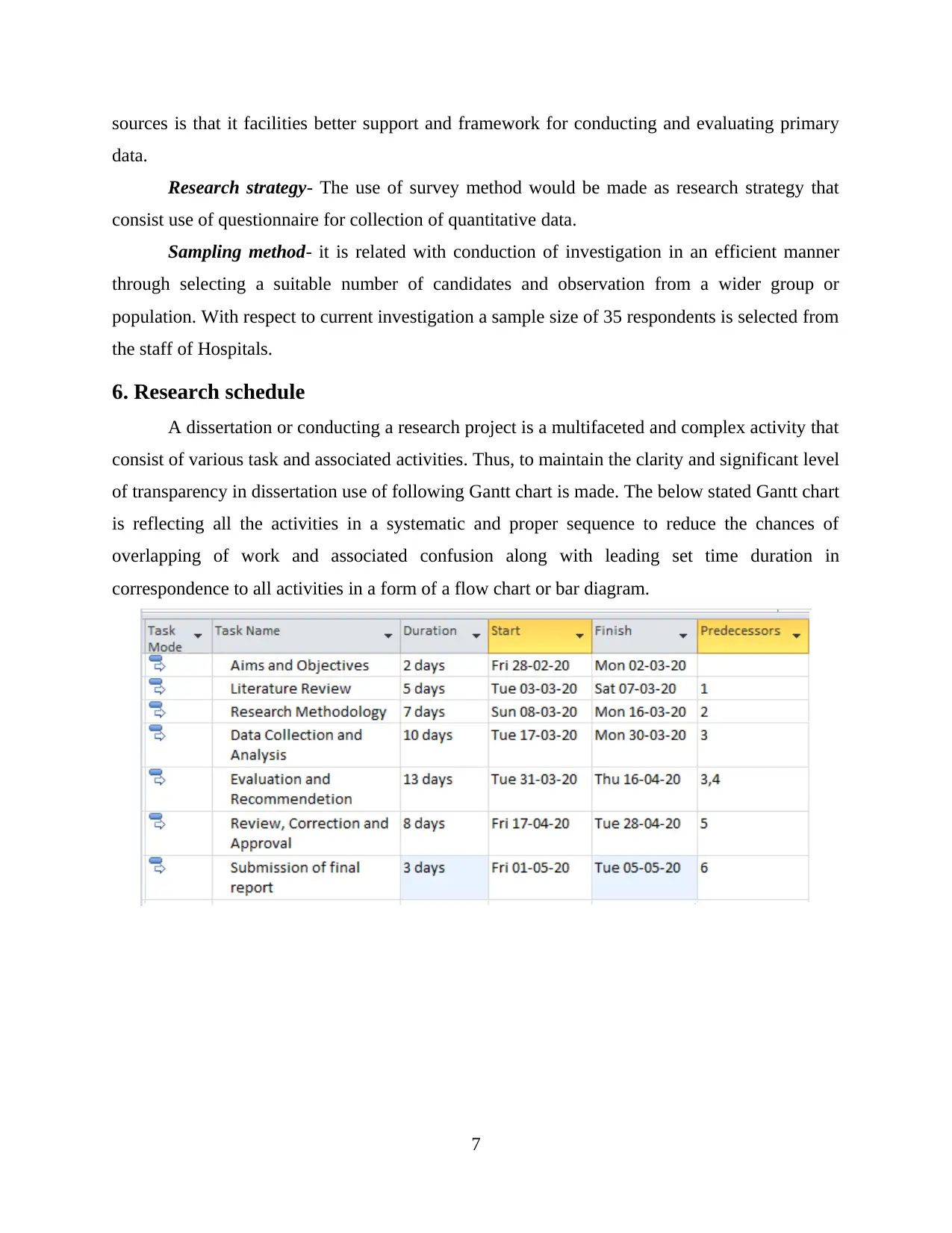
6. Research schedule
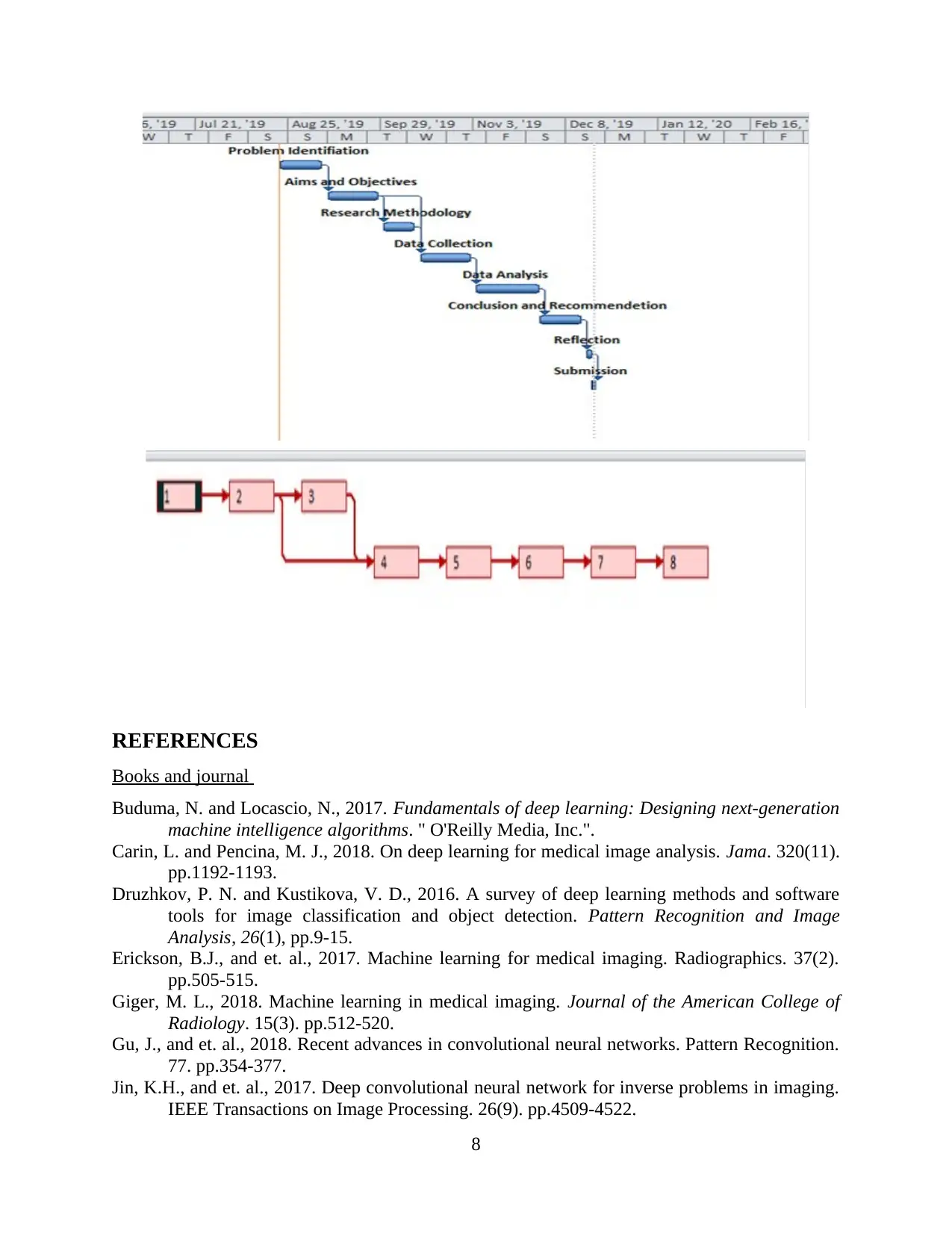
A dissertation or conducting a research project is a multifaceted and complex activity that
consist of various task and associated activities. Thus, to maintain the clarity and significant level
of transparency in dissertation use of following Gantt chart is made. The below stated Gantt chart
is reflecting all the activities in a systematic and proper sequence to reduce the chances of
overlapping of work and associated confusion along with leading set time duration in
correspondence to all activities in a form of a flow chart or bar diagram.
7
data.
Research strategy- The use of survey method would be made as research strategy that
consist use of questionnaire for collection of quantitative data.
Sampling method- it is related with conduction of investigation in an efficient manner
through selecting a suitable number of candidates and observation from a wider group or
population. With respect to current investigation a sample size of 35 respondents is selected from
the staff of Hospitals.
6. Research schedule
A dissertation or conducting a research project is a multifaceted and complex activity that
consist of various task and associated activities. Thus, to maintain the clarity and significant level
of transparency in dissertation use of following Gantt chart is made. The below stated Gantt chart
is reflecting all the activities in a systematic and proper sequence to reduce the chances of
overlapping of work and associated confusion along with leading set time duration in
correspondence to all activities in a form of a flow chart or bar diagram.
7
Paraphrase This Document
Need a fresh take? Get an instant paraphrase of this document with our AI Paraphraser
REFERENCES
Books and journal
Buduma, N. and Locascio, N., 2017. Fundamentals of deep learning: Designing next-generation
machine intelligence algorithms. " O'Reilly Media, Inc.".
Carin, L. and Pencina, M. J., 2018. On deep learning for medical image analysis. Jama. 320(11).
pp.1192-1193.
Druzhkov, P. N. and Kustikova, V. D., 2016. A survey of deep learning methods and software
tools for image classification and object detection. Pattern Recognition and Image
Analysis, 26(1), pp.9-15.
Erickson, B.J., and et. al., 2017. Machine learning for medical imaging. Radiographics. 37(2).
pp.505-515.
Giger, M. L., 2018. Machine learning in medical imaging. Journal of the American College of
Radiology. 15(3). pp.512-520.
Gu, J., and et. al., 2018. Recent advances in convolutional neural networks. Pattern Recognition.
77. pp.354-377.
Jin, K.H., and et. al., 2017. Deep convolutional neural network for inverse problems in imaging.
IEEE Transactions on Image Processing. 26(9). pp.4509-4522.
8
Books and journal
Buduma, N. and Locascio, N., 2017. Fundamentals of deep learning: Designing next-generation
machine intelligence algorithms. " O'Reilly Media, Inc.".
Carin, L. and Pencina, M. J., 2018. On deep learning for medical image analysis. Jama. 320(11).
pp.1192-1193.
Druzhkov, P. N. and Kustikova, V. D., 2016. A survey of deep learning methods and software
tools for image classification and object detection. Pattern Recognition and Image
Analysis, 26(1), pp.9-15.
Erickson, B.J., and et. al., 2017. Machine learning for medical imaging. Radiographics. 37(2).
pp.505-515.
Giger, M. L., 2018. Machine learning in medical imaging. Journal of the American College of
Radiology. 15(3). pp.512-520.
Gu, J., and et. al., 2018. Recent advances in convolutional neural networks. Pattern Recognition.
77. pp.354-377.
Jin, K.H., and et. al., 2017. Deep convolutional neural network for inverse problems in imaging.
IEEE Transactions on Image Processing. 26(9). pp.4509-4522.
8
Ker, J., and et. al., 2017. Deep learning applications in medical image analysis. Ieee Access. 6.
pp.9375-9389.
Li, H., 2017. Deep learning for natural language processing: advantages and challenges. National
Science Review.
Ongsulee, P., 2017, November. Artificial intelligence, machine learning and deep learning. In
2017 15th International Conference on ICT and Knowledge Engineering (ICT&KE) (pp.
1-6). IEEE.
Vasconcelos, C. N. and Vasconcelos, B. N., 2017. Experiments using deep learning for
dermoscopy image analysis. Pattern Recognition Letters.
Xing, F. and et. al., 2017. Deep learning in microscopy image analysis: A survey. IEEE
Transactions on Neural Networks and Learning Systems. 29(10). pp.4550-4568.
Online:
Sayon Dutta. 2020. A 2020 Guide to Deep Learning for Medical Imaging and the Healthcare
Industry. [Online] Available Through:< https://nanonets.com/blog/deep-learning-for-
medical-imaging/ >.
9
pp.9375-9389.
Li, H., 2017. Deep learning for natural language processing: advantages and challenges. National
Science Review.
Ongsulee, P., 2017, November. Artificial intelligence, machine learning and deep learning. In
2017 15th International Conference on ICT and Knowledge Engineering (ICT&KE) (pp.
1-6). IEEE.
Vasconcelos, C. N. and Vasconcelos, B. N., 2017. Experiments using deep learning for
dermoscopy image analysis. Pattern Recognition Letters.
Xing, F. and et. al., 2017. Deep learning in microscopy image analysis: A survey. IEEE
Transactions on Neural Networks and Learning Systems. 29(10). pp.4550-4568.
Online:
Sayon Dutta. 2020. A 2020 Guide to Deep Learning for Medical Imaging and the Healthcare
Industry. [Online] Available Through:< https://nanonets.com/blog/deep-learning-for-
medical-imaging/ >.
9
⊘ This is a preview!⊘
Do you want full access?
Subscribe today to unlock all pages.
Trusted by 1+ million students worldwide

1 out of 12


Related Documents


Your All-in-One AI-Powered Toolkit for Academic Success.
+13062052269
info@desklib.com
Available 24*7 on WhatsApp / Email
![[object Object]](/_next/static/media/star-bottom.7253800d.svg)
Unlock your academic potential
Copyright © 2020–2026 A2Z Services. All Rights Reserved. Developed and managed by ZUCOL.