Medical Nursing Principles and Their Application to Disease Management
VerifiedAdded on 2023/06/08
|9
|2110
|472
Report
AI Summary
This report delves into the critical medical nursing principles that guide healthcare professionals in treating various diseases. It outlines eight key principles: attention to human values, accountability, risk management, patient-centered treatment, effective communication, continuous evaluation and follow-up, up-to-date knowledge and skills, and unity. The report provides a rationale for each principle, emphasizing their importance in ensuring quality patient care, promoting ethical practices, and adapting to advancements in medical knowledge and technology. Furthermore, it illustrates the application of these principles in managing specific conditions such as iron deficiency, chronic kidney disease, sexually transmitted diseases, leukemia, and acute kidney disease. The discussion includes specific treatment codes and guidelines for each disease, highlighting the practical implementation of the principles in diverse clinical scenarios. The report underscores the significance of these principles in making informed decisions, providing patient-friendly care, and contributing to optimal patient outcomes. The references used in this report includes articles, guidelines and books on the subject matter.
Running Head: medical nursing principles 1
MEDICAL NURSING PRINCIPLES
Name
Professor
Institution
Course
Date
MEDICAL NURSING PRINCIPLES
Name
Professor
Institution
Course
Date
Paraphrase This Document
Need a fresh take? Get an instant paraphrase of this document with our AI Paraphraser

2
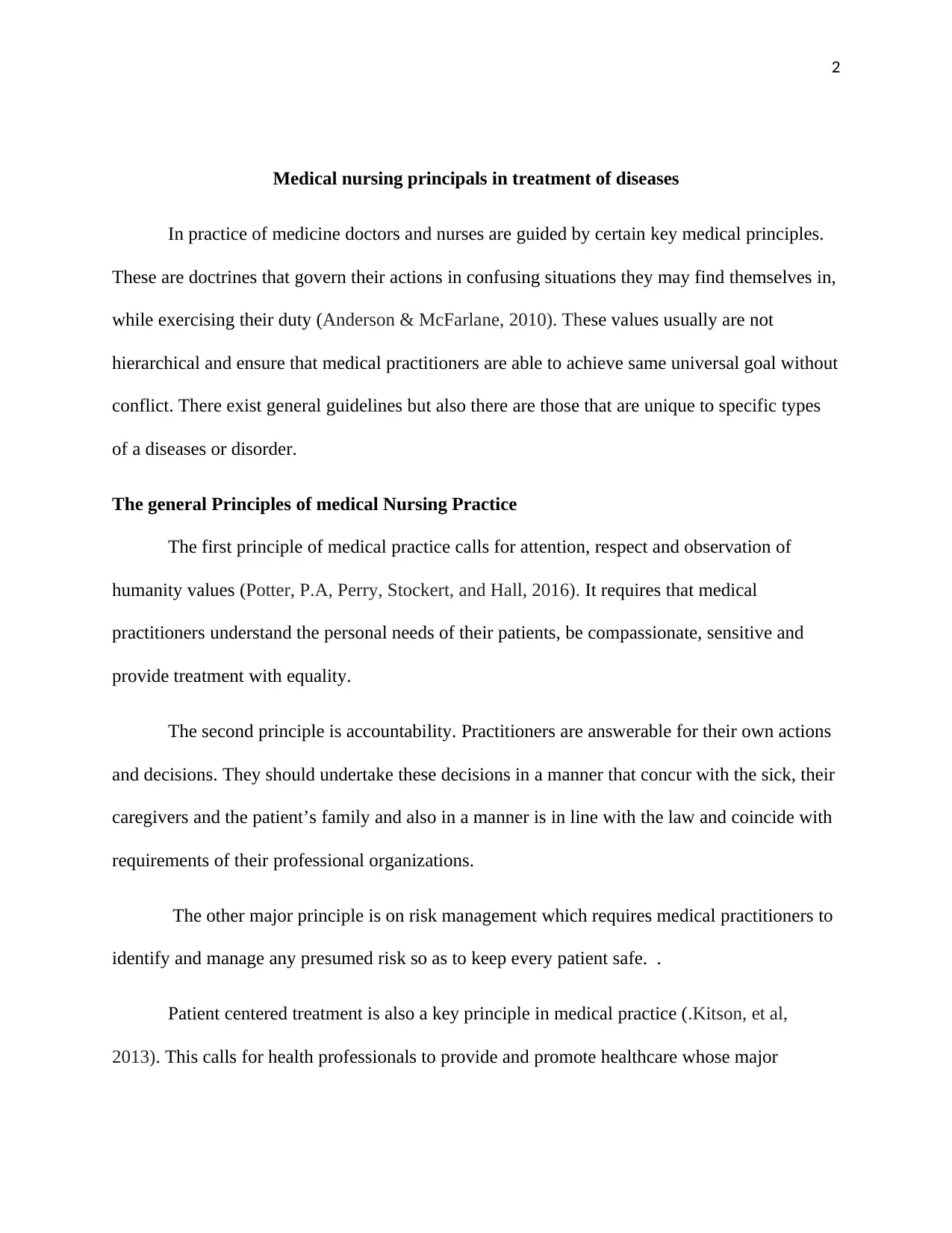
Medical nursing principals in treatment of diseases
In practice of medicine doctors and nurses are guided by certain key medical principles.
These are doctrines that govern their actions in confusing situations they may find themselves in,
while exercising their duty (Anderson & McFarlane, 2010). These values usually are not
hierarchical and ensure that medical practitioners are able to achieve same universal goal without
conflict. There exist general guidelines but also there are those that are unique to specific types
of a diseases or disorder.
The general Principles of medical Nursing Practice
The first principle of medical practice calls for attention, respect and observation of
humanity values (Potter, P.A, Perry, Stockert, and Hall, 2016). It requires that medical
practitioners understand the personal needs of their patients, be compassionate, sensitive and
provide treatment with equality.
The second principle is accountability. Practitioners are answerable for their own actions
and decisions. They should undertake these decisions in a manner that concur with the sick, their
caregivers and the patient’s family and also in a manner is in line with the law and coincide with
requirements of their professional organizations.
The other major principle is on risk management which requires medical practitioners to
identify and manage any presumed risk so as to keep every patient safe. .
Patient centered treatment is also a key principle in medical practice (.Kitson, et al,
2013). This calls for health professionals to provide and promote healthcare whose major
Medical nursing principals in treatment of diseases
In practice of medicine doctors and nurses are guided by certain key medical principles.
These are doctrines that govern their actions in confusing situations they may find themselves in,
while exercising their duty (Anderson & McFarlane, 2010). These values usually are not
hierarchical and ensure that medical practitioners are able to achieve same universal goal without
conflict. There exist general guidelines but also there are those that are unique to specific types
of a diseases or disorder.
The general Principles of medical Nursing Practice
The first principle of medical practice calls for attention, respect and observation of
humanity values (Potter, P.A, Perry, Stockert, and Hall, 2016). It requires that medical
practitioners understand the personal needs of their patients, be compassionate, sensitive and
provide treatment with equality.
The second principle is accountability. Practitioners are answerable for their own actions
and decisions. They should undertake these decisions in a manner that concur with the sick, their
caregivers and the patient’s family and also in a manner is in line with the law and coincide with
requirements of their professional organizations.
The other major principle is on risk management which requires medical practitioners to
identify and manage any presumed risk so as to keep every patient safe. .
Patient centered treatment is also a key principle in medical practice (.Kitson, et al,
2013). This calls for health professionals to provide and promote healthcare whose major

3
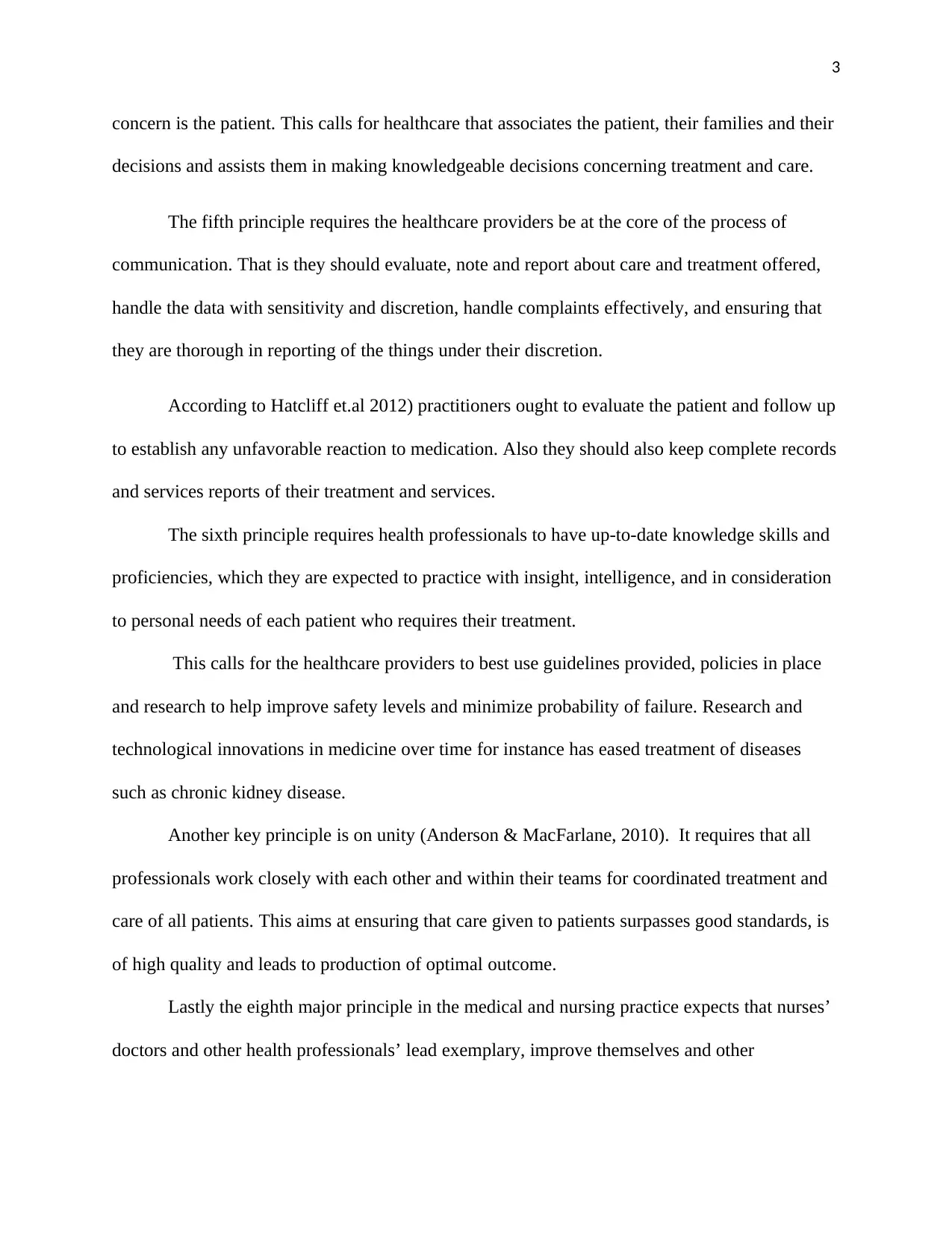
concern is the patient. This calls for healthcare that associates the patient, their families and their
decisions and assists them in making knowledgeable decisions concerning treatment and care.
The fifth principle requires the healthcare providers be at the core of the process of
communication. That is they should evaluate, note and report about care and treatment offered,
handle the data with sensitivity and discretion, handle complaints effectively, and ensuring that
they are thorough in reporting of the things under their discretion.
According to Hatcliff et.al 2012) practitioners ought to evaluate the patient and follow up
to establish any unfavorable reaction to medication. Also they should also keep complete records
and services reports of their treatment and services.
The sixth principle requires health professionals to have up-to-date knowledge skills and
proficiencies, which they are expected to practice with insight, intelligence, and in consideration
to personal needs of each patient who requires their treatment.
This calls for the healthcare providers to best use guidelines provided, policies in place
and research to help improve safety levels and minimize probability of failure. Research and
technological innovations in medicine over time for instance has eased treatment of diseases
such as chronic kidney disease.
Another key principle is on unity (Anderson & MacFarlane, 2010). It requires that all
professionals work closely with each other and within their teams for coordinated treatment and
care of all patients. This aims at ensuring that care given to patients surpasses good standards, is
of high quality and leads to production of optimal outcome.
Lastly the eighth major principle in the medical and nursing practice expects that nurses’
doctors and other health professionals’ lead exemplary, improve themselves and other
concern is the patient. This calls for healthcare that associates the patient, their families and their
decisions and assists them in making knowledgeable decisions concerning treatment and care.
The fifth principle requires the healthcare providers be at the core of the process of
communication. That is they should evaluate, note and report about care and treatment offered,
handle the data with sensitivity and discretion, handle complaints effectively, and ensuring that
they are thorough in reporting of the things under their discretion.
According to Hatcliff et.al 2012) practitioners ought to evaluate the patient and follow up
to establish any unfavorable reaction to medication. Also they should also keep complete records
and services reports of their treatment and services.
The sixth principle requires health professionals to have up-to-date knowledge skills and
proficiencies, which they are expected to practice with insight, intelligence, and in consideration
to personal needs of each patient who requires their treatment.
This calls for the healthcare providers to best use guidelines provided, policies in place
and research to help improve safety levels and minimize probability of failure. Research and
technological innovations in medicine over time for instance has eased treatment of diseases
such as chronic kidney disease.
Another key principle is on unity (Anderson & MacFarlane, 2010). It requires that all
professionals work closely with each other and within their teams for coordinated treatment and
care of all patients. This aims at ensuring that care given to patients surpasses good standards, is
of high quality and leads to production of optimal outcome.
Lastly the eighth major principle in the medical and nursing practice expects that nurses’
doctors and other health professionals’ lead exemplary, improve themselves and other
⊘ This is a preview!⊘
Do you want full access?
Subscribe today to unlock all pages.

Trusted by 1+ million students worldwide

4
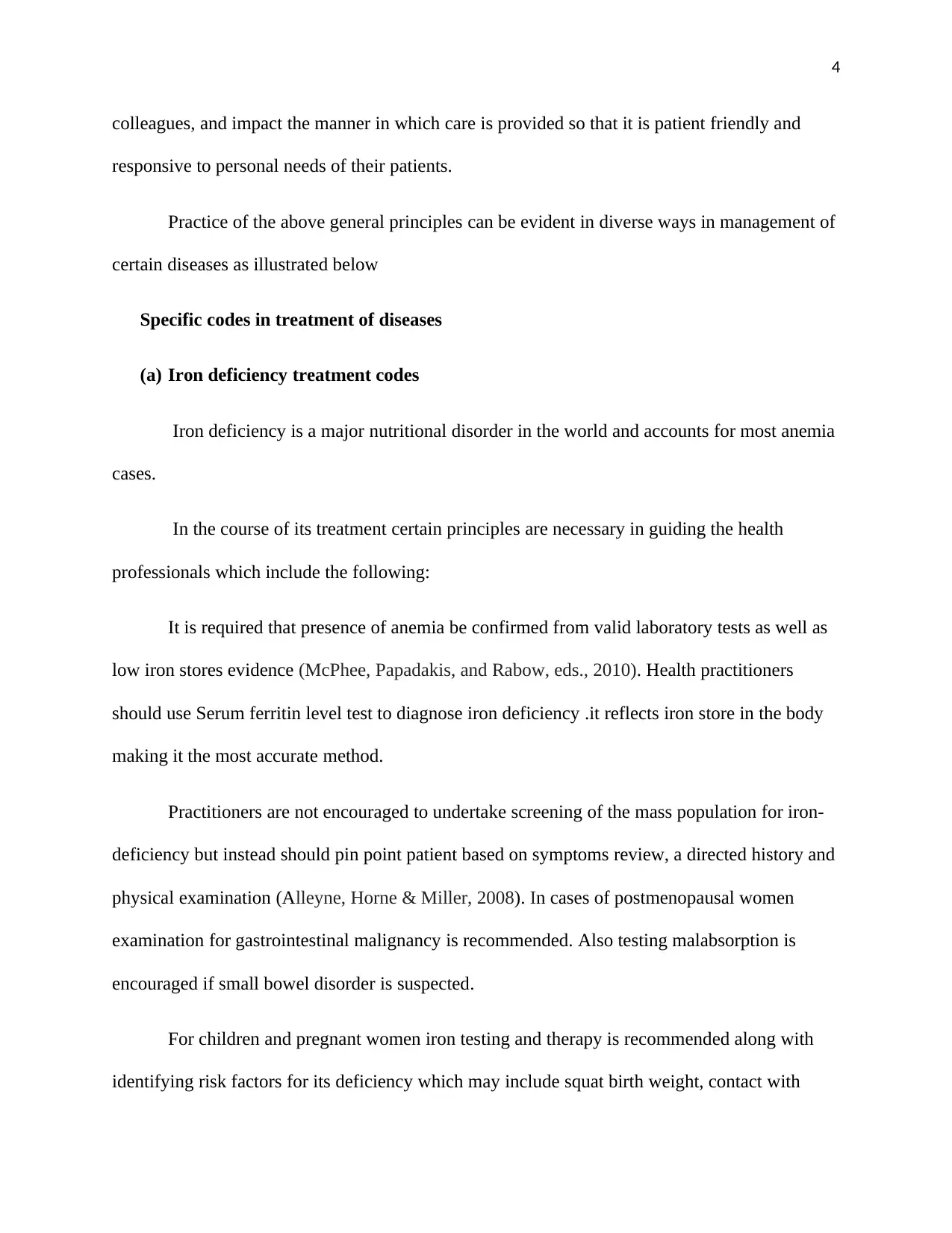
colleagues, and impact the manner in which care is provided so that it is patient friendly and
responsive to personal needs of their patients.
Practice of the above general principles can be evident in diverse ways in management of
certain diseases as illustrated below
Specific codes in treatment of diseases
(a) Iron deficiency treatment codes
Iron deficiency is a major nutritional disorder in the world and accounts for most anemia
cases.
In the course of its treatment certain principles are necessary in guiding the health
professionals which include the following:
It is required that presence of anemia be confirmed from valid laboratory tests as well as
low iron stores evidence (McPhee, Papadakis, and Rabow, eds., 2010). Health practitioners
should use Serum ferritin level test to diagnose iron deficiency .it reflects iron store in the body
making it the most accurate method.
Practitioners are not encouraged to undertake screening of the mass population for iron-
deficiency but instead should pin point patient based on symptoms review, a directed history and
physical examination (Alleyne, Horne & Miller, 2008). In cases of postmenopausal women
examination for gastrointestinal malignancy is recommended. Also testing malabsorption is
encouraged if small bowel disorder is suspected.
For children and pregnant women iron testing and therapy is recommended along with
identifying risk factors for its deficiency which may include squat birth weight, contact with
colleagues, and impact the manner in which care is provided so that it is patient friendly and
responsive to personal needs of their patients.
Practice of the above general principles can be evident in diverse ways in management of
certain diseases as illustrated below
Specific codes in treatment of diseases
(a) Iron deficiency treatment codes
Iron deficiency is a major nutritional disorder in the world and accounts for most anemia
cases.
In the course of its treatment certain principles are necessary in guiding the health
professionals which include the following:
It is required that presence of anemia be confirmed from valid laboratory tests as well as
low iron stores evidence (McPhee, Papadakis, and Rabow, eds., 2010). Health practitioners
should use Serum ferritin level test to diagnose iron deficiency .it reflects iron store in the body
making it the most accurate method.
Practitioners are not encouraged to undertake screening of the mass population for iron-
deficiency but instead should pin point patient based on symptoms review, a directed history and
physical examination (Alleyne, Horne & Miller, 2008). In cases of postmenopausal women
examination for gastrointestinal malignancy is recommended. Also testing malabsorption is
encouraged if small bowel disorder is suspected.
For children and pregnant women iron testing and therapy is recommended along with
identifying risk factors for its deficiency which may include squat birth weight, contact with
Paraphrase This Document
Need a fresh take? Get an instant paraphrase of this document with our AI Paraphraser

5
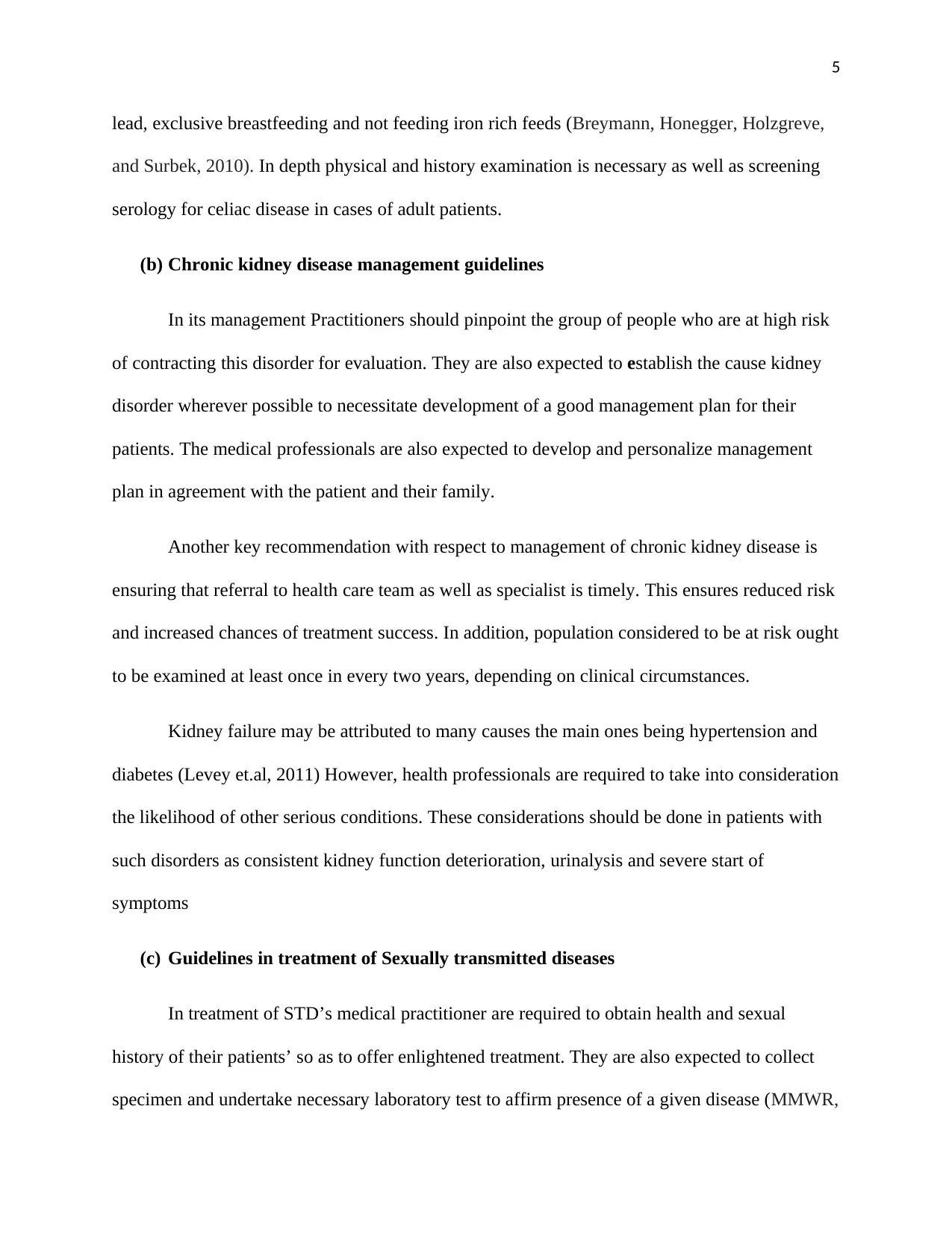
lead, exclusive breastfeeding and not feeding iron rich feeds (Breymann, Honegger, Holzgreve,
and Surbek, 2010). In depth physical and history examination is necessary as well as screening
serology for celiac disease in cases of adult patients.
(b) Chronic kidney disease management guidelines
In its management Practitioners should pinpoint the group of people who are at high risk
of contracting this disorder for evaluation. They are also expected to establish the cause kidney
disorder wherever possible to necessitate development of a good management plan for their
patients. The medical professionals are also expected to develop and personalize management
plan in agreement with the patient and their family.
Another key recommendation with respect to management of chronic kidney disease is
ensuring that referral to health care team as well as specialist is timely. This ensures reduced risk
and increased chances of treatment success. In addition, population considered to be at risk ought
to be examined at least once in every two years, depending on clinical circumstances.
Kidney failure may be attributed to many causes the main ones being hypertension and
diabetes (Levey et.al, 2011) However, health professionals are required to take into consideration
the likelihood of other serious conditions. These considerations should be done in patients with
such disorders as consistent kidney function deterioration, urinalysis and severe start of
symptoms
(c) Guidelines in treatment of Sexually transmitted diseases
In treatment of STD’s medical practitioner are required to obtain health and sexual
history of their patients’ so as to offer enlightened treatment. They are also expected to collect
specimen and undertake necessary laboratory test to affirm presence of a given disease (MMWR,
lead, exclusive breastfeeding and not feeding iron rich feeds (Breymann, Honegger, Holzgreve,
and Surbek, 2010). In depth physical and history examination is necessary as well as screening
serology for celiac disease in cases of adult patients.
(b) Chronic kidney disease management guidelines
In its management Practitioners should pinpoint the group of people who are at high risk
of contracting this disorder for evaluation. They are also expected to establish the cause kidney
disorder wherever possible to necessitate development of a good management plan for their
patients. The medical professionals are also expected to develop and personalize management
plan in agreement with the patient and their family.
Another key recommendation with respect to management of chronic kidney disease is
ensuring that referral to health care team as well as specialist is timely. This ensures reduced risk
and increased chances of treatment success. In addition, population considered to be at risk ought
to be examined at least once in every two years, depending on clinical circumstances.
Kidney failure may be attributed to many causes the main ones being hypertension and
diabetes (Levey et.al, 2011) However, health professionals are required to take into consideration
the likelihood of other serious conditions. These considerations should be done in patients with
such disorders as consistent kidney function deterioration, urinalysis and severe start of
symptoms
(c) Guidelines in treatment of Sexually transmitted diseases
In treatment of STD’s medical practitioner are required to obtain health and sexual
history of their patients’ so as to offer enlightened treatment. They are also expected to collect
specimen and undertake necessary laboratory test to affirm presence of a given disease (MMWR,

6
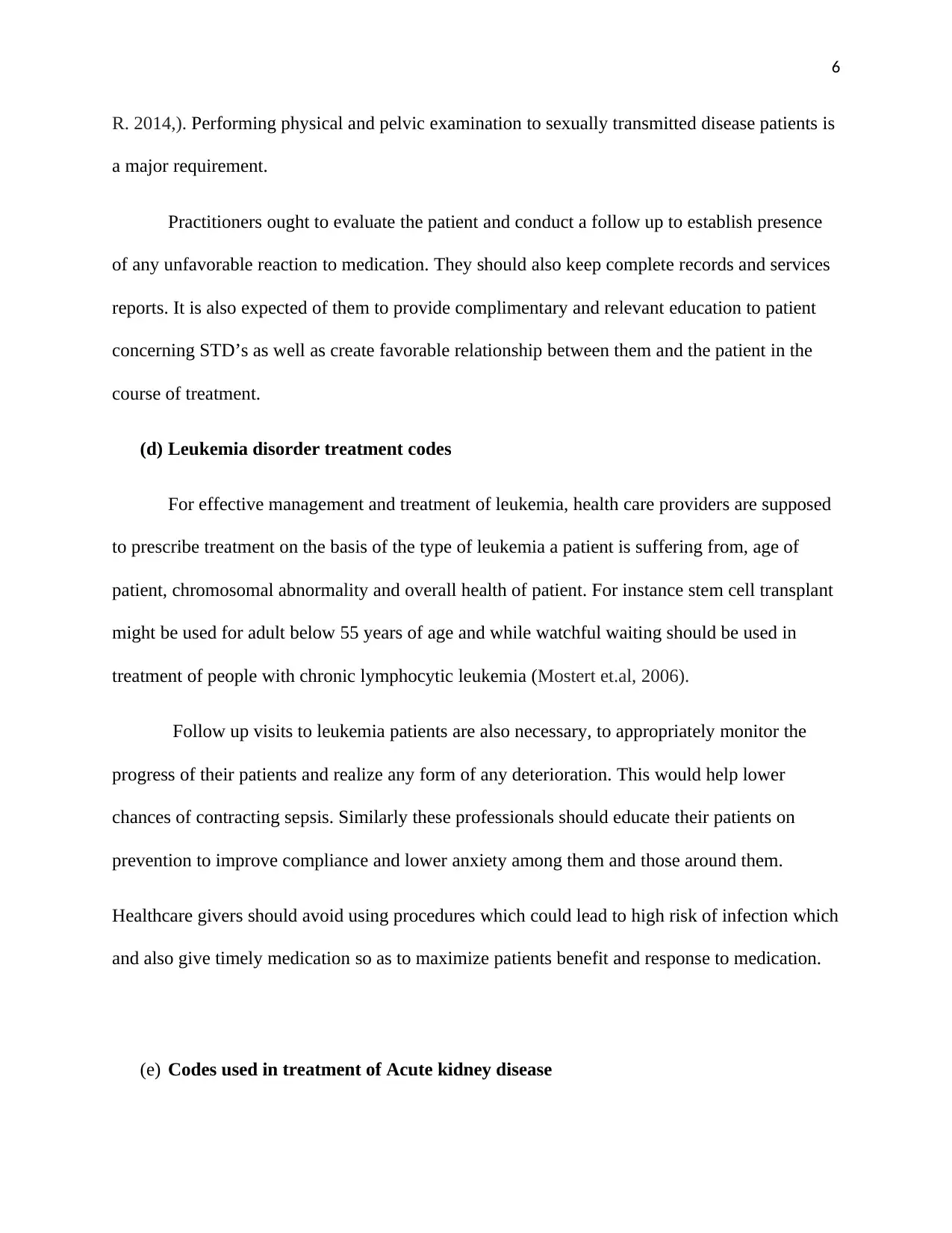
R. 2014,). Performing physical and pelvic examination to sexually transmitted disease patients is
a major requirement.
Practitioners ought to evaluate the patient and conduct a follow up to establish presence
of any unfavorable reaction to medication. They should also keep complete records and services
reports. It is also expected of them to provide complimentary and relevant education to patient
concerning STD’s as well as create favorable relationship between them and the patient in the
course of treatment.
(d) Leukemia disorder treatment codes
For effective management and treatment of leukemia, health care providers are supposed
to prescribe treatment on the basis of the type of leukemia a patient is suffering from, age of
patient, chromosomal abnormality and overall health of patient. For instance stem cell transplant
might be used for adult below 55 years of age and while watchful waiting should be used in
treatment of people with chronic lymphocytic leukemia (Mostert et.al, 2006).
Follow up visits to leukemia patients are also necessary, to appropriately monitor the
progress of their patients and realize any form of any deterioration. This would help lower
chances of contracting sepsis. Similarly these professionals should educate their patients on
prevention to improve compliance and lower anxiety among them and those around them.
Healthcare givers should avoid using procedures which could lead to high risk of infection which
and also give timely medication so as to maximize patients benefit and response to medication.
(e) Codes used in treatment of Acute kidney disease
R. 2014,). Performing physical and pelvic examination to sexually transmitted disease patients is
a major requirement.
Practitioners ought to evaluate the patient and conduct a follow up to establish presence
of any unfavorable reaction to medication. They should also keep complete records and services
reports. It is also expected of them to provide complimentary and relevant education to patient
concerning STD’s as well as create favorable relationship between them and the patient in the
course of treatment.
(d) Leukemia disorder treatment codes
For effective management and treatment of leukemia, health care providers are supposed
to prescribe treatment on the basis of the type of leukemia a patient is suffering from, age of
patient, chromosomal abnormality and overall health of patient. For instance stem cell transplant
might be used for adult below 55 years of age and while watchful waiting should be used in
treatment of people with chronic lymphocytic leukemia (Mostert et.al, 2006).
Follow up visits to leukemia patients are also necessary, to appropriately monitor the
progress of their patients and realize any form of any deterioration. This would help lower
chances of contracting sepsis. Similarly these professionals should educate their patients on
prevention to improve compliance and lower anxiety among them and those around them.
Healthcare givers should avoid using procedures which could lead to high risk of infection which
and also give timely medication so as to maximize patients benefit and response to medication.
(e) Codes used in treatment of Acute kidney disease
⊘ This is a preview!⊘
Do you want full access?
Subscribe today to unlock all pages.

Trusted by 1+ million students worldwide

7
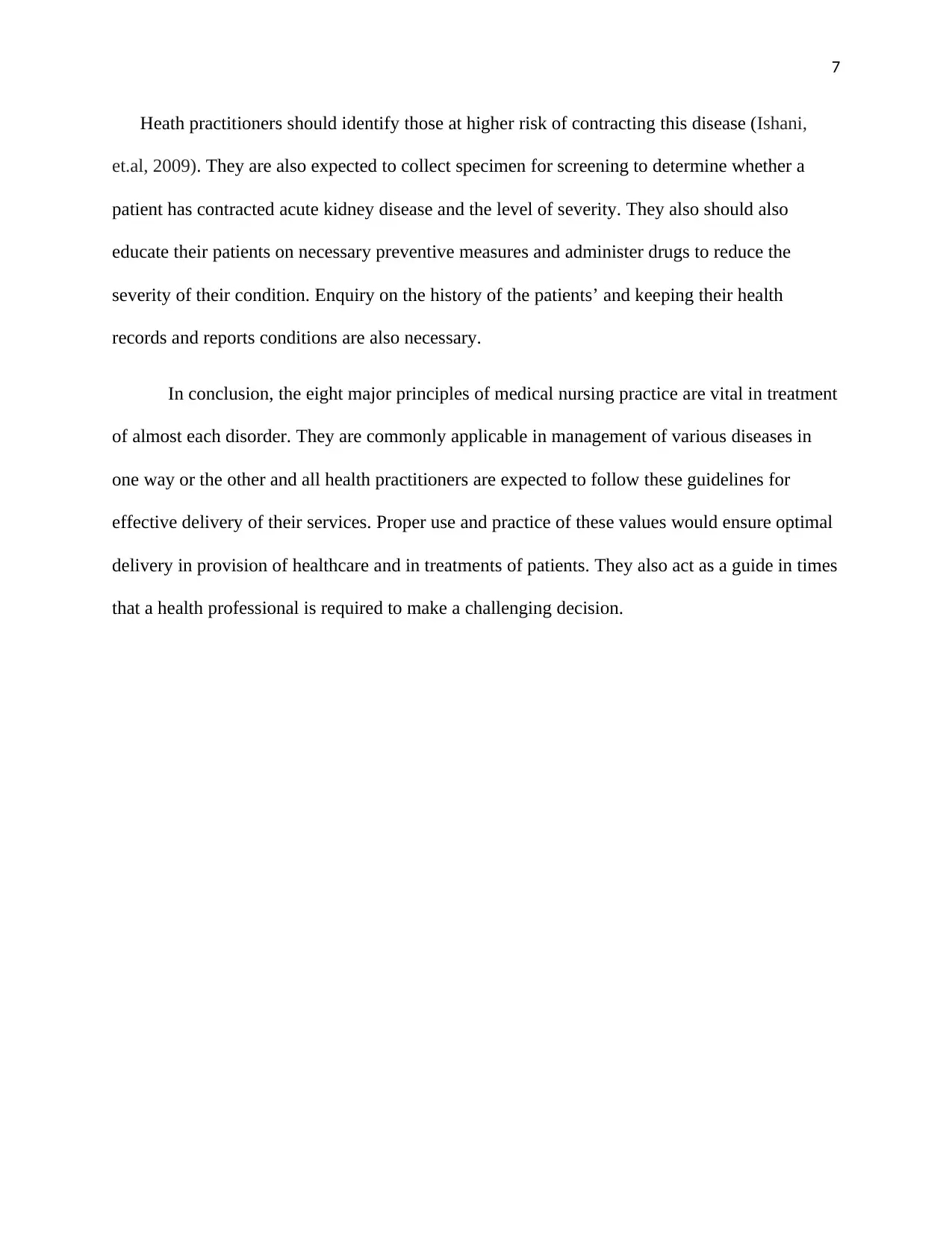
Heath practitioners should identify those at higher risk of contracting this disease (Ishani,
et.al, 2009). They are also expected to collect specimen for screening to determine whether a
patient has contracted acute kidney disease and the level of severity. They also should also
educate their patients on necessary preventive measures and administer drugs to reduce the
severity of their condition. Enquiry on the history of the patients’ and keeping their health
records and reports conditions are also necessary.
In conclusion, the eight major principles of medical nursing practice are vital in treatment
of almost each disorder. They are commonly applicable in management of various diseases in
one way or the other and all health practitioners are expected to follow these guidelines for
effective delivery of their services. Proper use and practice of these values would ensure optimal
delivery in provision of healthcare and in treatments of patients. They also act as a guide in times
that a health professional is required to make a challenging decision.
Heath practitioners should identify those at higher risk of contracting this disease (Ishani,
et.al, 2009). They are also expected to collect specimen for screening to determine whether a
patient has contracted acute kidney disease and the level of severity. They also should also
educate their patients on necessary preventive measures and administer drugs to reduce the
severity of their condition. Enquiry on the history of the patients’ and keeping their health
records and reports conditions are also necessary.
In conclusion, the eight major principles of medical nursing practice are vital in treatment
of almost each disorder. They are commonly applicable in management of various diseases in
one way or the other and all health practitioners are expected to follow these guidelines for
effective delivery of their services. Proper use and practice of these values would ensure optimal
delivery in provision of healthcare and in treatments of patients. They also act as a guide in times
that a health professional is required to make a challenging decision.
Paraphrase This Document
Need a fresh take? Get an instant paraphrase of this document with our AI Paraphraser

8
References
Alleyne, M., Horne, M. K., & Miller, J. L. (2008). Individualized treatment for iron-deficiency
anemia in adults. The American journal of medicine, 121(11), 943-948.
Anderson, E.T. and McFarlane, J.M., 2010. Community as partner: Theory and practice in
nursing. Lippincott Williams & Wilkins.
Breymann, C., Honegger, C., Holzgreve, W. and Surbek, D., 2010. Diagnosis and treatment of
iron-deficiency anaemia during pregnancy and postpartum. Archives of gynecology and
obstetrics, 282(5), pp.577-580. on-deficiency anemia in adults. The American journal of
medicine, 121(11), pp.943-948.
Hatcliff, J., King, A., Lee, I., Macdonald, A., Fernando, A., Robkin, M., Vasserman, E.,
Weininger, S. and Goldman, J.M., 2012, April. Rationale and architecture principles for medical
application platforms. In Proceedings of the 2012 IEEE/ACM Third International Conference on
Cyber-Physical Systems(pp. 3-12). IEEE Computer Society.
Ishani, A., Xue, J.L., Himmelfarb, J., Eggers, P.W., Kimmel, P.L., Molitoris, B.A. and Collins,
A.J., 2009. Acute kidney injury increases risk of ESRD among elderly. Journal of the American
Society of Nephrology, 20(1), pp.223-228.
References
Alleyne, M., Horne, M. K., & Miller, J. L. (2008). Individualized treatment for iron-deficiency
anemia in adults. The American journal of medicine, 121(11), 943-948.
Anderson, E.T. and McFarlane, J.M., 2010. Community as partner: Theory and practice in
nursing. Lippincott Williams & Wilkins.
Breymann, C., Honegger, C., Holzgreve, W. and Surbek, D., 2010. Diagnosis and treatment of
iron-deficiency anaemia during pregnancy and postpartum. Archives of gynecology and
obstetrics, 282(5), pp.577-580. on-deficiency anemia in adults. The American journal of
medicine, 121(11), pp.943-948.
Hatcliff, J., King, A., Lee, I., Macdonald, A., Fernando, A., Robkin, M., Vasserman, E.,
Weininger, S. and Goldman, J.M., 2012, April. Rationale and architecture principles for medical
application platforms. In Proceedings of the 2012 IEEE/ACM Third International Conference on
Cyber-Physical Systems(pp. 3-12). IEEE Computer Society.
Ishani, A., Xue, J.L., Himmelfarb, J., Eggers, P.W., Kimmel, P.L., Molitoris, B.A. and Collins,
A.J., 2009. Acute kidney injury increases risk of ESRD among elderly. Journal of the American
Society of Nephrology, 20(1), pp.223-228.

9
Kitson, A., Marshall, A., Bassett, K. and Zeitz, K., 2013. What are the core elements of patient‐
centred care? A narrative review and synthesis of the literature from health policy, medicine and
nursing. Journal of advanced nursing, 69(1), pp.4-15.
Levey, A.S., De Jong, P.E., Coresh, J., Nahas, M.E., Astor, B.C., Matsushita, K., Gansevoort,
R.T., Kasiske, B.L. and Eckardt, K.U., 2011. The definition, classification, and prognosis of
chronic kidney disease: a KDIGO Controversies Conference report. Kidney international, 80(1),
pp.17-28
McPhee, S.J., Papadakis, M.A. and Rabow, M.W. eds., 2010. Current medical diagnosis &
treatment 2010. New York:: McGraw-Hill Medical.
MMWR, R. (2014). Sexually Transmitted Diseases Treatment Guidelines, 2015. MMWR
Supplements, 64(1).
Mostert, S., Sitaresmi, M.N., Gundy, C.M. and Veerman, A.J., 2006. Influence of socioeconomic
status on childhood acute lymphoblastic leukemia treatment in Indonesia. Pediatrics, 118(6),
pp.e1600-e1606.
Potter, P.A., Perry, A.G., Stockert, P. and Hall, A., 2016. Fundamentals of Nursing-E-Book.
Elsevier Health Sciences.Perry, A.G. ed., 2011. Basic nursing. Mosby Elsevier.
Kitson, A., Marshall, A., Bassett, K. and Zeitz, K., 2013. What are the core elements of patient‐
centred care? A narrative review and synthesis of the literature from health policy, medicine and
nursing. Journal of advanced nursing, 69(1), pp.4-15.
Levey, A.S., De Jong, P.E., Coresh, J., Nahas, M.E., Astor, B.C., Matsushita, K., Gansevoort,
R.T., Kasiske, B.L. and Eckardt, K.U., 2011. The definition, classification, and prognosis of
chronic kidney disease: a KDIGO Controversies Conference report. Kidney international, 80(1),
pp.17-28
McPhee, S.J., Papadakis, M.A. and Rabow, M.W. eds., 2010. Current medical diagnosis &
treatment 2010. New York:: McGraw-Hill Medical.
MMWR, R. (2014). Sexually Transmitted Diseases Treatment Guidelines, 2015. MMWR
Supplements, 64(1).
Mostert, S., Sitaresmi, M.N., Gundy, C.M. and Veerman, A.J., 2006. Influence of socioeconomic
status on childhood acute lymphoblastic leukemia treatment in Indonesia. Pediatrics, 118(6),
pp.e1600-e1606.
Potter, P.A., Perry, A.G., Stockert, P. and Hall, A., 2016. Fundamentals of Nursing-E-Book.
Elsevier Health Sciences.Perry, A.G. ed., 2011. Basic nursing. Mosby Elsevier.
⊘ This is a preview!⊘
Do you want full access?
Subscribe today to unlock all pages.

Trusted by 1+ million students worldwide
1 out of 9
Related Documents
Your All-in-One AI-Powered Toolkit for Academic Success.
+13062052269
info@desklib.com
Available 24*7 on WhatsApp / Email
Unlock your academic potential
Copyright © 2020–2026 A2Z Services. All Rights Reserved. Developed and managed by ZUCOL.