Medication Errors and Distraction: A Nursing Presentation

Verified

Added on  2022/09/28

|3
|709
|20
Presentation
AI Summary
This presentation addresses the critical issue of medication errors stemming from distractions within the nursing environment. It begins with an overview of the problem, emphasizing the significance of distraction as a primary cause of such errors, and highlights the importance of understanding consequences and implementing preventative measures. The presentation delves into the background, noting the frequent interruptions nurses face during medication verification and administration, and the limited impact of current interventions. It then outlines objectives, focusing on high-risk areas like emergency departments, and discusses the impact of distractions on nurses, while providing potential solutions. The presentation underscores the importance of nurses having complete patient and drug information, and maintaining open communication. Finally, it concludes with recommendations for mitigating distractions, including establishing no-interruption zones, staff education, and system improvements, while also emphasizing the need for further research to ensure these practices effectively reduce errors. The presentation draws on evidence-based literature to support its claims.
Document Page
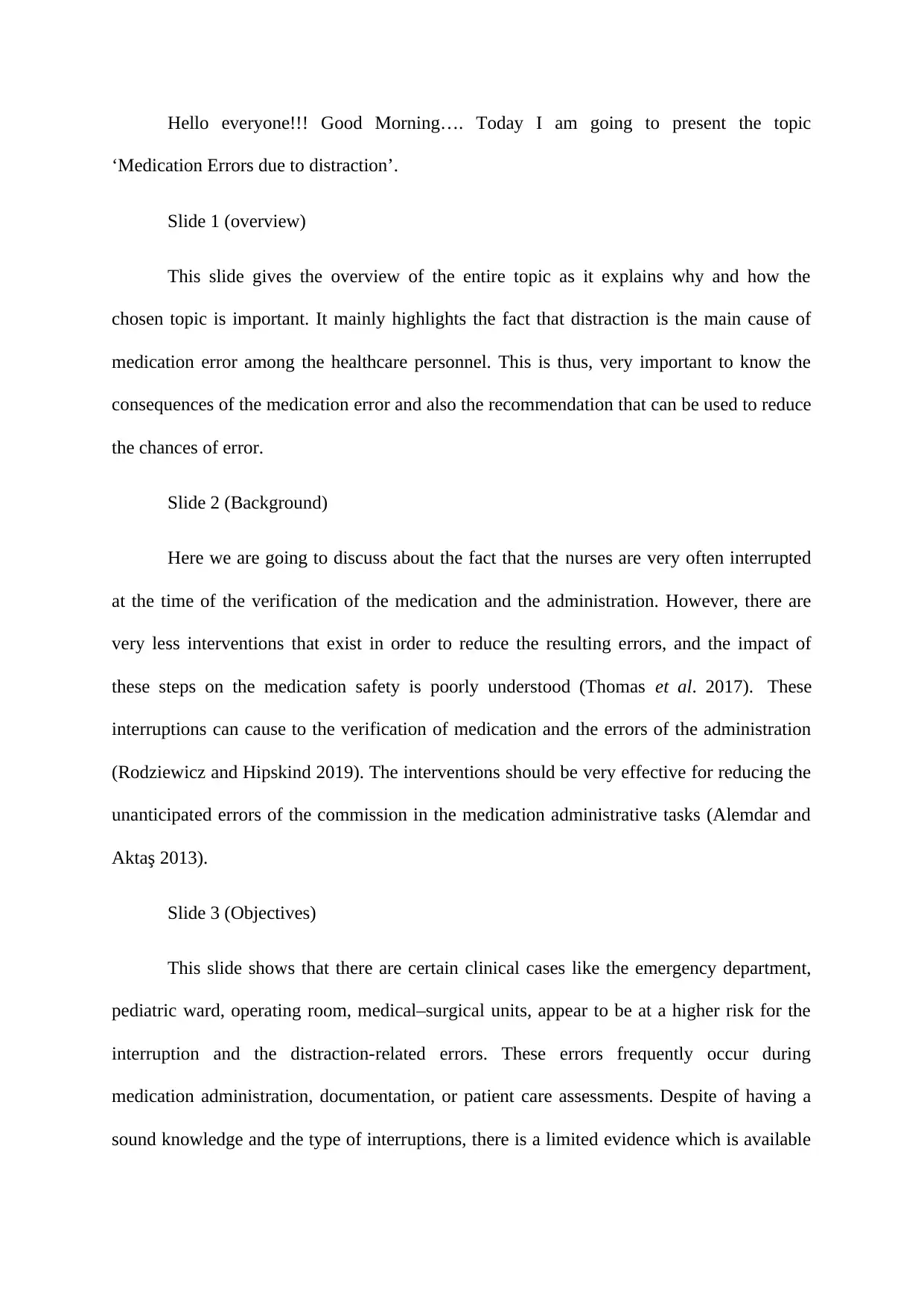
Hello everyone!!! Good Morning…. Today I am going to present the topic
‘Medication Errors due to distraction’.
Slide 1 (overview)
This slide gives the overview of the entire topic as it explains why and how the
chosen topic is important. It mainly highlights the fact that distraction is the main cause of
medication error among the healthcare personnel. This is thus, very important to know the
consequences of the medication error and also the recommendation that can be used to reduce
the chances of error.
Slide 2 (Background)
Here we are going to discuss about the fact that the nurses are very often interrupted
at the time of the verification of the medication and the administration. However, there are
very less interventions that exist in order to reduce the resulting errors, and the impact of
these steps on the medication safety is poorly understood (Thomas et al. 2017). These
interruptions can cause to the verification of medication and the errors of the administration
(Rodziewicz and Hipskind 2019). The interventions should be very effective for reducing the
unanticipated errors of the commission in the medication administrative tasks (Alemdar and
Aktaş 2013).
Slide 3 (Objectives)
This slide shows that there are certain clinical cases like the emergency department,
pediatric ward, operating room, medical–surgical units, appear to be at a higher risk for the
interruption and the distraction-related errors. These errors frequently occur during
medication administration, documentation, or patient care assessments. Despite of having a
sound knowledge and the type of interruptions, there is a limited evidence which is available
tabler-icon-diamond-filled.svg

Paraphrase This Document

Need a fresh take? Get an instant paraphrase of this document with our AI Paraphraser
Document Page
to escort the efforts that are designed to lower the effects of medication errors (Jothiraj et al.
2013; McBride and LeVasseur 2017).
Slide 3 (Outline of topic)
In this slide the physician who is very mindful about the adverse impact caused due to
the distractions and interruptions might react with focus, increasing attention, and the
concentration on his or her workplace environment. The medication verification task consists
of checking all the five rules of medication administration. The factors that affect the work of
the nurse are the most common reason for the medical errors (Mentis et al. 2017).
Slide 4 (Impact on nurses)
The nurses may not have the capability to interfere with the infrastructure of the
organization in order to deal with the medication error, however they can do a lot of things in
order to deal with the medication error. The steps that can be taken by the nurses are having
the complete information about the patient and the drug that is being given to them. The
nurses should keep the lines of communication open and that should be a very open in order
to reduce the effects of medication error. The higher the chances of medication error the more
are the chances of negative patient outcome that affects the efficacy of the nurses (Mentis et
al. 2017).
Slide 5 (Conclusion)
Thus finally we can conclude that here are certain steps that can be included in order to solve
the problem of noises that involves (i) ensuring do-not-disturb approach (ii) the establishment
of a no interruption zone (NIZ); (iii) determining the time that is best for necessary
interruptions; (iv) providing staff education; (v) creating the checklists; (vi) managing the
mobile devices; (vii) gathering all supplies prior to the prescribing, preparation, or
administering medication; (viii) making system improvements. Although each of these
Document Page
practices has the substantial face validity, it is important to study them, individually as well
as collectively, in order to ensure that they actually do reduce the frequency and severity of
all the medication errors without the negative unanticipated consequences (Thomas et al.
2015; Williams and Drew 2017).
chevron_up_icon
1 out of 3
circle_padding
hide_on_mobile
zoom_out_icon
[object Object]