The Role of Trade in Shaping Medieval Africa: Sahara and Indian Ocean

Verified

Added on  2023/04/21

|5
|844
|463
Essay
AI Summary
This essay examines the crucial role of trade in Medieval Africa, specifically focusing on the trans-Saharan routes and the Indian Ocean trade networks. It discusses how the growth of trade, particularly in commodities like gold, salt, and slaves, influenced the economic conditions of empires such as Ghana and Mali. The essay highlights the importance of trade centers like Timbuktu and the use of camel caravans for traversing the Sahara. Furthermore, it explores the trade relationships between East African city-states and Asian merchants via the Indian Ocean, emphasizing the exchange of goods like silk, cotton, and porcelain. The analysis concludes that trade was essential for Africa's participation in the global economy, fostering economic development and civilization growth.

Document Page
Running head: MEDIEVAL WORLD HISTORY
Medieval World History
Name of the Student
Name of the Student
Author Note
tabler-icon-diamond-filled.svg

Paraphrase This Document

Need a fresh take? Get an instant paraphrase of this document with our AI Paraphraser
Document Page
1MEDIEVAL WORLD HISTORY
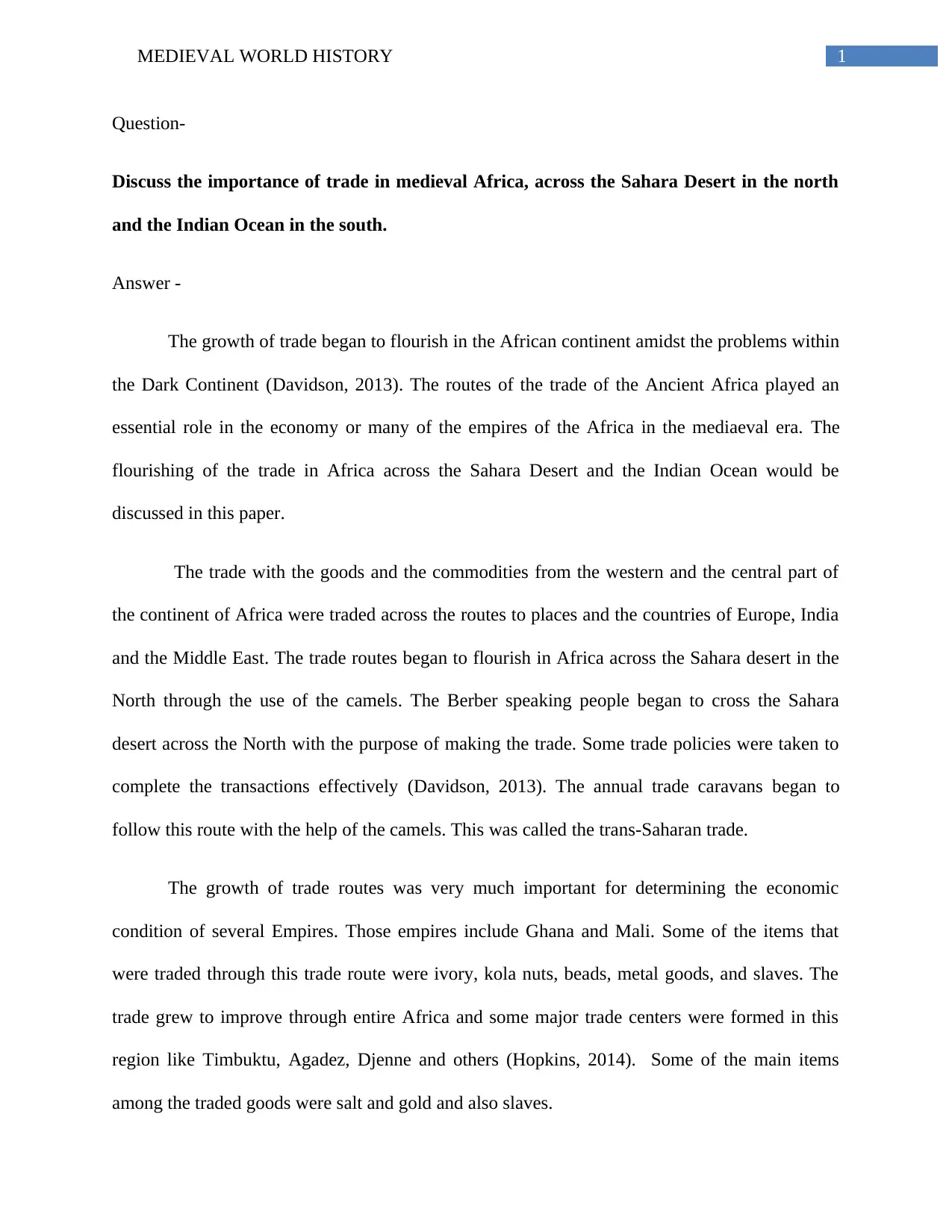
Question-
Discuss the importance of trade in medieval Africa, across the Sahara Desert in the north
and the Indian Ocean in the south.
Answer -
The growth of trade began to flourish in the African continent amidst the problems within
the Dark Continent (Davidson, 2013). The routes of the trade of the Ancient Africa played an
essential role in the economy or many of the empires of the Africa in the mediaeval era. The
flourishing of the trade in Africa across the Sahara Desert and the Indian Ocean would be
discussed in this paper.
The trade with the goods and the commodities from the western and the central part of
the continent of Africa were traded across the routes to places and the countries of Europe, India
and the Middle East. The trade routes began to flourish in Africa across the Sahara desert in the
North through the use of the camels. The Berber speaking people began to cross the Sahara
desert across the North with the purpose of making the trade. Some trade policies were taken to
complete the transactions effectively (Davidson, 2013). The annual trade caravans began to
follow this route with the help of the camels. This was called the trans-Saharan trade.
The growth of trade routes was very much important for determining the economic
condition of several Empires. Those empires include Ghana and Mali. Some of the items that
were traded through this trade route were ivory, kola nuts, beads, metal goods, and slaves. The
trade grew to improve through entire Africa and some major trade centers were formed in this
region like Timbuktu, Agadez, Djenne and others (Hopkins, 2014). Some of the main items
among the traded goods were salt and gold and also slaves.
Document Page
2MEDIEVAL WORLD HISTORY
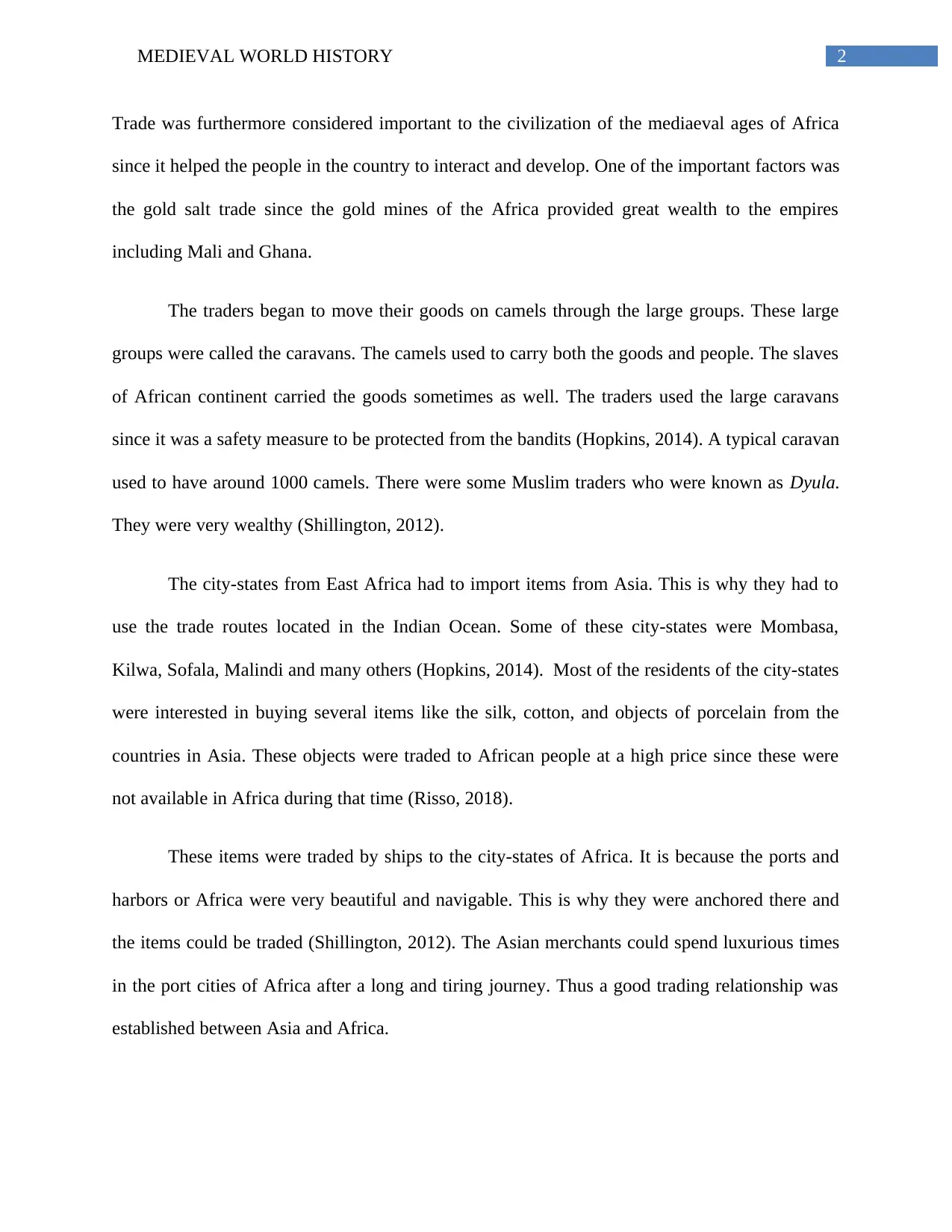
Trade was furthermore considered important to the civilization of the mediaeval ages of Africa
since it helped the people in the country to interact and develop. One of the important factors was
the gold salt trade since the gold mines of the Africa provided great wealth to the empires
including Mali and Ghana.
The traders began to move their goods on camels through the large groups. These large
groups were called the caravans. The camels used to carry both the goods and people. The slaves
of African continent carried the goods sometimes as well. The traders used the large caravans
since it was a safety measure to be protected from the bandits (Hopkins, 2014). A typical caravan
used to have around 1000 camels. There were some Muslim traders who were known as Dyula.
They were very wealthy (Shillington, 2012).
The city-states from East Africa had to import items from Asia. This is why they had to
use the trade routes located in the Indian Ocean. Some of these city-states were Mombasa,
Kilwa, Sofala, Malindi and many others (Hopkins, 2014). Most of the residents of the city-states
were interested in buying several items like the silk, cotton, and objects of porcelain from the
countries in Asia. These objects were traded to African people at a high price since these were
not available in Africa during that time (Risso, 2018).
These items were traded by ships to the city-states of Africa. It is because the ports and
harbors or Africa were very beautiful and navigable. This is why they were anchored there and
the items could be traded (Shillington, 2012). The Asian merchants could spend luxurious times
in the port cities of Africa after a long and tiring journey. Thus a good trading relationship was
established between Asia and Africa.
Document Page
3MEDIEVAL WORLD HISTORY
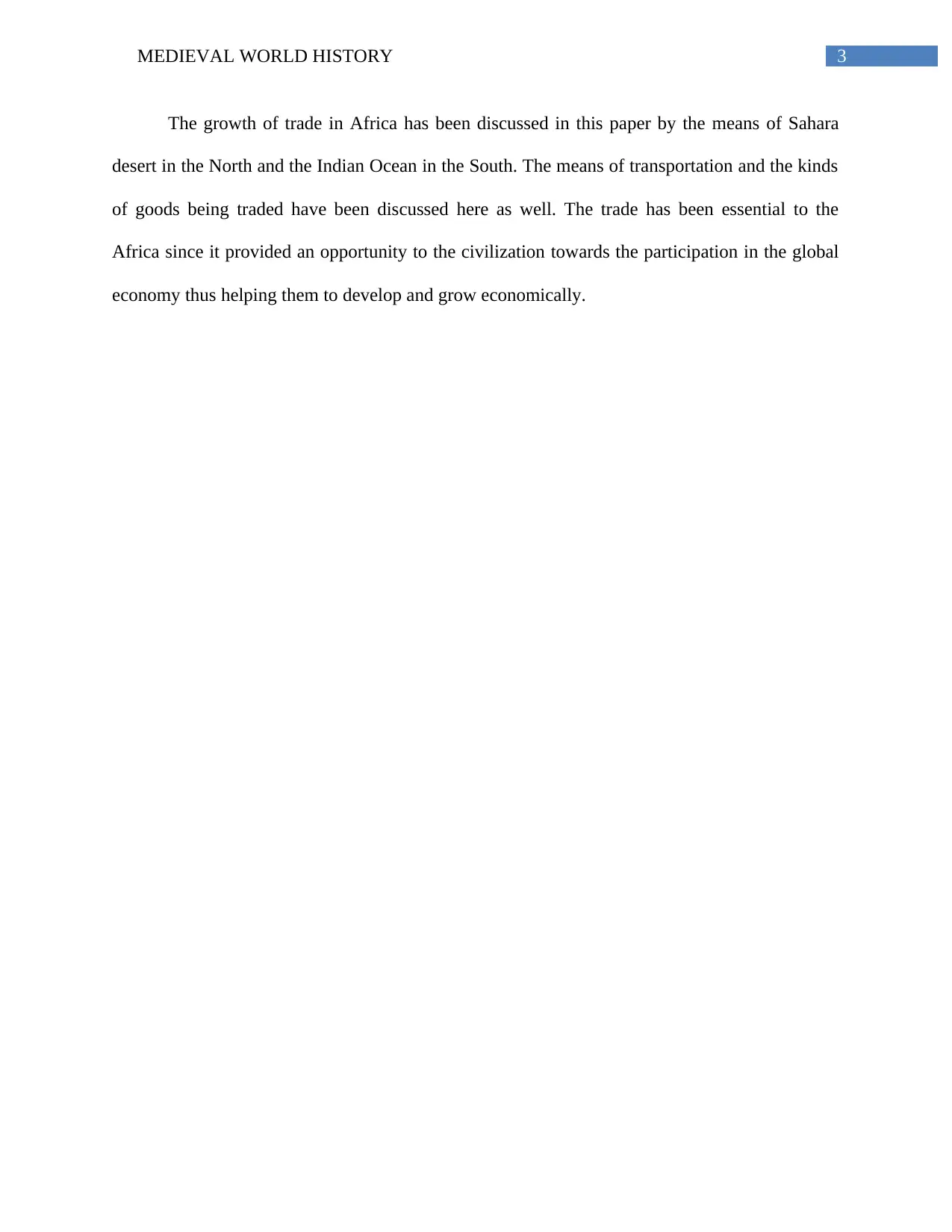
The growth of trade in Africa has been discussed in this paper by the means of Sahara
desert in the North and the Indian Ocean in the South. The means of transportation and the kinds
of goods being traded have been discussed here as well. The trade has been essential to the
Africa since it provided an opportunity to the civilization towards the participation in the global
economy thus helping them to develop and grow economically.
tabler-icon-diamond-filled.svg

Paraphrase This Document

Need a fresh take? Get an instant paraphrase of this document with our AI Paraphraser
Document Page
4MEDIEVAL WORLD HISTORY
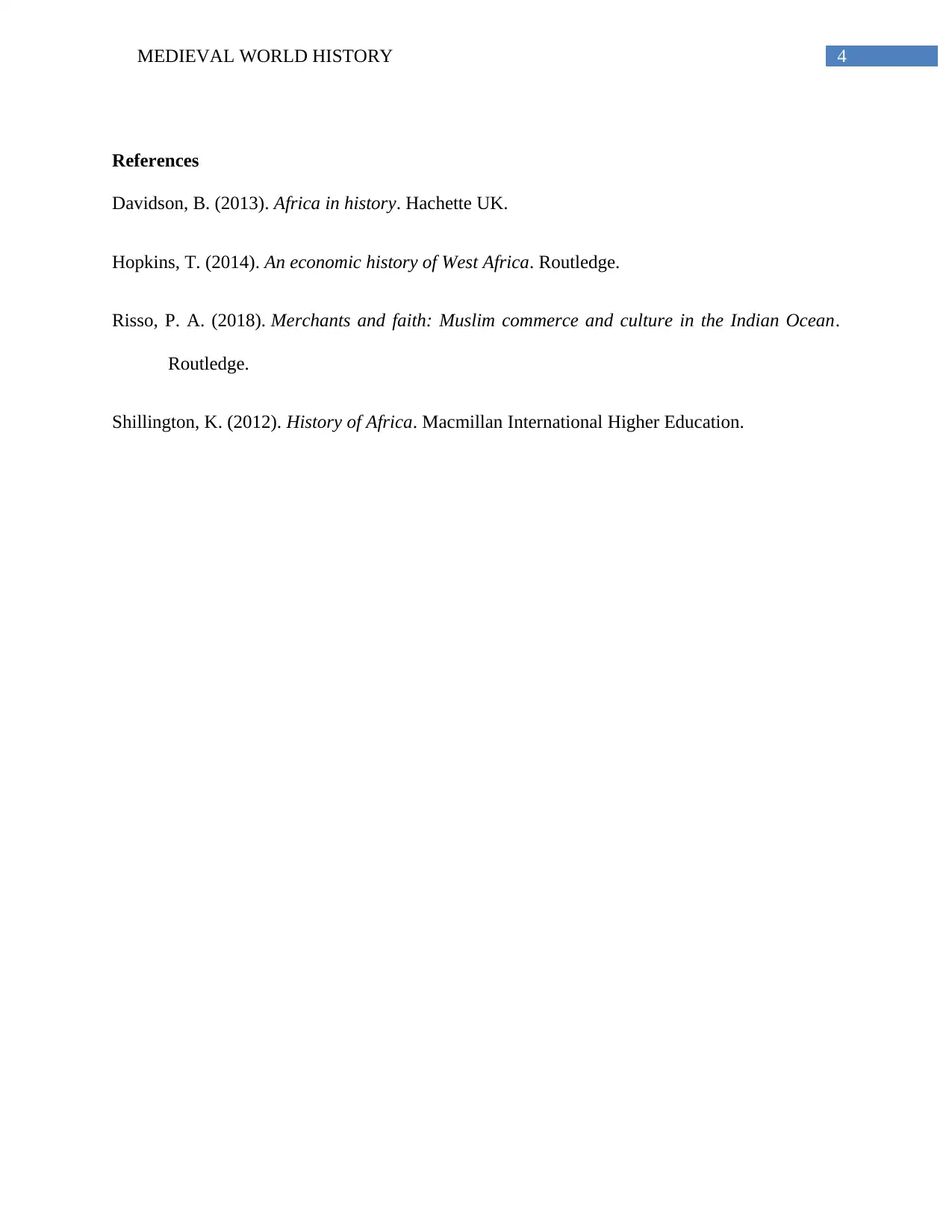
References
Davidson, B. (2013). Africa in history. Hachette UK.
Hopkins, T. (2014). An economic history of West Africa. Routledge.
Risso, P. A. (2018). Merchants and faith: Muslim commerce and culture in the Indian Ocean.
Routledge.
Shillington, K. (2012). History of Africa. Macmillan International Higher Education.
chevron_up_icon
1 out of 5
circle_padding
hide_on_mobile
zoom_out_icon
[object Object]