EPM5500 Assignment: Long-Term Infrastructure Plan for Melbourne City

Verified

Added on  2023/01/18

|11
|1904
|85
Project
AI Summary
This project charter outlines a comprehensive plan for managing changes and planning long-term infrastructure for Melbourne City. It addresses the city's future in 2026, considering potential risks, financial support, and high-level requirements. The charter includes an executive summary, table of contents, and detailed sections on project purpose, description, boundaries, requirements, assumptions, risks, objectives, milestones, financial resources, stakeholders, and exit criteria. It also defines the roles and responsibilities of the project manager and sponsor. The project aims to guide governmental policy, create a competitive and sustainable city, and identify strategies for achieving desired outcomes. The financial resources include significant investments in metro tunnels, regional rail, school infrastructure, and other key projects. The project's stakeholders encompass a skilled workforce and various governmental entities. The conclusion emphasizes the complexity of Melbourne's infrastructure and the government's commitment to shaping its future through community involvement and long-term planning. The document is supported by a bibliography of relevant academic sources.
Document Page
Running head: PLAN INFRASTRUCTURE FOR A LONG TERM
City Managing Changes: Plan infrastructure for a long term
Name of the student:
Name of the University:
tabler-icon-diamond-filled.svg

Paraphrase This Document

Need a fresh take? Get an instant paraphrase of this document with our AI Paraphraser
Document Page
1PLAN INFRASTRUCTURE FOR A LONG TERM
Executive summary
Professional project management planning and practices are referred to as very crucial and
important actions needed for the successful delivery and implementation of any project. The
project that has been nominated here is planning infrastructure for long term for managing the
changes in Melbourne city. The potential risks, financial support, high level requirements
considered for this project are elaborate in this charter.
Document Page
2PLAN INFRASTRUCTURE FOR A LONG TERM
Table of Contents
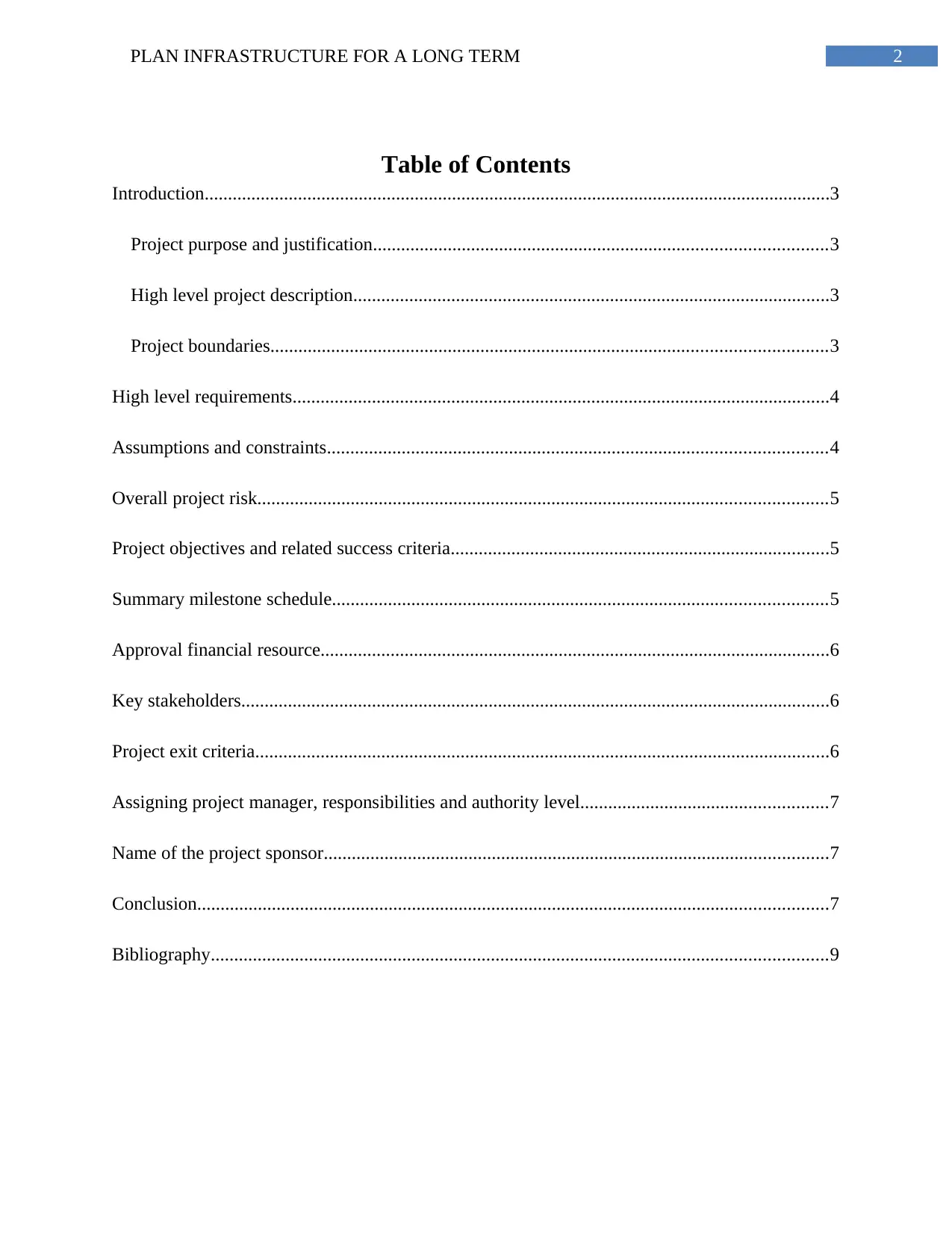
Introduction......................................................................................................................................3
Project purpose and justification.................................................................................................3
High level project description......................................................................................................3
Project boundaries.......................................................................................................................3
High level requirements...................................................................................................................4
Assumptions and constraints...........................................................................................................4
Overall project risk..........................................................................................................................5
Project objectives and related success criteria.................................................................................5
Summary milestone schedule..........................................................................................................5
Approval financial resource.............................................................................................................6
Key stakeholders..............................................................................................................................6
Project exit criteria...........................................................................................................................6
Assigning project manager, responsibilities and authority level.....................................................7
Name of the project sponsor............................................................................................................7
Conclusion.......................................................................................................................................7
Bibliography....................................................................................................................................9
Document Page
3PLAN INFRASTRUCTURE FOR A LONG TERM
Introduction
Project purpose and justification
These days due to lack of governmental operation and functionality prospect
consideration the Melbourne city’s future has fall under risk. The city of Melbourne is willing to
act as a sponsor for future Melbourne in 2025. The City would like to acknowledge all the
individual and organizations that has high level contribution to refresh the Melbourne city
Future. The city is interested to acknowledge for the contribution and dedication of the future
Melbourne 2026 Ambassadors and members of the citizen’s jury for the collaboration to develop
this plan for the coming decades of the Melbourne city.
High level project description
In order to design and develop long term success for Melbourne city the Melbourne
Government is required to take potential responsibilities to develop the long term plan for the
project. Metropolitan planning strategies are to be undertaken by the government to meet the
project goal city managing changes considering the priority plan infrastructure for the long term.
High level project justification, assumptions, and constraints, financial resources, project risk,
milestone schedules for this project are elaborated in this charter.
Project boundaries
The City of Melbourne’s future has successfully guided all operational aspects of the city
liveability, prosperity and development. Few numbers of comments were made regarding the
limiting urban sprawl for preserving valuable food growing land. On the other hand, some citizen
has suggested that the city must extend to the Port Philip Bay as it can successfully offer a much
better project outcome. The metropolitan planning strategies are lagging some major
tabler-icon-diamond-filled.svg

Paraphrase This Document

Need a fresh take? Get an instant paraphrase of this document with our AI Paraphraser
Document Page
4PLAN INFRASTRUCTURE FOR A LONG TERM
perspectives. The risks and properly assumed and the project cost is also not accurately. Lack of
partnership from the local government is the other major boundary estimated for the project.
High level requirements
The contaminated land of the Melbourne city needs remediation. Proper remediation and
treatment are needed to improve the process of remediating and accessing the contaminated sites
to reduce the rate of risks and uncertainty of requirements and bring back the land to a marker
sooner.
The other requirement is to develop a tourism infrastructure for city commercial growth
and long term success. The land usage should be identified and for growing the tourism market
infrastructure requirements are mandatory. In addition to this the other necessary aspect is proper
delivery timeline and location selection. The tourist destination needs to ne strengthen by
capitalizing the existing strategies of current central Melbourne future tourism. The other
requirements needed for the Melbourne city future development include climate change
requirements, green star community requirements, buffer requirements fir sewerage and water.
Assumptions and constraints
For this project triple project constraints have been considered in terms of time, budget
and scope. In order to prepare a long terms future success plan for Melbourne City the
Government has identified certain high level requirements. The net budget estimated for the
implementation of the project is $236.90 Million (excluding transportation- metro rail, regional
rail transport, tourism etc).
Document Page
5PLAN INFRASTRUCTURE FOR A LONG TERM
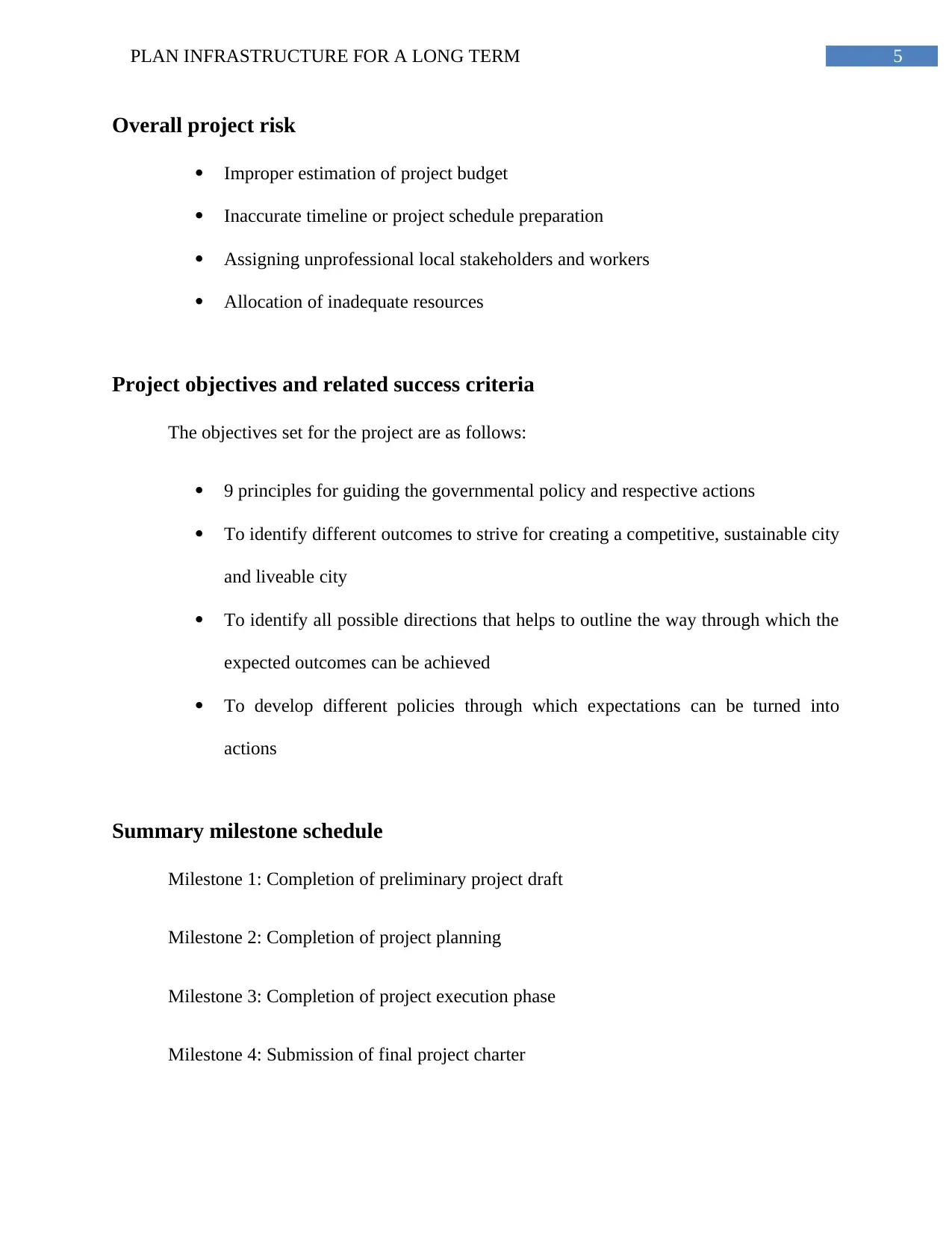
Overall project risk
Improper estimation of project budget
Inaccurate timeline or project schedule preparation
Assigning unprofessional local stakeholders and workers
Allocation of inadequate resources
Project objectives and related success criteria
The objectives set for the project are as follows:
9 principles for guiding the governmental policy and respective actions
To identify different outcomes to strive for creating a competitive, sustainable city
and liveable city
To identify all possible directions that helps to outline the way through which the
expected outcomes can be achieved
To develop different policies through which expectations can be turned into
actions
Summary milestone schedule
Milestone 1: Completion of preliminary project draft
Milestone 2: Completion of project planning
Milestone 3: Completion of project execution phase
Milestone 4: Submission of final project charter
Document Page
6PLAN INFRASTRUCTURE FOR A LONG TERM
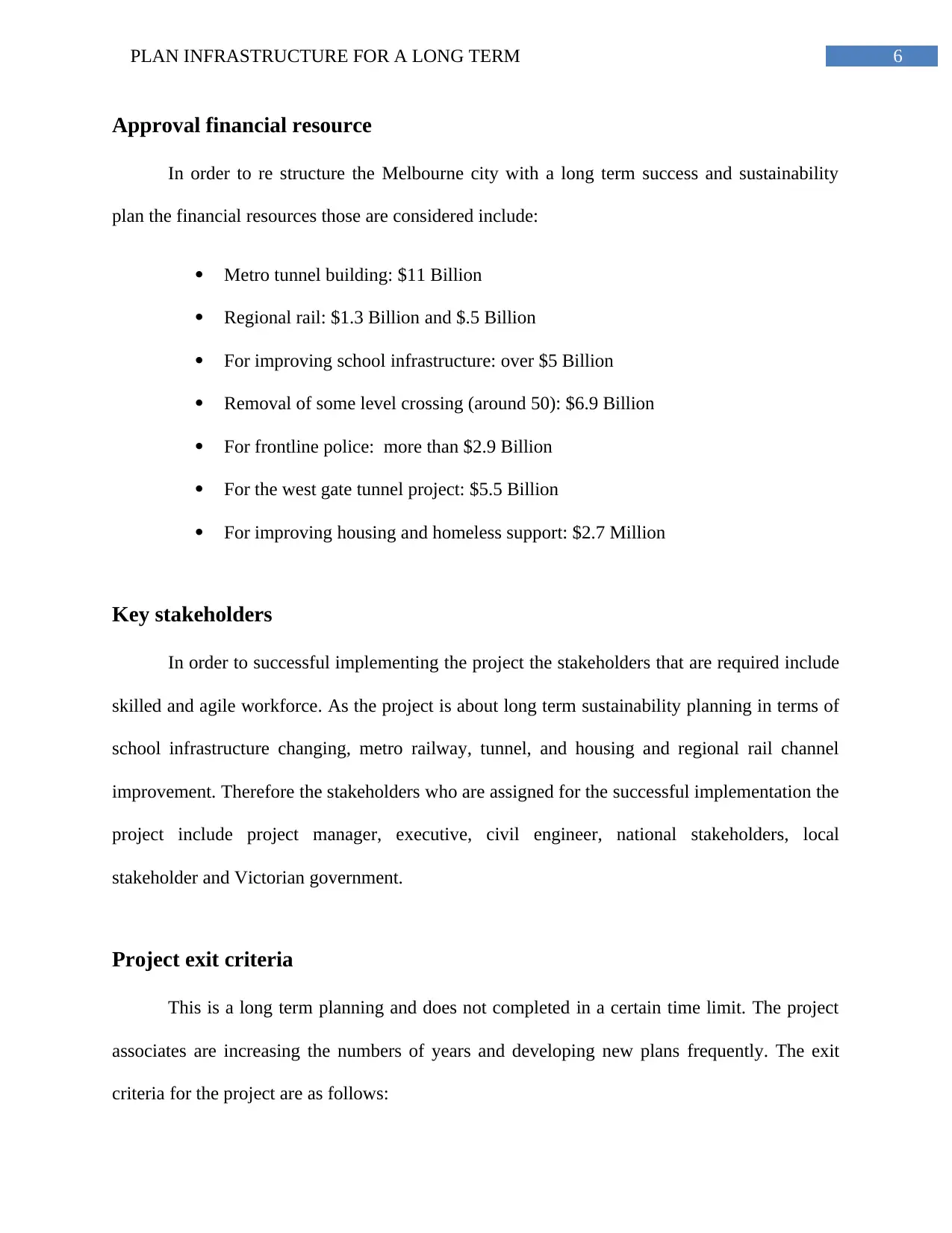
Approval financial resource
In order to re structure the Melbourne city with a long term success and sustainability
plan the financial resources those are considered include:
Metro tunnel building: $11 Billion
Regional rail: $1.3 Billion and $.5 Billion
For improving school infrastructure: over $5 Billion
Removal of some level crossing (around 50): $6.9 Billion
For frontline police: more than $2.9 Billion
For the west gate tunnel project: $5.5 Billion
For improving housing and homeless support: $2.7 Million
Key stakeholders
In order to successful implementing the project the stakeholders that are required include
skilled and agile workforce. As the project is about long term sustainability planning in terms of
school infrastructure changing, metro railway, tunnel, and housing and regional rail channel
improvement. Therefore the stakeholders who are assigned for the successful implementation the
project include project manager, executive, civil engineer, national stakeholders, local
stakeholder and Victorian government.
Project exit criteria
This is a long term planning and does not completed in a certain time limit. The project
associates are increasing the numbers of years and developing new plans frequently. The exit
criteria for the project are as follows:
tabler-icon-diamond-filled.svg

Paraphrase This Document

Need a fresh take? Get an instant paraphrase of this document with our AI Paraphraser
Document Page
7PLAN INFRASTRUCTURE FOR A LONG TERM
Accurate corrective actions to make sure that all the necessary changes can be
processed
Timely update and process the completion
Continuous improvement plan \proper change management program
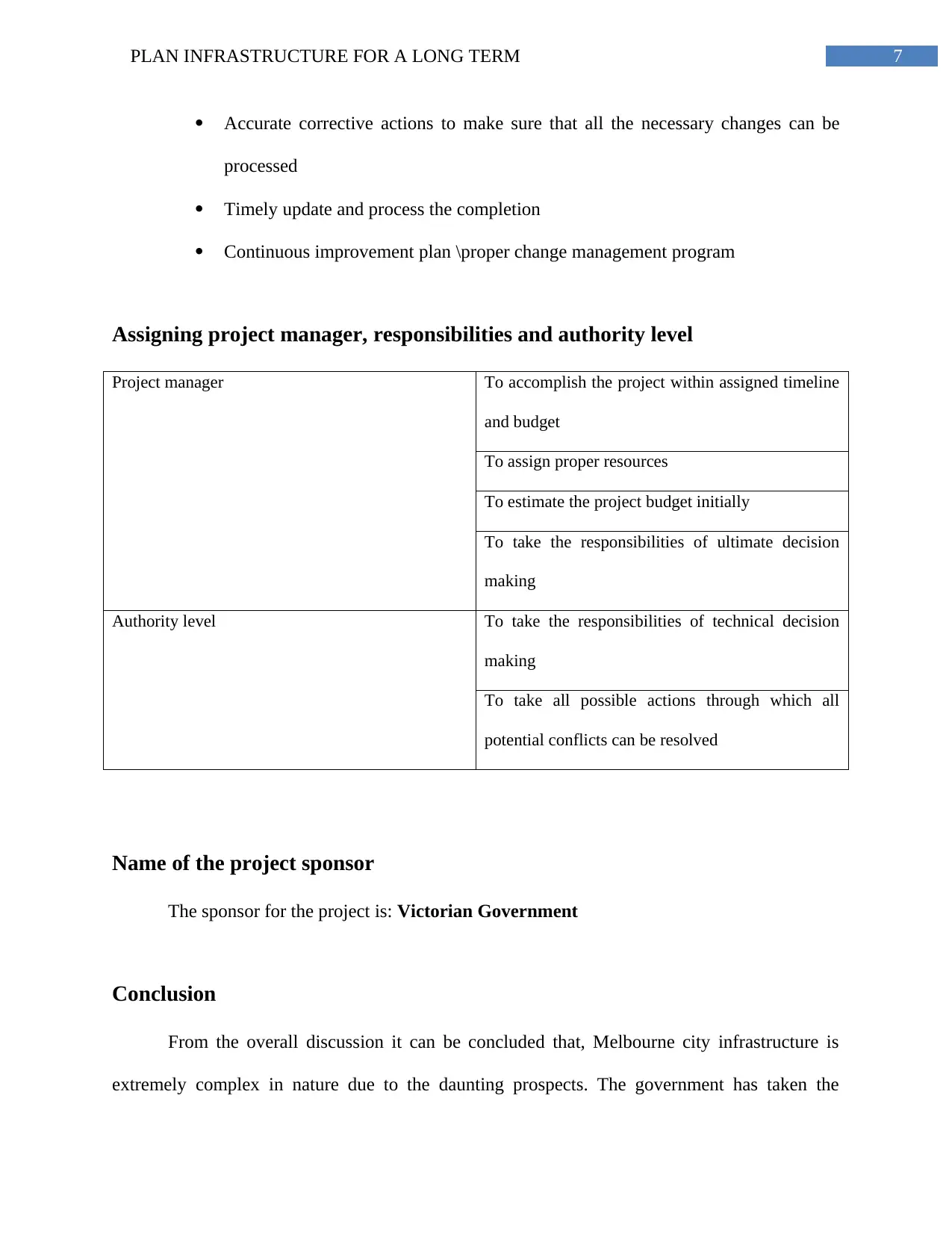
Assigning project manager, responsibilities and authority level
Project manager To accomplish the project within assigned timeline
and budget
To assign proper resources
To estimate the project budget initially
To take the responsibilities of ultimate decision
making
Authority level To take the responsibilities of technical decision
making
To take all possible actions through which all
potential conflicts can be resolved
Name of the project sponsor
The sponsor for the project is: Victorian Government
Conclusion
From the overall discussion it can be concluded that, Melbourne city infrastructure is
extremely complex in nature due to the daunting prospects. The government has taken the
Document Page
8PLAN INFRASTRUCTURE FOR A LONG TERM
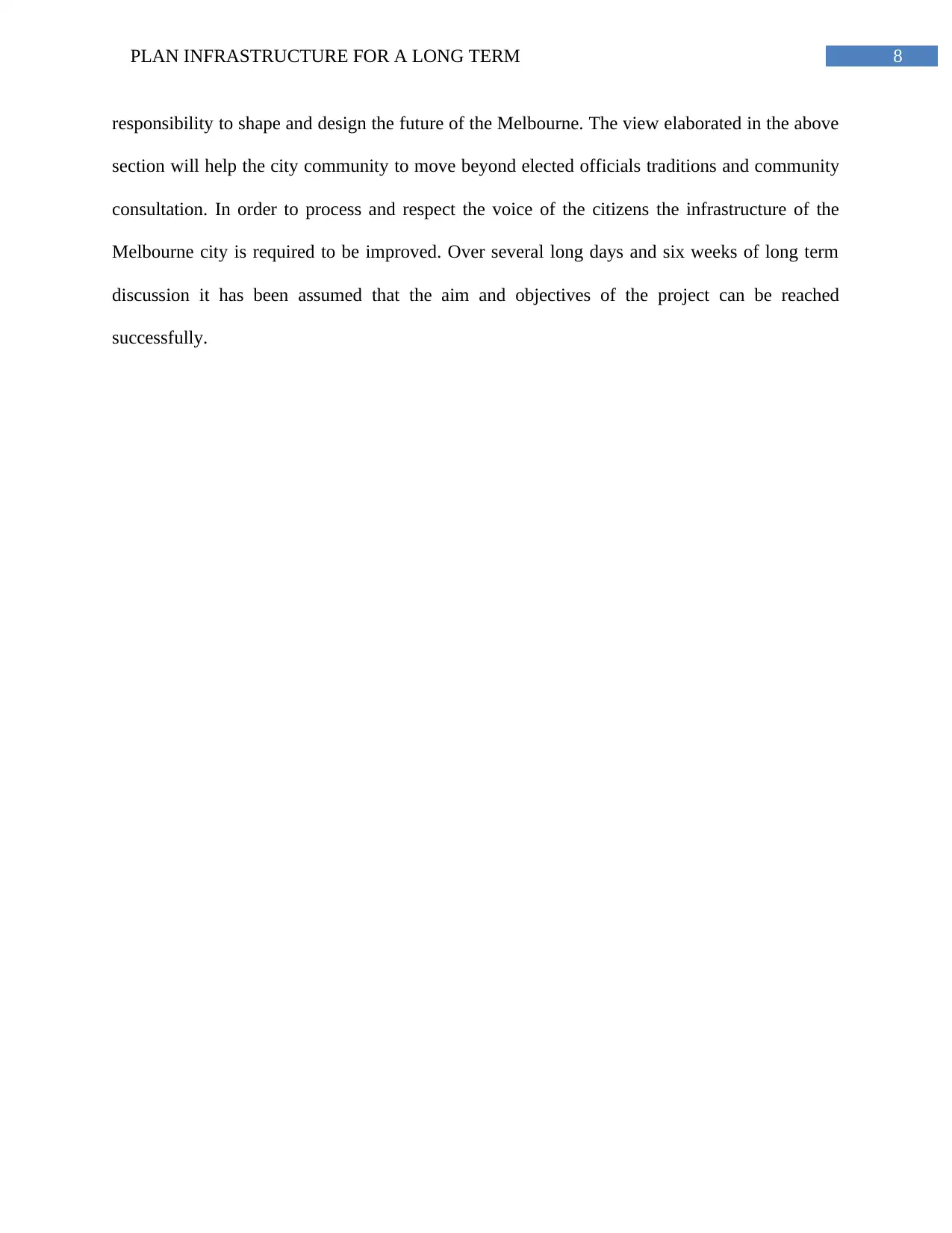
responsibility to shape and design the future of the Melbourne. The view elaborated in the above
section will help the city community to move beyond elected officials traditions and community
consultation. In order to process and respect the voice of the citizens the infrastructure of the
Melbourne city is required to be improved. Over several long days and six weeks of long term
discussion it has been assumed that the aim and objectives of the project can be reached
successfully.
Document Page
9PLAN INFRASTRUCTURE FOR A LONG TERM
Bibliography
Ajmal, M., Helo, P. and Kekäle, T., 2010. Critical factors for knowledge management in project
business. Journal of knowledge management, 14(1), pp.156-168.
Blomquist, T., Hällgren, M., Nilsson, A. and Söderholm, A., 2010. Projectaspractice: In search
of project management research that matters. Project management journal, 41(1), pp.5-16.
De Bakker, K., Boonstra, A. and Wortmann, H., 2010. Does risk management contribute to IT
project success? A meta-analysis of empirical evidence. International Journal of Project
Management, 28(5), pp.493-503.
Demir, C. and Kocabaş, İ., 2010. Project management maturity model (PMMM) in educational
organizations. Procedia-Social and Behavioral Sciences, 9, pp.1641-1645.
Goddard, M.A., Dougill, A.J. and Benton, T.G., 2010. Scaling up from gardens: biodiversity
conservation in urban environments. Trends in ecology & evolution, 25(2), pp.90-98.
Hodson, M. and Marvin, S., 2010. Can cities shape socio-technical transitions and how would we
know if they were?. Research policy, 39(4), pp.477-485.
Jin, J., Gubbi, J., Marusic, S. and Palaniswami, M., 2010. An information framework for creating
a smart city through internet of things. IEEE Internet of Things journal, 1(2), pp.112-121.
Kutsch, E. and Hall, M., 2010. Deliberate ignorance in project risk management. International
journal of project management, 28(3), pp.245-255.
Mandarano, L., Meenar, M. and Steins, C., 2010. Building social capital in the digital age of
civic engagement. Journal of planning literature, 25(2), pp.123-135.
tabler-icon-diamond-filled.svg

Paraphrase This Document

Need a fresh take? Get an instant paraphrase of this document with our AI Paraphraser
Document Page
10PLAN INFRASTRUCTURE FOR A LONG TERM
Meskendahl, S., 2010. The influence of business strategy on project portfolio management and
its success—A conceptual framework. International Journal of Project Management, 28(8),
pp.807-817.
O'NEILL, P.M., 2010. Infrastructure financing and operation in the contemporary
city. Geographical research, 48(1), pp.3-12.
Patanakul, P., Iewwongcharoen, B. and Milosevic, D., 2010. An empirical study on the use of
project management tools and techniques across project life-cycle and their impact on project
success. Journal of General management, 35(3), pp.41-66.
Shen, L.Y., Ochoa, J.J., Shah, M.N. and Zhang, X., 2011. The application of urban sustainability
indicators–A comparison between various practices. Habitat international, 35(1), pp.17-29.
Tomaney, J., 2010. Place-based approaches to regional development: Global trends and
Australian implications. Sydney: Australian Business Foundation.
Yigitcanlar, T., 2010. Making space and place for the knowledge economy: knowledge-based
development of Australian cities. European Planning Studies, 18(11), pp.1769-1786.
chevron_up_icon
1 out of 11
circle_padding
hide_on_mobile
zoom_out_icon
[object Object]