Hospitality Business Strategy: Analysis of Melia Hotels International
VerifiedAdded on 2023/01/11
|13
|4065
|1
Report
AI Summary
This report provides a comprehensive analysis of Melia Hotels International's business strategy. It begins with an introduction to business strategy and an overview of Melia Hotels. Part A analyzes the macro environment using PESTLE analysis, examining political, economic, social, technological, legal, and environmental factors influencing the company's decision-making. It then assesses the internal environment using SWOT analysis, highlighting strengths, weaknesses, opportunities, and threats. Furthermore, it employs VRIO analysis to evaluate the internal capabilities and resources of Melia Hotels. Finally, it evaluates the competitive forces in the market using Porter’s Five Forces model. Part B applies strategic management concepts to devise a strategic management plan for future growth. The report concludes by summarizing the key findings and providing recommendations for Melia Hotels International. The analysis covers various aspects of the hospitality industry, providing insights into the company's strategic position and potential for growth.
Hospitality Business Strategy
1
1

Paraphrase This Document
Need a fresh take? Get an instant paraphrase of this document with our AI Paraphraser
Contents
INTRODUCTION...........................................................................................................................3
PART A...........................................................................................................................................3
P1 Analysis of the influence and impact of macro business environment on a hospitality
organisation and its decision-making with the help of application of appropriate frameworks..3
P2 Using frameworks to analyse the internal environment and capability of a hospitality
business organisation...................................................................................................................5
P3 Evaluation of the competitive forces of market for the hospitality organisation with the
application of Porter’s Five Forces Model..................................................................................7
PART B...........................................................................................................................................9
P4 Application of a range of theory, concept and models to interpret and devise strategic
management planning for a hospitality business organisation....................................................9
CONCLUSION..............................................................................................................................12
REFERENCES..............................................................................................................................13
2
INTRODUCTION...........................................................................................................................3
PART A...........................................................................................................................................3
P1 Analysis of the influence and impact of macro business environment on a hospitality
organisation and its decision-making with the help of application of appropriate frameworks..3
P2 Using frameworks to analyse the internal environment and capability of a hospitality
business organisation...................................................................................................................5
P3 Evaluation of the competitive forces of market for the hospitality organisation with the
application of Porter’s Five Forces Model..................................................................................7
PART B...........................................................................................................................................9
P4 Application of a range of theory, concept and models to interpret and devise strategic
management planning for a hospitality business organisation....................................................9
CONCLUSION..............................................................................................................................12
REFERENCES..............................................................................................................................13
2
INTRODUCTION
Business strategy can be defined as the concept which involves the blend of various
practices and approaches utilized by the management of an organisation to achieve the
organisational objectives and vision of the company (Teece, 2010). Melia Hotels International,
S.A. is one of the leading chain of premium and luxury hotel rooms in Spain which was
established in the year 1956. It is also the 17th largest company in the hotel industry all over the
globe. Melia Hotels International have more than 370 hotels in 40 different countries
(Branquinho, 2018). The report deals with analysing the influence of external environment of an
organisation on the decision-making process and also aims to evaluate the internal strength and
capability using various models and frameworks. At last, the report aims to prepare a strategic
management plan for future growth after determining the competitive position of the
organisation in the industry.
3
Business strategy can be defined as the concept which involves the blend of various
practices and approaches utilized by the management of an organisation to achieve the
organisational objectives and vision of the company (Teece, 2010). Melia Hotels International,
S.A. is one of the leading chain of premium and luxury hotel rooms in Spain which was
established in the year 1956. It is also the 17th largest company in the hotel industry all over the
globe. Melia Hotels International have more than 370 hotels in 40 different countries
(Branquinho, 2018). The report deals with analysing the influence of external environment of an
organisation on the decision-making process and also aims to evaluate the internal strength and
capability using various models and frameworks. At last, the report aims to prepare a strategic
management plan for future growth after determining the competitive position of the
organisation in the industry.
3
⊘ This is a preview!⊘
Do you want full access?
Subscribe today to unlock all pages.

Trusted by 1+ million students worldwide
PART A
P1 Analysis of the influence and impact of macro business environment on a hospitality
organisation and its decision-making with the help of application of appropriate
frameworks.
PESTLE Analysis of Melia Hotels International:
PESTLE Analysis is one of the most vital tools of strategic change management which is
being used by the managers of business organisation to identify any early threat or opportunity as
a result of changes in factors of macro environment of a business organisation which are not
within the control of management but have a significant influence on their decision-making
(Policy, 2016). Factors such as political stability or instability and trends of consumption
influence the functioning of an organisation. The management of Melia Hotels International
undertakes market analysis to improve the effectiveness of the decision-making process. Here is
an analysis of the key macro environment factors which influence the decisions of business
managers of Melia Hotels International:
Political Factors: Political factors refers to extent of stability in a country with respect to
policies made by government and external regulation. All such factors have a major influence on
the functioning of any organisation and affects the decision-making process of the business
managers. In the context of Melia Hotels International, management of the company have
strategically formulated policy in accordance with the political influence of Spain’s government
and their policies promoting economical and social development of the country. It has been an
opportunity for the company to expand their operations in the country and promote tourism
industry (Resende, 2017). Liberalisation policies being adopted worldwide has also influenced
the strategic decision of the business managers of the company to expand over 40 countries in
the past many years.
Economic Factors: Global rise in the production and economic activities have influenced
the various elements of economic factors affecting decision-making such as disposable income
of people, taxes, import-export duties etcetera. Over 10% of the GDP of Spain is attributable to
the tourism industry in the country which also accounts for more than 11% of the country’s
employment. A significant rise in disposable income of people has also encouraged them to
spend more on high standard of living and leisure activities. All these economic factors have
presented an opportunity for the business managers of Melia Hotels International to expand the
4
P1 Analysis of the influence and impact of macro business environment on a hospitality
organisation and its decision-making with the help of application of appropriate
frameworks.
PESTLE Analysis of Melia Hotels International:
PESTLE Analysis is one of the most vital tools of strategic change management which is
being used by the managers of business organisation to identify any early threat or opportunity as
a result of changes in factors of macro environment of a business organisation which are not
within the control of management but have a significant influence on their decision-making
(Policy, 2016). Factors such as political stability or instability and trends of consumption
influence the functioning of an organisation. The management of Melia Hotels International
undertakes market analysis to improve the effectiveness of the decision-making process. Here is
an analysis of the key macro environment factors which influence the decisions of business
managers of Melia Hotels International:
Political Factors: Political factors refers to extent of stability in a country with respect to
policies made by government and external regulation. All such factors have a major influence on
the functioning of any organisation and affects the decision-making process of the business
managers. In the context of Melia Hotels International, management of the company have
strategically formulated policy in accordance with the political influence of Spain’s government
and their policies promoting economical and social development of the country. It has been an
opportunity for the company to expand their operations in the country and promote tourism
industry (Resende, 2017). Liberalisation policies being adopted worldwide has also influenced
the strategic decision of the business managers of the company to expand over 40 countries in
the past many years.
Economic Factors: Global rise in the production and economic activities have influenced
the various elements of economic factors affecting decision-making such as disposable income
of people, taxes, import-export duties etcetera. Over 10% of the GDP of Spain is attributable to
the tourism industry in the country which also accounts for more than 11% of the country’s
employment. A significant rise in disposable income of people has also encouraged them to
spend more on high standard of living and leisure activities. All these economic factors have
presented an opportunity for the business managers of Melia Hotels International to expand the
4
Paraphrase This Document
Need a fresh take? Get an instant paraphrase of this document with our AI Paraphraser
operations of the company and maximise the revenue. More and more people are obtaining the
various services under tourism sector which is a huge opportunity for the group of hotels to
retain the leader position in the country.
Social Factors: Over the past many years, changes in trends of consumption and
demands of consumer has influenced the operations in every industry. Rising household incomes
have urged the desire of people to have vacations leading to an exponential growth in the tourism
industry (Munar, and Jacobsen, 2014). However, there has been a decrease in household income
of people in Spain and a significant proportion of people are not able to afford a decent vacation
which has presented a threat for Melia Hotels International. It has caused the management of the
group to take measures which can improve its domestic performance but also presents a
opportunity for the company to take leverage of the international operations and maximise the
revenue from the international markets.
Technological Factors: Drastic changes and development in technology have shaped the
consumer dynamics and operations in every industry. In-room technology of hotel rooms has
changes substantially with aspects such as automatic key cards, wi-fi etcetera. Moreover, the
management of the company needs to formulate strategy for the expansion of online sales
platform and showcasing the services being offered by the company to a much wider audience
and potential customers using social media tools and techniques facilitated by the innovation in
technology.
Legal Factors: Legal factors present a challenge for the management of Melia Hotels
International since the operations of the company are extended to more than 40 countries in four
different continents and rules and regulation relations to tourism differs in each country which
makes it difficult for the management to get the legal complications right. It is important for the
management to formulate policies which makes them aware about what is allowed and what is
not allowed within the business territory in which it operates.
Environmental Factors: Increasing tourism activities all over the world has also
contributed to a significant rise in the amount of carbon footprints and release of greenhouse
gases causing ozone depletion. Environmental concerns and issues have gained a massive
awareness in the past few years which makes it imperative for the management of Melia Hotels
International to improve their sustainability standing by adopting eco-friendly policies (Hsiao
and et. al, 2014). Green energy consumption and waste management has been implemented at
5
various services under tourism sector which is a huge opportunity for the group of hotels to
retain the leader position in the country.
Social Factors: Over the past many years, changes in trends of consumption and
demands of consumer has influenced the operations in every industry. Rising household incomes
have urged the desire of people to have vacations leading to an exponential growth in the tourism
industry (Munar, and Jacobsen, 2014). However, there has been a decrease in household income
of people in Spain and a significant proportion of people are not able to afford a decent vacation
which has presented a threat for Melia Hotels International. It has caused the management of the
group to take measures which can improve its domestic performance but also presents a
opportunity for the company to take leverage of the international operations and maximise the
revenue from the international markets.
Technological Factors: Drastic changes and development in technology have shaped the
consumer dynamics and operations in every industry. In-room technology of hotel rooms has
changes substantially with aspects such as automatic key cards, wi-fi etcetera. Moreover, the
management of the company needs to formulate strategy for the expansion of online sales
platform and showcasing the services being offered by the company to a much wider audience
and potential customers using social media tools and techniques facilitated by the innovation in
technology.
Legal Factors: Legal factors present a challenge for the management of Melia Hotels
International since the operations of the company are extended to more than 40 countries in four
different continents and rules and regulation relations to tourism differs in each country which
makes it difficult for the management to get the legal complications right. It is important for the
management to formulate policies which makes them aware about what is allowed and what is
not allowed within the business territory in which it operates.
Environmental Factors: Increasing tourism activities all over the world has also
contributed to a significant rise in the amount of carbon footprints and release of greenhouse
gases causing ozone depletion. Environmental concerns and issues have gained a massive
awareness in the past few years which makes it imperative for the management of Melia Hotels
International to improve their sustainability standing by adopting eco-friendly policies (Hsiao
and et. al, 2014). Green energy consumption and waste management has been implemented at
5
Melia Hotels International and the management has an opportunity to take an early lead and
increase its goodwill and competitive position in the industry.
P2 Using frameworks to analyse the internal environment and capability of a hospitality business
organisation.
SWOT Analysis of Melia Hotels International:
SWOT Analysis can be defined as the study conducted by an organisation to determine
its internal strength and weakness and as a result of it, external opportunities and threats
(Phadermrod, Crowder and Wills, 2019). Here is an analysis of the internal strength and
weakness of Melia Hotels International:
Strengths: Melia Hotels International has a clear strategy of employee satisfaction and
increasing satisfaction levels of customers with the help of data obtained through CRM.
Employee retention is one of the biggest strength of the company. A strong customer relationship
management is also a major strength. As a result of the long experience of 60 years, the brand
image of Melia Hotels International is also a strength. Melia Hotels International is the leading
group of hotels in Spain which creates a huge advantage for the company.
Weakness: Financial constraints and limited financial resources is one of the biggest
weakness of Melia Hotels International and the profitability of the company has reduced to a
below industry average in the past few years (Melia and Robinson, 2010). Melia has an image of
luxury and premium rooms which is creating an obstacle for the company with respect to
decreasing prices by the competitors to cater to the additional demands and needs of consumer
considering the world economic crisis. However, reducing prices will impact the image of the
Melia Hotels International which is one of the biggest weakness of the company.
Opportunities: Increasing tourism in Spain has been a major opportunity for the Melia
Hotels International to maximise its revenue from the domestic markets and some changes needs
to be done by the managers in its pricing policy to increase the spectrum of potential customers.
Also, an existing online presence and rapid technological developments have been an
opportunity for the company to promote the services which are being offered using online tools
and increase sales from online platforms.
Threats: Increasing competition and a limited financial resources is one of the biggest
threats for Melia Hotels International as it restricts the capability of the company to offer
discounts and use more sales promotional tools to fight the competition. There is an urgent need
6
increase its goodwill and competitive position in the industry.
P2 Using frameworks to analyse the internal environment and capability of a hospitality business
organisation.
SWOT Analysis of Melia Hotels International:
SWOT Analysis can be defined as the study conducted by an organisation to determine
its internal strength and weakness and as a result of it, external opportunities and threats
(Phadermrod, Crowder and Wills, 2019). Here is an analysis of the internal strength and
weakness of Melia Hotels International:
Strengths: Melia Hotels International has a clear strategy of employee satisfaction and
increasing satisfaction levels of customers with the help of data obtained through CRM.
Employee retention is one of the biggest strength of the company. A strong customer relationship
management is also a major strength. As a result of the long experience of 60 years, the brand
image of Melia Hotels International is also a strength. Melia Hotels International is the leading
group of hotels in Spain which creates a huge advantage for the company.
Weakness: Financial constraints and limited financial resources is one of the biggest
weakness of Melia Hotels International and the profitability of the company has reduced to a
below industry average in the past few years (Melia and Robinson, 2010). Melia has an image of
luxury and premium rooms which is creating an obstacle for the company with respect to
decreasing prices by the competitors to cater to the additional demands and needs of consumer
considering the world economic crisis. However, reducing prices will impact the image of the
Melia Hotels International which is one of the biggest weakness of the company.
Opportunities: Increasing tourism in Spain has been a major opportunity for the Melia
Hotels International to maximise its revenue from the domestic markets and some changes needs
to be done by the managers in its pricing policy to increase the spectrum of potential customers.
Also, an existing online presence and rapid technological developments have been an
opportunity for the company to promote the services which are being offered using online tools
and increase sales from online platforms.
Threats: Increasing competition and a limited financial resources is one of the biggest
threats for Melia Hotels International as it restricts the capability of the company to offer
discounts and use more sales promotional tools to fight the competition. There is an urgent need
6
⊘ This is a preview!⊘
Do you want full access?
Subscribe today to unlock all pages.
Trusted by 1+ million students worldwide
for the management of the company to improve its profitability which can help the company in
maintaining its competitive position in the industry.
VRIO Analysis of Melia Hotels International:
VRIO Analysis is a tool or strategic framework which is applied to determine the ability of
internal resources of an organisation to provide long-term sustainable competitive strength to the
company. It is primarily based on the fundamental that resources of an organisation can be used
effectively to obtain competitive edge instead of market research (Lin and et. al, 2012). Here is
an analysis of internal capability of Melia Hotels International with the application of VRIO
framework:
Valuable: Melia Hotels International has a vast pool of many valuable resources such as
strong brand image, industry leader position in the domestic market of Spain, high integration of
technology, premium services and rooms, financial resources, loyal customers and a highly
motivated and trained workforce. These resources are of utmost importance for the company and
add a great value to the operations of the company.
Rare: It can be evaluated that amongst the large pool of valuable resources, some resources
held by Melia Hotels International are also rare which are a better source of deriving competitive
advantage and edge. Resources such as highly trained workforce, technological resources, strong
brand image, premium rooms and the industrial leader position have an element of rarity.
However, there exists many other brands which have financial resources similar to Melia and
loyal customers that are not rare and can only be used by the company to derive competitive
advantage for a very short period.
Imitable: It has been observed that technological resources held by Melia Hotels
International are imitable with the use and application of financial resources and every
organisation these days is keen to integrate the latest technological innovation hence these
resources are easily imitable. Although, every organisation trains and develops its employees but
employee satisfaction has been a strategy of Melia Hotels International for very long which is a
source of deriving long-term competitive advantage for the company (Carneiro, 2016). Along
with the human resources, brand image and premium rooms are also highly valuable and rare
resources which are not imitable and can be the potential source of long-term competitive
advantage.
7
maintaining its competitive position in the industry.
VRIO Analysis of Melia Hotels International:
VRIO Analysis is a tool or strategic framework which is applied to determine the ability of
internal resources of an organisation to provide long-term sustainable competitive strength to the
company. It is primarily based on the fundamental that resources of an organisation can be used
effectively to obtain competitive edge instead of market research (Lin and et. al, 2012). Here is
an analysis of internal capability of Melia Hotels International with the application of VRIO
framework:
Valuable: Melia Hotels International has a vast pool of many valuable resources such as
strong brand image, industry leader position in the domestic market of Spain, high integration of
technology, premium services and rooms, financial resources, loyal customers and a highly
motivated and trained workforce. These resources are of utmost importance for the company and
add a great value to the operations of the company.
Rare: It can be evaluated that amongst the large pool of valuable resources, some resources
held by Melia Hotels International are also rare which are a better source of deriving competitive
advantage and edge. Resources such as highly trained workforce, technological resources, strong
brand image, premium rooms and the industrial leader position have an element of rarity.
However, there exists many other brands which have financial resources similar to Melia and
loyal customers that are not rare and can only be used by the company to derive competitive
advantage for a very short period.
Imitable: It has been observed that technological resources held by Melia Hotels
International are imitable with the use and application of financial resources and every
organisation these days is keen to integrate the latest technological innovation hence these
resources are easily imitable. Although, every organisation trains and develops its employees but
employee satisfaction has been a strategy of Melia Hotels International for very long which is a
source of deriving long-term competitive advantage for the company (Carneiro, 2016). Along
with the human resources, brand image and premium rooms are also highly valuable and rare
resources which are not imitable and can be the potential source of long-term competitive
advantage.
7
Paraphrase This Document
Need a fresh take? Get an instant paraphrase of this document with our AI Paraphraser
Organised: All the resources held by Melia Hotels Internal have been organised effectively
which promotes and facilitates its best possible use to derive competitive edge for the business
organisation. Brand image of the company is in complete harmony with the premium rooms and
highly trained workforce which ensures providing high quality service to the customers for
further improving the brand image and maintaining the position of industry leader in Spain.
On the basis of above VRIO analysis, it can be observed that Melia Hotels International
have many resources such as strong brand image and a team of highly trained and motivated
workforce which is essential in the hospitality industry and can be the source of deriving long-
term sustained competitive advantage for the company. Technology and the industry leader
position is also effective for deriving a short-term competitive advantage in the hospitality
industry.
P3 Evaluation of the competitive forces of market for the hospitality organisation with the
application of Porter’s Five Forces Model.
Porter’s Five Forces Model for Melia Hotels International:
Porter’s five force model is a tool of strategic management which helps in determination of
competitive position of an organisation in its industrial environmental with the help of evaluation
of the strength of various market forces of competition (Dobbs, 2014). Here is an application of
porter’s five force model to determine the competitive position of Melia Hotels International in
hospitality industry:
Bargaining power of customers: Bargaining power of customers is a very strong force for
the Melia Hotels International since there are a large number of firms and companies which are
engaged in providing various kinds of tourism services in the hospitality industry and the
switching costs are particularly low for the consumers and hence, management of the Melia
Hotels International can’t increase the price of the services and are dominated by customers who
are very price-sensitive.
Bargaining power of suppliers: Suppliers in the tourism and hospitality industry have a
weak to moderate bargaining power since the firms are usually their own suppliers and most of
the operations are carried out internally. Hence, the management of Melia Hotels International
are in a very strong position to dictate terms and obtain the best quality of materials and other
services from its suppliers at the best price due to low dependency and low cost of switching.
8
which promotes and facilitates its best possible use to derive competitive edge for the business
organisation. Brand image of the company is in complete harmony with the premium rooms and
highly trained workforce which ensures providing high quality service to the customers for
further improving the brand image and maintaining the position of industry leader in Spain.
On the basis of above VRIO analysis, it can be observed that Melia Hotels International
have many resources such as strong brand image and a team of highly trained and motivated
workforce which is essential in the hospitality industry and can be the source of deriving long-
term sustained competitive advantage for the company. Technology and the industry leader
position is also effective for deriving a short-term competitive advantage in the hospitality
industry.
P3 Evaluation of the competitive forces of market for the hospitality organisation with the
application of Porter’s Five Forces Model.
Porter’s Five Forces Model for Melia Hotels International:
Porter’s five force model is a tool of strategic management which helps in determination of
competitive position of an organisation in its industrial environmental with the help of evaluation
of the strength of various market forces of competition (Dobbs, 2014). Here is an application of
porter’s five force model to determine the competitive position of Melia Hotels International in
hospitality industry:
Bargaining power of customers: Bargaining power of customers is a very strong force for
the Melia Hotels International since there are a large number of firms and companies which are
engaged in providing various kinds of tourism services in the hospitality industry and the
switching costs are particularly low for the consumers and hence, management of the Melia
Hotels International can’t increase the price of the services and are dominated by customers who
are very price-sensitive.
Bargaining power of suppliers: Suppliers in the tourism and hospitality industry have a
weak to moderate bargaining power since the firms are usually their own suppliers and most of
the operations are carried out internally. Hence, the management of Melia Hotels International
are in a very strong position to dictate terms and obtain the best quality of materials and other
services from its suppliers at the best price due to low dependency and low cost of switching.
8
Threat of new entrants: Melia Hotels International has been the leader in the hospitality
industry and domestic markets of Spain. However, due to the exponential growth and rise in the
attractiveness of the tourism industry, many firms and companies are entering the markets with
large-scale operations and operations at local level which presents a significant amount of threat
for the Melia Hotels International (Crouch and Ritchie, 2012).
Threat of substitutes: Threat of substitutes is a force which is increasing for the Melia Hotels
International since the company has an image of providing premium and luxury experience to its
visitors which often comes at a high price. Hostels have gained wide popularity in the past few
years and attracts more tourist and solo travellers who are on a strict budget. Hence, threat of
substitutes is a strong force which undermines the competitive position of Melia Hotels
International.
Competitive rivalry: Hospitality industry faces a cut-throat competition and there are many
firms and companies which are operating at a very large scale and provide stiff competition to
the Melia Hotels International. Accor Group is among the key competitors of the company in
Spain and a lot of other firms such as Marriott International and TUI Group also compete with
Melia Hotels International in the multinational markets (Becerra, Santaló and Silva, 2013).
Hence, the management of Melia needs to form strategy and take measures to maintain its
competitive edge in the industry.
On the basis of above analysis of Porter’s five forces for Melia Hotels International, it can
be analysed that the company has a strong competitive position especially in the domestic market
of Spain but with the increasing number of substitutes, new entrants, competition from big firms
and bargaining power of customers, the management is under an obligation to formulate policies
and strategy for future growth and operations of the company to maintain and derive a sustained
competitive edge in the long-term industrial environment.
PART B
P4 Application of a range of theory, concept and models to interpret and devise strategic
management planning for a hospitality business organisation.
Ansoff Growth Matrix:
Ansoff Growth Matrix is one of the fundamental framework and model of strategic
administration and management which gives directions to the business managers which can be
9
industry and domestic markets of Spain. However, due to the exponential growth and rise in the
attractiveness of the tourism industry, many firms and companies are entering the markets with
large-scale operations and operations at local level which presents a significant amount of threat
for the Melia Hotels International (Crouch and Ritchie, 2012).
Threat of substitutes: Threat of substitutes is a force which is increasing for the Melia Hotels
International since the company has an image of providing premium and luxury experience to its
visitors which often comes at a high price. Hostels have gained wide popularity in the past few
years and attracts more tourist and solo travellers who are on a strict budget. Hence, threat of
substitutes is a strong force which undermines the competitive position of Melia Hotels
International.
Competitive rivalry: Hospitality industry faces a cut-throat competition and there are many
firms and companies which are operating at a very large scale and provide stiff competition to
the Melia Hotels International. Accor Group is among the key competitors of the company in
Spain and a lot of other firms such as Marriott International and TUI Group also compete with
Melia Hotels International in the multinational markets (Becerra, Santaló and Silva, 2013).
Hence, the management of Melia needs to form strategy and take measures to maintain its
competitive edge in the industry.
On the basis of above analysis of Porter’s five forces for Melia Hotels International, it can
be analysed that the company has a strong competitive position especially in the domestic market
of Spain but with the increasing number of substitutes, new entrants, competition from big firms
and bargaining power of customers, the management is under an obligation to formulate policies
and strategy for future growth and operations of the company to maintain and derive a sustained
competitive edge in the long-term industrial environment.
PART B
P4 Application of a range of theory, concept and models to interpret and devise strategic
management planning for a hospitality business organisation.
Ansoff Growth Matrix:
Ansoff Growth Matrix is one of the fundamental framework and model of strategic
administration and management which gives directions to the business managers which can be
9
⊘ This is a preview!⊘
Do you want full access?
Subscribe today to unlock all pages.
Trusted by 1+ million students worldwide
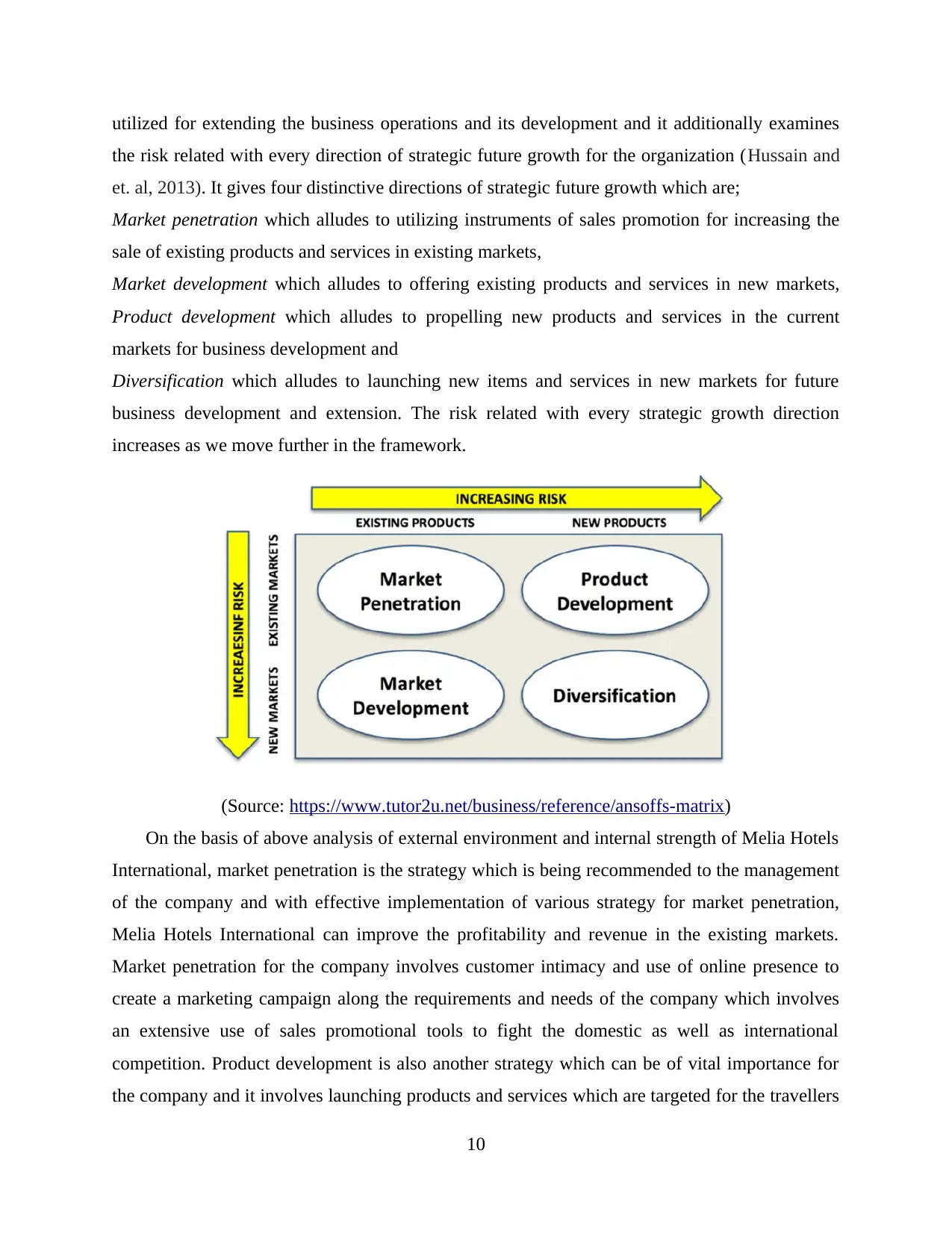
utilized for extending the business operations and its development and it additionally examines
the risk related with every direction of strategic future growth for the organization (Hussain and
et. al, 2013). It gives four distinctive directions of strategic future growth which are;
Market penetration which alludes to utilizing instruments of sales promotion for increasing the
sale of existing products and services in existing markets,
Market development which alludes to offering existing products and services in new markets,
Product development which alludes to propelling new products and services in the current
markets for business development and
Diversification which alludes to launching new items and services in new markets for future
business development and extension. The risk related with every strategic growth direction
increases as we move further in the framework.
(Source: https://www.tutor2u.net/business/reference/ansoffs-matrix)
On the basis of above analysis of external environment and internal strength of Melia Hotels
International, market penetration is the strategy which is being recommended to the management
of the company and with effective implementation of various strategy for market penetration,
Melia Hotels International can improve the profitability and revenue in the existing markets.
Market penetration for the company involves customer intimacy and use of online presence to
create a marketing campaign along the requirements and needs of the company which involves
an extensive use of sales promotional tools to fight the domestic as well as international
competition. Product development is also another strategy which can be of vital importance for
the company and it involves launching products and services which are targeted for the travellers
10
the risk related with every direction of strategic future growth for the organization (Hussain and
et. al, 2013). It gives four distinctive directions of strategic future growth which are;
Market penetration which alludes to utilizing instruments of sales promotion for increasing the
sale of existing products and services in existing markets,
Market development which alludes to offering existing products and services in new markets,
Product development which alludes to propelling new products and services in the current
markets for business development and
Diversification which alludes to launching new items and services in new markets for future
business development and extension. The risk related with every strategic growth direction
increases as we move further in the framework.
(Source: https://www.tutor2u.net/business/reference/ansoffs-matrix)
On the basis of above analysis of external environment and internal strength of Melia Hotels
International, market penetration is the strategy which is being recommended to the management
of the company and with effective implementation of various strategy for market penetration,
Melia Hotels International can improve the profitability and revenue in the existing markets.
Market penetration for the company involves customer intimacy and use of online presence to
create a marketing campaign along the requirements and needs of the company which involves
an extensive use of sales promotional tools to fight the domestic as well as international
competition. Product development is also another strategy which can be of vital importance for
the company and it involves launching products and services which are targeted for the travellers
10
Paraphrase This Document
Need a fresh take? Get an instant paraphrase of this document with our AI Paraphraser
who can’t afford the current premium and luxury segment services offered by the company. With
the help of Market Penetration and Product development, Melia Hotels International can devise a
strategic plan for future growth and development of the business operations and maintain a
strong position in the hospitality industry.
Strategic Management Plan:
A strategic management plan for Melia Hotels International which outlines the strategy,
objectives and tactics for the company for future business growth and expansion along the lines
of market penetration and product development is as follows:
Strategy:
Melia Hotels International needs to develop and follow a cost-leadership strategy which
involves minimising the cost of operations and improving the profitability of the operations
which can further facilitate the use of additional sales promotional tools such as discounts,
loyalty programs etcetera. Various measures need to be taken by the management to ensure that
optimum utilisation of resources is being promoted for obtaining cost-leadership. Differentiation
strategy is also being recommended for the managers of Melia Hotels International which will
facilitate the product development (Valipour, Birjandi and Honarbakhsh, 2012). Hospitality
industry has witnessed huge growth and there is a need to offer differentiated products and
services which can attract more customers and this is the key strategy for the Melia Hotels
International.
Objectives:
SMART objectives for future business growth and expansion of Melia Hotels
International are being described as follows:
To increase the revenue generated in Spain by 18% in next 24 months through increasing
online marketing campaigns and using sales promotional tools and offering differentiated
products and services.
Tactics:
Tactics can be defined as action plan or steps for implementation of a strategy (Weintraub
and Litwinka, 2013). Tactics for implementing the above mentioned strategic plan for Melia
Hotels International are as follows:
Use of online sales platform and engaging potential customers through company website
11
the help of Market Penetration and Product development, Melia Hotels International can devise a
strategic plan for future growth and development of the business operations and maintain a
strong position in the hospitality industry.
Strategic Management Plan:
A strategic management plan for Melia Hotels International which outlines the strategy,
objectives and tactics for the company for future business growth and expansion along the lines
of market penetration and product development is as follows:
Strategy:
Melia Hotels International needs to develop and follow a cost-leadership strategy which
involves minimising the cost of operations and improving the profitability of the operations
which can further facilitate the use of additional sales promotional tools such as discounts,
loyalty programs etcetera. Various measures need to be taken by the management to ensure that
optimum utilisation of resources is being promoted for obtaining cost-leadership. Differentiation
strategy is also being recommended for the managers of Melia Hotels International which will
facilitate the product development (Valipour, Birjandi and Honarbakhsh, 2012). Hospitality
industry has witnessed huge growth and there is a need to offer differentiated products and
services which can attract more customers and this is the key strategy for the Melia Hotels
International.
Objectives:
SMART objectives for future business growth and expansion of Melia Hotels
International are being described as follows:
To increase the revenue generated in Spain by 18% in next 24 months through increasing
online marketing campaigns and using sales promotional tools and offering differentiated
products and services.
Tactics:
Tactics can be defined as action plan or steps for implementation of a strategy (Weintraub
and Litwinka, 2013). Tactics for implementing the above mentioned strategic plan for Melia
Hotels International are as follows:
Use of online sales platform and engaging potential customers through company website
11
Additional discounts and offers to attract potential customers from low household income
group
Implementation of loyalty programs after the initial few months for long-term customer
relationship management
Implementation of referral programs after successful launch of loyalty programs
Investment into R&D projects for product differentiation
Targeting the new customer segments and catering to their particular demands
Designing tourism packages and adopting revenue-maximisation models as a key pricing
strategy
CONCLUSION
The above report can be used to conclude that external factors such as political stability and
desire of people to improve their standard of living has led to a significant growth in the
hospitality industry which has also impacted the managerial decision-making of Melia Hotels
International. It has also been observed that the internal resources and strengths of the company
provide a source of deriving long-term sustained competitive advantage to the managers of Melia
Hotels International. On the basis of Porter’s five force analysis, it can be determined that Melia
Hotels International operates in a highly competitive environment which forces managers to
constantly innovate and develop. At last, a strategic plan based on market penetration and
product development has been recommended to the managers of Melia Hotels International as a
strategic direction for future business growth and expansion.
12
group
Implementation of loyalty programs after the initial few months for long-term customer
relationship management
Implementation of referral programs after successful launch of loyalty programs
Investment into R&D projects for product differentiation
Targeting the new customer segments and catering to their particular demands
Designing tourism packages and adopting revenue-maximisation models as a key pricing
strategy
CONCLUSION
The above report can be used to conclude that external factors such as political stability and
desire of people to improve their standard of living has led to a significant growth in the
hospitality industry which has also impacted the managerial decision-making of Melia Hotels
International. It has also been observed that the internal resources and strengths of the company
provide a source of deriving long-term sustained competitive advantage to the managers of Melia
Hotels International. On the basis of Porter’s five force analysis, it can be determined that Melia
Hotels International operates in a highly competitive environment which forces managers to
constantly innovate and develop. At last, a strategic plan based on market penetration and
product development has been recommended to the managers of Melia Hotels International as a
strategic direction for future business growth and expansion.
12
⊘ This is a preview!⊘
Do you want full access?
Subscribe today to unlock all pages.
Trusted by 1+ million students worldwide

1 out of 13


Related Documents


Your All-in-One AI-Powered Toolkit for Academic Success.
+13062052269
info@desklib.com
Available 24*7 on WhatsApp / Email
![[object Object]](/_next/static/media/star-bottom.7253800d.svg)
Unlock your academic potential
Copyright © 2020–2026 A2Z Services. All Rights Reserved. Developed and managed by ZUCOL.