Diploma of Mental Health Assessment 1: Assisting Clients' Needs
VerifiedAdded on 2023/01/11
|16
|8409
|27
Homework Assignment
AI Summary
This assignment, completed for a Diploma of Mental Health Assessment, addresses key aspects of assisting clients with mental health needs. It begins with an exploration of care networks and services, including factors to consider when providing care, and identification of relevant state, territory, and local services. The assignment then delves into client privacy, covering the use and sharing of information, record management, mandatory reporting, and relevant legislation like the Privacy Act 1988 and Personal Information Act 1998. It details the Australian Privacy Principles, mental health legislation, and practice standards. Furthermore, the assignment covers the concept of care coordination, including different models and the roles involved, followed by a discussion of natural supports, the importance of family and friends, and the concept of peer support. The assignment emphasizes the significance of these elements in client recovery and empowerment.

16197869419261313727.doc
x
© Australian Learning Group
2020 1
Assisting Clients To Meet Needs
Diploma of Mental Health
Assessment 1
Date
x
© Australian Learning Group
2020 1
Assisting Clients To Meet Needs
Diploma of Mental Health
Assessment 1
Date

Paraphrase This Document
Need a fresh take? Get an instant paraphrase of this document with our AI Paraphraser
© Australian Learning Group
2020 2 16197869419261313727.doc
x
ASSESSMENT TASK 1
Part A: WRITTEN QUESTIONS
This assessment will contribute towards your progress in demonstrating application and competency in the
unit(s):
– CHCMHS004 Work collaboratively with the care network and other services
TASK SUMMARY:
This task requires you to complete a series of short answer questions.
RESOURCES AND EQUIPMENT REQUIRED TO COMPLETE THIS TASK
Access to your Structured Study Plan
Access to textbooks and other learning materials.
Access to a computer and the Internet
INSTRUCTIONS:
You will do this task in your own time
Please refer to the Structured Study Plan for the scheduled activities and timelines associated
with this task.
You must use your computer to type in the answers to the questions
To complete this task, you will need to read and answer each question
2020 2 16197869419261313727.doc
x
ASSESSMENT TASK 1
Part A: WRITTEN QUESTIONS
This assessment will contribute towards your progress in demonstrating application and competency in the
unit(s):
– CHCMHS004 Work collaboratively with the care network and other services
TASK SUMMARY:
This task requires you to complete a series of short answer questions.
RESOURCES AND EQUIPMENT REQUIRED TO COMPLETE THIS TASK
Access to your Structured Study Plan
Access to textbooks and other learning materials.
Access to a computer and the Internet
INSTRUCTIONS:
You will do this task in your own time
Please refer to the Structured Study Plan for the scheduled activities and timelines associated
with this task.
You must use your computer to type in the answers to the questions
To complete this task, you will need to read and answer each question
© Australian Learning Group
2020 3 16197869419261313727.doc
x
QUESTION 1
a) Identify at least four types of care networks and services you might be required to interact with to
assist a client with mental illness. When identifying services for your clients, explain what factors
would need to consider in terms of availability and appropriateness.
A care network refers to specific organisations working in support and providing effective care services to patients.
It includes the coordination and connection between two or more organisations through which they can perform
collaboratively. Meanwhile, it is necessary to interact with various kinds of care networks in order to deliver
appropriate care for completing actual medical needs of client for their well-being (Worden, 2018). However, it
includes number of care networks such as Health maintenance organisations (HMOs), Preferred provider
organisations (PPOs), Exclusive provider organisations (EPOs), Point-of-service (POS) plans and High-deductible
health plans (HDHPs). It is required to interact with these networks in order to satisfy all the needs of clients in
effective manner. In addition to this, it has been analysed that there are several factors which are required to be
consider for providing appropriate care facilities including actual medical needs, mental & emotional state,
availability of resources, ethics, evidence based practice, person centred care and legislations.
b) Research the Internet and identify two states/territory services and two local services to which you
could refer clients. Provide their contact details or a link to their website.
The separate healthcare services are required to be available in every state, district and local area to make people
capable for gaining desired care facilities respectively. It includes the different types of medical services, public
hospitals and medicinal facilities availability in local areas of the country. However, it has been analysed that
effective services should be available where client can be referred for further treatment. Moreover, it involves The
Canberra Hospital situated in Australian Capital Territory and Armidale Hospital established in New South Wales
whereas local services includes Hughenden Hospital and Inglewood hospital that are situated in local areas of
Queensland.
QUESTION 2
a) These days people are quite concerned about the use of their private information. Imagine a client
has asked you how your service uses and shares your information with others. Write down an
explanation as to what you would tell them. Include in your answer how records are managed and
kept safe from unauthorised access, and what information is considered under mandatory reporting
laws.
The privacy of client information must be maintained with strict policies and regulations of particular healthcare
organisation. In context of a patient, it is required to maintain confidentiality of their relevant medical data
from others because a minor medical issue may become responsible for developing major social problem for an
individual from whom they may suffer lifelong (Pilgrim, 2019). However, it can be conveyed to client about
privacy of their data that hospital has strict policy to maintain confidentiality by following relevant legislation. It
is necessary for every medical practitioner and staff to follow Privacy Act 1988 to protect privacy of an
individual. Moreover, this regulation helps to manage safety of patient records and only associated
professionals can access the data.
b) Identify at least two pieces of legislation you would need to adhere to regarding client information.
The legislation is must to maintain safety and privacy of patient data while dealing with them. It includes
legislations which are required to be followed by medical staff in order to ensure privacy of clients’ records to
remove chance of occurring relevant problems. However, the legislation regarding client information include
The Privacy Act 1988 and Personal information Act 1998 which must be followed by medical professionals to
maintain confidentially of patient records.
c) Identify how many principles make up the Australian Privacy Principles. List each one.
There are number of Australian privacy principles which are formulated in respect of maintain privacy of client
information in more effective manner. It consist around 13 such principles which are mentioned her with their title
and purpose.
APP 1: Open and transparent management of personal data – This has purpose of ensuring the management of
personal information in an open as well as transparent manner. It consist the clearly expressed and up to date
privacy policy.
2020 3 16197869419261313727.doc
x
QUESTION 1
a) Identify at least four types of care networks and services you might be required to interact with to
assist a client with mental illness. When identifying services for your clients, explain what factors
would need to consider in terms of availability and appropriateness.
A care network refers to specific organisations working in support and providing effective care services to patients.
It includes the coordination and connection between two or more organisations through which they can perform
collaboratively. Meanwhile, it is necessary to interact with various kinds of care networks in order to deliver
appropriate care for completing actual medical needs of client for their well-being (Worden, 2018). However, it
includes number of care networks such as Health maintenance organisations (HMOs), Preferred provider
organisations (PPOs), Exclusive provider organisations (EPOs), Point-of-service (POS) plans and High-deductible
health plans (HDHPs). It is required to interact with these networks in order to satisfy all the needs of clients in
effective manner. In addition to this, it has been analysed that there are several factors which are required to be
consider for providing appropriate care facilities including actual medical needs, mental & emotional state,
availability of resources, ethics, evidence based practice, person centred care and legislations.
b) Research the Internet and identify two states/territory services and two local services to which you
could refer clients. Provide their contact details or a link to their website.
The separate healthcare services are required to be available in every state, district and local area to make people
capable for gaining desired care facilities respectively. It includes the different types of medical services, public
hospitals and medicinal facilities availability in local areas of the country. However, it has been analysed that
effective services should be available where client can be referred for further treatment. Moreover, it involves The
Canberra Hospital situated in Australian Capital Territory and Armidale Hospital established in New South Wales
whereas local services includes Hughenden Hospital and Inglewood hospital that are situated in local areas of
Queensland.
QUESTION 2
a) These days people are quite concerned about the use of their private information. Imagine a client
has asked you how your service uses and shares your information with others. Write down an
explanation as to what you would tell them. Include in your answer how records are managed and
kept safe from unauthorised access, and what information is considered under mandatory reporting
laws.
The privacy of client information must be maintained with strict policies and regulations of particular healthcare
organisation. In context of a patient, it is required to maintain confidentiality of their relevant medical data
from others because a minor medical issue may become responsible for developing major social problem for an
individual from whom they may suffer lifelong (Pilgrim, 2019). However, it can be conveyed to client about
privacy of their data that hospital has strict policy to maintain confidentiality by following relevant legislation. It
is necessary for every medical practitioner and staff to follow Privacy Act 1988 to protect privacy of an
individual. Moreover, this regulation helps to manage safety of patient records and only associated
professionals can access the data.
b) Identify at least two pieces of legislation you would need to adhere to regarding client information.
The legislation is must to maintain safety and privacy of patient data while dealing with them. It includes
legislations which are required to be followed by medical staff in order to ensure privacy of clients’ records to
remove chance of occurring relevant problems. However, the legislation regarding client information include
The Privacy Act 1988 and Personal information Act 1998 which must be followed by medical professionals to
maintain confidentially of patient records.
c) Identify how many principles make up the Australian Privacy Principles. List each one.
There are number of Australian privacy principles which are formulated in respect of maintain privacy of client
information in more effective manner. It consist around 13 such principles which are mentioned her with their title
and purpose.
APP 1: Open and transparent management of personal data – This has purpose of ensuring the management of
personal information in an open as well as transparent manner. It consist the clearly expressed and up to date
privacy policy.
⊘ This is a preview!⊘
Do you want full access?
Subscribe today to unlock all pages.

Trusted by 1+ million students worldwide
© Australian Learning Group
2020 4 16197869419261313727.doc
x
APP 2: Anonymity and pseudonymity – This contains the criterion of providing opportunity to an individual for not
determining themselves or using a pseudonym.
APP 3: Collection of solicited personal information – It consist the purpose of gathering personal data which is
solicited and it applies high standards to collect sensitive information.
APP 4: Dealing with unsolicited personal data – In this, it is responsible for providing a way to deal with unsolicited
information (Scheid and Wright, 2017).
APP 5: Notification of the collection of personal information – This includes the circumstances an APP entity which
collects personal data must tell a person about certain aspects or matters.
APP 6: Use or disclosure of personal information – It consist the circumstances in which the client data can be sued
or disclosed with having valid reason.
APP 7: Direct marketing – This includes the specific criterion in which an organisation can utilise client data for
direct marketing purpose when few of terms and condition are fulfilled.
APP 8: Cross-border disclosure of personal data – It involves the information about number of steps which are
helpful to protect the personal data before disclosing the same.
APP 9: Adoption, use or disclosure of government related identifiers – This consist the way of evaluate government
identifier of an individual for using or disclosing the data of an individual.
APP 10: Quality of personal information – It consist the way of collecting information which is accurate, up to date
and complete. It is required that the collected data should be relevant fir the purpose of using it.
APP 11: Security of personal information – It includes number of step for protecting personal information of client
by considering several aspects like it holds from misuse, interference, loss and from unauthorised access.
APP 12: Access to personal information – This involves the way of putting obligations when someone ask to access
for personal data of client.
APP 13: Correction of personal information – It includes the criterion of putting obligations for correction of
personal data it holds about individuals.
d) Identify the mental health legislation and practise standards you must adhere to in your line of work.
Australian mental health legislations consists number of Acts such as Mental health act 2007, Mental health
regulation 2013, Mental health (forensic provisions) Act 1990, Mental health (forensic provisions) Regulation 2017,
Guardianship act 1987 and mental health commission act 2012 (Segal, Qualls and Smyer, 2018). It is necessary for
mental health professionals to follow these legislations in order to deliver appropriate care for wellbeing of patient.
However, the practise standards include effective factors which should be consider while dealing with mental health
patients that are given below.
Standard 1 – Rights, responsibilities, safety and privacy
Standard 2 – Working with people, families and carers in recovery-focussed ways
Standard 3 – Meeting diverse needs
Standard 4 – Working with Aboriginal and Torres Strait Islander people, families and communities
Standard 5 – Access to services
Standard 6 – Individual planning
Standard 7 – Treatment and support
Standard 8 – Transitions in care
Standard 9 – Integrating and partnership
Standard 10 – Quality improvement
Standard 11 – Communication and information management
Standard 12 – Health promotion and prevention
Standard 13 – Ethical practice and professional development responsibilities
e) Identify two further pieces of legislation that will impact on your role in the mental health sector.
Explain the impact of each piece of legislation.
Considering the mental health sector, it has been analysed that legislation should be followed by care
professionals to deliver appropriate facilities. The roles of performance of medical practitioners improved by
impact of mental health legislations. However, the Mental health act 2007 and Mental health regulation 2013
which impact positively on role of professionals due to which they can provide effective mental health facilities
for wellness of an individual.
2020 4 16197869419261313727.doc
x
APP 2: Anonymity and pseudonymity – This contains the criterion of providing opportunity to an individual for not
determining themselves or using a pseudonym.
APP 3: Collection of solicited personal information – It consist the purpose of gathering personal data which is
solicited and it applies high standards to collect sensitive information.
APP 4: Dealing with unsolicited personal data – In this, it is responsible for providing a way to deal with unsolicited
information (Scheid and Wright, 2017).
APP 5: Notification of the collection of personal information – This includes the circumstances an APP entity which
collects personal data must tell a person about certain aspects or matters.
APP 6: Use or disclosure of personal information – It consist the circumstances in which the client data can be sued
or disclosed with having valid reason.
APP 7: Direct marketing – This includes the specific criterion in which an organisation can utilise client data for
direct marketing purpose when few of terms and condition are fulfilled.
APP 8: Cross-border disclosure of personal data – It involves the information about number of steps which are
helpful to protect the personal data before disclosing the same.
APP 9: Adoption, use or disclosure of government related identifiers – This consist the way of evaluate government
identifier of an individual for using or disclosing the data of an individual.
APP 10: Quality of personal information – It consist the way of collecting information which is accurate, up to date
and complete. It is required that the collected data should be relevant fir the purpose of using it.
APP 11: Security of personal information – It includes number of step for protecting personal information of client
by considering several aspects like it holds from misuse, interference, loss and from unauthorised access.
APP 12: Access to personal information – This involves the way of putting obligations when someone ask to access
for personal data of client.
APP 13: Correction of personal information – It includes the criterion of putting obligations for correction of
personal data it holds about individuals.
d) Identify the mental health legislation and practise standards you must adhere to in your line of work.
Australian mental health legislations consists number of Acts such as Mental health act 2007, Mental health
regulation 2013, Mental health (forensic provisions) Act 1990, Mental health (forensic provisions) Regulation 2017,
Guardianship act 1987 and mental health commission act 2012 (Segal, Qualls and Smyer, 2018). It is necessary for
mental health professionals to follow these legislations in order to deliver appropriate care for wellbeing of patient.
However, the practise standards include effective factors which should be consider while dealing with mental health
patients that are given below.
Standard 1 – Rights, responsibilities, safety and privacy
Standard 2 – Working with people, families and carers in recovery-focussed ways
Standard 3 – Meeting diverse needs
Standard 4 – Working with Aboriginal and Torres Strait Islander people, families and communities
Standard 5 – Access to services
Standard 6 – Individual planning
Standard 7 – Treatment and support
Standard 8 – Transitions in care
Standard 9 – Integrating and partnership
Standard 10 – Quality improvement
Standard 11 – Communication and information management
Standard 12 – Health promotion and prevention
Standard 13 – Ethical practice and professional development responsibilities
e) Identify two further pieces of legislation that will impact on your role in the mental health sector.
Explain the impact of each piece of legislation.
Considering the mental health sector, it has been analysed that legislation should be followed by care
professionals to deliver appropriate facilities. The roles of performance of medical practitioners improved by
impact of mental health legislations. However, the Mental health act 2007 and Mental health regulation 2013
which impact positively on role of professionals due to which they can provide effective mental health facilities
for wellness of an individual.
Paraphrase This Document
Need a fresh take? Get an instant paraphrase of this document with our AI Paraphraser
© Australian Learning Group
2020 5 16197869419261313727.doc
x
QUESTION 3
Describe the concept of care coordination. In your response, include a reference to at least two different
models of care coordination. What person is responsible for this, and what are some things they might do
a part of their job?
Care coordination refers to a deliberate organisation of patient care activities among two or more participants. It
includes care coordination models such as the program of all-inclusive care for elderly (PACE) model, Wraparound
model, community HUB model, Community health workers model and health homes model. However, the people
involved in coordinated care are client, nurse, specialist, patient family members and relevant physician for
providing coordinated treatment for wellness of an individual (Ryle and Kerr, 2020).
QUESTION 4
a) Describe the concept of ‘natural supports’ in relation to a person with mental illness. Provide an example
of three different natural supports.
Natural support for a mental patient refers to a moral support given by family members, friends, relatives
and neighbours to an individual. It will impact positively on mental condition of patient which facilitates to
gain improved treatment outcomes. Meanwhile, it includes an example of encouraging communication of
neighbours to become well soon. For instance, the caring and sensitive behaviour of family members
becomes strength for patient. For example, the moral support of relatives is helpful to improve will power of
an individual to become disease free very soon.
b) Describe how the support of family, friends and carers are important to a person with mental illness and
what role they can play in recovery, including how they can empower the person with a mental illness.
The support of family, friends and carers plays an important role because it becomes strength for patient to
become internally strong. This strength will provide support to fight with specific mental health illness more
effectively to gain better health condition. Carers empower patients for using principle of informed consent and
make them able to choose their treatment by providing information. It will impact positively on treatment
which facilitates to improve patient outcomes.
c) Describe the concept and importance of ‘peer support’. What does a peer support person do? Identify at
least one mental health issue where a peer support could be of great help, and how they can assist with
empowerment.
The peer support is a situation when people provide information, experience, emotion and social help to
each other. It is important because peer support make an individual comfortable to remain focussed and
perform their work properly (Mikkelsen and et. al., 2017). However, the peer support clarifies little doubts and
removes fear to conduct complex clinical practices when a professional is going to do so for the first time.
For example, a professional is transferred to wards of violent mental patient for which working experience is
nil then peer support improve confidence and make an individual comfortable to deal with violent patient
with patience and calmness.
d) Explain the concepts of citizenship and natural supports (family, friends, etc). How do you think natural
supports can assist a person with mental illness in regard to citizenship?
Citizenship is a position or status having all fundamental rights of being a citizen of particular country. Apart
from this, natural supports refer to sympathy and support for family, friends and neighbours for taking care of
patient and remained concerned all the time. They give moral and emotional support to an individual who
improve their internal strength to fight with their mental illness and become healthy very soon. Moreover,
natural support includes providing information about their rights to gain appropriate medical facilities on time
and clarifying doubts accordingly.
e) Explain the importance and role of formal services in a client’s recovery.
The formal services have a role to provide care and other facilities in a formal manner with correct sequence that is
favourable for client wellness. It is helpful to deliver appropriate medications and treatment that impact positively
on recovery speed of patient which make then healthy as soon as possible.
2020 5 16197869419261313727.doc
x
QUESTION 3
Describe the concept of care coordination. In your response, include a reference to at least two different
models of care coordination. What person is responsible for this, and what are some things they might do
a part of their job?
Care coordination refers to a deliberate organisation of patient care activities among two or more participants. It
includes care coordination models such as the program of all-inclusive care for elderly (PACE) model, Wraparound
model, community HUB model, Community health workers model and health homes model. However, the people
involved in coordinated care are client, nurse, specialist, patient family members and relevant physician for
providing coordinated treatment for wellness of an individual (Ryle and Kerr, 2020).
QUESTION 4
a) Describe the concept of ‘natural supports’ in relation to a person with mental illness. Provide an example
of three different natural supports.
Natural support for a mental patient refers to a moral support given by family members, friends, relatives
and neighbours to an individual. It will impact positively on mental condition of patient which facilitates to
gain improved treatment outcomes. Meanwhile, it includes an example of encouraging communication of
neighbours to become well soon. For instance, the caring and sensitive behaviour of family members
becomes strength for patient. For example, the moral support of relatives is helpful to improve will power of
an individual to become disease free very soon.
b) Describe how the support of family, friends and carers are important to a person with mental illness and
what role they can play in recovery, including how they can empower the person with a mental illness.
The support of family, friends and carers plays an important role because it becomes strength for patient to
become internally strong. This strength will provide support to fight with specific mental health illness more
effectively to gain better health condition. Carers empower patients for using principle of informed consent and
make them able to choose their treatment by providing information. It will impact positively on treatment
which facilitates to improve patient outcomes.
c) Describe the concept and importance of ‘peer support’. What does a peer support person do? Identify at
least one mental health issue where a peer support could be of great help, and how they can assist with
empowerment.
The peer support is a situation when people provide information, experience, emotion and social help to
each other. It is important because peer support make an individual comfortable to remain focussed and
perform their work properly (Mikkelsen and et. al., 2017). However, the peer support clarifies little doubts and
removes fear to conduct complex clinical practices when a professional is going to do so for the first time.
For example, a professional is transferred to wards of violent mental patient for which working experience is
nil then peer support improve confidence and make an individual comfortable to deal with violent patient
with patience and calmness.
d) Explain the concepts of citizenship and natural supports (family, friends, etc). How do you think natural
supports can assist a person with mental illness in regard to citizenship?
Citizenship is a position or status having all fundamental rights of being a citizen of particular country. Apart
from this, natural supports refer to sympathy and support for family, friends and neighbours for taking care of
patient and remained concerned all the time. They give moral and emotional support to an individual who
improve their internal strength to fight with their mental illness and become healthy very soon. Moreover,
natural support includes providing information about their rights to gain appropriate medical facilities on time
and clarifying doubts accordingly.
e) Explain the importance and role of formal services in a client’s recovery.
The formal services have a role to provide care and other facilities in a formal manner with correct sequence that is
favourable for client wellness. It is helpful to deliver appropriate medications and treatment that impact positively
on recovery speed of patient which make then healthy as soon as possible.
© Australian Learning Group
2020 6 16197869419261313727.doc
x
f) Explain the importance of early intervention.
The early intervention is significant to overcome with specific health problem easily and delayed intervention
develops risk of occurring complications. It involves the importance of early intervention to easily heal with a health
issues in short period of time and become healthy. However, early intervention eliminates risk factors and
complications.
QUESTION 5
Social justice principles are important across all areas of community services work. Describe social justice
principles as they apply to your work and how you would ensure that you apply these principles when
providing services to clients.
Social justice principles include several factors such as access, equity, rights and participation. These elements
are helpful for an individual to gain care facilities effectively by securing their all the rights while deliver care
facilities for their better health. However, these social justice principles should be applied to provide effective
services for welfare of people (Hall, 2016).
QUESTION 6
Describe concepts of mental health promotion and prevention. In your response, explain how these can be
of benefit to clients.
Mental health promotion and prevention includes the criterion of organising campaigns for public to provide
information about precautions to avoid mental illnesses. It includes delivering knowledge of preventive strategies
which should be adopted by people in order to maintain better mental health condition.
2020 6 16197869419261313727.doc
x
f) Explain the importance of early intervention.
The early intervention is significant to overcome with specific health problem easily and delayed intervention
develops risk of occurring complications. It involves the importance of early intervention to easily heal with a health
issues in short period of time and become healthy. However, early intervention eliminates risk factors and
complications.
QUESTION 5
Social justice principles are important across all areas of community services work. Describe social justice
principles as they apply to your work and how you would ensure that you apply these principles when
providing services to clients.
Social justice principles include several factors such as access, equity, rights and participation. These elements
are helpful for an individual to gain care facilities effectively by securing their all the rights while deliver care
facilities for their better health. However, these social justice principles should be applied to provide effective
services for welfare of people (Hall, 2016).
QUESTION 6
Describe concepts of mental health promotion and prevention. In your response, explain how these can be
of benefit to clients.
Mental health promotion and prevention includes the criterion of organising campaigns for public to provide
information about precautions to avoid mental illnesses. It includes delivering knowledge of preventive strategies
which should be adopted by people in order to maintain better mental health condition.
⊘ This is a preview!⊘
Do you want full access?
Subscribe today to unlock all pages.
Trusted by 1+ million students worldwide
© Australian Learning Group
2020 7 16197869419261313727.doc
x
QUESTION 7
Explain what you believe is the importance of reflective practice for a person working in the mental health
sector. In your response, ensure you address the benefits to self, colleagues, the service and clients.
Reflective Practice is a functioning, powerful activity based and moral arrangement of abilities, put progressively
and managing genuine, unpredictable and troublesome circumstances. This benefits in different ways like in terms
of self, service, clients and colleagues within mental health sector. If it is talk about self then reflective practice
specifically helps in learning from the self experiences which has been experienced by an individual. The help of
this, an individual can easily take right decisions in your future when the same type of task is performed. On the
other hand while working with colleagues, reflective practice help an individual in sharing the experience which has
been experienced in the past and also the suggestions can be given to them or it can be taken from them in order to
reach to a conclusion over a particular patient within mental health sector (Pliszka, 2016). If it is talk about service,
then reflective practice may help an individual in taking innovative approaches considering the experience which
has been learnt from the past. Including this, reflective practice can help clients as well and this could be
understood with good example where particular patient was specifically dealing with the same mental health
problem which has been solved by the individual in the past when it was faced by the previous patient to whom all
the service was given. Under this, the treatment which was given previously can be given to the same position
based on the medical conditions in order to pull out favourable results in short period of time.
QUESTION 8
Describe the purpose of a wellness plan.
a plan of action towards achieving personal wellness such as physical, mental, social, financial and aome other
elements as well. A wellness program on a planet is a comprehensive Health Care initiative a plan is developed in
order to maintain and improve the wellbeing of the patient with proper diet, stress management, exercises and
illness prevention. In mental health a wellness plan helps in in keeping the track of what is exactly helpful and what
is not helpful for the patient in maintaining their mental wellness. Assist and helps the patient in creating a direction
about what they exactly need everyday to maintain their mental health (Ramírez, 2017). A wellness plan also helps
the individual in keeping a track of the skills which helps in coping and utilize them to ensure that a balance is
maintained between the thoughts emotion and behavior of the patient.
The purpose of wellness plan is to make sure that the patient incorporate all the elements needed in building a
strong plan that will help them in their mental health. There are several elements that fulfills and highlights the
purpose of a wellness plan which are:
• It provides an understanding to the patient about their mental health status and their needs to maintain a
good mental health. In such activities mental health wellness worksheets and applications are helpful for the
patients.
• The wellness plan consisting a list of coping strategies that help the patient in coping with life stresses,
emotions, unexpected circumstances and unsetting situations.
• The wellness plan another purpose is to provide understanding to the patient about their personal triggers
and life stresses that may become a challenge for them in maintaining a good mental health.
Another very important purpose of these plants is they empower the patient in their recovery and helpful for them
in identifying early warning signs and triggers are the positive and negative that are affecting for me affect their
wellness (Connolly and et. al., 2016).
QUESTION 9
Describe the limitations of a wellness plan.
The wellness plans are very important and essential tools which are documents develop for the benefits of
individuals and for keeping an appropriate record of the improvements or any changes taking place in the mental
health of an individual. But these mental health wellness plans also have some challenges and limitations which are
negative factors associated with it. These limitations of wellness plans are elaborated underneath:
•
2020 7 16197869419261313727.doc
x
QUESTION 7
Explain what you believe is the importance of reflective practice for a person working in the mental health
sector. In your response, ensure you address the benefits to self, colleagues, the service and clients.
Reflective Practice is a functioning, powerful activity based and moral arrangement of abilities, put progressively
and managing genuine, unpredictable and troublesome circumstances. This benefits in different ways like in terms
of self, service, clients and colleagues within mental health sector. If it is talk about self then reflective practice
specifically helps in learning from the self experiences which has been experienced by an individual. The help of
this, an individual can easily take right decisions in your future when the same type of task is performed. On the
other hand while working with colleagues, reflective practice help an individual in sharing the experience which has
been experienced in the past and also the suggestions can be given to them or it can be taken from them in order to
reach to a conclusion over a particular patient within mental health sector (Pliszka, 2016). If it is talk about service,
then reflective practice may help an individual in taking innovative approaches considering the experience which
has been learnt from the past. Including this, reflective practice can help clients as well and this could be
understood with good example where particular patient was specifically dealing with the same mental health
problem which has been solved by the individual in the past when it was faced by the previous patient to whom all
the service was given. Under this, the treatment which was given previously can be given to the same position
based on the medical conditions in order to pull out favourable results in short period of time.
QUESTION 8
Describe the purpose of a wellness plan.
a plan of action towards achieving personal wellness such as physical, mental, social, financial and aome other
elements as well. A wellness program on a planet is a comprehensive Health Care initiative a plan is developed in
order to maintain and improve the wellbeing of the patient with proper diet, stress management, exercises and
illness prevention. In mental health a wellness plan helps in in keeping the track of what is exactly helpful and what
is not helpful for the patient in maintaining their mental wellness. Assist and helps the patient in creating a direction
about what they exactly need everyday to maintain their mental health (Ramírez, 2017). A wellness plan also helps
the individual in keeping a track of the skills which helps in coping and utilize them to ensure that a balance is
maintained between the thoughts emotion and behavior of the patient.
The purpose of wellness plan is to make sure that the patient incorporate all the elements needed in building a
strong plan that will help them in their mental health. There are several elements that fulfills and highlights the
purpose of a wellness plan which are:
• It provides an understanding to the patient about their mental health status and their needs to maintain a
good mental health. In such activities mental health wellness worksheets and applications are helpful for the
patients.
• The wellness plan consisting a list of coping strategies that help the patient in coping with life stresses,
emotions, unexpected circumstances and unsetting situations.
• The wellness plan another purpose is to provide understanding to the patient about their personal triggers
and life stresses that may become a challenge for them in maintaining a good mental health.
Another very important purpose of these plants is they empower the patient in their recovery and helpful for them
in identifying early warning signs and triggers are the positive and negative that are affecting for me affect their
wellness (Connolly and et. al., 2016).
QUESTION 9
Describe the limitations of a wellness plan.
The wellness plans are very important and essential tools which are documents develop for the benefits of
individuals and for keeping an appropriate record of the improvements or any changes taking place in the mental
health of an individual. But these mental health wellness plans also have some challenges and limitations which are
negative factors associated with it. These limitations of wellness plans are elaborated underneath:
•
Paraphrase This Document
Need a fresh take? Get an instant paraphrase of this document with our AI Paraphraser
© Australian Learning Group
2020 8 16197869419261313727.doc
x
First and the most affecting factors associated with these wellness plans are the cost incurred to the patient in
development of these plans. the wellness plans are extremely expensive to create and sometimes it is very difficult
for patients to afford such plans and therefore that treatment is not properly conducted.
• Another limitation of these plans is that the privacy of the patient is invaded which is not accepted by some
patients. Every individual love their privacy and if anyone tries to invade in their privacy people run from such
activities. Therefore some patients do not opt for developing a wellness plan for themselves because of the privacy
factor which hinders their growth and their mental health as well.
The wellness plans are not the right fit for everyone that is sometimes it is it possible that for some patients
wellness plans are not appropriate enough and they do not fit with the conditions of the patients (Rieder and et. al.,
2017).
QUESTION 10
Describe the purpose of an advanced directive.
Comes into effect when a person is unable to make medications about medical treatments other than mental
health. The advance directives are basically legal documents that are signed by the patients and their family
members which allows them to spell out their decisions about end of Life Care ahead of time. These Advance
directives provides a chance to the person for telling their wishes to their family members, friends and healthcare
professionals working with them for avoiding any confusion in future. There are two main types of advance
directives the “Living Will” and the “Durable Power of Attorney for Healthcare”.
The main purpose which is served by these advanced directives is pre-planning in relation with medical care an
individual desires at the time of need. These advance directives provides a right and a opportunity for a person to
make their major medical decisions in relation with their health care during the moments they wish to make them
and also reduce any confusion about their medical care in the later stage. These advance directives are commonly
used by elder people but it is a minute misconception. These advance directives are available for everyone
belonging to the different age groups.
QUESTION 11
Describe the limitations of an advanced directive.
The advance directives provides the best means and methods of respecting the patient’s wishes and preserving
autonomy when the patient know has the decision making capacity. Many patients make use of these advance
directives in such situations but there are few challenges and limitations of these advance directives which are as
follows:
• One of the major drawback or limitation linked with an advanced directive is that it is a piece of paper. That
means a doctor might not know about the existence of a advance directive which is in relation with the patient.
along with that it is also possible that the advance directives might not be produced at the right time therefore in
later stage it might be of no much use.
• Another possibility is a limitation of an advance directive is sometimes it can happen that these directors
won't be honored by the doctors for the healthcare professional if it is formed and belongs to another state. Some
States explicitly overrule these living waves and advance directives if the patient is pregnant and therefore it is
possible that the advance directive is not honored by the professional doctors and medical experts.
The third limitation associated with the use of advance directives is its consideration (Cervenka, Agudelo and Ruas,
2017). That is sometimes people and patience fear that an advanced directive can create a barrier and interfere with
an advocate care at the time of need in their life. The advance directive cannot complement every possibility which
happens in the life of individuals and therefore it is usually suggested that Health Care proxy also be designated and
make actual decision with the benefits of knowing the facts. Therefore it is heard that is a doctor is a knows a
patient and their wish for not wanted to be kept alive on any artificial support at all cost then other measures are
also ignored and might not be taken either.
QUESTION 12
There are a number of different types and formats of wellness plans. Describe the advantage in selecting a
plan which has been designed and developed by people who have lived experience of mental health issues.
Primal advantage of adopting the Behavioural Health & Wellness Program is that, it helps in reducing elevated
mental health related risks which can be faced by staff within mental health sector. Another benefit that came in
2020 8 16197869419261313727.doc
x
First and the most affecting factors associated with these wellness plans are the cost incurred to the patient in
development of these plans. the wellness plans are extremely expensive to create and sometimes it is very difficult
for patients to afford such plans and therefore that treatment is not properly conducted.
• Another limitation of these plans is that the privacy of the patient is invaded which is not accepted by some
patients. Every individual love their privacy and if anyone tries to invade in their privacy people run from such
activities. Therefore some patients do not opt for developing a wellness plan for themselves because of the privacy
factor which hinders their growth and their mental health as well.
The wellness plans are not the right fit for everyone that is sometimes it is it possible that for some patients
wellness plans are not appropriate enough and they do not fit with the conditions of the patients (Rieder and et. al.,
2017).
QUESTION 10
Describe the purpose of an advanced directive.
Comes into effect when a person is unable to make medications about medical treatments other than mental
health. The advance directives are basically legal documents that are signed by the patients and their family
members which allows them to spell out their decisions about end of Life Care ahead of time. These Advance
directives provides a chance to the person for telling their wishes to their family members, friends and healthcare
professionals working with them for avoiding any confusion in future. There are two main types of advance
directives the “Living Will” and the “Durable Power of Attorney for Healthcare”.
The main purpose which is served by these advanced directives is pre-planning in relation with medical care an
individual desires at the time of need. These advance directives provides a right and a opportunity for a person to
make their major medical decisions in relation with their health care during the moments they wish to make them
and also reduce any confusion about their medical care in the later stage. These advance directives are commonly
used by elder people but it is a minute misconception. These advance directives are available for everyone
belonging to the different age groups.
QUESTION 11
Describe the limitations of an advanced directive.
The advance directives provides the best means and methods of respecting the patient’s wishes and preserving
autonomy when the patient know has the decision making capacity. Many patients make use of these advance
directives in such situations but there are few challenges and limitations of these advance directives which are as
follows:
• One of the major drawback or limitation linked with an advanced directive is that it is a piece of paper. That
means a doctor might not know about the existence of a advance directive which is in relation with the patient.
along with that it is also possible that the advance directives might not be produced at the right time therefore in
later stage it might be of no much use.
• Another possibility is a limitation of an advance directive is sometimes it can happen that these directors
won't be honored by the doctors for the healthcare professional if it is formed and belongs to another state. Some
States explicitly overrule these living waves and advance directives if the patient is pregnant and therefore it is
possible that the advance directive is not honored by the professional doctors and medical experts.
The third limitation associated with the use of advance directives is its consideration (Cervenka, Agudelo and Ruas,
2017). That is sometimes people and patience fear that an advanced directive can create a barrier and interfere with
an advocate care at the time of need in their life. The advance directive cannot complement every possibility which
happens in the life of individuals and therefore it is usually suggested that Health Care proxy also be designated and
make actual decision with the benefits of knowing the facts. Therefore it is heard that is a doctor is a knows a
patient and their wish for not wanted to be kept alive on any artificial support at all cost then other measures are
also ignored and might not be taken either.
QUESTION 12
There are a number of different types and formats of wellness plans. Describe the advantage in selecting a
plan which has been designed and developed by people who have lived experience of mental health issues.
Primal advantage of adopting the Behavioural Health & Wellness Program is that, it helps in reducing elevated
mental health related risks which can be faced by staff within mental health sector. Another benefit that came in
© Australian Learning Group
2020 9 16197869419261313727.doc
x
front is that it improve worker practices will see a twisting of the medicinal services cost pattern. Frequently they
will find that the investment funds from program interest will be more noteworthy than the genuine expense of the
program. On the other hand, wellness plans like behavioral health and wellness program can effectively reduce the
absenteeism as well within the hospital or any other health institute. Nearly everybody of these arrival on venture
(ROI) examines show a positive rate of profitability. Analysts from Harvard as of late distributed another rundown of
the health ROI examine. Another advantage that came in front of behavioral health and wellness program is that it
increases the employee retention and also reduces high turnover ratio of staff members within mental health
tractor.
QUESTION 13
Describe the purpose of a statement of capacity. What should be included in the statement?
Before treatment can be managed to a patient, a clinician must look for the educated assent regarding the
individual. The clinician must assume that the patient has ability to give educated agree to the treatment. This
assumption of capacity might be disproved on the off chance that it very well may be indicated that the patient
doesn't have the ability to give educated assent at the time the specific treatment choice should be made (Valmaggia
and et. al., 2016).
A patient's ability to settle on a treatment choice can vary. A patient might not have ability to settle on a specific
treatment choice today, anyway they might have the option to settle on the treatment choice tomorrow. The
clinician should attempt to acquire educated assent at once and in a situation when the patient is well on the way
to have the option to give educated assent.
QUESTION 14
There are many services for people experiencing mental distress, unwellness and crisis. List at least five
services relevant to your work and location. Explain how you would match the needs of a client with an
appropriate service.
mental health helplines:
Some of the crucial service relevant to my work and location are given underneath:
1. Lifeline – Australia-wide crisis support and suicide prevention service
2. Suicide Call Back Service – Free service for people having suicidal thoughts or for family or friends
affected by suicide
3. SuicideLine – Free and anonymous support, 24 hours a day, seven days a week across Victoria
4. Kids Help Line – Free counselling for young people between the ages of five and 25
5. Mensline Australia – Free telephone support service for men with family and relationship issues
In order to match the needs of a client an appropriate service which can deliver the different range of benefits is
lifeline. This could be understood with the very good example of an individual who is dealing with depression.
Preventive services along with the crisis support can easily be given by the representative through making the
individual understand the whole situation and ask him to not to perform any sort of activities that can harm the
person (Brown and Jones, 2016).
QUESTION 15
Describe the role of witnesses in the development of advanced directives. What criteria must a person fulfil
to be suitable as a witness?
Authorized witnesses describe the justice regarding the peace for the mental stability and consider the
doctors, nurses, pharmacists and public servants. In this an individual needs to be independent for witnessing and
cannot include its health practitioner and paid professionals career. For the overall enhancement of mental health
of a person, the health practitioners should not witnesses their own advance care directive. In terms of this, a
suitable witness is the one who is more competent enough in order to understand their nature and legal effects and
also proposed the advanced care and also comes under the list of suitable witness considering the schedule 1 of the
advance care directive regulations act 2014.
Despite from this, an individual cannot witness as they has direct or indirect interest considering the mental
condition of person by offering the advance care and also responsible to witness to ensure that they are not in the
doubt position while signing any document. Along with this, the health practitioner is responsible for the health
care of an individual in order to offer the advance care directive and also occupies the prominent position in the
2020 9 16197869419261313727.doc
x
front is that it improve worker practices will see a twisting of the medicinal services cost pattern. Frequently they
will find that the investment funds from program interest will be more noteworthy than the genuine expense of the
program. On the other hand, wellness plans like behavioral health and wellness program can effectively reduce the
absenteeism as well within the hospital or any other health institute. Nearly everybody of these arrival on venture
(ROI) examines show a positive rate of profitability. Analysts from Harvard as of late distributed another rundown of
the health ROI examine. Another advantage that came in front of behavioral health and wellness program is that it
increases the employee retention and also reduces high turnover ratio of staff members within mental health
tractor.
QUESTION 13
Describe the purpose of a statement of capacity. What should be included in the statement?
Before treatment can be managed to a patient, a clinician must look for the educated assent regarding the
individual. The clinician must assume that the patient has ability to give educated agree to the treatment. This
assumption of capacity might be disproved on the off chance that it very well may be indicated that the patient
doesn't have the ability to give educated assent at the time the specific treatment choice should be made (Valmaggia
and et. al., 2016).
A patient's ability to settle on a treatment choice can vary. A patient might not have ability to settle on a specific
treatment choice today, anyway they might have the option to settle on the treatment choice tomorrow. The
clinician should attempt to acquire educated assent at once and in a situation when the patient is well on the way
to have the option to give educated assent.
QUESTION 14
There are many services for people experiencing mental distress, unwellness and crisis. List at least five
services relevant to your work and location. Explain how you would match the needs of a client with an
appropriate service.
mental health helplines:
Some of the crucial service relevant to my work and location are given underneath:
1. Lifeline – Australia-wide crisis support and suicide prevention service
2. Suicide Call Back Service – Free service for people having suicidal thoughts or for family or friends
affected by suicide
3. SuicideLine – Free and anonymous support, 24 hours a day, seven days a week across Victoria
4. Kids Help Line – Free counselling for young people between the ages of five and 25
5. Mensline Australia – Free telephone support service for men with family and relationship issues
In order to match the needs of a client an appropriate service which can deliver the different range of benefits is
lifeline. This could be understood with the very good example of an individual who is dealing with depression.
Preventive services along with the crisis support can easily be given by the representative through making the
individual understand the whole situation and ask him to not to perform any sort of activities that can harm the
person (Brown and Jones, 2016).
QUESTION 15
Describe the role of witnesses in the development of advanced directives. What criteria must a person fulfil
to be suitable as a witness?
Authorized witnesses describe the justice regarding the peace for the mental stability and consider the
doctors, nurses, pharmacists and public servants. In this an individual needs to be independent for witnessing and
cannot include its health practitioner and paid professionals career. For the overall enhancement of mental health
of a person, the health practitioners should not witnesses their own advance care directive. In terms of this, a
suitable witness is the one who is more competent enough in order to understand their nature and legal effects and
also proposed the advanced care and also comes under the list of suitable witness considering the schedule 1 of the
advance care directive regulations act 2014.
Despite from this, an individual cannot witness as they has direct or indirect interest considering the mental
condition of person by offering the advance care and also responsible to witness to ensure that they are not in the
doubt position while signing any document. Along with this, the health practitioner is responsible for the health
care of an individual in order to offer the advance care directive and also occupies the prominent position in the
⊘ This is a preview!⊘
Do you want full access?
Subscribe today to unlock all pages.
Trusted by 1+ million students worldwide
© Australian Learning Group
2020 10 16197869419261313727.doc
x
hospital authority. Therefore, to fulfill the witness obligations a certification is required to appear a person to
understand the suitable information regarding the advanced care directive and does not appear under any form of
duress or coercion. In many states, advance mandates must be marked within the sight of two individuals who at
that point sign the archive as witnesses. Each state has various prerequisites in regards to who could conceivably be
an observer. As a rule, be that as it may, any individual who could remain to profit by the individual's demise, for
example, recipients of disaster protection arrangements as well as beneficiaries to the individual's home—can't be
an observer. Numerous states additionally forbid medicinal services specialists, including the individual's primary
care physician, going to attendants, and different experts engaged with human services, from being observers
(Torous and Roberts, 2017). So as to keep away from later difficulties to a development order, your adored one should
endeavor to discover observers who are not family members, have no monetary associations with the person in
question, and have no relationship to conceivable clinical treatment. Your cherished one ought to likewise ensure
that any potential observers know about their desires, and that the observers will be accessible to show up at a
conference should the legitimacy of the mandate be tested. Moreover, witnesses should be comfortable enough
with your cherished one's condition that they can affirm that your adored one was completely able when the
individual in question marked the record.
QUESTION 16
There are times when a client may disclose something to you and you are required by law to not
keep it confidential, and to report it. Identify when you need to disclose such information, using two
examples.
If the information of the client is related to the health issue then the personal carers or support workers can report
that information. It can be stated that the workers can report the information of the client with the consent of the
client. For example, if the client mentioned some personal relationship related issue which can be marked as the
cause of trauma then the worker should report the issue as the cause of the trauma development. On the other
hand, the client can also inform the worker about the negative situation of the brain injury or another issue due to
some personal issue then the care professional should also report the issue as the cause of the trauma. However,
the report should be developed with the consent of the client.
QUESTION 17
Describe the role of codes of practice in providing support to people living with mental health
issues, referencing the code of practice relevant to your sector or organisation.
The code of practice gives detailed information about how the standards can be achieved that is needed under the
WHS. The code of conduct does not replace the law of WHS, but it is issued to help the employers to carry out their
work in an appropriate manner. It is required that better or equivalent ways should be recorgnised for achieving the
work health and safety results. It provides practical directions to the employers to comply with the legal obligations
and determining the solutions for the issues (Anthes, 2016). The employers should issue a set of rules and
regulations that will be helpful in providing adequate assistance to both the organisation and the employees. The
case manager can provide appropriate direction to the employers.
QUESTION 18
Describe dignity of risk and its importance in self-determination and empowerment for people living
with mental health issues.
Dignity of risk refers to the factor of the acceptance of the risk in the life style of every human being. Self-
determination and the right of reasonable risks are the factors that protect the dignity and the self-esteem of the
client. In this context, it should be provided with the self-esteem and dignity of risk maintenance by the provider to
the client. It should be stated that the elimination of the risk of the conflicting interest should be considered for the
improvement of the care delivery to the clients with mental health issues. Thus, maintaining the dignity of the client
should also be considered for this context.
QUESTION 19
Describe mandatory reporting as it applies to the health and wellbeing of children and young people.
2020 10 16197869419261313727.doc
x
hospital authority. Therefore, to fulfill the witness obligations a certification is required to appear a person to
understand the suitable information regarding the advanced care directive and does not appear under any form of
duress or coercion. In many states, advance mandates must be marked within the sight of two individuals who at
that point sign the archive as witnesses. Each state has various prerequisites in regards to who could conceivably be
an observer. As a rule, be that as it may, any individual who could remain to profit by the individual's demise, for
example, recipients of disaster protection arrangements as well as beneficiaries to the individual's home—can't be
an observer. Numerous states additionally forbid medicinal services specialists, including the individual's primary
care physician, going to attendants, and different experts engaged with human services, from being observers
(Torous and Roberts, 2017). So as to keep away from later difficulties to a development order, your adored one should
endeavor to discover observers who are not family members, have no monetary associations with the person in
question, and have no relationship to conceivable clinical treatment. Your cherished one ought to likewise ensure
that any potential observers know about their desires, and that the observers will be accessible to show up at a
conference should the legitimacy of the mandate be tested. Moreover, witnesses should be comfortable enough
with your cherished one's condition that they can affirm that your adored one was completely able when the
individual in question marked the record.
QUESTION 16
There are times when a client may disclose something to you and you are required by law to not
keep it confidential, and to report it. Identify when you need to disclose such information, using two
examples.
If the information of the client is related to the health issue then the personal carers or support workers can report
that information. It can be stated that the workers can report the information of the client with the consent of the
client. For example, if the client mentioned some personal relationship related issue which can be marked as the
cause of trauma then the worker should report the issue as the cause of the trauma development. On the other
hand, the client can also inform the worker about the negative situation of the brain injury or another issue due to
some personal issue then the care professional should also report the issue as the cause of the trauma. However,
the report should be developed with the consent of the client.
QUESTION 17
Describe the role of codes of practice in providing support to people living with mental health
issues, referencing the code of practice relevant to your sector or organisation.
The code of practice gives detailed information about how the standards can be achieved that is needed under the
WHS. The code of conduct does not replace the law of WHS, but it is issued to help the employers to carry out their
work in an appropriate manner. It is required that better or equivalent ways should be recorgnised for achieving the
work health and safety results. It provides practical directions to the employers to comply with the legal obligations
and determining the solutions for the issues (Anthes, 2016). The employers should issue a set of rules and
regulations that will be helpful in providing adequate assistance to both the organisation and the employees. The
case manager can provide appropriate direction to the employers.
QUESTION 18
Describe dignity of risk and its importance in self-determination and empowerment for people living
with mental health issues.
Dignity of risk refers to the factor of the acceptance of the risk in the life style of every human being. Self-
determination and the right of reasonable risks are the factors that protect the dignity and the self-esteem of the
client. In this context, it should be provided with the self-esteem and dignity of risk maintenance by the provider to
the client. It should be stated that the elimination of the risk of the conflicting interest should be considered for the
improvement of the care delivery to the clients with mental health issues. Thus, maintaining the dignity of the client
should also be considered for this context.
QUESTION 19
Describe mandatory reporting as it applies to the health and wellbeing of children and young people.
Paraphrase This Document
Need a fresh take? Get an instant paraphrase of this document with our AI Paraphraser
© Australian Learning Group
2020 11 16197869419261313727.doc
x
What must be reported?
Who is mandated to report?
State/territory:
The mandatory reporting is frequently allied to depict the legislative or legal requirement forced on selected
classes of the people for reporting the suspected cases or incidences of child abusing plus negligence of the
government authorities. The mandatory reporting for the community and children services is most essential as it
supports in understanding the key issues related to the specific cases of the children and community. For
instance, in case of the child abuse, the mandatory reporting is most important as its support in detecting the
suspected offenders of the childhood abuse and in these ways the children can be kept in the distance from the
offenders, and it can be possible for delivering required treatment for the victim children. Hence, the social
workers or support workers are mandated to report the suspected child abuse as well as must neglect in the
entire fifty states.
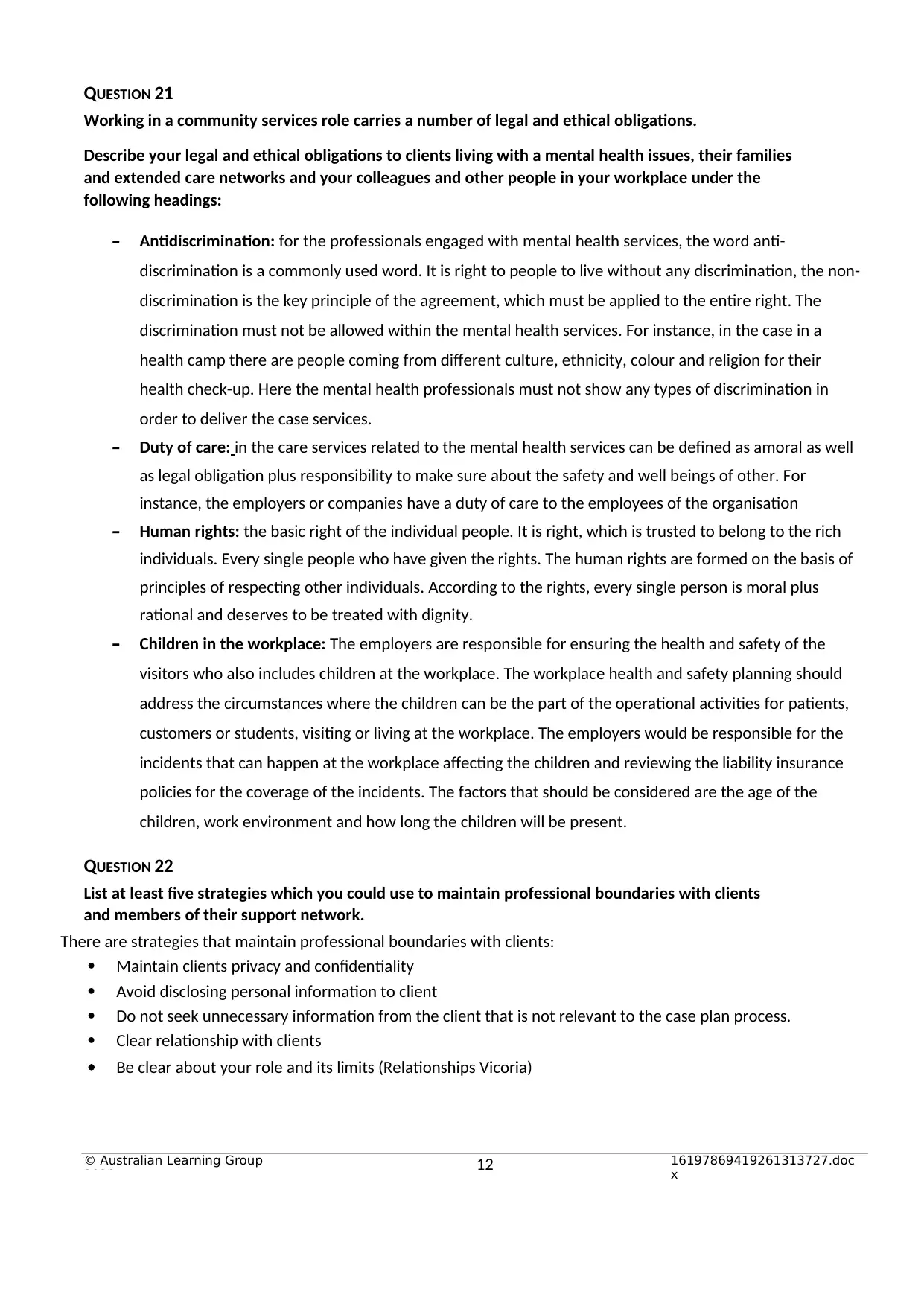
QUESTION 20
Although you may not be working directly with children and young people, there is the potential for you to
become aware of potential child abuse or neglect in the course of your work. Mandatory reporting
requirements vary by state and territory in Australia. Explain the mandatory reporting requirements relevant
to your state or territory and work role by completing the following table.
Abuse and neglect types that
must be reported?
Relevant legislation
2020 11 16197869419261313727.doc
x
What must be reported?
Who is mandated to report?
State/territory:
The mandatory reporting is frequently allied to depict the legislative or legal requirement forced on selected
classes of the people for reporting the suspected cases or incidences of child abusing plus negligence of the
government authorities. The mandatory reporting for the community and children services is most essential as it
supports in understanding the key issues related to the specific cases of the children and community. For
instance, in case of the child abuse, the mandatory reporting is most important as its support in detecting the
suspected offenders of the childhood abuse and in these ways the children can be kept in the distance from the
offenders, and it can be possible for delivering required treatment for the victim children. Hence, the social
workers or support workers are mandated to report the suspected child abuse as well as must neglect in the
entire fifty states.
QUESTION 20
Although you may not be working directly with children and young people, there is the potential for you to
become aware of potential child abuse or neglect in the course of your work. Mandatory reporting
requirements vary by state and territory in Australia. Explain the mandatory reporting requirements relevant
to your state or territory and work role by completing the following table.
Abuse and neglect types that
must be reported?
Relevant legislation
© Australian Learning Group
2020 12 16197869419261313727.doc
x
QUESTION 21
Working in a community services role carries a number of legal and ethical obligations.
Describe your legal and ethical obligations to clients living with a mental health issues, their families
and extended care networks and your colleagues and other people in your workplace under the
following headings:
– Antidiscrimination: for the professionals engaged with mental health services, the word anti-
discrimination is a commonly used word. It is right to people to live without any discrimination, the non-
discrimination is the key principle of the agreement, which must be applied to the entire right. The
discrimination must not be allowed within the mental health services. For instance, in the case in a
health camp there are people coming from different culture, ethnicity, colour and religion for their
health check-up. Here the mental health professionals must not show any types of discrimination in
order to deliver the case services.
– Duty of care: in the care services related to the mental health services can be defined as amoral as well
as legal obligation plus responsibility to make sure about the safety and well beings of other. For
instance, the employers or companies have a duty of care to the employees of the organisation
– Human rights: the basic right of the individual people. It is right, which is trusted to belong to the rich
individuals. Every single people who have given the rights. The human rights are formed on the basis of
principles of respecting other individuals. According to the rights, every single person is moral plus
rational and deserves to be treated with dignity.
– Children in the workplace: The employers are responsible for ensuring the health and safety of the
visitors who also includes children at the workplace. The workplace health and safety planning should
address the circumstances where the children can be the part of the operational activities for patients,
customers or students, visiting or living at the workplace. The employers would be responsible for the
incidents that can happen at the workplace affecting the children and reviewing the liability insurance
policies for the coverage of the incidents. The factors that should be considered are the age of the
children, work environment and how long the children will be present.
QUESTION 22
List at least five strategies which you could use to maintain professional boundaries with clients
and members of their support network.
There are strategies that maintain professional boundaries with clients:
Maintain clients privacy and confidentiality
Avoid disclosing personal information to client
Do not seek unnecessary information from the client that is not relevant to the case plan process.
Clear relationship with clients
Be clear about your role and its limits (Relationships Vicoria)
2020 12 16197869419261313727.doc
x
QUESTION 21
Working in a community services role carries a number of legal and ethical obligations.
Describe your legal and ethical obligations to clients living with a mental health issues, their families
and extended care networks and your colleagues and other people in your workplace under the
following headings:
– Antidiscrimination: for the professionals engaged with mental health services, the word anti-
discrimination is a commonly used word. It is right to people to live without any discrimination, the non-
discrimination is the key principle of the agreement, which must be applied to the entire right. The
discrimination must not be allowed within the mental health services. For instance, in the case in a
health camp there are people coming from different culture, ethnicity, colour and religion for their
health check-up. Here the mental health professionals must not show any types of discrimination in
order to deliver the case services.
– Duty of care: in the care services related to the mental health services can be defined as amoral as well
as legal obligation plus responsibility to make sure about the safety and well beings of other. For
instance, the employers or companies have a duty of care to the employees of the organisation
– Human rights: the basic right of the individual people. It is right, which is trusted to belong to the rich
individuals. Every single people who have given the rights. The human rights are formed on the basis of
principles of respecting other individuals. According to the rights, every single person is moral plus
rational and deserves to be treated with dignity.
– Children in the workplace: The employers are responsible for ensuring the health and safety of the
visitors who also includes children at the workplace. The workplace health and safety planning should
address the circumstances where the children can be the part of the operational activities for patients,
customers or students, visiting or living at the workplace. The employers would be responsible for the
incidents that can happen at the workplace affecting the children and reviewing the liability insurance
policies for the coverage of the incidents. The factors that should be considered are the age of the
children, work environment and how long the children will be present.
QUESTION 22
List at least five strategies which you could use to maintain professional boundaries with clients
and members of their support network.
There are strategies that maintain professional boundaries with clients:
Maintain clients privacy and confidentiality
Avoid disclosing personal information to client
Do not seek unnecessary information from the client that is not relevant to the case plan process.
Clear relationship with clients
Be clear about your role and its limits (Relationships Vicoria)
⊘ This is a preview!⊘
Do you want full access?
Subscribe today to unlock all pages.
Trusted by 1+ million students worldwide

1 out of 16


Related Documents


Your All-in-One AI-Powered Toolkit for Academic Success.
+13062052269
info@desklib.com
Available 24*7 on WhatsApp / Email
![[object Object]](/_next/static/media/star-bottom.7253800d.svg)
Unlock your academic potential
Copyright © 2020–2026 A2Z Services. All Rights Reserved. Developed and managed by ZUCOL.