Mental Health Crisis: Community Disaster and Referral Plan Report
VerifiedAdded on 2021/11/18
|9
|1969
|44
Report
AI Summary
This report outlines a comprehensive community disaster and referral plan designed for mental health crises, specifically tailored for North West Washington. It begins by emphasizing the unpredictable nature of disasters and the crucial role of mental health professionals. The plan details response strategies, intervention strategies, and interfacing agency strategies to provide immediate support. It covers crisis debriefing strategies to address emotional and traumatic experiences, and provides a treatment plan addressing physical exhaustion, negative thinking, traumatic situations, detachment, and spiritual disillusionment. The plan emphasizes the ethical duty to help individuals return to a pre-crisis state, incorporating various therapeutic approaches like cognitive behavioral therapy, and stress management techniques. The report underscores the importance of preparation, effective communication, and tailored interventions to ensure the well-being of the community during and after a crisis.
COMMUNITY DISASTER AND REFERRAL
PLAN
PLAN

Paraphrase This Document
Need a fresh take? Get an instant paraphrase of this document with our AI Paraphraser
Table of Contents
Disaster plan....................................................................................................................................2
Response strategy............................................................................................................................2
Intervention strategies..................................................................................................................3
Interfacing agency strategy..........................................................................................................3
Crisis debriefing strategy.............................................................................................................3
Providing assistance to the individuals to return pre-crisis stage................................................4
The treatment plan...........................................................................................................................4
Reference list...................................................................................................................................7
1 | P a g e
Disaster plan....................................................................................................................................2
Response strategy............................................................................................................................2
Intervention strategies..................................................................................................................3
Interfacing agency strategy..........................................................................................................3
Crisis debriefing strategy.............................................................................................................3
Providing assistance to the individuals to return pre-crisis stage................................................4
The treatment plan...........................................................................................................................4
Reference list...................................................................................................................................7
1 | P a g e
Disaster plan
Disasters happen are most unpredictable manner. It is an unavoidable incident that the mental
health professionals of North West Washington have to face. However, mental health
professionals need to be steady enough to counter any type of disaster (RM, 2017). The
communities are greatly dependant on the mental health professionals during the crisis time. The
mental health professionals need to choose specific strategies to enhance the treatment procedure
of the community mental health disasters (RM, 2017). Strategies are taken by mental health
professionals to mitigate the disaster of mental health.
Response strategy
The strategy starts by preparing the community people to respond to the mental health
intervention process. It is necessary to align the intervention process with the arising crisis for
the quick mental health recovery (Brooks, 2017). The mental health information of the patient is
essential here to locate the crisis. Moreover, this could be helpful for the mental health
professionals of North West Washington to understand both the suffering and the reaction of the
suffering of the patient. The analysis of the information is effective enough to understand the
stage of the mental health problem the patient belongs (Retrieved from counseling.org on June
24, 2018). Apart from that, the analysis is helpful to measure the recovery stage; whether it is
just occurred or continuing for months or it can be recovered easily. The situational
understanding the most essential criteria of the mental health analysis. The American Counseling
Association (ACA) has classified the mental health situation in three specific parts; emotionally
stressful event, the sudden occurrence of the critical situation and a traumatized emotional effect
("American Counseling Association | A professional home for counselors", 2018).
The determination of the crisis situation is the most helpful situation for the mental health
professionals to locate the problem and process the intervention plan effectively. Strategies must
be implemented keeping alignment with the mental health problem for the best outcome (Young,
Ford, Ruzek, Friedman & Gusman, 2018). Additionally, emotional and cognitive supports are
also required for the patient’s recovery.
2 | P a g e
Disasters happen are most unpredictable manner. It is an unavoidable incident that the mental
health professionals of North West Washington have to face. However, mental health
professionals need to be steady enough to counter any type of disaster (RM, 2017). The
communities are greatly dependant on the mental health professionals during the crisis time. The
mental health professionals need to choose specific strategies to enhance the treatment procedure
of the community mental health disasters (RM, 2017). Strategies are taken by mental health
professionals to mitigate the disaster of mental health.
Response strategy
The strategy starts by preparing the community people to respond to the mental health
intervention process. It is necessary to align the intervention process with the arising crisis for
the quick mental health recovery (Brooks, 2017). The mental health information of the patient is
essential here to locate the crisis. Moreover, this could be helpful for the mental health
professionals of North West Washington to understand both the suffering and the reaction of the
suffering of the patient. The analysis of the information is effective enough to understand the
stage of the mental health problem the patient belongs (Retrieved from counseling.org on June
24, 2018). Apart from that, the analysis is helpful to measure the recovery stage; whether it is
just occurred or continuing for months or it can be recovered easily. The situational
understanding the most essential criteria of the mental health analysis. The American Counseling
Association (ACA) has classified the mental health situation in three specific parts; emotionally
stressful event, the sudden occurrence of the critical situation and a traumatized emotional effect
("American Counseling Association | A professional home for counselors", 2018).
The determination of the crisis situation is the most helpful situation for the mental health
professionals to locate the problem and process the intervention plan effectively. Strategies must
be implemented keeping alignment with the mental health problem for the best outcome (Young,
Ford, Ruzek, Friedman & Gusman, 2018). Additionally, emotional and cognitive supports are
also required for the patient’s recovery.
2 | P a g e
⊘ This is a preview!⊘
Do you want full access?
Subscribe today to unlock all pages.

Trusted by 1+ million students worldwide
Intervention strategies
The foundation for effective intervention strategies is essential to promote the recovery process
of the mental health patient. In this occasion, the mental health professionals of North West
Washington are considered to be the second respondent. Thus, they are bound to support the
formation of mental health strategies (Young, Ford, Ruzek, Friedman & Gusman, 2018). The
mental health professionals of North West Washington need to connect with other mental health
workers to formulate strategies immediately after the response. The information must be
gathered regarding the mental health issue (Candy, 2016). Thereafter, effective communication
must be built up to assist and connect the survivors. The strategies can be formulated as follows
Interfacing agency strategy
The interfacing strategy demonstrates the effectiveness of the mental caregiving in response to
the clinical crisis. The clinicians must carry a profound knowledge regarding the necessary skills
for mental care (Enos, 2016). The mental care administrative team must take initiative to
monitor the future activities of the clinicians. Additionally, sufficient funding, proper timing, and
optimization of assessment are also required.
The administrative team must notice and locate the number of clinicians in order to understand
the type of disaster. The referral guide must also be provided for effective communication. The
communication can be beneficial to protect, care and support the emergency responders (Brice,
Gregg, Sawyer & Cyr, 2017). The implementation of the further strategies must be implemented
for the counseling process to trigger the safety issues.
Crisis debriefing strategy
The immediate assistance is required for the mental health crisis. As per the researchers, a
structural attempt is always impactful on the sensuous development of the crisis experience. The
debriefing stage can be implemented by the mental health professionals of North West
Washington through a regular conversation regarding the crisis experiences (Evangelista et al.,
2016). The facts, symptoms, and reactions must be properly noted and categorized through
several data process. The data processor also includes the emotional gesture, physical
experience, and trauma care. The final process includes the data re-entry. The situational
experience and traumatic experiences are reanalyzed to conceptualize in the re-entry process
3 | P a g e
The foundation for effective intervention strategies is essential to promote the recovery process
of the mental health patient. In this occasion, the mental health professionals of North West
Washington are considered to be the second respondent. Thus, they are bound to support the
formation of mental health strategies (Young, Ford, Ruzek, Friedman & Gusman, 2018). The
mental health professionals of North West Washington need to connect with other mental health
workers to formulate strategies immediately after the response. The information must be
gathered regarding the mental health issue (Candy, 2016). Thereafter, effective communication
must be built up to assist and connect the survivors. The strategies can be formulated as follows
Interfacing agency strategy
The interfacing strategy demonstrates the effectiveness of the mental caregiving in response to
the clinical crisis. The clinicians must carry a profound knowledge regarding the necessary skills
for mental care (Enos, 2016). The mental care administrative team must take initiative to
monitor the future activities of the clinicians. Additionally, sufficient funding, proper timing, and
optimization of assessment are also required.
The administrative team must notice and locate the number of clinicians in order to understand
the type of disaster. The referral guide must also be provided for effective communication. The
communication can be beneficial to protect, care and support the emergency responders (Brice,
Gregg, Sawyer & Cyr, 2017). The implementation of the further strategies must be implemented
for the counseling process to trigger the safety issues.
Crisis debriefing strategy
The immediate assistance is required for the mental health crisis. As per the researchers, a
structural attempt is always impactful on the sensuous development of the crisis experience. The
debriefing stage can be implemented by the mental health professionals of North West
Washington through a regular conversation regarding the crisis experiences (Evangelista et al.,
2016). The facts, symptoms, and reactions must be properly noted and categorized through
several data process. The data processor also includes the emotional gesture, physical
experience, and trauma care. The final process includes the data re-entry. The situational
experience and traumatic experiences are reanalyzed to conceptualize in the re-entry process
3 | P a g e
Paraphrase This Document
Need a fresh take? Get an instant paraphrase of this document with our AI Paraphraser
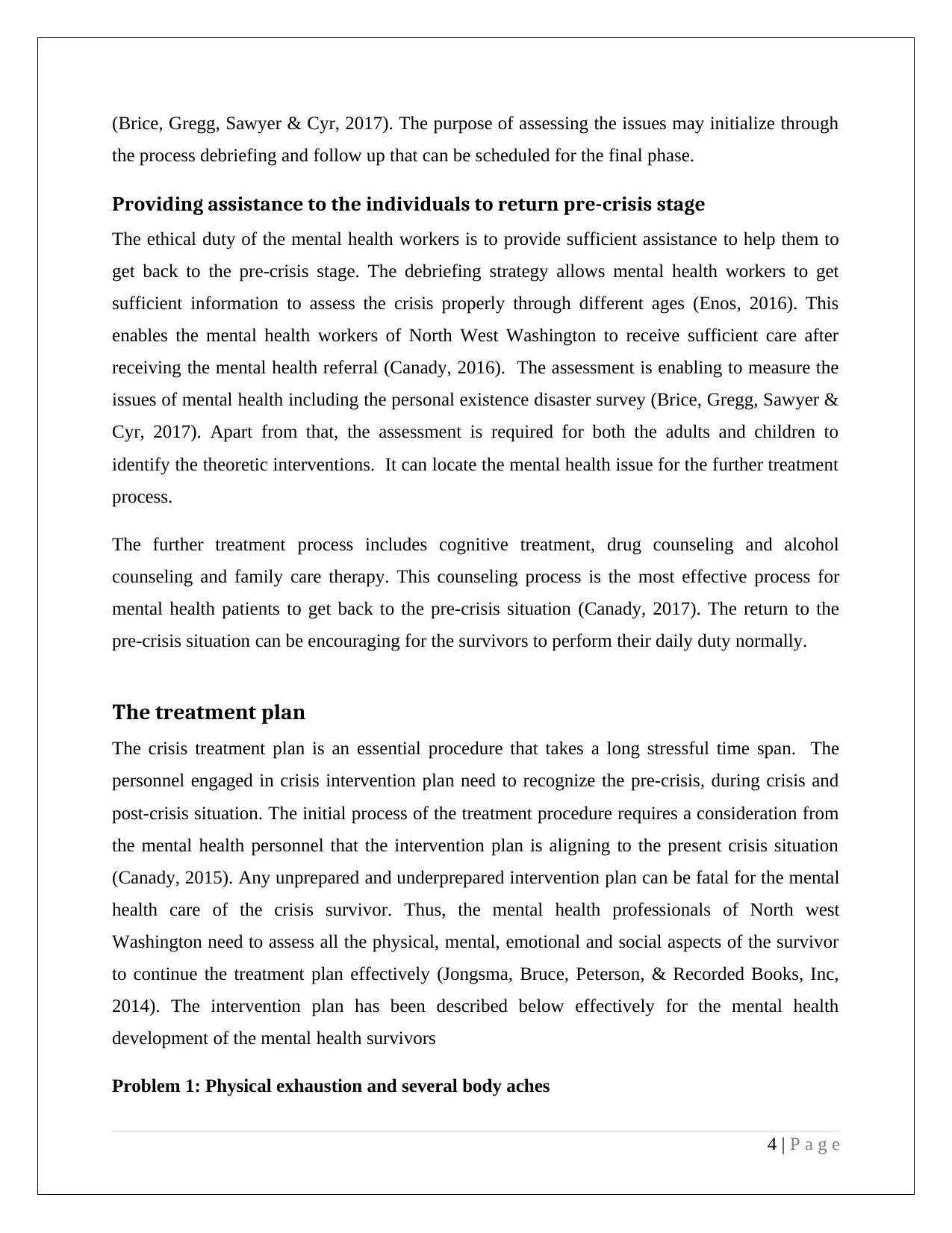
(Brice, Gregg, Sawyer & Cyr, 2017). The purpose of assessing the issues may initialize through
the process debriefing and follow up that can be scheduled for the final phase.
Providing assistance to the individuals to return pre-crisis stage
The ethical duty of the mental health workers is to provide sufficient assistance to help them to
get back to the pre-crisis stage. The debriefing strategy allows mental health workers to get
sufficient information to assess the crisis properly through different ages (Enos, 2016). This
enables the mental health workers of North West Washington to receive sufficient care after
receiving the mental health referral (Canady, 2016). The assessment is enabling to measure the
issues of mental health including the personal existence disaster survey (Brice, Gregg, Sawyer &
Cyr, 2017). Apart from that, the assessment is required for both the adults and children to
identify the theoretic interventions. It can locate the mental health issue for the further treatment
process.
The further treatment process includes cognitive treatment, drug counseling and alcohol
counseling and family care therapy. This counseling process is the most effective process for
mental health patients to get back to the pre-crisis situation (Canady, 2017). The return to the
pre-crisis situation can be encouraging for the survivors to perform their daily duty normally.
The treatment plan
The crisis treatment plan is an essential procedure that takes a long stressful time span. The
personnel engaged in crisis intervention plan need to recognize the pre-crisis, during crisis and
post-crisis situation. The initial process of the treatment procedure requires a consideration from
the mental health personnel that the intervention plan is aligning to the present crisis situation
(Canady, 2015). Any unprepared and underprepared intervention plan can be fatal for the mental
health care of the crisis survivor. Thus, the mental health professionals of North west
Washington need to assess all the physical, mental, emotional and social aspects of the survivor
to continue the treatment plan effectively (Jongsma, Bruce, Peterson, & Recorded Books, Inc,
2014). The intervention plan has been described below effectively for the mental health
development of the mental health survivors
Problem 1: Physical exhaustion and several body aches
4 | P a g e
the process debriefing and follow up that can be scheduled for the final phase.
Providing assistance to the individuals to return pre-crisis stage
The ethical duty of the mental health workers is to provide sufficient assistance to help them to
get back to the pre-crisis stage. The debriefing strategy allows mental health workers to get
sufficient information to assess the crisis properly through different ages (Enos, 2016). This
enables the mental health workers of North West Washington to receive sufficient care after
receiving the mental health referral (Canady, 2016). The assessment is enabling to measure the
issues of mental health including the personal existence disaster survey (Brice, Gregg, Sawyer &
Cyr, 2017). Apart from that, the assessment is required for both the adults and children to
identify the theoretic interventions. It can locate the mental health issue for the further treatment
process.
The further treatment process includes cognitive treatment, drug counseling and alcohol
counseling and family care therapy. This counseling process is the most effective process for
mental health patients to get back to the pre-crisis situation (Canady, 2017). The return to the
pre-crisis situation can be encouraging for the survivors to perform their daily duty normally.
The treatment plan
The crisis treatment plan is an essential procedure that takes a long stressful time span. The
personnel engaged in crisis intervention plan need to recognize the pre-crisis, during crisis and
post-crisis situation. The initial process of the treatment procedure requires a consideration from
the mental health personnel that the intervention plan is aligning to the present crisis situation
(Canady, 2015). Any unprepared and underprepared intervention plan can be fatal for the mental
health care of the crisis survivor. Thus, the mental health professionals of North west
Washington need to assess all the physical, mental, emotional and social aspects of the survivor
to continue the treatment plan effectively (Jongsma, Bruce, Peterson, & Recorded Books, Inc,
2014). The intervention plan has been described below effectively for the mental health
development of the mental health survivors
Problem 1: Physical exhaustion and several body aches
4 | P a g e
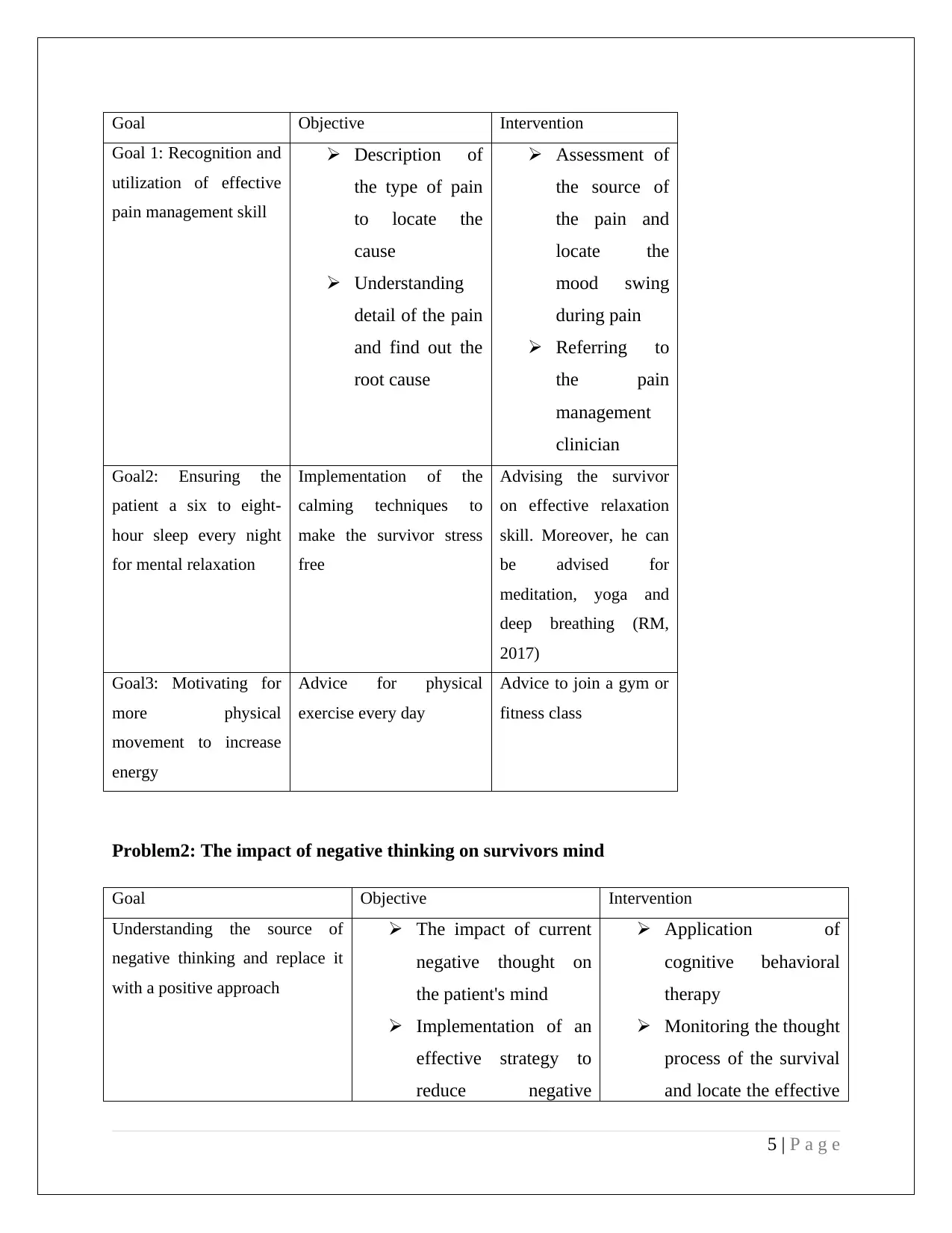
Goal Objective Intervention
Goal 1: Recognition and
utilization of effective
pain management skill
Description of
the type of pain
to locate the
cause
Understanding
detail of the pain
and find out the
root cause
Assessment of
the source of
the pain and
locate the
mood swing
during pain
Referring to
the pain
management
clinician
Goal2: Ensuring the
patient a six to eight-
hour sleep every night
for mental relaxation
Implementation of the
calming techniques to
make the survivor stress
free
Advising the survivor
on effective relaxation
skill. Moreover, he can
be advised for
meditation, yoga and
deep breathing (RM,
2017)
Goal3: Motivating for
more physical
movement to increase
energy
Advice for physical
exercise every day
Advice to join a gym or
fitness class
Problem2: The impact of negative thinking on survivors mind
Goal Objective Intervention
Understanding the source of
negative thinking and replace it
with a positive approach
The impact of current
negative thought on
the patient's mind
Implementation of an
effective strategy to
reduce negative
Application of
cognitive behavioral
therapy
Monitoring the thought
process of the survival
and locate the effective
5 | P a g e
Goal 1: Recognition and
utilization of effective
pain management skill
Description of
the type of pain
to locate the
cause
Understanding
detail of the pain
and find out the
root cause
Assessment of
the source of
the pain and
locate the
mood swing
during pain
Referring to
the pain
management
clinician
Goal2: Ensuring the
patient a six to eight-
hour sleep every night
for mental relaxation
Implementation of the
calming techniques to
make the survivor stress
free
Advising the survivor
on effective relaxation
skill. Moreover, he can
be advised for
meditation, yoga and
deep breathing (RM,
2017)
Goal3: Motivating for
more physical
movement to increase
energy
Advice for physical
exercise every day
Advice to join a gym or
fitness class
Problem2: The impact of negative thinking on survivors mind
Goal Objective Intervention
Understanding the source of
negative thinking and replace it
with a positive approach
The impact of current
negative thought on
the patient's mind
Implementation of an
effective strategy to
reduce negative
Application of
cognitive behavioral
therapy
Monitoring the thought
process of the survival
and locate the effective
5 | P a g e
⊘ This is a preview!⊘
Do you want full access?
Subscribe today to unlock all pages.
Trusted by 1+ million students worldwide
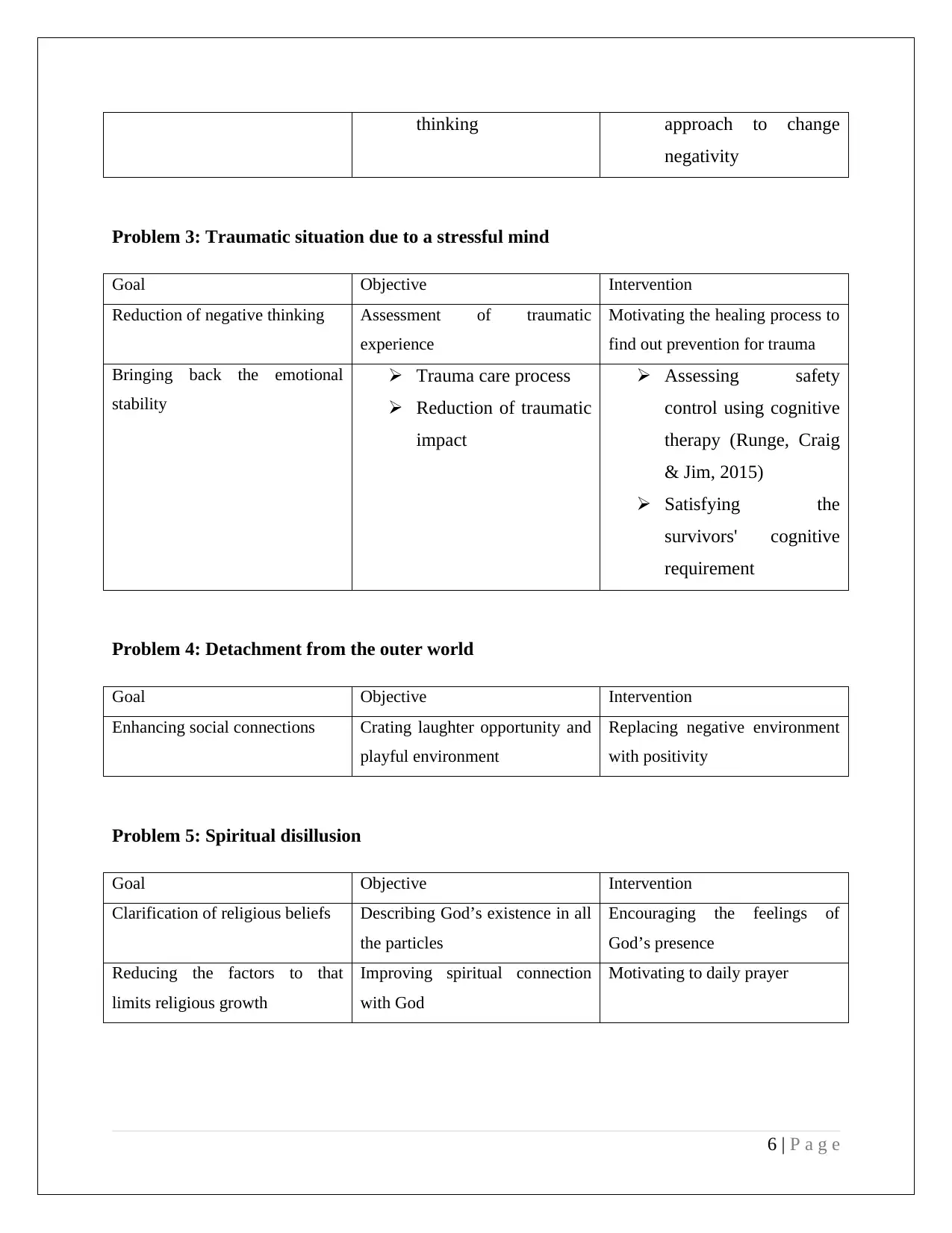
thinking approach to change
negativity
Problem 3: Traumatic situation due to a stressful mind
Goal Objective Intervention
Reduction of negative thinking Assessment of traumatic
experience
Motivating the healing process to
find out prevention for trauma
Bringing back the emotional
stability
Trauma care process
Reduction of traumatic
impact
Assessing safety
control using cognitive
therapy (Runge, Craig
& Jim, 2015)
Satisfying the
survivors' cognitive
requirement
Problem 4: Detachment from the outer world
Goal Objective Intervention
Enhancing social connections Crating laughter opportunity and
playful environment
Replacing negative environment
with positivity
Problem 5: Spiritual disillusion
Goal Objective Intervention
Clarification of religious beliefs Describing God’s existence in all
the particles
Encouraging the feelings of
God’s presence
Reducing the factors to that
limits religious growth
Improving spiritual connection
with God
Motivating to daily prayer
6 | P a g e
negativity
Problem 3: Traumatic situation due to a stressful mind
Goal Objective Intervention
Reduction of negative thinking Assessment of traumatic
experience
Motivating the healing process to
find out prevention for trauma
Bringing back the emotional
stability
Trauma care process
Reduction of traumatic
impact
Assessing safety
control using cognitive
therapy (Runge, Craig
& Jim, 2015)
Satisfying the
survivors' cognitive
requirement
Problem 4: Detachment from the outer world
Goal Objective Intervention
Enhancing social connections Crating laughter opportunity and
playful environment
Replacing negative environment
with positivity
Problem 5: Spiritual disillusion
Goal Objective Intervention
Clarification of religious beliefs Describing God’s existence in all
the particles
Encouraging the feelings of
God’s presence
Reducing the factors to that
limits religious growth
Improving spiritual connection
with God
Motivating to daily prayer
6 | P a g e
Paraphrase This Document
Need a fresh take? Get an instant paraphrase of this document with our AI Paraphraser

7 | P a g e
Reference list
American Counseling Association | A professional home for counselors. (2018). Retrieved from
https://www.counseling.org/
Brice, J., Gregg, D., Sawyer, D., & Cyr, J. (2017). Survey of Hospital Employees’ Personal
Preparedness and Willingness to Work Following a Disaster. Southern Medical
Journal, 110(8), 516-522. doi: 10.14423/smj.0000000000000680
Brooks, J., (2017). Crisis Intervention: The Neurobiology of Crisis. Carol Stream, IL.: Tyndale
House Publishers.
Canady, V. (2015). SAMHSA releases 5-point plan to improve mental health. Mental Health
Weekly, 25(8), 7-7. doi: 10.1002/mhw.30087
Canady, V. (2016). Health system donation supports Mental Health First Aid. Mental Health
Weekly, 26(39), 7-7. doi: 10.1002/mhw.30786
Canady, V. (2017). MHA annual state of mental health report finds youth in crisis. Mental
Health Weekly, 27(46), 3-4. doi: 10.1002/mhw.31275
Enos, G. (2016). New York leaders see loan repayment as key strategy to lure
psychiatrists. Mental Health Weekly, 26(35), 1-7. doi: 10.1002/mhw.30746
Jongsma, A. E., Bruce, T. J., Peterson, L. M., & Recorded Books, Inc. (2014). The Complete
Adult Psychotherapy Treatment Planner: Includes Dsm-5 Updates. Hoboken, N.J: Wiley.
RM, M. (2017). Substance Misuse Assessment in Mental Health Services: The Importance of
Professional Curiosity. Psychology & Psychological Research International Journal, 2(4).
doi: 10.23880/pprij-16000135
Runge, S., Craig, B., & Jim, H. (2015). Word Recall: Cognitive Performance Within Internet
Surveys. JMIR Mental Health, 2(2), e20. doi: 10.2196/mental.3969
Trauma and Disaster Mental Health. (n.d.). Retrieved June 24, 2018, from
https://www.counseling.org/knowledge-center/trauma-disaster
8 | P a g e
American Counseling Association | A professional home for counselors. (2018). Retrieved from
https://www.counseling.org/
Brice, J., Gregg, D., Sawyer, D., & Cyr, J. (2017). Survey of Hospital Employees’ Personal
Preparedness and Willingness to Work Following a Disaster. Southern Medical
Journal, 110(8), 516-522. doi: 10.14423/smj.0000000000000680
Brooks, J., (2017). Crisis Intervention: The Neurobiology of Crisis. Carol Stream, IL.: Tyndale
House Publishers.
Canady, V. (2015). SAMHSA releases 5-point plan to improve mental health. Mental Health
Weekly, 25(8), 7-7. doi: 10.1002/mhw.30087
Canady, V. (2016). Health system donation supports Mental Health First Aid. Mental Health
Weekly, 26(39), 7-7. doi: 10.1002/mhw.30786
Canady, V. (2017). MHA annual state of mental health report finds youth in crisis. Mental
Health Weekly, 27(46), 3-4. doi: 10.1002/mhw.31275
Enos, G. (2016). New York leaders see loan repayment as key strategy to lure
psychiatrists. Mental Health Weekly, 26(35), 1-7. doi: 10.1002/mhw.30746
Jongsma, A. E., Bruce, T. J., Peterson, L. M., & Recorded Books, Inc. (2014). The Complete
Adult Psychotherapy Treatment Planner: Includes Dsm-5 Updates. Hoboken, N.J: Wiley.
RM, M. (2017). Substance Misuse Assessment in Mental Health Services: The Importance of
Professional Curiosity. Psychology & Psychological Research International Journal, 2(4).
doi: 10.23880/pprij-16000135
Runge, S., Craig, B., & Jim, H. (2015). Word Recall: Cognitive Performance Within Internet
Surveys. JMIR Mental Health, 2(2), e20. doi: 10.2196/mental.3969
Trauma and Disaster Mental Health. (n.d.). Retrieved June 24, 2018, from
https://www.counseling.org/knowledge-center/trauma-disaster
8 | P a g e
⊘ This is a preview!⊘
Do you want full access?
Subscribe today to unlock all pages.
Trusted by 1+ million students worldwide

1 out of 9


Your All-in-One AI-Powered Toolkit for Academic Success.
+13062052269
info@desklib.com
Available 24*7 on WhatsApp / Email
![[object Object]](/_next/static/media/star-bottom.7253800d.svg)
Unlock your academic potential
Copyright © 2020–2026 A2Z Services. All Rights Reserved. Developed and managed by ZUCOL.