Mental Health Nursing: Applying Recovery and Therapeutic Relationships
VerifiedAdded on 2023/06/07
|11
|2822
|137
Essay
AI Summary
This essay delves into the concept of recovery in mental health nursing, emphasizing its dynamic nature and the importance of individual agency. It highlights key principles such as uniqueness, attitudes and rights, hope, and partnership in fostering recovery. The essay also discusses how psychiatric nurses utilize the recovery process to assess treatment effectiveness, goal achievement, and the improvement of social functioning. Furthermore, it examines the phases of therapeutic relationships between nurses and patients—orientation, identification, exploitation, and resolution—and underscores the necessity of communication skills and trust-building. Finally, it emphasizes the interconnectedness of therapeutic relationships and recovery principles, highlighting their shared goals of empowering patients, promoting shared decision-making, and improving the overall quality of mental healthcare. Desklib offers a wide array of resources including past papers and solved assignments to aid students in their studies.
MENTAL HEALTH- NURSING
Name:
Institution:
Instructor:
Course:
Date:
Name:
Institution:
Instructor:
Course:
Date:

Paraphrase This Document
Need a fresh take? Get an instant paraphrase of this document with our AI Paraphraser
2
Introduction
Mental health is the ability of every individual to feel, think and act in a way that
improves our capability to enjoy life and develop the ability to face the challenges we face. It is
considered as the emotional and spiritual that appreciates the significance of culture, equity and
respecting personal dignity in the society. On the other side, recovery is identified as a dynamic
process towards finality related to individual normality. Through the recovery process, a person
can rebuild and develop new personal, environmental and social relationship which enables them
to adjust their attitude, feelings, and perception in life. A person with mental illness is said to
have recovered if they change their way of living and start living a healthy life according to
Fortinash & Worret (2014).
Question 1
Recovery is essential in mental health nursing. In mental health, recovery does not
necessarily mean the process of complete recovery from a mental problem as compared to the
way that we may recover from a physical health problem (Brophy, Roper, Hamilton, Tellez &
McSherry, 2016, p.6). Many people view recovery as the process in which they can stay in
control of their life despite experiencing some mental health problem. Healthcare professional in
mental healthcare sector refers to recovery principles to describe this way of thinking. People
undergoing through the recovery process are encouraged to believe that recovery from severe
mental illness is possible and that it does not necessarily mean they should recover completely
and get back to where they were before. They should also be made aware that mental illness can
happen to anyone in the society despite their social background (De Vecchi, Kenny & Kidd,
2015, p.11). The primary purposes of recovery in mental health care to enable individuals to
improve their health and wellness live a self-directed life where they can make their own
Introduction
Mental health is the ability of every individual to feel, think and act in a way that
improves our capability to enjoy life and develop the ability to face the challenges we face. It is
considered as the emotional and spiritual that appreciates the significance of culture, equity and
respecting personal dignity in the society. On the other side, recovery is identified as a dynamic
process towards finality related to individual normality. Through the recovery process, a person
can rebuild and develop new personal, environmental and social relationship which enables them
to adjust their attitude, feelings, and perception in life. A person with mental illness is said to
have recovered if they change their way of living and start living a healthy life according to
Fortinash & Worret (2014).
Question 1
Recovery is essential in mental health nursing. In mental health, recovery does not
necessarily mean the process of complete recovery from a mental problem as compared to the
way that we may recover from a physical health problem (Brophy, Roper, Hamilton, Tellez &
McSherry, 2016, p.6). Many people view recovery as the process in which they can stay in
control of their life despite experiencing some mental health problem. Healthcare professional in
mental healthcare sector refers to recovery principles to describe this way of thinking. People
undergoing through the recovery process are encouraged to believe that recovery from severe
mental illness is possible and that it does not necessarily mean they should recover completely
and get back to where they were before. They should also be made aware that mental illness can
happen to anyone in the society despite their social background (De Vecchi, Kenny & Kidd,
2015, p.11). The primary purposes of recovery in mental health care to enable individuals to
improve their health and wellness live a self-directed life where they can make their own
3
decisions and strive to achieve their objectives in life. There are various principles which are
used in recovery which are made to ensure that healthcare services offered by healthcare
professionals are delivered in a way that improves the recovery process of mental health patients.
The first principle is the uniqueness of the patient. This principle alerts the patients that
recovery is not all about the cure but giving them opportunities to make their own choices which
makes their living meaningful and satisfying. The decisions they make should earn them respect
and be valued by other members of the society. The way various people accepts the outcomes of
recovery results is unique for every individual. According Townsend & Morgan (2017) attitudes
and rights is another principle of recovery in mental health nursing. Mental health professionals
have to listen, learn from the mentally impaired person and act upon the communication and
explain to them what is significant to their life. The government should promote and protect
citizenship and human right to individuals with mental illness. Family members and friends are
advised to support patients with mental illness to enable them to develop social, recreational,
occupational vocational activities which make their life more meaningful (Cowley et al., 2016,
p.33). The mental health professional should instill hopes to the patients to allow them to focus
on their future and the capability to live a useful life. The last principle is partnership and
communication which will allow individuals with mental problems to be able to a socialite with
others quickly and be able to share their problems. Through interactions, mentally challenged
individuals can realize their hopes and goals in life.
Question 2
Psychiatric mental health nurses and other healthcare professionals can use the recovery
process in mental health nursing to determine if the patient is experiencing relief from the
previously presented problems. According to Alligood (2017), when mentally challenged
decisions and strive to achieve their objectives in life. There are various principles which are
used in recovery which are made to ensure that healthcare services offered by healthcare
professionals are delivered in a way that improves the recovery process of mental health patients.
The first principle is the uniqueness of the patient. This principle alerts the patients that
recovery is not all about the cure but giving them opportunities to make their own choices which
makes their living meaningful and satisfying. The decisions they make should earn them respect
and be valued by other members of the society. The way various people accepts the outcomes of
recovery results is unique for every individual. According Townsend & Morgan (2017) attitudes
and rights is another principle of recovery in mental health nursing. Mental health professionals
have to listen, learn from the mentally impaired person and act upon the communication and
explain to them what is significant to their life. The government should promote and protect
citizenship and human right to individuals with mental illness. Family members and friends are
advised to support patients with mental illness to enable them to develop social, recreational,
occupational vocational activities which make their life more meaningful (Cowley et al., 2016,
p.33). The mental health professional should instill hopes to the patients to allow them to focus
on their future and the capability to live a useful life. The last principle is partnership and
communication which will allow individuals with mental problems to be able to a socialite with
others quickly and be able to share their problems. Through interactions, mentally challenged
individuals can realize their hopes and goals in life.
Question 2
Psychiatric mental health nurses and other healthcare professionals can use the recovery
process in mental health nursing to determine if the patient is experiencing relief from the
previously presented problems. According to Alligood (2017), when mentally challenged
⊘ This is a preview!⊘
Do you want full access?
Subscribe today to unlock all pages.

Trusted by 1+ million students worldwide
4
individuals are taken to the hospital they have a lot of signs and symptoms of the problem, as
they continue receiving medication and treatment they start to recover from the problem.
Therefore, the recovery process helps psychiatric nurses to evaluate if the symptoms of the
illness have ceased and that they no longer have any effects on individual personal life. With the
help of the recovery process, nurses are also able to identify and analyze the effective treatment
and medication which can make a patient recover quickly. Psychiatric mental health nurses can
also be able to determine if the treatments goals and objectives have been achieved through the
recovery process (Le Boutillier et al., 2015, p.87). This objective may also include a therapeutic
contract. It is also possible to determine if the social functioning of a mentally challenged person
has improved through recovery. People with mental problems most of the time seems to isolate
themselves from other members of the society. As patients continue getting medication and
treatment, they start recovering from the illness in their interpersonal relationship with other
members of the community improves. Recovery enables psychiatric mental health nurses to be
able to analyze and identify if a patient is developing an effective defense mechanism. This is
because a person who cannot achieve adaptive coping strategies will establish a defense
mechanism which will enable them to stabilize with their health status (Shanley & JUBB‐
SHANLEY, 2007, p.734). The mentally challenged individual is termed to be recovering I
mental health nurses noted self-dependence and been able to make their own decision which
makes their life worth living. Psychiatric health care professional use recovery process to
estimate the length of treatment and medication a patient needs to recover fully from mental
illness.
individuals are taken to the hospital they have a lot of signs and symptoms of the problem, as
they continue receiving medication and treatment they start to recover from the problem.
Therefore, the recovery process helps psychiatric nurses to evaluate if the symptoms of the
illness have ceased and that they no longer have any effects on individual personal life. With the
help of the recovery process, nurses are also able to identify and analyze the effective treatment
and medication which can make a patient recover quickly. Psychiatric mental health nurses can
also be able to determine if the treatments goals and objectives have been achieved through the
recovery process (Le Boutillier et al., 2015, p.87). This objective may also include a therapeutic
contract. It is also possible to determine if the social functioning of a mentally challenged person
has improved through recovery. People with mental problems most of the time seems to isolate
themselves from other members of the society. As patients continue getting medication and
treatment, they start recovering from the illness in their interpersonal relationship with other
members of the community improves. Recovery enables psychiatric mental health nurses to be
able to analyze and identify if a patient is developing an effective defense mechanism. This is
because a person who cannot achieve adaptive coping strategies will establish a defense
mechanism which will enable them to stabilize with their health status (Shanley & JUBB‐
SHANLEY, 2007, p.734). The mentally challenged individual is termed to be recovering I
mental health nurses noted self-dependence and been able to make their own decision which
makes their life worth living. Psychiatric health care professional use recovery process to
estimate the length of treatment and medication a patient needs to recover fully from mental
illness.
Paraphrase This Document
Need a fresh take? Get an instant paraphrase of this document with our AI Paraphraser
5
Question 3
Establishing effective and trusting therapeutic relationships with patients is recognized as
an essential component in nursing practices and it is significant for effective healthcare services.
This is because there are various challenges that healthcare professionals face from the patient as
they attend them which makes it very hard for them to deliver high-quality services which can
meet the patient requirement (McGuire et al., 2016, p.81). Some patients are hard to handle
which forces healthcare professionals come up with ways in which they can develop and
maintain a therapeutic relationship with them to be in a position to acquire relevant information
when necessary. There is a theoretical framework made of phases which nurses use to develop a
healthy therapeutic relationship with patients. Orientation phase is the first stage when the nurse
and the patient first meets and some objectives are made (Menendez & Williams, 2015). The
primary purpose of this phase is to build trust and relationship between the nurse and patient.
Both the nurse and the patient are strangers to each other, and they have different expectations
based on their previous encounters. However the limitations of this relationship can be
communicated and solved through greetings, eye contact and mindfulness if the patient's
boundaries (Korteweg & Root, 2017, p.178). The nurse has sought from the patient why they are
seeking medical attention and their goals after the medication and treatment by asking them
questions. The patient and nurse enter into a conversation asking questions and sharing their
opinions which can significantly enhance the therapeutic relationship between them (Slade et al.,
2014, p.12).
Identification is the second phase in which the relationship between the nurse and the
patient begins to develop. The patients or clients start to associate themselves with those people
who accept them. The patient feels free to share their personal experiences with the nurse who
Question 3
Establishing effective and trusting therapeutic relationships with patients is recognized as
an essential component in nursing practices and it is significant for effective healthcare services.
This is because there are various challenges that healthcare professionals face from the patient as
they attend them which makes it very hard for them to deliver high-quality services which can
meet the patient requirement (McGuire et al., 2016, p.81). Some patients are hard to handle
which forces healthcare professionals come up with ways in which they can develop and
maintain a therapeutic relationship with them to be in a position to acquire relevant information
when necessary. There is a theoretical framework made of phases which nurses use to develop a
healthy therapeutic relationship with patients. Orientation phase is the first stage when the nurse
and the patient first meets and some objectives are made (Menendez & Williams, 2015). The
primary purpose of this phase is to build trust and relationship between the nurse and patient.
Both the nurse and the patient are strangers to each other, and they have different expectations
based on their previous encounters. However the limitations of this relationship can be
communicated and solved through greetings, eye contact and mindfulness if the patient's
boundaries (Korteweg & Root, 2017, p.178). The nurse has sought from the patient why they are
seeking medical attention and their goals after the medication and treatment by asking them
questions. The patient and nurse enter into a conversation asking questions and sharing their
opinions which can significantly enhance the therapeutic relationship between them (Slade et al.,
2014, p.12).
Identification is the second phase in which the relationship between the nurse and the
patient begins to develop. The patients or clients start to associate themselves with those people
who accept them. The patient feels free to share their personal experiences with the nurse who
6
encourages them to promote self-acceptance. The patient is in a position to identify the
challenges which need to be worked on to enhance their therapeutic relationship with the nurse.
In this phase, the relationship between the nurse and patient is identified. They accept each
other, identify their problems and identify means of solving them. Exploitation is the third phase
in which the patient exploits all the available healthcare services which are available to them, and
they can select the best medication and treatment based on their interest and need (Smith, 2015).
The nurse helps the patient in choosing the best service which fits their need. A patient may
express a change in the way they communicate which is a new skill used to evaluate the
interpersonal relationship and problems between the nurse and patient are solved. It is the
responsibility of the nurse to continue assessing and helping the patient meet the new needs
which arise. The last phase of the therapeutic relationship between nurse and patient is the
resolution phase. In this phase, the patient no longer needs healthcare services, and they develop
new goals and abandons the old ones. Patients are now in a position to apply new problem-
solving skills and maintain changes in communication and interaction style with their nurses.
Both the patient and the healthcare professional experience growth in their therapeutic
relationship (Wallis, Sutton & Bassett, 2018, p.122). However, for therapeutic relationship to be
successfully applied and implemented the nurses have to acquire some specific professional
skills which enable them to be in a position to interact effectively with the patients. Nurses need
to have verbal and non-verbal communication skills which will allow them to be able to get
accurate information from the client and be able to give the right medication and treatment to
them. Alliance relationship is significant as they build trust between a nurse and patients
improving the quality of healthcare services.
encourages them to promote self-acceptance. The patient is in a position to identify the
challenges which need to be worked on to enhance their therapeutic relationship with the nurse.
In this phase, the relationship between the nurse and patient is identified. They accept each
other, identify their problems and identify means of solving them. Exploitation is the third phase
in which the patient exploits all the available healthcare services which are available to them, and
they can select the best medication and treatment based on their interest and need (Smith, 2015).
The nurse helps the patient in choosing the best service which fits their need. A patient may
express a change in the way they communicate which is a new skill used to evaluate the
interpersonal relationship and problems between the nurse and patient are solved. It is the
responsibility of the nurse to continue assessing and helping the patient meet the new needs
which arise. The last phase of the therapeutic relationship between nurse and patient is the
resolution phase. In this phase, the patient no longer needs healthcare services, and they develop
new goals and abandons the old ones. Patients are now in a position to apply new problem-
solving skills and maintain changes in communication and interaction style with their nurses.
Both the patient and the healthcare professional experience growth in their therapeutic
relationship (Wallis, Sutton & Bassett, 2018, p.122). However, for therapeutic relationship to be
successfully applied and implemented the nurses have to acquire some specific professional
skills which enable them to be in a position to interact effectively with the patients. Nurses need
to have verbal and non-verbal communication skills which will allow them to be able to get
accurate information from the client and be able to give the right medication and treatment to
them. Alliance relationship is significant as they build trust between a nurse and patients
improving the quality of healthcare services.
⊘ This is a preview!⊘
Do you want full access?
Subscribe today to unlock all pages.
Trusted by 1+ million students worldwide
7
Question 4
Therapeutic relationship and recovery principles are essential components in mental
healthcare. Both therapeutic coalition and recovery principle are made to ensure that there is an
equal relationship between the patient and healthcare professional (Halter, 2018). This
relationship helps nurses to be able to interact effectively, and they can get information about the
patient health condition which enables them to come up with the best decision about the
medication they should administer to the patient to have entirely recovered from their illness
(Fortinash & Worret, 2014). Recovery principle enables nurses and other healthcare
professionals to recognize their skills and expertise. Therefore they can apply them to deliver
quality services to patients and ensure that every person in the society is leading a healthy life
which is worth living (Osborn & Stein, 2016, p.757). Both the therapeutic relationship and
recovery principles allow a patient to participate in decision making. The patient is given a
chance to express their opinion based on the different situation; they can select the type of
medication and treatment which they want to be administered to them and which best meets their
needs (Rienecke, Richmond & Lebow, 2016, p.124). This is very essential as it makes the
patients feel appreciated by the society despite their health status and they are capable of making
valuable decisions in their life making it more enjoyable. They both enhance cooperation and
teamwork among nurses and other healthcare professionals which has led to an improvement in
the qualities of healthcare services they offer to patients.
Conclusion
Recovery is very essential in mental healthcare nursing. Recovery principles are applied
in healthcare institution to ensure that mentally challenged patients are treated with respect and
that they are given an opportunity to express their opinions. The community should not isolate
Question 4
Therapeutic relationship and recovery principles are essential components in mental
healthcare. Both therapeutic coalition and recovery principle are made to ensure that there is an
equal relationship between the patient and healthcare professional (Halter, 2018). This
relationship helps nurses to be able to interact effectively, and they can get information about the
patient health condition which enables them to come up with the best decision about the
medication they should administer to the patient to have entirely recovered from their illness
(Fortinash & Worret, 2014). Recovery principle enables nurses and other healthcare
professionals to recognize their skills and expertise. Therefore they can apply them to deliver
quality services to patients and ensure that every person in the society is leading a healthy life
which is worth living (Osborn & Stein, 2016, p.757). Both the therapeutic relationship and
recovery principles allow a patient to participate in decision making. The patient is given a
chance to express their opinion based on the different situation; they can select the type of
medication and treatment which they want to be administered to them and which best meets their
needs (Rienecke, Richmond & Lebow, 2016, p.124). This is very essential as it makes the
patients feel appreciated by the society despite their health status and they are capable of making
valuable decisions in their life making it more enjoyable. They both enhance cooperation and
teamwork among nurses and other healthcare professionals which has led to an improvement in
the qualities of healthcare services they offer to patients.
Conclusion
Recovery is very essential in mental healthcare nursing. Recovery principles are applied
in healthcare institution to ensure that mentally challenged patients are treated with respect and
that they are given an opportunity to express their opinions. The community should not isolate
Paraphrase This Document
Need a fresh take? Get an instant paraphrase of this document with our AI Paraphraser
8
them because they need a chance to interact with other people so that they can feel valued and
make decisions which are essential in their life. Interactions make them enhance their
communication and interpersonal skills. Therapeutic relationship between nurses and patients is
also crucial in the healthcare sector as it improves patient’s trust and social skills.
them because they need a chance to interact with other people so that they can feel valued and
make decisions which are essential in their life. Interactions make them enhance their
communication and interpersonal skills. Therapeutic relationship between nurses and patients is
also crucial in the healthcare sector as it improves patient’s trust and social skills.
9
Bibliography
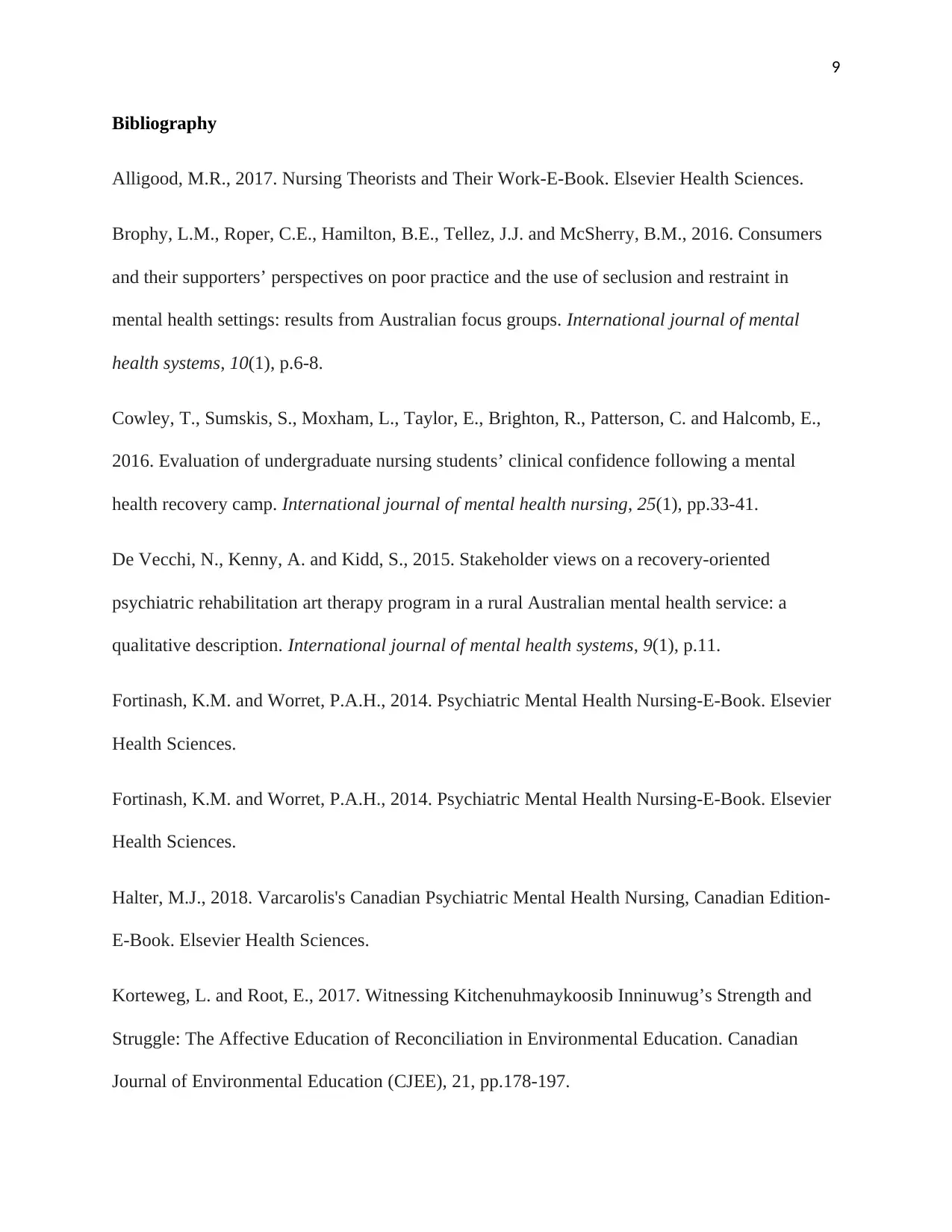
Alligood, M.R., 2017. Nursing Theorists and Their Work-E-Book. Elsevier Health Sciences.
Brophy, L.M., Roper, C.E., Hamilton, B.E., Tellez, J.J. and McSherry, B.M., 2016. Consumers
and their supporters’ perspectives on poor practice and the use of seclusion and restraint in
mental health settings: results from Australian focus groups. International journal of mental
health systems, 10(1), p.6-8.
Cowley, T., Sumskis, S., Moxham, L., Taylor, E., Brighton, R., Patterson, C. and Halcomb, E.,
2016. Evaluation of undergraduate nursing students’ clinical confidence following a mental
health recovery camp. International journal of mental health nursing, 25(1), pp.33-41.
De Vecchi, N., Kenny, A. and Kidd, S., 2015. Stakeholder views on a recovery-oriented
psychiatric rehabilitation art therapy program in a rural Australian mental health service: a
qualitative description. International journal of mental health systems, 9(1), p.11.
Fortinash, K.M. and Worret, P.A.H., 2014. Psychiatric Mental Health Nursing-E-Book. Elsevier
Health Sciences.
Fortinash, K.M. and Worret, P.A.H., 2014. Psychiatric Mental Health Nursing-E-Book. Elsevier
Health Sciences.
Halter, M.J., 2018. Varcarolis's Canadian Psychiatric Mental Health Nursing, Canadian Edition-
E-Book. Elsevier Health Sciences.
Korteweg, L. and Root, E., 2017. Witnessing Kitchenuhmaykoosib Inninuwug’s Strength and
Struggle: The Affective Education of Reconciliation in Environmental Education. Canadian
Journal of Environmental Education (CJEE), 21, pp.178-197.
Bibliography
Alligood, M.R., 2017. Nursing Theorists and Their Work-E-Book. Elsevier Health Sciences.
Brophy, L.M., Roper, C.E., Hamilton, B.E., Tellez, J.J. and McSherry, B.M., 2016. Consumers
and their supporters’ perspectives on poor practice and the use of seclusion and restraint in
mental health settings: results from Australian focus groups. International journal of mental
health systems, 10(1), p.6-8.
Cowley, T., Sumskis, S., Moxham, L., Taylor, E., Brighton, R., Patterson, C. and Halcomb, E.,
2016. Evaluation of undergraduate nursing students’ clinical confidence following a mental
health recovery camp. International journal of mental health nursing, 25(1), pp.33-41.
De Vecchi, N., Kenny, A. and Kidd, S., 2015. Stakeholder views on a recovery-oriented
psychiatric rehabilitation art therapy program in a rural Australian mental health service: a
qualitative description. International journal of mental health systems, 9(1), p.11.
Fortinash, K.M. and Worret, P.A.H., 2014. Psychiatric Mental Health Nursing-E-Book. Elsevier
Health Sciences.
Fortinash, K.M. and Worret, P.A.H., 2014. Psychiatric Mental Health Nursing-E-Book. Elsevier
Health Sciences.
Halter, M.J., 2018. Varcarolis's Canadian Psychiatric Mental Health Nursing, Canadian Edition-
E-Book. Elsevier Health Sciences.
Korteweg, L. and Root, E., 2017. Witnessing Kitchenuhmaykoosib Inninuwug’s Strength and
Struggle: The Affective Education of Reconciliation in Environmental Education. Canadian
Journal of Environmental Education (CJEE), 21, pp.178-197.
⊘ This is a preview!⊘
Do you want full access?
Subscribe today to unlock all pages.
Trusted by 1+ million students worldwide
10
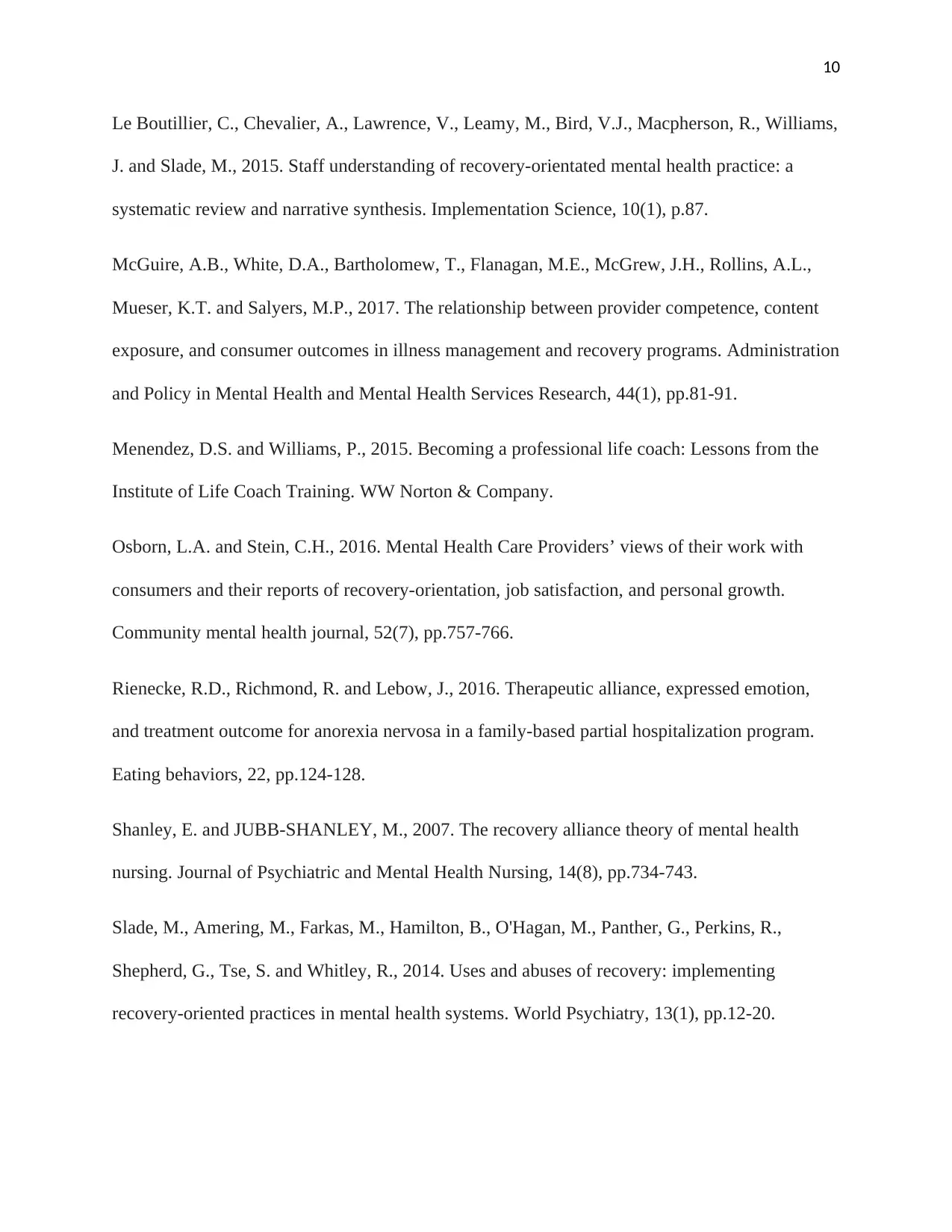
Le Boutillier, C., Chevalier, A., Lawrence, V., Leamy, M., Bird, V.J., Macpherson, R., Williams,
J. and Slade, M., 2015. Staff understanding of recovery-orientated mental health practice: a
systematic review and narrative synthesis. Implementation Science, 10(1), p.87.
McGuire, A.B., White, D.A., Bartholomew, T., Flanagan, M.E., McGrew, J.H., Rollins, A.L.,
Mueser, K.T. and Salyers, M.P., 2017. The relationship between provider competence, content
exposure, and consumer outcomes in illness management and recovery programs. Administration
and Policy in Mental Health and Mental Health Services Research, 44(1), pp.81-91.
Menendez, D.S. and Williams, P., 2015. Becoming a professional life coach: Lessons from the
Institute of Life Coach Training. WW Norton & Company.
Osborn, L.A. and Stein, C.H., 2016. Mental Health Care Providers’ views of their work with
consumers and their reports of recovery-orientation, job satisfaction, and personal growth.
Community mental health journal, 52(7), pp.757-766.
Rienecke, R.D., Richmond, R. and Lebow, J., 2016. Therapeutic alliance, expressed emotion,
and treatment outcome for anorexia nervosa in a family-based partial hospitalization program.
Eating behaviors, 22, pp.124-128.
Shanley, E. and JUBB‐SHANLEY, M., 2007. The recovery alliance theory of mental health
nursing. Journal of Psychiatric and Mental Health Nursing, 14(8), pp.734-743.
Slade, M., Amering, M., Farkas, M., Hamilton, B., O'Hagan, M., Panther, G., Perkins, R.,
Shepherd, G., Tse, S. and Whitley, R., 2014. Uses and abuses of recovery: implementing
recovery‐oriented practices in mental health systems. World Psychiatry, 13(1), pp.12-20.
Le Boutillier, C., Chevalier, A., Lawrence, V., Leamy, M., Bird, V.J., Macpherson, R., Williams,
J. and Slade, M., 2015. Staff understanding of recovery-orientated mental health practice: a
systematic review and narrative synthesis. Implementation Science, 10(1), p.87.
McGuire, A.B., White, D.A., Bartholomew, T., Flanagan, M.E., McGrew, J.H., Rollins, A.L.,
Mueser, K.T. and Salyers, M.P., 2017. The relationship between provider competence, content
exposure, and consumer outcomes in illness management and recovery programs. Administration
and Policy in Mental Health and Mental Health Services Research, 44(1), pp.81-91.
Menendez, D.S. and Williams, P., 2015. Becoming a professional life coach: Lessons from the
Institute of Life Coach Training. WW Norton & Company.
Osborn, L.A. and Stein, C.H., 2016. Mental Health Care Providers’ views of their work with
consumers and their reports of recovery-orientation, job satisfaction, and personal growth.
Community mental health journal, 52(7), pp.757-766.
Rienecke, R.D., Richmond, R. and Lebow, J., 2016. Therapeutic alliance, expressed emotion,
and treatment outcome for anorexia nervosa in a family-based partial hospitalization program.
Eating behaviors, 22, pp.124-128.
Shanley, E. and JUBB‐SHANLEY, M., 2007. The recovery alliance theory of mental health
nursing. Journal of Psychiatric and Mental Health Nursing, 14(8), pp.734-743.
Slade, M., Amering, M., Farkas, M., Hamilton, B., O'Hagan, M., Panther, G., Perkins, R.,
Shepherd, G., Tse, S. and Whitley, R., 2014. Uses and abuses of recovery: implementing
recovery‐oriented practices in mental health systems. World Psychiatry, 13(1), pp.12-20.
Paraphrase This Document
Need a fresh take? Get an instant paraphrase of this document with our AI Paraphraser
11
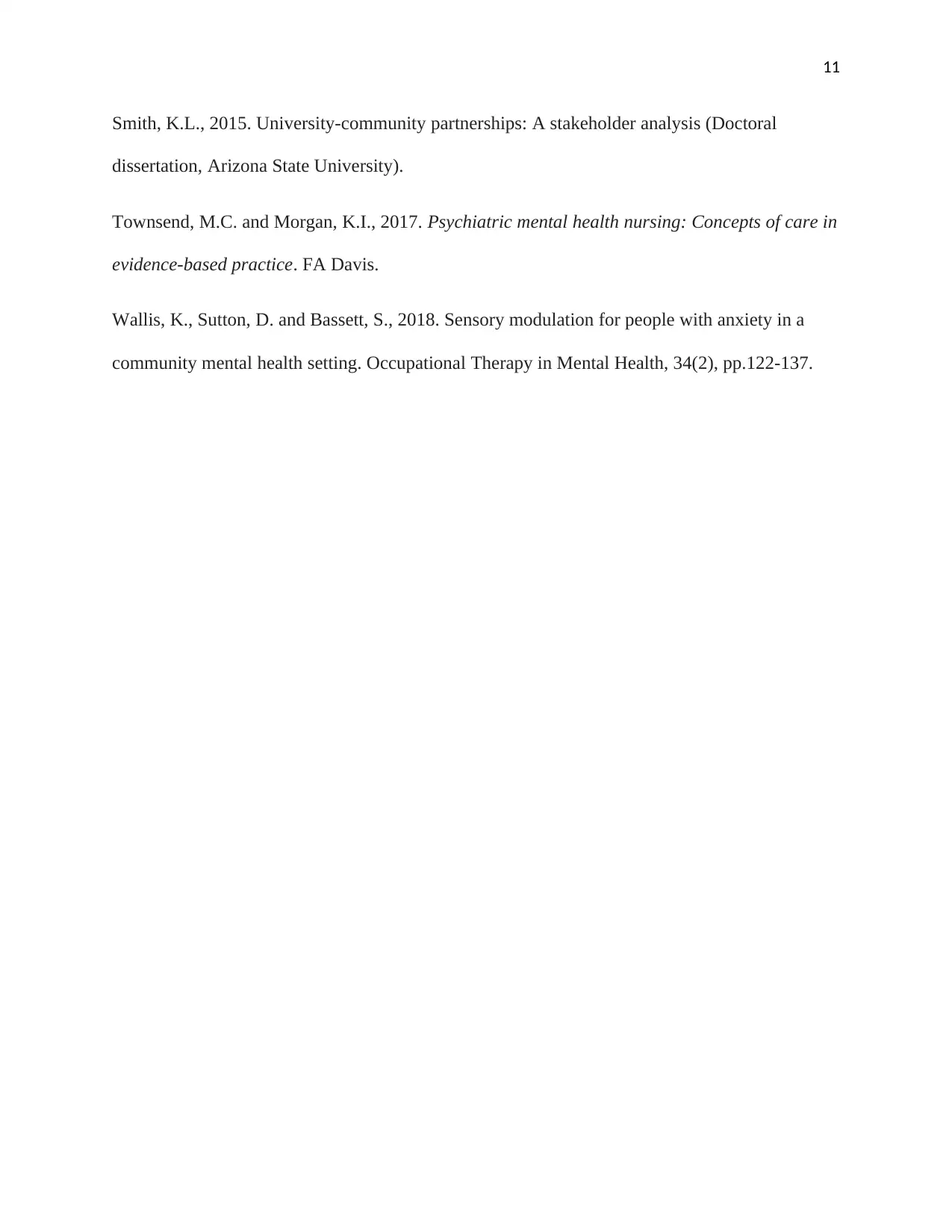
Smith, K.L., 2015. University-community partnerships: A stakeholder analysis (Doctoral
dissertation, Arizona State University).
Townsend, M.C. and Morgan, K.I., 2017. Psychiatric mental health nursing: Concepts of care in
evidence-based practice. FA Davis.
Wallis, K., Sutton, D. and Bassett, S., 2018. Sensory modulation for people with anxiety in a
community mental health setting. Occupational Therapy in Mental Health, 34(2), pp.122-137.
Smith, K.L., 2015. University-community partnerships: A stakeholder analysis (Doctoral
dissertation, Arizona State University).
Townsend, M.C. and Morgan, K.I., 2017. Psychiatric mental health nursing: Concepts of care in
evidence-based practice. FA Davis.
Wallis, K., Sutton, D. and Bassett, S., 2018. Sensory modulation for people with anxiety in a
community mental health setting. Occupational Therapy in Mental Health, 34(2), pp.122-137.

1 out of 11


Related Documents


Your All-in-One AI-Powered Toolkit for Academic Success.
+13062052269
info@desklib.com
Available 24*7 on WhatsApp / Email
![[object Object]](/_next/static/media/star-bottom.7253800d.svg)
Unlock your academic potential
Copyright © 2020–2026 A2Z Services. All Rights Reserved. Developed and managed by ZUCOL.