Academic Skills (Assessment 2): Mental Health Research Report
VerifiedAdded on 2022/12/29
|19
|3325
|86
Report
AI Summary
This report, focusing on the importance of mental health, employs a mixed-methods approach to data collection and analysis. The methodology includes both qualitative and quantitative research methods, utilizing interviews and questionnaires to gather data from a sample of participants. The qualitative data is interpreted from the responses of three interviewees, exploring their perceptions of anxiety, mental illness, and the need for interventions. The quantitative data, derived from questionnaire responses, provides numerical insights into participants' understanding of mental health, their self-rated mental health status, and their experiences with mental health issues. The report analyzes the collected data to draw conclusions about the significance of mental health and the need for interventions, offering recommendations based on the research findings.
Academic Skills
(Assessment 2 – Mental
Health)
(Assessment 2 – Mental
Health)

Paraphrase This Document
Need a fresh take? Get an instant paraphrase of this document with our AI Paraphraser
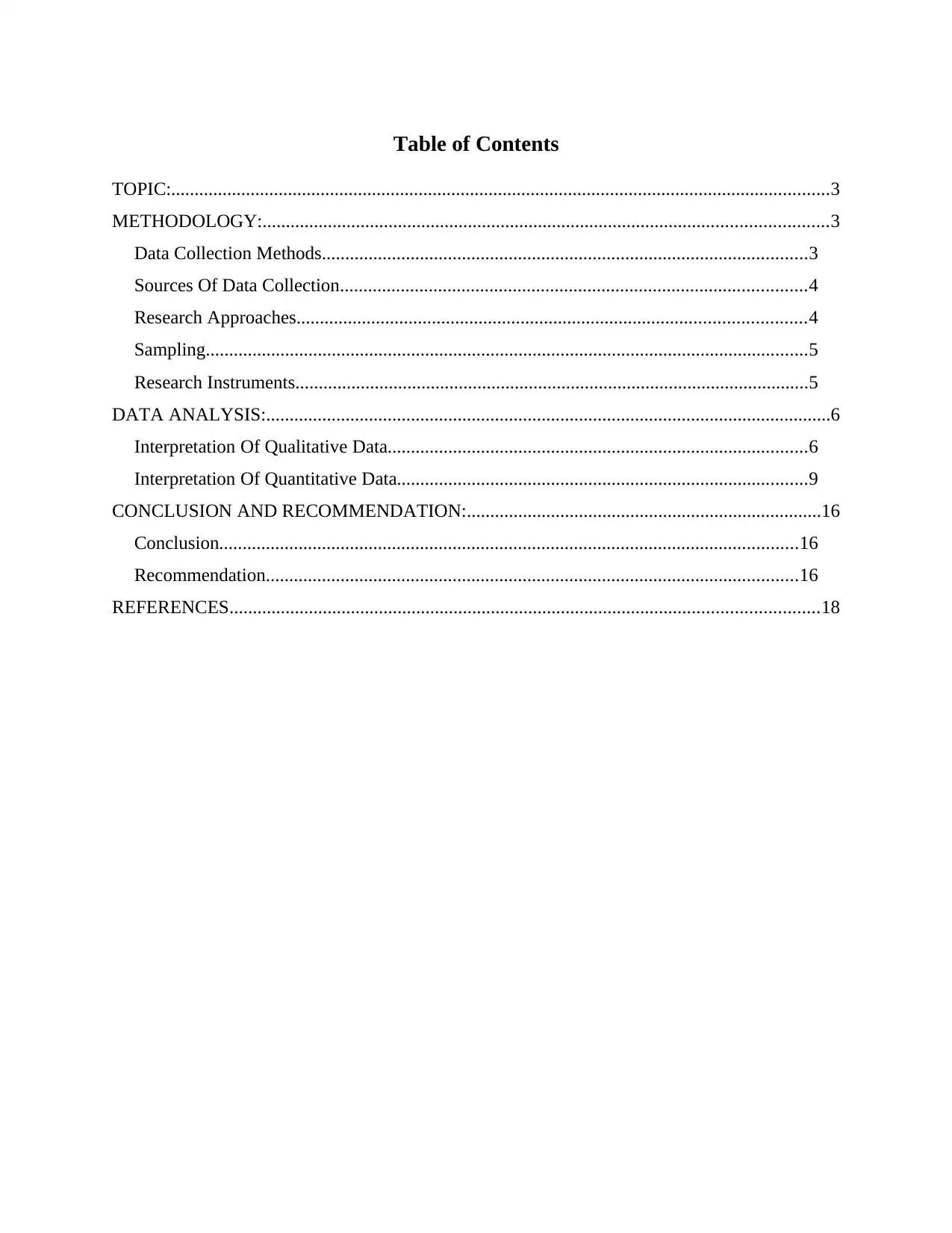
Table of Contents
TOPIC:.............................................................................................................................................3
METHODOLOGY:.........................................................................................................................3
Data Collection Methods........................................................................................................3
Sources Of Data Collection....................................................................................................4
Research Approaches.............................................................................................................4
Sampling.................................................................................................................................5
Research Instruments..............................................................................................................5
DATA ANALYSIS:.........................................................................................................................6
Interpretation Of Qualitative Data..........................................................................................6
Interpretation Of Quantitative Data........................................................................................9
CONCLUSION AND RECOMMENDATION:............................................................................16
Conclusion............................................................................................................................16
Recommendation..................................................................................................................16
REFERENCES..............................................................................................................................18
TOPIC:.............................................................................................................................................3
METHODOLOGY:.........................................................................................................................3
Data Collection Methods........................................................................................................3
Sources Of Data Collection....................................................................................................4
Research Approaches.............................................................................................................4
Sampling.................................................................................................................................5
Research Instruments..............................................................................................................5
DATA ANALYSIS:.........................................................................................................................6
Interpretation Of Qualitative Data..........................................................................................6
Interpretation Of Quantitative Data........................................................................................9
CONCLUSION AND RECOMMENDATION:............................................................................16
Conclusion............................................................................................................................16
Recommendation..................................................................................................................16
REFERENCES..............................................................................................................................18
TOPIC:
“WHY MENTAL HEALTH IS SO IMPORTANT”?
METHODOLOGY:
Research methodology is a specific procedure and process that is used for identifying,
selecting, processing and analysing information about certain topics and research options (Dodds
and Hess, 2020). It offers the researcher an opportunity to systematically design the research and
study their research topic in case of ensuring valid and reliable outcomes which enable the
investigator to collect and present appropriate evidences to support their outcomes and fulfil the
research aims and objectives. At present the research topic is “Mental Health”.
Data Collection Methods
Data collection is defined as a process by which n number of information and data is
accumulated and analysed for gaining better insight in order to provide evidence based
conclusions to the research by using validated techniques. There are two types of data collection
techniques that is quantitative and qualitative which are also used in this research for making
thorough analysis and gathering appropriate data (Babii, 2020).
Qualitative- Research- The research method of Qualitative is used for collecting and
analysing non-numerical data for example text, video, or audio to understand concepts,
opinions and experiences of the respondents. This form of research technique is used for
gathering in-depth insights into a problem as well as generate new ideas for research.
Qualitative research is commonly used in areas of study like humanities and social
sciences in subjects such as anthropology, sociology, education, health sciences, history,
etc.
Quantitative Research- This is a research process by which numerical data is collected
and analysed (Säfsten and Gustavsson, 2020). This is a form of research method which is
used for finding patterns and averages, make predictions, test relationships and generalize
results of a larger and wider segment or population. Quantitative research is just opposite
of qualitative research, which involves collecting and analysing non-numerical data.
Quantitative research outcomes are mostly used in area of social sciences using the
statistical methods which helps in to collect quantitative data from the research study.
“WHY MENTAL HEALTH IS SO IMPORTANT”?
METHODOLOGY:
Research methodology is a specific procedure and process that is used for identifying,
selecting, processing and analysing information about certain topics and research options (Dodds
and Hess, 2020). It offers the researcher an opportunity to systematically design the research and
study their research topic in case of ensuring valid and reliable outcomes which enable the
investigator to collect and present appropriate evidences to support their outcomes and fulfil the
research aims and objectives. At present the research topic is “Mental Health”.
Data Collection Methods
Data collection is defined as a process by which n number of information and data is
accumulated and analysed for gaining better insight in order to provide evidence based
conclusions to the research by using validated techniques. There are two types of data collection
techniques that is quantitative and qualitative which are also used in this research for making
thorough analysis and gathering appropriate data (Babii, 2020).
Qualitative- Research- The research method of Qualitative is used for collecting and
analysing non-numerical data for example text, video, or audio to understand concepts,
opinions and experiences of the respondents. This form of research technique is used for
gathering in-depth insights into a problem as well as generate new ideas for research.
Qualitative research is commonly used in areas of study like humanities and social
sciences in subjects such as anthropology, sociology, education, health sciences, history,
etc.
Quantitative Research- This is a research process by which numerical data is collected
and analysed (Säfsten and Gustavsson, 2020). This is a form of research method which is
used for finding patterns and averages, make predictions, test relationships and generalize
results of a larger and wider segment or population. Quantitative research is just opposite
of qualitative research, which involves collecting and analysing non-numerical data.
Quantitative research outcomes are mostly used in area of social sciences using the
statistical methods which helps in to collect quantitative data from the research study.
⊘ This is a preview!⊘
Do you want full access?
Subscribe today to unlock all pages.

Trusted by 1+ million students worldwide
Sources Of Data Collection
There are number of data collection sources which are used by investigators and
researchers in accordance to the favourableness of their research study and topic on which the
study needs to be conducted. The sources are broadly divided into two:
Primary Data- The primary data collection method is used when the researcher is
gathering information from the respondents and developing a new set of information
which they extract and renders the world with new undetected information. The primary
data collection is a complex and a costly process as it involved huge time and resources
to be completed in an effective manner and dig up value adding evidences. For example,
conducting interviews, surveys, using questionnaires and taking feedbacks these are some
of the data source which are primary in nature and directly accumulated form the
respondents (Sovacool, Del Rio and Griffiths, 2020).
Secondary Data- The secondary research and data collection source is varied in number
which are used by investigators in order to search for the exact and best useful
information for their research. The secondary data source is effective as the work is
already present and the researcher or the investigator only needs to sort and extract the
related information from the existing data. The secondary sources are Online published
articles, newspapers, books and journals etc. The advantage of the same to the
investigator is they do not need to be worrying about the authenticity of the information
as it is already being investigated and proven by the initial researcher (Bell and et. al.,
2020).
Research Approaches
Inductive Research Approach- This form of research approach began when the
researcher starts collecting and gathering data which is highly related to the topic of their
research and study. The inductive research approach is generally attached with using
qualitative research method. This approach requires the users that is the researcher to be
free of any perceptions and existing preconceived ideas.
Deductive Research Approach- The second form of research approach is deductive
which is commonly used while conducting quantitative research and when the
investigator is dealing with numerical data like facts and figures. In such approach
emphasis is placed on causality.
There are number of data collection sources which are used by investigators and
researchers in accordance to the favourableness of their research study and topic on which the
study needs to be conducted. The sources are broadly divided into two:
Primary Data- The primary data collection method is used when the researcher is
gathering information from the respondents and developing a new set of information
which they extract and renders the world with new undetected information. The primary
data collection is a complex and a costly process as it involved huge time and resources
to be completed in an effective manner and dig up value adding evidences. For example,
conducting interviews, surveys, using questionnaires and taking feedbacks these are some
of the data source which are primary in nature and directly accumulated form the
respondents (Sovacool, Del Rio and Griffiths, 2020).
Secondary Data- The secondary research and data collection source is varied in number
which are used by investigators in order to search for the exact and best useful
information for their research. The secondary data source is effective as the work is
already present and the researcher or the investigator only needs to sort and extract the
related information from the existing data. The secondary sources are Online published
articles, newspapers, books and journals etc. The advantage of the same to the
investigator is they do not need to be worrying about the authenticity of the information
as it is already being investigated and proven by the initial researcher (Bell and et. al.,
2020).
Research Approaches
Inductive Research Approach- This form of research approach began when the
researcher starts collecting and gathering data which is highly related to the topic of their
research and study. The inductive research approach is generally attached with using
qualitative research method. This approach requires the users that is the researcher to be
free of any perceptions and existing preconceived ideas.
Deductive Research Approach- The second form of research approach is deductive
which is commonly used while conducting quantitative research and when the
investigator is dealing with numerical data like facts and figures. In such approach
emphasis is placed on causality.
Paraphrase This Document
Need a fresh take? Get an instant paraphrase of this document with our AI Paraphraser
Sampling
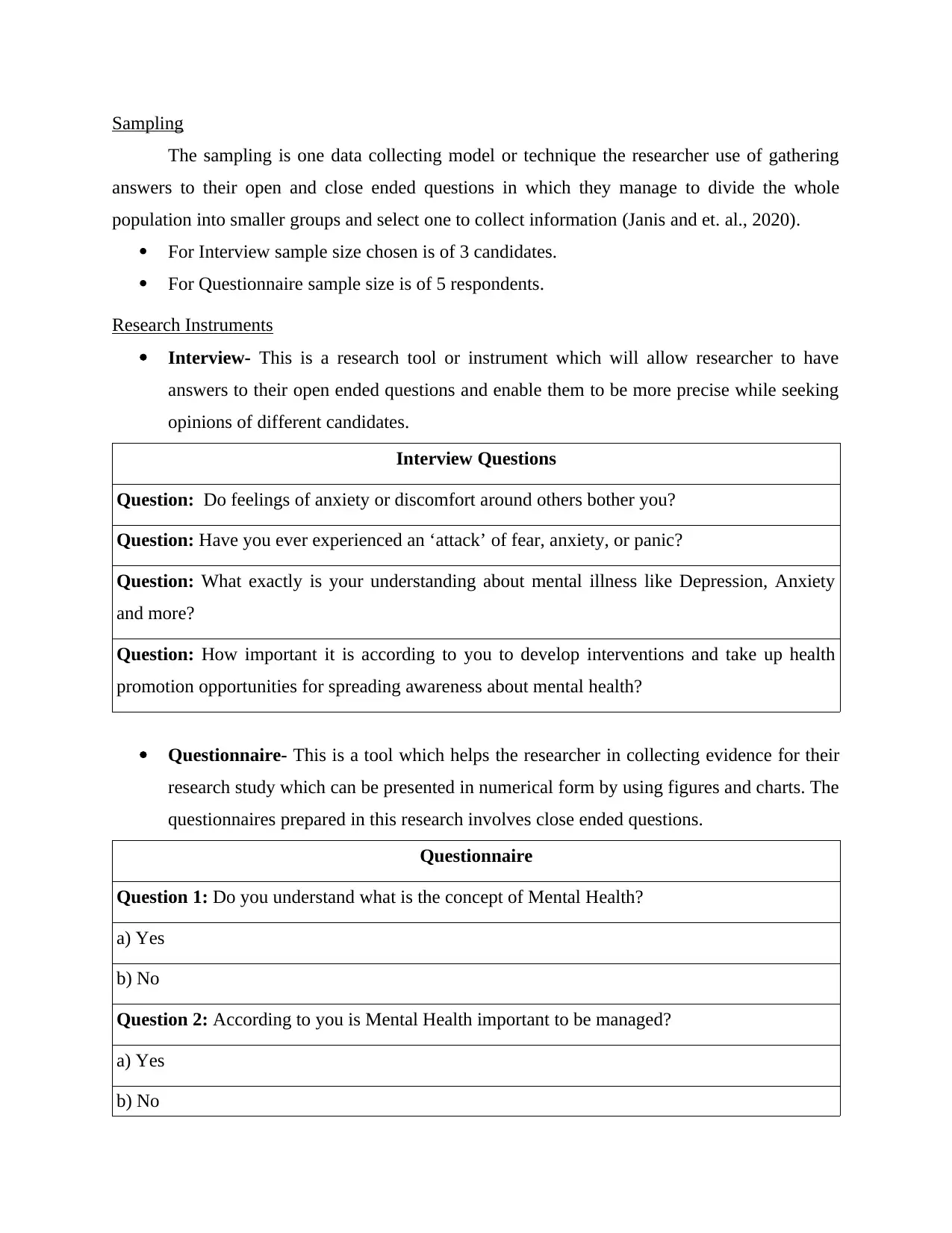
The sampling is one data collecting model or technique the researcher use of gathering
answers to their open and close ended questions in which they manage to divide the whole
population into smaller groups and select one to collect information (Janis and et. al., 2020).
For Interview sample size chosen is of 3 candidates.
For Questionnaire sample size is of 5 respondents.
Research Instruments
Interview- This is a research tool or instrument which will allow researcher to have
answers to their open ended questions and enable them to be more precise while seeking
opinions of different candidates.
Interview Questions
Question: Do feelings of anxiety or discomfort around others bother you?
Question: Have you ever experienced an ‘attack’ of fear, anxiety, or panic?
Question: What exactly is your understanding about mental illness like Depression, Anxiety
and more?
Question: How important it is according to you to develop interventions and take up health
promotion opportunities for spreading awareness about mental health?
Questionnaire- This is a tool which helps the researcher in collecting evidence for their
research study which can be presented in numerical form by using figures and charts. The
questionnaires prepared in this research involves close ended questions.
Questionnaire
Question 1: Do you understand what is the concept of Mental Health?
a) Yes
b) No
Question 2: According to you is Mental Health important to be managed?
a) Yes
b) No
The sampling is one data collecting model or technique the researcher use of gathering
answers to their open and close ended questions in which they manage to divide the whole
population into smaller groups and select one to collect information (Janis and et. al., 2020).
For Interview sample size chosen is of 3 candidates.
For Questionnaire sample size is of 5 respondents.
Research Instruments
Interview- This is a research tool or instrument which will allow researcher to have
answers to their open ended questions and enable them to be more precise while seeking
opinions of different candidates.
Interview Questions
Question: Do feelings of anxiety or discomfort around others bother you?
Question: Have you ever experienced an ‘attack’ of fear, anxiety, or panic?
Question: What exactly is your understanding about mental illness like Depression, Anxiety
and more?
Question: How important it is according to you to develop interventions and take up health
promotion opportunities for spreading awareness about mental health?
Questionnaire- This is a tool which helps the researcher in collecting evidence for their
research study which can be presented in numerical form by using figures and charts. The
questionnaires prepared in this research involves close ended questions.
Questionnaire
Question 1: Do you understand what is the concept of Mental Health?
a) Yes
b) No
Question 2: According to you is Mental Health important to be managed?
a) Yes
b) No
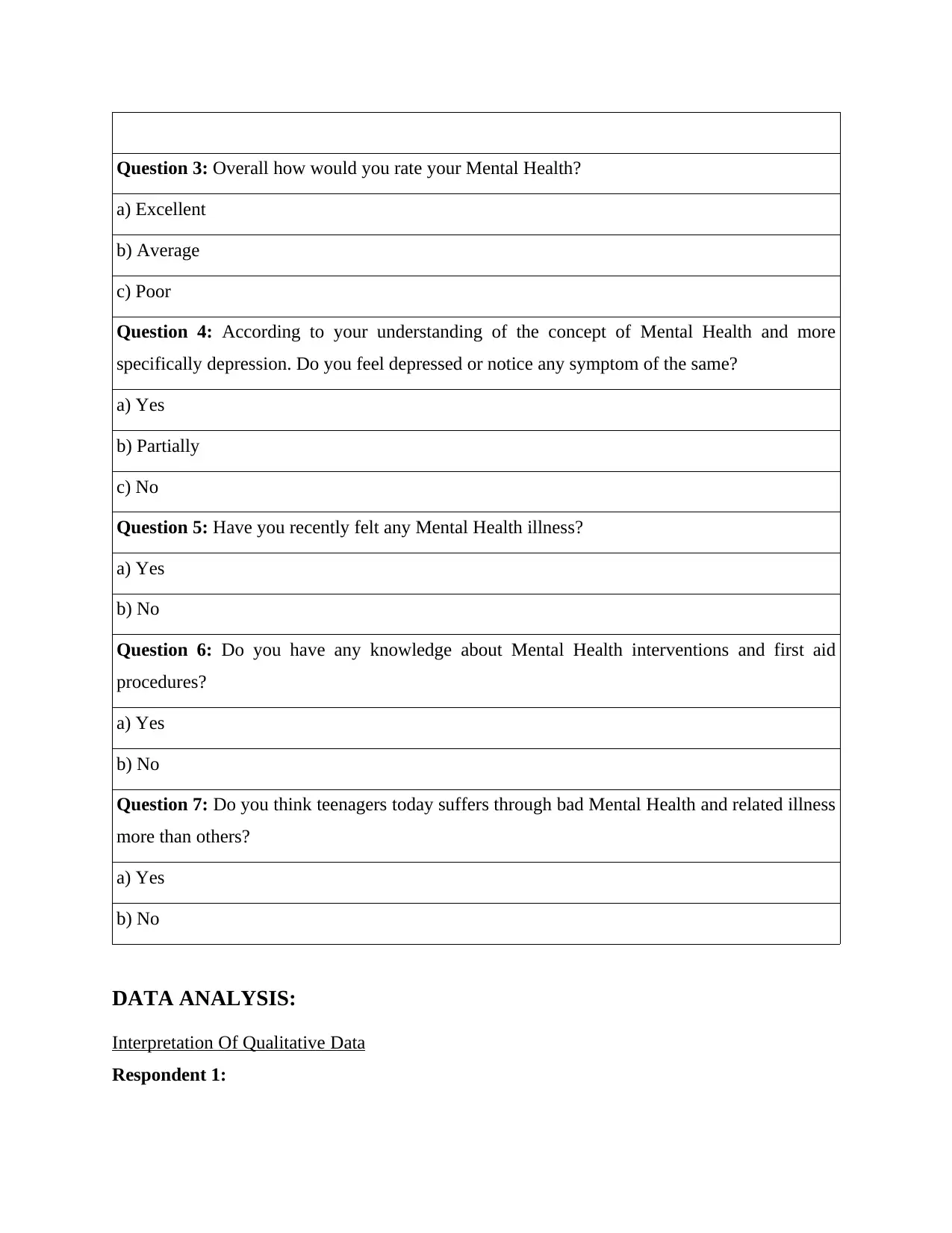
Question 3: Overall how would you rate your Mental Health?
a) Excellent
b) Average
c) Poor
Question 4: According to your understanding of the concept of Mental Health and more
specifically depression. Do you feel depressed or notice any symptom of the same?
a) Yes
b) Partially
c) No
Question 5: Have you recently felt any Mental Health illness?
a) Yes
b) No
Question 6: Do you have any knowledge about Mental Health interventions and first aid
procedures?
a) Yes
b) No
Question 7: Do you think teenagers today suffers through bad Mental Health and related illness
more than others?
a) Yes
b) No
DATA ANALYSIS:
Interpretation Of Qualitative Data
Respondent 1:
a) Excellent
b) Average
c) Poor
Question 4: According to your understanding of the concept of Mental Health and more
specifically depression. Do you feel depressed or notice any symptom of the same?
a) Yes
b) Partially
c) No
Question 5: Have you recently felt any Mental Health illness?
a) Yes
b) No
Question 6: Do you have any knowledge about Mental Health interventions and first aid
procedures?
a) Yes
b) No
Question 7: Do you think teenagers today suffers through bad Mental Health and related illness
more than others?
a) Yes
b) No
DATA ANALYSIS:
Interpretation Of Qualitative Data
Respondent 1:
⊘ This is a preview!⊘
Do you want full access?
Subscribe today to unlock all pages.
Trusted by 1+ million students worldwide
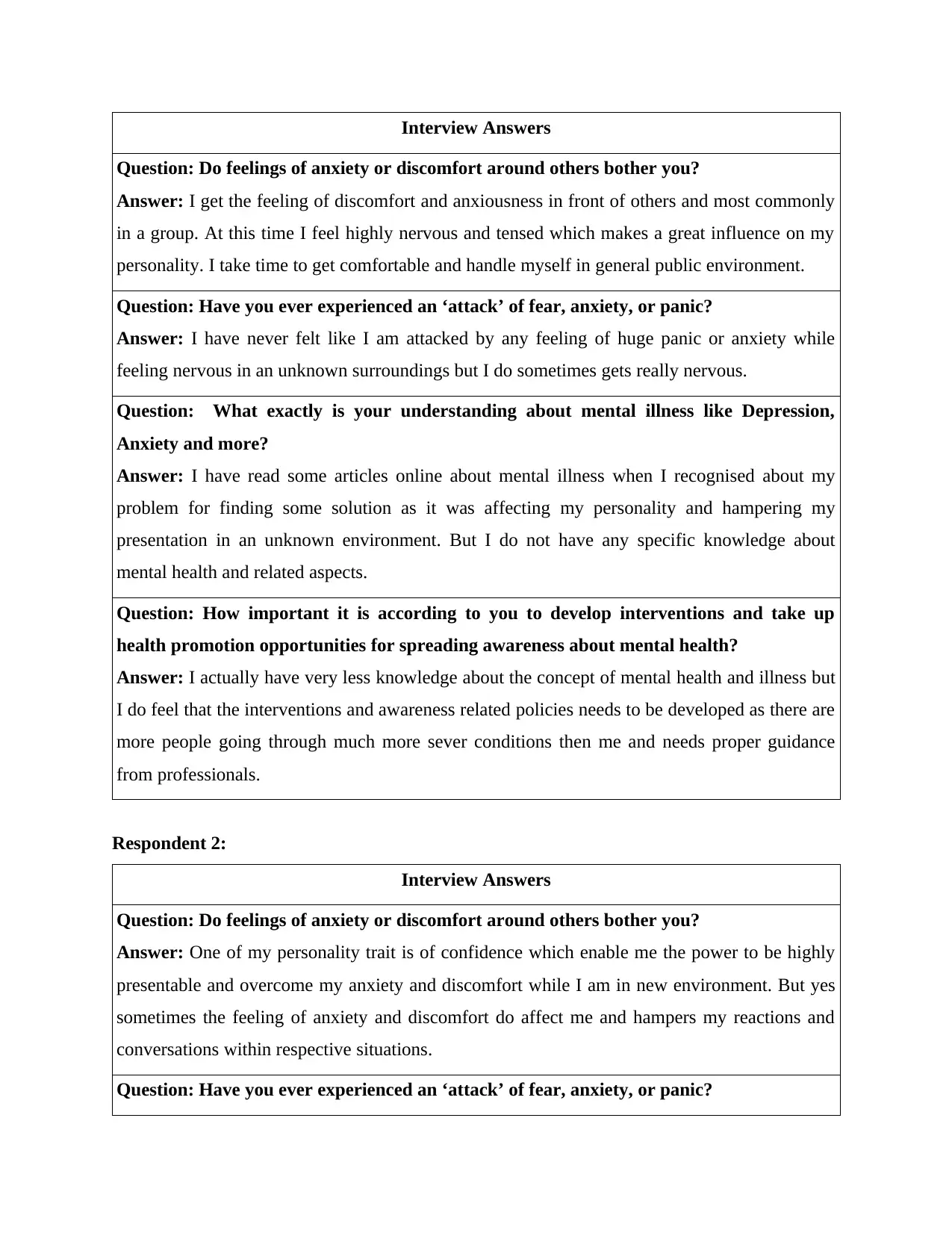
Interview Answers
Question: Do feelings of anxiety or discomfort around others bother you?
Answer: I get the feeling of discomfort and anxiousness in front of others and most commonly
in a group. At this time I feel highly nervous and tensed which makes a great influence on my
personality. I take time to get comfortable and handle myself in general public environment.
Question: Have you ever experienced an ‘attack’ of fear, anxiety, or panic?
Answer: I have never felt like I am attacked by any feeling of huge panic or anxiety while
feeling nervous in an unknown surroundings but I do sometimes gets really nervous.
Question: What exactly is your understanding about mental illness like Depression,
Anxiety and more?
Answer: I have read some articles online about mental illness when I recognised about my
problem for finding some solution as it was affecting my personality and hampering my
presentation in an unknown environment. But I do not have any specific knowledge about
mental health and related aspects.
Question: How important it is according to you to develop interventions and take up
health promotion opportunities for spreading awareness about mental health?
Answer: I actually have very less knowledge about the concept of mental health and illness but
I do feel that the interventions and awareness related policies needs to be developed as there are
more people going through much more sever conditions then me and needs proper guidance
from professionals.
Respondent 2:
Interview Answers
Question: Do feelings of anxiety or discomfort around others bother you?
Answer: One of my personality trait is of confidence which enable me the power to be highly
presentable and overcome my anxiety and discomfort while I am in new environment. But yes
sometimes the feeling of anxiety and discomfort do affect me and hampers my reactions and
conversations within respective situations.
Question: Have you ever experienced an ‘attack’ of fear, anxiety, or panic?
Question: Do feelings of anxiety or discomfort around others bother you?
Answer: I get the feeling of discomfort and anxiousness in front of others and most commonly
in a group. At this time I feel highly nervous and tensed which makes a great influence on my
personality. I take time to get comfortable and handle myself in general public environment.
Question: Have you ever experienced an ‘attack’ of fear, anxiety, or panic?
Answer: I have never felt like I am attacked by any feeling of huge panic or anxiety while
feeling nervous in an unknown surroundings but I do sometimes gets really nervous.
Question: What exactly is your understanding about mental illness like Depression,
Anxiety and more?
Answer: I have read some articles online about mental illness when I recognised about my
problem for finding some solution as it was affecting my personality and hampering my
presentation in an unknown environment. But I do not have any specific knowledge about
mental health and related aspects.
Question: How important it is according to you to develop interventions and take up
health promotion opportunities for spreading awareness about mental health?
Answer: I actually have very less knowledge about the concept of mental health and illness but
I do feel that the interventions and awareness related policies needs to be developed as there are
more people going through much more sever conditions then me and needs proper guidance
from professionals.
Respondent 2:
Interview Answers
Question: Do feelings of anxiety or discomfort around others bother you?
Answer: One of my personality trait is of confidence which enable me the power to be highly
presentable and overcome my anxiety and discomfort while I am in new environment. But yes
sometimes the feeling of anxiety and discomfort do affect me and hampers my reactions and
conversations within respective situations.
Question: Have you ever experienced an ‘attack’ of fear, anxiety, or panic?
Paraphrase This Document
Need a fresh take? Get an instant paraphrase of this document with our AI Paraphraser
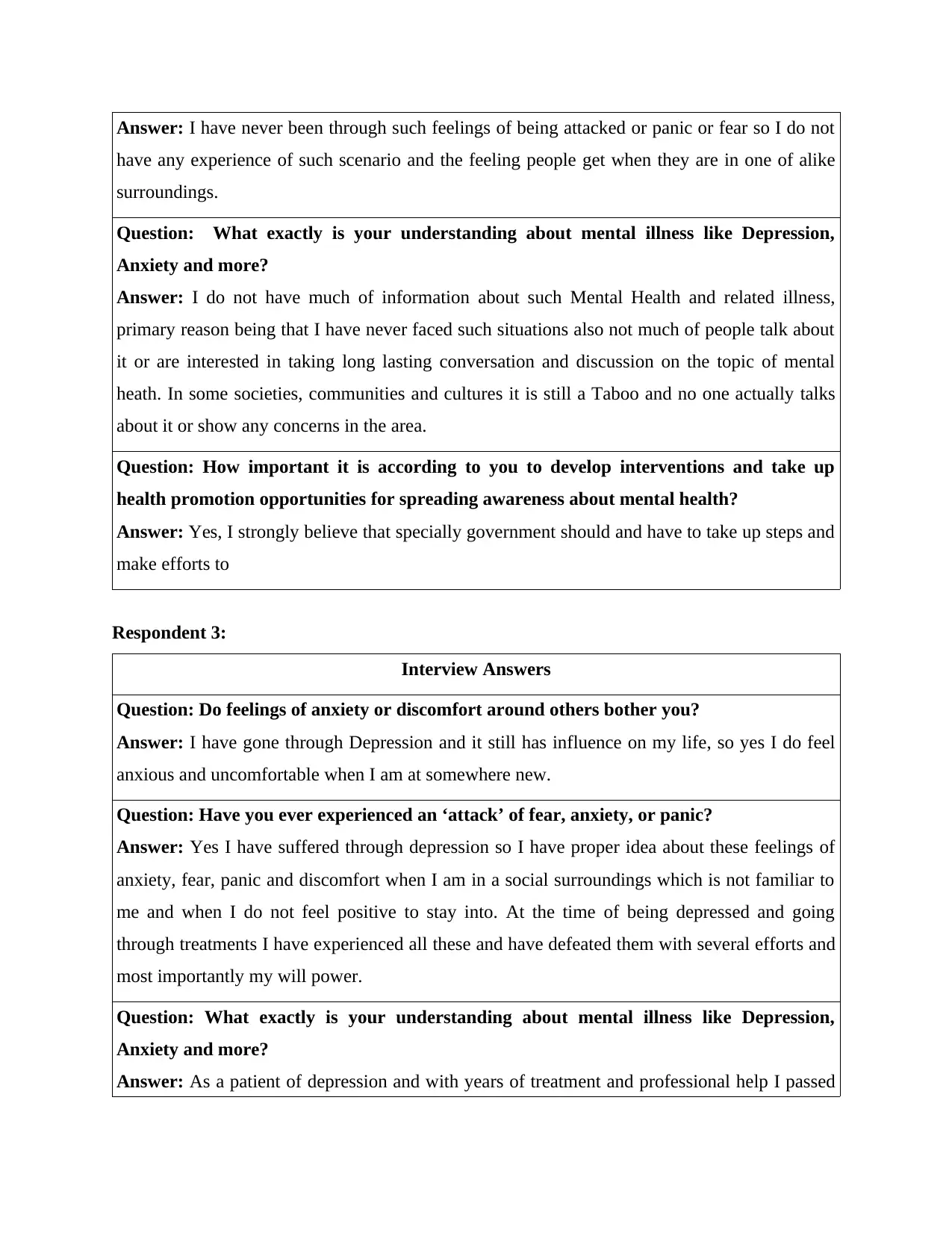
Answer: I have never been through such feelings of being attacked or panic or fear so I do not
have any experience of such scenario and the feeling people get when they are in one of alike
surroundings.
Question: What exactly is your understanding about mental illness like Depression,
Anxiety and more?
Answer: I do not have much of information about such Mental Health and related illness,
primary reason being that I have never faced such situations also not much of people talk about
it or are interested in taking long lasting conversation and discussion on the topic of mental
heath. In some societies, communities and cultures it is still a Taboo and no one actually talks
about it or show any concerns in the area.
Question: How important it is according to you to develop interventions and take up
health promotion opportunities for spreading awareness about mental health?
Answer: Yes, I strongly believe that specially government should and have to take up steps and
make efforts to
Respondent 3:
Interview Answers
Question: Do feelings of anxiety or discomfort around others bother you?
Answer: I have gone through Depression and it still has influence on my life, so yes I do feel
anxious and uncomfortable when I am at somewhere new.
Question: Have you ever experienced an ‘attack’ of fear, anxiety, or panic?
Answer: Yes I have suffered through depression so I have proper idea about these feelings of
anxiety, fear, panic and discomfort when I am in a social surroundings which is not familiar to
me and when I do not feel positive to stay into. At the time of being depressed and going
through treatments I have experienced all these and have defeated them with several efforts and
most importantly my will power.
Question: What exactly is your understanding about mental illness like Depression,
Anxiety and more?
Answer: As a patient of depression and with years of treatment and professional help I passed
have any experience of such scenario and the feeling people get when they are in one of alike
surroundings.
Question: What exactly is your understanding about mental illness like Depression,
Anxiety and more?
Answer: I do not have much of information about such Mental Health and related illness,
primary reason being that I have never faced such situations also not much of people talk about
it or are interested in taking long lasting conversation and discussion on the topic of mental
heath. In some societies, communities and cultures it is still a Taboo and no one actually talks
about it or show any concerns in the area.
Question: How important it is according to you to develop interventions and take up
health promotion opportunities for spreading awareness about mental health?
Answer: Yes, I strongly believe that specially government should and have to take up steps and
make efforts to
Respondent 3:
Interview Answers
Question: Do feelings of anxiety or discomfort around others bother you?
Answer: I have gone through Depression and it still has influence on my life, so yes I do feel
anxious and uncomfortable when I am at somewhere new.
Question: Have you ever experienced an ‘attack’ of fear, anxiety, or panic?
Answer: Yes I have suffered through depression so I have proper idea about these feelings of
anxiety, fear, panic and discomfort when I am in a social surroundings which is not familiar to
me and when I do not feel positive to stay into. At the time of being depressed and going
through treatments I have experienced all these and have defeated them with several efforts and
most importantly my will power.
Question: What exactly is your understanding about mental illness like Depression,
Anxiety and more?
Answer: As a patient of depression and with years of treatment and professional help I passed
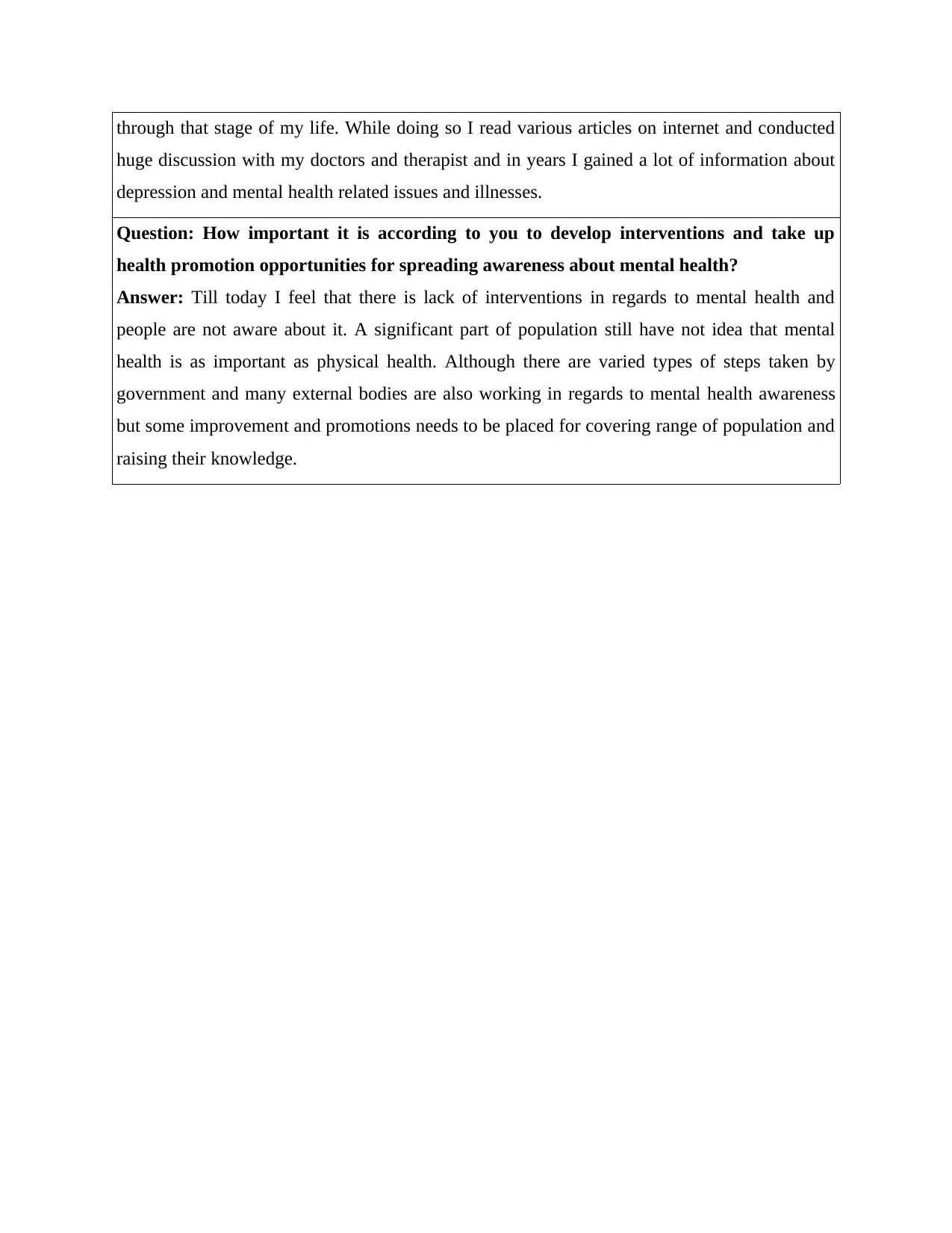
through that stage of my life. While doing so I read various articles on internet and conducted
huge discussion with my doctors and therapist and in years I gained a lot of information about
depression and mental health related issues and illnesses.
Question: How important it is according to you to develop interventions and take up
health promotion opportunities for spreading awareness about mental health?
Answer: Till today I feel that there is lack of interventions in regards to mental health and
people are not aware about it. A significant part of population still have not idea that mental
health is as important as physical health. Although there are varied types of steps taken by
government and many external bodies are also working in regards to mental health awareness
but some improvement and promotions needs to be placed for covering range of population and
raising their knowledge.
huge discussion with my doctors and therapist and in years I gained a lot of information about
depression and mental health related issues and illnesses.
Question: How important it is according to you to develop interventions and take up
health promotion opportunities for spreading awareness about mental health?
Answer: Till today I feel that there is lack of interventions in regards to mental health and
people are not aware about it. A significant part of population still have not idea that mental
health is as important as physical health. Although there are varied types of steps taken by
government and many external bodies are also working in regards to mental health awareness
but some improvement and promotions needs to be placed for covering range of population and
raising their knowledge.
⊘ This is a preview!⊘
Do you want full access?
Subscribe today to unlock all pages.
Trusted by 1+ million students worldwide
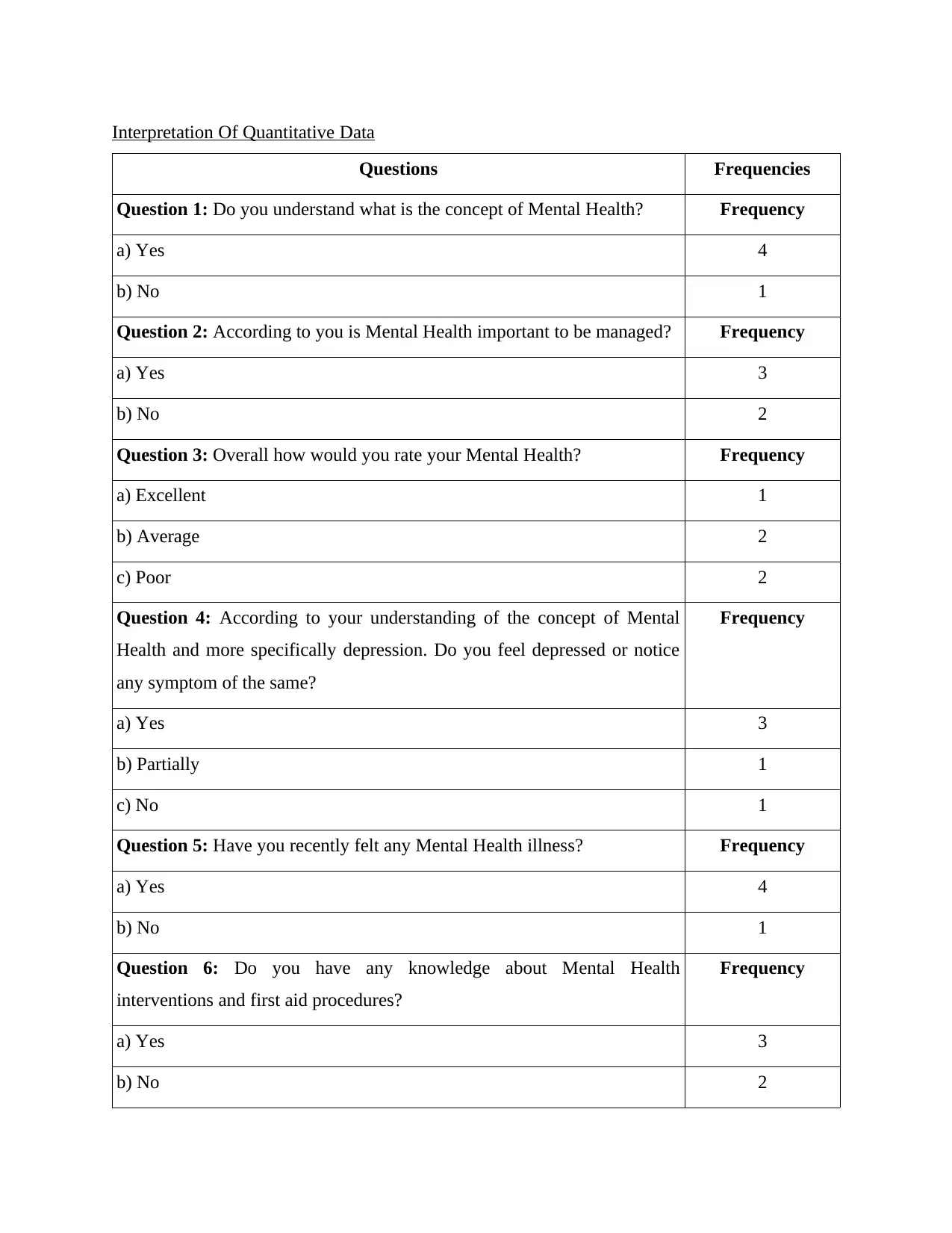
Interpretation Of Quantitative Data
Questions Frequencies
Question 1: Do you understand what is the concept of Mental Health? Frequency
a) Yes 4
b) No 1
Question 2: According to you is Mental Health important to be managed? Frequency
a) Yes 3
b) No 2
Question 3: Overall how would you rate your Mental Health? Frequency
a) Excellent 1
b) Average 2
c) Poor 2
Question 4: According to your understanding of the concept of Mental
Health and more specifically depression. Do you feel depressed or notice
any symptom of the same?
Frequency
a) Yes 3
b) Partially 1
c) No 1
Question 5: Have you recently felt any Mental Health illness? Frequency
a) Yes 4
b) No 1
Question 6: Do you have any knowledge about Mental Health
interventions and first aid procedures?
Frequency
a) Yes 3
b) No 2
Questions Frequencies
Question 1: Do you understand what is the concept of Mental Health? Frequency
a) Yes 4
b) No 1
Question 2: According to you is Mental Health important to be managed? Frequency
a) Yes 3
b) No 2
Question 3: Overall how would you rate your Mental Health? Frequency
a) Excellent 1
b) Average 2
c) Poor 2
Question 4: According to your understanding of the concept of Mental
Health and more specifically depression. Do you feel depressed or notice
any symptom of the same?
Frequency
a) Yes 3
b) Partially 1
c) No 1
Question 5: Have you recently felt any Mental Health illness? Frequency
a) Yes 4
b) No 1
Question 6: Do you have any knowledge about Mental Health
interventions and first aid procedures?
Frequency
a) Yes 3
b) No 2
Paraphrase This Document
Need a fresh take? Get an instant paraphrase of this document with our AI Paraphraser
Question 7: Do you think teenagers today suffers through bad Mental
Health and related illness more than others?
Frequency
a) Yes 3
b) No 2
QUESTION 1:
Question 1: Do you understand what is the concept of Mental Health? Frequency
a) Yes 4
b) No 1
a) Yes
b) No
INTERPRETATION:
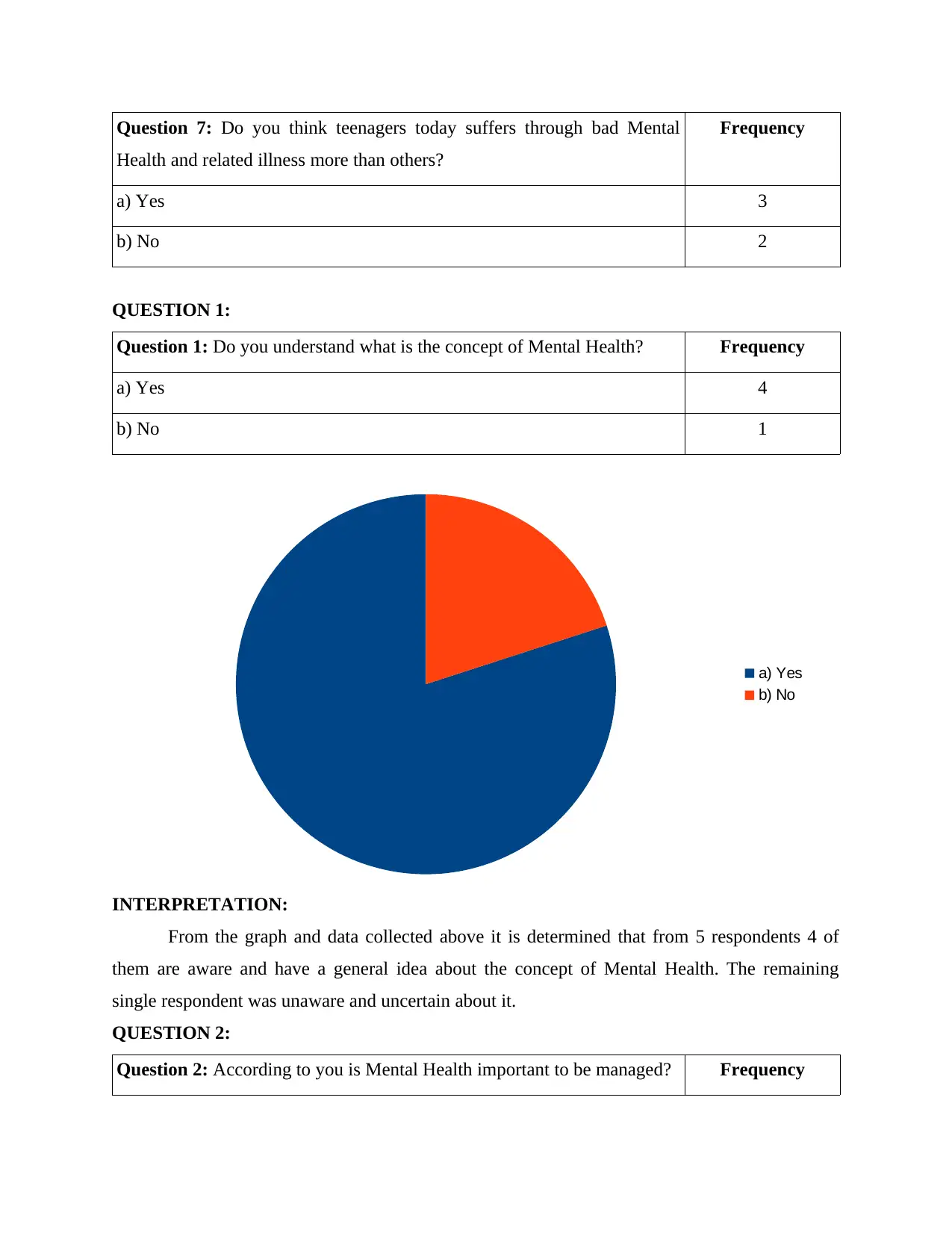
From the graph and data collected above it is determined that from 5 respondents 4 of
them are aware and have a general idea about the concept of Mental Health. The remaining
single respondent was unaware and uncertain about it.
QUESTION 2:
Question 2: According to you is Mental Health important to be managed? Frequency
Health and related illness more than others?
Frequency
a) Yes 3
b) No 2
QUESTION 1:
Question 1: Do you understand what is the concept of Mental Health? Frequency
a) Yes 4
b) No 1
a) Yes
b) No
INTERPRETATION:
From the graph and data collected above it is determined that from 5 respondents 4 of
them are aware and have a general idea about the concept of Mental Health. The remaining
single respondent was unaware and uncertain about it.
QUESTION 2:
Question 2: According to you is Mental Health important to be managed? Frequency
a) Yes 3
b) No 2
a) Yes
b) No
INTERPRETATION:
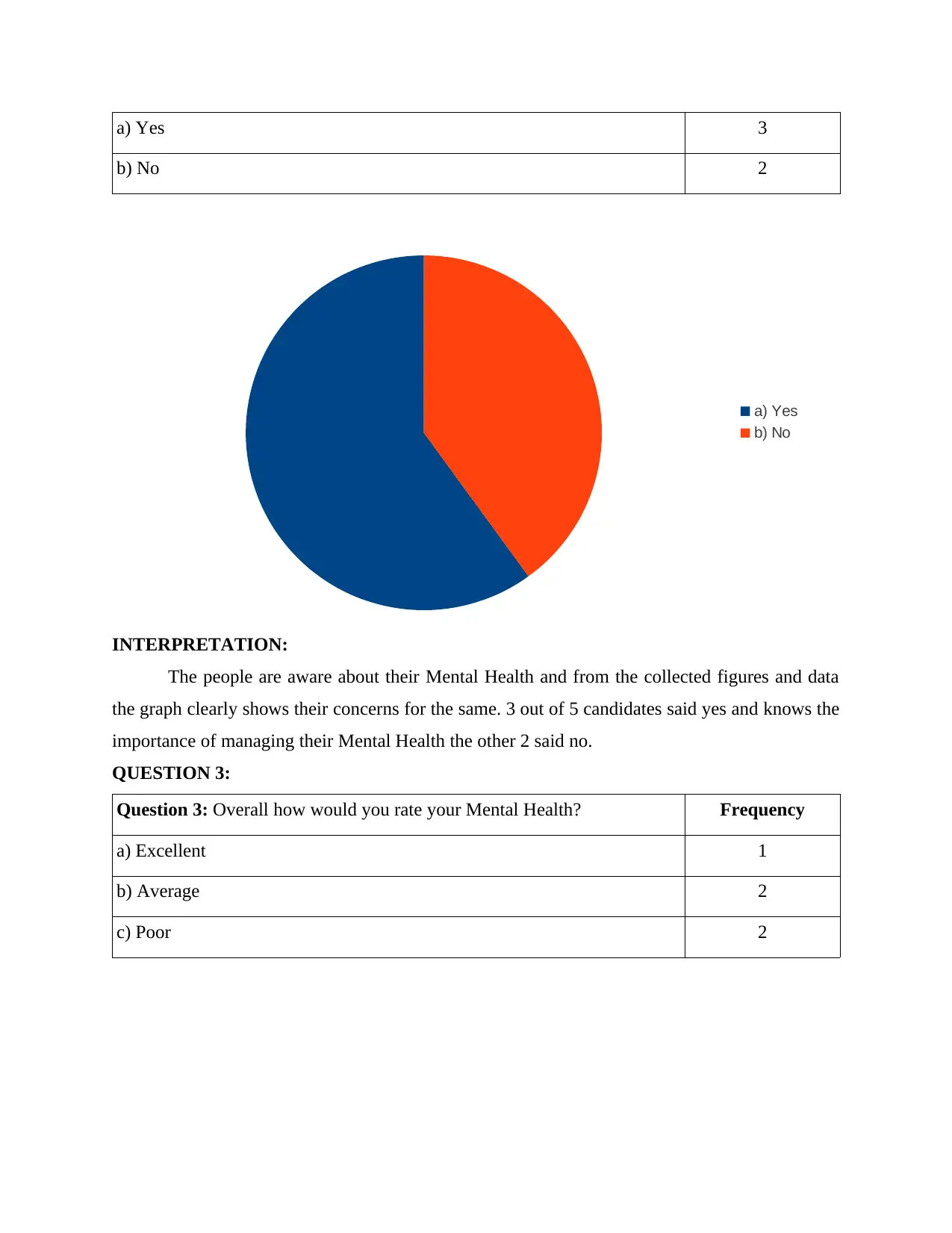
The people are aware about their Mental Health and from the collected figures and data
the graph clearly shows their concerns for the same. 3 out of 5 candidates said yes and knows the
importance of managing their Mental Health the other 2 said no.
QUESTION 3:
Question 3: Overall how would you rate your Mental Health? Frequency
a) Excellent 1
b) Average 2
c) Poor 2
b) No 2
a) Yes
b) No
INTERPRETATION:
The people are aware about their Mental Health and from the collected figures and data
the graph clearly shows their concerns for the same. 3 out of 5 candidates said yes and knows the
importance of managing their Mental Health the other 2 said no.
QUESTION 3:
Question 3: Overall how would you rate your Mental Health? Frequency
a) Excellent 1
b) Average 2
c) Poor 2
⊘ This is a preview!⊘
Do you want full access?
Subscribe today to unlock all pages.
Trusted by 1+ million students worldwide

1 out of 19


Related Documents


Your All-in-One AI-Powered Toolkit for Academic Success.
+13062052269
info@desklib.com
Available 24*7 on WhatsApp / Email
![[object Object]](/_next/static/media/star-bottom.7253800d.svg)
Unlock your academic potential
Copyright © 2020–2026 A2Z Services. All Rights Reserved. Developed and managed by ZUCOL.