University Study: Methodology Report on Cuban Mental Health - SOCI1001
VerifiedAdded on 2022/09/12
|8
|1410
|24
Report
AI Summary
This report outlines the methodology for a qualitative study on mental health in Cuba. The study employs a qualitative design to address research questions regarding mental health conditions and barriers to mental health services in Cuba. The study will involve purposive sampling, selecting family members of mental health patients and healthcare professionals. Data will be collected through structured interviews with open-ended questions. The interviews will be audio-recorded, and manual data will also be collected. The report also discusses study limitations, including sample size and potential biases, as well as ethical considerations such as participant consent and data security. Data analysis will involve narrative analysis and coding of interview data to answer the research questions. References and an appendix with a consent form are also included.

Running head: METHODOLOGY
Methodology
Name of the Student
Name of the University
Author Note
Methodology
Name of the Student
Name of the University
Author Note
Paraphrase This Document
Need a fresh take? Get an instant paraphrase of this document with our AI Paraphraser

1METHODOLOGY
Methodology
Study Type
In this particular study the researchers will use a qualitative study design in order to
answer the formulated research questions. The main reason of choosing this study design for
this study is associated with the type of the research question. Both of the research questions
can be answered by using a qualitative study design (McCusker & Gunaydin 2015).
According to the study of Mayer (2015), it is reported that the use of qualitative research
design will help the researchers to understand the actual conditions of mental health condition
of Cuba. Moreover, this qualitative study will also help the researchers to understand the
barriers of the mental health services in the country.
Sampling Technique
In order to select the study participants, it can be stated that the researchers will select
the family members of the mental health patients and the health care professionals of the
mental care centres of Cuba. The main reason for selecting this population as the subject is
the fact they are directly associated with the care processes of the mental health patients. The
researchers will follow a purposive sampling technique to execute the present study. The
purposive sampling technique will help the researchers to answer the research question
properly. The main advantage of this sampling technique is that the researchers can only
select those population who are perfectly fit for the study and so the result of the study can be
generalized for the mental health care professionals of the country (Etikan, Musa &
Alkassim, 2016). In this study approximately 24 participants will be selected as sample
population and half of them will be mental health patients’ family members and half of them
will be mental health care professionals.
Methodology
Study Type
In this particular study the researchers will use a qualitative study design in order to
answer the formulated research questions. The main reason of choosing this study design for
this study is associated with the type of the research question. Both of the research questions
can be answered by using a qualitative study design (McCusker & Gunaydin 2015).
According to the study of Mayer (2015), it is reported that the use of qualitative research
design will help the researchers to understand the actual conditions of mental health condition
of Cuba. Moreover, this qualitative study will also help the researchers to understand the
barriers of the mental health services in the country.
Sampling Technique
In order to select the study participants, it can be stated that the researchers will select
the family members of the mental health patients and the health care professionals of the
mental care centres of Cuba. The main reason for selecting this population as the subject is
the fact they are directly associated with the care processes of the mental health patients. The
researchers will follow a purposive sampling technique to execute the present study. The
purposive sampling technique will help the researchers to answer the research question
properly. The main advantage of this sampling technique is that the researchers can only
select those population who are perfectly fit for the study and so the result of the study can be
generalized for the mental health care professionals of the country (Etikan, Musa &
Alkassim, 2016). In this study approximately 24 participants will be selected as sample
population and half of them will be mental health patients’ family members and half of them
will be mental health care professionals.

2METHODOLOGY
Data Collection Process
For collecting the data from the participants an interview method will be used by the
researchers. For conducting the interviews among the study participants the researchers will
form a structured interview questions that comprised of 10- 13 open ended questions. The
main advantage of using an open ended question is that the participants can share their views
regarding the condition of a particular situation and thus the researchers can interpret the
result from the interviews. All of the interviews will be recorded by using audio recorders for
the future references and along with this manual data of the interview sessions will also be
collected by the researchers. Each of the interview sessions will last approximately for 5-10
minutes. The main advantage of using a recording method during the interview is the fact
that a recorded interview cannot be tampered and if there is any discrepancy in the manually
collected data, the authors can recheck it from the recorded interview as well. Along with
this, being a digital method, the storing of the interview data is easier than that of the
conventional method.
Limitation of the Study
While discussing about the study limitations, it can be stated that the small size of the
research can be marked as one of the limitations of the study. Moreover, during the interview
sessions, it may possible that the mental health care professionals can hide the original
conditions of the mental health disorders of the country. Moreover, it is also possible that the
researchers may face the issue of bias from the family members of the mental health patients
as they can raise their personal concern and it may affect the actual study result. According to
the study of Alshenqeeti (2014), it is reported that the problem related to the language of the
participants can be major limitations as the researchers decided to conduct the interview in
English. Therefore, it can be stated that conduction of the interview in English can cause
Data Collection Process
For collecting the data from the participants an interview method will be used by the
researchers. For conducting the interviews among the study participants the researchers will
form a structured interview questions that comprised of 10- 13 open ended questions. The
main advantage of using an open ended question is that the participants can share their views
regarding the condition of a particular situation and thus the researchers can interpret the
result from the interviews. All of the interviews will be recorded by using audio recorders for
the future references and along with this manual data of the interview sessions will also be
collected by the researchers. Each of the interview sessions will last approximately for 5-10
minutes. The main advantage of using a recording method during the interview is the fact
that a recorded interview cannot be tampered and if there is any discrepancy in the manually
collected data, the authors can recheck it from the recorded interview as well. Along with
this, being a digital method, the storing of the interview data is easier than that of the
conventional method.
Limitation of the Study
While discussing about the study limitations, it can be stated that the small size of the
research can be marked as one of the limitations of the study. Moreover, during the interview
sessions, it may possible that the mental health care professionals can hide the original
conditions of the mental health disorders of the country. Moreover, it is also possible that the
researchers may face the issue of bias from the family members of the mental health patients
as they can raise their personal concern and it may affect the actual study result. According to
the study of Alshenqeeti (2014), it is reported that the problem related to the language of the
participants can be major limitations as the researchers decided to conduct the interview in
English. Therefore, it can be stated that conduction of the interview in English can cause
⊘ This is a preview!⊘
Do you want full access?
Subscribe today to unlock all pages.

Trusted by 1+ million students worldwide

3METHODOLOGY
linguistic problems among the study population as it may possible that all of the study
participants are not able to understand English and so they will be unable to express their
views regarding the mental health conditions of the country properly.
Ethics
While discussing about the ethical considerations of the study, it can be stated that the
researchers will ensure the fact the collected data will not be used in any other purposes and
all the collected data will be kept electronically under the security of passwords. Apart from
the researchers, no other person has the right to access the data. All the participants are
requested to take part in the study and they are free to leave the study at any point of time. All
the participants will be given a consent letter prior to the initiation of the study and they will
be instructed to read and sign the consent letter before the study (Powney & Watts, 2018).
Data Analysis
As a part of the data analysis, it can be stated that the researchers will use a narrative
analysis and after collecting the data from the participants the researchers will code the
interview data from the recorded interview. After assessing the data from the interview
process the coded data will be used by the researchers for future analysis (Akinsanya & Bach,
2014). Therefore, by using those data the researchers will be able to answer the formulated
research questions easily.
linguistic problems among the study population as it may possible that all of the study
participants are not able to understand English and so they will be unable to express their
views regarding the mental health conditions of the country properly.
Ethics
While discussing about the ethical considerations of the study, it can be stated that the
researchers will ensure the fact the collected data will not be used in any other purposes and
all the collected data will be kept electronically under the security of passwords. Apart from
the researchers, no other person has the right to access the data. All the participants are
requested to take part in the study and they are free to leave the study at any point of time. All
the participants will be given a consent letter prior to the initiation of the study and they will
be instructed to read and sign the consent letter before the study (Powney & Watts, 2018).
Data Analysis
As a part of the data analysis, it can be stated that the researchers will use a narrative
analysis and after collecting the data from the participants the researchers will code the
interview data from the recorded interview. After assessing the data from the interview
process the coded data will be used by the researchers for future analysis (Akinsanya & Bach,
2014). Therefore, by using those data the researchers will be able to answer the formulated
research questions easily.
Paraphrase This Document
Need a fresh take? Get an instant paraphrase of this document with our AI Paraphraser

4METHODOLOGY
References
Akinsanya, A., & Bach, C. (2014). Narrative analysis: The personal experience narrative
approach. In ASEE 2014 Zone I Conference.
Alshenqeeti, H. (2014). Interviewing as a data collection method: A critical review. English
linguistics research, 3(1), 39-45.
Etikan, I., Musa, S. A., & Alkassim, R. S. (2016). Comparison of convenience sampling and
purposive sampling. American journal of theoretical and applied statistics, 5(1), 1-4.
Mayer, I. (2015). Qualitative research with a focus on qualitative data analysis. International
Journal of Sales, Retailing & Marketing, 4(9), pp.53-67.
McCusker, K. and Gunaydin, S. (2015). Research using qualitative, quantitative or mixed
methods and choice based on the research. Perfusion, 30(7), pp.537-542.
Powney, J., & Watts, M. (2018). Interviewing in educational research. Routledge.
References
Akinsanya, A., & Bach, C. (2014). Narrative analysis: The personal experience narrative
approach. In ASEE 2014 Zone I Conference.
Alshenqeeti, H. (2014). Interviewing as a data collection method: A critical review. English
linguistics research, 3(1), 39-45.
Etikan, I., Musa, S. A., & Alkassim, R. S. (2016). Comparison of convenience sampling and
purposive sampling. American journal of theoretical and applied statistics, 5(1), 1-4.
Mayer, I. (2015). Qualitative research with a focus on qualitative data analysis. International
Journal of Sales, Retailing & Marketing, 4(9), pp.53-67.
McCusker, K. and Gunaydin, S. (2015). Research using qualitative, quantitative or mixed
methods and choice based on the research. Perfusion, 30(7), pp.537-542.
Powney, J., & Watts, M. (2018). Interviewing in educational research. Routledge.

5METHODOLOGY
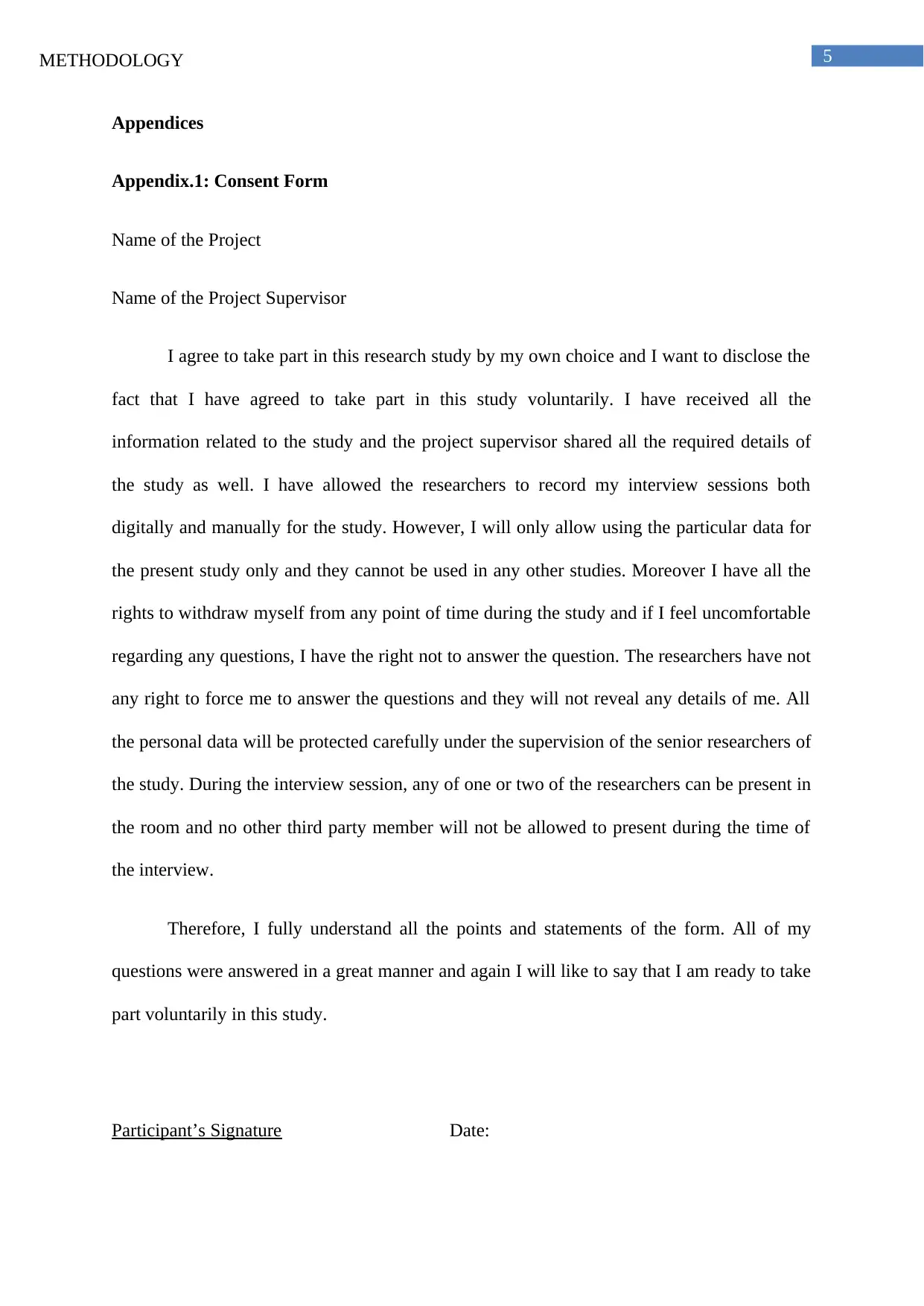
Appendices
Appendix.1: Consent Form
Name of the Project
Name of the Project Supervisor
I agree to take part in this research study by my own choice and I want to disclose the
fact that I have agreed to take part in this study voluntarily. I have received all the
information related to the study and the project supervisor shared all the required details of
the study as well. I have allowed the researchers to record my interview sessions both
digitally and manually for the study. However, I will only allow using the particular data for
the present study only and they cannot be used in any other studies. Moreover I have all the
rights to withdraw myself from any point of time during the study and if I feel uncomfortable
regarding any questions, I have the right not to answer the question. The researchers have not
any right to force me to answer the questions and they will not reveal any details of me. All
the personal data will be protected carefully under the supervision of the senior researchers of
the study. During the interview session, any of one or two of the researchers can be present in
the room and no other third party member will not be allowed to present during the time of
the interview.
Therefore, I fully understand all the points and statements of the form. All of my
questions were answered in a great manner and again I will like to say that I am ready to take
part voluntarily in this study.
Participant’s Signature Date:
Appendices
Appendix.1: Consent Form
Name of the Project
Name of the Project Supervisor
I agree to take part in this research study by my own choice and I want to disclose the
fact that I have agreed to take part in this study voluntarily. I have received all the
information related to the study and the project supervisor shared all the required details of
the study as well. I have allowed the researchers to record my interview sessions both
digitally and manually for the study. However, I will only allow using the particular data for
the present study only and they cannot be used in any other studies. Moreover I have all the
rights to withdraw myself from any point of time during the study and if I feel uncomfortable
regarding any questions, I have the right not to answer the question. The researchers have not
any right to force me to answer the questions and they will not reveal any details of me. All
the personal data will be protected carefully under the supervision of the senior researchers of
the study. During the interview session, any of one or two of the researchers can be present in
the room and no other third party member will not be allowed to present during the time of
the interview.
Therefore, I fully understand all the points and statements of the form. All of my
questions were answered in a great manner and again I will like to say that I am ready to take
part voluntarily in this study.
Participant’s Signature Date:
⊘ This is a preview!⊘
Do you want full access?
Subscribe today to unlock all pages.

Trusted by 1+ million students worldwide

6METHODOLOGY
Researcher’s Signature
Paraphrase This Document
Need a fresh take? Get an instant paraphrase of this document with our AI Paraphraser

7METHODOLOGY
1 out of 8
Related Documents
Your All-in-One AI-Powered Toolkit for Academic Success.
+13062052269
info@desklib.com
Available 24*7 on WhatsApp / Email
Unlock your academic potential
Copyright © 2020–2025 A2Z Services. All Rights Reserved. Developed and managed by ZUCOL.