NURS6085 Forensic Mental Health: Discharge Planning & Violence Risk

Verified

Added on  2023/04/08

|3
|391
|95
Essay
AI Summary
This essay discusses the factors to consider when discharging psychiatric patients, particularly those with schizophrenia and poly-substance abuse, to mitigate the risk of violence. It highlights the importance of continuous monitoring and abstinence, addressing the gap in research that comprehensively treats mental illness and substance abuse as co-morbidity. The essay advocates for psychiatric services tailored to patients with both conditions, emphasizing the need for effective pharmacological interventions and long-term hospital stays for those with a history of malicious activities and assault. It also stresses the inclusion of forensic psychologists and mental health physicians in the multidisciplinary team (MDT) to ensure comprehensive care, proper abstinence, and medication monitoring for drug-abusing, mentally ill offenders.
Document Page
Running head: FORENSIC MENTAL HEALTH
FORENSIC MENTAL HEALTH ASSIGNMENT
Name of the student
Name of the university
Author note
tabler-icon-diamond-filled.svg

Paraphrase This Document

Need a fresh take? Get an instant paraphrase of this document with our AI Paraphraser
Document Page
1FORENSIC MENTAL HEALTH
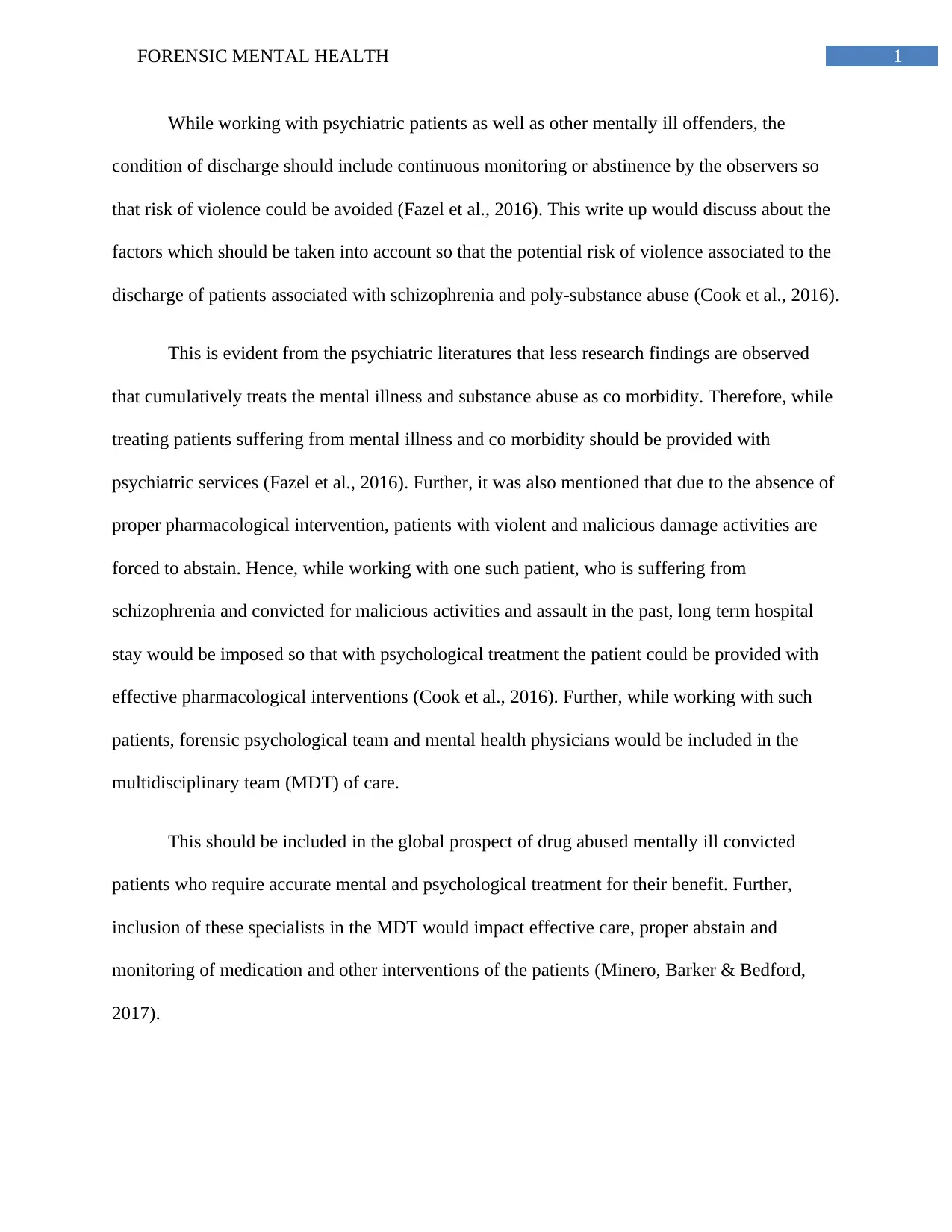
While working with psychiatric patients as well as other mentally ill offenders, the
condition of discharge should include continuous monitoring or abstinence by the observers so
that risk of violence could be avoided (Fazel et al., 2016). This write up would discuss about the
factors which should be taken into account so that the potential risk of violence associated to the
discharge of patients associated with schizophrenia and poly-substance abuse (Cook et al., 2016).
This is evident from the psychiatric literatures that less research findings are observed
that cumulatively treats the mental illness and substance abuse as co morbidity. Therefore, while
treating patients suffering from mental illness and co morbidity should be provided with
psychiatric services (Fazel et al., 2016). Further, it was also mentioned that due to the absence of
proper pharmacological intervention, patients with violent and malicious damage activities are
forced to abstain. Hence, while working with one such patient, who is suffering from
schizophrenia and convicted for malicious activities and assault in the past, long term hospital
stay would be imposed so that with psychological treatment the patient could be provided with
effective pharmacological interventions (Cook et al., 2016). Further, while working with such
patients, forensic psychological team and mental health physicians would be included in the
multidisciplinary team (MDT) of care.
This should be included in the global prospect of drug abused mentally ill convicted
patients who require accurate mental and psychological treatment for their benefit. Further,
inclusion of these specialists in the MDT would impact effective care, proper abstain and
monitoring of medication and other interventions of the patients (Minero, Barker & Bedford,
2017).
Document Page
2FORENSIC MENTAL HEALTH
References
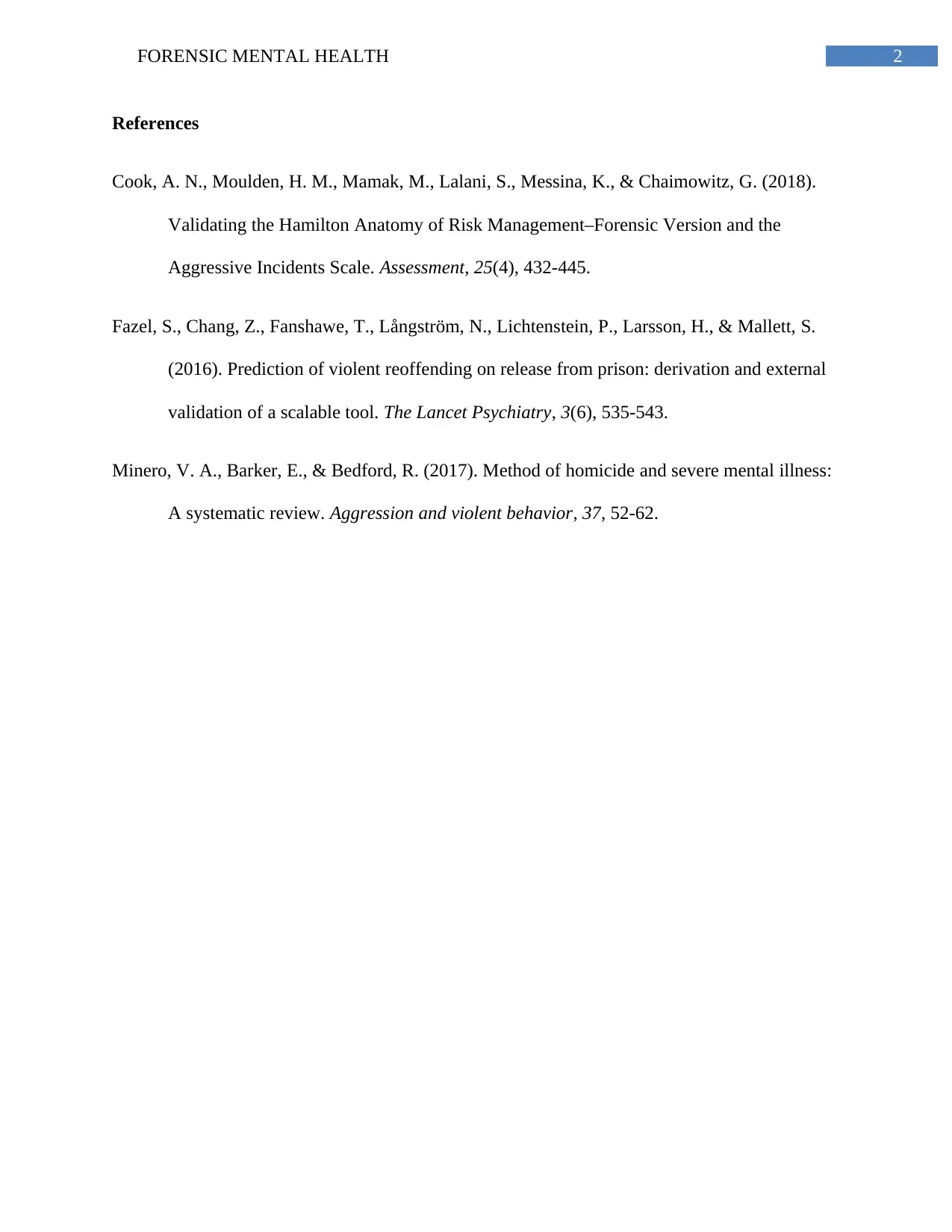
Cook, A. N., Moulden, H. M., Mamak, M., Lalani, S., Messina, K., & Chaimowitz, G. (2018).
Validating the Hamilton Anatomy of Risk Management–Forensic Version and the
Aggressive Incidents Scale. Assessment, 25(4), 432-445.
Fazel, S., Chang, Z., Fanshawe, T., Långström, N., Lichtenstein, P., Larsson, H., & Mallett, S.
(2016). Prediction of violent reoffending on release from prison: derivation and external
validation of a scalable tool. The Lancet Psychiatry, 3(6), 535-543.
Minero, V. A., Barker, E., & Bedford, R. (2017). Method of homicide and severe mental illness:
A systematic review. Aggression and violent behavior, 37, 52-62.
chevron_up_icon
1 out of 3
circle_padding
hide_on_mobile
zoom_out_icon
[object Object]