Case Study: Mercury Poisoning, Kidney Failure, Diagnosis and Treatment
VerifiedAdded on 2021/04/24
|6
|1571
|123
Case Study
AI Summary
This case study presents a 30-year-old male patient, Davis, who is suffering from kidney failure due to mercury poisoning. The case details his physical and clinical information, including symptoms like headaches, diarrhea, fatigue, and elevated blood pressure. The pathophysiology of mercury poisoning, its impact on the kidneys, and the formation of sulfhydryl groups which damage tissues and cells are discussed. Diagnostic methods, including renal ultrasound and other imaging techniques, are explored. The case study also outlines various treatment options such as nephrostomy and kidney transplant. Davis underwent a kidney transplant as the most effective treatment. The importance of early detection and avoiding mercury exposure is emphasized, along with a discussion of the patient's symptoms and the implications of kidney failure. The study concludes with references to relevant research articles.
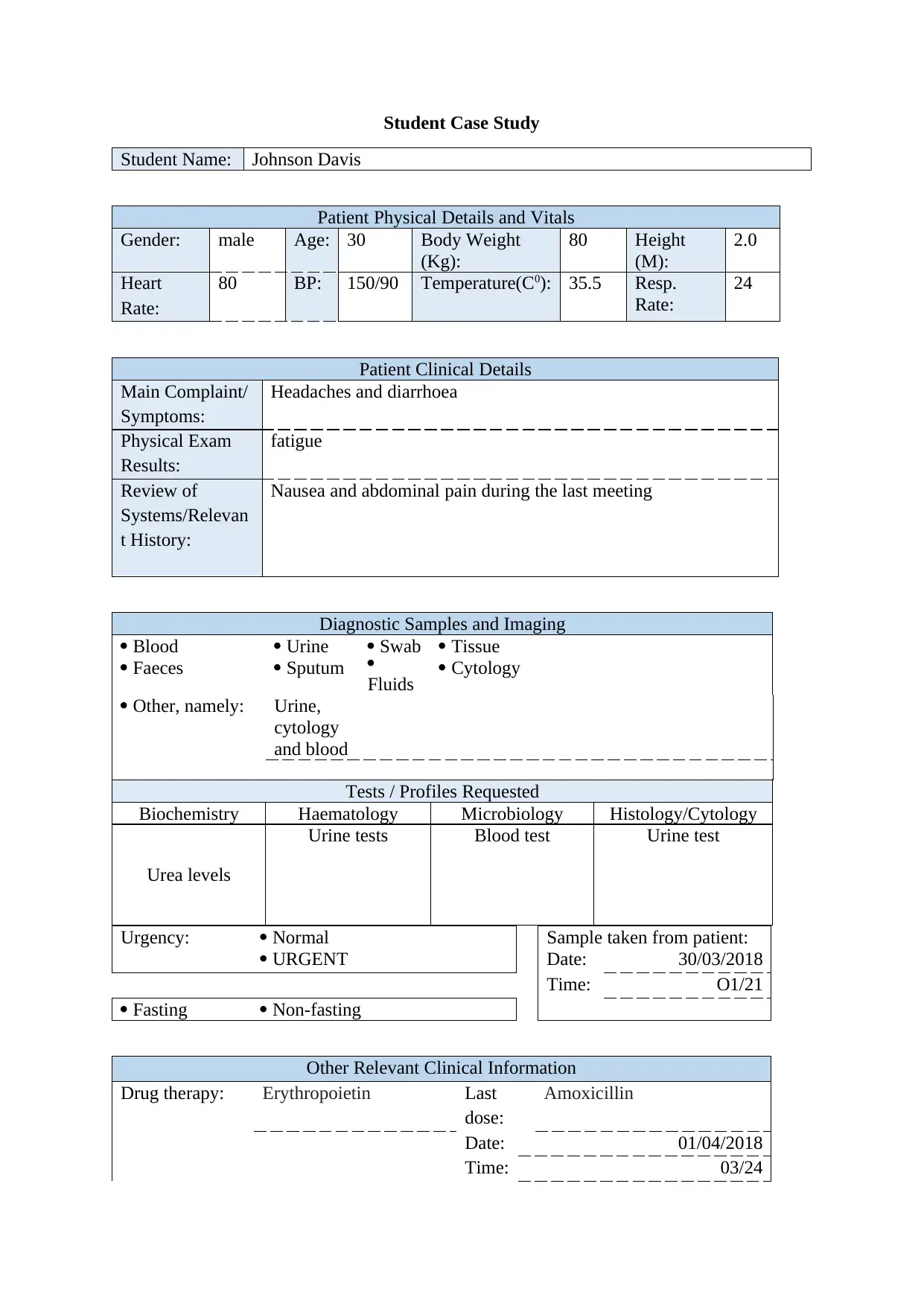
Student Case Study
Student Name: Johnson Davis
Patient Physical Details and Vitals
Gender: male Age: 30 Body Weight
(Kg):
80 Height
(M):
2.0
Heart
Rate:
80 BP: 150/90 Temperature(C0): 35.5 Resp.
Rate:
24
Patient Clinical Details
Main Complaint/
Symptoms:
Headaches and diarrhoea
Physical Exam
Results:
fatigue
Review of
Systems/Relevan
t History:
Nausea and abdominal pain during the last meeting
Diagnostic Samples and Imaging
Blood
Faeces
Urine
Sputum
Swab
Fluids
Tissue
Cytology
Other, namely: Urine,
cytology
and blood
Tests / Profiles Requested
Biochemistry Haematology Microbiology Histology/Cytology
Urea levels
Urine tests Blood test Urine test
Urgency: Normal Sample taken from patient:
URGENT Date: 30/03/2018
Time: O1/21
Fasting Non-fasting
Other Relevant Clinical Information
Drug therapy: Erythropoietin Last
dose:
Amoxicillin
Date: 01/04/2018
Time: 03/24
Student Name: Johnson Davis
Patient Physical Details and Vitals
Gender: male Age: 30 Body Weight
(Kg):
80 Height
(M):
2.0
Heart
Rate:
80 BP: 150/90 Temperature(C0): 35.5 Resp.
Rate:
24
Patient Clinical Details
Main Complaint/
Symptoms:
Headaches and diarrhoea
Physical Exam
Results:
fatigue
Review of
Systems/Relevan
t History:
Nausea and abdominal pain during the last meeting
Diagnostic Samples and Imaging
Blood
Faeces
Urine
Sputum
Swab
Fluids
Tissue
Cytology
Other, namely: Urine,
cytology
and blood
Tests / Profiles Requested
Biochemistry Haematology Microbiology Histology/Cytology
Urea levels
Urine tests Blood test Urine test
Urgency: Normal Sample taken from patient:
URGENT Date: 30/03/2018
Time: O1/21
Fasting Non-fasting
Other Relevant Clinical Information
Drug therapy: Erythropoietin Last
dose:
Amoxicillin
Date: 01/04/2018
Time: 03/24
Paraphrase This Document
Need a fresh take? Get an instant paraphrase of this document with our AI Paraphraser

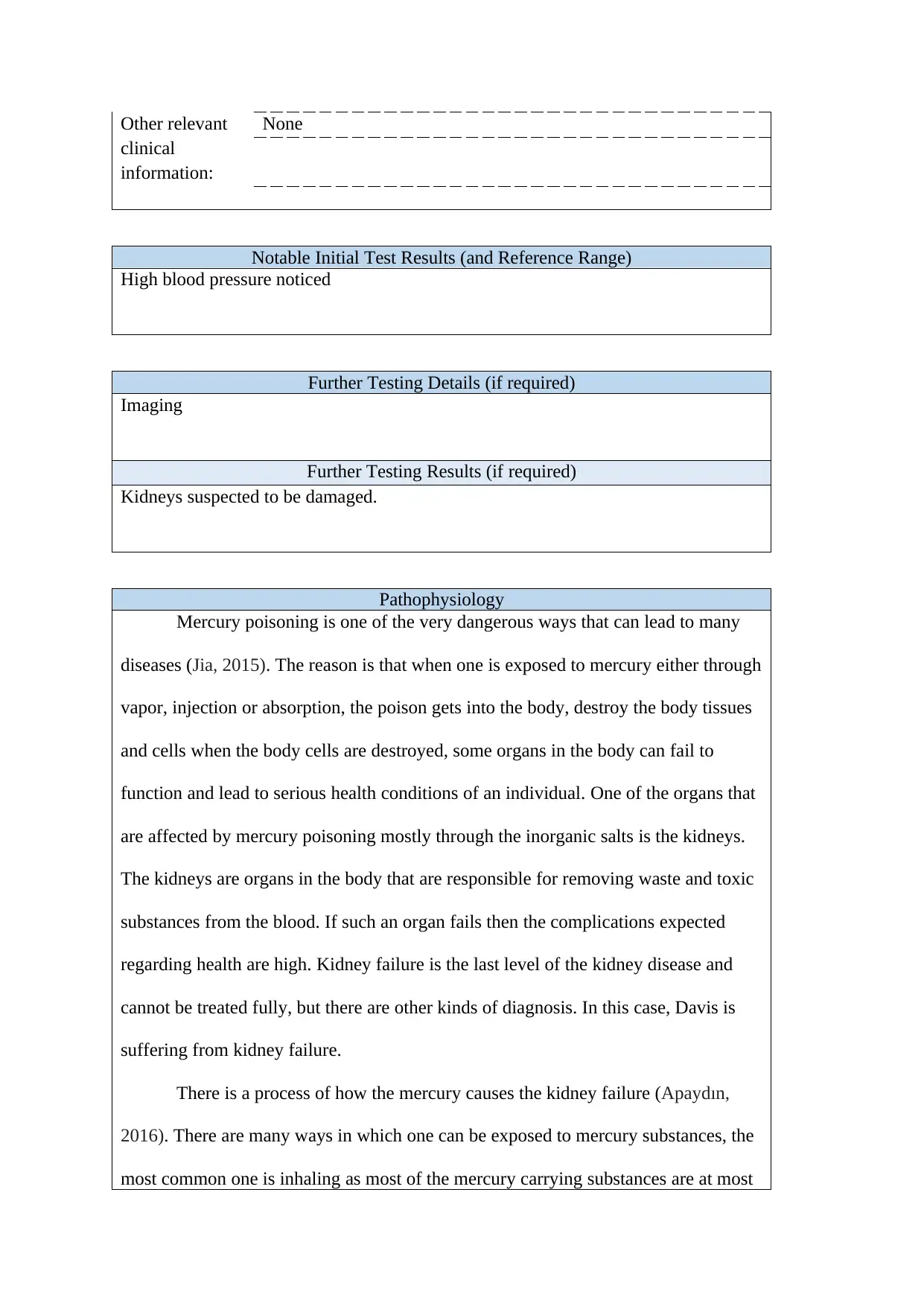
Other relevant
clinical
information:
None
Notable Initial Test Results (and Reference Range)
High blood pressure noticed
Further Testing Details (if required)
Imaging
Further Testing Results (if required)
Kidneys suspected to be damaged.
Pathophysiology
Mercury poisoning is one of the very dangerous ways that can lead to many
diseases (Jia, 2015). The reason is that when one is exposed to mercury either through
vapor, injection or absorption, the poison gets into the body, destroy the body tissues
and cells when the body cells are destroyed, some organs in the body can fail to
function and lead to serious health conditions of an individual. One of the organs that
are affected by mercury poisoning mostly through the inorganic salts is the kidneys.
The kidneys are organs in the body that are responsible for removing waste and toxic
substances from the blood. If such an organ fails then the complications expected
regarding health are high. Kidney failure is the last level of the kidney disease and
cannot be treated fully, but there are other kinds of diagnosis. In this case, Davis is
suffering from kidney failure.
There is a process of how the mercury causes the kidney failure (Apaydın,
2016). There are many ways in which one can be exposed to mercury substances, the
most common one is inhaling as most of the mercury carrying substances are at most
clinical
information:
None
Notable Initial Test Results (and Reference Range)
High blood pressure noticed
Further Testing Details (if required)
Imaging
Further Testing Results (if required)
Kidneys suspected to be damaged.
Pathophysiology
Mercury poisoning is one of the very dangerous ways that can lead to many
diseases (Jia, 2015). The reason is that when one is exposed to mercury either through
vapor, injection or absorption, the poison gets into the body, destroy the body tissues
and cells when the body cells are destroyed, some organs in the body can fail to
function and lead to serious health conditions of an individual. One of the organs that
are affected by mercury poisoning mostly through the inorganic salts is the kidneys.
The kidneys are organs in the body that are responsible for removing waste and toxic
substances from the blood. If such an organ fails then the complications expected
regarding health are high. Kidney failure is the last level of the kidney disease and
cannot be treated fully, but there are other kinds of diagnosis. In this case, Davis is
suffering from kidney failure.
There is a process of how the mercury causes the kidney failure (Apaydın,
2016). There are many ways in which one can be exposed to mercury substances, the
most common one is inhaling as most of the mercury carrying substances are at most

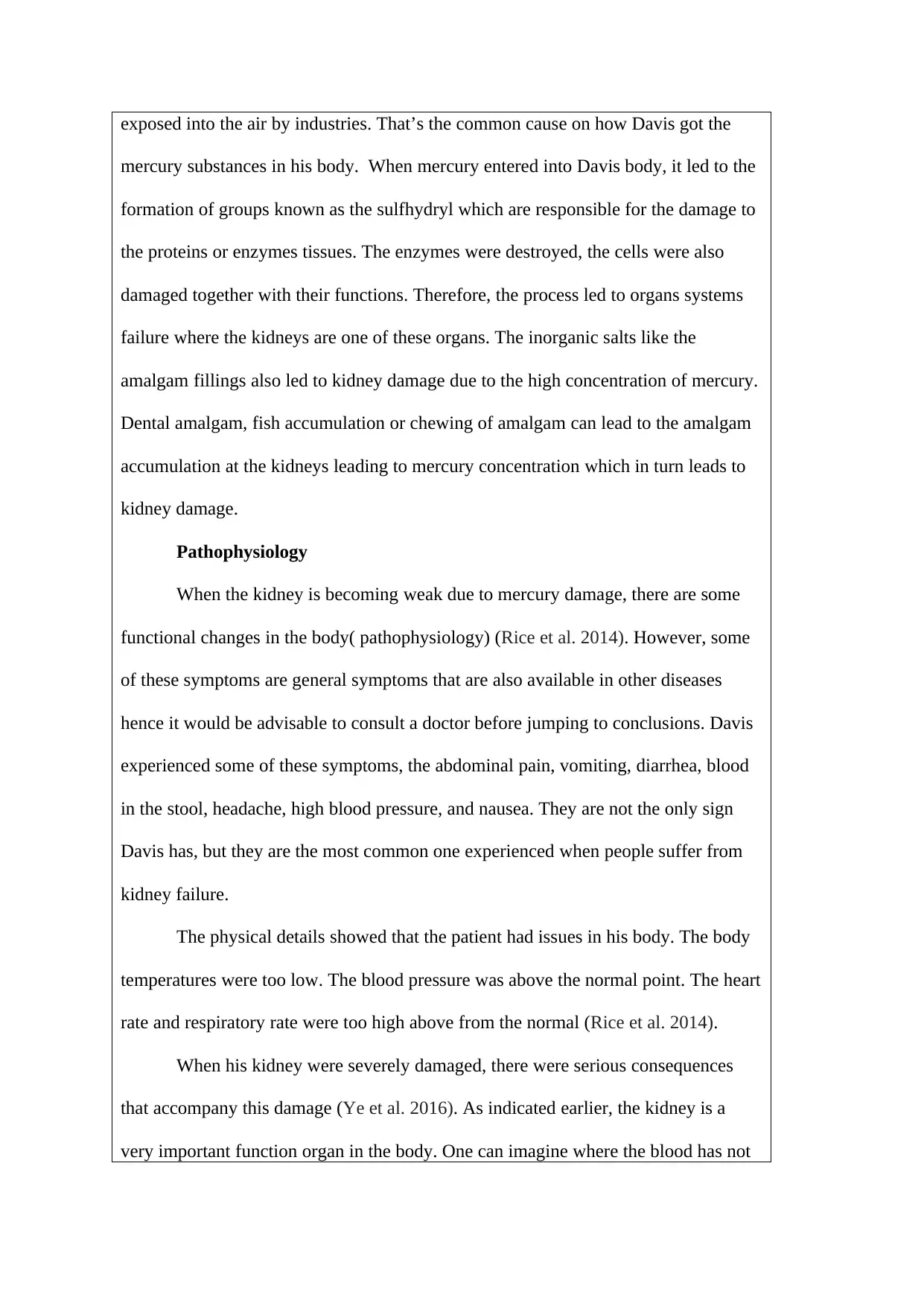
exposed into the air by industries. That’s the common cause on how Davis got the
mercury substances in his body. When mercury entered into Davis body, it led to the
formation of groups known as the sulfhydryl which are responsible for the damage to
the proteins or enzymes tissues. The enzymes were destroyed, the cells were also
damaged together with their functions. Therefore, the process led to organs systems
failure where the kidneys are one of these organs. The inorganic salts like the
amalgam fillings also led to kidney damage due to the high concentration of mercury.
Dental amalgam, fish accumulation or chewing of amalgam can lead to the amalgam
accumulation at the kidneys leading to mercury concentration which in turn leads to
kidney damage.
Pathophysiology
When the kidney is becoming weak due to mercury damage, there are some
functional changes in the body( pathophysiology) (Rice et al. 2014). However, some
of these symptoms are general symptoms that are also available in other diseases
hence it would be advisable to consult a doctor before jumping to conclusions. Davis
experienced some of these symptoms, the abdominal pain, vomiting, diarrhea, blood
in the stool, headache, high blood pressure, and nausea. They are not the only sign
Davis has, but they are the most common one experienced when people suffer from
kidney failure.
The physical details showed that the patient had issues in his body. The body
temperatures were too low. The blood pressure was above the normal point. The heart
rate and respiratory rate were too high above from the normal (Rice et al. 2014).
When his kidney were severely damaged, there were serious consequences
that accompany this damage (Ye et al. 2016). As indicated earlier, the kidney is a
very important function organ in the body. One can imagine where the blood has not
mercury substances in his body. When mercury entered into Davis body, it led to the
formation of groups known as the sulfhydryl which are responsible for the damage to
the proteins or enzymes tissues. The enzymes were destroyed, the cells were also
damaged together with their functions. Therefore, the process led to organs systems
failure where the kidneys are one of these organs. The inorganic salts like the
amalgam fillings also led to kidney damage due to the high concentration of mercury.
Dental amalgam, fish accumulation or chewing of amalgam can lead to the amalgam
accumulation at the kidneys leading to mercury concentration which in turn leads to
kidney damage.
Pathophysiology
When the kidney is becoming weak due to mercury damage, there are some
functional changes in the body( pathophysiology) (Rice et al. 2014). However, some
of these symptoms are general symptoms that are also available in other diseases
hence it would be advisable to consult a doctor before jumping to conclusions. Davis
experienced some of these symptoms, the abdominal pain, vomiting, diarrhea, blood
in the stool, headache, high blood pressure, and nausea. They are not the only sign
Davis has, but they are the most common one experienced when people suffer from
kidney failure.
The physical details showed that the patient had issues in his body. The body
temperatures were too low. The blood pressure was above the normal point. The heart
rate and respiratory rate were too high above from the normal (Rice et al. 2014).
When his kidney were severely damaged, there were serious consequences
that accompany this damage (Ye et al. 2016). As indicated earlier, the kidney is a
very important function organ in the body. One can imagine where the blood has not
⊘ This is a preview!⊘
Do you want full access?
Subscribe today to unlock all pages.

Trusted by 1+ million students worldwide

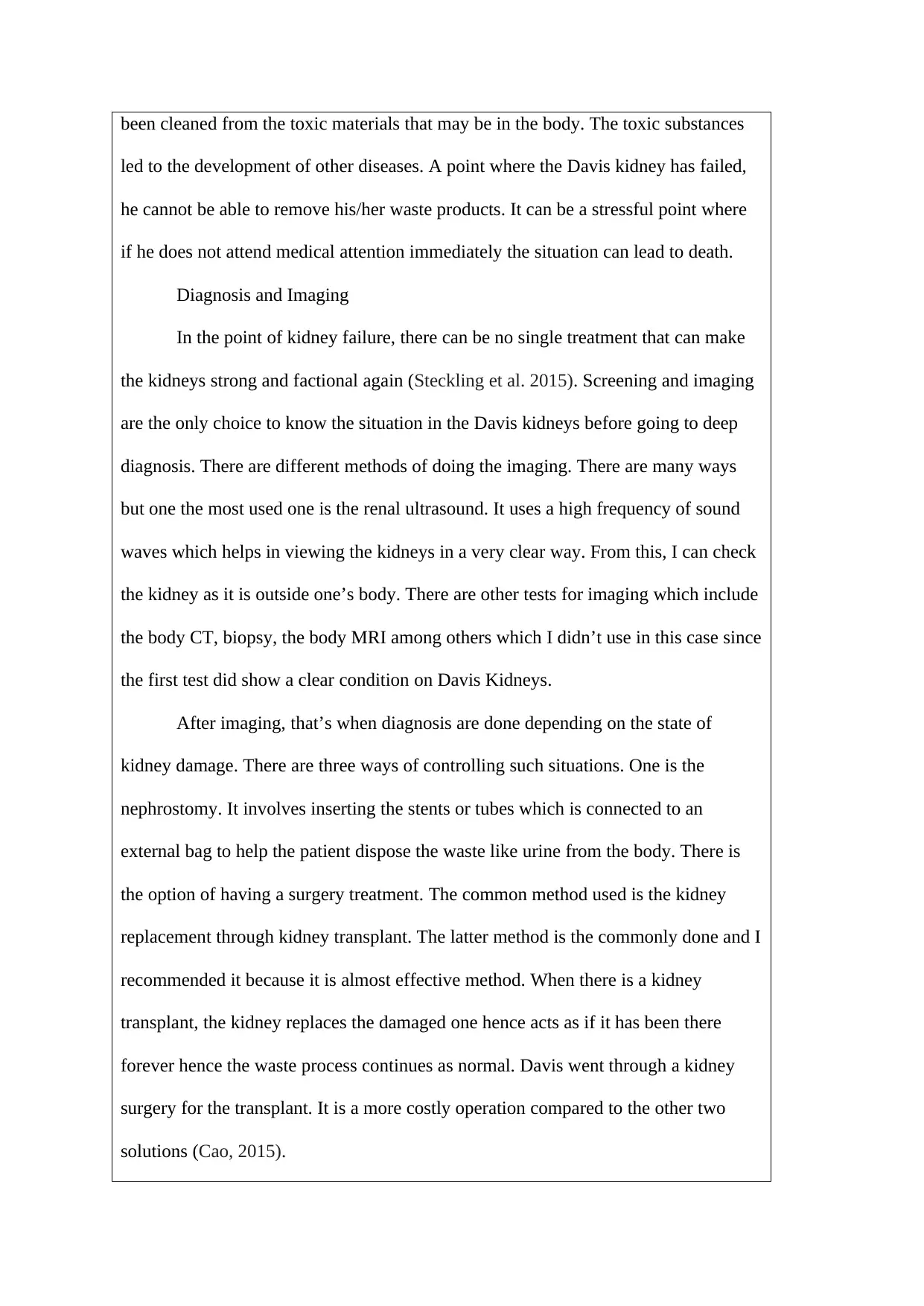
been cleaned from the toxic materials that may be in the body. The toxic substances
led to the development of other diseases. A point where the Davis kidney has failed,
he cannot be able to remove his/her waste products. It can be a stressful point where
if he does not attend medical attention immediately the situation can lead to death.
Diagnosis and Imaging
In the point of kidney failure, there can be no single treatment that can make
the kidneys strong and factional again (Steckling et al. 2015). Screening and imaging
are the only choice to know the situation in the Davis kidneys before going to deep
diagnosis. There are different methods of doing the imaging. There are many ways
but one the most used one is the renal ultrasound. It uses a high frequency of sound
waves which helps in viewing the kidneys in a very clear way. From this, I can check
the kidney as it is outside one’s body. There are other tests for imaging which include
the body CT, biopsy, the body MRI among others which I didn’t use in this case since
the first test did show a clear condition on Davis Kidneys.
After imaging, that’s when diagnosis are done depending on the state of
kidney damage. There are three ways of controlling such situations. One is the
nephrostomy. It involves inserting the stents or tubes which is connected to an
external bag to help the patient dispose the waste like urine from the body. There is
the option of having a surgery treatment. The common method used is the kidney
replacement through kidney transplant. The latter method is the commonly done and I
recommended it because it is almost effective method. When there is a kidney
transplant, the kidney replaces the damaged one hence acts as if it has been there
forever hence the waste process continues as normal. Davis went through a kidney
surgery for the transplant. It is a more costly operation compared to the other two
solutions (Cao, 2015).
led to the development of other diseases. A point where the Davis kidney has failed,
he cannot be able to remove his/her waste products. It can be a stressful point where
if he does not attend medical attention immediately the situation can lead to death.
Diagnosis and Imaging
In the point of kidney failure, there can be no single treatment that can make
the kidneys strong and factional again (Steckling et al. 2015). Screening and imaging
are the only choice to know the situation in the Davis kidneys before going to deep
diagnosis. There are different methods of doing the imaging. There are many ways
but one the most used one is the renal ultrasound. It uses a high frequency of sound
waves which helps in viewing the kidneys in a very clear way. From this, I can check
the kidney as it is outside one’s body. There are other tests for imaging which include
the body CT, biopsy, the body MRI among others which I didn’t use in this case since
the first test did show a clear condition on Davis Kidneys.
After imaging, that’s when diagnosis are done depending on the state of
kidney damage. There are three ways of controlling such situations. One is the
nephrostomy. It involves inserting the stents or tubes which is connected to an
external bag to help the patient dispose the waste like urine from the body. There is
the option of having a surgery treatment. The common method used is the kidney
replacement through kidney transplant. The latter method is the commonly done and I
recommended it because it is almost effective method. When there is a kidney
transplant, the kidney replaces the damaged one hence acts as if it has been there
forever hence the waste process continues as normal. Davis went through a kidney
surgery for the transplant. It is a more costly operation compared to the other two
solutions (Cao, 2015).
Paraphrase This Document
Need a fresh take? Get an instant paraphrase of this document with our AI Paraphraser

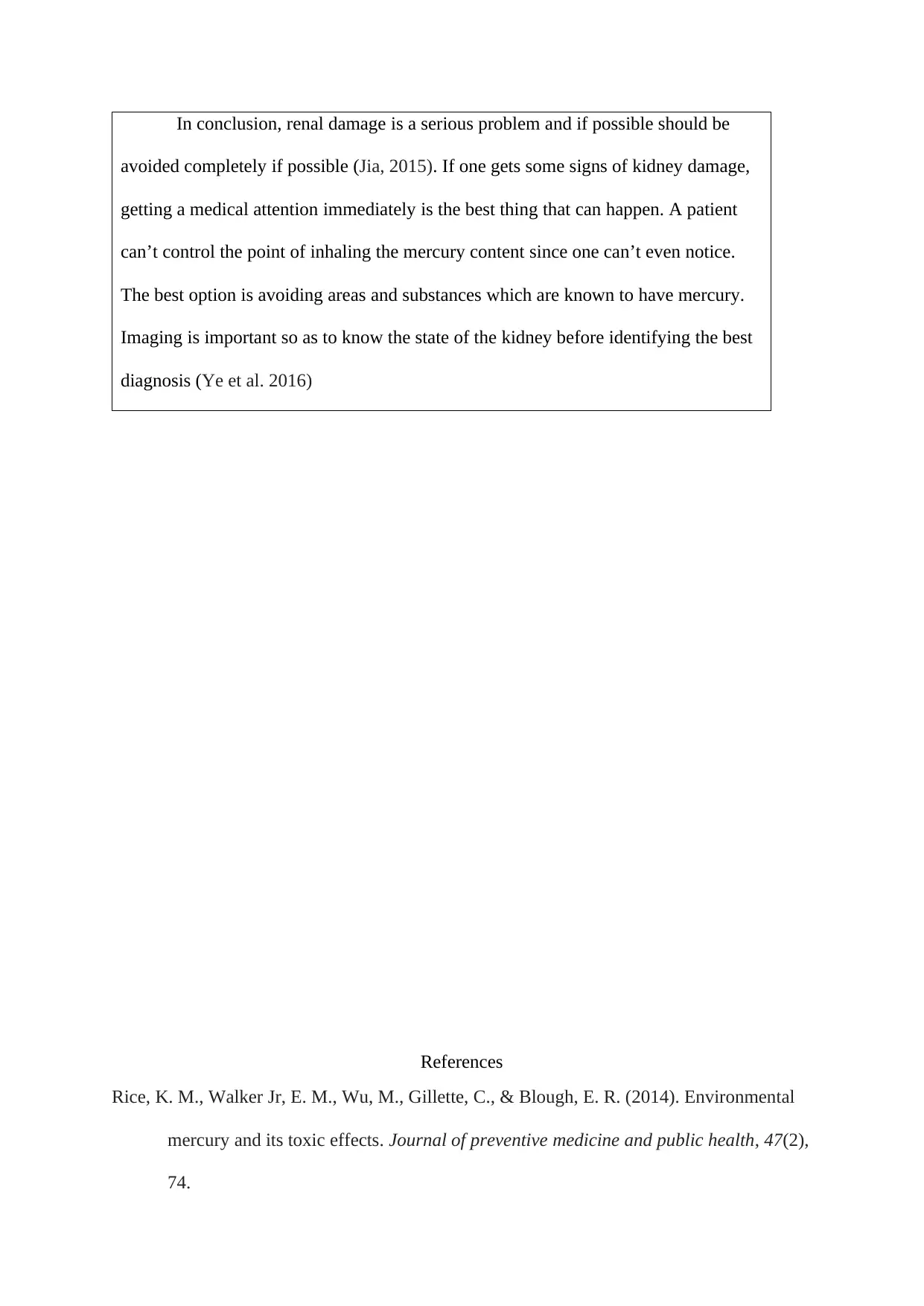
In conclusion, renal damage is a serious problem and if possible should be
avoided completely if possible (Jia, 2015). If one gets some signs of kidney damage,
getting a medical attention immediately is the best thing that can happen. A patient
can’t control the point of inhaling the mercury content since one can’t even notice.
The best option is avoiding areas and substances which are known to have mercury.
Imaging is important so as to know the state of the kidney before identifying the best
diagnosis (Ye et al. 2016)
References
Rice, K. M., Walker Jr, E. M., Wu, M., Gillette, C., & Blough, E. R. (2014). Environmental
mercury and its toxic effects. Journal of preventive medicine and public health, 47(2),
74.
avoided completely if possible (Jia, 2015). If one gets some signs of kidney damage,
getting a medical attention immediately is the best thing that can happen. A patient
can’t control the point of inhaling the mercury content since one can’t even notice.
The best option is avoiding areas and substances which are known to have mercury.
Imaging is important so as to know the state of the kidney before identifying the best
diagnosis (Ye et al. 2016)
References
Rice, K. M., Walker Jr, E. M., Wu, M., Gillette, C., & Blough, E. R. (2014). Environmental
mercury and its toxic effects. Journal of preventive medicine and public health, 47(2),
74.

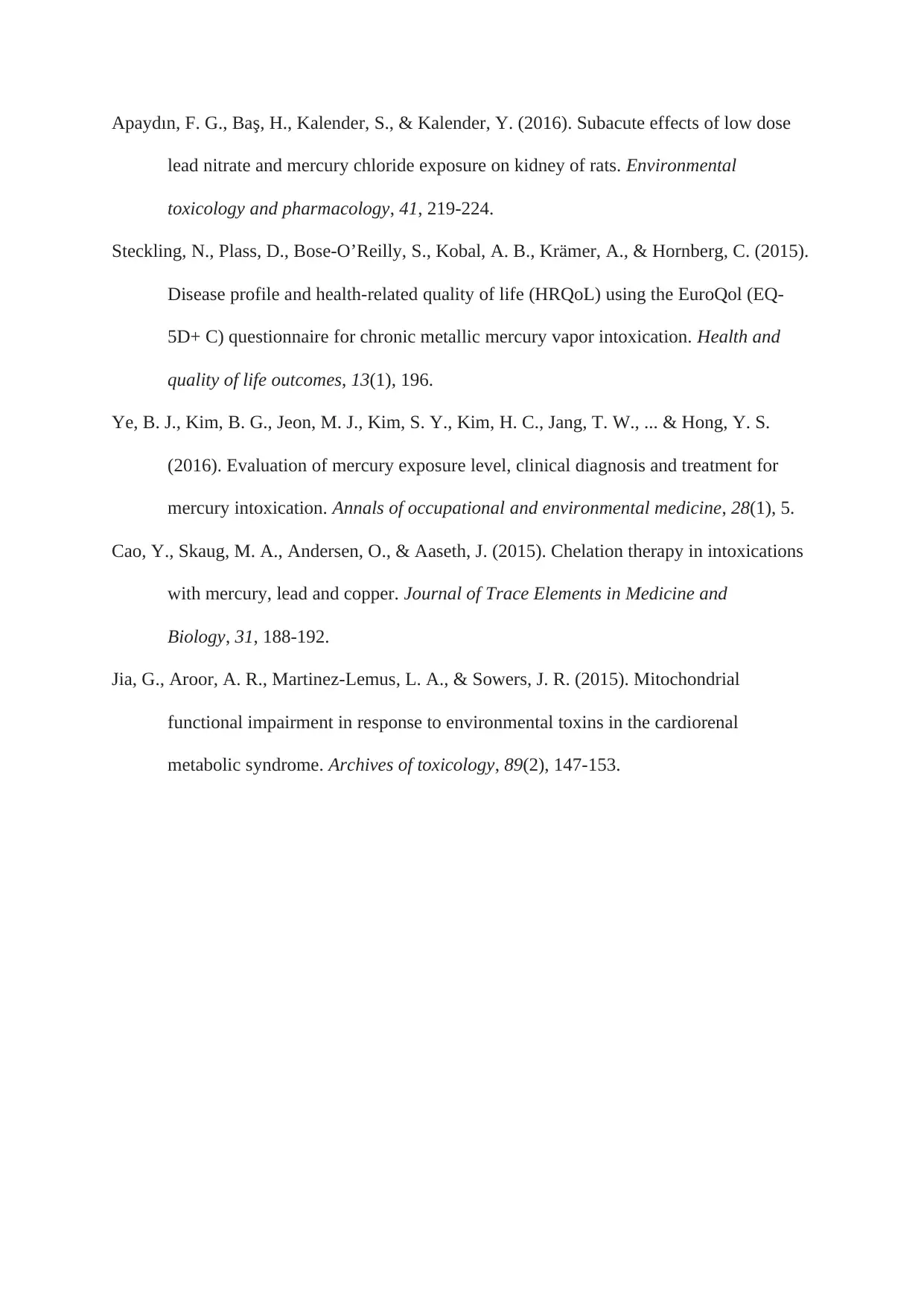
Apaydın, F. G., Baş, H., Kalender, S., & Kalender, Y. (2016). Subacute effects of low dose
lead nitrate and mercury chloride exposure on kidney of rats. Environmental
toxicology and pharmacology, 41, 219-224.
Steckling, N., Plass, D., Bose-O’Reilly, S., Kobal, A. B., Krämer, A., & Hornberg, C. (2015).
Disease profile and health-related quality of life (HRQoL) using the EuroQol (EQ-
5D+ C) questionnaire for chronic metallic mercury vapor intoxication. Health and
quality of life outcomes, 13(1), 196.
Ye, B. J., Kim, B. G., Jeon, M. J., Kim, S. Y., Kim, H. C., Jang, T. W., ... & Hong, Y. S.
(2016). Evaluation of mercury exposure level, clinical diagnosis and treatment for
mercury intoxication. Annals of occupational and environmental medicine, 28(1), 5.
Cao, Y., Skaug, M. A., Andersen, O., & Aaseth, J. (2015). Chelation therapy in intoxications
with mercury, lead and copper. Journal of Trace Elements in Medicine and
Biology, 31, 188-192.
Jia, G., Aroor, A. R., Martinez-Lemus, L. A., & Sowers, J. R. (2015). Mitochondrial
functional impairment in response to environmental toxins in the cardiorenal
metabolic syndrome. Archives of toxicology, 89(2), 147-153.
lead nitrate and mercury chloride exposure on kidney of rats. Environmental
toxicology and pharmacology, 41, 219-224.
Steckling, N., Plass, D., Bose-O’Reilly, S., Kobal, A. B., Krämer, A., & Hornberg, C. (2015).
Disease profile and health-related quality of life (HRQoL) using the EuroQol (EQ-
5D+ C) questionnaire for chronic metallic mercury vapor intoxication. Health and
quality of life outcomes, 13(1), 196.
Ye, B. J., Kim, B. G., Jeon, M. J., Kim, S. Y., Kim, H. C., Jang, T. W., ... & Hong, Y. S.
(2016). Evaluation of mercury exposure level, clinical diagnosis and treatment for
mercury intoxication. Annals of occupational and environmental medicine, 28(1), 5.
Cao, Y., Skaug, M. A., Andersen, O., & Aaseth, J. (2015). Chelation therapy in intoxications
with mercury, lead and copper. Journal of Trace Elements in Medicine and
Biology, 31, 188-192.
Jia, G., Aroor, A. R., Martinez-Lemus, L. A., & Sowers, J. R. (2015). Mitochondrial
functional impairment in response to environmental toxins in the cardiorenal
metabolic syndrome. Archives of toxicology, 89(2), 147-153.
⊘ This is a preview!⊘
Do you want full access?
Subscribe today to unlock all pages.

Trusted by 1+ million students worldwide
1 out of 6
Related Documents
Your All-in-One AI-Powered Toolkit for Academic Success.
+13062052269
info@desklib.com
Available 24*7 on WhatsApp / Email
Unlock your academic potential
Copyright © 2020–2025 A2Z Services. All Rights Reserved. Developed and managed by ZUCOL.