Analysis of M&A Deals: Value, Concerns, and Metrics

Verified

Added on  2022/10/10

|5
|648
|211
Report
AI Summary
This report provides an analysis of Merger and Acquisition (M&A) deals, addressing two key questions. The first question explores the primary concerns of buyers in M&A transactions, highlighting the risk of failure and the factors contributing to this concern, such as inadequate due diligence, pressure to close deals quickly, and lack of understanding of market conditions. The second question focuses on determining value creation or destruction in M&A deals, identifying cost reduction, revenue increases, and real options as key drivers. The report discusses both strategic and financial metrics used to assess the success of M&A deals, including revenue growth, profit margins, and return on assets. It also references academic sources to support the analysis.
Document Page
Running head: MERGER AND ACQUISITION DEALS
Merger and Acquisition Deals
Name of the Student
Name of the University
Author Note
tabler-icon-diamond-filled.svg

Paraphrase This Document

Need a fresh take? Get an instant paraphrase of this document with our AI Paraphraser
Document Page
1MERGER AND ACQUISITION DEALS
Table of Contents
Acceleration of gain to the seller.................................................................................................2
Exceptions to instalment sale gains.............................................................................................2
References....................................................................................................................................4
Document Page
2MERGER AND ACQUISITION DEALS
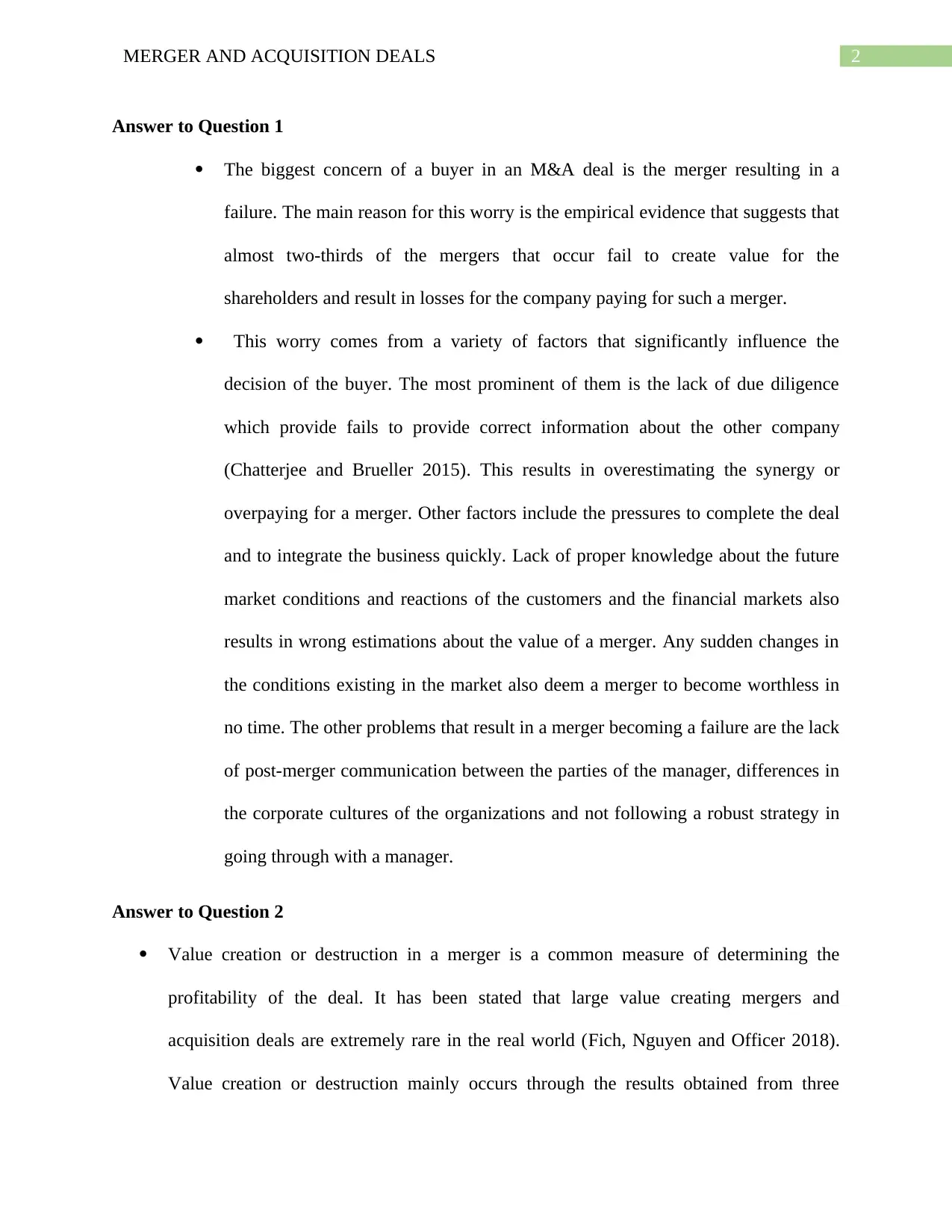
Answer to Question 1
The biggest concern of a buyer in an M&A deal is the merger resulting in a
failure. The main reason for this worry is the empirical evidence that suggests that
almost two-thirds of the mergers that occur fail to create value for the
shareholders and result in losses for the company paying for such a merger.
This worry comes from a variety of factors that significantly influence the
decision of the buyer. The most prominent of them is the lack of due diligence
which provide fails to provide correct information about the other company
(Chatterjee and Brueller 2015). This results in overestimating the synergy or
overpaying for a merger. Other factors include the pressures to complete the deal
and to integrate the business quickly. Lack of proper knowledge about the future
market conditions and reactions of the customers and the financial markets also
results in wrong estimations about the value of a merger. Any sudden changes in
the conditions existing in the market also deem a merger to become worthless in
no time. The other problems that result in a merger becoming a failure are the lack
of post-merger communication between the parties of the manager, differences in
the corporate cultures of the organizations and not following a robust strategy in
going through with a manager.
Answer to Question 2
Value creation or destruction in a merger is a common measure of determining the
profitability of the deal. It has been stated that large value creating mergers and
acquisition deals are extremely rare in the real world (Fich, Nguyen and Officer 2018).
Value creation or destruction mainly occurs through the results obtained from three
Document Page
3MERGER AND ACQUISITION DEALS
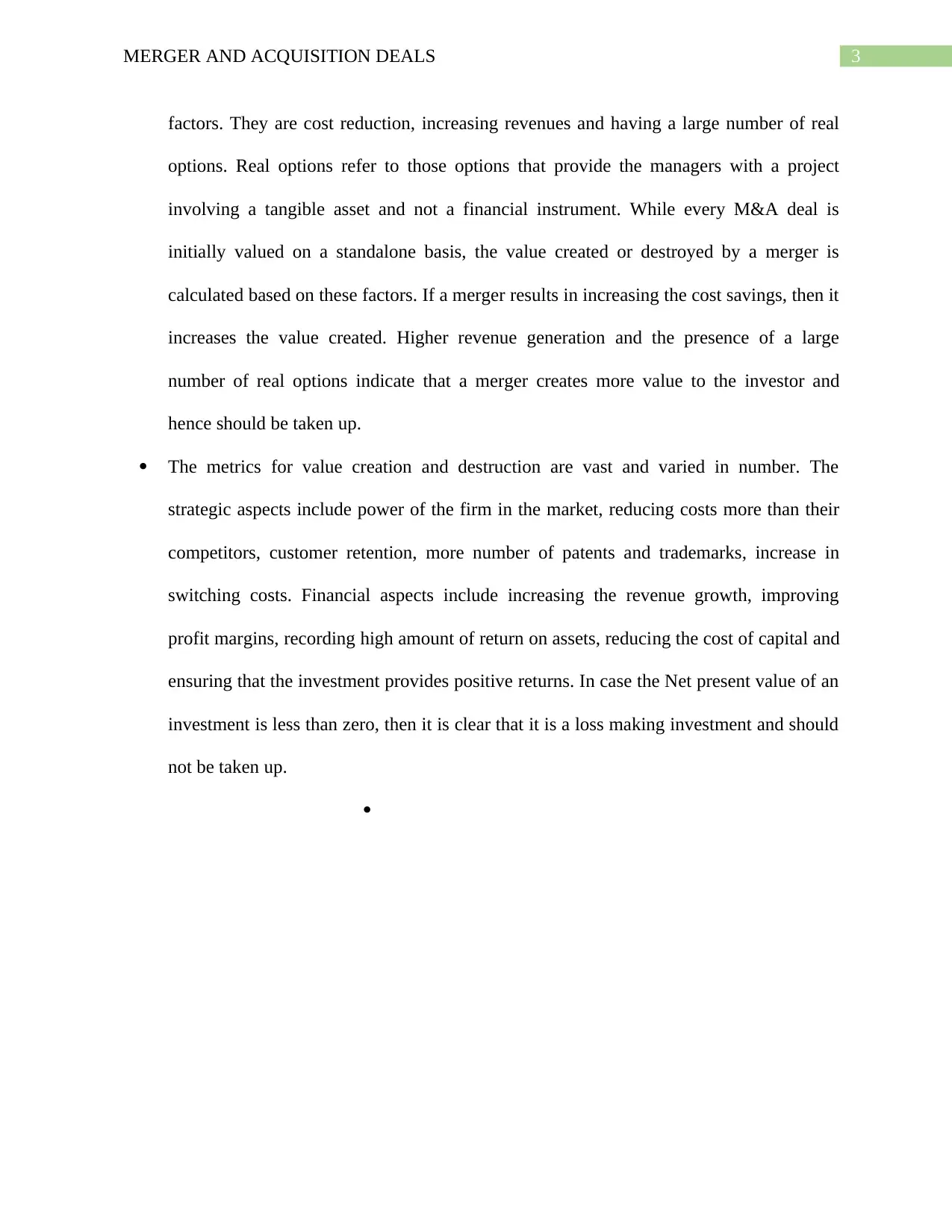
factors. They are cost reduction, increasing revenues and having a large number of real
options. Real options refer to those options that provide the managers with a project
involving a tangible asset and not a financial instrument. While every M&A deal is
initially valued on a standalone basis, the value created or destroyed by a merger is
calculated based on these factors. If a merger results in increasing the cost savings, then it
increases the value created. Higher revenue generation and the presence of a large
number of real options indicate that a merger creates more value to the investor and
hence should be taken up.
The metrics for value creation and destruction are vast and varied in number. The
strategic aspects include power of the firm in the market, reducing costs more than their
competitors, customer retention, more number of patents and trademarks, increase in
switching costs. Financial aspects include increasing the revenue growth, improving
profit margins, recording high amount of return on assets, reducing the cost of capital and
ensuring that the investment provides positive returns. In case the Net present value of an
investment is less than zero, then it is clear that it is a loss making investment and should
not be taken up.
tabler-icon-diamond-filled.svg

Paraphrase This Document

Need a fresh take? Get an instant paraphrase of this document with our AI Paraphraser
Document Page
4MERGER AND ACQUISITION DEALS
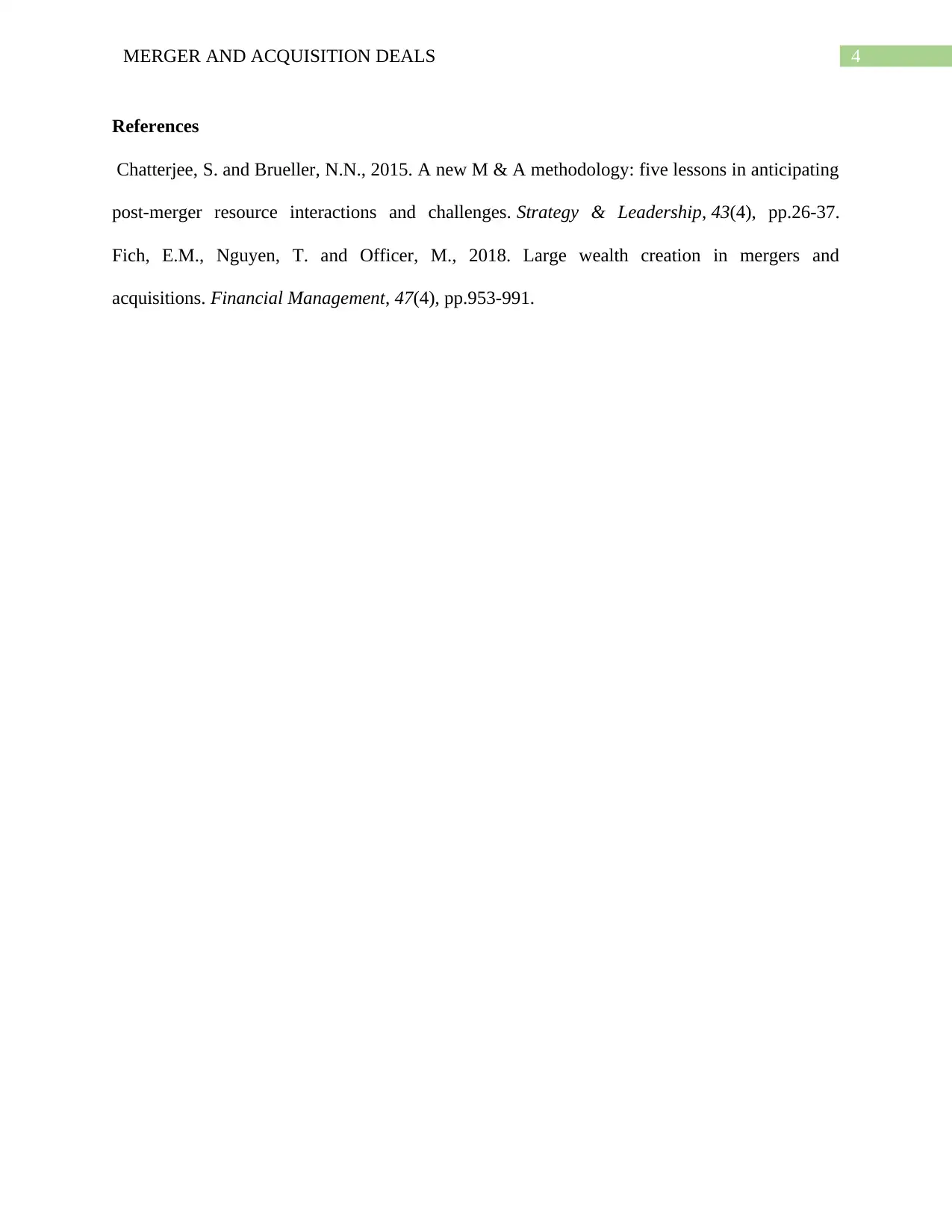
References
Chatterjee, S. and Brueller, N.N., 2015. A new M & A methodology: five lessons in anticipating
post-merger resource interactions and challenges. Strategy & Leadership, 43(4), pp.26-37.
Fich, E.M., Nguyen, T. and Officer, M., 2018. Large wealth creation in mergers and
acquisitions. Financial Management, 47(4), pp.953-991.
chevron_up_icon
1 out of 5
circle_padding
hide_on_mobile
zoom_out_icon
[object Object]