MN7183DL: Comparative Methodological Critique of Research Studies
VerifiedAdded on 2021/02/19
|10
|2567
|21
Report
AI Summary
This report presents a comparative methodological critique of two research studies, one employing qualitative methods and the other quantitative. The report begins with an introduction outlining the aims and objectives of the comparative analysis. The main body then discusses the research aims, objectives, and rationales of the case studies, which focus on satisfaction and loyalty in the Israeli hi-tech industry and managerialism in education. It then delves into the epistemological positions, research designs (exploratory and conclusive), and data collection methods (qualitative and quantitative) used in each study, evaluating their pros and cons. The discussion section synthesizes the findings, highlighting the significance of each methodological approach. Finally, the conclusion summarizes the key comparisons and contrasts between the two research studies. The report emphasizes the strengths and weaknesses of each research design and data collection method, ultimately providing a comprehensive understanding of the application of both qualitative and quantitative research methodologies.

Comparative Methodological Critique

Paraphrase This Document
Need a fresh take? Get an instant paraphrase of this document with our AI Paraphraser
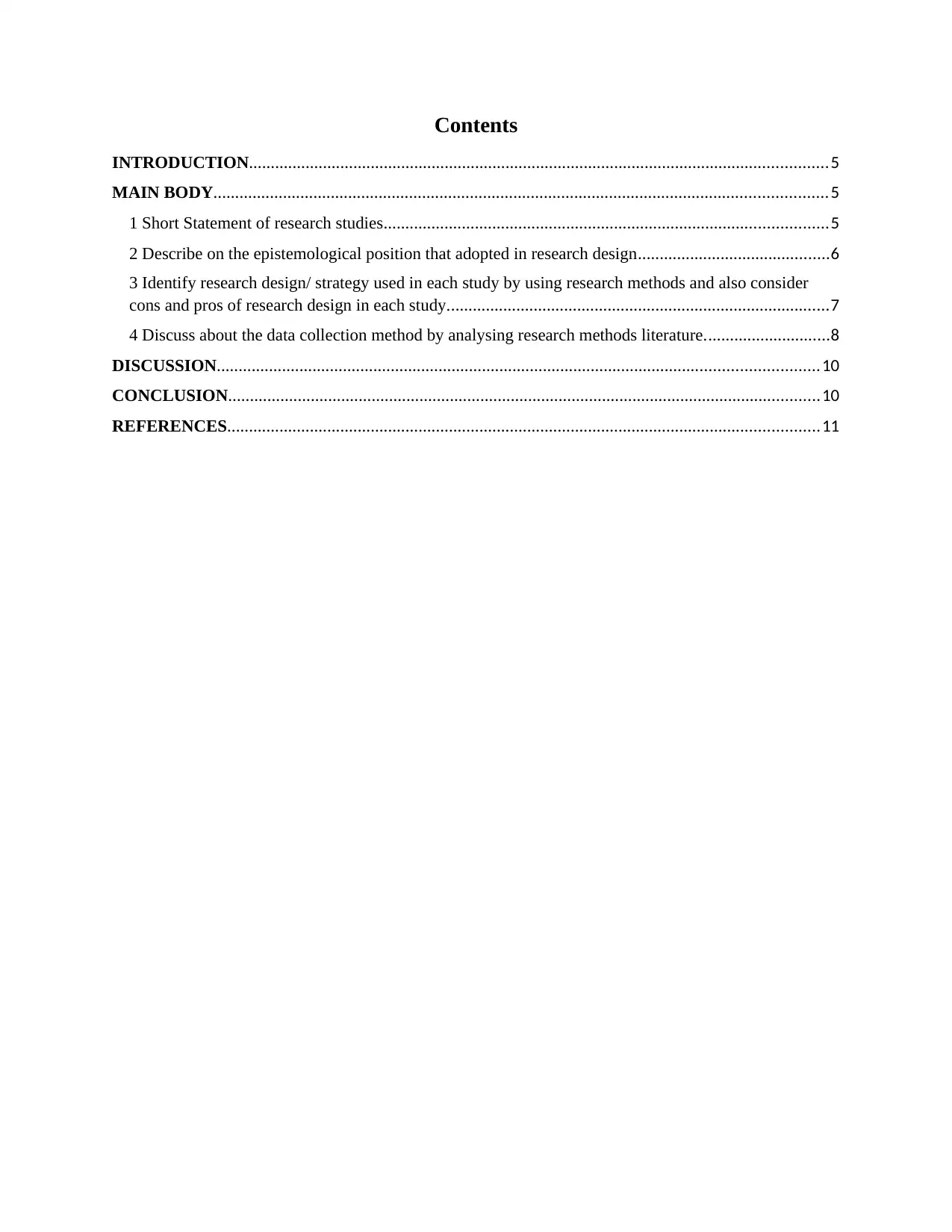
Contents
INTRODUCTION.....................................................................................................................................5
MAIN BODY.............................................................................................................................................5
1 Short Statement of research studies......................................................................................................5
2 Describe on the epistemological position that adopted in research design............................................6
3 Identify research design/ strategy used in each study by using research methods and also consider
cons and pros of research design in each study........................................................................................7
4 Discuss about the data collection method by analysing research methods literature.............................8
DISCUSSION..........................................................................................................................................10
CONCLUSION........................................................................................................................................10
REFERENCES........................................................................................................................................11
INTRODUCTION.....................................................................................................................................5
MAIN BODY.............................................................................................................................................5
1 Short Statement of research studies......................................................................................................5
2 Describe on the epistemological position that adopted in research design............................................6
3 Identify research design/ strategy used in each study by using research methods and also consider
cons and pros of research design in each study........................................................................................7
4 Discuss about the data collection method by analysing research methods literature.............................8
DISCUSSION..........................................................................................................................................10
CONCLUSION........................................................................................................................................10
REFERENCES........................................................................................................................................11
INTRODUCTION
In this review essay, it should include comparative study about the pair 3 which is mainly
focused on the satisfaction and loyalty management in the Israeli hi-tech industry that increase
challenges in context of contemporary society. On the other hand, another case study is based on
the ‘response to managerialism’ where how management pressure effects on the relations and
loyalties in educations. Satisfaction and loyalty is important concept in terms of hi-tech industry
that improved the business operations and functions. It has required to build an effective trust
between employees that implemented accurate policies and procedures of improvement as well
as development. In this case study, it would like to discuss about the RAD data communication
company that used hi-technology for improving communication between one places to other. It
useful for business to increase productivity and profitability in marketplace. Another case study
is discussed about managerialism response in the terms of education where how it will increase
pressure on management regarding implementing new approaches by manager in education
development.
MAIN BODY
1 Short Statement of research studies
Discuss about the research aim and objective of each study.
Case study-1
Aim: To analyse the challenges in Israel’s hi-technology sectors for business development. A
case study on “RAD Data Communication”
Objective:
To analyse impact of Israel hi-technology on multinational companies.
To determine threats that effects on business growth of organization.
To overcome challenges by using strategic approaches in multinational companies.
Case study-2
Aim: To analyse that impact of management pressure in business context of relation and loyalties
in education. A case study on education industry.
In this review essay, it should include comparative study about the pair 3 which is mainly
focused on the satisfaction and loyalty management in the Israeli hi-tech industry that increase
challenges in context of contemporary society. On the other hand, another case study is based on
the ‘response to managerialism’ where how management pressure effects on the relations and
loyalties in educations. Satisfaction and loyalty is important concept in terms of hi-tech industry
that improved the business operations and functions. It has required to build an effective trust
between employees that implemented accurate policies and procedures of improvement as well
as development. In this case study, it would like to discuss about the RAD data communication
company that used hi-technology for improving communication between one places to other. It
useful for business to increase productivity and profitability in marketplace. Another case study
is discussed about managerialism response in the terms of education where how it will increase
pressure on management regarding implementing new approaches by manager in education
development.
MAIN BODY
1 Short Statement of research studies
Discuss about the research aim and objective of each study.
Case study-1
Aim: To analyse the challenges in Israel’s hi-technology sectors for business development. A
case study on “RAD Data Communication”
Objective:
To analyse impact of Israel hi-technology on multinational companies.
To determine threats that effects on business growth of organization.
To overcome challenges by using strategic approaches in multinational companies.
Case study-2
Aim: To analyse that impact of management pressure in business context of relation and loyalties
in education. A case study on education industry.
⊘ This is a preview!⊘
Do you want full access?
Subscribe today to unlock all pages.

Trusted by 1+ million students worldwide
Objective:
To determine positive and negative impact of managerialism responses in the relation and
loyalties on business.
To recommend to overcome barriers in the education sector.
Rational for each study
The rationale of case study is to find the specific reason for conducting particular areas
where it help for analysing overall significance in terms of improvement and development. In
this way, researcher should improve the depth knowledge about conceptual framework that
applicable for enhancement. As per research study on “satisfaction and loyalty management in
the Israeli hi-tech industry’ where researcher has been found the coordination between the
employee and manager. In this way, researcher is analysing depth knowledge about satisfaction
and understand different approaches that applicable to increase capabilities and abilities
(Cesafsky and Derickson, 2019). Another case study, researcher will understand about the
management pressure that effects on the overall business in context of education. Researcher has
been found that there are different drawbacks which effects on education process because it has
understand that education systems are made up by implanting innovative idea which is
responsible for innovative achievement in education sector. In this way, researcher has gathered
and collected large number of information about the management response and how it directly
effects on business.
2 Describe on the epistemological position that adopted in research design
Discuss and identify research philosophy and ontology underpinning the rationale for
research design in case study.
Research philosophy is a type of vast topic where it mainly discuss about the depth level
of methodology that implemented in the research study. It deals with the nature, development of
knowledge and source. It belief about the better ways to collect particular data about the case
study and used in appropriate manner. Research philosophy can be divided into different groups:
Realism, interpretivism, positivism and pragmatism (Fattore, Fegter and Hunner-Kreisel, 2019).
To determine positive and negative impact of managerialism responses in the relation and
loyalties on business.
To recommend to overcome barriers in the education sector.
Rational for each study
The rationale of case study is to find the specific reason for conducting particular areas
where it help for analysing overall significance in terms of improvement and development. In
this way, researcher should improve the depth knowledge about conceptual framework that
applicable for enhancement. As per research study on “satisfaction and loyalty management in
the Israeli hi-tech industry’ where researcher has been found the coordination between the
employee and manager. In this way, researcher is analysing depth knowledge about satisfaction
and understand different approaches that applicable to increase capabilities and abilities
(Cesafsky and Derickson, 2019). Another case study, researcher will understand about the
management pressure that effects on the overall business in context of education. Researcher has
been found that there are different drawbacks which effects on education process because it has
understand that education systems are made up by implanting innovative idea which is
responsible for innovative achievement in education sector. In this way, researcher has gathered
and collected large number of information about the management response and how it directly
effects on business.
2 Describe on the epistemological position that adopted in research design
Discuss and identify research philosophy and ontology underpinning the rationale for
research design in case study.
Research philosophy is a type of vast topic where it mainly discuss about the depth level
of methodology that implemented in the research study. It deals with the nature, development of
knowledge and source. It belief about the better ways to collect particular data about the case
study and used in appropriate manner. Research philosophy can be divided into different groups:
Realism, interpretivism, positivism and pragmatism (Fattore, Fegter and Hunner-Kreisel, 2019).
Paraphrase This Document
Need a fresh take? Get an instant paraphrase of this document with our AI Paraphraser
Pragmatism research philosophy is based on the concepts that relevant to the case study
and implement actions that supports on research enhancement. It is way to recognise the
interpreting which undertaken research.
Realism research philosophy is mainly relies on the innovative idea that implement on
the research study by researcher. It is based on the assumption by putting scientific approach in
the development.
In case study-1, Researcher is mainly used interpretivism philosophy because it
applicable in qualitative data collection method which involves interpret element in case study.
By using interpretivism philosophy, researcher assume that easily access reality and which
emphasizes qualitative analysis in case study. This type of approach is mainly used observation,
questionnaires and interview for collecting data or information about research study (Flood and
Starr, 2019).
In case study-2, Researcher will use the positivism philosophy that gained knowledge
about the observations which including proper measurement to collect data and information
about case study. In this study, it applicable quantitative approach to collect information through
appropriate facts and finding. It depends on the quantifiable observation that increase to the
statistical analysis.
3 Identify research design/ strategy used in each study by using research methods and also
consider cons and pros of research design in each study.
Research design is a type of concept that refers to overall strategy that would choose by
researcher, implementing in different components of case study (Golovina, Batudaeva and
Tarasova, 2019). It is basically created logical and coherent views about to ensure effectively
address the research problems. Research design can be categorised into two different types:
Exploratory and Conclusive research design.
Exploratory research design implies that explore the research questions in research study.
It does not offer the final conclusion because it based on theoretical aspects to improve quality of
case study. In order to identify the nature of problem that occurs in the research study.
Advantage of exploratory design is an effective in terms of future enhancement because it
became adaptability and flexibility (Huaman, 2019) . On the other hand, it is potentiatlly save
and implement actions that supports on research enhancement. It is way to recognise the
interpreting which undertaken research.
Realism research philosophy is mainly relies on the innovative idea that implement on
the research study by researcher. It is based on the assumption by putting scientific approach in
the development.
In case study-1, Researcher is mainly used interpretivism philosophy because it
applicable in qualitative data collection method which involves interpret element in case study.
By using interpretivism philosophy, researcher assume that easily access reality and which
emphasizes qualitative analysis in case study. This type of approach is mainly used observation,
questionnaires and interview for collecting data or information about research study (Flood and
Starr, 2019).
In case study-2, Researcher will use the positivism philosophy that gained knowledge
about the observations which including proper measurement to collect data and information
about case study. In this study, it applicable quantitative approach to collect information through
appropriate facts and finding. It depends on the quantifiable observation that increase to the
statistical analysis.
3 Identify research design/ strategy used in each study by using research methods and also
consider cons and pros of research design in each study.
Research design is a type of concept that refers to overall strategy that would choose by
researcher, implementing in different components of case study (Golovina, Batudaeva and
Tarasova, 2019). It is basically created logical and coherent views about to ensure effectively
address the research problems. Research design can be categorised into two different types:
Exploratory and Conclusive research design.
Exploratory research design implies that explore the research questions in research study.
It does not offer the final conclusion because it based on theoretical aspects to improve quality of
case study. In order to identify the nature of problem that occurs in the research study.
Advantage of exploratory design is an effective in terms of future enhancement because it
became adaptability and flexibility (Huaman, 2019) . On the other hand, it is potentiatlly save
time and resources by identifying at earlier stages. The disadvantage of exploratory design
usually make large number of samples that may not consider adequately manner.
Conclusive research design is applied to generate the findings where practically useful for
identifying accurate conclusion and helping for researcher in decision making.
Advantage of conclusive research design is to find out accurate results and outcome
because it is based on the statistical data analysis. On the other hand, Disadvantage is that when
increase causes and effects in relationships during case studies. It totally depending on the
experiments.
In case study-1, researcher will use exploratory design because it useful in qualitative
method for analysing data or information about case study. When it can be used in case study for
exploring research questions that asked with the other participants where finding accurate
solution. This case study is based on the qualitative method so as it only applicable existing
theories and different approaches for finding results.
In case study-2 researcher will use conclusive design that applies to generate the finding.
It is based on the objectives and requirements of data that clearly defined in proper manner. An
appropriate finding of conclusive research studies have specified uses, which provide the better
way to verify and quantify by researcher (Milana, 2019). This type of design approach is mainly
involved application of quantitative method in terms of data collection and analysis.
Ontology: it is defined research study that deals with nature of reality and also belief that
reflect interpretation by researcher. In research study, it associated with the questions whether
entities should be included in both subjective and objective manner. It can be divided into two
different groups: Objectivism and subjectivism (Turner, 2019).
Objectivism is position of social entities that exits in the reality external that focused with
the existences. It asserts that managing social phenomena and their existences in terms of social
actors.
Subjectivism is another phenomena that created from the consequent actions and
perceptions of social actor which are concerned about their existences. It is also known as
interpretivism which uses in qualitative approach of research study-1.
usually make large number of samples that may not consider adequately manner.
Conclusive research design is applied to generate the findings where practically useful for
identifying accurate conclusion and helping for researcher in decision making.
Advantage of conclusive research design is to find out accurate results and outcome
because it is based on the statistical data analysis. On the other hand, Disadvantage is that when
increase causes and effects in relationships during case studies. It totally depending on the
experiments.
In case study-1, researcher will use exploratory design because it useful in qualitative
method for analysing data or information about case study. When it can be used in case study for
exploring research questions that asked with the other participants where finding accurate
solution. This case study is based on the qualitative method so as it only applicable existing
theories and different approaches for finding results.
In case study-2 researcher will use conclusive design that applies to generate the finding.
It is based on the objectives and requirements of data that clearly defined in proper manner. An
appropriate finding of conclusive research studies have specified uses, which provide the better
way to verify and quantify by researcher (Milana, 2019). This type of design approach is mainly
involved application of quantitative method in terms of data collection and analysis.
Ontology: it is defined research study that deals with nature of reality and also belief that
reflect interpretation by researcher. In research study, it associated with the questions whether
entities should be included in both subjective and objective manner. It can be divided into two
different groups: Objectivism and subjectivism (Turner, 2019).
Objectivism is position of social entities that exits in the reality external that focused with
the existences. It asserts that managing social phenomena and their existences in terms of social
actors.
Subjectivism is another phenomena that created from the consequent actions and
perceptions of social actor which are concerned about their existences. It is also known as
interpretivism which uses in qualitative approach of research study-1.
⊘ This is a preview!⊘
Do you want full access?
Subscribe today to unlock all pages.
Trusted by 1+ million students worldwide
4 Discuss about the data collection method by analysing research methods literature.
Data collection is a method and process of gathering, collecting data from relevant
sources to find out the answer (Wyse and Anders, 2019). It is the best approach to test hypothesis
and evaluate the outcome or results. It can be divided into two different types: Primary data
collection and secondary data collection.
Primary data collection is also divided into two ways: qualitative data collection and
quantitative data collection. On the other hand, Secondary data collection method is another
process of collecting and gathering information that already published in newspapers, online
portals and magazine etc.
Quantitative method is basically applied within short period of time which compared with
the qualitative method (Wyse and Anders, 2019). It aim is to ensure that greater of depth
understanding and qualitative data method which including questionnaires, focus groups and
observations etc.
In case study-1, it applicable qualitative method for analysing data or information. The
negative point of qualitative method is that when sometimes, it not provide conclusive answer
and not appropriate for further research enhancement because it is only based on theoretical
aspects to assume existing approach for improve depth understanding of researcher. The positive
aspects of qualitative method is very reliable and flexible in identify results (Yang, 2019) This is
the good approach in terms of qualitative study of expanding and exploring its finding.
Sometimes, it become easier for researcher to understand about previous study that will put
innovative idea for improvement. In the qualitative data collection method, researcher will use
thematic analysis tool for identifying proper data.
In case study-2, researcher will applicable quantitative data collection method that must
describe to measure the proper level of occurrences on basis of numerical and calculations. As
per quantitative method which describing the entailing collection of numerical information and
exhibiting the view of relationship between theories in research study. Researcher is basically
used random sampling in collection of data which are usually compare, present, summarise and
generalise in proper manner (Wyse and Anders, 2019). Quantitative method is good approach for
researcher to analyse accurate solution. It also used estimation to calculate overall view of people
and find percentage in proper manner. In this way, it can colluded that quantitative data
Data collection is a method and process of gathering, collecting data from relevant
sources to find out the answer (Wyse and Anders, 2019). It is the best approach to test hypothesis
and evaluate the outcome or results. It can be divided into two different types: Primary data
collection and secondary data collection.
Primary data collection is also divided into two ways: qualitative data collection and
quantitative data collection. On the other hand, Secondary data collection method is another
process of collecting and gathering information that already published in newspapers, online
portals and magazine etc.
Quantitative method is basically applied within short period of time which compared with
the qualitative method (Wyse and Anders, 2019). It aim is to ensure that greater of depth
understanding and qualitative data method which including questionnaires, focus groups and
observations etc.
In case study-1, it applicable qualitative method for analysing data or information. The
negative point of qualitative method is that when sometimes, it not provide conclusive answer
and not appropriate for further research enhancement because it is only based on theoretical
aspects to assume existing approach for improve depth understanding of researcher. The positive
aspects of qualitative method is very reliable and flexible in identify results (Yang, 2019) This is
the good approach in terms of qualitative study of expanding and exploring its finding.
Sometimes, it become easier for researcher to understand about previous study that will put
innovative idea for improvement. In the qualitative data collection method, researcher will use
thematic analysis tool for identifying proper data.
In case study-2, researcher will applicable quantitative data collection method that must
describe to measure the proper level of occurrences on basis of numerical and calculations. As
per quantitative method which describing the entailing collection of numerical information and
exhibiting the view of relationship between theories in research study. Researcher is basically
used random sampling in collection of data which are usually compare, present, summarise and
generalise in proper manner (Wyse and Anders, 2019). Quantitative method is good approach for
researcher to analyse accurate solution. It also used estimation to calculate overall view of people
and find percentage in proper manner. In this way, it can colluded that quantitative data
Paraphrase This Document
Need a fresh take? Get an instant paraphrase of this document with our AI Paraphraser
collection method appropriate for researcher for increasing chances to collect relevant data or
information about particular case study. in quantitative data collection method, researcher will
use statistical tool to determine the particular solution effectively and efficiently.
DISCUSSION
In above discussion, it can be determined the significance of finding in each case studies
on behalf of qualitative and quantitative research method. It helps to investigate about the
research problem that being to expand new understanding in research studies. It should insight
that emerged as outcome of case study of problem. Furthermore, it also analysing with two
different case studies that connect with research questions, which propose literature reviews on
basis of implementing various approaches in research project. The above comparative
methodological discussion that explained the advanced understanding of researcher that easily
find negative and positive aspects in terms of results calculations. In this way, it also identifying
the problem from where at end of review of research studies. It present underlying the proper
methods and design of research which possible applicable in case study and also contribute to
explore improvement in order to find solution.
CONCLUSION
As per discussion, it has been summarised two different case studies that implemented in
qualitative and quantitative method for collecting suitable information through relevant source. It
can be used the different type of research design accordingly research method that applied on the
data collection. Both case studies are used different design such as exploratory and conclusive
etc. it can be found the accurate results and outcome by using research design in case studies. It
has been summarised the aim and objective of each study on the basis of situation and condition
where it also identified that what type of existing theories useful for further enhancement and
development. In this way, it has been overviews the brief idea about the each study and find
different type of relevant sources.
information about particular case study. in quantitative data collection method, researcher will
use statistical tool to determine the particular solution effectively and efficiently.
DISCUSSION
In above discussion, it can be determined the significance of finding in each case studies
on behalf of qualitative and quantitative research method. It helps to investigate about the
research problem that being to expand new understanding in research studies. It should insight
that emerged as outcome of case study of problem. Furthermore, it also analysing with two
different case studies that connect with research questions, which propose literature reviews on
basis of implementing various approaches in research project. The above comparative
methodological discussion that explained the advanced understanding of researcher that easily
find negative and positive aspects in terms of results calculations. In this way, it also identifying
the problem from where at end of review of research studies. It present underlying the proper
methods and design of research which possible applicable in case study and also contribute to
explore improvement in order to find solution.
CONCLUSION
As per discussion, it has been summarised two different case studies that implemented in
qualitative and quantitative method for collecting suitable information through relevant source. It
can be used the different type of research design accordingly research method that applied on the
data collection. Both case studies are used different design such as exploratory and conclusive
etc. it can be found the accurate results and outcome by using research design in case studies. It
has been summarised the aim and objective of each study on the basis of situation and condition
where it also identified that what type of existing theories useful for further enhancement and
development. In this way, it has been overviews the brief idea about the each study and find
different type of relevant sources.
REFERENCES
Book and Journals
Cesafsky, L. and Derickson, K., 2019. Worlding cities and comparative urbanism. In Handbook
of Urban Geography. Edward Elgar Publishing.
Fattore, T., Fegter, S. and Hunner-Kreisel, C., 2019. Children’s understandings of well-being in
global and local contexts: Theoretical and methodological considerations for a
multinational qualitative study. Child Indicators Research. 12(2). pp.385-407.
Flood, D. and Starr, J., 2019. Situated Comparison: A Methodological Response to an
Epistemological Dilemma. Ethos. 47(2). pp.211-232.
Golovina, V., Batudaeva, L. and Tarasova, I., 2019, February. Formation of Theoretical and
Methodological Bases of Revolutionary Views of K. Marx and F. Engels.
In International Conference Communicative Strategies of Information Society (CSIS
2018). Atlantis Press.
Huaman, E.S., 2019. Comparative Indigenous education research (CIER): Indigenous
epistemologies and comparative education methodologies. International Review of
Education. 65(1). pp.163-184.
Milana, M., 2019. Debating (International) Comparative Adult Education Research: Reflections
on Conceptual Clarity and Methodological Challenges. In Mapping out the Research
Field of Adult Education and Learning (pp. 203-221). Springer, Cham.
Turner, D.A., 2019. Comparative and International Education: Development of a Field and its
Method and Theory. Comparative and International Education: Survey of an Infinite
Field (International Perspectives on Education and Society, Vol. 36), Emerald
Publishing Limited. pp.11-28.
Wyse, D. and Anders, J., 2019. Primary Education Curricula across the World: Qualitative and
Quantitative Methodology in International Comparison. The SAGE Handbook of
Comparative Studies in Education. p.342.
Book and Journals
Cesafsky, L. and Derickson, K., 2019. Worlding cities and comparative urbanism. In Handbook
of Urban Geography. Edward Elgar Publishing.
Fattore, T., Fegter, S. and Hunner-Kreisel, C., 2019. Children’s understandings of well-being in
global and local contexts: Theoretical and methodological considerations for a
multinational qualitative study. Child Indicators Research. 12(2). pp.385-407.
Flood, D. and Starr, J., 2019. Situated Comparison: A Methodological Response to an
Epistemological Dilemma. Ethos. 47(2). pp.211-232.
Golovina, V., Batudaeva, L. and Tarasova, I., 2019, February. Formation of Theoretical and
Methodological Bases of Revolutionary Views of K. Marx and F. Engels.
In International Conference Communicative Strategies of Information Society (CSIS
2018). Atlantis Press.
Huaman, E.S., 2019. Comparative Indigenous education research (CIER): Indigenous
epistemologies and comparative education methodologies. International Review of
Education. 65(1). pp.163-184.
Milana, M., 2019. Debating (International) Comparative Adult Education Research: Reflections
on Conceptual Clarity and Methodological Challenges. In Mapping out the Research
Field of Adult Education and Learning (pp. 203-221). Springer, Cham.
Turner, D.A., 2019. Comparative and International Education: Development of a Field and its
Method and Theory. Comparative and International Education: Survey of an Infinite
Field (International Perspectives on Education and Society, Vol. 36), Emerald
Publishing Limited. pp.11-28.
Wyse, D. and Anders, J., 2019. Primary Education Curricula across the World: Qualitative and
Quantitative Methodology in International Comparison. The SAGE Handbook of
Comparative Studies in Education. p.342.
⊘ This is a preview!⊘
Do you want full access?
Subscribe today to unlock all pages.
Trusted by 1+ million students worldwide

Yang, R., 2019. Riddled with Gaping Wounds: A Methodological Critique of Comparative and
International Studies in Education: Views of a Professor. The SAGE Handbook of
Comparative Studies in Education. p.64.
International Studies in Education: Views of a Professor. The SAGE Handbook of
Comparative Studies in Education. p.64.

1 out of 10


Related Documents


Your All-in-One AI-Powered Toolkit for Academic Success.
+13062052269
info@desklib.com
Available 24*7 on WhatsApp / Email
![[object Object]](/_next/static/media/star-bottom.7253800d.svg)
Unlock your academic potential
Copyright © 2020–2026 A2Z Services. All Rights Reserved. Developed and managed by ZUCOL.