Report on Kinetics of Methylene Blue Reduction by Ascorbic Acid

Verified

Added on  2023/06/04

|8
|1813
|80
Report
AI Summary
This report examines the kinetics of methylene blue reduction by ascorbic acid, delving into the causes of color fading in textile dyes and the underlying reaction mechanisms. It covers topics such as the Jablonski scheme, photochemical reactions, radiationless transitions, and the effect of singlet oxygen generation on dye destruction. Specific molecules known to fade, like methylene blue dimers, are discussed, along with the conditions under which fading occurs, including the role of excited singlet states and triplet-triplet annihilation. The report also outlines various reaction mechanisms for fading, such as those involving tin nanoparticles, ozone, and reactive oxygen species. The kinetics of the fading process are explained in terms of reaction rates and the relationship between concentration and reaction order, with examples of how oxygen affects the process. The mechanism of fading for thiazole orange and methylene blue is explored, noting their capacity to damage cellulose. The document concludes with a list of references used in the analysis. Desklib provides similar documents and solved assignments for students.
Document Page
Running head: KINETICS OF METHYLENE BLUE REDUCTION BY ASCORBIC ACID
Kinetics of Fading
Name of the Student
Name of the University
Author Note
tabler-icon-diamond-filled.svg

Paraphrase This Document

Need a fresh take? Get an instant paraphrase of this document with our AI Paraphraser
Document Page
2
KINETICS OF METHYLENE BLUE REDUCTION BY ASCORBIC ACID
Color Fading and its Causes
The molecular attraction of the pigment in the garment loses the molecular attraction with the
fabric that alternatively results in color fading. The chemical reaction results in incorporating the dye
with the fabric as a part of the fabric as a layer of the fabric.
UV light sources could lead to the reduction of the intensity absorption of the materials those
have been dyed and this phenomenon can be termed as the photo fading. Simply, it can be stated as
the elimination of the absorbed or excess energy and following are the ways through which the fading
can occur due to the following factors:
Radiation emission or the interaction of the phosphorescence or the fluorescence
Photochemical are other possible causes those could lead to the fading (Oster and
Wotherspoon 1957)
The factors associated with the internal energy conversion or intersystem crossing could lead
to the radiation less transitions are another major ways those could lead to the fading.
The very low or high pH can also result in the breakage of the azo bond that could be an
instance process.
Jablonski Scheme: The following diagram represents the difference between the
phosphorescence and fluorescence or in other words, it can explain the photochemistry of textile dyes:
Document Page
3
KINETICS OF METHYLENE BLUE REDUCTION BY ASCORBIC ACID
Figure 1: Jablonski Scheme
(Source: )
The above diagram explains the essential transition between the electronic states of the fiber
molecule and dyes components. The absorption of the light by the ground state molecules (S0) raises
to excited electronic states (S1 or S2). The excited states tend to be short-lived as that of the molecules
tending to be at the ground state.
Photochemical reactions: the conventional photochemical generally originate from the
triplet states those lives till 10s from 100ns. The excited singlet tends to live for much shorter lifetime
of 1-1000 ps. During the process of the degradation reaction, there are possibilities that the molecule
might undergo intersystem results crossing in the corresponding triplet state that lives longer than the
excited molecules. The accelerated reaction might occur due to the cases that the molecules could get
to the high vibrational level.
Radiationless transitions: It could occur because of the internal energy conversion or
intersystem crossing right behind the vibrational relaxation. The above mentioned diagram indicates
the process using wavy lines those could be macroscopically observed due to heat evolution. The
major cause behind the radiationless transition is because of the internal energy conversion or
intersystem crossing those can be described as the iso-energic process or can be represented as no
change in overall energy.
Emission of radiation: this radiation occurs from the excited states’ lowest vibrational levels
of the ground state that could be stated as the fluorescence. The radiation being emitted to the ground
state from the lowest triplet state T, is known as phosphorescence.
Photochemical reactions: The triplet state contributes in the most conventional
photochemical reaction those have limited lifetime ranging between the age 10 s and 100 ns. The
excited singlet state span between 1-1000ps and lives much shorter than compared to that of the
ground state element that elads to the efficient chemical reaction. The relaxation of the higher excited
singlet generally relaxes in condensed phase that alternatively results in the loss of thermal energy to
Document Page
4
KINETICS OF METHYLENE BLUE REDUCTION BY ASCORBIC ACID
the singlet those have been lowest excited and leading to the insignificance of the chemical reactions
in general. “Although singlet excited states, HD*, produced when a molecule absorbs a photon of
light, tend to be too short-lived for conventional photochemical reactions.”
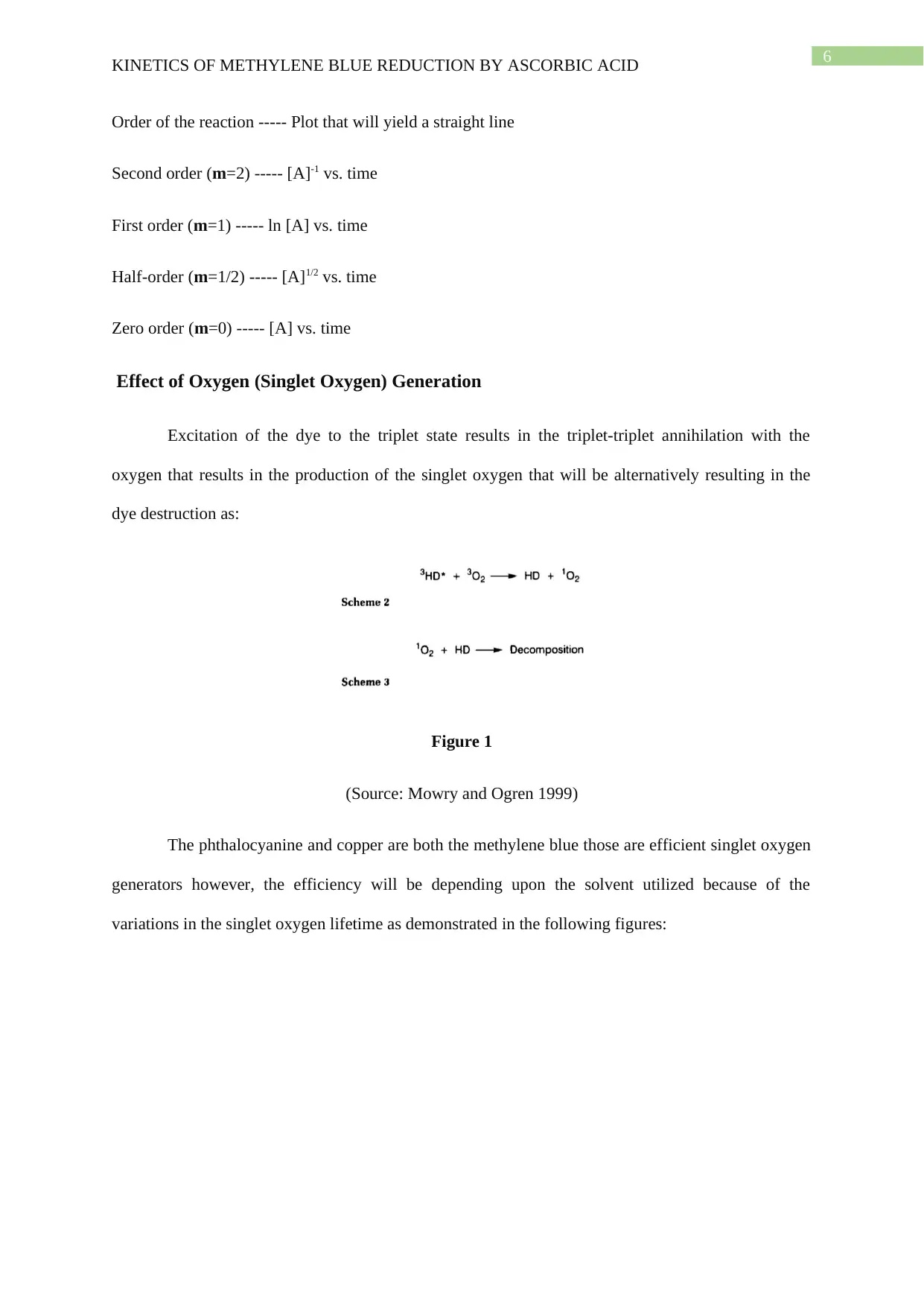
Photo-oxidation via singlet oxygen: Excitation of the dye to the triplet state results in the
triplet-triplet annihilation with the oxygen that results in the production of the singlet oxygen that will
be alternatively resulting in the dye destruction. The triplet-triplet annihilation could possibly occur
with the oxygen for the instance when dye is excited to the triplet state that could alternatively result
in the production of the singlet oxygen (scheme 2) that in turn initiates the dye destruction (scheme 3).
3HD* + 3O2 - HD + 1O2
1O2 + HD ------ Decomposition
The efficient singlet oxygen generators include the methylene blue and copper (ii)
phthalocyanine because of the variations in the singlet oxygen lifetimes.
Molecules known to fade
Methylene blue, dimers, or aggregates containing a sm2~11 number of molecules are the
molecules those could fade away due to the interaction of the ultra-violate rays or any other chemical
reaction. “In connection with the basophilic staining of wool fibers by Methylene Blue to disclose
cortical differentiation, the persistence of the intensity of the initial staining of the orthocortex has
been suspect (Dong et al. 2011).” It can be instructive that there is the possibility of the relationship
between the light intensity and the rate of fading considering the assumption of the existence of
threshold intensity.
Condition under which Molecules Fade
Fading occurs due to excited single states that is being produced when one of the molecule
absorbs a photon of light that has been intended to be short-living for the conventional photochemical
reactions. The photo degradation occurs due to the absorption of the 1 out of 100, 000 through the
typical quantum resulting in the textile dye fading. Fading occurring due to the singlet oxygen as the
tabler-icon-diamond-filled.svg

Paraphrase This Document

Need a fresh take? Get an instant paraphrase of this document with our AI Paraphraser
Document Page
5
KINETICS OF METHYLENE BLUE REDUCTION BY ASCORBIC ACID
dye molecules might undergo triplet-triplet annihilation with the oxygen having triplet ground state
that alternatively results in the production of the singlet oxygen resulting in the destruction of the dye
(Barka, Abdennouri and Makhfouk 2011). Superoxide might also result in the fading of the dye
molecules.
Reaction mechanism for Fading of Molecules
Following are the known reaction mechanisms those have been evaluated for the molecules
that fade way:
Capacity-fading and reaction mechanisms of the tin nanoparticles in potassium-ion batteries,
reaction of ozone with indigos results fading of the natural organic colorants, the mechanism of the
photofading of the azo dye within the hydrazine and azo forms through the UV irradiation ( Franca,
Oliveira and Ferreira 2009). The mechanism of the TiO2-coated photoluminescent materials. Another
study focused on the capsanthin fading in vitro being induced due to the reactive oxyzen spices.
Kinetics of the Fading Process
The kinetics of fading can be explained as following:
For a reaction:
aA + bB ---> cC + dD
The reactions’ rate can be defined in terms of the change in the concentration of the product or
reactants per unit of the time:
Reaction rate = -D[A]/(a Dt) = -D[B]/(b Dt) = D[C]/(c Dt) = D[D]/(d Dt)
The relationship between the instantaneous concentration and rate of the reaction of the reactants can
be defined as:
Rate of reaction = k [A]m[B]n
Following are the known relationships considering different order of reaction as:
Document Page
6
KINETICS OF METHYLENE BLUE REDUCTION BY ASCORBIC ACID
Order of the reaction ----- Plot that will yield a straight line
Second order (m=2) ----- [A]-1 vs. time
First order (m=1) ----- ln [A] vs. time
Half-order (m=1/2) ----- [A]1/2 vs. time
Zero order (m=0) ----- [A] vs. time
Effect of Oxygen (Singlet Oxygen) Generation
Excitation of the dye to the triplet state results in the triplet-triplet annihilation with the
oxygen that results in the production of the singlet oxygen that will be alternatively resulting in the
dye destruction as:
Figure 1
(Source: Mowry and Ogren 1999)
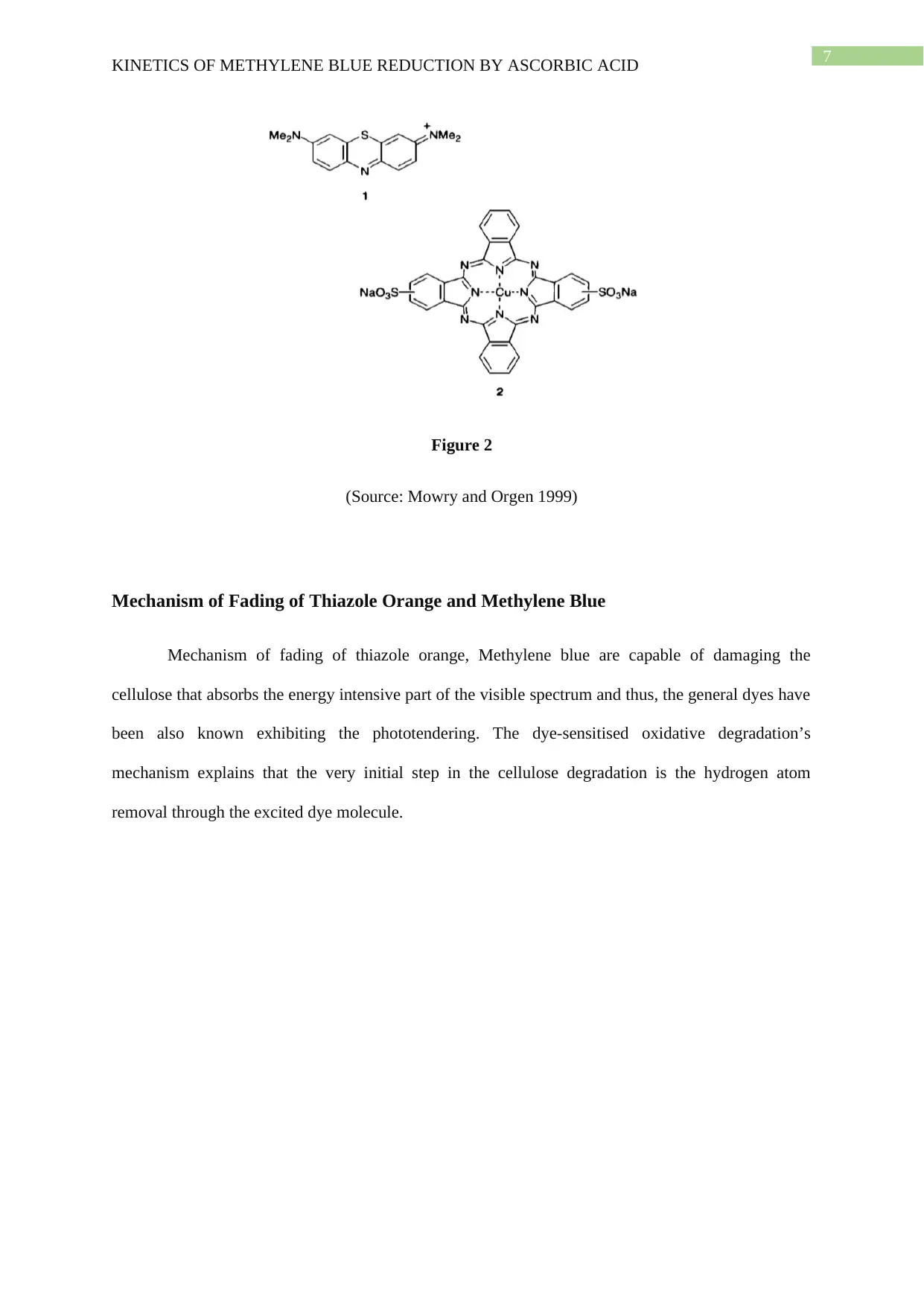
The phthalocyanine and copper are both the methylene blue those are efficient singlet oxygen
generators however, the efficiency will be depending upon the solvent utilized because of the
variations in the singlet oxygen lifetime as demonstrated in the following figures:
Document Page
7
KINETICS OF METHYLENE BLUE REDUCTION BY ASCORBIC ACID
Figure 2
(Source: Mowry and Orgen 1999)
Mechanism of Fading of Thiazole Orange and Methylene Blue
Mechanism of fading of thiazole orange, Methylene blue are capable of damaging the
cellulose that absorbs the energy intensive part of the visible spectrum and thus, the general dyes have
been also known exhibiting the phototendering. The dye-sensitised oxidative degradation’s
mechanism explains that the very initial step in the cellulose degradation is the hydrogen atom
removal through the excited dye molecule.
tabler-icon-diamond-filled.svg

Paraphrase This Document

Need a fresh take? Get an instant paraphrase of this document with our AI Paraphraser
Document Page
8
KINETICS OF METHYLENE BLUE REDUCTION BY ASCORBIC ACID
References:
Oakes, J., 2001. Photofading of textile dyes. Review of Progress in Coloration and Related Topics,
31(1), pp.21-28.
Mowry, S. and Ogren, P.J., 1999. Kinetics of methylene blue reduction by ascorbic acid. Journal of
chemical education, 76(7), p.970.
Franca, A.S., Oliveira, L.S. and Ferreira, M.E., 2009. Kinetics and equilibrium studies of methylene
blue adsorption by spent coffee grounds. Desalination, 249(1), pp.267-272.
Dong, Y., Lu, B., Zang, S., Zhao, J., Wang, X. and Cai, Q., 2011. Removal of methylene blue from
coloured effluents by adsorption onto SBA‐15. Journal of Chemical Technology & Biotechnology,
86(4), pp.616-619.
Barka, N., Abdennouri, M. and Makhfouk, M.E., 2011. Removal of Methylene Blue and Eriochrome
Black T from aqueous solutions by biosorption on Scolymus hispanicus L.: Kinetics, equilibrium and
thermodynamics. Journal of the Taiwan Institute of Chemical Engineers, 42(2), pp.320-326.
Oster, G. and Wotherspoon, N., 1957. Photoreduction of Methylene Blue by
Ethylenediaminetetraacetic Acid1a, b. Journal of the American Chemical Society, 79(18), pp.4836-
4838.
chevron_up_icon
1 out of 8
circle_padding
hide_on_mobile
zoom_out_icon
[object Object]