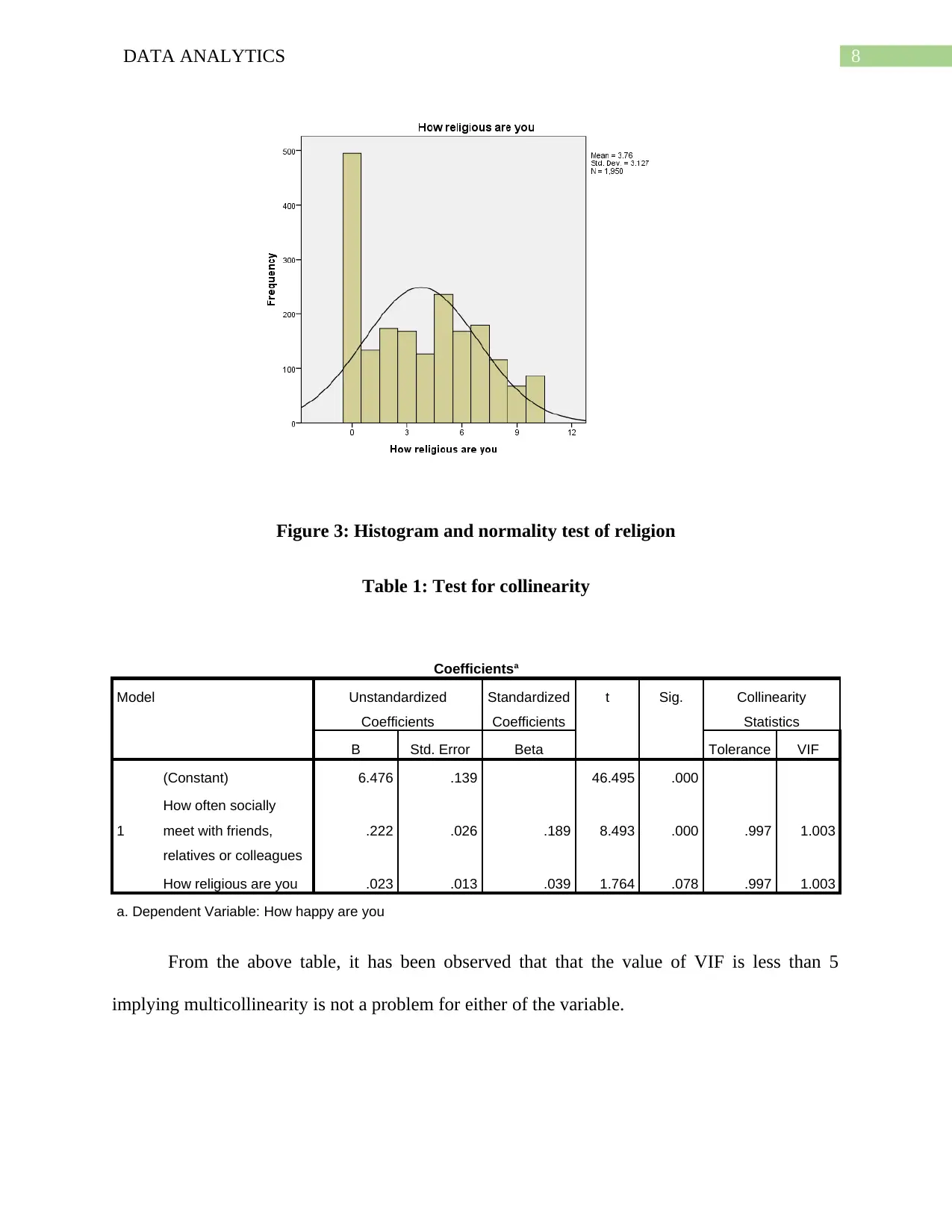
MG4002 - Data Analytics: How Religion & Friendship Affect Happiness
VerifiedAdded on  2023/05/28
|18
|3117
|223
Report
AI Summary
This report explores the relationship between religion, friendship, and individual happiness through data analytics. It begins with a problem statement highlighting the varying dimensions of happiness and the roles of friendship and religion. The research aims to determine how these factors affect happiness within a society. The conceptual framework outlines existing literature supporting the claim that friendship enhances happiness and discusses the inconsistent findings regarding religion's impact. Hypotheses are formulated to test the statistical significance of these associations. The research methodology details the data collection process, including statistical assumptions, descriptive statistics, correlation, and regression analysis. The data analysis section presents findings on normality, multicollinearity, linearity, and homoscedasticity, followed by descriptive statistics for happiness, religion, and friendship. Correlation analysis reveals a positive association between happiness and both friendship and religion. Regression analysis indicates that religion and friendship explain a small percentage of the variation in happiness. The report concludes with a discussion of the findings and their implications. Desklib offers a wealth of similar solved assignments and past papers for students.
Running head: DATA ANALYTICS
Data Analytics
Name of the Student
Name of the University
Course ID
Data Analytics
Name of the Student
Name of the University
Course ID
Paraphrase This Document
Need a fresh take? Get an instant paraphrase of this document with our AI Paraphraser

1DATA ANALYTICS
Table of Contents
1.0 Introduction................................................................................................................................2
1.1 Problem statement.................................................................................................................2
1.2 Research aim..........................................................................................................................3
2.0 Conceptual framework...............................................................................................................3
2.1 Hypotheses.............................................................................................................................5
3.0 Research methodology...............................................................................................................5
4.0 Data analysis..............................................................................................................................6
4.1 Statistical assumption............................................................................................................6
4.2 Descriptive statistics............................................................................................................10
4.3 Correlation...........................................................................................................................11
4.4 Regression............................................................................................................................12
5.0 Discussion and Conclusion......................................................................................................14
6.0 References................................................................................................................................16
Table of Contents
1.0 Introduction................................................................................................................................2
1.1 Problem statement.................................................................................................................2
1.2 Research aim..........................................................................................................................3
2.0 Conceptual framework...............................................................................................................3
2.1 Hypotheses.............................................................................................................................5
3.0 Research methodology...............................................................................................................5
4.0 Data analysis..............................................................................................................................6
4.1 Statistical assumption............................................................................................................6
4.2 Descriptive statistics............................................................................................................10
4.3 Correlation...........................................................................................................................11
4.4 Regression............................................................................................................................12
5.0 Discussion and Conclusion......................................................................................................14
6.0 References................................................................................................................................16

2DATA ANALYTICS
1.0 Introduction
1.1 Problem statement
There are different dimensions of happiness derived from different sources. Friendships
are considered as one important source of bringing happiness. Despite the fact that most
variation in happiness has been sourced from genetic factor, recent studies find that close
relationship brings happiness beyond the contribution of individual’s personality. Finding of
these studies encourage further research to find out the connectedness between happiness and
friendship. Empirical investigation has been made to evaluate the role of friendship in happiness.
In literatures, there are different definition of friendship (Demir, Tyra and Özen-Çıplak 2018).
Friendship refers to the voluntary interdependence that developed overtime between the two
persons. Followed by its name, friendship defines to a qualitative relationship. Scholars also
argued that friend is actually a mixed blessing involving various degree of conflict. The two
main dimension of friendship thus are conflict and quality. Most researchers support the claim
that friendship is one vital source of happiness (Holder and Coleman 2015). The conflict
dimension of friendship however suggests a negative association between friendship and
happiness. Further study thus needed to explore any proposed relation between the two
friendship and happiness.
Another aspect that is often considered to be one factor contributing to happiness is
religion. Religion has been found to be one factor that enhances happiness. Many researches
concludes a positive association between happiness and religiosity. Some studies also found
happiness to be independent of religiosity (Aghababaei and Błachnio 2014). The measurement of
happiness is responsible for producing inconsistent results among studies. Researches claim that
40 percent variation in happiness has been explained by the intentional activities. In order to find
1.0 Introduction
1.1 Problem statement
There are different dimensions of happiness derived from different sources. Friendships
are considered as one important source of bringing happiness. Despite the fact that most
variation in happiness has been sourced from genetic factor, recent studies find that close
relationship brings happiness beyond the contribution of individual’s personality. Finding of
these studies encourage further research to find out the connectedness between happiness and
friendship. Empirical investigation has been made to evaluate the role of friendship in happiness.
In literatures, there are different definition of friendship (Demir, Tyra and Özen-Çıplak 2018).
Friendship refers to the voluntary interdependence that developed overtime between the two
persons. Followed by its name, friendship defines to a qualitative relationship. Scholars also
argued that friend is actually a mixed blessing involving various degree of conflict. The two
main dimension of friendship thus are conflict and quality. Most researchers support the claim
that friendship is one vital source of happiness (Holder and Coleman 2015). The conflict
dimension of friendship however suggests a negative association between friendship and
happiness. Further study thus needed to explore any proposed relation between the two
friendship and happiness.
Another aspect that is often considered to be one factor contributing to happiness is
religion. Religion has been found to be one factor that enhances happiness. Many researches
concludes a positive association between happiness and religiosity. Some studies also found
happiness to be independent of religiosity (Aghababaei and Błachnio 2014). The measurement of
happiness is responsible for producing inconsistent results among studies. Researches claim that
40 percent variation in happiness has been explained by the intentional activities. In order to find
⊘ This is a preview!⊘
Do you want full access?
Subscribe today to unlock all pages.

Trusted by 1+ million students worldwide

3DATA ANALYTICS
out factors explaining rest of the variation in happiness several factors have been taken into
consideration. Researches have confirmed that there is a satisfactory interlinkage between
happiness and satisfactory social relation (Mandeville 2017). Evidences also support that the
relationship between religiosity and material well-being. This leads to a research area for
scrutinizing the relationship between religion and happiness.
1.2 Research aim
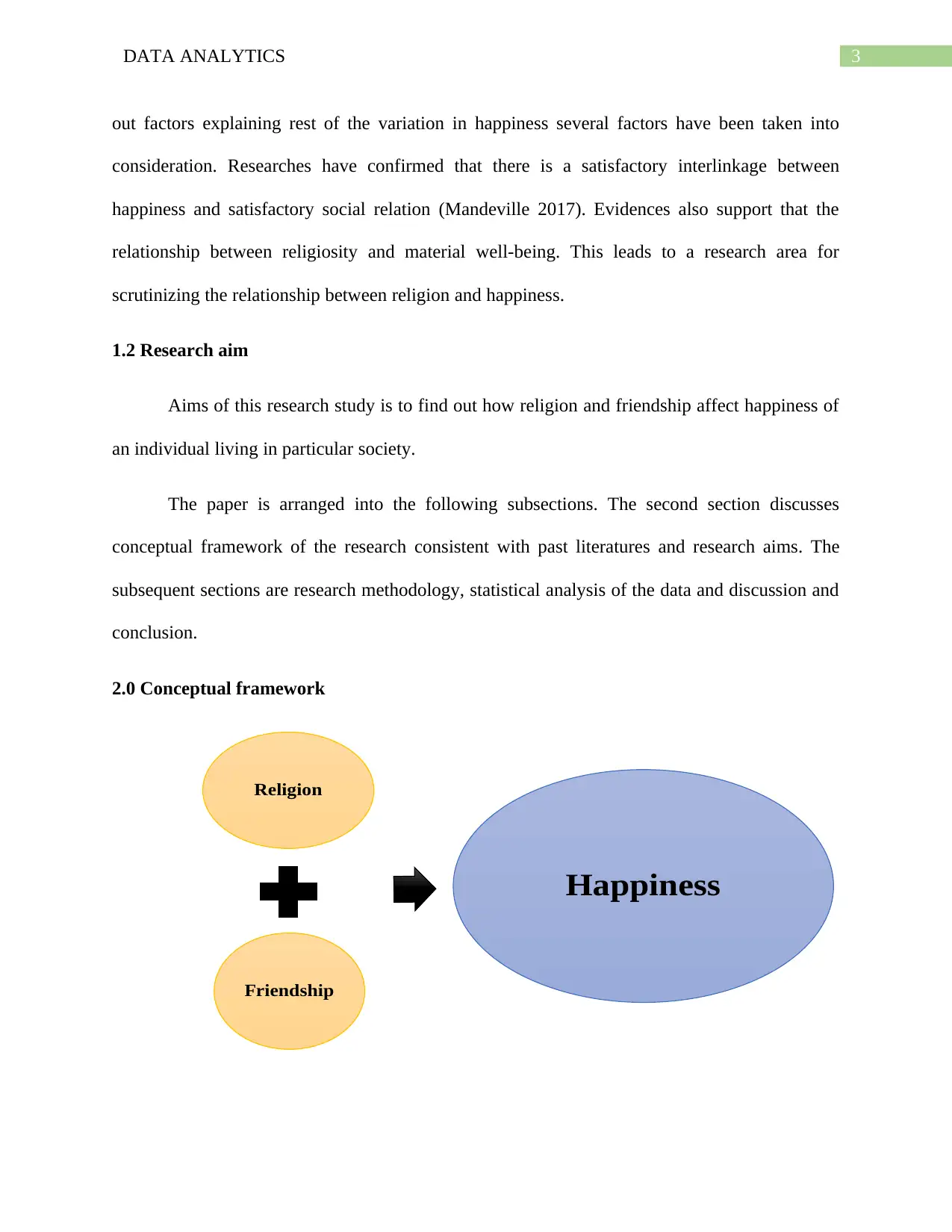
Aims of this research study is to find out how religion and friendship affect happiness of
an individual living in particular society.
The paper is arranged into the following subsections. The second section discusses
conceptual framework of the research consistent with past literatures and research aims. The
subsequent sections are research methodology, statistical analysis of the data and discussion and
conclusion.
2.0 Conceptual framework
Religion
Friendship
Happiness
out factors explaining rest of the variation in happiness several factors have been taken into
consideration. Researches have confirmed that there is a satisfactory interlinkage between
happiness and satisfactory social relation (Mandeville 2017). Evidences also support that the
relationship between religiosity and material well-being. This leads to a research area for
scrutinizing the relationship between religion and happiness.
1.2 Research aim
Aims of this research study is to find out how religion and friendship affect happiness of
an individual living in particular society.
The paper is arranged into the following subsections. The second section discusses
conceptual framework of the research consistent with past literatures and research aims. The
subsequent sections are research methodology, statistical analysis of the data and discussion and
conclusion.
2.0 Conceptual framework
Religion
Friendship
Happiness
Paraphrase This Document
Need a fresh take? Get an instant paraphrase of this document with our AI Paraphraser

4DATA ANALYTICS
Friendship is regarded one source of enhancing happiness. Past literatures support this
claim in three ways. These are focus on overall quality of friendship, particular features of
friendship and number of friends. One study found that best friendship quality and associated
conflict are related with happiness especially for young and late adolescent. This study showed
that the most important features of friendship are self-validation and companionship. The support
received friendship or companionship is an important attribute of happiness. The closeness and
satisfaction received from friendship are associated with happiness (Demir et al. 2018). These
studies are based on the either best friendship or general friendship. Some study found a negative
association between happiness and conflicts resulted from friendship especially among late
adolescent. Researches based on conflict and other indices of adjustment also assert a negative
relation between friendship and happiness. There have been considerable number of researches
establishing the relationship between quality and conflict with happiness. Studies based on
quality of friendship confirms a positive connection between happiness and quality of friendship.
These studies conclude two things. Firstly, more the number of friends happier a person is.
Secondly, individual benefit from all friends they have. This however is not true always. All the
friendly do not always equally benefit an individual (Lynch 2015). Most study confirm the first
is more likely to happen that is more friends means more happiness contributing to economic
well-being. People often distinguishes among friends depending on degree of happiness. In
relation to already existing literatures, the present study attempts to find how friendship is
actually associated with happiness.
One aspect contributing to happiness is the religiosity. Several researches conclude that
religiosity has a positive influence on happiness. There are also some studies finding no
association between religion and happiness. Measuring happiness is considered as an important
Friendship is regarded one source of enhancing happiness. Past literatures support this
claim in three ways. These are focus on overall quality of friendship, particular features of
friendship and number of friends. One study found that best friendship quality and associated
conflict are related with happiness especially for young and late adolescent. This study showed
that the most important features of friendship are self-validation and companionship. The support
received friendship or companionship is an important attribute of happiness. The closeness and
satisfaction received from friendship are associated with happiness (Demir et al. 2018). These
studies are based on the either best friendship or general friendship. Some study found a negative
association between happiness and conflicts resulted from friendship especially among late
adolescent. Researches based on conflict and other indices of adjustment also assert a negative
relation between friendship and happiness. There have been considerable number of researches
establishing the relationship between quality and conflict with happiness. Studies based on
quality of friendship confirms a positive connection between happiness and quality of friendship.
These studies conclude two things. Firstly, more the number of friends happier a person is.
Secondly, individual benefit from all friends they have. This however is not true always. All the
friendly do not always equally benefit an individual (Lynch 2015). Most study confirm the first
is more likely to happen that is more friends means more happiness contributing to economic
well-being. People often distinguishes among friends depending on degree of happiness. In
relation to already existing literatures, the present study attempts to find how friendship is
actually associated with happiness.
One aspect contributing to happiness is the religiosity. Several researches conclude that
religiosity has a positive influence on happiness. There are also some studies finding no
association between religion and happiness. Measuring happiness is considered as an important

5DATA ANALYTICS
factor in finding out how religiosity influence happiness (Sander 2017). The two widely used
index Oxford Happiness Questionnaire and Depression Happiness scale produced inconsistent
result among several studies. Recently, researchers have been found it import to assess the state
of health and wellbeing of atheists in relation to their emergence as an important socio cultural
group. One study found an appealing case where non-religious are found to have a lower scale of
happiness when directly compared with the religious are. Most studies however are limited in its
scope in making a comparative assessment between religious and non-religious group making it
difficult to draw conclusion. International comparisons reveal a contradictory finding. These
studies find that higher level of happiness are recorded by higher levels of non-religious (Edling,
Rydgren and Bohma 2014). This is in direct contraction with the claim that religious people
document a higher degree of well-being. One study conducted on satisfaction, one measure of
happiness and religious, atheists and agonistic found no significant relation between happiness
and religion.
2.1 Hypotheses
The following two hypotheses are developed to address the research questions
Hypothesis 1
Null hypothesis: There is no statistically significant association between happiness and
friendship.
Alternative hypothesis: Friendship has a statistically significant relation with happiness
Hypothesis 2
Null hypothesis: There is no statistically significant association between happiness and religion
factor in finding out how religiosity influence happiness (Sander 2017). The two widely used
index Oxford Happiness Questionnaire and Depression Happiness scale produced inconsistent
result among several studies. Recently, researchers have been found it import to assess the state
of health and wellbeing of atheists in relation to their emergence as an important socio cultural
group. One study found an appealing case where non-religious are found to have a lower scale of
happiness when directly compared with the religious are. Most studies however are limited in its
scope in making a comparative assessment between religious and non-religious group making it
difficult to draw conclusion. International comparisons reveal a contradictory finding. These
studies find that higher level of happiness are recorded by higher levels of non-religious (Edling,
Rydgren and Bohma 2014). This is in direct contraction with the claim that religious people
document a higher degree of well-being. One study conducted on satisfaction, one measure of
happiness and religious, atheists and agonistic found no significant relation between happiness
and religion.
2.1 Hypotheses
The following two hypotheses are developed to address the research questions
Hypothesis 1
Null hypothesis: There is no statistically significant association between happiness and
friendship.
Alternative hypothesis: Friendship has a statistically significant relation with happiness
Hypothesis 2
Null hypothesis: There is no statistically significant association between happiness and religion
⊘ This is a preview!⊘
Do you want full access?
Subscribe today to unlock all pages.

Trusted by 1+ million students worldwide

6DATA ANALYTICS
Alternative hypothesis: Religion has a statistically significant relation with happiness
3.0 Research methodology
This section discusses the research methods that have been employed in this paper to
reach to the final conclusion. Research design is an important part of research study. The
research methodology comprises of data collection or gathering data, relevant information and
analyzes those data and information to achieve the research aim. Exploratory research is
conducted in areas lacking clear research and sufficient description (DeWitt 2017). The first
important part of research methodology is data collection. Data are collected from either
primary or secondary sources The primary data are collected through design of questionnaire and
gathering response from a selected population. The reliable source for secondary data are
authorized websites, peer reviewed journal, research article and periodicals. The method of
random sampling is an appropriate method of selecting sample from the entire population. The
collection of data has succeeded by analysis of the data. The basic statistical assumptions are
examined through the test of normality, linearity, multicollinearity and homoscedasticity. The
descriptive statistics have been computed to understand nature of the distribution (Creswell and
Creswell 2017). The correlation and regression analysis are finally used to evaluate and establish
relationship between happiness, friendship and religion.
4.0 Data analysis
4.1 Statistical assumption
The basic statistical assumptions of a distribution include assumption of normality,
linearity, multicollinearity and homoscedasticity. To test the normality histograms of each of the
variables constructed. The multicollinearityamong the variables are examined through computed
Alternative hypothesis: Religion has a statistically significant relation with happiness
3.0 Research methodology
This section discusses the research methods that have been employed in this paper to
reach to the final conclusion. Research design is an important part of research study. The
research methodology comprises of data collection or gathering data, relevant information and
analyzes those data and information to achieve the research aim. Exploratory research is
conducted in areas lacking clear research and sufficient description (DeWitt 2017). The first
important part of research methodology is data collection. Data are collected from either
primary or secondary sources The primary data are collected through design of questionnaire and
gathering response from a selected population. The reliable source for secondary data are
authorized websites, peer reviewed journal, research article and periodicals. The method of
random sampling is an appropriate method of selecting sample from the entire population. The
collection of data has succeeded by analysis of the data. The basic statistical assumptions are
examined through the test of normality, linearity, multicollinearity and homoscedasticity. The
descriptive statistics have been computed to understand nature of the distribution (Creswell and
Creswell 2017). The correlation and regression analysis are finally used to evaluate and establish
relationship between happiness, friendship and religion.
4.0 Data analysis
4.1 Statistical assumption
The basic statistical assumptions of a distribution include assumption of normality,
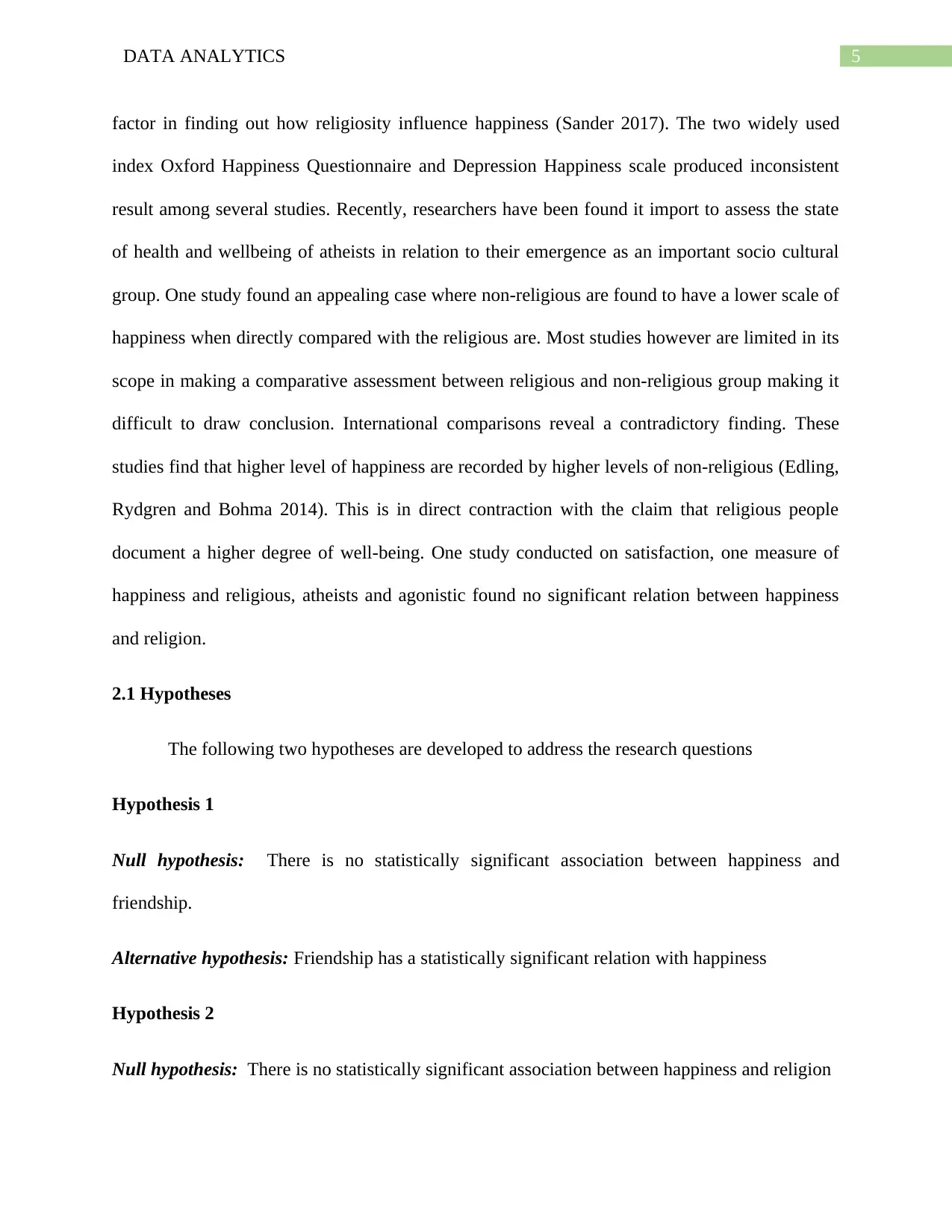
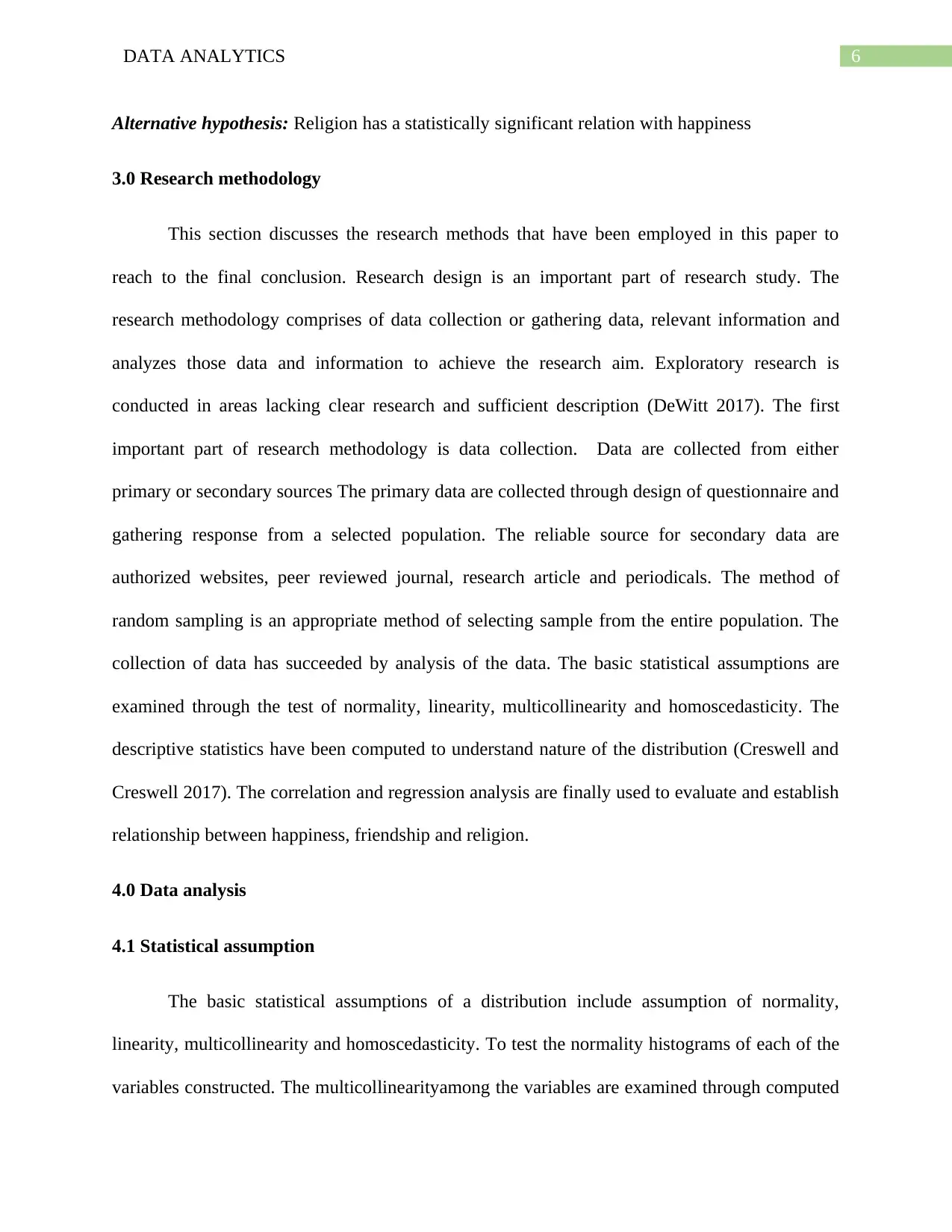
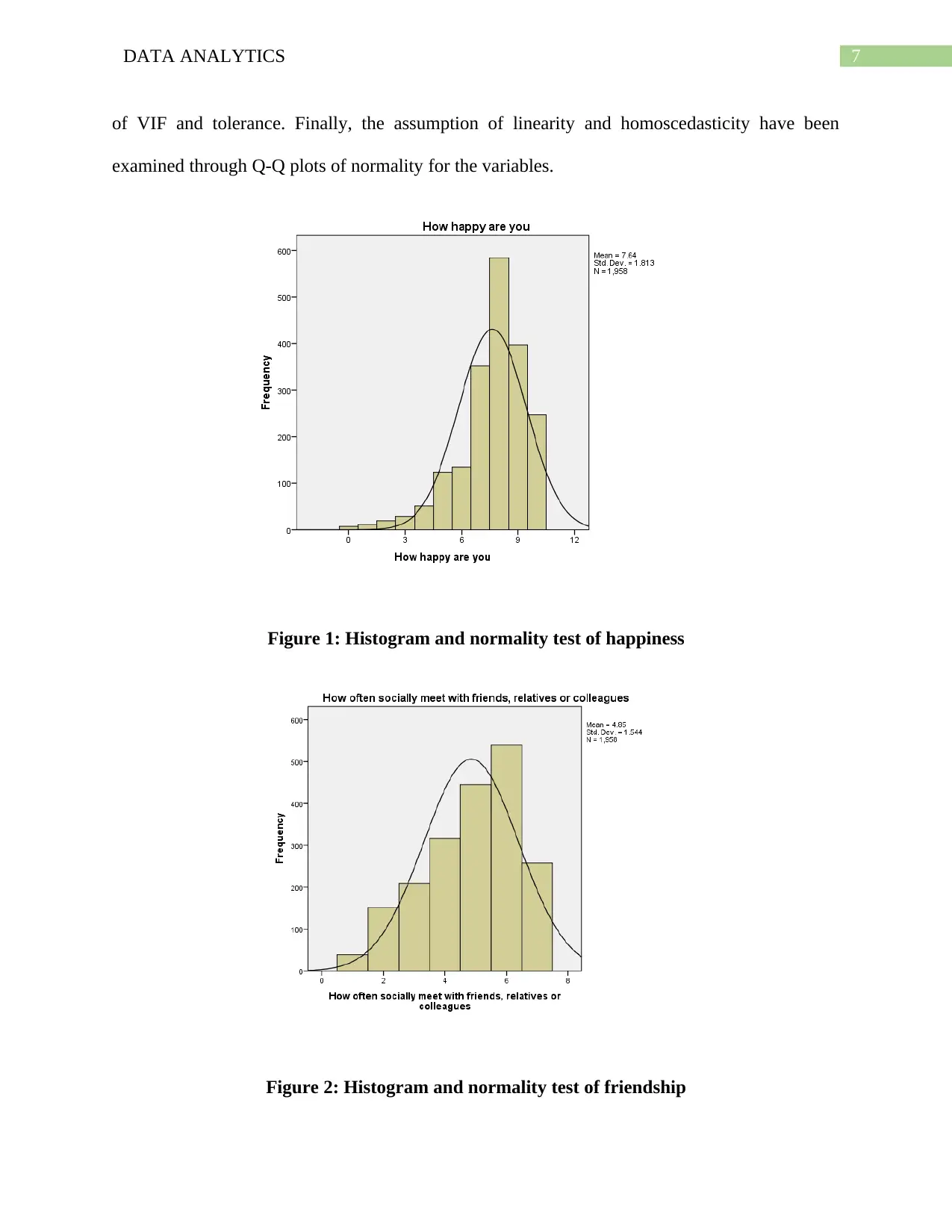
linearity, multicollinearity and homoscedasticity. To test the normality histograms of each of the
variables constructed. The multicollinearityamong the variables are examined through computed
Paraphrase This Document
Need a fresh take? Get an instant paraphrase of this document with our AI Paraphraser

7DATA ANALYTICS
of VIF and tolerance. Finally, the assumption of linearity and homoscedasticity have been
examined through Q-Q plots of normality for the variables.
Figure 1: Histogram and normality test of happiness
Figure 2: Histogram and normality test of friendship
of VIF and tolerance. Finally, the assumption of linearity and homoscedasticity have been
examined through Q-Q plots of normality for the variables.
Figure 1: Histogram and normality test of happiness
Figure 2: Histogram and normality test of friendship

8DATA ANALYTICS
Figure 3: Histogram and normality test of religion
Table 1: Test for collinearity
Coefficientsa
Model Unstandardized
Coefficients
Standardized
Coefficients
t Sig. Collinearity
Statistics
B Std. Error Beta Tolerance VIF
1
(Constant) 6.476 .139 46.495 .000
How often socially
meet with friends,
relatives or colleagues
.222 .026 .189 8.493 .000 .997 1.003
How religious are you .023 .013 .039 1.764 .078 .997 1.003
a. Dependent Variable: How happy are you
From the above table, it has been observed that that the value of VIF is less than 5
implying multicollinearity is not a problem for either of the variable.
Figure 3: Histogram and normality test of religion
Table 1: Test for collinearity
Coefficientsa
Model Unstandardized
Coefficients
Standardized
Coefficients
t Sig. Collinearity
Statistics
B Std. Error Beta Tolerance VIF
1
(Constant) 6.476 .139 46.495 .000
How often socially
meet with friends,
relatives or colleagues
.222 .026 .189 8.493 .000 .997 1.003
How religious are you .023 .013 .039 1.764 .078 .997 1.003
a. Dependent Variable: How happy are you
From the above table, it has been observed that that the value of VIF is less than 5
implying multicollinearity is not a problem for either of the variable.
⊘ This is a preview!⊘
Do you want full access?
Subscribe today to unlock all pages.

Trusted by 1+ million students worldwide

9DATA ANALYTICS
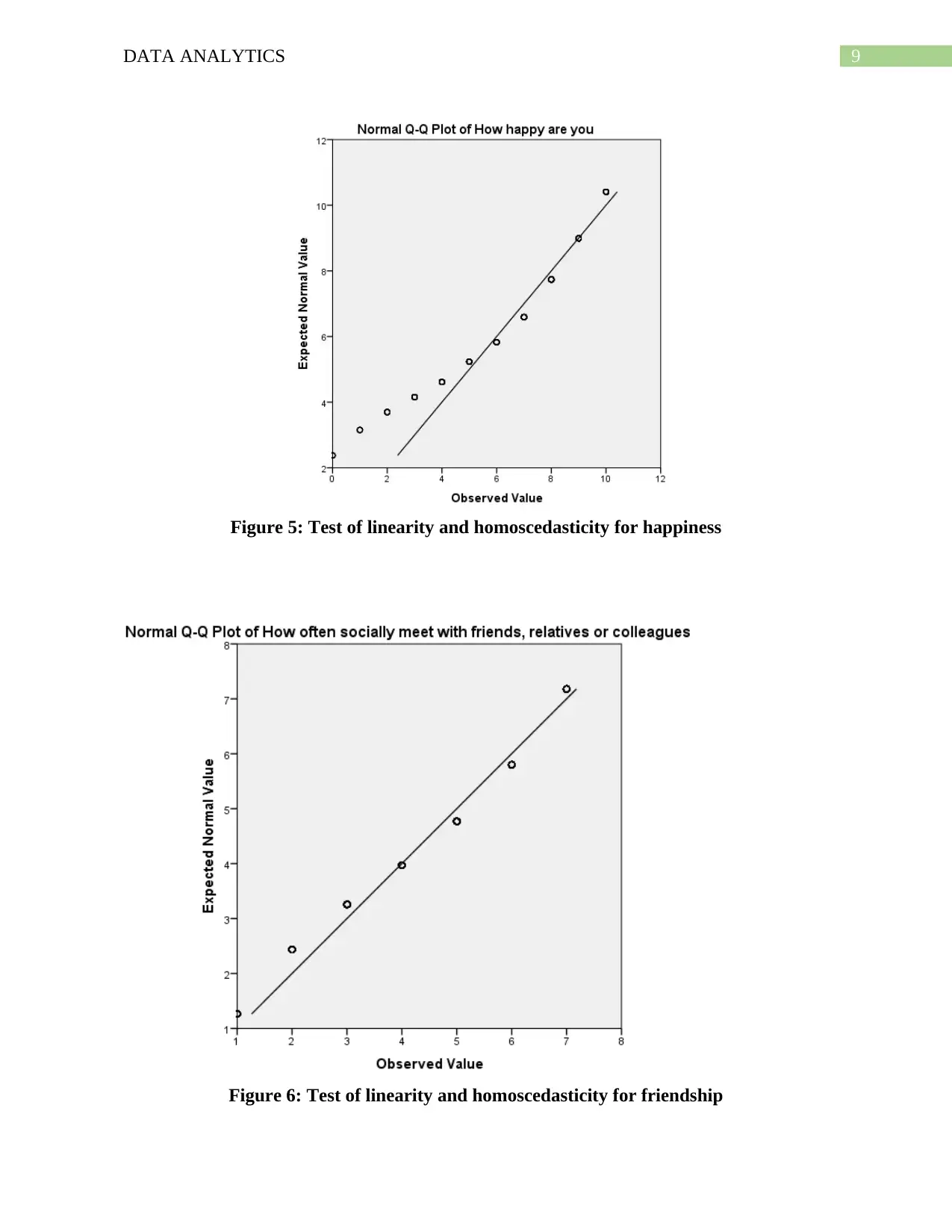
Figure 5: Test of linearity and homoscedasticity for happiness
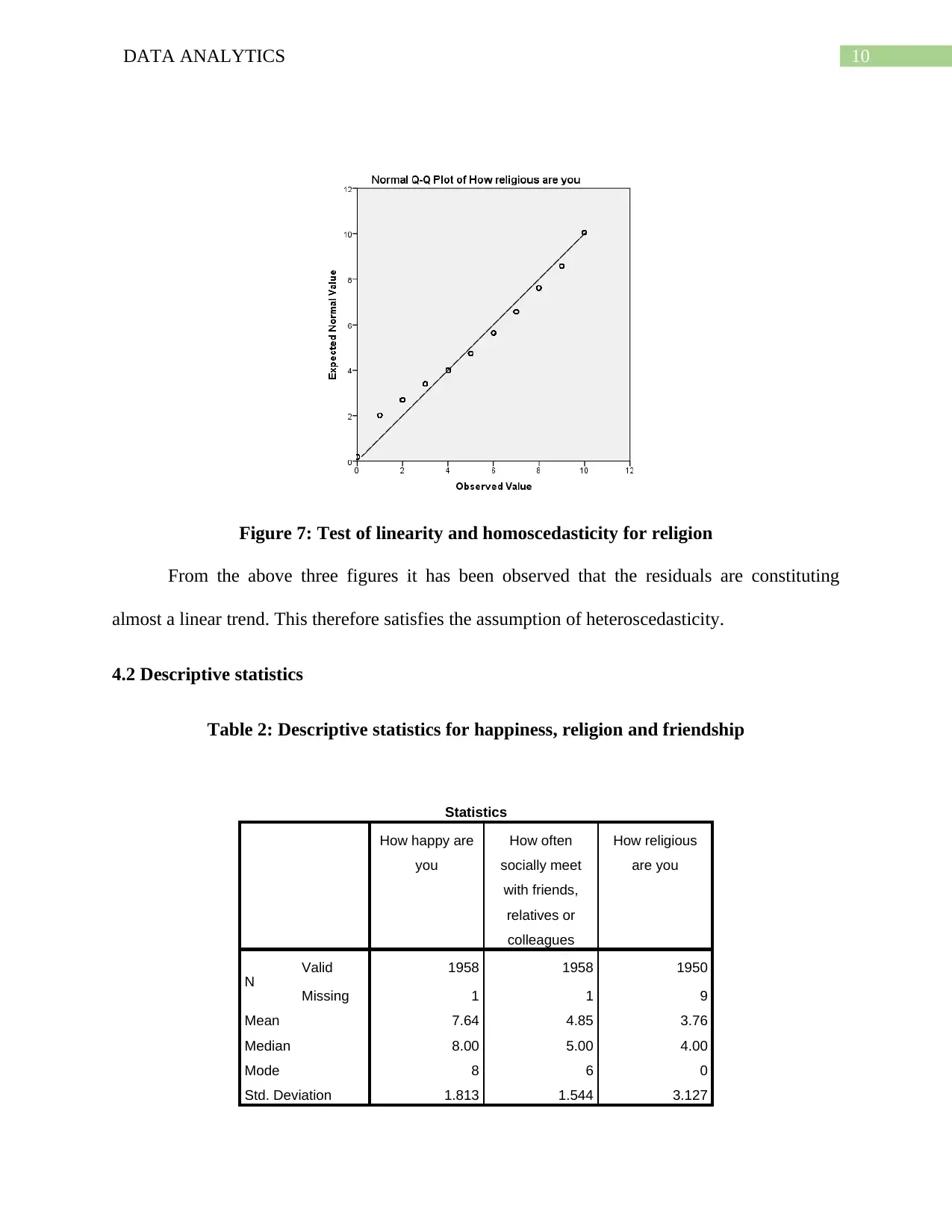
Figure 6: Test of linearity and homoscedasticity for friendship
Figure 5: Test of linearity and homoscedasticity for happiness
Figure 6: Test of linearity and homoscedasticity for friendship
Paraphrase This Document
Need a fresh take? Get an instant paraphrase of this document with our AI Paraphraser

10DATA ANALYTICS
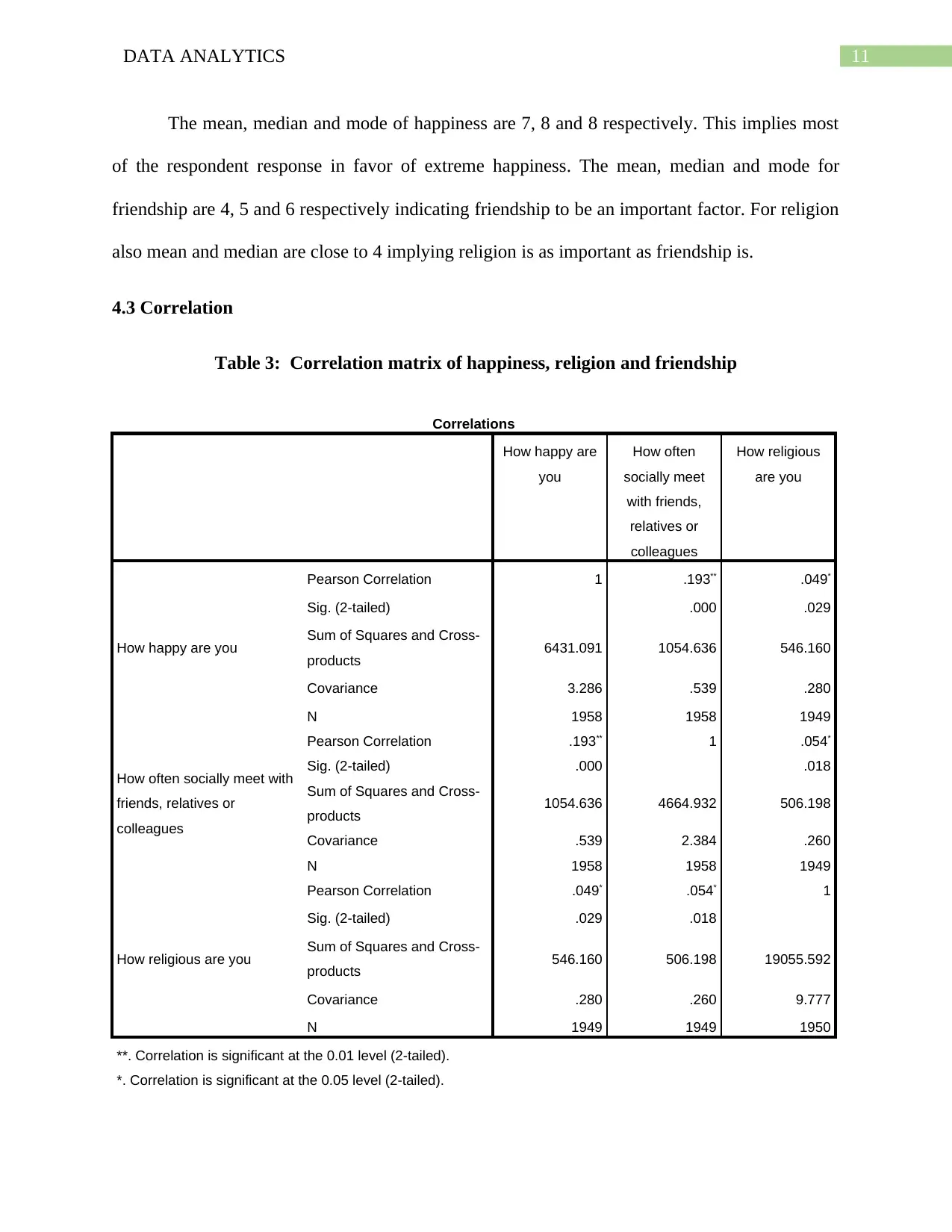
Figure 7: Test of linearity and homoscedasticity for religion
From the above three figures it has been observed that the residuals are constituting
almost a linear trend. This therefore satisfies the assumption of heteroscedasticity.
4.2 Descriptive statistics
Table 2: Descriptive statistics for happiness, religion and friendship
Statistics
How happy are
you
How often
socially meet
with friends,
relatives or
colleagues
How religious
are you
N Valid 1958 1958 1950
Missing 1 1 9
Mean 7.64 4.85 3.76
Median 8.00 5.00 4.00
Mode 8 6 0
Std. Deviation 1.813 1.544 3.127
Figure 7: Test of linearity and homoscedasticity for religion
From the above three figures it has been observed that the residuals are constituting
almost a linear trend. This therefore satisfies the assumption of heteroscedasticity.
4.2 Descriptive statistics
Table 2: Descriptive statistics for happiness, religion and friendship
Statistics
How happy are
you
How often
socially meet
with friends,
relatives or
colleagues
How religious
are you
N Valid 1958 1958 1950
Missing 1 1 9
Mean 7.64 4.85 3.76
Median 8.00 5.00 4.00
Mode 8 6 0
Std. Deviation 1.813 1.544 3.127

11DATA ANALYTICS
The mean, median and mode of happiness are 7, 8 and 8 respectively. This implies most
of the respondent response in favor of extreme happiness. The mean, median and mode for
friendship are 4, 5 and 6 respectively indicating friendship to be an important factor. For religion
also mean and median are close to 4 implying religion is as important as friendship is.
4.3 Correlation
Table 3: Correlation matrix of happiness, religion and friendship
Correlations
How happy are
you
How often
socially meet
with friends,
relatives or
colleagues
How religious
are you
How happy are you
Pearson Correlation 1 .193** .049*
Sig. (2-tailed) .000 .029
Sum of Squares and Cross-
products 6431.091 1054.636 546.160
Covariance 3.286 .539 .280
N 1958 1958 1949
How often socially meet with
friends, relatives or
colleagues
Pearson Correlation .193** 1 .054*
Sig. (2-tailed) .000 .018
Sum of Squares and Cross-
products 1054.636 4664.932 506.198
Covariance .539 2.384 .260
N 1958 1958 1949
How religious are you
Pearson Correlation .049* .054* 1
Sig. (2-tailed) .029 .018
Sum of Squares and Cross-
products 546.160 506.198 19055.592
Covariance .280 .260 9.777
N 1949 1949 1950
**. Correlation is significant at the 0.01 level (2-tailed).
*. Correlation is significant at the 0.05 level (2-tailed).
The mean, median and mode of happiness are 7, 8 and 8 respectively. This implies most
of the respondent response in favor of extreme happiness. The mean, median and mode for
friendship are 4, 5 and 6 respectively indicating friendship to be an important factor. For religion
also mean and median are close to 4 implying religion is as important as friendship is.
4.3 Correlation
Table 3: Correlation matrix of happiness, religion and friendship
Correlations
How happy are
you
How often
socially meet
with friends,
relatives or
colleagues
How religious
are you
How happy are you
Pearson Correlation 1 .193** .049*
Sig. (2-tailed) .000 .029
Sum of Squares and Cross-
products 6431.091 1054.636 546.160
Covariance 3.286 .539 .280
N 1958 1958 1949
How often socially meet with
friends, relatives or
colleagues
Pearson Correlation .193** 1 .054*
Sig. (2-tailed) .000 .018
Sum of Squares and Cross-
products 1054.636 4664.932 506.198
Covariance .539 2.384 .260
N 1958 1958 1949
How religious are you
Pearson Correlation .049* .054* 1
Sig. (2-tailed) .029 .018
Sum of Squares and Cross-
products 546.160 506.198 19055.592
Covariance .280 .260 9.777
N 1949 1949 1950
**. Correlation is significant at the 0.01 level (2-tailed).
*. Correlation is significant at the 0.05 level (2-tailed).
⊘ This is a preview!⊘
Do you want full access?
Subscribe today to unlock all pages.

Trusted by 1+ million students worldwide
1 out of 18
Related Documents
Your All-in-One AI-Powered Toolkit for Academic Success.
 +13062052269
info@desklib.com
Available 24*7 on WhatsApp / Email
Unlock your academic potential
Copyright © 2020–2026 A2Z Services. All Rights Reserved. Developed and managed by ZUCOL.