MGBBT0UBN Case Study: Premier Inn's Business Organizations & Env

Verified

Added on  2023/06/18

|8
|1973
|497
Case Study
AI Summary
This case study provides an in-depth analysis of Premier Inn's business organization and its operating environment. It examines the organizational structure of Premier Inn, highlighting its hierarchical approach and divisional breakdown based on ownership, timeshare, and franchise models. The study employs SWOT analysis to evaluate Premier Inn's internal strengths and weaknesses, as well as external opportunities and threats, including profitability, brand image, limited global presence, and competition. Furthermore, a PESTEL analysis is conducted to assess the political, economic, social, technological, environmental, and legal factors impacting the hotel chain. The analysis reveals how Premier Inn navigates political policies, leverages economic opportunities, adapts to social trends, utilizes technological advancements, addresses environmental concerns, and complies with legal regulations. The study concludes that understanding the business environment and adopting appropriate organizational structures are crucial for Premier Inn's success and sustained profitability.
Document Page
UNDERSTANDING
BUSINESS
ORGANIZATIONS
tabler-icon-diamond-filled.svg

Paraphrase This Document

Need a fresh take? Get an instant paraphrase of this document with our AI Paraphraser
Document Page
Table of Contents
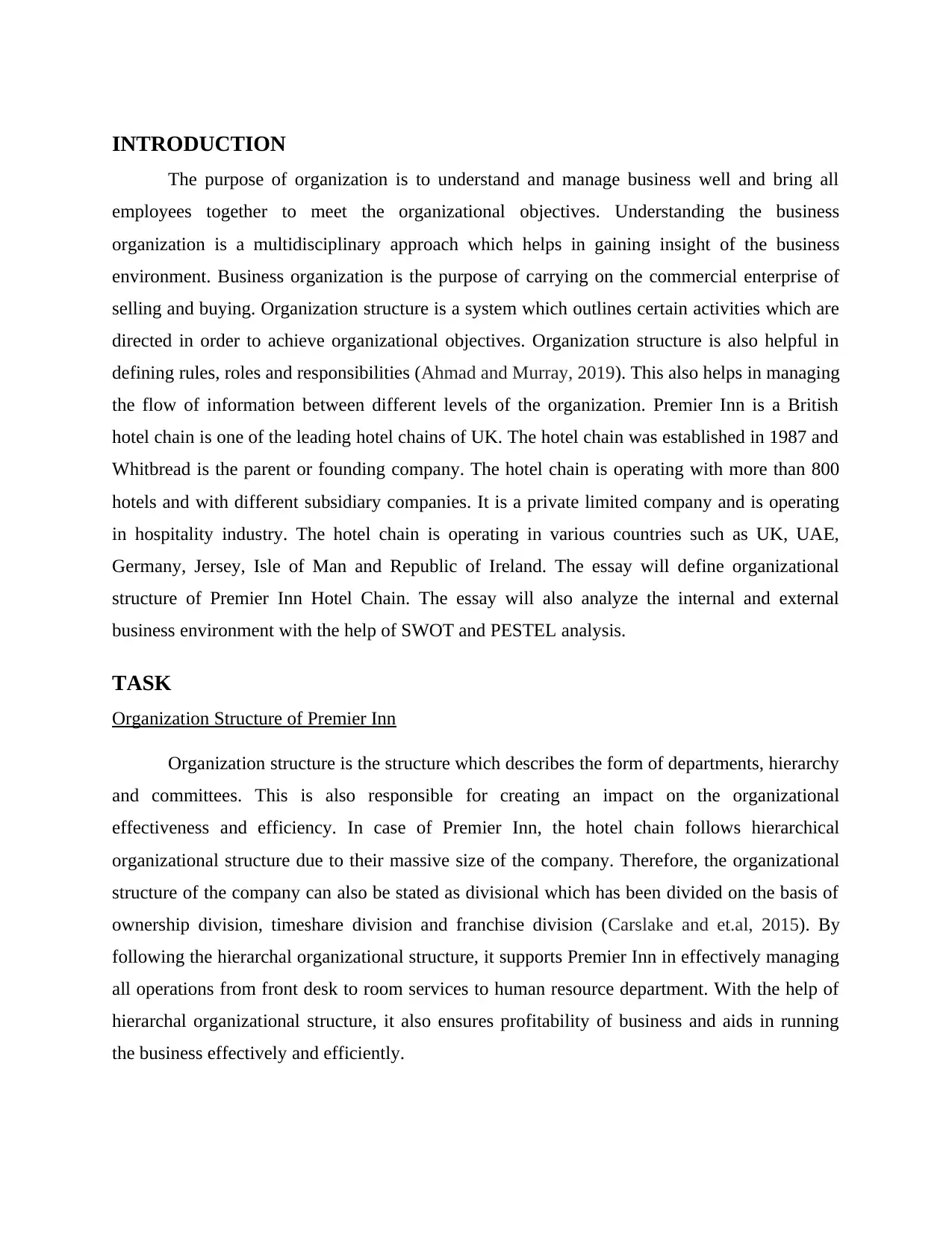
INTRODUCTION.........................................................................................................................3
TASK..............................................................................................................................................3
Organization Structure of Premier Inn........................................................................................3
Environmental Analysis...............................................................................................................4
CONCLUSION..............................................................................................................................7
REFERENCES..............................................................................................................................8
Document Page
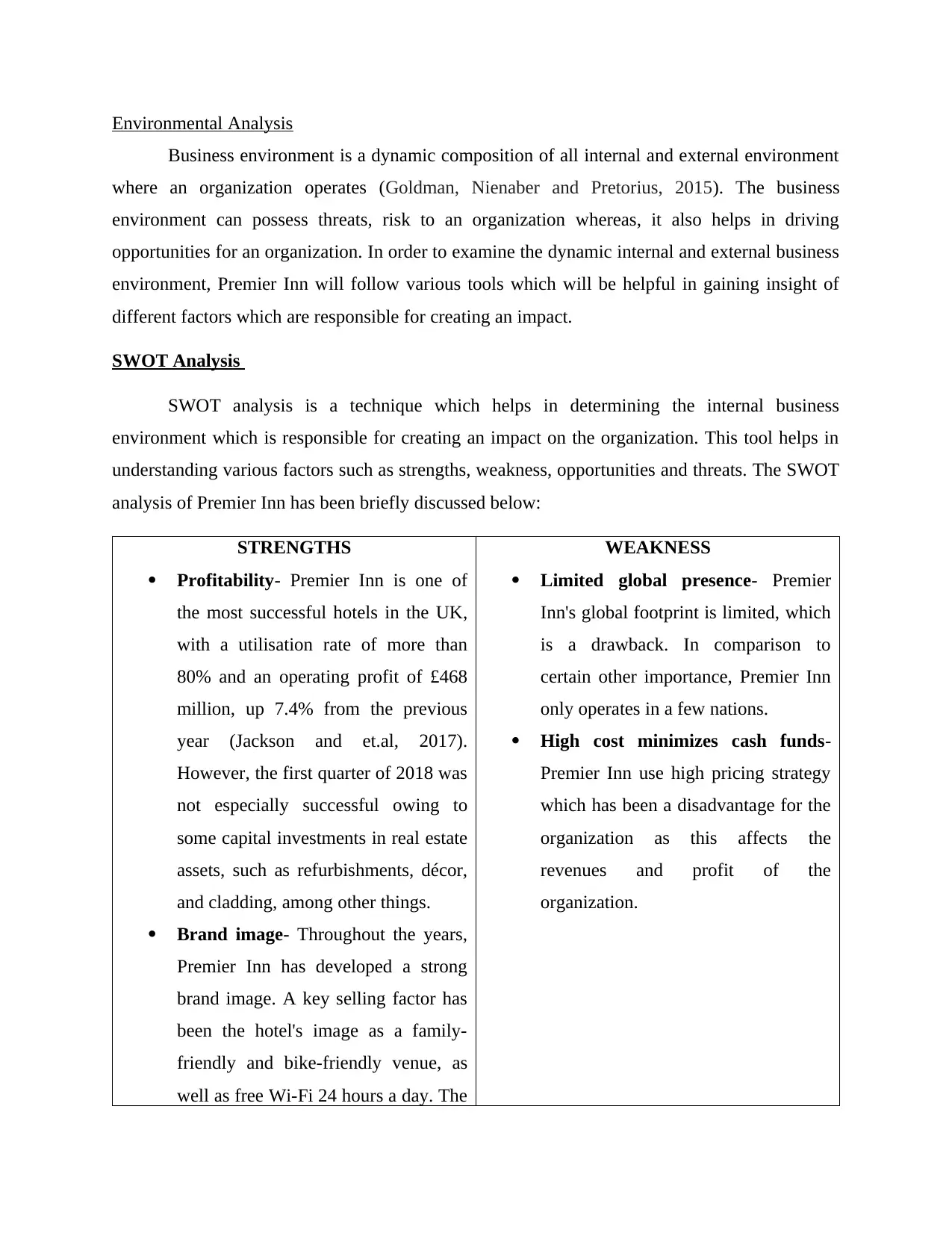
INTRODUCTION
The purpose of organization is to understand and manage business well and bring all
employees together to meet the organizational objectives. Understanding the business
organization is a multidisciplinary approach which helps in gaining insight of the business
environment. Business organization is the purpose of carrying on the commercial enterprise of
selling and buying. Organization structure is a system which outlines certain activities which are
directed in order to achieve organizational objectives. Organization structure is also helpful in
defining rules, roles and responsibilities (Ahmad and Murray, 2019). This also helps in managing
the flow of information between different levels of the organization. Premier Inn is a British
hotel chain is one of the leading hotel chains of UK. The hotel chain was established in 1987 and
Whitbread is the parent or founding company. The hotel chain is operating with more than 800
hotels and with different subsidiary companies. It is a private limited company and is operating
in hospitality industry. The hotel chain is operating in various countries such as UK, UAE,
Germany, Jersey, Isle of Man and Republic of Ireland. The essay will define organizational
structure of Premier Inn Hotel Chain. The essay will also analyze the internal and external
business environment with the help of SWOT and PESTEL analysis.
TASK
Organization Structure of Premier Inn
Organization structure is the structure which describes the form of departments, hierarchy
and committees. This is also responsible for creating an impact on the organizational
effectiveness and efficiency. In case of Premier Inn, the hotel chain follows hierarchical
organizational structure due to their massive size of the company. Therefore, the organizational
structure of the company can also be stated as divisional which has been divided on the basis of
ownership division, timeshare division and franchise division (Carslake and et.al, 2015). By
following the hierarchal organizational structure, it supports Premier Inn in effectively managing
all operations from front desk to room services to human resource department. With the help of
hierarchal organizational structure, it also ensures profitability of business and aids in running
the business effectively and efficiently.
Document Page
Environmental Analysis
Business environment is a dynamic composition of all internal and external environment
where an organization operates (Goldman, Nienaber and Pretorius, 2015). The business
environment can possess threats, risk to an organization whereas, it also helps in driving
opportunities for an organization. In order to examine the dynamic internal and external business
environment, Premier Inn will follow various tools which will be helpful in gaining insight of
different factors which are responsible for creating an impact.
SWOT Analysis
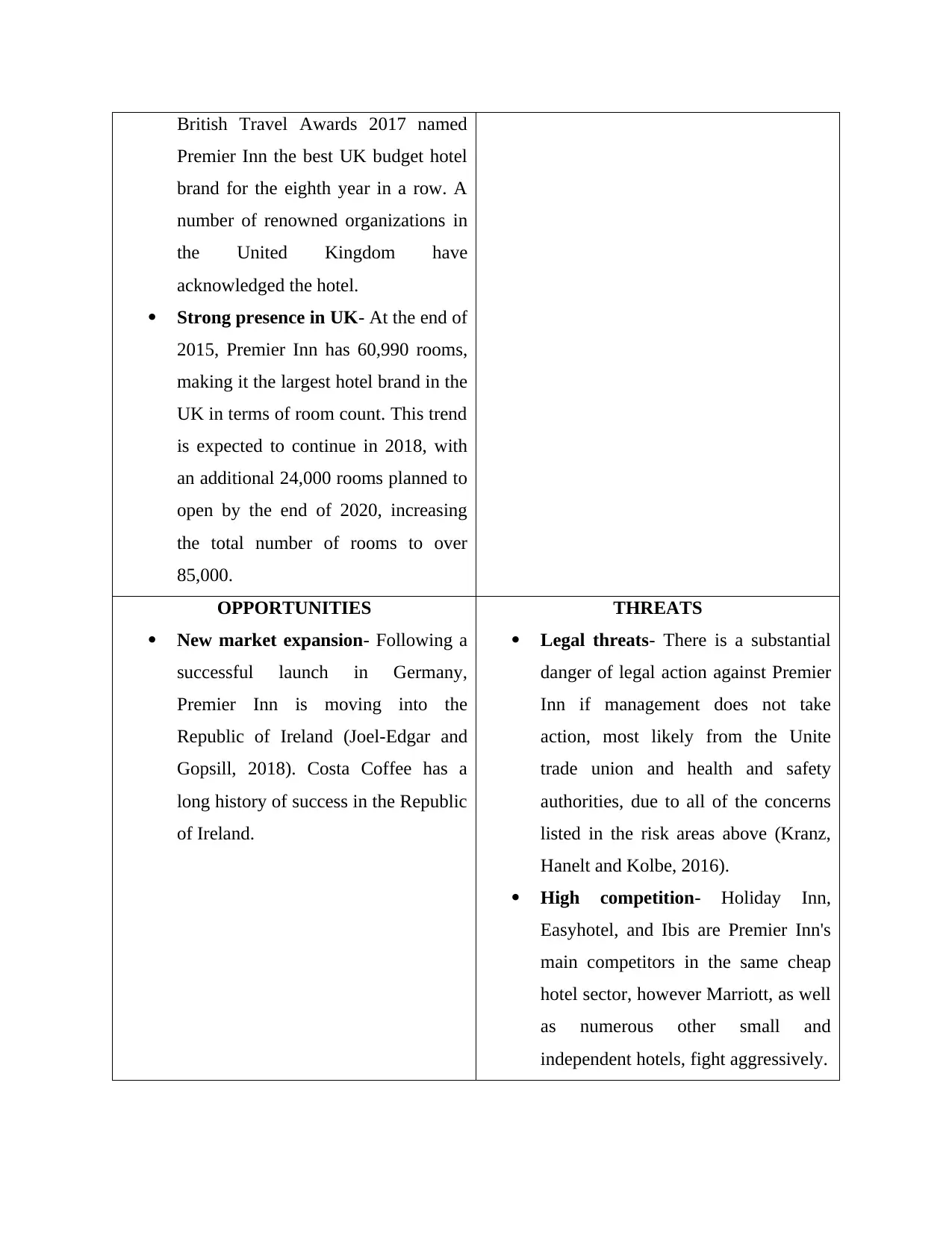
SWOT analysis is a technique which helps in determining the internal business
environment which is responsible for creating an impact on the organization. This tool helps in
understanding various factors such as strengths, weakness, opportunities and threats. The SWOT
analysis of Premier Inn has been briefly discussed below:
STRENGTHS
Profitability- Premier Inn is one of
the most successful hotels in the UK,
with a utilisation rate of more than
80% and an operating profit of £468
million, up 7.4% from the previous
year (Jackson and et.al, 2017).
However, the first quarter of 2018 was
not especially successful owing to
some capital investments in real estate
assets, such as refurbishments, décor,
and cladding, among other things.
Brand image- Throughout the years,
Premier Inn has developed a strong
brand image. A key selling factor has
been the hotel's image as a family-
friendly and bike-friendly venue, as
well as free Wi-Fi 24 hours a day. The
WEAKNESS
Limited global presence- Premier
Inn's global footprint is limited, which
is a drawback. In comparison to
certain other importance, Premier Inn
only operates in a few nations.
High cost minimizes cash funds-
Premier Inn use high pricing strategy
which has been a disadvantage for the
organization as this affects the
revenues and profit of the
organization.
tabler-icon-diamond-filled.svg

Paraphrase This Document

Need a fresh take? Get an instant paraphrase of this document with our AI Paraphraser
Document Page
British Travel Awards 2017 named
Premier Inn the best UK budget hotel
brand for the eighth year in a row. A
number of renowned organizations in
the United Kingdom have
acknowledged the hotel.
Strong presence in UK- At the end of
2015, Premier Inn has 60,990 rooms,
making it the largest hotel brand in the
UK in terms of room count. This trend
is expected to continue in 2018, with
an additional 24,000 rooms planned to
open by the end of 2020, increasing
the total number of rooms to over
85,000.
OPPORTUNITIES
New market expansion- Following a
successful launch in Germany,
Premier Inn is moving into the
Republic of Ireland (Joel-Edgar and
Gopsill, 2018). Costa Coffee has a
long history of success in the Republic
of Ireland.
THREATS
Legal threats- There is a substantial
danger of legal action against Premier
Inn if management does not take
action, most likely from the Unite
trade union and health and safety
authorities, due to all of the concerns
listed in the risk areas above (Kranz,
Hanelt and Kolbe, 2016).
High competition- Holiday Inn,
Easyhotel, and Ibis are Premier Inn's
main competitors in the same cheap
hotel sector, however Marriott, as well
as numerous other small and
independent hotels, fight aggressively.
Document Page
PESTEL Analysis
PESETEL analysis is a tool which helps in determining the external business
environment factors through which an organization can gain knowledge of such factors which
can influence the operations of organization. A detailed PESTEL analysis of Premier Inn has
been discussed below:
Political factors- Political factors such as government policy creates major influence on
the organization and influences the organization directly and indirectly which offers chances and
challenges. There are various government policies which are helpful in boosting economic
growth. In terms of Premier Inn, the company adopted various operating strategies which is
aggressive to manage the political situation (Ludbey, Brooks and Coole, 2018). The company
also introduced Good Together Program which helped in minimizing CO2.
Economic factors- Economic factors provide a variety of chances for organizations to
expand their businesses. The Financial Crisis pushed the United Kingdom into recession,
producing substantial challenges for businesses; yet, the slump had certain advantages for
Premier Inn. Budget hotels are frequently seen as lesser goods, thus demand for Premier Inn's
services may increase, or at the very least be less affected, during times of crisis than demand for
higher-end hotels.
Social factors- Seasonal holidays such as Easter, bank holidays, and Christmas are
important dates to target since consumers are more inclined to spend money during these times.
Technological factors- The growing usage of computers, internet surfing, and the
availability of mobile applications has enhanced Premier Inn's exposure and simplicity of use.
With the rise of social media, advertising, and, most importantly, viral marketing, more cost-
effective means of targeting a big particular audience have become accessible.
Environmental factors- Premier Inn may be adversely affected by climate change.
Because travellers are forced to drive or sleep overnight at service stations, Premier Inn has
witnessed a drop in business as a result of railway line closures and airline cancellations.
Document Page
Legal factors- A recent legal reform resulted in a 12p rise in the minimum wage in
October 2013 (Peri, Marki, and Peri, 2018). Premier Inn must also observe all applicable health
and safety laws and give equal employment opportunities to all employees.
CONCLUSION
From detailed analysis of essay, it can be summarized that business organization is one
which performs commercial activities for earning the profit. It can be analyzed that
organizational structure is the approach in which activities of organization is divided, grouped
and coordinated between managers and employees. It can be understood that there are various
tools and frameworks which supports an organization to determine that factors that can create
analyzing impact on the operations of an organization. With the help of SWOT analysis, an
organization can gain knowledge regarding the internal business environment which relies on
various factors such as strengths, weakness, opportunities and threats. The other analysis is
PESTEL analysis which defines the external business environment factors that can create impact
on business operations and functions. It can be analyzed that there are various organizational
structures which helps an organization to perform all business activities effectively and ensure
business success. By following different organizational structure, this supports business in
maintaining effective communication through which they can share all valuable information that
is required to meet organizational objective and maximize business profitability and
performance. There are various factors such as technological advancement, social factors,
environmental factors and other factors which are responsible for driving opportunities for
business. Some of the other factors such as political instability, high competition and some other
legal threats which possess threats for the organization to hold their position within the industry.
tabler-icon-diamond-filled.svg

Paraphrase This Document

Need a fresh take? Get an instant paraphrase of this document with our AI Paraphraser
Document Page
REFERENCES
Books and journals
Ahmad, M. U. and Murray, J., 2019. Understanding the connect between digitalisation,
sustainability and performance of an organisation. International Journal of Business
Excellence. 17(1). pp.83-96.
Carslake, J and et.al., 2015. The National Road Safety Partnership Program providing a pathway
for any business/organisation to create a positive road safety culture. In Proceedings of
the 2015 Australasian Road Safety Conference (ARSC2015) (pp. 1-4). Australasian
College of Road Safety (ACRS).
Goldman, G. A., Nienaber, H. and Pretorius, M., 2015. The essence of the contemporary
business organisation: A critical reflection.
Jackson, D and et.al., 2017. Employer understanding of work-integrated learning and the
challenges of engaging in work placement opportunities. Studies in Continuing
Education. 39(1). pp.35-51.
Joel-Edgar, S. and Gopsill, J., 2018, January. Understanding user requirements in context: a case
study of developing a visualisation tool to map skills in an engineering organisation.
In 2018 International Conference on Information Management and Processing
(ICIMP) (pp. 6-10). IEEE.
Kranz, J. J., Hanelt, A. and Kolbe, L. M., 2016. Understanding the influence of absorptive
capacity and ambidexterity on the process of business model change–the case of on‐
premise and cloud‐computing software. Information Systems Journal. 26(5). pp.477-517.
Ludbey, C. R., Brooks, D. J. and Coole, M. P., 2018. Corporate security: identifying and
understanding the levels of security work in an organisation. Asian Journal of
Criminology. 13(2). pp.109-128.
Peršič, A., Markič, M. and Peršič, M., 2018. The impact of socially responsible management
standards on the business success of an organisation. Total Quality Management &
Business Excellence. 29(1-2). pp.225-237.
chevron_up_icon
1 out of 8
circle_padding
hide_on_mobile
zoom_out_icon
[object Object]