MGMT6003 Operation Management: Analyzing Emergency Room Value Stream
VerifiedAdded on 2023/06/08
|16
|4198
|490
Case Study
AI Summary
This case study provides an in-depth analysis of operation management within a hospital emergency room, utilizing a value stream map to illustrate material and information flow. It identifies nine key stages in patient treatment, from registration to departure, and examines the information flow between healthcare professionals. The study highlights the similarities between operation management in healthcare and business, particularly in information management for process improvement. Furthermore, the study touches upon disruptive innovation and how it can be applied to improve the processes within the emergency room. The document concludes by emphasizing the importance of efficient operation management for effective patient care and suggests potential areas for improvement through technological advancements. Desklib offers a range of resources, including past papers and solved assignments, to aid students in understanding and applying these concepts.
Running head: OPERATION MANAGEMENT
Operation Management
Name of the Student:
Name of the University:
Author’s Note:
Operation Management
Name of the Student:
Name of the University:
Author’s Note:

Paraphrase This Document
Need a fresh take? Get an instant paraphrase of this document with our AI Paraphraser
1OPERATION MANAGEMENT
Table of Contents
Introduction................................................................................................................................2
Operation Management..............................................................................................................3
Value Stream Map- Emergency Room......................................................................................4
Material Flow.........................................................................................................................4
Information Flow...................................................................................................................5
Issues with the operation management plan...............................................................................7
Research Principles....................................................................................................................8
Disruptive Innovation.................................................................................................................8
Disruptive Innovation and its application in the case study.....................................................10
Conclusion................................................................................................................................11
References................................................................................................................................13
Table of Contents
Introduction................................................................................................................................2
Operation Management..............................................................................................................3
Value Stream Map- Emergency Room......................................................................................4
Material Flow.........................................................................................................................4
Information Flow...................................................................................................................5
Issues with the operation management plan...............................................................................7
Research Principles....................................................................................................................8
Disruptive Innovation.................................................................................................................8
Disruptive Innovation and its application in the case study.....................................................10
Conclusion................................................................................................................................11
References................................................................................................................................13
2OPERATION MANAGEMENT
Introduction
The concept of management refers to the manner or the process in which the diverse
affairs of a particular organization or enterprise are managed or taken care of so that the
concerned organization or the enterprise is being able to achieve the target or the objective
outlined by them (Ginter, Duncan & Swayne, 2018). Furthermore, it is seen that the majority
of the concepts related to the process of management have been designed from the
perspective of the business world and thus the various health care organizations find it very
difficult to integrate these concepts within the framework of their health care organization
(Wang, Kung & Byrd, 2018). This is perhaps one of the major reasons why the framework of
the various health care organizations is drastically different from the ones followed within the
domain of the business world (Wang, Kung & Byrd, 2018).
One of the major factors on the basis of which the differences between the practices
as well as policies of management followed within the framework of these two types of
organizations can be explained is the fact that both of them cater to the interests of different
end users and this causes the differences between the style of management followed by these
two industries (Langabeer II & Helton, 2015). For example, the end users of the services
provided by the various business enterprises are the customers who opt for the products or the
services offered by the concerned business enterprise and the focus of these enterprises is on
earning the maximum amount of profit (Wager, Lee & Glaser, 2017). In the case of the health
care organizations, on the other hand, the end users of the services provided by these
organizations are the patients who come to these organizations to get themselves cured and
thus the insistence in this case is on treating the patient suffering from health problems
(Wager, Lee & Glaser, 2017). It can be said that the ultimate objective of these two
organizations are different and herein is the major reason for the difference in the
Introduction
The concept of management refers to the manner or the process in which the diverse
affairs of a particular organization or enterprise are managed or taken care of so that the
concerned organization or the enterprise is being able to achieve the target or the objective
outlined by them (Ginter, Duncan & Swayne, 2018). Furthermore, it is seen that the majority
of the concepts related to the process of management have been designed from the
perspective of the business world and thus the various health care organizations find it very
difficult to integrate these concepts within the framework of their health care organization
(Wang, Kung & Byrd, 2018). This is perhaps one of the major reasons why the framework of
the various health care organizations is drastically different from the ones followed within the
domain of the business world (Wang, Kung & Byrd, 2018).
One of the major factors on the basis of which the differences between the practices
as well as policies of management followed within the framework of these two types of
organizations can be explained is the fact that both of them cater to the interests of different
end users and this causes the differences between the style of management followed by these
two industries (Langabeer II & Helton, 2015). For example, the end users of the services
provided by the various business enterprises are the customers who opt for the products or the
services offered by the concerned business enterprise and the focus of these enterprises is on
earning the maximum amount of profit (Wager, Lee & Glaser, 2017). In the case of the health
care organizations, on the other hand, the end users of the services provided by these
organizations are the patients who come to these organizations to get themselves cured and
thus the insistence in this case is on treating the patient suffering from health problems
(Wager, Lee & Glaser, 2017). It can be said that the ultimate objective of these two
organizations are different and herein is the major reason for the difference in the
⊘ This is a preview!⊘
Do you want full access?
Subscribe today to unlock all pages.

Trusted by 1+ million students worldwide
3OPERATION MANAGEMENT
management styles followed by the two. This paper will undertake a review of the process of
operation management followed in the emergency ward of one of the hospitals.
Operation Management
The concept of operation management in the field of business is associated with the
processes of designing as well as the controlling of the means of production (Raghupathi &
Raghupathi, 2014). Furthermore, this process is also associated with the redesigning of the
entire process of business management so as to further boost the production of the products
or the services on which the annual revenue of the concerned business enterprise will depend
(Lee, Kao & Yang, 2014). This process begins with the procurement of raw materials that
would be needed for the production of the products or the services that the company offers
and terminates after the manufactured product or service is shipped out (Lee, Kao & Yang,
2014). In the genre of health care industry, on the other hand, the process of operation
management refers to the process by means of which the entire treatment process which is
provided to a particular patient is managed in the most effective manner so as to provide the
best quality treatment to the patient (Ward, Marsolo & Froehle, 2014). The process begins
from the step wherein the patient is required to register themselves at the very beginning and
ends when the patient finally gets treated and goes home (Ward, Marsolo & Froehle, 2014).
Furthermore, it is seen that different health care organizations have different operation
management styles which they follow for the process of providing treatment to the patients
and the effectiveness of the operational management system depends on the objective with
which that particular style of operation management is being used and also on the manner in
which the different attributes of the system are being taken care of (Yuehong et al., 2016).
management styles followed by the two. This paper will undertake a review of the process of
operation management followed in the emergency ward of one of the hospitals.
Operation Management
The concept of operation management in the field of business is associated with the
processes of designing as well as the controlling of the means of production (Raghupathi &
Raghupathi, 2014). Furthermore, this process is also associated with the redesigning of the
entire process of business management so as to further boost the production of the products
or the services on which the annual revenue of the concerned business enterprise will depend
(Lee, Kao & Yang, 2014). This process begins with the procurement of raw materials that
would be needed for the production of the products or the services that the company offers
and terminates after the manufactured product or service is shipped out (Lee, Kao & Yang,
2014). In the genre of health care industry, on the other hand, the process of operation
management refers to the process by means of which the entire treatment process which is
provided to a particular patient is managed in the most effective manner so as to provide the
best quality treatment to the patient (Ward, Marsolo & Froehle, 2014). The process begins
from the step wherein the patient is required to register themselves at the very beginning and
ends when the patient finally gets treated and goes home (Ward, Marsolo & Froehle, 2014).
Furthermore, it is seen that different health care organizations have different operation
management styles which they follow for the process of providing treatment to the patients
and the effectiveness of the operational management system depends on the objective with
which that particular style of operation management is being used and also on the manner in
which the different attributes of the system are being taken care of (Yuehong et al., 2016).
Paraphrase This Document
Need a fresh take? Get an instant paraphrase of this document with our AI Paraphraser
4OPERATION MANAGEMENT
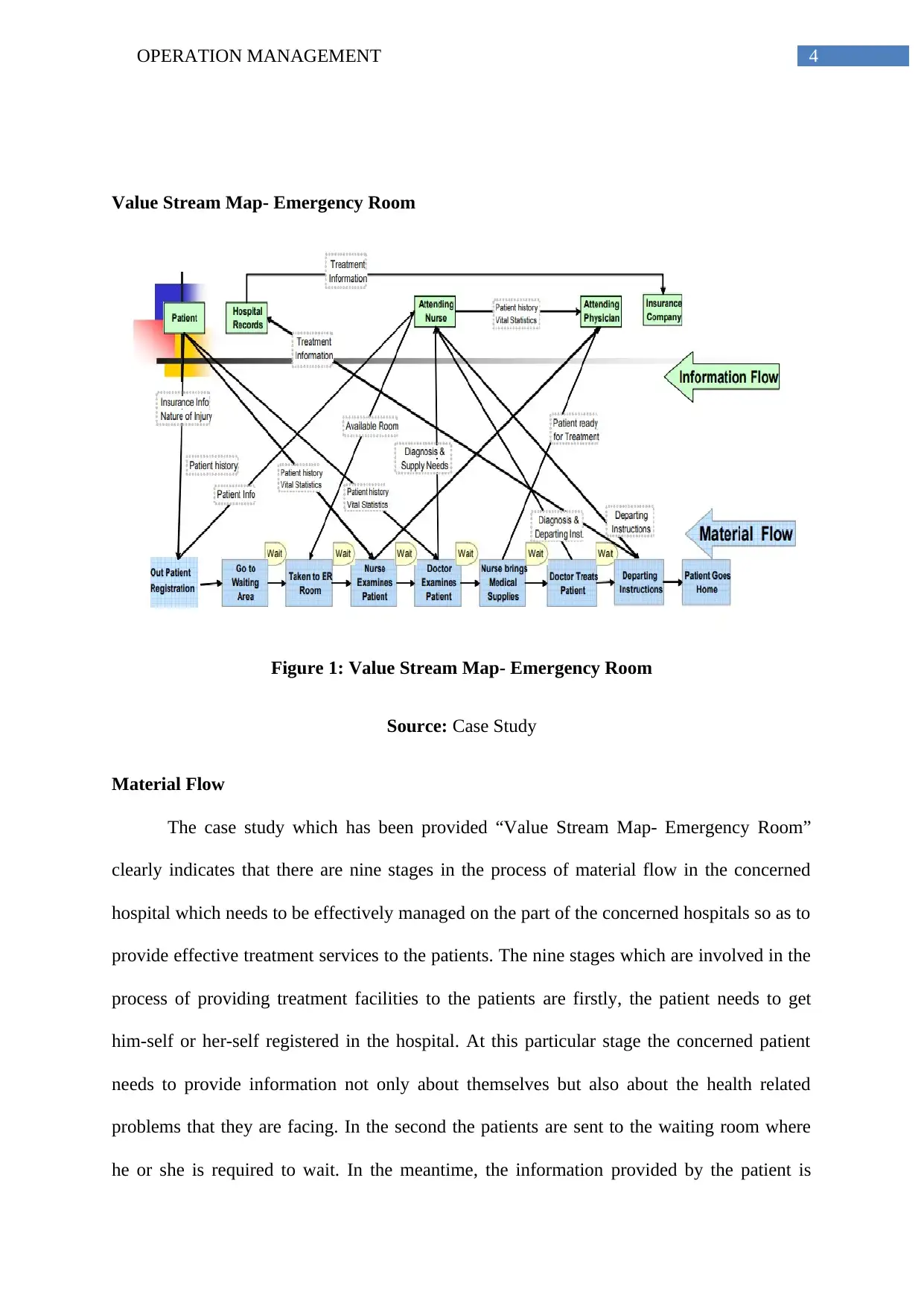
Value Stream Map- Emergency Room
Figure 1: Value Stream Map- Emergency Room
Source: Case Study
Material Flow
The case study which has been provided “Value Stream Map- Emergency Room”
clearly indicates that there are nine stages in the process of material flow in the concerned
hospital which needs to be effectively managed on the part of the concerned hospitals so as to
provide effective treatment services to the patients. The nine stages which are involved in the
process of providing treatment facilities to the patients are firstly, the patient needs to get
him-self or her-self registered in the hospital. At this particular stage the concerned patient
needs to provide information not only about themselves but also about the health related
problems that they are facing. In the second the patients are sent to the waiting room where
he or she is required to wait. In the meantime, the information provided by the patient is
Value Stream Map- Emergency Room
Figure 1: Value Stream Map- Emergency Room
Source: Case Study
Material Flow
The case study which has been provided “Value Stream Map- Emergency Room”
clearly indicates that there are nine stages in the process of material flow in the concerned
hospital which needs to be effectively managed on the part of the concerned hospitals so as to
provide effective treatment services to the patients. The nine stages which are involved in the
process of providing treatment facilities to the patients are firstly, the patient needs to get
him-self or her-self registered in the hospital. At this particular stage the concerned patient
needs to provide information not only about themselves but also about the health related
problems that they are facing. In the second the patients are sent to the waiting room where
he or she is required to wait. In the meantime, the information provided by the patient is
5OPERATION MANAGEMENT
being processed and the as per the symptoms of the diseases mentioned by the patient his or
her information is passed on to the concerned department. After the completion of this stage,
the patient is taken to emergency room wherein he or she is again required to wait for a while
until his or her turn comes up. In the fourth stage, the patient is being examined by a
registered nurse who does a basic check and tries to find out more about the problems that the
patients is suffering, their blood pressure level, body temperature and other relevant details
depending on the severity of the case of the patient. In the next stage, the patient is being
examined by a doctor who undertakes a thorough examination and tries to address the issues
or the problems faced by the patient in the best possible manner. At the same time the doctor
makes a list of tests that the patient needs to undertake so that he or she can get a better
picture of the problems or the disease that the patient is suffering from and doctor even makes
a preliminary list of the medications which might be useful for the patient in the meantime
while the doctor is awaiting for test reports of the patients. In the next stage the nurse brings
the temporary medication for the patient and if possible the test results of the patient.
Following the test results of the concerned patient the doctor provides medication to the
patient and provides them the kind of treatment that is needed in the particular medical case.
Finally the departing instructions for the patient are prepared and going of the patient to his or
her is the final stage in the process. These steps were primarily concerned with the effective
management of the material flow so that the concerned hospital is being able to provide the
right kind of treatment facilities to the patients who take the help of the medical services
provided by them.
Information Flow
In addition to the management of the flow of the material there is also the flow of the
required information from one department of the hospital or one individual health care
professional of the emergency room to another. It is significant to note that this particular
being processed and the as per the symptoms of the diseases mentioned by the patient his or
her information is passed on to the concerned department. After the completion of this stage,
the patient is taken to emergency room wherein he or she is again required to wait for a while
until his or her turn comes up. In the fourth stage, the patient is being examined by a
registered nurse who does a basic check and tries to find out more about the problems that the
patients is suffering, their blood pressure level, body temperature and other relevant details
depending on the severity of the case of the patient. In the next stage, the patient is being
examined by a doctor who undertakes a thorough examination and tries to address the issues
or the problems faced by the patient in the best possible manner. At the same time the doctor
makes a list of tests that the patient needs to undertake so that he or she can get a better
picture of the problems or the disease that the patient is suffering from and doctor even makes
a preliminary list of the medications which might be useful for the patient in the meantime
while the doctor is awaiting for test reports of the patients. In the next stage the nurse brings
the temporary medication for the patient and if possible the test results of the patient.
Following the test results of the concerned patient the doctor provides medication to the
patient and provides them the kind of treatment that is needed in the particular medical case.
Finally the departing instructions for the patient are prepared and going of the patient to his or
her is the final stage in the process. These steps were primarily concerned with the effective
management of the material flow so that the concerned hospital is being able to provide the
right kind of treatment facilities to the patients who take the help of the medical services
provided by them.
Information Flow
In addition to the management of the flow of the material there is also the flow of the
required information from one department of the hospital or one individual health care
professional of the emergency room to another. It is significant to note that this particular
⊘ This is a preview!⊘
Do you want full access?
Subscribe today to unlock all pages.
Trusted by 1+ million students worldwide
6OPERATION MANAGEMENT
process is also related to the process of treatment which is being provided to the patients
since the required information of the patient are passed from one individual health care
professional to another with the help of this particular process. The process of information
flow also begins with the registration of the patient and his or her act of providing the
information about the state of their health or the problem that they are facing to the person
who is taking his or her registration form. Furthermore, at this stage the medical insurance
details of the patients and also the past medical history details of the patients are also being
looked up into the medical database of the hospital which are likely to make the process of
providing treatment to the concerned patient much better as well as easier. Next the registered
nurse takes the vital statistics of the patient and this is being matched with the past medical
history records of the same patient that the hospital has from the previous visits of the same
patient. In the next stage as well when the doctor examines the patient the results of body
statistics and other relevant tests that the doctor has conducted on the patient are being tallied
with the past results of similar kinds of tests conducted on the past and then tallying the past
results of the patient with the present ones the doctor needs to judge whether the condition of
the patient has shown signs of improvement or has declined. The doctor is required to
administer the medicines to the past based on this particular analysis of the past and the
present medical condition of the patient and if the doctor finds that the patient is not showing
signs of improvement then the doctor can sent the concerned patient to the attending
physician who is likely to first consult the hospital records and access other kinds of
information to see whether the patient has medical insurance or not or for that matter would
be able to afford the medical treatment or not. Finally after the treatment process is over the
departure papers of the patients are prepared and the patients leave for home. However, after
the patient goes home the hospital once again saves the medical information of the patient so
that this could be used by them for future reference.
process is also related to the process of treatment which is being provided to the patients
since the required information of the patient are passed from one individual health care
professional to another with the help of this particular process. The process of information
flow also begins with the registration of the patient and his or her act of providing the
information about the state of their health or the problem that they are facing to the person
who is taking his or her registration form. Furthermore, at this stage the medical insurance
details of the patients and also the past medical history details of the patients are also being
looked up into the medical database of the hospital which are likely to make the process of
providing treatment to the concerned patient much better as well as easier. Next the registered
nurse takes the vital statistics of the patient and this is being matched with the past medical
history records of the same patient that the hospital has from the previous visits of the same
patient. In the next stage as well when the doctor examines the patient the results of body
statistics and other relevant tests that the doctor has conducted on the patient are being tallied
with the past results of similar kinds of tests conducted on the past and then tallying the past
results of the patient with the present ones the doctor needs to judge whether the condition of
the patient has shown signs of improvement or has declined. The doctor is required to
administer the medicines to the past based on this particular analysis of the past and the
present medical condition of the patient and if the doctor finds that the patient is not showing
signs of improvement then the doctor can sent the concerned patient to the attending
physician who is likely to first consult the hospital records and access other kinds of
information to see whether the patient has medical insurance or not or for that matter would
be able to afford the medical treatment or not. Finally after the treatment process is over the
departure papers of the patients are prepared and the patients leave for home. However, after
the patient goes home the hospital once again saves the medical information of the patient so
that this could be used by them for future reference.
Paraphrase This Document
Need a fresh take? Get an instant paraphrase of this document with our AI Paraphraser
7OPERATION MANAGEMENT
Issues with the operation management plan
An analysis of the “Value Stream Map - Emergency Room” clearly reveals the fact
that the operation management style followed in the concerned case and the ones followed by
the various business enterprises for the manufacture of the products or the services offered by
them to the customers are to some extent identical with each other. For example, in the world
of business it is seen that the focus of the various enterprises is on the process of the
production of products or the services offered by them to the customers from the raw
materials (Dafny, 2014). However, it is generally seen that there is also an emphasis on the
management of the information from the past manufacturing processes of products or
services that these enterprises so that these information can be used in the future times for the
manufacture of similar kinds of products or services (Wager, Lee & Glaser, 2017). In many
cases it is seen that the use of this particular method helps the concerned enterprise to save a
lot of valuable time as well as resources which would have been spent on again identifying
the factors or the critical paths that it had found during the last time. It is significant to note
that the analysis of the operation management system in the case study “Value Stream Map -
Emergency Room” also revealed the same fact. For example, the concerned emergency room
by taking the help of information flow system was not only able the manage the various
operations that the health care professionals related to the emergency ward were required to
handle or take care but at the same time by taking the help of the process of information flow
ensured that the doctors and the nurses would not have to conducted the same kinds of tests
on the patients each time they visit the emergency ward. Therefore, it can be said that the
efficiency as well as the effectiveness of the emergency ward is dependent to a large extent
on the kind of operation management system that the concerned hospital is following at the
current moment.
Issues with the operation management plan
An analysis of the “Value Stream Map - Emergency Room” clearly reveals the fact
that the operation management style followed in the concerned case and the ones followed by
the various business enterprises for the manufacture of the products or the services offered by
them to the customers are to some extent identical with each other. For example, in the world
of business it is seen that the focus of the various enterprises is on the process of the
production of products or the services offered by them to the customers from the raw
materials (Dafny, 2014). However, it is generally seen that there is also an emphasis on the
management of the information from the past manufacturing processes of products or
services that these enterprises so that these information can be used in the future times for the
manufacture of similar kinds of products or services (Wager, Lee & Glaser, 2017). In many
cases it is seen that the use of this particular method helps the concerned enterprise to save a
lot of valuable time as well as resources which would have been spent on again identifying
the factors or the critical paths that it had found during the last time. It is significant to note
that the analysis of the operation management system in the case study “Value Stream Map -
Emergency Room” also revealed the same fact. For example, the concerned emergency room
by taking the help of information flow system was not only able the manage the various
operations that the health care professionals related to the emergency ward were required to
handle or take care but at the same time by taking the help of the process of information flow
ensured that the doctors and the nurses would not have to conducted the same kinds of tests
on the patients each time they visit the emergency ward. Therefore, it can be said that the
efficiency as well as the effectiveness of the emergency ward is dependent to a large extent
on the kind of operation management system that the concerned hospital is following at the
current moment.
8OPERATION MANAGEMENT
Research Principles
For the purpose of the analysis of the operation plan of the emergency room a detailed
consideration of the various stages involved in the process of treatment that is being provided
to the patient was analyzed. This required a critical analysis of the various stages involved in
the process right from the registration process to the exit of the patient from the emergency
room and all the stages involved in between. Furthermore, the analysis also required a
detailed analysis of the two components of the operation management process followed by
the emergency room, namely, material flow and the information flow and also the manner in
which they are being managed. On the basis of these the issues with the operation
management plan followed by the emergency room were identified and a proposed solution
for its improvement has been provided in the later sections of the paper.
Disruptive Innovation
The term disruptive innovation was first coined in 1995 by Clayton M. Christensen,
an American Scholar and his colleagues and since then the term had gained widespread
significance within the framework of the contemporary business world (Christensen, Raynor
& McDonald, 2015). In the particular cannon of the business world the term is generally used
to refer to the kind of innovations which not only a business market for themselves and a
value network but at the same time in the longer lead to the disruption or the destruction of
the older forms of market and also value networks which have been a part of the system
before its invention (Christensen, Raynor & McDonald, 2015). It is significant to note that
the concept of disruptive innovation is being increasingly used by the smaller firms for the
purpose of outrivaling the larger competitors of theirs (Nagy, Schuessler & Dubinsky, 2016).
For example, it is generally seen that the major focus of the successful organizations is on
satisfying the needs of one particular section or segment of their entire customers and mostly
Research Principles
For the purpose of the analysis of the operation plan of the emergency room a detailed
consideration of the various stages involved in the process of treatment that is being provided
to the patient was analyzed. This required a critical analysis of the various stages involved in
the process right from the registration process to the exit of the patient from the emergency
room and all the stages involved in between. Furthermore, the analysis also required a
detailed analysis of the two components of the operation management process followed by
the emergency room, namely, material flow and the information flow and also the manner in
which they are being managed. On the basis of these the issues with the operation
management plan followed by the emergency room were identified and a proposed solution
for its improvement has been provided in the later sections of the paper.
Disruptive Innovation
The term disruptive innovation was first coined in 1995 by Clayton M. Christensen,
an American Scholar and his colleagues and since then the term had gained widespread
significance within the framework of the contemporary business world (Christensen, Raynor
& McDonald, 2015). In the particular cannon of the business world the term is generally used
to refer to the kind of innovations which not only a business market for themselves and a
value network but at the same time in the longer lead to the disruption or the destruction of
the older forms of market and also value networks which have been a part of the system
before its invention (Christensen, Raynor & McDonald, 2015). It is significant to note that
the concept of disruptive innovation is being increasingly used by the smaller firms for the
purpose of outrivaling the larger competitors of theirs (Nagy, Schuessler & Dubinsky, 2016).
For example, it is generally seen that the major focus of the successful organizations is on
satisfying the needs of one particular section or segment of their entire customers and mostly
⊘ This is a preview!⊘
Do you want full access?
Subscribe today to unlock all pages.
Trusted by 1+ million students worldwide
9OPERATION MANAGEMENT
it is the richer and the most profitable section of the society (Nagy, Schuessler & Dubinsky,
2016). Thus, it is generally seen that in order to fulfill the needs and the desires of these
customers the concerned organization often overreaches the disruptive curve and fail to
effectively fulfill the need of the customers belonging the other sections of the same curve.
Experts are of the viewpoint that in the longer run this can have negative repercussions for
the concerned organization and is more likely to lose its competitive edge to the organizations
which are trying to focus on all the three sections of the disruptive innovation model (King &
Baatartogtokh, 2015). It is a reflection of this particular fact that the various new start-up
organizations and also the others smaller organizations are increasingly turning towards the
use of this particular innovation model to gain a sustainable competitive edge over their
competitors (Jung & Padman, 2015).
Figure 2: Disruptive Innovation Model
Source: Christensen, Raynor, & McDonald, 2015
it is the richer and the most profitable section of the society (Nagy, Schuessler & Dubinsky,
2016). Thus, it is generally seen that in order to fulfill the needs and the desires of these
customers the concerned organization often overreaches the disruptive curve and fail to
effectively fulfill the need of the customers belonging the other sections of the same curve.
Experts are of the viewpoint that in the longer run this can have negative repercussions for
the concerned organization and is more likely to lose its competitive edge to the organizations
which are trying to focus on all the three sections of the disruptive innovation model (King &
Baatartogtokh, 2015). It is a reflection of this particular fact that the various new start-up
organizations and also the others smaller organizations are increasingly turning towards the
use of this particular innovation model to gain a sustainable competitive edge over their
competitors (Jung & Padman, 2015).
Figure 2: Disruptive Innovation Model
Source: Christensen, Raynor, & McDonald, 2015
Paraphrase This Document
Need a fresh take? Get an instant paraphrase of this document with our AI Paraphraser
10OPERATION MANAGEMENT
Disruptive Innovation and its application in the case study
The operation management system discussed in the case study “Value Stream Map -
Emergency Room” can take the help of the Disruptive Innovation Model not only for the
process of the improvement of the existing model of operation management that it is
following but also to provide better services in comparison to the other hospitals. Following
the precepts of this particular model the concerned emergency ward of the hospital can
improve the service map that it currently has. For example, for the effective management of
the different operations that the emergency ward needs to undertake in order to provide
effective health care services to the patients the emergency ward takes the help of two
different kinds of processes, namely, the information flow and the material flow. It is
significant to note that the hospital follows a step-by-step process for the completion of each
of these tasks and this ends up taking a lot of time as well as resources of not only the
hospital but also of the concerned patients. Thus, taking the help of the system of disruptive
innovation the concerned hospital can club together the two different systems of information
flow and material flow into one model which will take care of the information as well as the
material also. Furthermore, instead of having the manual methods of checking the past
medical information of the patient at each stage of the process of treatment the hospital taking
the help of the process of disruptive innovation can come up with the creation of a new
software which will store the information of all the past medical history of the patient
provided the patient has undergone treatment in the concerned hospital in the past. Thus,
during the time of registering itself when the name and the other details of the patient is being
entered into the software it will show all the medical information of the patient that the
nurses, doctors and the attending physicians would need to know about the patients. This is
not only likely to significantly reduce the time that the health care professionals would have
to invest for treating one particular patient but the health care professionals would be able to
Disruptive Innovation and its application in the case study
The operation management system discussed in the case study “Value Stream Map -
Emergency Room” can take the help of the Disruptive Innovation Model not only for the
process of the improvement of the existing model of operation management that it is
following but also to provide better services in comparison to the other hospitals. Following
the precepts of this particular model the concerned emergency ward of the hospital can
improve the service map that it currently has. For example, for the effective management of
the different operations that the emergency ward needs to undertake in order to provide
effective health care services to the patients the emergency ward takes the help of two
different kinds of processes, namely, the information flow and the material flow. It is
significant to note that the hospital follows a step-by-step process for the completion of each
of these tasks and this ends up taking a lot of time as well as resources of not only the
hospital but also of the concerned patients. Thus, taking the help of the system of disruptive
innovation the concerned hospital can club together the two different systems of information
flow and material flow into one model which will take care of the information as well as the
material also. Furthermore, instead of having the manual methods of checking the past
medical information of the patient at each stage of the process of treatment the hospital taking
the help of the process of disruptive innovation can come up with the creation of a new
software which will store the information of all the past medical history of the patient
provided the patient has undergone treatment in the concerned hospital in the past. Thus,
during the time of registering itself when the name and the other details of the patient is being
entered into the software it will show all the medical information of the patient that the
nurses, doctors and the attending physicians would need to know about the patients. This is
not only likely to significantly reduce the time that the health care professionals would have
to invest for treating one particular patient but the health care professionals would be able to
11OPERATION MANAGEMENT
treat more patients in comparatively lesser amount of time and the best part is that the margin
for error will be very less. This in turn would enhance the quality of treatment services
provided by the concerned health care organizations to the patients who opt for the services
provided by them.
Conclusion
To conclude, the concept of operation management since the traditional times has
been defined in the particular context of the business world and the basic precepts as well as
the strategy outlined for the use of this particular concept are also from the perspective of the
business world. However, in the recent times it is seen that the other industries like the health
care industry and others are also increasingly turning towards the use of this particular
process for the effective management of their operations. It is significant to note that be it the
world of business or the health care industry there is always some end users who consume the
services or the products offered by these industries. In this particular context the service
provided by the health care industry is more important since it is related to the life and death
of an individual and thus it can be said that the management of the various processes which
are used for providing treatment to the patients is very important. This is one of the major
reasons why the use of the concept of operation management is more important in the health
care industry. In addition to this, at the same time it is also seen that there are various health
care organizations which are increasingly taking the help of the concept of disruptive
innovation to provide better quality of treatment facilities to the patients. The use of
disruptive innovation not only helps the various health care organizations to improve the
operation management system which they are following at the current moment but at the
same time helps them to provide better quality services at very low prices. Furthermore, the
use of disruptive innovation specially in the case study discussed in this paper is likely to help
treat more patients in comparatively lesser amount of time and the best part is that the margin
for error will be very less. This in turn would enhance the quality of treatment services
provided by the concerned health care organizations to the patients who opt for the services
provided by them.
Conclusion
To conclude, the concept of operation management since the traditional times has
been defined in the particular context of the business world and the basic precepts as well as
the strategy outlined for the use of this particular concept are also from the perspective of the
business world. However, in the recent times it is seen that the other industries like the health
care industry and others are also increasingly turning towards the use of this particular
process for the effective management of their operations. It is significant to note that be it the
world of business or the health care industry there is always some end users who consume the
services or the products offered by these industries. In this particular context the service
provided by the health care industry is more important since it is related to the life and death
of an individual and thus it can be said that the management of the various processes which
are used for providing treatment to the patients is very important. This is one of the major
reasons why the use of the concept of operation management is more important in the health
care industry. In addition to this, at the same time it is also seen that there are various health
care organizations which are increasingly taking the help of the concept of disruptive
innovation to provide better quality of treatment facilities to the patients. The use of
disruptive innovation not only helps the various health care organizations to improve the
operation management system which they are following at the current moment but at the
same time helps them to provide better quality services at very low prices. Furthermore, the
use of disruptive innovation specially in the case study discussed in this paper is likely to help
⊘ This is a preview!⊘
Do you want full access?
Subscribe today to unlock all pages.
Trusted by 1+ million students worldwide

1 out of 16


Related Documents


Your All-in-One AI-Powered Toolkit for Academic Success.
+13062052269
info@desklib.com
Available 24*7 on WhatsApp / Email
![[object Object]](/_next/static/media/star-bottom.7253800d.svg)
Unlock your academic potential
Copyright © 2020–2026 A2Z Services. All Rights Reserved. Developed and managed by ZUCOL.