MGT100: Corporate Social Responsibility Analysis and Application

Verified

Added on  2023/04/20

|8
|1808
|338
Report
AI Summary
This report provides a comprehensive analysis of corporate social responsibility (CSR), addressing its main arguments, assumptions, and limitations as presented in the provided article. It connects CSR concepts to the themes taught in MGT100, using Coles Supermarket as a real-world example to illustrate the practical application and potential pitfalls of CSR strategies. The report also includes a review of two peer-reviewed journal articles on organizational culture, highlighting their relevance to understanding CSR's impact on organizational dynamics and culture. The analysis emphasizes the importance of considering employee and stakeholder perspectives in CSR initiatives to avoid negative consequences, as demonstrated by the Coles case study. Desklib offers a wealth of similar solved assignments and past papers to aid students in their studies.
Document Page
Corporate Social Responsibility 0
Title: Corporate Social Responsibility
Assignment Name:
Student Name:
Course Name and Number:
Professor:
Date:
tabler-icon-diamond-filled.svg

Paraphrase This Document

Need a fresh take? Get an instant paraphrase of this document with our AI Paraphraser
Document Page
Corporate Social Responsibility 1
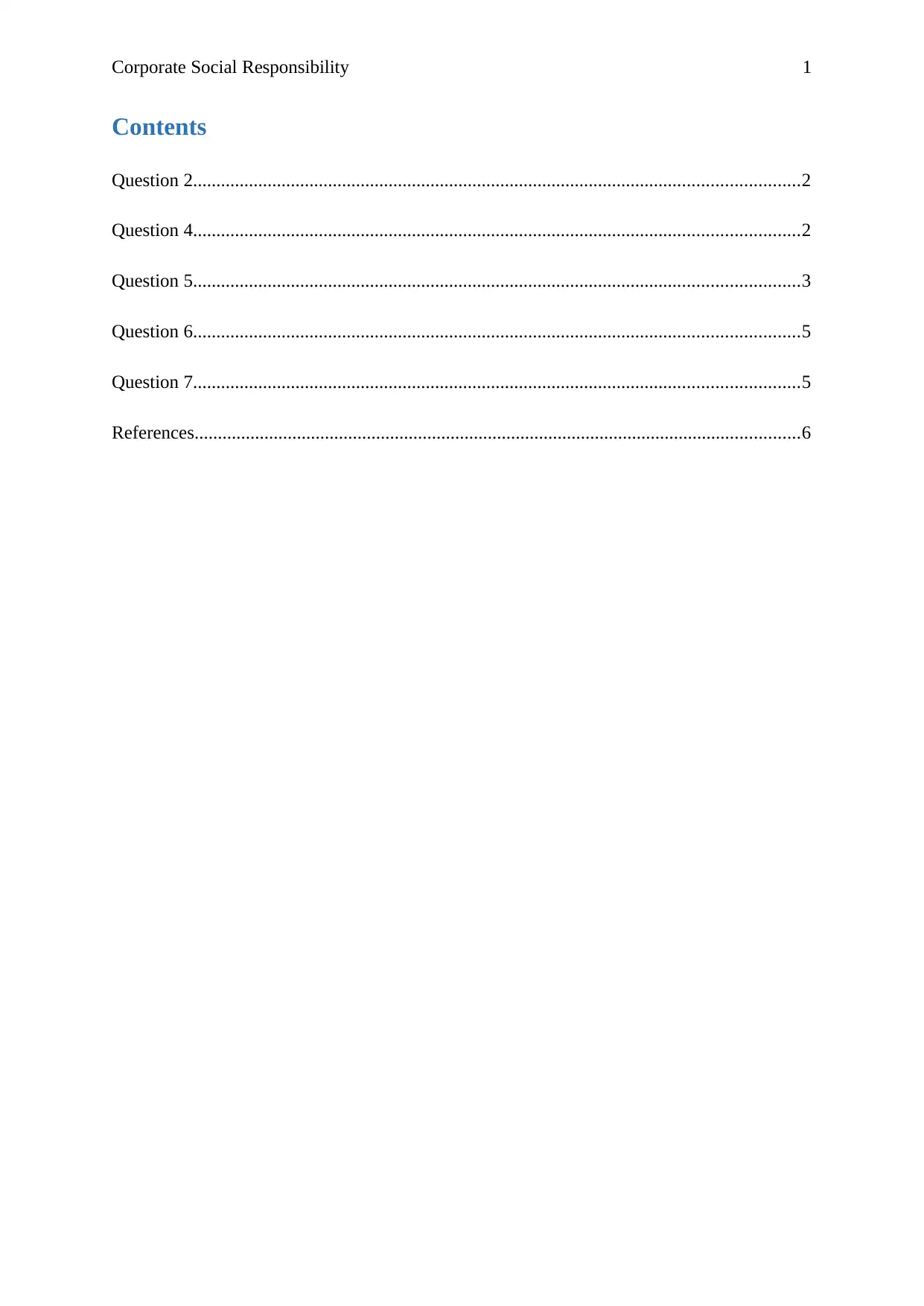
Contents
Question 2..................................................................................................................................2
Question 4..................................................................................................................................2
Question 5..................................................................................................................................3
Question 6..................................................................................................................................5
Question 7..................................................................................................................................5
References..................................................................................................................................6
Document Page
Corporate Social Responsibility 2
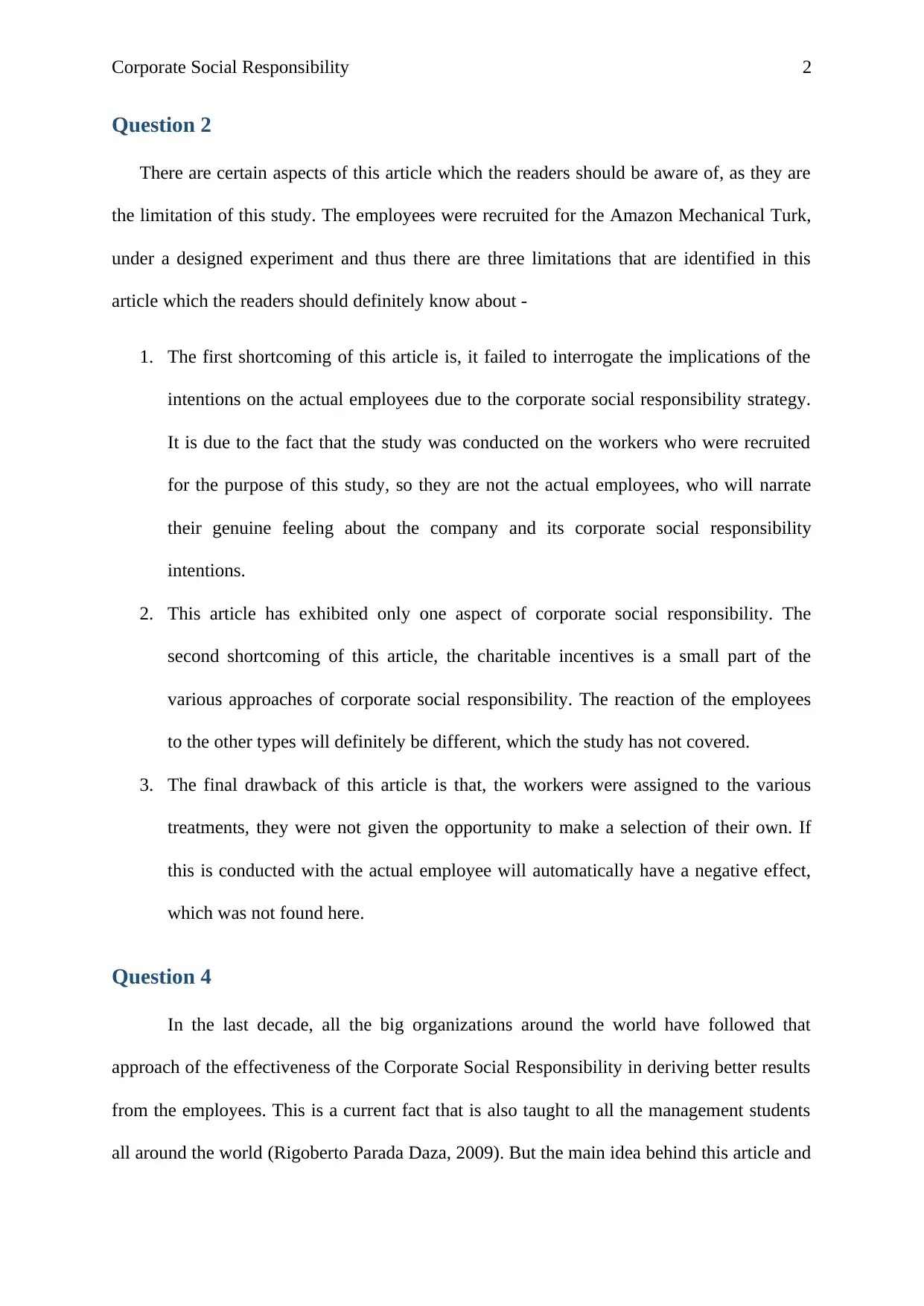
Question 2
There are certain aspects of this article which the readers should be aware of, as they are
the limitation of this study. The employees were recruited for the Amazon Mechanical Turk,
under a designed experiment and thus there are three limitations that are identified in this
article which the readers should definitely know about -
1. The first shortcoming of this article is, it failed to interrogate the implications of the
intentions on the actual employees due to the corporate social responsibility strategy.
It is due to the fact that the study was conducted on the workers who were recruited
for the purpose of this study, so they are not the actual employees, who will narrate
their genuine feeling about the company and its corporate social responsibility
intentions.
2. This article has exhibited only one aspect of corporate social responsibility. The
second shortcoming of this article, the charitable incentives is a small part of the
various approaches of corporate social responsibility. The reaction of the employees
to the other types will definitely be different, which the study has not covered.
3. The final drawback of this article is that, the workers were assigned to the various
treatments, they were not given the opportunity to make a selection of their own. If
this is conducted with the actual employee will automatically have a negative effect,
which was not found here.
Question 4
In the last decade, all the big organizations around the world have followed that
approach of the effectiveness of the Corporate Social Responsibility in deriving better results
from the employees. This is a current fact that is also taught to all the management students
all around the world (Rigoberto Parada Daza, 2009). But the main idea behind this article and
Document Page
Corporate Social Responsibility 3
the study conducted to provide with an evidence-based knowledge about the effectiveness of
Corporate Social Responsibility and its uncertainties under different conditions. The main
approach of this article is to clear the myths that are associated with Corporate Social
Responsibilities and how it is beneficial for all the organizations and their employees (Jones,
Bowd & Tench, 2009). The strategy of CSR that is taught to the students is built on a perfect
world which ignores the feeling of the people for whom the intentions of the organizations
matter a lot. Thus, the main idea of the article is built around this approach of knowing the
real truth behind corporate social responsibility and how its result differs when there are
conditions applied to the employees for the charitable incentives. The idea of conducting this
experiment in an organization, was to clear the air around the Corporate Social
Responsibility, which was touted as the best approach for employees’ motivation and
extracting better performance, while the study provided proof of a different result under
different scenarios (Ketola, 2013).
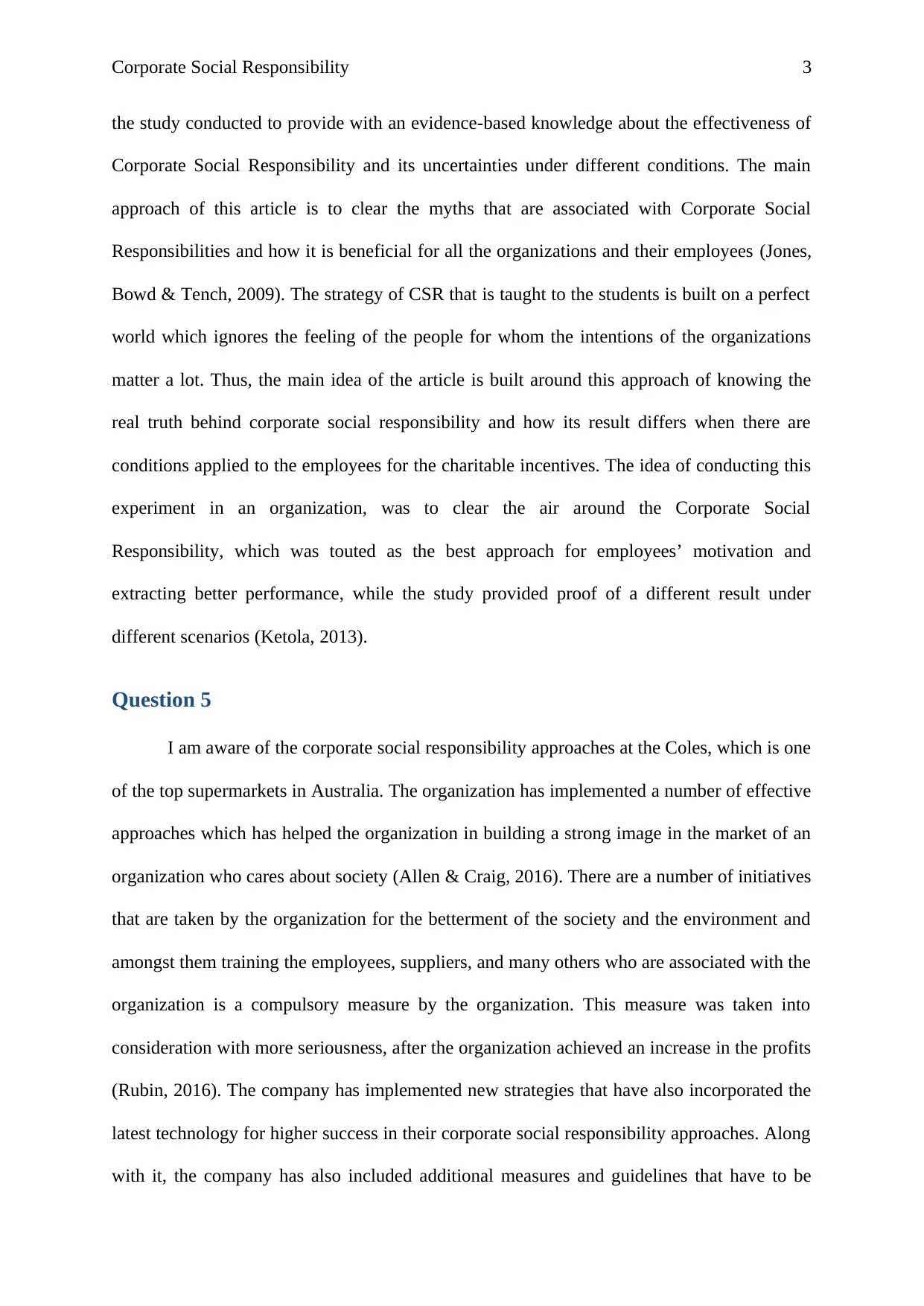
Question 5
I am aware of the corporate social responsibility approaches at the Coles, which is one
of the top supermarkets in Australia. The organization has implemented a number of effective
approaches which has helped the organization in building a strong image in the market of an
organization who cares about society (Allen & Craig, 2016). There are a number of initiatives
that are taken by the organization for the betterment of the society and the environment and
amongst them training the employees, suppliers, and many others who are associated with the
organization is a compulsory measure by the organization. This measure was taken into
consideration with more seriousness, after the organization achieved an increase in the profits
(Rubin, 2016). The company has implemented new strategies that have also incorporated the
latest technology for higher success in their corporate social responsibility approaches. Along
with it, the company has also included additional measures and guidelines that have to be
tabler-icon-diamond-filled.svg

Paraphrase This Document

Need a fresh take? Get an instant paraphrase of this document with our AI Paraphraser
Document Page
Corporate Social Responsibility 4
followed by the employees, suppliers, and others, to accomplish the approaches for
sustainable development of the business.
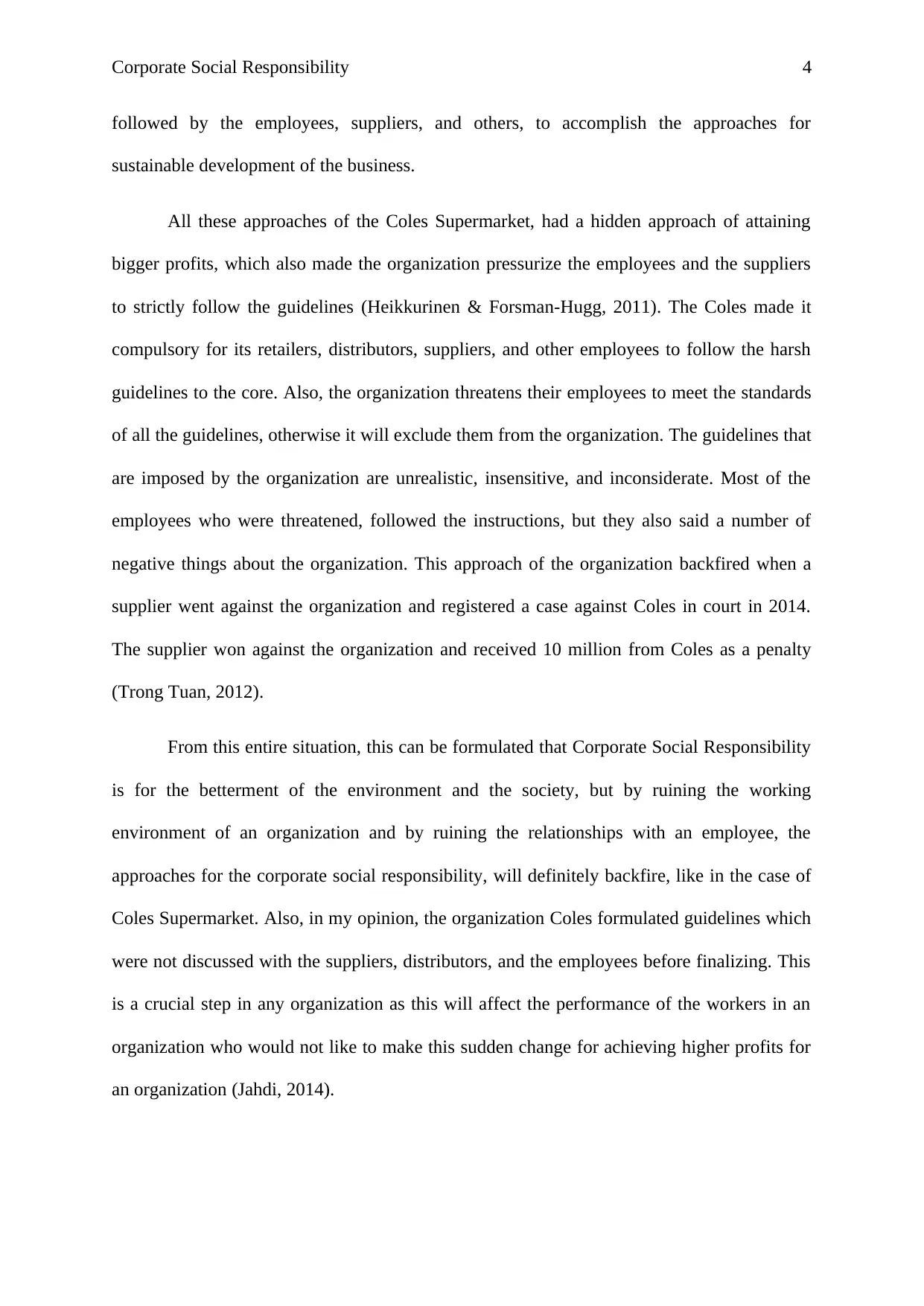
All these approaches of the Coles Supermarket, had a hidden approach of attaining
bigger profits, which also made the organization pressurize the employees and the suppliers
to strictly follow the guidelines (Heikkurinen & Forsman-Hugg, 2011). The Coles made it
compulsory for its retailers, distributors, suppliers, and other employees to follow the harsh
guidelines to the core. Also, the organization threatens their employees to meet the standards
of all the guidelines, otherwise it will exclude them from the organization. The guidelines that
are imposed by the organization are unrealistic, insensitive, and inconsiderate. Most of the
employees who were threatened, followed the instructions, but they also said a number of
negative things about the organization. This approach of the organization backfired when a
supplier went against the organization and registered a case against Coles in court in 2014.
The supplier won against the organization and received 10 million from Coles as a penalty
(Trong Tuan, 2012).
From this entire situation, this can be formulated that Corporate Social Responsibility
is for the betterment of the environment and the society, but by ruining the working
environment of an organization and by ruining the relationships with an employee, the
approaches for the corporate social responsibility, will definitely backfire, like in the case of
Coles Supermarket. Also, in my opinion, the organization Coles formulated guidelines which
were not discussed with the suppliers, distributors, and the employees before finalizing. This
is a crucial step in any organization as this will affect the performance of the workers in an
organization who would not like to make this sudden change for achieving higher profits for
an organization (Jahdi, 2014).
Document Page
Corporate Social Responsibility 5
Question 6
The article by Übius & Alas, that is “Organizational Culture Types as Predictors of
Corporate Social Responsibility” is an article that has been written by conducting a study in
various places and have analyzed the organizational cultures in different countries. Also, the
experiment conducted for the study, will provide with a more elaborate knowledge about the
organizational culture and the impact of the corporate social responsibility. (Übius & Alas,
2009)
The second journal article that I have selected is by Culler, that is “Good Works:
Assessing the Relationship between Organizational Culture, Corporate Social Responsibility
Programs, and Weberian Theory”. This article has will be beneficial in understanding the
organizational culture and the changes it goes through due to the new additions and
evolution. In this article, the changes witnessed by the Walt Disney Company have been
discussed, which will provide with better knowledge (Culler, 2010).
Question 7
According to Cornelius, Todres, Janjuha-Jivraj, Woods & Wallace, the corporate
social responsibility is a new vocabulary in the organizational culture that has created huge
dynamics in the functioning of an organization and has led to the evolution of various
management issues (Cornelius, Todres, Janjuha-Jivraj, Woods & Wallace, 2008).
According to Griswold, “Culture is a way through which human being communicate
and the transfer of knowledge happens through this medium. It is an objectification,
internalization, and externalization of the human experience. Also, there is a familiar
distinction between culture and nature. The organizational culture and the social attitudes all
constitute for to a better organizational culture (Griswold, 2008).
Document Page
Corporate Social Responsibility 6
References
Allen, M., & Craig, C. (2016). Rethinking corporate social responsibility in the age of climate
change: a communication perspective. International Journal of Corporate Social
Responsibility, 1(1), 6-12.
Cornelius, N., Todres, M., Janjuha-Jivraj, S., Woods, A., & Wallace, J. (2008). Corporate
Social Responsibility and the Social Enterprise. Journal of Business Ethics, 81(1), 355-
370.
Culler, C. (2010). Good Works: Assessing the Relationship between Organizational Culture,
Corporate Social Responsibility Programs, and Weberian Theory. International Journal
of Arts and Sciences, 3(13), 357-374.
Griswold, W. (2008). Cultures and Societies in a Changing World. Los Angeles: Pine Forge
Press, p. 13.
Heikkurinen, P., & Forsman-Hugg, S. (2011). Strategic Corporate Responsibility in the Food
Chain. Corporate Social Responsibility and Environmental Management, 18(5), 306-
316.
Jahdi, K. (2014). Cause-related marketing (CaRM) and corporate social responsibility
(CSR). Social Responsibility Journal, 10(4), 674-684.
Jones, B., Bowd, R., & Tench, R. (2009). Corporate irresponsibility and corporate social
responsibility: competing realities. Social Responsibility Journal, 5(3), 300-310.
Ketola, T. (2013). Rationale, Morals, and Needs Pyramid for Corporate Responsibility
Development. Corporate Social Responsibility and Environmental Management, 21(4),
228-239.
tabler-icon-diamond-filled.svg

Paraphrase This Document

Need a fresh take? Get an instant paraphrase of this document with our AI Paraphraser
Document Page
Corporate Social Responsibility 7
Rigoberto Parada Daza, J. (2009). A valuation model for corporate social
responsibility. Social Responsibility Journal, 5(3), 284-299.
Rubin, M. (2016). Corporate Social Responsibility, Risk Diversification, and Firm Value:
Does Corporate Social Responsibility Diversify Risk. SSRN Electronic Journal, 1(1),
10-15.
Trong Tuan, L. (2012). Corporate social responsibility, ethics, and corporate
governance. Social Responsibility Journal, 8(4), 547-560.
Übius, Ü, & Alas, R. (2009). Organizational Culture Types as Predictors of Corporate Social
Responsibility. Commerce of Engineering Decisions, 61(1), 90-97.
chevron_up_icon
1 out of 8
circle_padding
hide_on_mobile
zoom_out_icon
[object Object]