Stakeholder Analysis and Mapping for Tata India Limited (MGT583)

Verified

Added on  2023/01/12

|5
|738
|82
Report
AI Summary
This report presents a stakeholder analysis of Tata India Limited, the largest steel and iron producer in India, which has expanded into automobile and consumer durable products. The analysis utilizes Freeman's stakeholder theory to create a stakeholder map, categorizing stakeholders into dormant, discretionary, demanding, dominant, dangerous, dependent, definitive, and non-stakeholders. The report identifies key stakeholders such as government, direct buyers, distributors, shareholders, employees, and board members. It also highlights neglected areas like direct buyers and competitors, emphasizing the need for improved engagement with discretionary stakeholders and the distribution network to maintain market share and trust. The conclusion stresses the importance of addressing the needs of discretionary stakeholders and competitors with urgency to maintain the company's market position. The report also provides a bibliography of the sources used.

Document Page
1
tabler-icon-diamond-filled.svg

Paraphrase This Document

Need a fresh take? Get an instant paraphrase of this document with our AI Paraphraser
Document Page
Introduction of the Organization and stakeholder map
The name of the organization is Tata India Limited. This company is the largest Steel and
iron producer in India; during the last year this company went for above the line integration
and now they are dealing with automobile products, consumer durable products like A.C and
Refrigerators. The core business of TATA India limited is Steel and now they are adding new
products in their product catalog. Their CSR record is very impressive and this company is
also reaching in human capital (Thomas, 2019).
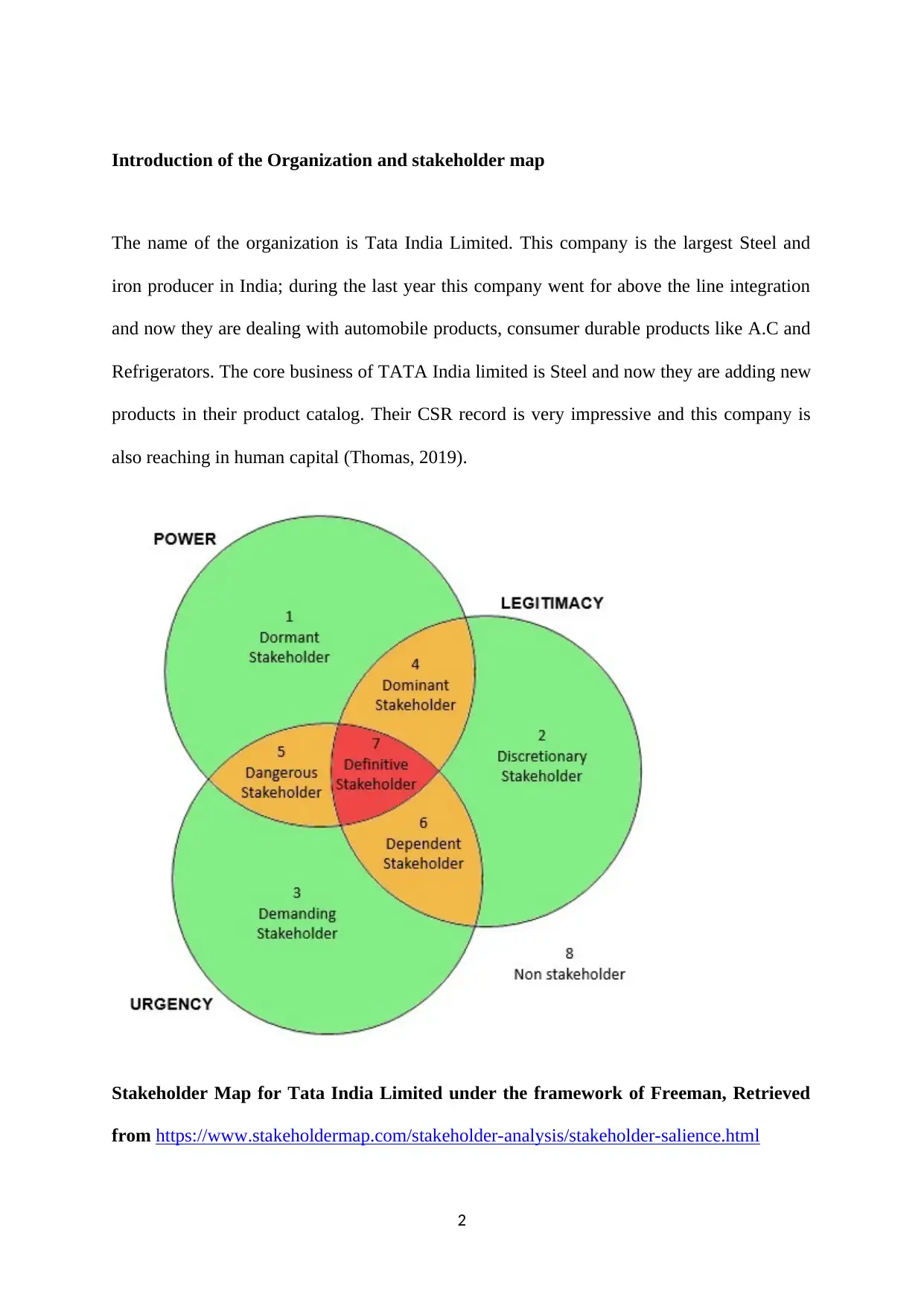
Stakeholder Map for Tata India Limited under the framework of Freeman, Retrieved
from https://www.stakeholdermap.com/stakeholder-analysis/stakeholder-salience.html
2
Document Page
1. Dormant Stakeholders: Government sector players and policymakers for the core
sector of the country. They are the legitimate stimulator of the external factors
supporting the business.
2. Discretionary stakeholders: Direct Buyers of finished and secondary market buyers in
the market of raw steel. The most powerful stakeholders in the chain, considering the
fact that the customer is the king. The most urgent segment of the stakeholder map.
3. Demanding stakeholders: Distribution network for the above the line products like
consumer long durable goods and automobiles. They are legitimate stakeholders
because the company is committed to serving their best interest in the market
(Donaldson, 2016).
4. Dominant stakeholders: The shareholders, investors, and promoters of the company.
In the equation of power, this segment of the stakeholders can be treated as the second
most powerful after the market forces.
5. Dangerous Stakeholders: Floating shareholders using the equity as a tool to make
money in daily deals of Indian Sensex. These types of stakeholders are out of the
locus of the control of the company.
6. Dependent Stakeholders: Employees, members of the distribution chain, Beneficiaries
of the CSR activity. Since the company floating on its human capital, these
stakeholders are legitimate stakeholders.
7. Definitive stakeholders: The promoters of the business and the board of the managing
directors, on the scale of the power, they are the third most important stakeholders.
8. Non Stakeholders: Competitors, urgent.
The list of the neglected stakeholders
3
Document Page
This company is losing its stake in the market of the automobile and the culture of the rolled
or recycled steel is catching up. These are two factors that are bringing down the profit
margins of the company. Direct buyers of the finished good and secondary market players are
the neglected area. The distribution network of the company is the most demanding area
neglect here can force them to look for other options of the investment (Brown, 2010). This is
one area where the company should look very carefully because this neglect directly forces
neglect on the area of competitors.
Conclusion
In the current stakeholder map while fixing a matrix for neglect and key result area we find
that the company should try to handle Discretionary stakeholders and competitors with
utmost urgency. They are the largest steel maker in India; the gain of any competitor is a loss
of Tata steel which is their core business. The company has earned trust in the market during
the last seventy years. The role of distribution network cannot be denied in this process. Right
now the company is not able to engage the money of the distribution network. This idling can
force the distributors to look for other avenues and the company can lose a fair deal of trust
and market share. This is the second most neglected area of the matrix.
4
tabler-icon-diamond-filled.svg

Paraphrase This Document

Need a fresh take? Get an instant paraphrase of this document with our AI Paraphraser
Document Page
Bibliography
Brown, J. (2010). CSR and Stakeholder Theory: A Tale of Adam Smith. Bus Ethics,
http://www.csringreece.gr/files/research/CSR-1331562726.pdf.
Donaldson, T. (2016). The Stakeholder Theory of the Corporation: Concepts, Evidence, and
Implications. The Academy of Management Review,
https://www.researchgate.net/publication/248020400_The_Stakeholder_Theory_of_th
e_Corporation_Concepts_Evidence_and_Implications.
Thomas, T. (2019). PIL seeks scrapping of Tata Steel's iron ore mining rights in Odisha. Live
Mint, https://www.livemint.com/industry/manufacturing/pil-seeks-scrapping-of-tata-
steel-s-iron-ore-mining-rights-in-odisha-1551829592300.html.
5
chevron_up_icon
1 out of 5
circle_padding
hide_on_mobile
zoom_out_icon
[object Object]