MGT602 Business Decision Analytics: Decision Style Analysis
VerifiedAdded on 2023/06/04
|8
|1721
|303
Report
AI Summary
This report presents a decision style analysis based on a decision preference instrument, a decision diary, a personality test (MBTI), and mentor feedback. The analysis reveals a high preference for logical decision-making, with average scores for intuition and balance. The report suggests strategies to enhance intuition, such as paying attention to the environment and building confidence in gut feelings. The personality test identifies the author as a 'debater' (ENTP), highlighting strengths in rational discussion and innovation, but also potential weaknesses in expressing emotions. The shadow side is identified as 'defender' (ISFJ), suggesting areas for improvement in communication and empathy. Recommendations include communicating emotions, listening to others, and enhancing intuition to achieve more balanced and effective decision-making. Desklib provides access to similar documents and study tools for students.
Running head: DECISION STYLE ANALYSIS 1
Decision Style Analysis
Name
University
Date
Decision Style Analysis
Name
University
Date
Paraphrase This Document
Need a fresh take? Get an instant paraphrase of this document with our AI Paraphraser

Decision Style Analysis 2
Introduction
This report presents the findings of a decisions style analysis that I undertook. Four
different exercises were undertaken. First, I completed a decisions preference instrument.
Second, I kept a diary of my decisions over the period of the exercises which I then analyzed to
find out trends in my decision making. Third, I completed a personality test to determine my
personality and my shadow side. Finally, I engaged in a mentors-feedback session whereby I
discussed the results from the three exercises with a colleague. The next section details the
findings and recommendations from the exercises described.
Decisions Style Analysis
Analysis of Own Decisions Preferences
Table 1 below shows my results from the decision instrument exercise. From the table,
my highest decision making preference is through logic. The score for this decision preference
was higher than the given average. On the other hand, my scores for intuition and balance were
average. The scores in these categories were similar to the given normal scores.
Currently, two of my decision preferences are not high; intuition and balance. A few
areas of improvement would push the two to high. First, enhancing my intuition would push my
balance preference higher. Having both intuition and logical preferences implies that the
decisions made will ultimately result from a blend of intuition and logical thinking (Bavolar &
Orosova, 2015). Therefore, I would primarily need to enhance my intuition so as to push the
three preferences to high.
To enhance my intuition, I need to start paying more attention to my
surrounding/environment. This will allow me to gather the necessary pieces of information that
Introduction
This report presents the findings of a decisions style analysis that I undertook. Four
different exercises were undertaken. First, I completed a decisions preference instrument.
Second, I kept a diary of my decisions over the period of the exercises which I then analyzed to
find out trends in my decision making. Third, I completed a personality test to determine my
personality and my shadow side. Finally, I engaged in a mentors-feedback session whereby I
discussed the results from the three exercises with a colleague. The next section details the
findings and recommendations from the exercises described.
Decisions Style Analysis
Analysis of Own Decisions Preferences
Table 1 below shows my results from the decision instrument exercise. From the table,
my highest decision making preference is through logic. The score for this decision preference
was higher than the given average. On the other hand, my scores for intuition and balance were
average. The scores in these categories were similar to the given normal scores.
Currently, two of my decision preferences are not high; intuition and balance. A few
areas of improvement would push the two to high. First, enhancing my intuition would push my
balance preference higher. Having both intuition and logical preferences implies that the
decisions made will ultimately result from a blend of intuition and logical thinking (Bavolar &
Orosova, 2015). Therefore, I would primarily need to enhance my intuition so as to push the
three preferences to high.
To enhance my intuition, I need to start paying more attention to my
surrounding/environment. This will allow me to gather the necessary pieces of information that

Decision Style Analysis 3
come together to form a ‘hunch/gut feeling’ (Ivanovska & Geiese, 2011). Second, I could build
my intuitiveness by building my personal confidences in my gut feelings. This could be done by
testing out a variety of hunches starting with the ones with the least consequences. Success in the
trials has the potential to build the subconscious confidence in my abilities to make intuitive
decisions (Azeska & Kevereski, 2017). Finally, I could build my intuitiveness by changing my
routines. Engaging in new and potentially unfamiliar activities requires creativity and is a good
way to try out my hunches (Elayyan, 2015).
Table 1: Decision Instrument Results
Decision Preference Mean Value
Intuition Average
Logic High
Balance Average
Decision Diary Analysis
I have learned a great deal about my decisions preferences by keeping and analyzing a
decision diary. The first thing I realized is that I tend to do things because they look right rather
than feel right. In most of the decisions entries in my diary, I arrived at my final decision after
considering the alternatives that were apparent to me although I would later realize that I could
have done something better in some cases.
Next, I realized that I do trust my gut feeling. However, when making important
decisions, I tend to investigate more before following my hunches. Further, most of the people I
consult with often encourage me to think rationally before making crucial decisions. However,
come together to form a ‘hunch/gut feeling’ (Ivanovska & Geiese, 2011). Second, I could build
my intuitiveness by building my personal confidences in my gut feelings. This could be done by
testing out a variety of hunches starting with the ones with the least consequences. Success in the
trials has the potential to build the subconscious confidence in my abilities to make intuitive
decisions (Azeska & Kevereski, 2017). Finally, I could build my intuitiveness by changing my
routines. Engaging in new and potentially unfamiliar activities requires creativity and is a good
way to try out my hunches (Elayyan, 2015).
Table 1: Decision Instrument Results
Decision Preference Mean Value
Intuition Average
Logic High
Balance Average
Decision Diary Analysis
I have learned a great deal about my decisions preferences by keeping and analyzing a
decision diary. The first thing I realized is that I tend to do things because they look right rather
than feel right. In most of the decisions entries in my diary, I arrived at my final decision after
considering the alternatives that were apparent to me although I would later realize that I could
have done something better in some cases.
Next, I realized that I do trust my gut feeling. However, when making important
decisions, I tend to investigate more before following my hunches. Further, most of the people I
consult with often encourage me to think rationally before making crucial decisions. However,
⊘ This is a preview!⊘
Do you want full access?
Subscribe today to unlock all pages.

Trusted by 1+ million students worldwide

Decision Style Analysis 4
this is not always the case. There are instances when I am advised to follow my guts. I always
prefer to justify my decisions objectively. This is partly why I rarely consider my emotional
responses when dealing with a problem. In such situations, my goal is usually to do whatever
will have the best long run results.
Own Type and Shadow Side Analysis
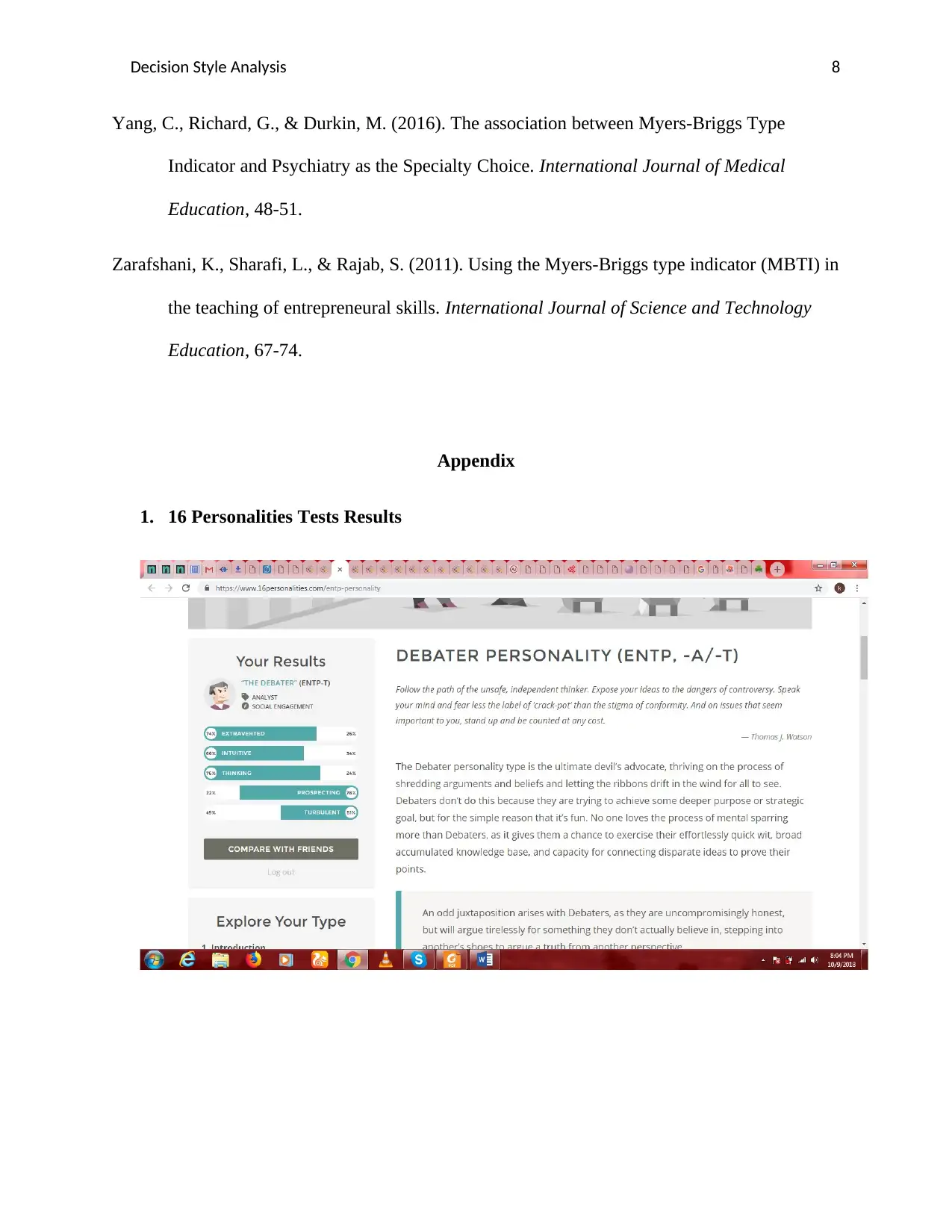
From the 16 personalities types test results, my primary type is a debater (ENTP) (Table
1) (Neris Analytics Limited, 2018). Debaters are typically quick witted, knowledgeable and who
can easily connect seemingly unrelated ideas to construct a robust argument. People with this
personality do not shy away from conflict and often derive pleasure in engaging in rational
discussions. Further, they are charismatic, energetic and have the tendency to keep innovating.
Consequently, they are indispensable in situations that require constant brainstorming and
innovation (Kim & Han, 2014). On the other hand, debaters are often ruthlessly honest especially
in defense of their point of view. This tendency to engage in honest and rational arguments may
present them as intolerant, insensitive and very argumentative (Zarafshani, Sharafi, & Rajab,
2011).
As a debater, I realize that I have the tendency to rationalize everything. I tend to analyze
anything I engage in with a view to finding the most logical solution. This may cause ripples
with some of the people I engage with particularly those that tend to shy away from arguments or
verbal conflicts. However, debaters tend to express themselves with exceptional charisma,
originality and natural enthusiasm (Yang, Richard, & Durkin, 2016). This may mitigate the
negative perception that the audience may have such as being overly argumentative. Further, due
this is not always the case. There are instances when I am advised to follow my guts. I always
prefer to justify my decisions objectively. This is partly why I rarely consider my emotional
responses when dealing with a problem. In such situations, my goal is usually to do whatever
will have the best long run results.
Own Type and Shadow Side Analysis
From the 16 personalities types test results, my primary type is a debater (ENTP) (Table
1) (Neris Analytics Limited, 2018). Debaters are typically quick witted, knowledgeable and who
can easily connect seemingly unrelated ideas to construct a robust argument. People with this
personality do not shy away from conflict and often derive pleasure in engaging in rational
discussions. Further, they are charismatic, energetic and have the tendency to keep innovating.
Consequently, they are indispensable in situations that require constant brainstorming and
innovation (Kim & Han, 2014). On the other hand, debaters are often ruthlessly honest especially
in defense of their point of view. This tendency to engage in honest and rational arguments may
present them as intolerant, insensitive and very argumentative (Zarafshani, Sharafi, & Rajab,
2011).
As a debater, I realize that I have the tendency to rationalize everything. I tend to analyze
anything I engage in with a view to finding the most logical solution. This may cause ripples
with some of the people I engage with particularly those that tend to shy away from arguments or
verbal conflicts. However, debaters tend to express themselves with exceptional charisma,
originality and natural enthusiasm (Yang, Richard, & Durkin, 2016). This may mitigate the
negative perception that the audience may have such as being overly argumentative. Further, due
Paraphrase This Document
Need a fresh take? Get an instant paraphrase of this document with our AI Paraphraser

Decision Style Analysis 5
to the carefully crafted/phrased arguments and their inherent logic, I expect that my personality
would enable me to easily solve problems and convince others that my proposal is the right way
to go. Finally, debaters tend to innovate more than taking time to formulate careful plans. This is
due to their reliance on their experience and knowledge base. My biggest surprise with the
results was that debaters only make up about 3% of the population; making us quite rare.
Table 2: Own Personality Type
High Medium Lo
w
Medium High
Extraversion
(E)
X Introversion (I)
Sensing (S) X Intuition (N)
Thinking (T) X Feeling (F)
Judging (J) X Perceiving (P)
My shadow side is the defender personality (ISFJ) (Neris Analytics Limited, 2018).
Defenders are quite conservative, altruistic, and supportive people. Unlike debaters, defenders
are humble and shy and will rarely express their thoughts; mainly due to their desire to avoid
upsetting others. Further, people with this personality always answer the call to a worthy cause if
it is within their power. In this regard, they can easily go out of their way to help others and
make them happy. Their main weaknesses is their inability to refuse calls for help. In light of
this, they are easily taken advantage of (Zarafshani, Sharafi, & Rajab, 2011).
to the carefully crafted/phrased arguments and their inherent logic, I expect that my personality
would enable me to easily solve problems and convince others that my proposal is the right way
to go. Finally, debaters tend to innovate more than taking time to formulate careful plans. This is
due to their reliance on their experience and knowledge base. My biggest surprise with the
results was that debaters only make up about 3% of the population; making us quite rare.
Table 2: Own Personality Type
High Medium Lo
w
Medium High
Extraversion
(E)
X Introversion (I)
Sensing (S) X Intuition (N)
Thinking (T) X Feeling (F)
Judging (J) X Perceiving (P)
My shadow side is the defender personality (ISFJ) (Neris Analytics Limited, 2018).
Defenders are quite conservative, altruistic, and supportive people. Unlike debaters, defenders
are humble and shy and will rarely express their thoughts; mainly due to their desire to avoid
upsetting others. Further, people with this personality always answer the call to a worthy cause if
it is within their power. In this regard, they can easily go out of their way to help others and
make them happy. Their main weaknesses is their inability to refuse calls for help. In light of
this, they are easily taken advantage of (Zarafshani, Sharafi, & Rajab, 2011).

Decision Style Analysis 6
I think I could improve my communication, interpersonal behaviors and my ability to use
information by adopting more of the altruistic and empathetic nature of the defenders. This
would enable me to use my debater capabilities to develop ideas that are mutually beneficial to
all parties and in a way that is acceptable to all. Further, I could improve my personality by
seeking ways to improve my abilities to express emotions.
Conclusion
From the foregoing, my decision style can be summarized as logical, rational and
innovative. The chief strength of these decision style is the ability to respond effectively in
situations that require creativity and where the rote approaches would not apply. However, the
downside is that people with this traits can appear insensitive and have weaknesses expressing
their emotions. The following recommendations would help me to better improve my areas of
weakness.
Recommendation
Always attempt to communicate my emotions and empathy to other people in words
Listen more to other people’s views before airing mine
Always try to arrive at a consensus rather than winning a debate for the sake of it
Pay more attention to my immediate surroundings to enhance intuition
Test my hunches regularly to enhance my confidence in my intuitive capabilities
Change my routines often to find a chance to practice my intuitiveness
I think I could improve my communication, interpersonal behaviors and my ability to use
information by adopting more of the altruistic and empathetic nature of the defenders. This
would enable me to use my debater capabilities to develop ideas that are mutually beneficial to
all parties and in a way that is acceptable to all. Further, I could improve my personality by
seeking ways to improve my abilities to express emotions.
Conclusion
From the foregoing, my decision style can be summarized as logical, rational and
innovative. The chief strength of these decision style is the ability to respond effectively in
situations that require creativity and where the rote approaches would not apply. However, the
downside is that people with this traits can appear insensitive and have weaknesses expressing
their emotions. The following recommendations would help me to better improve my areas of
weakness.
Recommendation
Always attempt to communicate my emotions and empathy to other people in words
Listen more to other people’s views before airing mine
Always try to arrive at a consensus rather than winning a debate for the sake of it
Pay more attention to my immediate surroundings to enhance intuition
Test my hunches regularly to enhance my confidence in my intuitive capabilities
Change my routines often to find a chance to practice my intuitiveness
⊘ This is a preview!⊘
Do you want full access?
Subscribe today to unlock all pages.

Trusted by 1+ million students worldwide

Decision Style Analysis 7
Reference
Azeska, A., & Kevereski, L. (2017). Styles of Decision Making and Management and
Dimensions of Personality of School Principals. International Journal of Cognitive
Research in Science, Engineering and Education, 5-20.
Bavolar, J., & Orosova, O. (2015). Decision-making styles and their associations with decision-
making competencies and mental health. Judgement and Decision Making, 115-122.
Elayyan, A. (2015). The Impact of Decision Making Styles on Organizational Learning: An
Empirical Study on the Public Manufucturing Companies in Jordan. International
Journal of Business and Social Sciences, 15-20.
Ivanovska, M., & Geiese, M. (2011). A Logic-based Approach to Decision Making. NIK-2011
conference. Oslo: University of Oslo.
Kim, M.-R., & Han, S.-J. (2014). Relationship between the Myers-Briggs Type Indicator
Personality Profiling, Academic Performance and Student Satisfaction in Nursing
Students. International Journal of Bio-Science and Bio-Technology, 1-12.
Neris Analytics Limited. (2018). 16 Personalities. Retrieved from Neris Analytics Ltd:
https://www.16personalities.com/
Reference
Azeska, A., & Kevereski, L. (2017). Styles of Decision Making and Management and
Dimensions of Personality of School Principals. International Journal of Cognitive
Research in Science, Engineering and Education, 5-20.
Bavolar, J., & Orosova, O. (2015). Decision-making styles and their associations with decision-
making competencies and mental health. Judgement and Decision Making, 115-122.
Elayyan, A. (2015). The Impact of Decision Making Styles on Organizational Learning: An
Empirical Study on the Public Manufucturing Companies in Jordan. International
Journal of Business and Social Sciences, 15-20.
Ivanovska, M., & Geiese, M. (2011). A Logic-based Approach to Decision Making. NIK-2011
conference. Oslo: University of Oslo.
Kim, M.-R., & Han, S.-J. (2014). Relationship between the Myers-Briggs Type Indicator
Personality Profiling, Academic Performance and Student Satisfaction in Nursing
Students. International Journal of Bio-Science and Bio-Technology, 1-12.
Neris Analytics Limited. (2018). 16 Personalities. Retrieved from Neris Analytics Ltd:
https://www.16personalities.com/
Paraphrase This Document
Need a fresh take? Get an instant paraphrase of this document with our AI Paraphraser

Decision Style Analysis 8
Yang, C., Richard, G., & Durkin, M. (2016). The association between Myers-Briggs Type
Indicator and Psychiatry as the Specialty Choice. International Journal of Medical
Education, 48-51.
Zarafshani, K., Sharafi, L., & Rajab, S. (2011). Using the Myers-Briggs type indicator (MBTI) in
the teaching of entrepreneural skills. International Journal of Science and Technology
Education, 67-74.
Appendix
1. 16 Personalities Tests Results
Yang, C., Richard, G., & Durkin, M. (2016). The association between Myers-Briggs Type
Indicator and Psychiatry as the Specialty Choice. International Journal of Medical
Education, 48-51.
Zarafshani, K., Sharafi, L., & Rajab, S. (2011). Using the Myers-Briggs type indicator (MBTI) in
the teaching of entrepreneural skills. International Journal of Science and Technology
Education, 67-74.
Appendix
1. 16 Personalities Tests Results
1 out of 8
Related Documents
Your All-in-One AI-Powered Toolkit for Academic Success.
+13062052269
info@desklib.com
Available 24*7 on WhatsApp / Email
Unlock your academic potential
Copyright © 2020–2026 A2Z Services. All Rights Reserved. Developed and managed by ZUCOL.