MGT603: System Thinking Report on Emergency Department Performance
VerifiedAdded on 2022/09/14
|12
|3737
|21
Report
AI Summary
This report provides an analysis of an emergency department (ED) using system thinking principles. The report identifies key system archetypes, including "goal drifting," "limits to success," "shifting the burden," and "fixes that fail," that impact the ED's performance, particularly patient turnaround time. The author utilizes a value stream map to visualize the current state of the ED and proposes a new state value stream map to improve efficiency. The analysis highlights the complexities within the ED and discusses both the intended and unintended consequences of proposed solutions. Recommendations are provided to improve the performance of the ED, focusing on addressing the root causes of problems rather than just treating the symptoms.
Running head: SYSTEM THINKING 1
System Thinking
Student’s Name
Institutional Affiliation
System Thinking
Student’s Name
Institutional Affiliation

Paraphrase This Document
Need a fresh take? Get an instant paraphrase of this document with our AI Paraphraser
SYSTEM THINKING 2
System Thinking
Executive Summary
In this report, a problem affecting the ED is identified and the hypothetical view of
the same is provided. It's known that the performance of an organization is affected by
various factors system archetypes. Identifying such archetypes and closely examining them
will help solve the problems in the organization. This report focuses on the emergency
department and the archetypes that affect the performance in the same department. However,
the emergency department is very complex. Addressing the complexities that exist in the
department will be given a priority in this report. Also, in managing the emergency
department, certain themes are very key. These themes will be widely mentioned in this
report. The solution to the problem identified will then be proposed using a system thinking
lens. lastly, both the unintended and intended consequences of the solution proposed will be
discussed before concluding with tenable recommendations for performance improvement.
Introduction
In this paper, one is subjected to imagine himself as one of the members of a team
responsible for managing the operations in the public hospital. Just like it’s in any other
organization, the emergency department receives feedback from the customers periodically
for evaluation purposes. Based on the case study given, the feedback that the emergency
department received from customers, it's believed that the waiting time in the department is
too long. Since the operations carried out in the department are very sensitive, there is a needs
to improve the waiting time in the department. However, the waiting time affects the
department as a whole. Therefore, for an improvement of the waiting time to happen, a full
examination of the whole department must be done. In examining the department, the value
stream map is very critical. The emergency department value map will be used to examine
how the department functions. Also, the system archetypes which are critical in determining
System Thinking
Executive Summary
In this report, a problem affecting the ED is identified and the hypothetical view of
the same is provided. It's known that the performance of an organization is affected by
various factors system archetypes. Identifying such archetypes and closely examining them
will help solve the problems in the organization. This report focuses on the emergency
department and the archetypes that affect the performance in the same department. However,
the emergency department is very complex. Addressing the complexities that exist in the
department will be given a priority in this report. Also, in managing the emergency
department, certain themes are very key. These themes will be widely mentioned in this
report. The solution to the problem identified will then be proposed using a system thinking
lens. lastly, both the unintended and intended consequences of the solution proposed will be
discussed before concluding with tenable recommendations for performance improvement.
Introduction
In this paper, one is subjected to imagine himself as one of the members of a team
responsible for managing the operations in the public hospital. Just like it’s in any other
organization, the emergency department receives feedback from the customers periodically
for evaluation purposes. Based on the case study given, the feedback that the emergency
department received from customers, it's believed that the waiting time in the department is
too long. Since the operations carried out in the department are very sensitive, there is a needs
to improve the waiting time in the department. However, the waiting time affects the
department as a whole. Therefore, for an improvement of the waiting time to happen, a full
examination of the whole department must be done. In examining the department, the value
stream map is very critical. The emergency department value map will be used to examine
how the department functions. Also, the system archetypes which are critical in determining
SYSTEM THINKING 3
the functioning of the organization will be utilized to analyze the performance organization.
Using the archetypes to analyze the performance of the organization is recommended
because, through such analysis, organization’s behavior can be provided clearly (Sujan,
Huang & Braithwaite, 2017). Therefore, it’s possible to diagnostically examine the
performance of the organization using archetypes and also, the patterns of behavior that are in
existence in the organization can be recognized by the manager (Behl & Ferreira, 2014).
Identification and analysis of the System Archetypes that may impede performance
As aforementioned above, in the organization, the system archetypes help us
understand the behavior of a system. Therefore, for the operations of a system to be identified
and the conclusion to be made on what affects those operations, the system archetypes of that
system must be analyzed thoroughly. However many types of system archetypes exist. In this
paper, only five types of archetypes that are relevant to the emergency department will be
discussed. One such archetype is the attractiveness principal. Attractiveness principal means
that because all the people can't be pleased by the organization, an organization is forced to
take sides by preferring some operations more than the others (Bal, Ceylan & Taçoğlu, 2017).
A good example is when a company considered to be highly valued for the services it
delivers and the price it charges but undervalued in the quality it provides. In such a scenario,
the attractiveness of such an organization is taken to be zero. From the description above, it's
evident that an organization can't address all its limitations at the same time because of
system archetype principle. Therefore, the system archetype limits the growth of an
organization. Shifting the burden archetype is another system archetype that will be discussed
in this paper. Shifting the burden archetype occurs in the organization when the organization
current problem is solved by bringing an intervener. (Doğan & Unutulmaz, 2016). Instead of
solving the problem permanently, the intervener only provides a temporary solution to the
problem and after some time, the organization is affected by the same problem again. Since
the functioning of the organization will be utilized to analyze the performance organization.
Using the archetypes to analyze the performance of the organization is recommended
because, through such analysis, organization’s behavior can be provided clearly (Sujan,
Huang & Braithwaite, 2017). Therefore, it’s possible to diagnostically examine the
performance of the organization using archetypes and also, the patterns of behavior that are in
existence in the organization can be recognized by the manager (Behl & Ferreira, 2014).
Identification and analysis of the System Archetypes that may impede performance
As aforementioned above, in the organization, the system archetypes help us
understand the behavior of a system. Therefore, for the operations of a system to be identified
and the conclusion to be made on what affects those operations, the system archetypes of that
system must be analyzed thoroughly. However many types of system archetypes exist. In this
paper, only five types of archetypes that are relevant to the emergency department will be
discussed. One such archetype is the attractiveness principal. Attractiveness principal means
that because all the people can't be pleased by the organization, an organization is forced to
take sides by preferring some operations more than the others (Bal, Ceylan & Taçoğlu, 2017).
A good example is when a company considered to be highly valued for the services it
delivers and the price it charges but undervalued in the quality it provides. In such a scenario,
the attractiveness of such an organization is taken to be zero. From the description above, it's
evident that an organization can't address all its limitations at the same time because of
system archetype principle. Therefore, the system archetype limits the growth of an
organization. Shifting the burden archetype is another system archetype that will be discussed
in this paper. Shifting the burden archetype occurs in the organization when the organization
current problem is solved by bringing an intervener. (Doğan & Unutulmaz, 2016). Instead of
solving the problem permanently, the intervener only provides a temporary solution to the
problem and after some time, the organization is affected by the same problem again. Since
⊘ This is a preview!⊘
Do you want full access?
Subscribe today to unlock all pages.

Trusted by 1+ million students worldwide
SYSTEM THINKING 4
by not solving the root cause of the problem enough time is given enough time to grow, the
problem in the organization will be even worse after the intervener is brought (Dal Forno et
al., 2014). As a result, more time and resources will be wasted in trying to solve the recurrent
problem now and then which affects the performance of the organization.
Fixes that fail is the third system archetype that will be discussed. The fixes that fail is
said to exist in the organization when the solution is rapidly implemented to address the
current problem in the organization (Henrique et al., 2016). The purpose of using the rapidly
implemented solution is to fix the problem quickly. However, many times, instead of fixing
the problem, the unintended consequence is produced by the rapidly implemented solution in
the organization (Henrique et al., 2016). The unintended consequences manifest themselves
at first, but with time, they disappear even though they continue to affect the performance in
the organization by hampering the operations (Shou et al., 2017). The company will have to
input a lot of resources and time in dealing with these problems which affect its performance.
"Limits to success" is the fourth system archetype that will be discussed. The "limits to
success" is said to exist in the company when the performance of a company is improved in a
short time basis by the efforts applied. With time, however, the performance in the company
are generally slowed down by the negative forces in the company meeting the efforts that are
improving the performance (Jimmerson, 2017). Then there is a drifting goal archetype which
is the fifth type of archetype that will be discussed in the paper. When the organization
realizes that its performance is leading it in a different direction in relation to the set goals, a
drifting goal is said to exist in that organization. When this happens, the organization will
readjust by lowering its goals to a level that its poor performance can meet (Masys, 2015).
However, by lowering the goals, the organization is indirectly promoting poor performance in
the organization because nothing is done to improve the performance.
by not solving the root cause of the problem enough time is given enough time to grow, the
problem in the organization will be even worse after the intervener is brought (Dal Forno et
al., 2014). As a result, more time and resources will be wasted in trying to solve the recurrent
problem now and then which affects the performance of the organization.
Fixes that fail is the third system archetype that will be discussed. The fixes that fail is
said to exist in the organization when the solution is rapidly implemented to address the
current problem in the organization (Henrique et al., 2016). The purpose of using the rapidly
implemented solution is to fix the problem quickly. However, many times, instead of fixing
the problem, the unintended consequence is produced by the rapidly implemented solution in
the organization (Henrique et al., 2016). The unintended consequences manifest themselves
at first, but with time, they disappear even though they continue to affect the performance in
the organization by hampering the operations (Shou et al., 2017). The company will have to
input a lot of resources and time in dealing with these problems which affect its performance.
"Limits to success" is the fourth system archetype that will be discussed. The "limits to
success" is said to exist in the company when the performance of a company is improved in a
short time basis by the efforts applied. With time, however, the performance in the company
are generally slowed down by the negative forces in the company meeting the efforts that are
improving the performance (Jimmerson, 2017). Then there is a drifting goal archetype which
is the fifth type of archetype that will be discussed in the paper. When the organization
realizes that its performance is leading it in a different direction in relation to the set goals, a
drifting goal is said to exist in that organization. When this happens, the organization will
readjust by lowering its goals to a level that its poor performance can meet (Masys, 2015).
However, by lowering the goals, the organization is indirectly promoting poor performance in
the organization because nothing is done to improve the performance.
Paraphrase This Document
Need a fresh take? Get an instant paraphrase of this document with our AI Paraphraser
SYSTEM THINKING 5
Analysis of the current State Value Stream Map of the emergency department based on
System Archetypes
Based on the value system map of the emergency department provided, various
system archetypes that affect the performance of the department can be identified. The first
archetype that affects the performance in the organization is the "goal drifting archetype". As
aforementioned above, the drifting goal system archetype happens when the performance of
the organization is leading the organization in a different direction in relation to the
organization’s goals. Looking at the value stream map given, it’s evident that the main goal
of the emergency department is to ensure that effective emergency care is provided to the
patients on a timely basis. However, many procedures are taken to deliver emergency care is
delivered to the patient. These procedures take a long time and patients are forced to wait. For
example, before a patient finally sees a doctor who will treat him, he has to undertake six
different waiting periods. Since the emergencies are very delicate situations, it can be said
that the performance of the organization is not likely to meet the goals of the organization.
Therefore, there is a huge gap between the goals of the organization with its performance.
Also, limits to success is another system archetype that affects the performance in the
emergency department. There are various efforts that the organization has put in place to
improve the performance in the department based on the value stream map provided. A good
example of the effort to improve the performance in the organization is the introduction of
the section that provides the insurance status of each patient injury before the treatment
commences. Since some patients had their treatment delayed because they cannot cater for
the treatment, the introduction of the section that confirmed the injury insurance status would
have improved the treatment by speeding the treatment of patients. However, the time has
been the main constraints that affect the efforts of the department to improve the performance
of the organization. This is so because a lot of time is taken to check the injury status which
Analysis of the current State Value Stream Map of the emergency department based on
System Archetypes
Based on the value system map of the emergency department provided, various
system archetypes that affect the performance of the department can be identified. The first
archetype that affects the performance in the organization is the "goal drifting archetype". As
aforementioned above, the drifting goal system archetype happens when the performance of
the organization is leading the organization in a different direction in relation to the
organization’s goals. Looking at the value stream map given, it’s evident that the main goal
of the emergency department is to ensure that effective emergency care is provided to the
patients on a timely basis. However, many procedures are taken to deliver emergency care is
delivered to the patient. These procedures take a long time and patients are forced to wait. For
example, before a patient finally sees a doctor who will treat him, he has to undertake six
different waiting periods. Since the emergencies are very delicate situations, it can be said
that the performance of the organization is not likely to meet the goals of the organization.
Therefore, there is a huge gap between the goals of the organization with its performance.
Also, limits to success is another system archetype that affects the performance in the
emergency department. There are various efforts that the organization has put in place to
improve the performance in the department based on the value stream map provided. A good
example of the effort to improve the performance in the organization is the introduction of
the section that provides the insurance status of each patient injury before the treatment
commences. Since some patients had their treatment delayed because they cannot cater for
the treatment, the introduction of the section that confirmed the injury insurance status would
have improved the treatment by speeding the treatment of patients. However, the time has
been the main constraints that affect the efforts of the department to improve the performance
of the organization. This is so because a lot of time is taken to check the injury status which
SYSTEM THINKING 6
adds to the waiting time of the patients before treatment commences. Therefore, its right to
say that the efforts that were meant to improve the performance in the organization have
instead slowed down the performance of the organization.
Also, based on the value stream map given, it’s evident that the organization is also
experiencing shifting the burden system type of archetype. The patient turnaround time is the
main problem in the emergency department. From the value stream provided, the
organization has introduced two new positions to temporarily deal with the problem instead
of finding the root cause of the problem and permanently fix it. The positions of the attending
physician and that of attending nurse are meant to reduce the waiting time by attending to the
patients directly instead of the patients waiting to see the doctor. The introduction of these
positions might have temporarily helped. However, since the problem was not solved, the
time taken deliver emergency care in the department is still long. Another system archetype
that affects the performance in the department based on the value stream map provided is the
fixes that fail. As earlier mentioned, the fixes that fail happen in the organization when
unintended consequences are produced by the solution that was meant to solve the problem.
In the emergency department, the section that required the status of the injury of the patients
to be verified before treatment commences was introduced to fix the delay of treatment by
those patients who could not afford their medical bills. However, since the time taken to
check the status of the injury added to the waiting time, the turnaround time was even made
longer which was not the intention of the solution introduced.
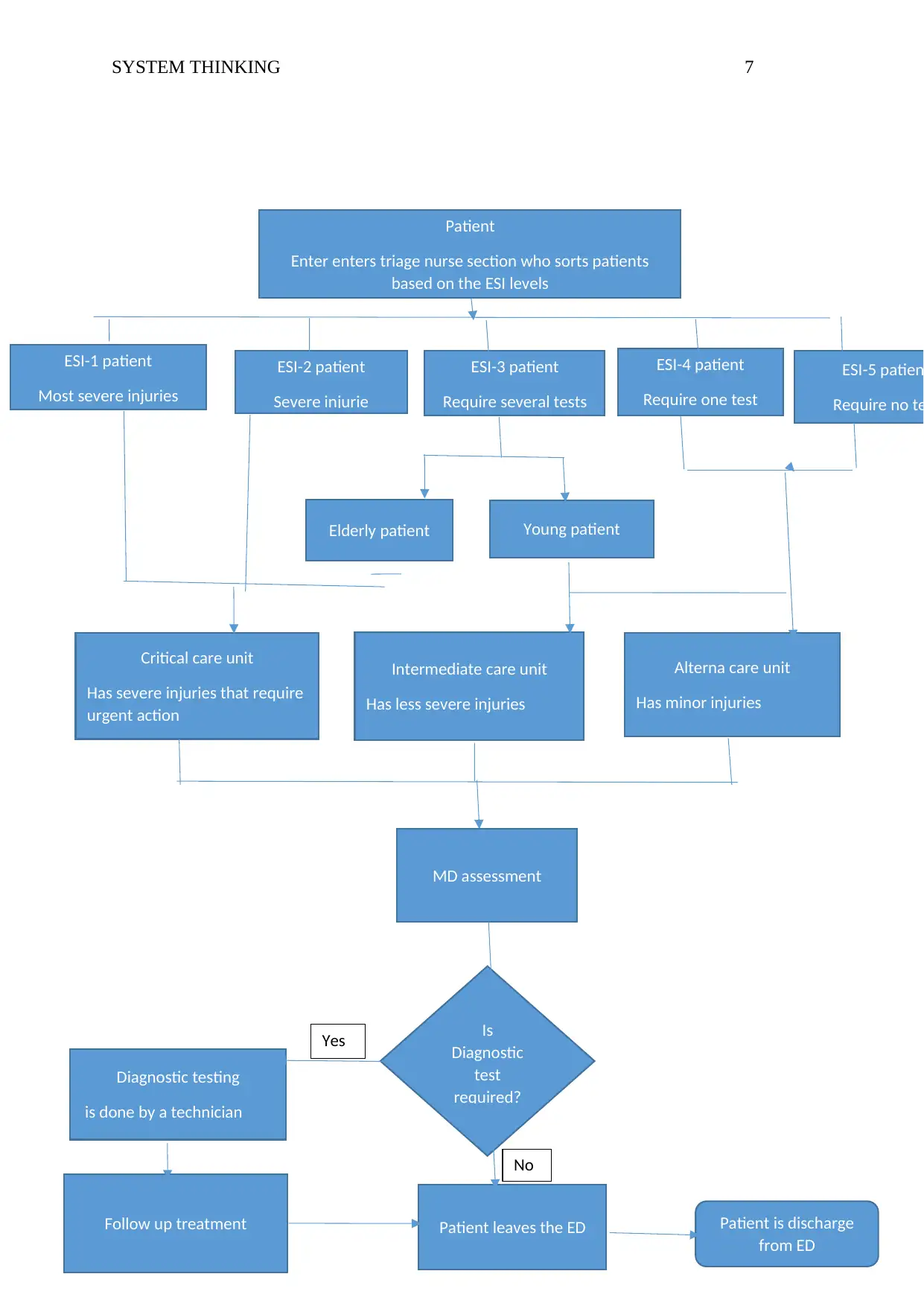
Recommended new State Value Stream Map with the desired reduction in
Patient turnaround time
adds to the waiting time of the patients before treatment commences. Therefore, its right to
say that the efforts that were meant to improve the performance in the organization have
instead slowed down the performance of the organization.
Also, based on the value stream map given, it’s evident that the organization is also
experiencing shifting the burden system type of archetype. The patient turnaround time is the
main problem in the emergency department. From the value stream provided, the
organization has introduced two new positions to temporarily deal with the problem instead
of finding the root cause of the problem and permanently fix it. The positions of the attending
physician and that of attending nurse are meant to reduce the waiting time by attending to the
patients directly instead of the patients waiting to see the doctor. The introduction of these
positions might have temporarily helped. However, since the problem was not solved, the
time taken deliver emergency care in the department is still long. Another system archetype
that affects the performance in the department based on the value stream map provided is the
fixes that fail. As earlier mentioned, the fixes that fail happen in the organization when
unintended consequences are produced by the solution that was meant to solve the problem.
In the emergency department, the section that required the status of the injury of the patients
to be verified before treatment commences was introduced to fix the delay of treatment by
those patients who could not afford their medical bills. However, since the time taken to
check the status of the injury added to the waiting time, the turnaround time was even made
longer which was not the intention of the solution introduced.
Recommended new State Value Stream Map with the desired reduction in
Patient turnaround time
⊘ This is a preview!⊘
Do you want full access?
Subscribe today to unlock all pages.
Trusted by 1+ million students worldwide
SYSTEM THINKING 7
Patient
Enter enters triage nurse section who sorts patients
based on the ESI levels
ESI-1 patient
Most severe injuries
ESI-2 patient
Severe injurie
ESI-3 patient
Require several tests
ESI-5 patien
Require no te
ESI-4 patient
Require one test
Intermediate care unit
Has less severe injuries
Elderly patient Young patient
Critical care unit
Has severe injuries that require
urgent action
Alterna care unit
Has minor injuries
MD assessment
Diagnostic testing
is done by a technician
Follow up treatment Patient leaves the ED Patient is discharge
from ED
Is
Diagnostic
test
required?
Yes
No
Patient
Enter enters triage nurse section who sorts patients
based on the ESI levels
ESI-1 patient
Most severe injuries
ESI-2 patient
Severe injurie
ESI-3 patient
Require several tests
ESI-5 patien
Require no te
ESI-4 patient
Require one test
Intermediate care unit
Has less severe injuries
Elderly patient Young patient
Critical care unit
Has severe injuries that require
urgent action
Alterna care unit
Has minor injuries
MD assessment
Diagnostic testing
is done by a technician
Follow up treatment Patient leaves the ED Patient is discharge
from ED
Is
Diagnostic
test
required?
Yes
No
Paraphrase This Document
Need a fresh take? Get an instant paraphrase of this document with our AI Paraphraser
SYSTEM THINKING 8
Looking at the value stream map provided, the triage nurse attends to all the patients
that check in the emergency department. The triage nurse attends to the patients in the triage
section of the department by recording the patient’s signs and symptoms (Spann & Ritchie-
Dunham, 2012). The nurse will then use the signs of the patients to ascertain the seriousness
of the injury of the patients and assign them the emergency severity index (ESI) which ranges
from 1-5 (Peters, 2014). After the patients have been assessed, they will be directed to the
available beds based on their ESI (Arnold& Wade, 2015). Those patients with most severe
injuries will be directed and served in the CCU (Stalter et al., 2017). Normally, the patients
with an ESI of both 1, 2, and 3 will be directed and served in the CCU. After these patients
directed in the CCU are assessed, they will then be admitted or discharged depending on the
results of the assessment. Those patients having less severe injuries will be directed and
served in the ICU (Brown et al., 2018). Those patients with ESI of both 3, 4, 5 are assessed in
the ESI. Similarly, these patients can either be discharged or admitted depending on the
results of the assessment. Lastly, it’s those patients with minor injuries mainly those with ESI
of 4 and 5 who will be directed and served in the ACU (Braithwaite, 2018).
After the patients from the ACU, ICU, and the CCU have been assessed, all of them
will be subjected to diagnostic tests. The diagnostic tests can be divided into two; the
phlebotomy test which samples the blood of the patients for assays, and the imaging tests
which takes CAT scans (Carey et al., 2015). Patients need to undergo diagnostic tests in the
emergency department for two reasons. First, it will help the physicians reveal the clinical
case that the patient is presenting, and second, it will help the physicians prepare for follow
up procedures (Tortorella et al., 2017). It’s after going through the diagnostic testing that the
patients will either be recommended for admission or discharged depending on the results of
the patients. In the emergency department, patient transportation is a very critical component
because mostly, patients requiring emergency treatment can move by themselves. Therefore,
Looking at the value stream map provided, the triage nurse attends to all the patients
that check in the emergency department. The triage nurse attends to the patients in the triage
section of the department by recording the patient’s signs and symptoms (Spann & Ritchie-
Dunham, 2012). The nurse will then use the signs of the patients to ascertain the seriousness
of the injury of the patients and assign them the emergency severity index (ESI) which ranges
from 1-5 (Peters, 2014). After the patients have been assessed, they will be directed to the
available beds based on their ESI (Arnold& Wade, 2015). Those patients with most severe
injuries will be directed and served in the CCU (Stalter et al., 2017). Normally, the patients
with an ESI of both 1, 2, and 3 will be directed and served in the CCU. After these patients
directed in the CCU are assessed, they will then be admitted or discharged depending on the
results of the assessment. Those patients having less severe injuries will be directed and
served in the ICU (Brown et al., 2018). Those patients with ESI of both 3, 4, 5 are assessed in
the ESI. Similarly, these patients can either be discharged or admitted depending on the
results of the assessment. Lastly, it’s those patients with minor injuries mainly those with ESI
of 4 and 5 who will be directed and served in the ACU (Braithwaite, 2018).
After the patients from the ACU, ICU, and the CCU have been assessed, all of them
will be subjected to diagnostic tests. The diagnostic tests can be divided into two; the
phlebotomy test which samples the blood of the patients for assays, and the imaging tests
which takes CAT scans (Carey et al., 2015). Patients need to undergo diagnostic tests in the
emergency department for two reasons. First, it will help the physicians reveal the clinical
case that the patient is presenting, and second, it will help the physicians prepare for follow
up procedures (Tortorella et al., 2017). It’s after going through the diagnostic testing that the
patients will either be recommended for admission or discharged depending on the results of
the patients. In the emergency department, patient transportation is a very critical component
because mostly, patients requiring emergency treatment can move by themselves. Therefore,
SYSTEM THINKING 9
patients have to be wheeled in the beds based on their ESI as assigned by the triage nurse
(Provost et al., 2015). However, wheeling patients if not done properly will worsen the injury
of the patients. That is why it’s important to transport patients with a lot of care (Roberts et
al., 2016).
Discussions on intended and unintended consequences of the modified system.
The improvement of the patient's turnaround time is one of the intended consequence.
There are various ways in which the patient’s turnaround time in the department will be
improved by the proposed value stream map provided. One such way is by reducing the
waiting time of the patients. In the proposed value stream map, the patient will only have one
waiting period and that is when he checks in the department. When the patient checks in, he
will have to wait for the triage nurse to assess and assign him/her the ESI. After the
assessment by the triage nurse, the next stages do not require the patient to wait. This is an
improvement especially given that in the previous value stream map, the patient had six
intervals of the waiting period. Increasing the department’s indoor readmission rate is another
intended consequence. The turnaround time for the patients in the department before the
introduction of the new value stream map was very long. This negatively affected the indoor
admission rate since only a few patients could be attended to. However, with the new value
stream map, the turnaround time of the patients will be improved and this will allow the
department to attend to more patients.
The unintended consequence of the proposed value stream map is for it to increase the
turnaround time further. This value stream map was created to reduce the turnaround time.
Therefore, it will be unusual for it to increase the turnaround time.
Conclusion
Various system archetypes affect the performance of different organizations. This
report has narrowed down those system archetypes that affect the performance in the ED of
patients have to be wheeled in the beds based on their ESI as assigned by the triage nurse
(Provost et al., 2015). However, wheeling patients if not done properly will worsen the injury
of the patients. That is why it’s important to transport patients with a lot of care (Roberts et
al., 2016).
Discussions on intended and unintended consequences of the modified system.
The improvement of the patient's turnaround time is one of the intended consequence.
There are various ways in which the patient’s turnaround time in the department will be
improved by the proposed value stream map provided. One such way is by reducing the
waiting time of the patients. In the proposed value stream map, the patient will only have one
waiting period and that is when he checks in the department. When the patient checks in, he
will have to wait for the triage nurse to assess and assign him/her the ESI. After the
assessment by the triage nurse, the next stages do not require the patient to wait. This is an
improvement especially given that in the previous value stream map, the patient had six
intervals of the waiting period. Increasing the department’s indoor readmission rate is another
intended consequence. The turnaround time for the patients in the department before the
introduction of the new value stream map was very long. This negatively affected the indoor
admission rate since only a few patients could be attended to. However, with the new value
stream map, the turnaround time of the patients will be improved and this will allow the
department to attend to more patients.
The unintended consequence of the proposed value stream map is for it to increase the
turnaround time further. This value stream map was created to reduce the turnaround time.
Therefore, it will be unusual for it to increase the turnaround time.
Conclusion
Various system archetypes affect the performance of different organizations. This
report has narrowed down those system archetypes that affect the performance in the ED of
⊘ This is a preview!⊘
Do you want full access?
Subscribe today to unlock all pages.
Trusted by 1+ million students worldwide
SYSTEM THINKING 10
one of the public hospitals and looked into them. This paper did this by first, identifying the
complexities in the emergency department and examining them. Since there is a need for the
waiting time in the ED to be improved based on the feedback from the patients, it means that
the performances of the emergency department have been affected. That is why these paper
has narrowed down on those system archetypes that affect performance in ED and analyzed
them in detail. Based on the analysis of the system archetypes that affect the performance in
the ED, the long-lasting solution to the problems that exist in the organization has been
provided by proposing a new value stream map with reduced waiting time for the patients.
Recommendation
The first recommendation of this paper is that there is a need for emergency care to be
provided to those people with emergencies only. This will help to note only save many lives
but also reduce the turnaround time for patients. This is so because the congestion in the ED
will be eliminated allowing patients to adequately handle patients with emergencies alone.
Therefore, a thorough assessment of the patients presenting themselves in the ED should be
done to determine if a patient requires emergency attention. This paper also recommends
there is a need for all the personnel involved in administering the emergency care to be
available 24 hours every day because of how untimely the emergencies happen.
one of the public hospitals and looked into them. This paper did this by first, identifying the
complexities in the emergency department and examining them. Since there is a need for the
waiting time in the ED to be improved based on the feedback from the patients, it means that
the performances of the emergency department have been affected. That is why these paper
has narrowed down on those system archetypes that affect performance in ED and analyzed
them in detail. Based on the analysis of the system archetypes that affect the performance in
the ED, the long-lasting solution to the problems that exist in the organization has been
provided by proposing a new value stream map with reduced waiting time for the patients.
Recommendation
The first recommendation of this paper is that there is a need for emergency care to be
provided to those people with emergencies only. This will help to note only save many lives
but also reduce the turnaround time for patients. This is so because the congestion in the ED
will be eliminated allowing patients to adequately handle patients with emergencies alone.
Therefore, a thorough assessment of the patients presenting themselves in the ED should be
done to determine if a patient requires emergency attention. This paper also recommends
there is a need for all the personnel involved in administering the emergency care to be
available 24 hours every day because of how untimely the emergencies happen.
Paraphrase This Document
Need a fresh take? Get an instant paraphrase of this document with our AI Paraphraser
SYSTEM THINKING 11
Reference
Arnold, R. D., & Wade, J. P. (2015). A definition of systems thinking: A systems
approach. Procedia Computer Science, 44, 669-678.
Behl, D. V., & Ferreira, S. (2014). Systems thinking: An analysis of key factors and
relationships. Procedia Computer Science, 36, 104-109.
Bal, A., Ceylan, C., & Taçoğlu, C. (2017). Using value stream mapping and discrete event
simulation to improve efficiency of emergency departments. International Journal of
Healthcare Management, 10(3), 196-206.
Doğan, N. Ö., & Unutulmaz, O. (2016). Lean production in healthcare: a simulation-based
value stream mapping in the physical therapy and rehabilitation department of a
public hospital. Total Quality Management & Business Excellence, 27(1-2), 64-80.
Dal Forno, A. J., Pereira, F. A., Forcellini, F. A., & Kipper, L. M. (2014). Value Stream
Mapping: a study about the problems and challenges found in the literature from the
past 15 years about application of Lean tools. The International Journal of Advanced
Manufacturing Technology, 72(5-8), 779-790.
Henrique, D. B., Rentes, A. F., Godinho Filho, M., & Esposto, K. F. (2016). A new value
stream mapping approach for healthcare environments. Production Planning &
Control, 27(1), 24-48.
Jimmerson, C. (2017). Value stream mapping for healthcare made easy. Productivity Press.
Masys, A. J. (2015). Applications of systems thinking and soft operations research in
managing complexity. Springer Publishing.
Peters, D. H. (2014). The application of systems thinking in health: why use systems
thinking?. Health Research Policy and Systems, 12(1), 51.
Reference
Arnold, R. D., & Wade, J. P. (2015). A definition of systems thinking: A systems
approach. Procedia Computer Science, 44, 669-678.
Behl, D. V., & Ferreira, S. (2014). Systems thinking: An analysis of key factors and
relationships. Procedia Computer Science, 36, 104-109.
Bal, A., Ceylan, C., & Taçoğlu, C. (2017). Using value stream mapping and discrete event
simulation to improve efficiency of emergency departments. International Journal of
Healthcare Management, 10(3), 196-206.
Doğan, N. Ö., & Unutulmaz, O. (2016). Lean production in healthcare: a simulation-based
value stream mapping in the physical therapy and rehabilitation department of a
public hospital. Total Quality Management & Business Excellence, 27(1-2), 64-80.
Dal Forno, A. J., Pereira, F. A., Forcellini, F. A., & Kipper, L. M. (2014). Value Stream
Mapping: a study about the problems and challenges found in the literature from the
past 15 years about application of Lean tools. The International Journal of Advanced
Manufacturing Technology, 72(5-8), 779-790.
Henrique, D. B., Rentes, A. F., Godinho Filho, M., & Esposto, K. F. (2016). A new value
stream mapping approach for healthcare environments. Production Planning &
Control, 27(1), 24-48.
Jimmerson, C. (2017). Value stream mapping for healthcare made easy. Productivity Press.
Masys, A. J. (2015). Applications of systems thinking and soft operations research in
managing complexity. Springer Publishing.
Peters, D. H. (2014). The application of systems thinking in health: why use systems
thinking?. Health Research Policy and Systems, 12(1), 51.
SYSTEM THINKING 12
Senge, P., Hamilton, H., & Kania, J. (2015). The dawn of system leadership. Stanford Social
Innovation Review, 13(1), 27-33.
Senge, P. M. (2014). The fifth discipline fieldbook: Strategies and tools for building a
learning organization. Crown Business.
Stalter, A. M., Phillips, J. M., Ruggiero, J. S., Scardaville, D. L., Merriam, D., Dolansky, M.
A., ... & Winegardner, S. (2017, October). A concept analysis of systems thinking.
In Nursing forum (Vol. 52, No. 4, pp. 323-330).
Shou, W., Wang, J., Wu, P., Wang, X., & Chong, H. Y. (2017). A cross-sector review on the
use of value stream mapping. International Journal of Production Research, 55(13),
3906-3928.
Tortorella, G. L., Fogliatto, F. S., Anzanello, M., Marodin, G. A., Garcia, M., & Reis Esteves,
R. (2017). Making the value flow: application of value stream mapping in a Brazilian
public healthcare organisation. Total Quality Management & Business
Excellence, 28(13-14), 1544-1558.
Senge, P., Hamilton, H., & Kania, J. (2015). The dawn of system leadership. Stanford Social
Innovation Review, 13(1), 27-33.
Senge, P. M. (2014). The fifth discipline fieldbook: Strategies and tools for building a
learning organization. Crown Business.
Stalter, A. M., Phillips, J. M., Ruggiero, J. S., Scardaville, D. L., Merriam, D., Dolansky, M.
A., ... & Winegardner, S. (2017, October). A concept analysis of systems thinking.
In Nursing forum (Vol. 52, No. 4, pp. 323-330).
Shou, W., Wang, J., Wu, P., Wang, X., & Chong, H. Y. (2017). A cross-sector review on the
use of value stream mapping. International Journal of Production Research, 55(13),
3906-3928.
Tortorella, G. L., Fogliatto, F. S., Anzanello, M., Marodin, G. A., Garcia, M., & Reis Esteves,
R. (2017). Making the value flow: application of value stream mapping in a Brazilian
public healthcare organisation. Total Quality Management & Business
Excellence, 28(13-14), 1544-1558.
⊘ This is a preview!⊘
Do you want full access?
Subscribe today to unlock all pages.
Trusted by 1+ million students worldwide

1 out of 12


Related Documents


Your All-in-One AI-Powered Toolkit for Academic Success.
+13062052269
info@desklib.com
Available 24*7 on WhatsApp / Email
![[object Object]](/_next/static/media/star-bottom.7253800d.svg)
Unlock your academic potential
Copyright © 2020–2026 A2Z Services. All Rights Reserved. Developed and managed by ZUCOL.