Critical Analysis: Spirituality and Mental Health (MHSMD3AMH)
VerifiedAdded on 2023/05/28
|13
|3478
|273
Essay
AI Summary
This essay provides a critical analysis of the complex relationship between spirituality and mental health, exploring their similarities and differences. It examines arguments from various researchers, including those who believe spirituality significantly impacts mental health, those who disagree, and those who remain neutral. The essay delves into the challenges of measuring both spirituality and mental health, and considers the role of factors such as religious beliefs, personality traits, and the presence of mental illness in shaping this relationship. Ultimately, the essay highlights the ongoing debate and the need for further research to fully understand the connection between these two aspects of human well-being. The document is available on Desklib, a platform offering a wealth of study resources for students.
Spirituality and Mental Health 1
CRITICAL ANALYSIS OF THE RELATIONSHIP BETWEEN SPIRITUALITY AND
MENTAL HEALTH
by [Name]
Course:
Tutor:
Institution
City
Date
CRITICAL ANALYSIS OF THE RELATIONSHIP BETWEEN SPIRITUALITY AND
MENTAL HEALTH
by [Name]
Course:
Tutor:
Institution
City
Date

Paraphrase This Document
Need a fresh take? Get an instant paraphrase of this document with our AI Paraphraser
Spirituality and Mental Health 2
Spirituality can be defined as a sacred belief of certain divine entities whose
influence results in certain behaviours, practices, and psychic consciousness (O'brien
2017). It is simply a belief of supernatural power outside oneself and forms a
fundamental aspect of human experience. Gilbert (2011) claims that spirituality may
denote an individual’s character, belief or choice. Mental health, on the other hand, is
one’s state of mind with regard to his or her emotional and psychological wellbeing
(Mental Health Taskforce 2016). Both conventional and traditional healthcare perceive
human wellbeing in terms of three major aspects namely the mental which represents
the mind, the physical which forms the body and the spiritual aspect for the soul.
However, for over a century there have been diverse and ever-changing perspectives
among mental healthcare professionals and spiritualists regarding the association of
spirituality and mental health. This work, therefore, endeavours to vividly explicate the
intricate yet intimate relationship between mental health and spirituality from a
contemporary perspective. Each of the aspects is discussed in brief before going deeper
into the controversial issue of whether or not spirituality bears any impact on one’s
mental health. This will be achieved by first looking into the similarities as well as the
differences between them, analysing the views of those who content that indeed
spirituality bears positive effects on mental health and those who are for the contrary
opinion. The opinions of psychoanalysts who do not take sides in this debate will also
be looked at with a specific focus on their justification for doing so. The paper
concludes by endorsing an expanding need to coordinate spirituality inside the
emotional health field despite there being few hindrances in accomplishing the
integration of the two.
Conducting a pathological analysis of the correlation between mental health and
spirituality requires an in-depth comprehension of the features shared by the two aspects
Spirituality can be defined as a sacred belief of certain divine entities whose
influence results in certain behaviours, practices, and psychic consciousness (O'brien
2017). It is simply a belief of supernatural power outside oneself and forms a
fundamental aspect of human experience. Gilbert (2011) claims that spirituality may
denote an individual’s character, belief or choice. Mental health, on the other hand, is
one’s state of mind with regard to his or her emotional and psychological wellbeing
(Mental Health Taskforce 2016). Both conventional and traditional healthcare perceive
human wellbeing in terms of three major aspects namely the mental which represents
the mind, the physical which forms the body and the spiritual aspect for the soul.
However, for over a century there have been diverse and ever-changing perspectives
among mental healthcare professionals and spiritualists regarding the association of
spirituality and mental health. This work, therefore, endeavours to vividly explicate the
intricate yet intimate relationship between mental health and spirituality from a
contemporary perspective. Each of the aspects is discussed in brief before going deeper
into the controversial issue of whether or not spirituality bears any impact on one’s
mental health. This will be achieved by first looking into the similarities as well as the
differences between them, analysing the views of those who content that indeed
spirituality bears positive effects on mental health and those who are for the contrary
opinion. The opinions of psychoanalysts who do not take sides in this debate will also
be looked at with a specific focus on their justification for doing so. The paper
concludes by endorsing an expanding need to coordinate spirituality inside the
emotional health field despite there being few hindrances in accomplishing the
integration of the two.
Conducting a pathological analysis of the correlation between mental health and
spirituality requires an in-depth comprehension of the features shared by the two aspects
Spirituality and Mental Health 3
as well as their differences.While each represents a stand-alone aspect, mental health
and spirituality are perceived as firmly related if not ward to one another (Greenstreet
2006).
Both are cognitive aspects and involve extensive use of one’s mind. While
spirituality bases most on reflection, mental aspect looks at the contemporary situation
and critical evaluation of a situation. While this may seem like a difference, and of
course it is, it is also a similarity in that reflection and critical thinking are both
functions of the brain. Simply the two are not only intangible but invisible.
Both spirituality and mental health grapple with issues like: What is great? What
is the idea of the real world? For what reason would we say we are here and what would
it be a good idea for us to do? As such they both bring a sense of self image to an
individual (Pilgrim 2014).
Lastly, both affect human judgement and decision making. A person who is
mentally disturbed because of heartbreak may be reluctant to engage in intimate
relationship as compared to one who hasn’t. Similarly, a person whose spiritual
doctrines stimulate non-maleficence will not act like one who isn’t spiritual when
wronged.
Despite there being a few similarities between the two, there are a number of
differences that set them apart. Mental health is measured in practices, not feeling.
Being healthy includes practices that add to your wellbeing and to the world more than
they hurt. Spiritual soundness is measured in feeling, explicitly happiness. When one
feels positive feelings like bliss when sticking to one's lot of convictions (Gilbert 2011).
Secondly, both are inward systems that may not be estimated by restorative
contraptions, may not be diagnosed through a single therapeutic technique, and can't be
treated by quantifiable dosages of medicine. Rather, these are achieved by inner systems
as well as their differences.While each represents a stand-alone aspect, mental health
and spirituality are perceived as firmly related if not ward to one another (Greenstreet
2006).
Both are cognitive aspects and involve extensive use of one’s mind. While
spirituality bases most on reflection, mental aspect looks at the contemporary situation
and critical evaluation of a situation. While this may seem like a difference, and of
course it is, it is also a similarity in that reflection and critical thinking are both
functions of the brain. Simply the two are not only intangible but invisible.
Both spirituality and mental health grapple with issues like: What is great? What
is the idea of the real world? For what reason would we say we are here and what would
it be a good idea for us to do? As such they both bring a sense of self image to an
individual (Pilgrim 2014).
Lastly, both affect human judgement and decision making. A person who is
mentally disturbed because of heartbreak may be reluctant to engage in intimate
relationship as compared to one who hasn’t. Similarly, a person whose spiritual
doctrines stimulate non-maleficence will not act like one who isn’t spiritual when
wronged.
Despite there being a few similarities between the two, there are a number of
differences that set them apart. Mental health is measured in practices, not feeling.
Being healthy includes practices that add to your wellbeing and to the world more than
they hurt. Spiritual soundness is measured in feeling, explicitly happiness. When one
feels positive feelings like bliss when sticking to one's lot of convictions (Gilbert 2011).
Secondly, both are inward systems that may not be estimated by restorative
contraptions, may not be diagnosed through a single therapeutic technique, and can't be
treated by quantifiable dosages of medicine. Rather, these are achieved by inner systems
⊘ This is a preview!⊘
Do you want full access?
Subscribe today to unlock all pages.

Trusted by 1+ million students worldwide
Spirituality and Mental Health 4
that exist along a continuum of certain behaviour or frames of disease that plagues
them. In spirituality for example, one may be considered a sinner but once he or she
repents and is fully convicted that he or she is forgiven by God, he gains instant feeling
of acceptance and satisfaction mind (Koenig 2015).
Lastly, unlike spiritual wellbeing, mental issues cannot be quickly resolved.
Regularly people with psychological maladjustment fight for a considerable length of
time (McGovern et al 2017).
There is no reservation that emotional wellbeing is an everyday aspect of human
beings and is as significant as any other type of health. Although quite a number of
individuals struggle to establish the relationship between mental health and physical
health, scientific studies and proofs have shown that indeed the two are quite dependent
on one another (Paton 2014). For instance, ailments such as stomach ulcers and high
blood pressure emanate from mental turbulence. Understanding emotional well-being is
thus an extremely mind-boggling idea. The vestige of psychological sickness and
franticness tells two normal and blemished meanings of emotional well-being. First, that
emotional wellness is the nonappearance of psychological instability, while the second
that emotional well-being is a condition of prosperity (Cornah 2006).
Nonetheless, the relationship between emotional health and spirituality has
remained to be one of the most contended topics in the fields of religion, psychology,
and social sciences. Researchers have attempted to explore the effects of spirituality on
mental health with the major questions being: Does spirituality bear any impact on the
mental health of an individual? Does one’s state of emotional wellbeing reflect his or
her spiritual health status? (Hood, Hill and Spilka 2018).
While a number of scholars do agree that spirituality is responsible for one’s
mental health, philosophers like Rosmarin, Alper, and Pargament (2016) quite differ
that exist along a continuum of certain behaviour or frames of disease that plagues
them. In spirituality for example, one may be considered a sinner but once he or she
repents and is fully convicted that he or she is forgiven by God, he gains instant feeling
of acceptance and satisfaction mind (Koenig 2015).
Lastly, unlike spiritual wellbeing, mental issues cannot be quickly resolved.
Regularly people with psychological maladjustment fight for a considerable length of
time (McGovern et al 2017).
There is no reservation that emotional wellbeing is an everyday aspect of human
beings and is as significant as any other type of health. Although quite a number of
individuals struggle to establish the relationship between mental health and physical
health, scientific studies and proofs have shown that indeed the two are quite dependent
on one another (Paton 2014). For instance, ailments such as stomach ulcers and high
blood pressure emanate from mental turbulence. Understanding emotional well-being is
thus an extremely mind-boggling idea. The vestige of psychological sickness and
franticness tells two normal and blemished meanings of emotional well-being. First, that
emotional wellness is the nonappearance of psychological instability, while the second
that emotional well-being is a condition of prosperity (Cornah 2006).
Nonetheless, the relationship between emotional health and spirituality has
remained to be one of the most contended topics in the fields of religion, psychology,
and social sciences. Researchers have attempted to explore the effects of spirituality on
mental health with the major questions being: Does spirituality bear any impact on the
mental health of an individual? Does one’s state of emotional wellbeing reflect his or
her spiritual health status? (Hood, Hill and Spilka 2018).
While a number of scholars do agree that spirituality is responsible for one’s
mental health, philosophers like Rosmarin, Alper, and Pargament (2016) quite differ
Paraphrase This Document
Need a fresh take? Get an instant paraphrase of this document with our AI Paraphraser
Spirituality and Mental Health 5
with this assertion. Rosmarin et al (2016) argue that most of the researches conducted to
establish the relationship between the two rely exclusively on quantitative measures
which are devoid of access to the innate denotation of spirituality for a particular
individual. Quantitative research has been criticised for its tendency to isolate the
significance of an individual’s spiritual engagements upon his or her mental status.
Pilgrim (2014) thus dismiss any linkage of spirituality to mental health since there is
insufficient evidence to claim that spirituality has some impact on one’s state of mind.
Curtis (2016) faults spiritualists for associating two entities that do not have
anything in common. He cites the case of pagans who neither practice any religion nor
have anything in spirituality but live a normal life contemporary challenges
notwithstanding. The issues that affect these individuals are the same issues that may
affect any other ordinary person and although their approach towards them is different,
they both strive to achieve one thing in common; peace of mind. While one may invoke
spirituality in attaining mental rest, another may choose alternatives like sharing with a
friend or counseling which does not involve any spiritual elements. Curtis
(2016) wonders why even the individuals perceived as being spiritual too suffer mental
illnesses like depression.
Salsman et al (2015) takes a look at the mentally challenged individuals in
society. Although their level of spirituality cannot be ascertained, one wonders whether
it is their level of spirituality that is responsible for their current mental condition.
Further, associating spirituality with mental health would imply that spiritual illness is
responsible for all mental health issues (Paton 2014). This would then imply that all
those individuals who do not believe in any form of spirituality or religion ought to be
mentally ill by default.
with this assertion. Rosmarin et al (2016) argue that most of the researches conducted to
establish the relationship between the two rely exclusively on quantitative measures
which are devoid of access to the innate denotation of spirituality for a particular
individual. Quantitative research has been criticised for its tendency to isolate the
significance of an individual’s spiritual engagements upon his or her mental status.
Pilgrim (2014) thus dismiss any linkage of spirituality to mental health since there is
insufficient evidence to claim that spirituality has some impact on one’s state of mind.
Curtis (2016) faults spiritualists for associating two entities that do not have
anything in common. He cites the case of pagans who neither practice any religion nor
have anything in spirituality but live a normal life contemporary challenges
notwithstanding. The issues that affect these individuals are the same issues that may
affect any other ordinary person and although their approach towards them is different,
they both strive to achieve one thing in common; peace of mind. While one may invoke
spirituality in attaining mental rest, another may choose alternatives like sharing with a
friend or counseling which does not involve any spiritual elements. Curtis
(2016) wonders why even the individuals perceived as being spiritual too suffer mental
illnesses like depression.
Salsman et al (2015) takes a look at the mentally challenged individuals in
society. Although their level of spirituality cannot be ascertained, one wonders whether
it is their level of spirituality that is responsible for their current mental condition.
Further, associating spirituality with mental health would imply that spiritual illness is
responsible for all mental health issues (Paton 2014). This would then imply that all
those individuals who do not believe in any form of spirituality or religion ought to be
mentally ill by default.
Spirituality and Mental Health 6
The impact of spirituality cannot be ascertained since there lacks a common
framework upon which one can use to determine how spiritual or otherwise one is.
Similarly, its impact on mental health is unknown. With varying religious doctrines and
vast denominations across the universe, it becomes impossible to tell which is more
holly and the effect of that holiness to its descendants. Since both mental state and
spirituality cannot be measured, it will be inaccurate to claim that the mind reflects the
spirit or the other way round (Curtis 2016).
The difference in personalities is also another issue that psychologists like
Bhugra (2018) base on to dispute the implication of spirituality in mental health. The
author relies on the fact that people are unique with different personality traits. For
instance there are individuals who although they actively participate in religious
activities, and as such perceived to be spiritual, tend to suffer stress over matters that a
non-spiritual counterpart would have amicably handled. One may thus be interested to
know the role of spirituality in such cases (Bhugra 2018).
Despite all the disregard some researchers have for the impact of spirituality on
mental health, scholars like Weber and Pargament (2014, 267) believe that indeed
spirituality is part and parcel of one’s mental health. To affirm this assertion, Weber and
Pargament (2014) and O'brien (2017) cite mental health issues as being outcomes of
spiritual illness. Depression for instance, is the most common mental health problem in
the world (O'brien 2017). The Evidence suggests that there exists a positive connotation
between participating in spiritual activities and reduced levels of despondency among
kids, youths, and grown-ups. It equally demonstrates that faith in an extraordinary
existence is related to lessened symptoms of depression (Paloutzian and Park 2014).
Some scientists have contended that some components of spirituality may
decidedly influence different physiological components associated with wellbeing.
The impact of spirituality cannot be ascertained since there lacks a common
framework upon which one can use to determine how spiritual or otherwise one is.
Similarly, its impact on mental health is unknown. With varying religious doctrines and
vast denominations across the universe, it becomes impossible to tell which is more
holly and the effect of that holiness to its descendants. Since both mental state and
spirituality cannot be measured, it will be inaccurate to claim that the mind reflects the
spirit or the other way round (Curtis 2016).
The difference in personalities is also another issue that psychologists like
Bhugra (2018) base on to dispute the implication of spirituality in mental health. The
author relies on the fact that people are unique with different personality traits. For
instance there are individuals who although they actively participate in religious
activities, and as such perceived to be spiritual, tend to suffer stress over matters that a
non-spiritual counterpart would have amicably handled. One may thus be interested to
know the role of spirituality in such cases (Bhugra 2018).
Despite all the disregard some researchers have for the impact of spirituality on
mental health, scholars like Weber and Pargament (2014, 267) believe that indeed
spirituality is part and parcel of one’s mental health. To affirm this assertion, Weber and
Pargament (2014) and O'brien (2017) cite mental health issues as being outcomes of
spiritual illness. Depression for instance, is the most common mental health problem in
the world (O'brien 2017). The Evidence suggests that there exists a positive connotation
between participating in spiritual activities and reduced levels of despondency among
kids, youths, and grown-ups. It equally demonstrates that faith in an extraordinary
existence is related to lessened symptoms of depression (Paloutzian and Park 2014).
Some scientists have contended that some components of spirituality may
decidedly influence different physiological components associated with wellbeing.
⊘ This is a preview!⊘
Do you want full access?
Subscribe today to unlock all pages.
Trusted by 1+ million students worldwide
Spirituality and Mental Health 7
Feelings preached and practiced in numerous spiritual customs such as trust, happiness,
love, and absolution, may serve the person by influencing the neural pathways that
associate with the endocrine and invulnerable frameworks (Sanders et al. 2015).
Gilbert (2011) and Greenstreet (2006) both assert that the significance of
spirituality in mental health cannot be underscored. In building his case, Gilbert (2011)
relies on the emerging literature and studies examining the connexion between post-
traumatic stress disorders (PTSD), a mental health complication and spirituality. He also
highlights some of the recent studies conducted in the recent years in different
institutions across the globe to establish the correlation between the two.
Ongoing examinations demonstrate that religious convictions and practices are
steady to adapt to worries throughout everyday life and are helpful to emotional
wellness. Thomas Ashby Wills, a Professor of Epidemiology and populace wellbeing at
Albert Einstein College of Medicine built up a scale that decides how critical religion is
to an individuals. This was accomplished to 1182 youngsters in New York. It was
discovered that religiosity shielded youngsters from drinking and substance abuse
(Awaad et al. 2015).
Some analysts chose to sit on the fence and content that none of the two aspects
affects the other. Although Moreira‐Almeida et al (2016) agrees that spirituality and
mental health may be related, their relationship is not that intimate as to affect each
other. And even if it did then the impact may be insignificant. While substantiating his
claims, Moreira‐Almeida et al (2014) claims that since both the spiritual and mental
health aspects cannot be quantifiably measured, then it becomes difficult to establish the
exact extent to which the two are related and how they impact each other. He cites the
scientific proof of the relationship between mental health and physical health where
stress and depression have been linked to overproduction of gastric acid in the stomach
Feelings preached and practiced in numerous spiritual customs such as trust, happiness,
love, and absolution, may serve the person by influencing the neural pathways that
associate with the endocrine and invulnerable frameworks (Sanders et al. 2015).
Gilbert (2011) and Greenstreet (2006) both assert that the significance of
spirituality in mental health cannot be underscored. In building his case, Gilbert (2011)
relies on the emerging literature and studies examining the connexion between post-
traumatic stress disorders (PTSD), a mental health complication and spirituality. He also
highlights some of the recent studies conducted in the recent years in different
institutions across the globe to establish the correlation between the two.
Ongoing examinations demonstrate that religious convictions and practices are
steady to adapt to worries throughout everyday life and are helpful to emotional
wellness. Thomas Ashby Wills, a Professor of Epidemiology and populace wellbeing at
Albert Einstein College of Medicine built up a scale that decides how critical religion is
to an individuals. This was accomplished to 1182 youngsters in New York. It was
discovered that religiosity shielded youngsters from drinking and substance abuse
(Awaad et al. 2015).
Some analysts chose to sit on the fence and content that none of the two aspects
affects the other. Although Moreira‐Almeida et al (2016) agrees that spirituality and
mental health may be related, their relationship is not that intimate as to affect each
other. And even if it did then the impact may be insignificant. While substantiating his
claims, Moreira‐Almeida et al (2014) claims that since both the spiritual and mental
health aspects cannot be quantifiably measured, then it becomes difficult to establish the
exact extent to which the two are related and how they impact each other. He cites the
scientific proof of the relationship between mental health and physical health where
stress and depression have been linked to overproduction of gastric acid in the stomach
Paraphrase This Document
Need a fresh take? Get an instant paraphrase of this document with our AI Paraphraser
Spirituality and Mental Health 8
that eventually leads to wearing out of stomach lining and hence ulcers. In such a case,
there is a systematic chain of events, processes and reactions that results into a given
condition. However, there is no known scientifically proven chain of reactions that links
mental illness or otherwise to spiritual health and vice versa.
Others researchers such as Weber and Pargament (2014) argue that the
researchers conducted lack the substance matter solid enough to declare a verdict of
dependability between spirituality and emotional wellbeing. He faults the wide range of
conceptual and methodical shortcomings have been evident in researches attempting to
establish the correlation between mental health and spirituality. With unclear
methodologies, the data acquired cannot be relied upon to make any judgement as to
whether or not mental health is dependent on spirituality or the other way round.
Glüer and Wikforss (2018) place the responsibility of one’s mental health or
spirituality on mechanisms applied by individuals on to deal with contemporary life
experiences. These mechanisms include locus of control, architecture and built
surrounding, coping styles, physiological mechanisms and, the social sustenance and its
networks. While the psychoanalysts observe that spiritual approaches such as
collaboration where individuals collaborate with supernatural being to tolerate pain and
stress have been associated with tremendous improvement in emotional wellbeing,
some social networks that are completely non-spiritual such as psychiatry do also
produce similar results. Thus one cannot lay credit on spirituality completely, neither
can he or she disregard it in totality as being immaterial.
There is an unpredictable exchange between psychological well-being and
spirituality, so one can't hold an oversimplified point of view that marks spirituality as
either "great" or "awful" for health (Sanders et al. 2015). For instance, an ongoing
Brazilian investigation of 168 outpatients with bipolar disorder found that religion was
that eventually leads to wearing out of stomach lining and hence ulcers. In such a case,
there is a systematic chain of events, processes and reactions that results into a given
condition. However, there is no known scientifically proven chain of reactions that links
mental illness or otherwise to spiritual health and vice versa.
Others researchers such as Weber and Pargament (2014) argue that the
researchers conducted lack the substance matter solid enough to declare a verdict of
dependability between spirituality and emotional wellbeing. He faults the wide range of
conceptual and methodical shortcomings have been evident in researches attempting to
establish the correlation between mental health and spirituality. With unclear
methodologies, the data acquired cannot be relied upon to make any judgement as to
whether or not mental health is dependent on spirituality or the other way round.
Glüer and Wikforss (2018) place the responsibility of one’s mental health or
spirituality on mechanisms applied by individuals on to deal with contemporary life
experiences. These mechanisms include locus of control, architecture and built
surrounding, coping styles, physiological mechanisms and, the social sustenance and its
networks. While the psychoanalysts observe that spiritual approaches such as
collaboration where individuals collaborate with supernatural being to tolerate pain and
stress have been associated with tremendous improvement in emotional wellbeing,
some social networks that are completely non-spiritual such as psychiatry do also
produce similar results. Thus one cannot lay credit on spirituality completely, neither
can he or she disregard it in totality as being immaterial.
There is an unpredictable exchange between psychological well-being and
spirituality, so one can't hold an oversimplified point of view that marks spirituality as
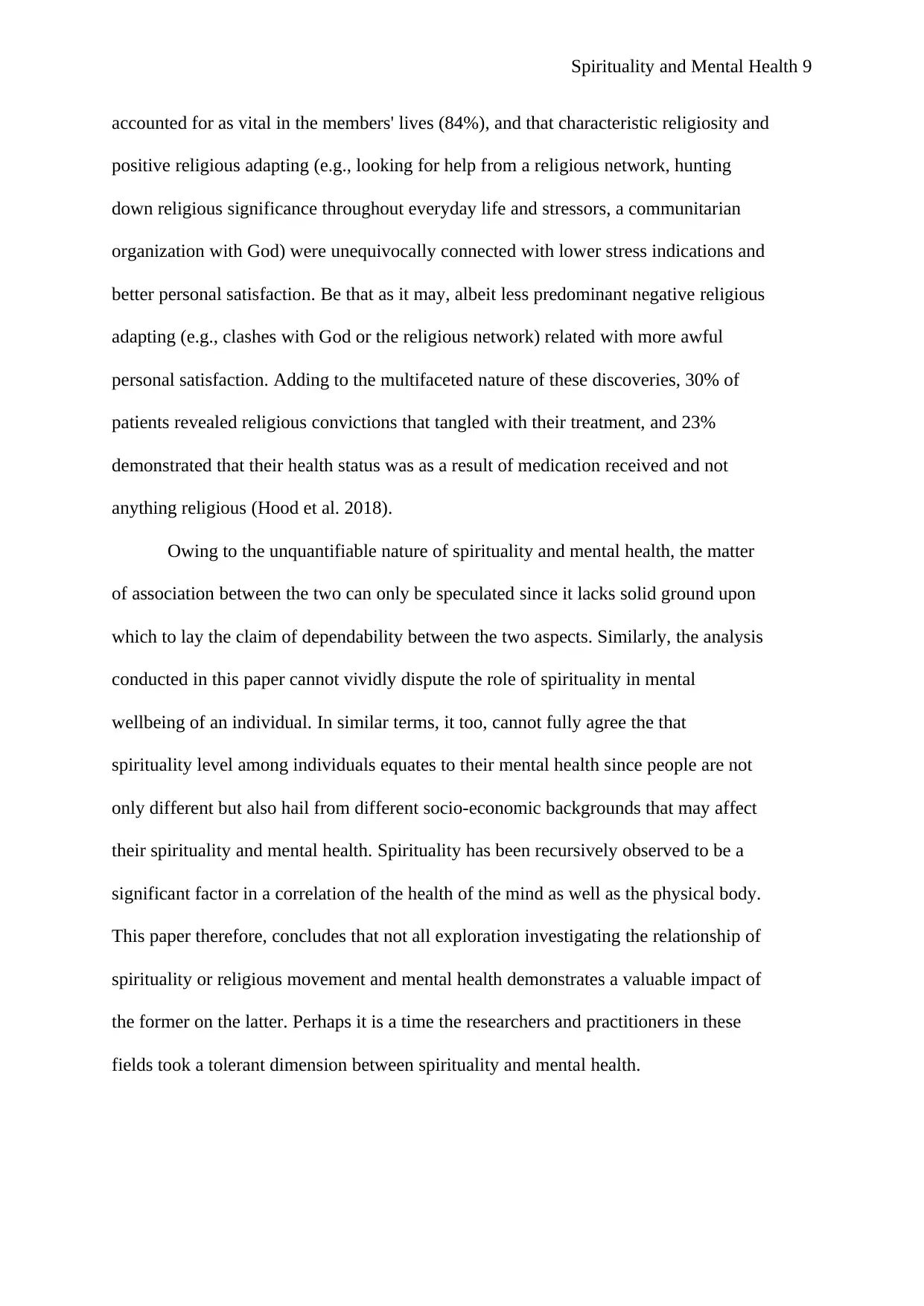
either "great" or "awful" for health (Sanders et al. 2015). For instance, an ongoing
Brazilian investigation of 168 outpatients with bipolar disorder found that religion was
Spirituality and Mental Health 9
accounted for as vital in the members' lives (84%), and that characteristic religiosity and
positive religious adapting (e.g., looking for help from a religious network, hunting
down religious significance throughout everyday life and stressors, a communitarian
organization with God) were unequivocally connected with lower stress indications and
better personal satisfaction. Be that as it may, albeit less predominant negative religious
adapting (e.g., clashes with God or the religious network) related with more awful
personal satisfaction. Adding to the multifaceted nature of these discoveries, 30% of
patients revealed religious convictions that tangled with their treatment, and 23%
demonstrated that their health status was as a result of medication received and not
anything religious (Hood et al. 2018).
Owing to the unquantifiable nature of spirituality and mental health, the matter
of association between the two can only be speculated since it lacks solid ground upon
which to lay the claim of dependability between the two aspects. Similarly, the analysis
conducted in this paper cannot vividly dispute the role of spirituality in mental
wellbeing of an individual. In similar terms, it too, cannot fully agree the that
spirituality level among individuals equates to their mental health since people are not
only different but also hail from different socio-economic backgrounds that may affect
their spirituality and mental health. Spirituality has been recursively observed to be a
significant factor in a correlation of the health of the mind as well as the physical body.
This paper therefore, concludes that not all exploration investigating the relationship of
spirituality or religious movement and mental health demonstrates a valuable impact of
the former on the latter. Perhaps it is a time the researchers and practitioners in these
fields took a tolerant dimension between spirituality and mental health.
accounted for as vital in the members' lives (84%), and that characteristic religiosity and
positive religious adapting (e.g., looking for help from a religious network, hunting
down religious significance throughout everyday life and stressors, a communitarian
organization with God) were unequivocally connected with lower stress indications and
better personal satisfaction. Be that as it may, albeit less predominant negative religious
adapting (e.g., clashes with God or the religious network) related with more awful
personal satisfaction. Adding to the multifaceted nature of these discoveries, 30% of
patients revealed religious convictions that tangled with their treatment, and 23%
demonstrated that their health status was as a result of medication received and not
anything religious (Hood et al. 2018).
Owing to the unquantifiable nature of spirituality and mental health, the matter
of association between the two can only be speculated since it lacks solid ground upon
which to lay the claim of dependability between the two aspects. Similarly, the analysis
conducted in this paper cannot vividly dispute the role of spirituality in mental
wellbeing of an individual. In similar terms, it too, cannot fully agree the that
spirituality level among individuals equates to their mental health since people are not
only different but also hail from different socio-economic backgrounds that may affect
their spirituality and mental health. Spirituality has been recursively observed to be a
significant factor in a correlation of the health of the mind as well as the physical body.
This paper therefore, concludes that not all exploration investigating the relationship of
spirituality or religious movement and mental health demonstrates a valuable impact of
the former on the latter. Perhaps it is a time the researchers and practitioners in these
fields took a tolerant dimension between spirituality and mental health.
⊘ This is a preview!⊘
Do you want full access?
Subscribe today to unlock all pages.
Trusted by 1+ million students worldwide
Spirituality and Mental Health 10
Paraphrase This Document
Need a fresh take? Get an instant paraphrase of this document with our AI Paraphraser
Spirituality and Mental Health 11
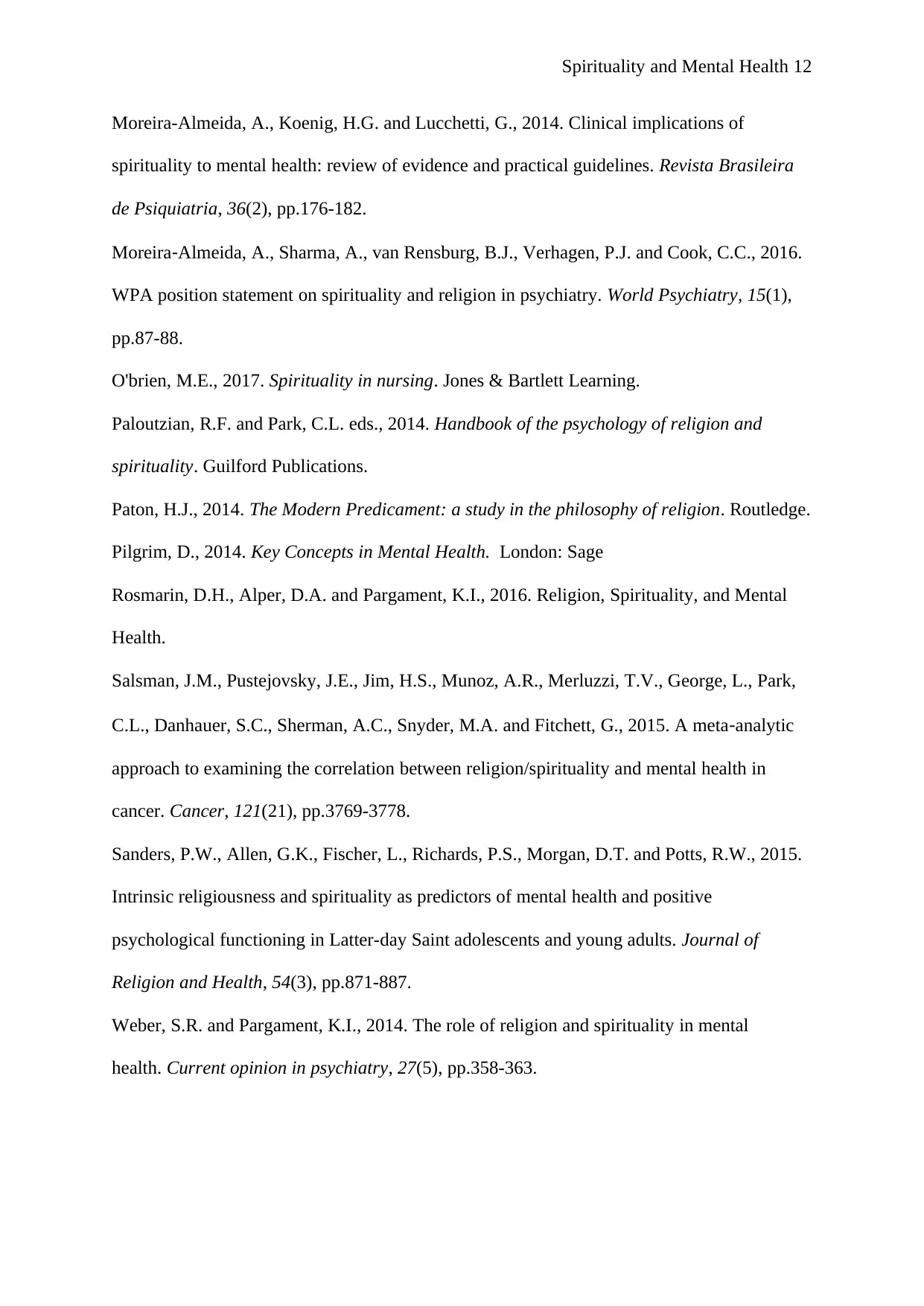
References
Awaad, R., Ali, S., Salvador, M. and Bandstra, B., 2015. A process-oriented approach to
teaching religion and spirituality in psychiatry residency training. Academic
Psychiatry, 39(6), pp.654-660.
Bhugra, D. ed., 2018. Psychiatry and religion: Context, consensus and controversies.
Routledge.
Cornah, D., 2006. The Impact of Spirituality on Mental Health: A Review of the
Literature.
Curtis, S., 2016. Space, place and mental health. Routledge.
Gilbert, P., 2011. Spirituality and mental health: a handbook for service users, carers
and staff wishing to bring a spiritual dimension to mental health services. Brighton:
Pavilion.
Glüer, K. and Wikforss, Å., 2018. Reasons for belief and normativity. In The Oxford
Handbook of Reasons and Normativity.
Greenstreet, W., 2006.Integrating Spirituality in Health and Social Care: perspectives
and practical approaches. Oxford: Radcliffe.
Hood Jr, R.W., Hill, P.C. and Spilka, B., 2018. The psychology of religion: An empirical
approach. Guilford Publications.
Koenig, H.G., 2015. Religion, spirituality, and health: a review and update. Advances in
mind-body medicine, 29(3), pp.19-26.
McGovern, T.F., McMahon, T., Nelson, J., Bundoc-Baronia, R., Giles, C. and Schmidt, V.,
2017. A Descriptive Study of a Spirituality Curriculum for General Psychiatry
Residents. Academic Psychiatry, 41(4), pp.471-476.
Mental Health Taskforce, 2016. The five year forward view for mental health.
References
Awaad, R., Ali, S., Salvador, M. and Bandstra, B., 2015. A process-oriented approach to
teaching religion and spirituality in psychiatry residency training. Academic
Psychiatry, 39(6), pp.654-660.
Bhugra, D. ed., 2018. Psychiatry and religion: Context, consensus and controversies.
Routledge.
Cornah, D., 2006. The Impact of Spirituality on Mental Health: A Review of the
Literature.
Curtis, S., 2016. Space, place and mental health. Routledge.
Gilbert, P., 2011. Spirituality and mental health: a handbook for service users, carers
and staff wishing to bring a spiritual dimension to mental health services. Brighton:
Pavilion.
Glüer, K. and Wikforss, Å., 2018. Reasons for belief and normativity. In The Oxford
Handbook of Reasons and Normativity.
Greenstreet, W., 2006.Integrating Spirituality in Health and Social Care: perspectives
and practical approaches. Oxford: Radcliffe.
Hood Jr, R.W., Hill, P.C. and Spilka, B., 2018. The psychology of religion: An empirical
approach. Guilford Publications.
Koenig, H.G., 2015. Religion, spirituality, and health: a review and update. Advances in
mind-body medicine, 29(3), pp.19-26.
McGovern, T.F., McMahon, T., Nelson, J., Bundoc-Baronia, R., Giles, C. and Schmidt, V.,
2017. A Descriptive Study of a Spirituality Curriculum for General Psychiatry
Residents. Academic Psychiatry, 41(4), pp.471-476.
Mental Health Taskforce, 2016. The five year forward view for mental health.
Spirituality and Mental Health 12
Moreira-Almeida, A., Koenig, H.G. and Lucchetti, G., 2014. Clinical implications of
spirituality to mental health: review of evidence and practical guidelines. Revista Brasileira
de Psiquiatria, 36(2), pp.176-182.
Moreira‐Almeida, A., Sharma, A., van Rensburg, B.J., Verhagen, P.J. and Cook, C.C., 2016.
WPA position statement on spirituality and religion in psychiatry. World Psychiatry, 15(1),
pp.87-88.
O'brien, M.E., 2017. Spirituality in nursing. Jones & Bartlett Learning.
Paloutzian, R.F. and Park, C.L. eds., 2014. Handbook of the psychology of religion and
spirituality. Guilford Publications.
Paton, H.J., 2014. The Modern Predicament: a study in the philosophy of religion. Routledge.
Pilgrim, D., 2014. Key Concepts in Mental Health. London: Sage
Rosmarin, D.H., Alper, D.A. and Pargament, K.I., 2016. Religion, Spirituality, and Mental
Health.
Salsman, J.M., Pustejovsky, J.E., Jim, H.S., Munoz, A.R., Merluzzi, T.V., George, L., Park,
C.L., Danhauer, S.C., Sherman, A.C., Snyder, M.A. and Fitchett, G., 2015. A meta‐analytic
approach to examining the correlation between religion/spirituality and mental health in
cancer. Cancer, 121(21), pp.3769-3778.
Sanders, P.W., Allen, G.K., Fischer, L., Richards, P.S., Morgan, D.T. and Potts, R.W., 2015.
Intrinsic religiousness and spirituality as predictors of mental health and positive
psychological functioning in Latter-day Saint adolescents and young adults. Journal of
Religion and Health, 54(3), pp.871-887.
Weber, S.R. and Pargament, K.I., 2014. The role of religion and spirituality in mental
health. Current opinion in psychiatry, 27(5), pp.358-363.
Moreira-Almeida, A., Koenig, H.G. and Lucchetti, G., 2014. Clinical implications of
spirituality to mental health: review of evidence and practical guidelines. Revista Brasileira
de Psiquiatria, 36(2), pp.176-182.
Moreira‐Almeida, A., Sharma, A., van Rensburg, B.J., Verhagen, P.J. and Cook, C.C., 2016.
WPA position statement on spirituality and religion in psychiatry. World Psychiatry, 15(1),
pp.87-88.
O'brien, M.E., 2017. Spirituality in nursing. Jones & Bartlett Learning.
Paloutzian, R.F. and Park, C.L. eds., 2014. Handbook of the psychology of religion and
spirituality. Guilford Publications.
Paton, H.J., 2014. The Modern Predicament: a study in the philosophy of religion. Routledge.
Pilgrim, D., 2014. Key Concepts in Mental Health. London: Sage
Rosmarin, D.H., Alper, D.A. and Pargament, K.I., 2016. Religion, Spirituality, and Mental
Health.
Salsman, J.M., Pustejovsky, J.E., Jim, H.S., Munoz, A.R., Merluzzi, T.V., George, L., Park,
C.L., Danhauer, S.C., Sherman, A.C., Snyder, M.A. and Fitchett, G., 2015. A meta‐analytic
approach to examining the correlation between religion/spirituality and mental health in
cancer. Cancer, 121(21), pp.3769-3778.
Sanders, P.W., Allen, G.K., Fischer, L., Richards, P.S., Morgan, D.T. and Potts, R.W., 2015.
Intrinsic religiousness and spirituality as predictors of mental health and positive
psychological functioning in Latter-day Saint adolescents and young adults. Journal of
Religion and Health, 54(3), pp.871-887.
Weber, S.R. and Pargament, K.I., 2014. The role of religion and spirituality in mental
health. Current opinion in psychiatry, 27(5), pp.358-363.
⊘ This is a preview!⊘
Do you want full access?
Subscribe today to unlock all pages.
Trusted by 1+ million students worldwide

1 out of 13


Related Documents


Your All-in-One AI-Powered Toolkit for Academic Success.
+13062052269
info@desklib.com
Available 24*7 on WhatsApp / Email
![[object Object]](/_next/static/media/star-bottom.7253800d.svg)
Unlock your academic potential
Copyright © 2020–2026 A2Z Services. All Rights Reserved. Developed and managed by ZUCOL.