Comprehensive Analysis of Michael Porter's Generic Strategies
VerifiedAdded on 2019/09/19
|16
|4097
|1712
Essay
AI Summary
This essay provides a comprehensive overview of Michael Porter's Generic Strategies, a cornerstone concept in strategic management. It details the three primary strategies: cost leadership, differentiation, and focus. The essay explains how businesses can leverage these strategies to achieve a competitive advantage in the market. Cost leadership focuses on achieving lower costs than competitors, while differentiation emphasizes creating unique products or services. The focus strategy involves targeting a specific niche market, either through cost leadership or differentiation. The essay explores the origins of these strategies, their practical applications, and the importance of selecting the appropriate strategy based on the organization's goals and market conditions. It also discusses the evolution of the concept and its ongoing relevance in the business world, offering insights into how organizations can improve their performance by strategically managing their resources and market position.

Michael Porter’s generic Strategies

Paraphrase This Document
Need a fresh take? Get an instant paraphrase of this document with our AI Paraphraser
1
Introduction
Strategic Management can be referred to as package of decisions and actions, undertaken by a
manager and which decides performance of the organization. It is all about planning for
anticipated and impractical contingencies. Strategic Management is of use to all types of the
organization whether small or large. Formulation and implementation of the suitable strategies
will lead to competitive advantage for the organization. Strategic Management is way by which
strategists of the organization can fix the objectives and then work towards the attainment of
those objectives.
It is a persistent process which controls and evaluate the business and industry in which the
organization is working. Strategic management helps in the evaluation of competitors and setting
goals and formulating strategies for competing the current and future competitors, it also
evaluates the strategies from time to time from determining how whether the strategies
implemented was successful or do they need to be replaced.
Strategic Management provides a broad perspective to the employees in an organization, so that
they can effectively understand the way their job and work fits in the organization and how it is
related to other members in the organization. It is the art of management of the employees in a
way, which will increase the ability of the organization to achieve the objectives of the business.
For assisting the organizations in the strategic management of their business and gaining
competitive advantage over the competitors, Strategic management provides wide range of
concepts like SOWT, BCG Matrix, Competitor analysis, Core competencies, Mergers and
Acquisitions, Generic Strategies, CSR, alliances, business ethics etc. In the following section,
Introduction
Strategic Management can be referred to as package of decisions and actions, undertaken by a
manager and which decides performance of the organization. It is all about planning for
anticipated and impractical contingencies. Strategic Management is of use to all types of the
organization whether small or large. Formulation and implementation of the suitable strategies
will lead to competitive advantage for the organization. Strategic Management is way by which
strategists of the organization can fix the objectives and then work towards the attainment of
those objectives.
It is a persistent process which controls and evaluate the business and industry in which the
organization is working. Strategic management helps in the evaluation of competitors and setting
goals and formulating strategies for competing the current and future competitors, it also
evaluates the strategies from time to time from determining how whether the strategies
implemented was successful or do they need to be replaced.
Strategic Management provides a broad perspective to the employees in an organization, so that
they can effectively understand the way their job and work fits in the organization and how it is
related to other members in the organization. It is the art of management of the employees in a
way, which will increase the ability of the organization to achieve the objectives of the business.
For assisting the organizations in the strategic management of their business and gaining
competitive advantage over the competitors, Strategic management provides wide range of
concepts like SOWT, BCG Matrix, Competitor analysis, Core competencies, Mergers and
Acquisitions, Generic Strategies, CSR, alliances, business ethics etc. In the following section,
2
Porter’s Generic Strategies will be discussed in detail and critical evaluation of the concept will
be done.
Concept of Generic Strategies
Michael Porter have developed three strategies, in 1980. Business organizations can utilize these
strategies for gaining a competitive advantage over the competitors. Three generic strategies
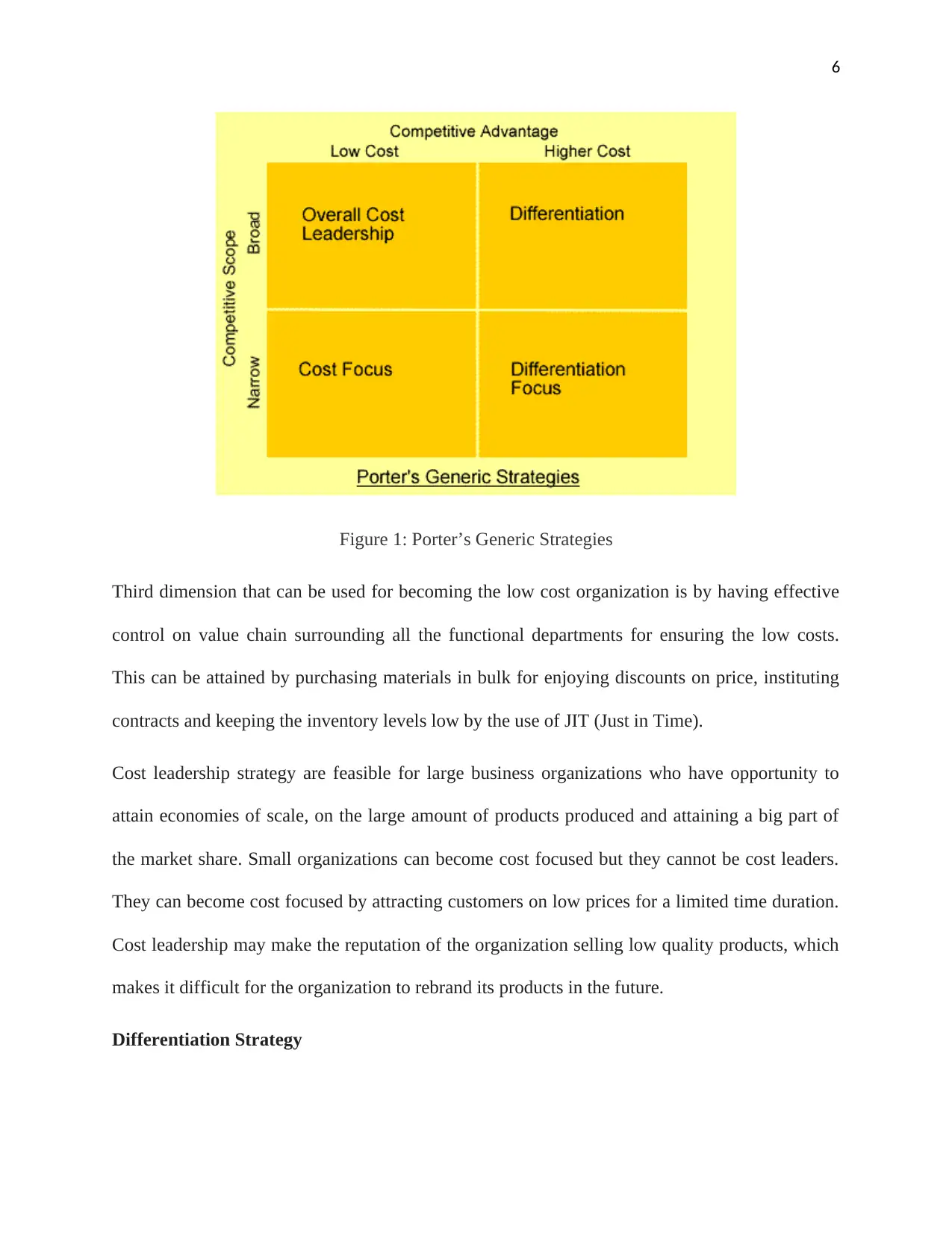
given by Michael Porter are Cost Leadership, focus and differentiation.
Porter have given this framework in 1980’s, which targets differentiation, cost leadership and
focus. These generic strategies can be implemented in any size and type of organization. Porter
have claimed that organizations should only select only one amidst the three, otherwise there is
risk that the organization will waste valuable resources. Generic strategies describes the
collaboration amidst cost reduction, differentiation and market focus.
Porter discussed that an industry which have numerous segments, can be selected as target
market by a firm. Breadth of the target market is the competitive scope for the business of the
organization. Porter have defined two approaches for competitive advantage such as low cost,
differentiation in relation to its competitors. Achievement of the competitive advantage will
result in the form of organizational ability to face the five market forces in better way then
compared to the other player in the market. Achievement of the competitive advantage will
require a firm to select type of advantage which it seeks to attain and scope in which
organization can attain it. Two basic approaches of gaining competitive advantage i.e. low cost
and differentiation when combined with activities which the organization seeks to attain will lead
to three strategies mentioned by porter for achieving performance above average (Dess, G.G. and
Davis, P.S., 1984).
Porter’s Generic Strategies will be discussed in detail and critical evaluation of the concept will
be done.
Concept of Generic Strategies
Michael Porter have developed three strategies, in 1980. Business organizations can utilize these
strategies for gaining a competitive advantage over the competitors. Three generic strategies
given by Michael Porter are Cost Leadership, focus and differentiation.
Porter have given this framework in 1980’s, which targets differentiation, cost leadership and
focus. These generic strategies can be implemented in any size and type of organization. Porter
have claimed that organizations should only select only one amidst the three, otherwise there is
risk that the organization will waste valuable resources. Generic strategies describes the
collaboration amidst cost reduction, differentiation and market focus.
Porter discussed that an industry which have numerous segments, can be selected as target
market by a firm. Breadth of the target market is the competitive scope for the business of the
organization. Porter have defined two approaches for competitive advantage such as low cost,
differentiation in relation to its competitors. Achievement of the competitive advantage will
result in the form of organizational ability to face the five market forces in better way then
compared to the other player in the market. Achievement of the competitive advantage will
require a firm to select type of advantage which it seeks to attain and scope in which
organization can attain it. Two basic approaches of gaining competitive advantage i.e. low cost
and differentiation when combined with activities which the organization seeks to attain will lead
to three strategies mentioned by porter for achieving performance above average (Dess, G.G. and
Davis, P.S., 1984).
⊘ This is a preview!⊘
Do you want full access?
Subscribe today to unlock all pages.

Trusted by 1+ million students worldwide
3
- If an organization targets all the customers in all the segments of a particular industry, and the
offering provided by the customer is low priced then the organization will said to be following
cost leadership strategy, which one out of the three generic strategies is given by Porter.
- If an organization targets the customers in all the markets and all the segments, on the basis of
special feature besides price, in order to achieve high price, then the organization is said to be
following differentiation strategy. An organization do so in order to differentiate the products
from those of the competitors are providing in the market.
- If the organization is focused on the few segments, then the organization is pursuing Focus
strategy. In this type of strategy the company is either attempts to provide low cost product in a
particular segment or it tries to differentiate.
The idea of choice is a different outlook on these strategies, because in 1970’s model was to
pursue the market share. Organizations who chased the high market position for the achievement
of the cost advantages, comes under the strategy of cost leadership. Notion of choice in relation
to focus and differentiation presented novel perspective (Allen, R.S. and Helms, M.M., 2006).
Origin of the Generic Strategies
Experimental research on the impact of profit on the marketing strategy shows that organizations
having high share in the market had high profits, but the organizations having low share also had
profits. Firms who have lowest profits had moderate share in the market. It was being referred to
as hole in the problem. Porter explained this scenario by saying that the organizations having
high share in the market were profitable and successful, as they pursued strategy of cost
leadership. On the other hand the organizations having low share in the market were also
successful as such organizations were using marketplace segmentation, for focusing on the
- If an organization targets all the customers in all the segments of a particular industry, and the
offering provided by the customer is low priced then the organization will said to be following
cost leadership strategy, which one out of the three generic strategies is given by Porter.
- If an organization targets the customers in all the markets and all the segments, on the basis of
special feature besides price, in order to achieve high price, then the organization is said to be
following differentiation strategy. An organization do so in order to differentiate the products
from those of the competitors are providing in the market.
- If the organization is focused on the few segments, then the organization is pursuing Focus
strategy. In this type of strategy the company is either attempts to provide low cost product in a
particular segment or it tries to differentiate.
The idea of choice is a different outlook on these strategies, because in 1970’s model was to
pursue the market share. Organizations who chased the high market position for the achievement
of the cost advantages, comes under the strategy of cost leadership. Notion of choice in relation
to focus and differentiation presented novel perspective (Allen, R.S. and Helms, M.M., 2006).
Origin of the Generic Strategies
Experimental research on the impact of profit on the marketing strategy shows that organizations
having high share in the market had high profits, but the organizations having low share also had
profits. Firms who have lowest profits had moderate share in the market. It was being referred to
as hole in the problem. Porter explained this scenario by saying that the organizations having
high share in the market were profitable and successful, as they pursued strategy of cost
leadership. On the other hand the organizations having low share in the market were also
successful as such organizations were using marketplace segmentation, for focusing on the
Paraphrase This Document
Need a fresh take? Get an instant paraphrase of this document with our AI Paraphraser
4
profitable and small market niche. Organizations who were having moderate share in the market
were not that profitable as they did not have any practical strategy.
Michael Porter proposed that combination of many strategies is fruitful in way only.
Combination of strategy of market segmentation along with the differentiation strategy is seen as
one of the effective way for matching an organization’s strategy of the product (supply) with the
features of the target market (demand). Combination of differentiation strategy along with the
cost leadership were hard to come across, due to the conflict that may arise while implementing
the strategies amidst reduction of cost for cost leadership and costs for value addition in the
differentiation strategy (Porter, M.E. and Strategy, C., 1980).
Since then, experimental research have shown that organizations following both low cost and
differentiation strategies, might be more profitable as compared to the companies who are only
pursuing one single strategy.
Differentiation have been made by some of the critics amidst best cost and low cost (Cost
Leadership) strategies. Critics say that generic strategy of being low cost is hardly capable of
providing sustainable advantage over the competitors. Most of the times organizations end up in
war related to price. Alternatively they have claimed that strategy of best cost will be preferred,
which consists of giving the best worth for a relative low price.
Description of the strategies
Generic Strategies given by Porter were utilized initially in the 1980’s and are utilized more
today. He have outlined three strategies for the organizations who want to attain competitive
advantage. All the three strategies are in the context of competitive environment. Cost leadership
profitable and small market niche. Organizations who were having moderate share in the market
were not that profitable as they did not have any practical strategy.
Michael Porter proposed that combination of many strategies is fruitful in way only.
Combination of strategy of market segmentation along with the differentiation strategy is seen as
one of the effective way for matching an organization’s strategy of the product (supply) with the
features of the target market (demand). Combination of differentiation strategy along with the
cost leadership were hard to come across, due to the conflict that may arise while implementing
the strategies amidst reduction of cost for cost leadership and costs for value addition in the
differentiation strategy (Porter, M.E. and Strategy, C., 1980).
Since then, experimental research have shown that organizations following both low cost and
differentiation strategies, might be more profitable as compared to the companies who are only
pursuing one single strategy.
Differentiation have been made by some of the critics amidst best cost and low cost (Cost
Leadership) strategies. Critics say that generic strategy of being low cost is hardly capable of
providing sustainable advantage over the competitors. Most of the times organizations end up in
war related to price. Alternatively they have claimed that strategy of best cost will be preferred,
which consists of giving the best worth for a relative low price.
Description of the strategies
Generic Strategies given by Porter were utilized initially in the 1980’s and are utilized more
today. He have outlined three strategies for the organizations who want to attain competitive
advantage. All the three strategies are in the context of competitive environment. Cost leadership
5
focuses on low cost products, Differentiation focuses on differentiating the product from the
other and focus can be of two types cost focus or different focus.
Cost Leadership Strategy
This strategy focuses on price sensitive consumers for gaining the market share. This strategy
can be achieved by setting low prices of the products in the target market. In order to succeed for
providing low price side by side achieving the targets of revenue and gaining ROI, a business
organization should be able to perform various operations at low cost as compared to the rivals in
the market. This can be done in three ways:
The first tactic to achieve low cost is by achieving high asset usage. This means the low cost can
be achieved by producing large volumes of products, which will yield low per unit cost and
giving frequent services to the customers in the service sector (Murray, A.I., 1988).
Second approach for becoming a low cost producer is by attaining less operating costs. This can
be achieved by providing customers with standardized products and offering a basic products
and limiting the personalization and customization of the products.
focuses on low cost products, Differentiation focuses on differentiating the product from the
other and focus can be of two types cost focus or different focus.
Cost Leadership Strategy
This strategy focuses on price sensitive consumers for gaining the market share. This strategy
can be achieved by setting low prices of the products in the target market. In order to succeed for
providing low price side by side achieving the targets of revenue and gaining ROI, a business
organization should be able to perform various operations at low cost as compared to the rivals in
the market. This can be done in three ways:
The first tactic to achieve low cost is by achieving high asset usage. This means the low cost can
be achieved by producing large volumes of products, which will yield low per unit cost and
giving frequent services to the customers in the service sector (Murray, A.I., 1988).
Second approach for becoming a low cost producer is by attaining less operating costs. This can
be achieved by providing customers with standardized products and offering a basic products
and limiting the personalization and customization of the products.
⊘ This is a preview!⊘
Do you want full access?
Subscribe today to unlock all pages.
Trusted by 1+ million students worldwide
6
Figure 1: Porter’s Generic Strategies
Third dimension that can be used for becoming the low cost organization is by having effective
control on value chain surrounding all the functional departments for ensuring the low costs.
This can be attained by purchasing materials in bulk for enjoying discounts on price, instituting
contracts and keeping the inventory levels low by the use of JIT (Just in Time).
Cost leadership strategy are feasible for large business organizations who have opportunity to
attain economies of scale, on the large amount of products produced and attaining a big part of
the market share. Small organizations can become cost focused but they cannot be cost leaders.
They can become cost focused by attracting customers on low prices for a limited time duration.
Cost leadership may make the reputation of the organization selling low quality products, which
makes it difficult for the organization to rebrand its products in the future.
Differentiation Strategy
Figure 1: Porter’s Generic Strategies
Third dimension that can be used for becoming the low cost organization is by having effective
control on value chain surrounding all the functional departments for ensuring the low costs.
This can be attained by purchasing materials in bulk for enjoying discounts on price, instituting
contracts and keeping the inventory levels low by the use of JIT (Just in Time).
Cost leadership strategy are feasible for large business organizations who have opportunity to
attain economies of scale, on the large amount of products produced and attaining a big part of
the market share. Small organizations can become cost focused but they cannot be cost leaders.
They can become cost focused by attracting customers on low prices for a limited time duration.
Cost leadership may make the reputation of the organization selling low quality products, which
makes it difficult for the organization to rebrand its products in the future.
Differentiation Strategy
Paraphrase This Document
Need a fresh take? Get an instant paraphrase of this document with our AI Paraphraser
7
Differentiation strategy calls for differentiating the services and products in some manner.
Examples of organizations who have used the differentiation strategy effectively are BMW
Automobiles, Apple Computers, and Mercedes Benz.
Differentiation strategy is feasible when the target group of customers is nor price sensitive and
when the market is saturated and competitive, customers in the market have very particular needs
which are not being met, and if an organization have capability and resources which will allow
the organization to meet those needs in such a way that cannot be copied by the other players in
the market. This consists of intellectual property rights and patents, different technical expertise,
talented personnel or might consist of creative processes (Hill, C.W., 1988).
Successful differentiation can be recognized when the organization is able to receive premium
price for its products and services, or the organization is able to get enhanced revenue per unit, or
the organization have the loyalty of the customers. Differentiation leads to enhanced profitability
when the additional price of the product overshadows the additional expense for acquiring the
products and services but this becomes ineffective when differentiation can be replicated with
ease by the competitors in the market. Efficient management of the brand will lead to apparent
differentiation even if the product is similar to the product of the competitors, like Starbucks
have branded coffee and Nike have branded sneakers. Differentiation is not feasible for small
organization, it is much suitable for large corporations.
Focus Strategy
Focus strategy is not a different strategy for large business organizations because of the small
marketplace conditions. Large organizations who applies differentiation strategy might want to
apply along with the combination of Focus Strategies, which can be either cost or differentiation.
Differentiation strategy calls for differentiating the services and products in some manner.
Examples of organizations who have used the differentiation strategy effectively are BMW
Automobiles, Apple Computers, and Mercedes Benz.
Differentiation strategy is feasible when the target group of customers is nor price sensitive and
when the market is saturated and competitive, customers in the market have very particular needs
which are not being met, and if an organization have capability and resources which will allow
the organization to meet those needs in such a way that cannot be copied by the other players in
the market. This consists of intellectual property rights and patents, different technical expertise,
talented personnel or might consist of creative processes (Hill, C.W., 1988).
Successful differentiation can be recognized when the organization is able to receive premium
price for its products and services, or the organization is able to get enhanced revenue per unit, or
the organization have the loyalty of the customers. Differentiation leads to enhanced profitability
when the additional price of the product overshadows the additional expense for acquiring the
products and services but this becomes ineffective when differentiation can be replicated with
ease by the competitors in the market. Efficient management of the brand will lead to apparent
differentiation even if the product is similar to the product of the competitors, like Starbucks
have branded coffee and Nike have branded sneakers. Differentiation is not feasible for small
organization, it is much suitable for large corporations.
Focus Strategy
Focus strategy is not a different strategy for large business organizations because of the small
marketplace conditions. Large organizations who applies differentiation strategy might want to
apply along with the combination of Focus Strategies, which can be either cost or differentiation.
8
Although focus strategy is certainly a suitable strategy for small scale organizations particularly
those who do not wish to compete with large organizations.
For the adoption of the narrow focus, an organization needs to focus on limited number of target
markets. These target markets can be unique groups with specific needs. Selection of offering
low cost products or differentiated products and services will depend upon the requirements of
selected target market and capability and resources of the organization. By focusing on the
marketing efforts on few niche markets and customizing the marketing mix for these specific
markets, an organization can better cater to the requirements of the that specific market. An
organization looks forward to attain competitive advantage via innovative product and marketing
the brand instead of improving efficiency (Kotha, S. and Orne, D., 1989).
Focus strategy of an organization, should target those markets which are not vulnerable to the
substitutes of the products, or where competition in the market is weak to earn profits above the
average range. Firms who have successfully utilized the focus strategy consist of Southwest
Airlines, which gives its customers short hauling points from flight to flight as compared to hub
and spoke approach of main carriers.
Evolution of the concept
Competitive advantage makes sure that organizations have high performance for a long time
duration. According to Porter, competitive advantage grows basically from the value that an
organization is able to create for its customers. On the basis of competitive advantages that a
firm can have over the competitors, Porter devised three generic strategies having their own
characteristics, demand and objectives viz. focus, differentiation and cost leadership. These
strategies were referred to as generic because these strategies can be adopted by various firms in
the industry.
Although focus strategy is certainly a suitable strategy for small scale organizations particularly
those who do not wish to compete with large organizations.
For the adoption of the narrow focus, an organization needs to focus on limited number of target
markets. These target markets can be unique groups with specific needs. Selection of offering
low cost products or differentiated products and services will depend upon the requirements of
selected target market and capability and resources of the organization. By focusing on the
marketing efforts on few niche markets and customizing the marketing mix for these specific
markets, an organization can better cater to the requirements of the that specific market. An
organization looks forward to attain competitive advantage via innovative product and marketing
the brand instead of improving efficiency (Kotha, S. and Orne, D., 1989).
Focus strategy of an organization, should target those markets which are not vulnerable to the
substitutes of the products, or where competition in the market is weak to earn profits above the
average range. Firms who have successfully utilized the focus strategy consist of Southwest
Airlines, which gives its customers short hauling points from flight to flight as compared to hub
and spoke approach of main carriers.
Evolution of the concept
Competitive advantage makes sure that organizations have high performance for a long time
duration. According to Porter, competitive advantage grows basically from the value that an
organization is able to create for its customers. On the basis of competitive advantages that a
firm can have over the competitors, Porter devised three generic strategies having their own
characteristics, demand and objectives viz. focus, differentiation and cost leadership. These
strategies were referred to as generic because these strategies can be adopted by various firms in
the industry.
⊘ This is a preview!⊘
Do you want full access?
Subscribe today to unlock all pages.
Trusted by 1+ million students worldwide
9
One of the popular model developed after the Michael Porter’s Generic Strategies, was given by
W. Chan Kim and Renée, in Harvard Business Review in the article named “Creating New
Market Space” In the article Renee and Kim described model of value innovation, where
organizations need to look beyond the exiting paradigms in order to find new value propositions.
Their tactic supplements the majority of the Porter’s approach, particularly the idea of
differentiation. Later the authors published their approaches in a book named Blue Ocean
Strategy. Therefore, it is quite tough but it is not impossible to collapse an organization, which
have set a governing standard.
Later Mintzberg have also approached the strategies given by Porter broadly, taking into account
the work of (Porter, M.E. and Strategy, C., 1980) and (Ansoff, H.I., 1987). According to
Mintzberg, generic strategies need to have a sequence based on logic which starts at the point of
formation of business, and when the organization will move forward into the stage of operations,
by observation of demand in the market and various constraints in the specific segments. After
this the configuration of the organization should be set up for competing in the broad market or
in the segmented market, while structuring the chain of activities for strategies of differentiation
and low cost.
As the marketplace is saturated then offers will be same, making the occurrence and persistency
of various solutions quite difficult and thus leading organizations have to utilize combination of
the strategies. On the basis of this argument, (Gilbert, X. and Strebel, P., 1989) stated that
selecting the competitive advantage will accentuate the awareness of the value of the product and
decrease in the price as stated by Porter, but there is possibility for competing and according to
porter which is possible. In the same manner, (Thompson Jr, A.A. and Strickland III, A.J., 1992)
have admitted the balance amidst the low cost and differentiation, within the strategy of best
One of the popular model developed after the Michael Porter’s Generic Strategies, was given by
W. Chan Kim and Renée, in Harvard Business Review in the article named “Creating New
Market Space” In the article Renee and Kim described model of value innovation, where
organizations need to look beyond the exiting paradigms in order to find new value propositions.
Their tactic supplements the majority of the Porter’s approach, particularly the idea of
differentiation. Later the authors published their approaches in a book named Blue Ocean
Strategy. Therefore, it is quite tough but it is not impossible to collapse an organization, which
have set a governing standard.
Later Mintzberg have also approached the strategies given by Porter broadly, taking into account
the work of (Porter, M.E. and Strategy, C., 1980) and (Ansoff, H.I., 1987). According to
Mintzberg, generic strategies need to have a sequence based on logic which starts at the point of
formation of business, and when the organization will move forward into the stage of operations,
by observation of demand in the market and various constraints in the specific segments. After
this the configuration of the organization should be set up for competing in the broad market or
in the segmented market, while structuring the chain of activities for strategies of differentiation
and low cost.
As the marketplace is saturated then offers will be same, making the occurrence and persistency
of various solutions quite difficult and thus leading organizations have to utilize combination of
the strategies. On the basis of this argument, (Gilbert, X. and Strebel, P., 1989) stated that
selecting the competitive advantage will accentuate the awareness of the value of the product and
decrease in the price as stated by Porter, but there is possibility for competing and according to
porter which is possible. In the same manner, (Thompson Jr, A.A. and Strickland III, A.J., 1992)
have admitted the balance amidst the low cost and differentiation, within the strategy of best
Paraphrase This Document
Need a fresh take? Get an instant paraphrase of this document with our AI Paraphraser
10
cost. As per the (Gilbert, X. and Strebel, P., 1989) organizations should have the capability to be
creative and innovative, for collecting many benefits in the competitive package, delivering it at
prices which are competitive and should do it concurrently.
(Treacy, M. and Wiersema, F., 1997) have enhanced the generic strategies of the Porter in the
book The Discipline of Market Leaders, for describing three fundamental value disciplines,
which will lead to creation of customer value and give competitive advantage. Those three
values are customer familiarity, operational excellence and product leadership. These areas
should be taken as generic strategies, as per these selection of a value will define the
organization’s succeeding decision and plans. Both of them argues that message of discipline
from the market leaders is that there is no organization which can be successful in the present
day environment by trying to be everything to all the people.
(Hax, A. and Wilde, D., 2001) have developed a project, which recommends three fundamental
strategies, which are supported by the idea of system lock in, providing solution to the customer
and best product. In the strategy of best product, competition should be based on economies
related to the product and it might follow strategies of low cost and differentiation. For providing
the customer solution should be based on the economics of consumers, which needs to have in
depth understanding of needs in order to provide a perfect package of goods and services. In the
strategy of system lock in, system should be considered as one and should not be related with
products or the customers as well as suppliers.
Generic Strategies fit with other concepts in the Strategic Management
Business organizations should identify and analyze its competitors, so that organization is able
analyze and identify that which strategies they can use in order to grow and survive in the
market. In order to analyze the competitors and the market place environment, organization can
cost. As per the (Gilbert, X. and Strebel, P., 1989) organizations should have the capability to be
creative and innovative, for collecting many benefits in the competitive package, delivering it at
prices which are competitive and should do it concurrently.
(Treacy, M. and Wiersema, F., 1997) have enhanced the generic strategies of the Porter in the
book The Discipline of Market Leaders, for describing three fundamental value disciplines,
which will lead to creation of customer value and give competitive advantage. Those three
values are customer familiarity, operational excellence and product leadership. These areas
should be taken as generic strategies, as per these selection of a value will define the
organization’s succeeding decision and plans. Both of them argues that message of discipline
from the market leaders is that there is no organization which can be successful in the present
day environment by trying to be everything to all the people.
(Hax, A. and Wilde, D., 2001) have developed a project, which recommends three fundamental
strategies, which are supported by the idea of system lock in, providing solution to the customer
and best product. In the strategy of best product, competition should be based on economies
related to the product and it might follow strategies of low cost and differentiation. For providing
the customer solution should be based on the economics of consumers, which needs to have in
depth understanding of needs in order to provide a perfect package of goods and services. In the
strategy of system lock in, system should be considered as one and should not be related with
products or the customers as well as suppliers.
Generic Strategies fit with other concepts in the Strategic Management
Business organizations should identify and analyze its competitors, so that organization is able
analyze and identify that which strategies they can use in order to grow and survive in the
market. In order to analyze the competitors and the market place environment, organization can
11
utilize various concept of Strategic Management. In order to analyze the strengths and weakness
organizations can use SWOT analysis, which will allow the organization to understand which
one of the generic strategies they can utilize for gaining advantage over the competitors in the
market. Business organizations can also use Five Force Analysis in order to analyze the market
forces that have impact upon the working of the organization and its ability to compete in the
market with the competitors (Kim, E., Nam, D.I. and Stimpert, J.L., 2004).
Besides this business organizations can also analyze the value chain. Value chain consists of
those activities which the organization performs for delivering a product or service in the target
market. When an organization is aware of its competitive environment, market forces and other
factors which have impact upon the competitiveness of the organization, which can be analyzed
by using various concepts of strategic management, only then the organization will be able to
devise an appropriate strategy amidst the three generic strategic given y porter, which will help
the organization to gain competitive advantage and gain high share of market. Thus it becomes
clear that all the concepts of strategic management are related to each other, and generic
strategies fits with all the concepts of strategic management.
Relevance of Generic Strategies
With the growing economic and technological development, business organizations today face
the challenge of increasing competition in the market. In order to survive this cut throat
competition organizations needs to formulate different strategies through which they will be able
to attract more and more customers and thereby leading to capturing of more market share.
Organizations should utilize their knowledge and understanding for designing products that
offers more value to the customers as compared to its competitors in the market (Parnell, J.A.,
2006).
utilize various concept of Strategic Management. In order to analyze the strengths and weakness
organizations can use SWOT analysis, which will allow the organization to understand which
one of the generic strategies they can utilize for gaining advantage over the competitors in the
market. Business organizations can also use Five Force Analysis in order to analyze the market
forces that have impact upon the working of the organization and its ability to compete in the
market with the competitors (Kim, E., Nam, D.I. and Stimpert, J.L., 2004).
Besides this business organizations can also analyze the value chain. Value chain consists of
those activities which the organization performs for delivering a product or service in the target
market. When an organization is aware of its competitive environment, market forces and other
factors which have impact upon the competitiveness of the organization, which can be analyzed
by using various concepts of strategic management, only then the organization will be able to
devise an appropriate strategy amidst the three generic strategic given y porter, which will help
the organization to gain competitive advantage and gain high share of market. Thus it becomes
clear that all the concepts of strategic management are related to each other, and generic
strategies fits with all the concepts of strategic management.
Relevance of Generic Strategies
With the growing economic and technological development, business organizations today face
the challenge of increasing competition in the market. In order to survive this cut throat
competition organizations needs to formulate different strategies through which they will be able
to attract more and more customers and thereby leading to capturing of more market share.
Organizations should utilize their knowledge and understanding for designing products that
offers more value to the customers as compared to its competitors in the market (Parnell, J.A.,
2006).
⊘ This is a preview!⊘
Do you want full access?
Subscribe today to unlock all pages.
Trusted by 1+ million students worldwide

1 out of 16


Related Documents


Your All-in-One AI-Powered Toolkit for Academic Success.
+13062052269
info@desklib.com
Available 24*7 on WhatsApp / Email
![[object Object]](/_next/static/media/star-bottom.7253800d.svg)
Unlock your academic potential
Copyright © 2020–2026 A2Z Services. All Rights Reserved. Developed and managed by ZUCOL.