Innovation Development Process of Michelin-Starred Chefs Report
VerifiedAdded on 2020/10/05
|11
|2994
|302
Report
AI Summary
This research report delves into the innovation development process employed by Michelin-starred chefs, examining the core concepts of haute cuisine and recipe development within the context of the hotel and restaurant industry. The study explores the significance of innovation in maintaining a competitive edge, focusing on the challenges and risk factors associated with introducing new food products. The report outlines the aims, objectives, and methodology, including secondary research, primary research using questionnaires, and focus group interviews. It investigates the differences between traditional and Michelin-starred chefs in terms of new product development, and the seven stages of the innovation process: idea generation, screening, business analysis, final testing, training, and commercialization. The report highlights the importance of taste, texture, and color in creating innovative dishes and addresses the need for effective management and chef training. The analysis includes a discussion of the quality of food and how it can be improved, offering recommendations for successful innovation development within restaurants. The research also looks at the importance of secondary research in collecting data, while also acknowledging the limitations of primary research methods, such as questionnaires and focus group interviews, and the challenges of recipe development, especially with seafood. The study concludes that effective management and staff training are essential for fostering innovation and ensuring the creation of high-quality food products.

RESEARCH PROPOSAL

Paraphrase This Document
Need a fresh take? Get an instant paraphrase of this document with our AI Paraphraser
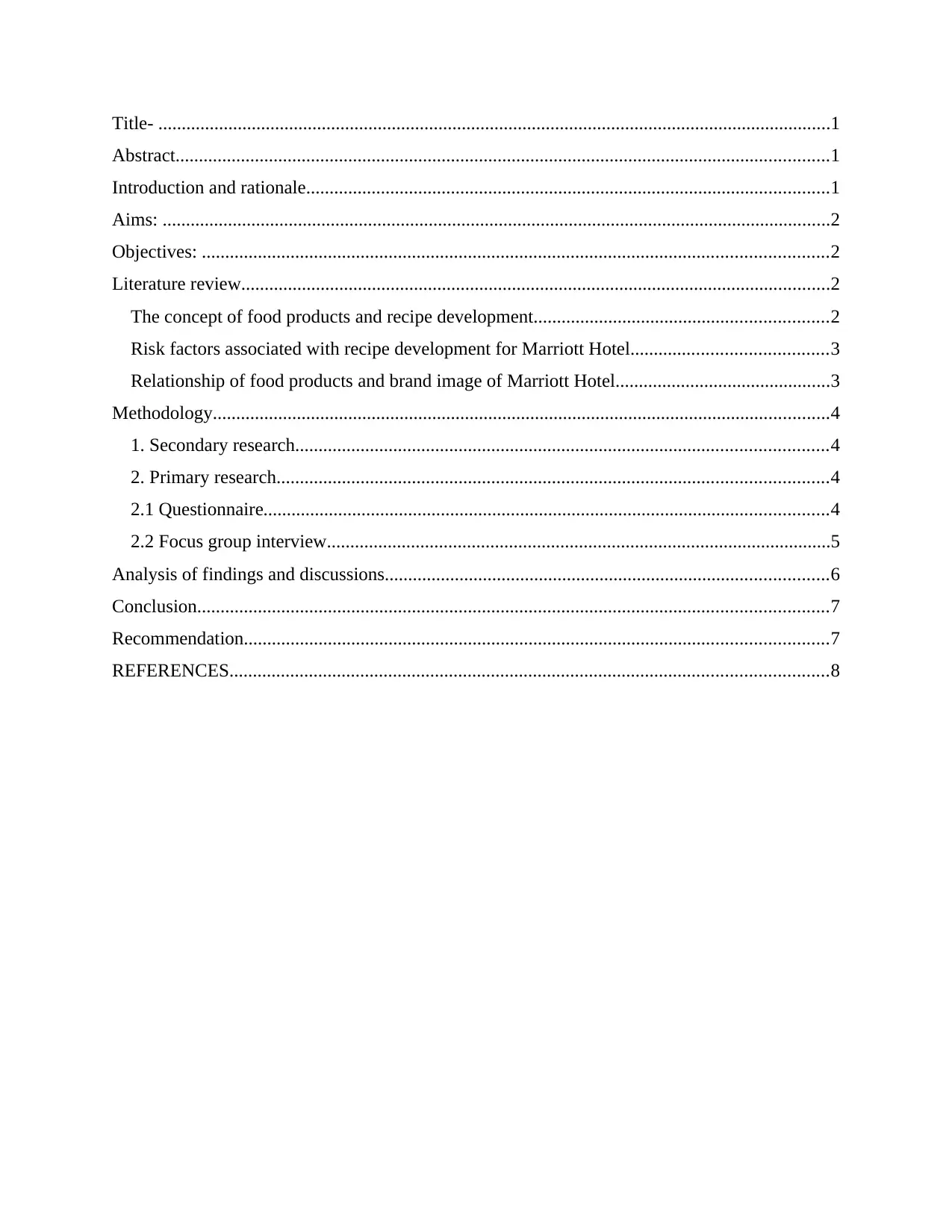
Title- ................................................................................................................................................1
Abstract............................................................................................................................................1
Introduction and rationale................................................................................................................1
Aims: ...............................................................................................................................................2
Objectives: ......................................................................................................................................2
Literature review..............................................................................................................................2
The concept of food products and recipe development...............................................................2
Risk factors associated with recipe development for Marriott Hotel..........................................3
Relationship of food products and brand image of Marriott Hotel..............................................3
Methodology....................................................................................................................................4
1. Secondary research..................................................................................................................4
2. Primary research......................................................................................................................4
2.1 Questionnaire.........................................................................................................................4
2.2 Focus group interview............................................................................................................5
Analysis of findings and discussions...............................................................................................6
Conclusion.......................................................................................................................................7
Recommendation.............................................................................................................................7
REFERENCES................................................................................................................................8
Abstract............................................................................................................................................1
Introduction and rationale................................................................................................................1
Aims: ...............................................................................................................................................2
Objectives: ......................................................................................................................................2
Literature review..............................................................................................................................2
The concept of food products and recipe development...............................................................2
Risk factors associated with recipe development for Marriott Hotel..........................................3
Relationship of food products and brand image of Marriott Hotel..............................................3
Methodology....................................................................................................................................4
1. Secondary research..................................................................................................................4
2. Primary research......................................................................................................................4
2.1 Questionnaire.........................................................................................................................4
2.2 Focus group interview............................................................................................................5
Analysis of findings and discussions...............................................................................................6
Conclusion.......................................................................................................................................7
Recommendation.............................................................................................................................7
REFERENCES................................................................................................................................8

⊘ This is a preview!⊘
Do you want full access?
Subscribe today to unlock all pages.

Trusted by 1+ million students worldwide
Title-
“The innovation development process of Michelin-starred chefs”
Abstract
Innovation provides various benefits to industries and individuals to get high profitability
and success in business. In context with hotel industries and restaurants, successfully innovation
and development process leads organisations to gain high competitive advantage (Sloan, Legrand
and Hindley, 2015). As innovation in food is generally copied by others more quickly therefore,
it helps restaurants in keeping their portfolio more competitive. Through this process, they can
gain long term profitability also by setting benchmark of recipe development in eyes of
customers.
Introduction and rationale
Today with increasing awareness about hygiene factor and nutritional level of food products,
it becomes essential for hotels and restaurants to concern on quality of items they serve to
customers. In context with innovation development process, for developing a new food product,
such organisations are needed to ensure if it will be accepted by potential customers or not. As
any kind of development involves a high degree of risk, therefore, before make changes in menu
and recipe of food, companies need to evaluate such factors also (Mohayidin and Kamarulzaman
2014). It includes loss of interest of potential customers, quality and taste of food, etc.
This research mainly aims at describing the concept of innovation process described by
Michelin-starred chefs. The term ' Michelin Star' refers as a hallmark of best dining quality with
restaurants. With this assistance, present report described the process of innovation development
process with some recommendation.
Aims:
Aim is considered as main part of research which defines what has to be achieved at the end
of an investigation. In this regard, the main aim of present research is “The innovation
development process of Michelin-starred chefs”.
Objectives:
It defines measurable outcomes as well as steps by which a research can be carried out in
specific manner. With this assistance, main objectives of present research are given as below:-
1
“The innovation development process of Michelin-starred chefs”
Abstract
Innovation provides various benefits to industries and individuals to get high profitability
and success in business. In context with hotel industries and restaurants, successfully innovation
and development process leads organisations to gain high competitive advantage (Sloan, Legrand
and Hindley, 2015). As innovation in food is generally copied by others more quickly therefore,
it helps restaurants in keeping their portfolio more competitive. Through this process, they can
gain long term profitability also by setting benchmark of recipe development in eyes of
customers.
Introduction and rationale
Today with increasing awareness about hygiene factor and nutritional level of food products,
it becomes essential for hotels and restaurants to concern on quality of items they serve to
customers. In context with innovation development process, for developing a new food product,
such organisations are needed to ensure if it will be accepted by potential customers or not. As
any kind of development involves a high degree of risk, therefore, before make changes in menu
and recipe of food, companies need to evaluate such factors also (Mohayidin and Kamarulzaman
2014). It includes loss of interest of potential customers, quality and taste of food, etc.
This research mainly aims at describing the concept of innovation process described by
Michelin-starred chefs. The term ' Michelin Star' refers as a hallmark of best dining quality with
restaurants. With this assistance, present report described the process of innovation development
process with some recommendation.
Aims:
Aim is considered as main part of research which defines what has to be achieved at the end
of an investigation. In this regard, the main aim of present research is “The innovation
development process of Michelin-starred chefs”.
Objectives:
It defines measurable outcomes as well as steps by which a research can be carried out in
specific manner. With this assistance, main objectives of present research are given as below:-
1
Paraphrase This Document
Need a fresh take? Get an instant paraphrase of this document with our AI Paraphraser
To study on creativity and innovation in Haute Cuisine.
To evaluate impact of managing culinary innovation process.
To find out basic difference between traditional and Michelin starred chefs for new
product development.
To research on innovation development process of Michelin starred chef.
To recommend ways of innovation development process of Michelin starred chef.
Research questions:
What is the concept of creativity and innovation in Haute Cuisine?
How to evaluate impact of managing culinary innovation process?
What is the basic difference between traditional and Michelin starred chefs for new
product development?
How to conduct research on innovation development process of Michelin starred chef?
What are the ways of innovation development process of Michelin starred chef?
Literature review
Creativity and innovation in Haute Cuisine
According to view point of Wong, Wan and Qi (2015), it has ascertained that the term
Haute cuisine is defined as cuisine of kitchen style which emphasized on preparation and
presentation of food. In this regard, behind building reputation and set benchmark for food and
taste in mind of customers, highly skilled chefs play a vital role. Therefore, using concept of
Haute Cuisine, chefs focused more on high-quality ingredients rather than on quantity of food.
Michelin star refers to a hallmark of finest dining quality within restaurants which
promote Michelin star status. It is also termed rating system where restaurants are awarded with
one-star, two-star and three-star category. Here 1-Star stated as 'a fine restaurant' and 2-Star for
'excellent cooking which is worth a detour' (Lu, Gursoy and Lu, 2015). Other than this, 3-Star
signifies as 'exceptional haute cuisine which is worth a special journey'.
Impact of managing culinary innovation process
According to opinion of Bowie and et. al. (2016), it has analysed that culinary process
refers to preparing and presenting food products within restaurant in attractive manner. In
context with haute cusine establishment, culinary innovation process is completely different, as it
focuses more on arts of preparation, cooking and presentation of food. Culinary innovation
2
To evaluate impact of managing culinary innovation process.
To find out basic difference between traditional and Michelin starred chefs for new
product development.
To research on innovation development process of Michelin starred chef.
To recommend ways of innovation development process of Michelin starred chef.
Research questions:
What is the concept of creativity and innovation in Haute Cuisine?
How to evaluate impact of managing culinary innovation process?
What is the basic difference between traditional and Michelin starred chefs for new
product development?
How to conduct research on innovation development process of Michelin starred chef?
What are the ways of innovation development process of Michelin starred chef?
Literature review
Creativity and innovation in Haute Cuisine
According to view point of Wong, Wan and Qi (2015), it has ascertained that the term
Haute cuisine is defined as cuisine of kitchen style which emphasized on preparation and
presentation of food. In this regard, behind building reputation and set benchmark for food and
taste in mind of customers, highly skilled chefs play a vital role. Therefore, using concept of
Haute Cuisine, chefs focused more on high-quality ingredients rather than on quantity of food.
Michelin star refers to a hallmark of finest dining quality within restaurants which
promote Michelin star status. It is also termed rating system where restaurants are awarded with
one-star, two-star and three-star category. Here 1-Star stated as 'a fine restaurant' and 2-Star for
'excellent cooking which is worth a detour' (Lu, Gursoy and Lu, 2015). Other than this, 3-Star
signifies as 'exceptional haute cuisine which is worth a special journey'.
Impact of managing culinary innovation process
According to opinion of Bowie and et. al. (2016), it has analysed that culinary process
refers to preparing and presenting food products within restaurant in attractive manner. In
context with haute cusine establishment, culinary innovation process is completely different, as it
focuses more on arts of preparation, cooking and presentation of food. Culinary innovation
2
process brings together multi-cuisine (fusion-cuisine) for new product development. Therefore,
to manage this kind of innovation process including haute cuisine, a restaurant managers need to
make a proper project management plan. This will describe in what manner, chefs can improve
quality of food and increase its taste in healthy manner.
Basic difference between traditional and Michelin starred chefs for new product development
As per the view of Ivanov, (2014), it has evaluated that concept of traditional and
Michelin starred chefs for new product development is completely different. Michelin starred
chef focuses on introducing best quality of ingredients for food and recipe development in order
to create fine dinning quality. While traditional process emphasis on developing skills of chefs
for making innovation in food products. To gain 3-Star Michelin-starred, chefs give their best for
presenting best quality of food. It will lead to restaurants to set a benchmark in innovation
process and gain high competitive advantage for longer period of time.
Innovation development process of Michelin starred chef
According to Ozdemir and Caliskan (2014), the innovation development process defines
a procedure to develop a new food product in restaurants. It includes seven main stages that are-
idea generation, screening, business analysis, final testing, training and commercialisation.
Under this process, several strategic ideas are formulated for development process which guides
how to develop a new dish. Furthermore, for successful innovation, chefs are also required to
concern on three main aspects that are Taste, Texture and Colour. Combining these three factors,
restaurant can provide a great taste experience to customers by offering new innovative dish.
Methodology
1. Secondary research
It refers to one of the best research methodologies that give sources by which investigators
can collect information more easily. It includes books and journals available on various websites
of internet applications, newspapers and magazines etc. Here both kinds of published and
unpublished data are available that helps project makers in collecting relevant information about
a certain topic. But due to availability of various websites on same topic sometime it seems to be
toughest task to extract reliable and accurate information. Therefore, mostly people use primary
research method for gathering data when concern about authenticity and reliability.
3
to manage this kind of innovation process including haute cuisine, a restaurant managers need to
make a proper project management plan. This will describe in what manner, chefs can improve
quality of food and increase its taste in healthy manner.
Basic difference between traditional and Michelin starred chefs for new product development
As per the view of Ivanov, (2014), it has evaluated that concept of traditional and
Michelin starred chefs for new product development is completely different. Michelin starred
chef focuses on introducing best quality of ingredients for food and recipe development in order
to create fine dinning quality. While traditional process emphasis on developing skills of chefs
for making innovation in food products. To gain 3-Star Michelin-starred, chefs give their best for
presenting best quality of food. It will lead to restaurants to set a benchmark in innovation
process and gain high competitive advantage for longer period of time.
Innovation development process of Michelin starred chef
According to Ozdemir and Caliskan (2014), the innovation development process defines
a procedure to develop a new food product in restaurants. It includes seven main stages that are-
idea generation, screening, business analysis, final testing, training and commercialisation.
Under this process, several strategic ideas are formulated for development process which guides
how to develop a new dish. Furthermore, for successful innovation, chefs are also required to
concern on three main aspects that are Taste, Texture and Colour. Combining these three factors,
restaurant can provide a great taste experience to customers by offering new innovative dish.
Methodology
1. Secondary research
It refers to one of the best research methodologies that give sources by which investigators
can collect information more easily. It includes books and journals available on various websites
of internet applications, newspapers and magazines etc. Here both kinds of published and
unpublished data are available that helps project makers in collecting relevant information about
a certain topic. But due to availability of various websites on same topic sometime it seems to be
toughest task to extract reliable and accurate information. Therefore, mostly people use primary
research method for gathering data when concern about authenticity and reliability.
3
⊘ This is a preview!⊘
Do you want full access?
Subscribe today to unlock all pages.
Trusted by 1+ million students worldwide
2. Primary research
This source of research methodology helps investigators in finding and collecting proper
information of a topic. Questionnaire, survey (online and offline), focus group interview, etc. are
some methods of primary research by which project makers can find accurate information. The
main advantage of this methodology is that it gives reliable and original data as compared to
secondary research. But for conducting this type of research, a user needs to a sufficient amount
of time and capital. Therefore, it shows cost ineffectiveness and time consuming aspects of
primary research.
2.1 Questionnaire
It is the most useful technique of primary data collection methods, where investigators are
required design a proper questionnaire. It includes some relevant questions of a specific which
will further filled by some respondents. This will help in analysing opinion and perception of
people according to which major conclusion can be drawn for business activities. Usually,
questionnaire is designed for analysing responses of targeted audience in statistical manner. The
main beneficial point of this method is that it looks cost-efficient because a questionnaire is just
needs to be placed on websites or e-mailed to selected users. It is also practical and easy method
as well as covers all aspects of a topic. But lack of willingness of participants, difficulties to
analyse and interpretation, shortage of personalisation etc. are some aspects which show
drawback of this method also.
2.2 Focus group interview
It refers to qualitative type of research method where an open discussion is made with
selective respondents about a common topic. Under this process, some questions are asked to
group in order to know their perceptions, views, preference towards new product development
etc. This would help decisions makers to analyse response of targeted audience and take
decisions accordingly in business. Therefore, this method is useful for obtaining useful
information in simple and easy manner. It creates transparency in result also as well as save time
and money both. But this technique of primary research fails to give in-depth analysis as
compared to other methods.
4
This source of research methodology helps investigators in finding and collecting proper
information of a topic. Questionnaire, survey (online and offline), focus group interview, etc. are
some methods of primary research by which project makers can find accurate information. The
main advantage of this methodology is that it gives reliable and original data as compared to
secondary research. But for conducting this type of research, a user needs to a sufficient amount
of time and capital. Therefore, it shows cost ineffectiveness and time consuming aspects of
primary research.
2.1 Questionnaire
It is the most useful technique of primary data collection methods, where investigators are
required design a proper questionnaire. It includes some relevant questions of a specific which
will further filled by some respondents. This will help in analysing opinion and perception of
people according to which major conclusion can be drawn for business activities. Usually,
questionnaire is designed for analysing responses of targeted audience in statistical manner. The
main beneficial point of this method is that it looks cost-efficient because a questionnaire is just
needs to be placed on websites or e-mailed to selected users. It is also practical and easy method
as well as covers all aspects of a topic. But lack of willingness of participants, difficulties to
analyse and interpretation, shortage of personalisation etc. are some aspects which show
drawback of this method also.
2.2 Focus group interview
It refers to qualitative type of research method where an open discussion is made with
selective respondents about a common topic. Under this process, some questions are asked to
group in order to know their perceptions, views, preference towards new product development
etc. This would help decisions makers to analyse response of targeted audience and take
decisions accordingly in business. Therefore, this method is useful for obtaining useful
information in simple and easy manner. It creates transparency in result also as well as save time
and money both. But this technique of primary research fails to give in-depth analysis as
compared to other methods.
4
Paraphrase This Document
Need a fresh take? Get an instant paraphrase of this document with our AI Paraphraser
2.3 Research approach
A research approach is an assumption and detailed interpretation of data collection and
analysis. There are two types of research approach .i.e. inductive and deductive. A inductive
approach is qualitative approach which focuses more on quality of data collection and
interpretation. It mainly focuses on generating new theory from the data collected. On the other
hand, deductive approach is basically a quantitative approach that gives more emphasis on
quantity of an research topic. The main aim of deductive approach is to focus on testing a theory.
In this present research, an investigator used inductive research to attain its aims and objectives.
Analysis of findings and discussions
Quality of food can be stated as degree of excellence of food items. It includes factors
like taste, nutritional level, appearance, hygiene and more (Samori, Ishak and Kassan, 2014).
Therefore, from food safety point of view, it is essential for restaurants and hotel industries to
monitor the quality of eatable items. Along with this, in order to gain retention of people, it is
also necessary for hotels and restaurants towards innovation development process. This would
help in getting high competitive advantage also. As per basis on analysis of Michelin-starred
chef's descriptions, it has evaluated that innovation development process can be successfully
introduced within restaurant by concerning on seven main steps. These strategies are idea
generation, idea screening, business analysis, final testing, training and commercialisation.
Through literature review and other methods of secondary research, it has summarised that under
first stage i.e. idea generation, chefs are required to analyse taste and preference of customers.
This would help generating a proper idea for creating innovation in products or services within
restaurants. After generating the cooking idea concept, next stage is screening where a trial
method is used for developing a new dish. For this process, a sample is offered to potential
customers and further their feedback is taken. This would help in analysing success of such
innovation (Wang, 2015). In the next step which is concept development, management will make
a proper plan about working instruction including presenting and photographing final dish.
Through present research, it has evaluated that recipe development or innovating a new
dish is not as simple as it looks. It requires effective management technique who will help chefs
in providing an easy road map for producing a great innovative food. Further, by developing a
perfect team of chefs, it becomes easy for restaurants to produce best food. For example, a recipe
development for a seafood dish is quite much challenging because when an experiment is done
5
A research approach is an assumption and detailed interpretation of data collection and
analysis. There are two types of research approach .i.e. inductive and deductive. A inductive
approach is qualitative approach which focuses more on quality of data collection and
interpretation. It mainly focuses on generating new theory from the data collected. On the other
hand, deductive approach is basically a quantitative approach that gives more emphasis on
quantity of an research topic. The main aim of deductive approach is to focus on testing a theory.
In this present research, an investigator used inductive research to attain its aims and objectives.
Analysis of findings and discussions
Quality of food can be stated as degree of excellence of food items. It includes factors
like taste, nutritional level, appearance, hygiene and more (Samori, Ishak and Kassan, 2014).
Therefore, from food safety point of view, it is essential for restaurants and hotel industries to
monitor the quality of eatable items. Along with this, in order to gain retention of people, it is
also necessary for hotels and restaurants towards innovation development process. This would
help in getting high competitive advantage also. As per basis on analysis of Michelin-starred
chef's descriptions, it has evaluated that innovation development process can be successfully
introduced within restaurant by concerning on seven main steps. These strategies are idea
generation, idea screening, business analysis, final testing, training and commercialisation.
Through literature review and other methods of secondary research, it has summarised that under
first stage i.e. idea generation, chefs are required to analyse taste and preference of customers.
This would help generating a proper idea for creating innovation in products or services within
restaurants. After generating the cooking idea concept, next stage is screening where a trial
method is used for developing a new dish. For this process, a sample is offered to potential
customers and further their feedback is taken. This would help in analysing success of such
innovation (Wang, 2015). In the next step which is concept development, management will make
a proper plan about working instruction including presenting and photographing final dish.
Through present research, it has evaluated that recipe development or innovating a new
dish is not as simple as it looks. It requires effective management technique who will help chefs
in providing an easy road map for producing a great innovative food. Further, by developing a
perfect team of chefs, it becomes easy for restaurants to produce best food. For example, a recipe
development for a seafood dish is quite much challenging because when an experiment is done
5
with meat then it is almost impossible to cook exact the same again. So, it causes variance in
same kind of cooking dishes. Another reason behind failure is that there are 16 slightly different
taste of seafood. Therefore, creating innovation with such kind of foodstuffs is really hard to
achieve success (Laura Sidali and Hemmerling, 2014). For addressing such kind of issues,
innovation development process as per Michelin chefs, management of restaurants are required
to give substantial training to chefs. This would help in developing skills and knowledge of chefs
and make them able to create innovation in products.
It has been analysed that by giving proper training to their staff and at the end by testing
them at various stages restaurants bring out best from their staff. It will helps staff members in
knowing elements and sequence of a particular dish. It is essential for an restaurant to have
testing resources that can helps them in identifying quality of dishes. The restaurant managers,
friends and regular customers can act as a testing resources but they should have good sensibility
regarding dishes. In this context, Michelin-starred chefs test their dish from one or more sources
in order to provide best in quality dish to their customers. In final testing, it is important for
restaurants to taste their dishes under normal conditions. The final step in this process is
commercialisation, in which restaurants want to know level of their customer satisfaction by
taking instant feedback them. This step also involves measuring sales of a new dish as compared
to other dishes in the menu. The creation of innovative dishes in their menu helps restaurants in
attracting their customers and in improving their sales in a competitive business environment.
Conclusion
It has concluded from this research that to stay in competition and gain retention of
customers, today every company used to create innovation in products or services. Similarly
hotel industries are also looked out the same, to gain retention of customers, they have carried
out to make innovation in food items. For this process, to offer a wide variety of food, they
concern on creation of recipe development. In this regard, for developing recipe, chefs mainly
focus on understanding the concept of culinary and haute cuisine system. This would aid
restaurants in developing innovation in food products and keeping portfolio to be more
competitive.
6
same kind of cooking dishes. Another reason behind failure is that there are 16 slightly different
taste of seafood. Therefore, creating innovation with such kind of foodstuffs is really hard to
achieve success (Laura Sidali and Hemmerling, 2014). For addressing such kind of issues,
innovation development process as per Michelin chefs, management of restaurants are required
to give substantial training to chefs. This would help in developing skills and knowledge of chefs
and make them able to create innovation in products.
It has been analysed that by giving proper training to their staff and at the end by testing
them at various stages restaurants bring out best from their staff. It will helps staff members in
knowing elements and sequence of a particular dish. It is essential for an restaurant to have
testing resources that can helps them in identifying quality of dishes. The restaurant managers,
friends and regular customers can act as a testing resources but they should have good sensibility
regarding dishes. In this context, Michelin-starred chefs test their dish from one or more sources
in order to provide best in quality dish to their customers. In final testing, it is important for
restaurants to taste their dishes under normal conditions. The final step in this process is
commercialisation, in which restaurants want to know level of their customer satisfaction by
taking instant feedback them. This step also involves measuring sales of a new dish as compared
to other dishes in the menu. The creation of innovative dishes in their menu helps restaurants in
attracting their customers and in improving their sales in a competitive business environment.
Conclusion
It has concluded from this research that to stay in competition and gain retention of
customers, today every company used to create innovation in products or services. Similarly
hotel industries are also looked out the same, to gain retention of customers, they have carried
out to make innovation in food items. For this process, to offer a wide variety of food, they
concern on creation of recipe development. In this regard, for developing recipe, chefs mainly
focus on understanding the concept of culinary and haute cuisine system. This would aid
restaurants in developing innovation in food products and keeping portfolio to be more
competitive.
6
⊘ This is a preview!⊘
Do you want full access?
Subscribe today to unlock all pages.
Trusted by 1+ million students worldwide
Recommendation
As per this report to create innovation in food items and recipe development, it has
recommended to Michelin-starred chefs to offer organic food to customers. Today people
concerns on eating organic food mostly which doesn’t create harm for their health. Along with
this, such type of food items also includes a wide variety of foodstuffs. This would help in
developing new recipe and making experimentation with items. Along with this, offering organic
food items also minimise risk factors associated with new product development.
7
As per this report to create innovation in food items and recipe development, it has
recommended to Michelin-starred chefs to offer organic food to customers. Today people
concerns on eating organic food mostly which doesn’t create harm for their health. Along with
this, such type of food items also includes a wide variety of foodstuffs. This would help in
developing new recipe and making experimentation with items. Along with this, offering organic
food items also minimise risk factors associated with new product development.
7
Paraphrase This Document
Need a fresh take? Get an instant paraphrase of this document with our AI Paraphraser
REFERENCES
Books & Journals
Bowie, D. and et. al., 2016. Hospitality marketing. Routledge.
Samori, Z., Ishak, A. H. and Kassan, N. H., 2014. Understanding the development of halal food
standard: suggestion for future research. International Journal of Social Science and
Humanity. 4(6). p.482.
Anselmsson, J., Vestman Bondesson, N. and Johansson, U., 2014. Brand image and customers'
willingness to pay a price premium for food brands. Journal of Product & Brand
Management. 23(2). pp.90-102.
Wang, E.S.T., 2015. Effect of food service-brand equity on consumer-perceived food value,
physical risk, and brand preference. British Food Journal. 117(2). pp.553-564.
Ivanov, S., 2014. Hotel revenue management: From theory to practice. Zangador.
Mohayidin, M.G. and Kamarulzaman, N.H., 2014. Consumers' preferences toward attributes of
manufactured halal food products. Journal of International Food & Agribusiness Marketing.
26(2). pp.125-139.
Laura Sidali, K. and Hemmerling, S., 2014. Developing an authenticity model of traditional food
specialties: Does the self-concept of consumers matter?. British Food Journal/ 116(11).
pp.1692-1709.
Ozdemir, B. and Caliskan, O., 2014. A review of literature on restaurant menus: Specifying the
managerial issues. International Journal of gastronomy and food science. 2(1). pp.3-13.
Sloan, P., Legrand, W. and Hindley, C. eds., 2015. The Routledge handbook of sustainable food
and gastronomy. Routledge.
Wong, I. A., Wan, Y. K. P. and Qi, S., 2015. Green events, value perceptions, and the role of
consumer involvement in festival design and performance. Journal of Sustainable Tourism,
23(2), pp.294-315.
Lu, A. C. C., Gursoy, D. and Lu, C. Y., 2015. Authenticity perceptions, brand equity and brand
choice intention: The case of ethnic restaurants. International Journal of Hospitality
Management. 50. pp.36-45.
8
Books & Journals
Bowie, D. and et. al., 2016. Hospitality marketing. Routledge.
Samori, Z., Ishak, A. H. and Kassan, N. H., 2014. Understanding the development of halal food
standard: suggestion for future research. International Journal of Social Science and
Humanity. 4(6). p.482.
Anselmsson, J., Vestman Bondesson, N. and Johansson, U., 2014. Brand image and customers'
willingness to pay a price premium for food brands. Journal of Product & Brand
Management. 23(2). pp.90-102.
Wang, E.S.T., 2015. Effect of food service-brand equity on consumer-perceived food value,
physical risk, and brand preference. British Food Journal. 117(2). pp.553-564.
Ivanov, S., 2014. Hotel revenue management: From theory to practice. Zangador.
Mohayidin, M.G. and Kamarulzaman, N.H., 2014. Consumers' preferences toward attributes of
manufactured halal food products. Journal of International Food & Agribusiness Marketing.
26(2). pp.125-139.
Laura Sidali, K. and Hemmerling, S., 2014. Developing an authenticity model of traditional food
specialties: Does the self-concept of consumers matter?. British Food Journal/ 116(11).
pp.1692-1709.
Ozdemir, B. and Caliskan, O., 2014. A review of literature on restaurant menus: Specifying the
managerial issues. International Journal of gastronomy and food science. 2(1). pp.3-13.
Sloan, P., Legrand, W. and Hindley, C. eds., 2015. The Routledge handbook of sustainable food
and gastronomy. Routledge.
Wong, I. A., Wan, Y. K. P. and Qi, S., 2015. Green events, value perceptions, and the role of
consumer involvement in festival design and performance. Journal of Sustainable Tourism,
23(2), pp.294-315.
Lu, A. C. C., Gursoy, D. and Lu, C. Y., 2015. Authenticity perceptions, brand equity and brand
choice intention: The case of ethnic restaurants. International Journal of Hospitality
Management. 50. pp.36-45.
8

1 out of 11


Related Documents


Your All-in-One AI-Powered Toolkit for Academic Success.
+13062052269
info@desklib.com
Available 24*7 on WhatsApp / Email
![[object Object]](/_next/static/media/star-bottom.7253800d.svg)
Unlock your academic potential
Copyright © 2020–2026 A2Z Services. All Rights Reserved. Developed and managed by ZUCOL.