University College Birmingham: Research Proposal on Michelin Chefs
VerifiedAdded on 2020/10/22
|11
|1616
|125
Report
AI Summary
This research proposal explores the innovation development process employed by Michelin-starred chefs. The study aims to understand how these chefs approach culinary innovation and new product development. The proposal outlines objectives, a rationale emphasizing the sequential and top-down approach used by Michelin chefs, and a theoretical framework centered on the impact of managing culinary innovation. Key concepts include innovation in the culinary process and new product development, with the application of the Innovation Development Process model. Data collection methods involve secondary data analysis of existing literature and primary data gathered from students and staff at UC Berkeley of Birmingham. The research employs qualitative data analysis techniques, focusing on thematic analysis. The findings of this research will be of interest to students of Culinary Arts Management at the University College Birmingham. The proposal includes a literature review discussing creativity and innovation in Haute Cuisine, the impact of managing culinary innovation, and differences between traditional and Michelin-starred chefs in new product development. The report also incorporates a topic choice matrix, planned research methods, and a list of relevant references. The proposal details a structured approach to the research, including weekly milestones for the project's progression.
Research Principles (1539) – Research Proposal
Student Details:
Family name/s:
First name/s:
Programme:
You’re Research Project Proposal:
1) WHAT IS YOUR AIM?
Your AIM:
The innovation development process of Michelin-starred chefs
2) COMPILING YOUR OBJECTIVES
Your
Objective
s:
Which
section it
covers
Objective
1
(Literatur
e review)
To study on creativity and innovation in Haute
Cuisine
Objective
2
(Literatur
e review)
To evaluate impact of managing culinary
innovation process
Objective
3
(Primary
Research)
To find out basic difference between traditional
and Michelin starred chefs for new product
development.
Objective (Findings/ To research on innovation development process of
Page 1
Student Details:
Family name/s:
First name/s:
Programme:
You’re Research Project Proposal:
1) WHAT IS YOUR AIM?
Your AIM:
The innovation development process of Michelin-starred chefs
2) COMPILING YOUR OBJECTIVES
Your
Objective
s:
Which
section it
covers
Objective
1
(Literatur
e review)
To study on creativity and innovation in Haute
Cuisine
Objective
2
(Literatur
e review)
To evaluate impact of managing culinary
innovation process
Objective
3
(Primary
Research)
To find out basic difference between traditional
and Michelin starred chefs for new product
development.
Objective (Findings/ To research on innovation development process of
Page 1
Paraphrase This Document
Need a fresh take? Get an instant paraphrase of this document with our AI Paraphraser

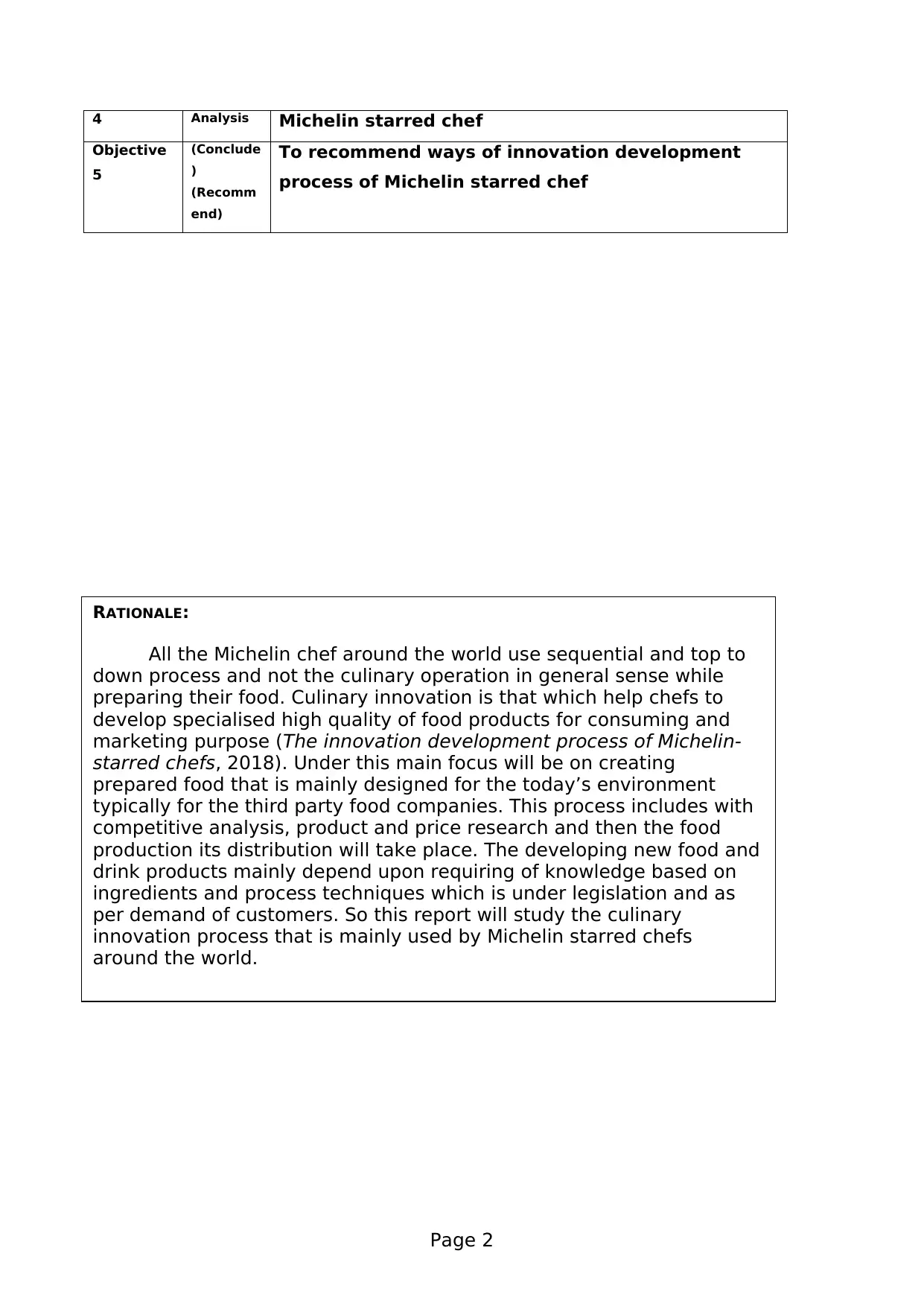
4 Analysis Michelin starred chef
Objective
5
(Conclude
)
(Recomm
end)
To recommend ways of innovation development
process of Michelin starred chef
Page 2
RATIONALE:
All the Michelin chef around the world use sequential and top to
down process and not the culinary operation in general sense while
preparing their food. Culinary innovation is that which help chefs to
develop specialised high quality of food products for consuming and
marketing purpose (The innovation development process of Michelin-
starred chefs, 2018). Under this main focus will be on creating
prepared food that is mainly designed for the today’s environment
typically for the third party food companies. This process includes with
competitive analysis, product and price research and then the food
production its distribution will take place. The developing new food and
drink products mainly depend upon requiring of knowledge based on
ingredients and process techniques which is under legislation and as
per demand of customers. So this report will study the culinary
innovation process that is mainly used by Michelin starred chefs
around the world.
Objective
5
(Conclude
)
(Recomm
end)
To recommend ways of innovation development
process of Michelin starred chef
Page 2
RATIONALE:
All the Michelin chef around the world use sequential and top to
down process and not the culinary operation in general sense while
preparing their food. Culinary innovation is that which help chefs to
develop specialised high quality of food products for consuming and
marketing purpose (The innovation development process of Michelin-
starred chefs, 2018). Under this main focus will be on creating
prepared food that is mainly designed for the today’s environment
typically for the third party food companies. This process includes with
competitive analysis, product and price research and then the food
production its distribution will take place. The developing new food and
drink products mainly depend upon requiring of knowledge based on
ingredients and process techniques which is under legislation and as
per demand of customers. So this report will study the culinary
innovation process that is mainly used by Michelin starred chefs
around the world.

3) THEORETICAL FRAMEWORK
Page 3
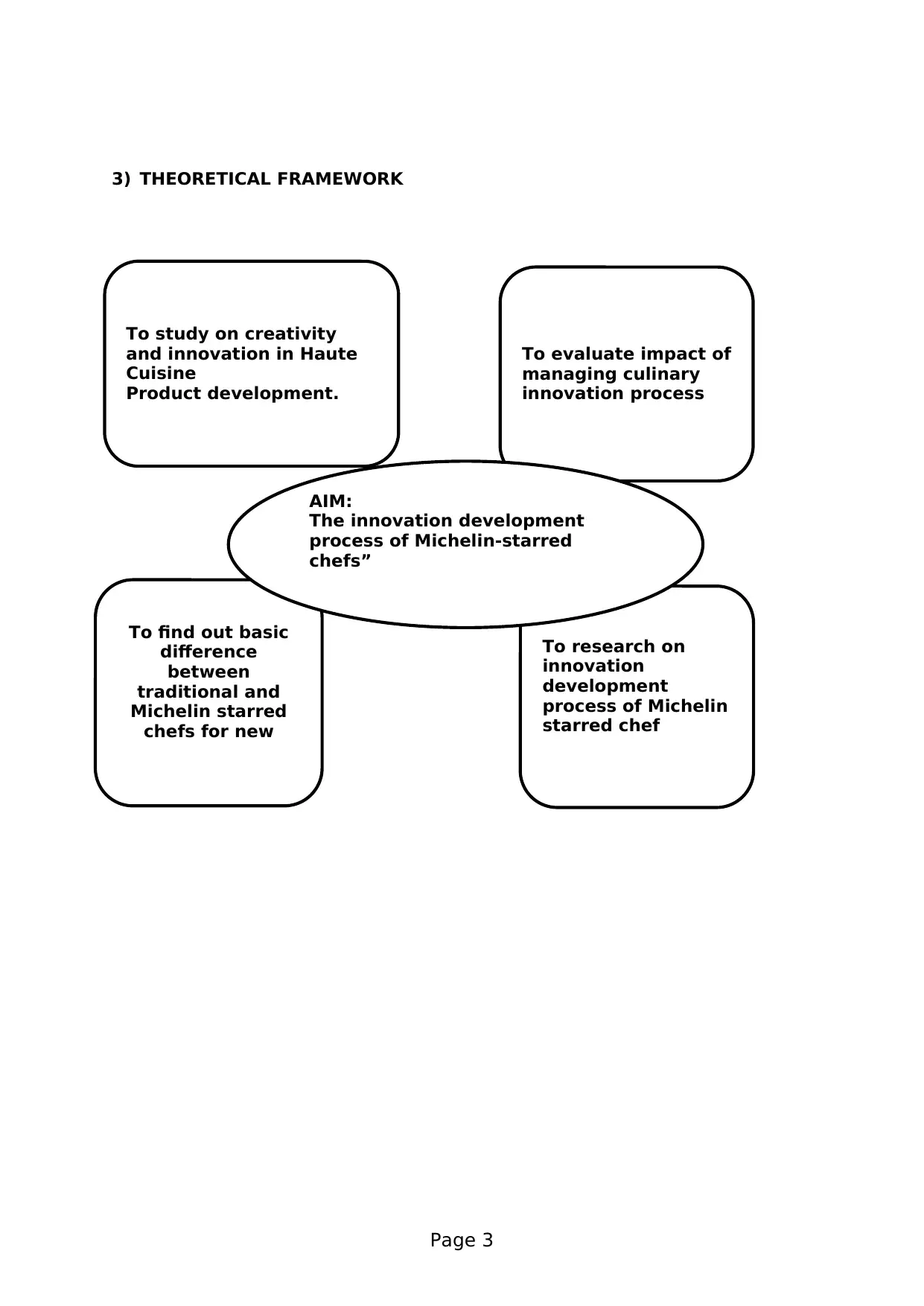
To study on creativity
and innovation in Haute
Cuisine
Product development.
To evaluate impact of
managing culinary
innovation process
To find out basic
difference
between
traditional and
Michelin starred
chefs for new
To research on
innovation
development
process of Michelin
starred chef
AIM:
The innovation development
process of Michelin-starred
chefs”
Page 3
To study on creativity
and innovation in Haute
Cuisine
Product development.
To evaluate impact of
managing culinary
innovation process
To find out basic
difference
between
traditional and
Michelin starred
chefs for new
To research on
innovation
development
process of Michelin
starred chef
AIM:
The innovation development
process of Michelin-starred
chefs”
⊘ This is a preview!⊘
Do you want full access?
Subscribe today to unlock all pages.

Trusted by 1+ million students worldwide

4) TOPIC CHOICE MATRIX
What key terms/concepts will you
use in your work:
Innovation in culinary process
New product development
What theory/models will be
applied in your work:
The Innovation Development Process
of Michelin-starred Chefs
What data or information will you
need to collect for your research?
The data related to culinary process
and product development based on
new innovation process of Michelin
starred chefs
What will you need to consider for
Primary research and data
collation?
The primary data is collected by
10 students and 5 staff members
of UC Berkeley of Birmingham.
Measurement – How will you
measure your data? Trends, pro’s
v con’s, SWOT, Buyer behaviors,
etc.
Data will be measured using
qualitative research analyses methods
like that of thematic analysis
Contribution: to whom and why
will your research be of interest
(or of use)?
This data and research is very much
important for students who are
pursuing their Culinary Arts
Page 4
What key terms/concepts will you
use in your work:
Innovation in culinary process
New product development
What theory/models will be
applied in your work:
The Innovation Development Process
of Michelin-starred Chefs
What data or information will you
need to collect for your research?
The data related to culinary process
and product development based on
new innovation process of Michelin
starred chefs
What will you need to consider for
Primary research and data
collation?
The primary data is collected by
10 students and 5 staff members
of UC Berkeley of Birmingham.
Measurement – How will you
measure your data? Trends, pro’s
v con’s, SWOT, Buyer behaviors,
etc.
Data will be measured using
qualitative research analyses methods
like that of thematic analysis
Contribution: to whom and why
will your research be of interest
(or of use)?
This data and research is very much
important for students who are
pursuing their Culinary Arts
Page 4
Paraphrase This Document
Need a fresh take? Get an instant paraphrase of this document with our AI Paraphraser

Management from
University College Birmingham.
PLANNED RESEARCH METHODS:
Data collection
Data collection means gathering and sorting of all information or facts
and figures which will be required by researchers for conducting their
research on given topic. Under this type of data collection secondary data
will be collected on analysing various innovation into process of Michelin
starred chefs in world. This type will be containing many books, website
articles and journals which are based on this culinary innovation process
(The Culinary Innovation Process: A Study of Michelin-Starred Chefs, 2018).
Whereas the primary data is collected by 10 students and 5 staff members
of UC Berkeley of Birmingham.
Data analysis
Data analysis is that part of research which related to formulating
research aims and objectives and then interpreting the collected data in
accordance with aim set. So within this research qualitative type of data
analysis technique is used which will be finding out new process innovation
within Michelin starred chefs.
LITERATURE REVIEW:
Page 5
University College Birmingham.
PLANNED RESEARCH METHODS:
Data collection
Data collection means gathering and sorting of all information or facts
and figures which will be required by researchers for conducting their
research on given topic. Under this type of data collection secondary data
will be collected on analysing various innovation into process of Michelin
starred chefs in world. This type will be containing many books, website
articles and journals which are based on this culinary innovation process
(The Culinary Innovation Process: A Study of Michelin-Starred Chefs, 2018).
Whereas the primary data is collected by 10 students and 5 staff members
of UC Berkeley of Birmingham.
Data analysis
Data analysis is that part of research which related to formulating
research aims and objectives and then interpreting the collected data in
accordance with aim set. So within this research qualitative type of data
analysis technique is used which will be finding out new process innovation
within Michelin starred chefs.
LITERATURE REVIEW:
Page 5

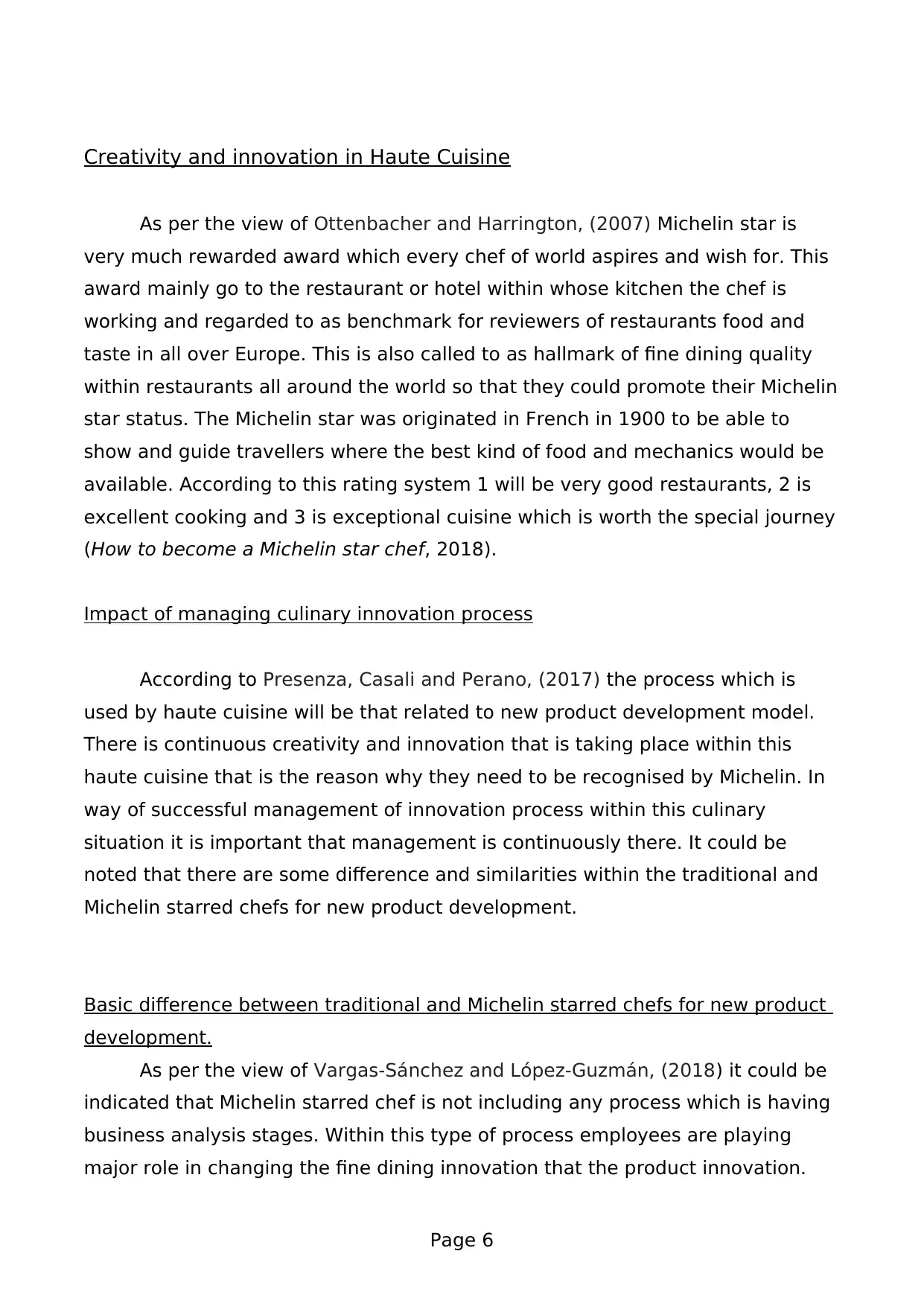
Creativity and innovation in Haute Cuisine
As per the view of Ottenbacher and Harrington, (2007) Michelin star is
very much rewarded award which every chef of world aspires and wish for. This
award mainly go to the restaurant or hotel within whose kitchen the chef is
working and regarded to as benchmark for reviewers of restaurants food and
taste in all over Europe. This is also called to as hallmark of fine dining quality
within restaurants all around the world so that they could promote their Michelin
star status. The Michelin star was originated in French in 1900 to be able to
show and guide travellers where the best kind of food and mechanics would be
available. According to this rating system 1 will be very good restaurants, 2 is
excellent cooking and 3 is exceptional cuisine which is worth the special journey
(How to become a Michelin star chef, 2018).
Impact of managing culinary innovation process
According to Presenza, Casali and Perano, (2017) the process which is
used by haute cuisine will be that related to new product development model.
There is continuous creativity and innovation that is taking place within this
haute cuisine that is the reason why they need to be recognised by Michelin. In
way of successful management of innovation process within this culinary
situation it is important that management is continuously there. It could be
noted that there are some difference and similarities within the traditional and
Michelin starred chefs for new product development.
Basic difference between traditional and Michelin starred chefs for new product
development.
As per the view of Vargas-Sánchez and López-Guzmán, (2018) it could be
indicated that Michelin starred chef is not including any process which is having
business analysis stages. Within this type of process employees are playing
major role in changing the fine dining innovation that the product innovation.
Page 6
As per the view of Ottenbacher and Harrington, (2007) Michelin star is
very much rewarded award which every chef of world aspires and wish for. This
award mainly go to the restaurant or hotel within whose kitchen the chef is
working and regarded to as benchmark for reviewers of restaurants food and
taste in all over Europe. This is also called to as hallmark of fine dining quality
within restaurants all around the world so that they could promote their Michelin
star status. The Michelin star was originated in French in 1900 to be able to
show and guide travellers where the best kind of food and mechanics would be
available. According to this rating system 1 will be very good restaurants, 2 is
excellent cooking and 3 is exceptional cuisine which is worth the special journey
(How to become a Michelin star chef, 2018).
Impact of managing culinary innovation process
According to Presenza, Casali and Perano, (2017) the process which is
used by haute cuisine will be that related to new product development model.
There is continuous creativity and innovation that is taking place within this
haute cuisine that is the reason why they need to be recognised by Michelin. In
way of successful management of innovation process within this culinary
situation it is important that management is continuously there. It could be
noted that there are some difference and similarities within the traditional and
Michelin starred chefs for new product development.
Basic difference between traditional and Michelin starred chefs for new product
development.
As per the view of Vargas-Sánchez and López-Guzmán, (2018) it could be
indicated that Michelin starred chef is not including any process which is having
business analysis stages. Within this type of process employees are playing
major role in changing the fine dining innovation that the product innovation.
Page 6
⊘ This is a preview!⊘
Do you want full access?
Subscribe today to unlock all pages.

Trusted by 1+ million students worldwide

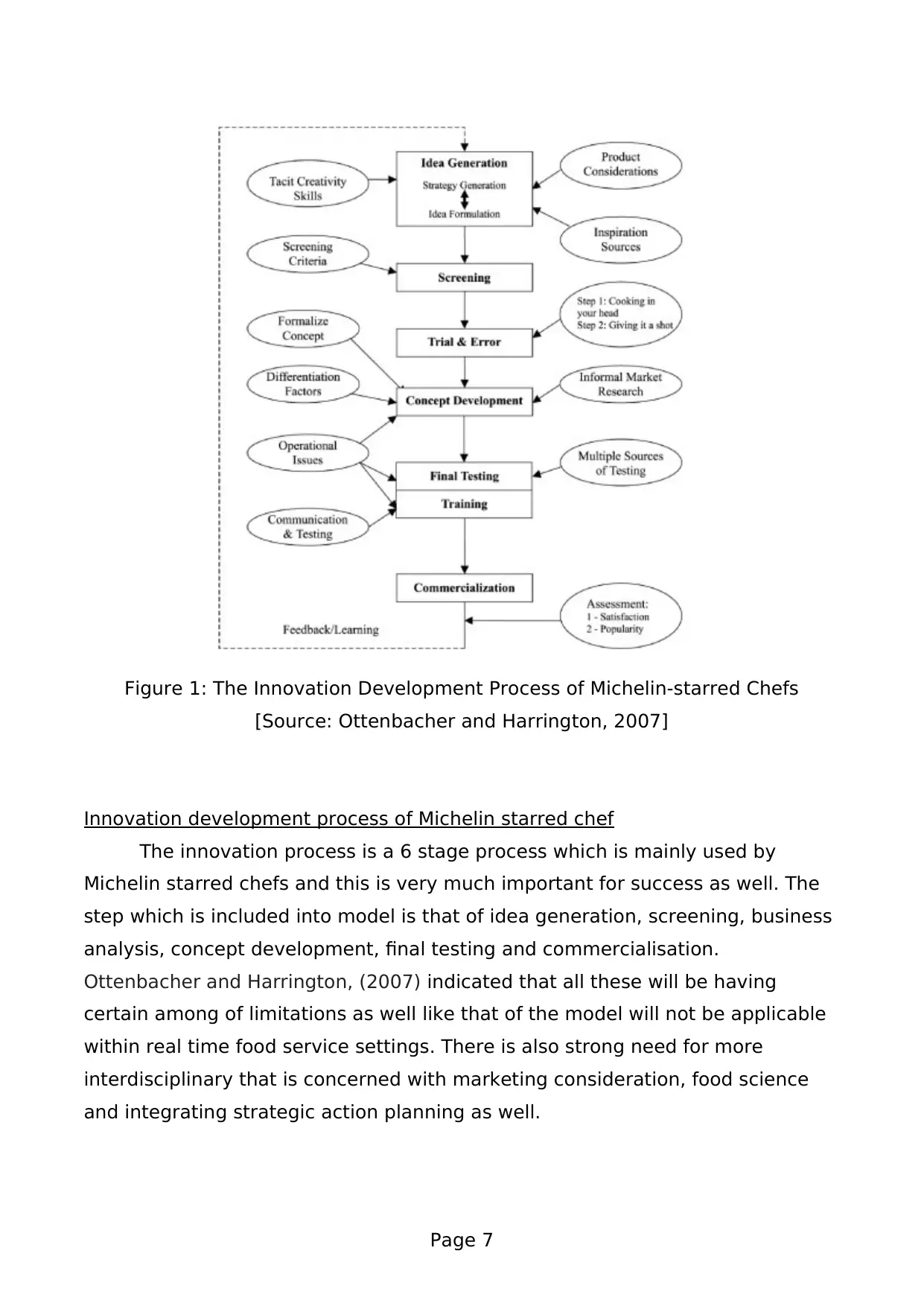
Figure 1: The Innovation Development Process of Michelin-starred Chefs
[Source: Ottenbacher and Harrington, 2007]
Innovation development process of Michelin starred chef
The innovation process is a 6 stage process which is mainly used by
Michelin starred chefs and this is very much important for success as well. The
step which is included into model is that of idea generation, screening, business
analysis, concept development, final testing and commercialisation.
Ottenbacher and Harrington, (2007) indicated that all these will be having
certain among of limitations as well like that of the model will not be applicable
within real time food service settings. There is also strong need for more
interdisciplinary that is concerned with marketing consideration, food science
and integrating strategic action planning as well.
Page 7
[Source: Ottenbacher and Harrington, 2007]
Innovation development process of Michelin starred chef
The innovation process is a 6 stage process which is mainly used by
Michelin starred chefs and this is very much important for success as well. The
step which is included into model is that of idea generation, screening, business
analysis, concept development, final testing and commercialisation.
Ottenbacher and Harrington, (2007) indicated that all these will be having
certain among of limitations as well like that of the model will not be applicable
within real time food service settings. There is also strong need for more
interdisciplinary that is concerned with marketing consideration, food science
and integrating strategic action planning as well.
Page 7
Paraphrase This Document
Need a fresh take? Get an instant paraphrase of this document with our AI Paraphraser

Page 8

LIST OF REFERENCES:
Books and Journals:
Ottenbacher, M. and Harrington, R.J., 2007. The innovation development
process of Michelin-starred chefs. International Journal of
Contemporary Hospitality Management, 19(6), pp.444-460.
Presenza, A., Casali, G.L. and Perano, M., 2017. An innovative approach to
the intellectual property in haute cuisine. International Journal of
Hospitality Management, 65, pp.81-88.
Vargas-Sánchez, A. and López-Guzmán, T., 2018. Protection of Culinary
Knowledge Generation in Michelin-Starred Restaurants. The Spanish
case. International Journal of Gastronomy and Food Science.
Online:
How to become a Michelin star chef. 2018. [Online]: accessed through:
<https://www.chefacademyoflondon.com/en/blog/110-how-to-become-
a-michelin-star-chef.html>.
The Culinary Innovation Process: A Study of Michelin-Starred Chefs. 2018.
[Online]: accessed through:
<https://www.tandfonline.com/doi/abs/10.1300/J385v05n04_02>.
The innovation development process of Michelin-starred chefs. 2018.
[Online]: accessed through: <http://yrkesuniversitet.se/rapporter/The
%20innovation%20development.pdf>.
Page 9
Books and Journals:
Ottenbacher, M. and Harrington, R.J., 2007. The innovation development
process of Michelin-starred chefs. International Journal of
Contemporary Hospitality Management, 19(6), pp.444-460.
Presenza, A., Casali, G.L. and Perano, M., 2017. An innovative approach to
the intellectual property in haute cuisine. International Journal of
Hospitality Management, 65, pp.81-88.
Vargas-Sánchez, A. and López-Guzmán, T., 2018. Protection of Culinary
Knowledge Generation in Michelin-Starred Restaurants. The Spanish
case. International Journal of Gastronomy and Food Science.
Online:
How to become a Michelin star chef. 2018. [Online]: accessed through:
<https://www.chefacademyoflondon.com/en/blog/110-how-to-become-
a-michelin-star-chef.html>.
The Culinary Innovation Process: A Study of Michelin-Starred Chefs. 2018.
[Online]: accessed through:
<https://www.tandfonline.com/doi/abs/10.1300/J385v05n04_02>.
The innovation development process of Michelin-starred chefs. 2018.
[Online]: accessed through: <http://yrkesuniversitet.se/rapporter/The
%20innovation%20development.pdf>.
Page 9
⊘ This is a preview!⊘
Do you want full access?
Subscribe today to unlock all pages.

Trusted by 1+ million students worldwide

Page 10
Paraphrase This Document
Need a fresh take? Get an instant paraphrase of this document with our AI Paraphraser

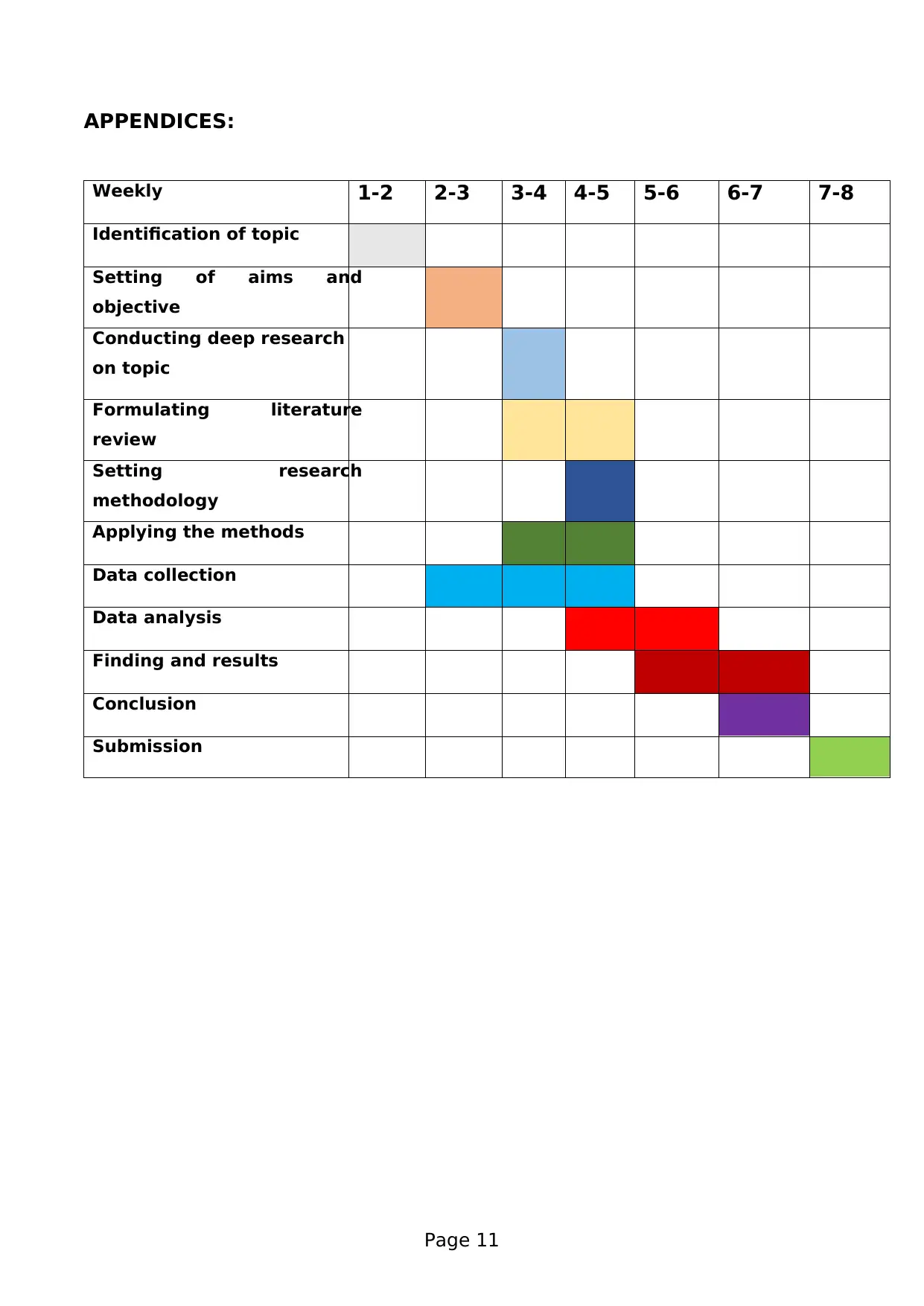
APPENDICES:
Weekly 1-2 2-3 3-4 4-5 5-6 6-7 7-8
Identification of topic
Setting of aims and
objective
Conducting deep research
on topic
Formulating literature
review
Setting research
methodology
Applying the methods
Data collection
Data analysis
Finding and results
Conclusion
Submission
Page 11
Weekly 1-2 2-3 3-4 4-5 5-6 6-7 7-8
Identification of topic
Setting of aims and
objective
Conducting deep research
on topic
Formulating literature
review
Setting research
methodology
Applying the methods
Data collection
Data analysis
Finding and results
Conclusion
Submission
Page 11
1 out of 11
Related Documents
Your All-in-One AI-Powered Toolkit for Academic Success.
+13062052269
info@desklib.com
Available 24*7 on WhatsApp / Email
Unlock your academic potential
Copyright © 2020–2026 A2Z Services. All Rights Reserved. Developed and managed by ZUCOL.