Strategic Management Report: Analysis of Indian Tire Industry
VerifiedAdded on 2022/09/09
|14
|2802
|16
Report
AI Summary
This report offers a comprehensive strategic analysis of the Indian tire industry, examining its key characteristics, competitive dynamics, and the strategies of major players. It begins with a five forces analysis of the tire industry, exploring the bargaining power of suppliers and buyers, the threat of substitutes and new entrants, and industry rivalry. The report then provides an overview of the Indian tire industry's contribution to the economy, including market segmentation and the strategies of key players like MRF, Apollo Tires, JK Tire, CEAT, Falcon, and TVS Srichakra. It also includes SWOT analysis of Michelin and competitive grid analysis, alongside industry matrix to evaluate the performance of different companies. The report highlights the strategies employed by different companies, their market share, and return on equity. The report also discusses the marketing strategies used by key players in the Indian tire industry.
Running head: STRATEGIC MANAGEMENT
STRATEGIC MANAGEMENT
Name of the Student
Name of the University
Author Note
STRATEGIC MANAGEMENT
Name of the Student
Name of the University
Author Note

Paraphrase This Document
Need a fresh take? Get an instant paraphrase of this document with our AI Paraphraser
1
STRATEGIC MANAGEMENT
Table of Contents
Answer to question 1:.................................................................................................................2
Answer to question 2:.................................................................................................................3
Answer to question 3:.................................................................................................................4
Answer to question 4:.................................................................................................................5
Answer to question 5:.................................................................................................................5
Answer to question 6:.................................................................................................................6
SWOT analysis of Michelin...................................................................................................7
References..................................................................................................................................8
STRATEGIC MANAGEMENT
Table of Contents
Answer to question 1:.................................................................................................................2
Answer to question 2:.................................................................................................................3
Answer to question 3:.................................................................................................................4
Answer to question 4:.................................................................................................................5
Answer to question 5:.................................................................................................................5
Answer to question 6:.................................................................................................................6
SWOT analysis of Michelin...................................................................................................7
References..................................................................................................................................8
2
STRATEGIC MANAGEMENT
Answer to question 1:
The five force analysis of the Tire Industry:
1. Bargaining power of the supplier: The bargaining power of suppliers can be divided into
two parts:
Rubber: There are several reasons for this; one of the reasons is that the firms do get 150 days
of credit from the international market, which is for the buying of rubber. At the time of
buying from the local merchants, it does not happen (Parthasarathy, Momaya & Jha, 2016).
Another reason which has been noted is that the credit which has been provided to then is at
the LIBOR rate.
Other Petro chemical-based material: The suppliers do have much more power, as per the
case of raw materials, which are carbon black, and the chemicals which are low in quality, in
the case of petro.
2. Bargaining power of the buyers:
OEM's: The OEMs do have a strong position at the time concerning the bargaining power of
buyers. Some of the reason behind is that they do have a contact which is related to the tire
manufacturer which can be seen that they are under the stable prices for the OEMs, and it
does not depend upon the market price (Singh & Kaur, 2019). Several benefits can be seen at
the time of buying them in bulk quantity.
Replacement: In this segment, it can be seen that it can be entirely reverse in the replacement
segment, which is moderate, as the matter of the fact that the bargaining power of buyers is
not substantial if it is compared to the OEM. As the road conditions in India are not right,
there is always a high demand for the bus and truck segment.
STRATEGIC MANAGEMENT
Answer to question 1:
The five force analysis of the Tire Industry:
1. Bargaining power of the supplier: The bargaining power of suppliers can be divided into
two parts:
Rubber: There are several reasons for this; one of the reasons is that the firms do get 150 days
of credit from the international market, which is for the buying of rubber. At the time of
buying from the local merchants, it does not happen (Parthasarathy, Momaya & Jha, 2016).
Another reason which has been noted is that the credit which has been provided to then is at
the LIBOR rate.
Other Petro chemical-based material: The suppliers do have much more power, as per the
case of raw materials, which are carbon black, and the chemicals which are low in quality, in
the case of petro.
2. Bargaining power of the buyers:
OEM's: The OEMs do have a strong position at the time concerning the bargaining power of
buyers. Some of the reason behind is that they do have a contact which is related to the tire
manufacturer which can be seen that they are under the stable prices for the OEMs, and it
does not depend upon the market price (Singh & Kaur, 2019). Several benefits can be seen at
the time of buying them in bulk quantity.
Replacement: In this segment, it can be seen that it can be entirely reverse in the replacement
segment, which is moderate, as the matter of the fact that the bargaining power of buyers is
not substantial if it is compared to the OEM. As the road conditions in India are not right,
there is always a high demand for the bus and truck segment.
⊘ This is a preview!⊘
Do you want full access?
Subscribe today to unlock all pages.

Trusted by 1+ million students worldwide
3
STRATEGIC MANAGEMENT
3. The threat of substitute: The industry does face some of the opposition from the rereading
sector, which is all over the world. In developed countries, the tire cost is much less
compared to others with 20-25 %. India is going to have that situation right now.
4. The threat of new entrants: The industry that has been found in that region is highly
intensive as the threat to this is very much moderate, it can be pretended as low, and the
technological expertise is much highly specific (Sharma, 2020). From the industry point
of view, it is usually defined as high. For restructuring, the global tire industry is
interested in mergers and acquisitions. Recently, India and China are involved in several
activities so that it does help them in manufacturing the products with a very much low
production cost that will have some relevant activities (Shanbag & Manjare, 2020). Thus,
it will be a good option for the organizations that do operate in India to have some
spotlight over them.
5. Industry rivalry: The industry rivalry is at a much higher rate in the Indian tire industry,
and it is also limited as most of the players do sue the automated technology, which does
include ERP and SCM. There are several reasons for which the industry structure is seen
in a much more competitive, some of the reasons are rise in the high-cost inputs, there is
very much profound realization in which the vehicle manufacturers do have the burden in
the tire firms, and the other portion is being taken by rereading sector which does have a
prolonged rate of growth; still, it is rising firmly (Gupta, Narayanamurthy & Acharya,
2018). The unorganized sector does give a headache to some of the established players
like the Apollo, JK, CEAT, and MRF.
Answer to question 2:
One of the integral parts of the automobile sector is the Indian tire industry. It does
help in the contribution of 3% of manufacturing GDP and 5% of total GDP directly. There is
STRATEGIC MANAGEMENT
3. The threat of substitute: The industry does face some of the opposition from the rereading
sector, which is all over the world. In developed countries, the tire cost is much less
compared to others with 20-25 %. India is going to have that situation right now.
4. The threat of new entrants: The industry that has been found in that region is highly
intensive as the threat to this is very much moderate, it can be pretended as low, and the
technological expertise is much highly specific (Sharma, 2020). From the industry point
of view, it is usually defined as high. For restructuring, the global tire industry is
interested in mergers and acquisitions. Recently, India and China are involved in several
activities so that it does help them in manufacturing the products with a very much low
production cost that will have some relevant activities (Shanbag & Manjare, 2020). Thus,
it will be a good option for the organizations that do operate in India to have some
spotlight over them.
5. Industry rivalry: The industry rivalry is at a much higher rate in the Indian tire industry,
and it is also limited as most of the players do sue the automated technology, which does
include ERP and SCM. There are several reasons for which the industry structure is seen
in a much more competitive, some of the reasons are rise in the high-cost inputs, there is
very much profound realization in which the vehicle manufacturers do have the burden in
the tire firms, and the other portion is being taken by rereading sector which does have a
prolonged rate of growth; still, it is rising firmly (Gupta, Narayanamurthy & Acharya,
2018). The unorganized sector does give a headache to some of the established players
like the Apollo, JK, CEAT, and MRF.
Answer to question 2:
One of the integral parts of the automobile sector is the Indian tire industry. It does
help in the contribution of 3% of manufacturing GDP and 5% of total GDP directly. There is
Paraphrase This Document
Need a fresh take? Get an instant paraphrase of this document with our AI Paraphraser
4
STRATEGIC MANAGEMENT
a massive rise in the automobile sector as global manufacturers are trying to invest in Indian
organizations. Thus, there is a share in rising for global automobile production and
investment of the global tire industry projects that do help in reaching out to the world.
In recent years, it can be seen that there is an increase in synthetic rubber in India. As
the tire production is increasing in a much faster way, several production units are growing
day by day, and so there is an increase in the competition. However, there is enough demand
for tire, both nationally and internationally (Balachandran, 2017). As per the current scenario,
the monopoly power is being determined through its ability for the non-pricing strategies
(Narayanamurthy et al., 2019). There are estimates of the organization's level monopoly
power, in which the differences in prices over the cost has been measured in several ways.
Thus, to maximize profits, it is usually based on the margins rather than the volumes of the
other aspects.
Answer to question 3:
The strategy which the tire industry uses is balanced and unique, which does have a
mix of both the B2B and B2C market segments. In the case of OEMs, it does help in the
representation of the B2B segment, where the automobile manufacturers are treated as
automobile manufacturers, for which this segment does not require marketing strategies in
detail (Jha et al., 2019). There is also a replacement category, which is the B2C segment, and
it requires to use extensive marketing strategies.
One of the oldest and leading players of the tire industry is CEAT. One of the
marketing strategies which the entity does use after many years is 'BE IDIOT PROOF,' in
which the advertisement has been showcased in such a way that will be like a solution to the
biker's problem and does establish the product for the most relevant tire brand for the bikers
STRATEGIC MANAGEMENT
a massive rise in the automobile sector as global manufacturers are trying to invest in Indian
organizations. Thus, there is a share in rising for global automobile production and
investment of the global tire industry projects that do help in reaching out to the world.
In recent years, it can be seen that there is an increase in synthetic rubber in India. As
the tire production is increasing in a much faster way, several production units are growing
day by day, and so there is an increase in the competition. However, there is enough demand
for tire, both nationally and internationally (Balachandran, 2017). As per the current scenario,
the monopoly power is being determined through its ability for the non-pricing strategies
(Narayanamurthy et al., 2019). There are estimates of the organization's level monopoly
power, in which the differences in prices over the cost has been measured in several ways.
Thus, to maximize profits, it is usually based on the margins rather than the volumes of the
other aspects.
Answer to question 3:
The strategy which the tire industry uses is balanced and unique, which does have a
mix of both the B2B and B2C market segments. In the case of OEMs, it does help in the
representation of the B2B segment, where the automobile manufacturers are treated as
automobile manufacturers, for which this segment does not require marketing strategies in
detail (Jha et al., 2019). There is also a replacement category, which is the B2C segment, and
it requires to use extensive marketing strategies.
One of the oldest and leading players of the tire industry is CEAT. One of the
marketing strategies which the entity does use after many years is 'BE IDIOT PROOF,' in
which the advertisement has been showcased in such a way that will be like a solution to the
biker's problem and does establish the product for the most relevant tire brand for the bikers
5
STRATEGIC MANAGEMENT
(Thomas, 2017). The organization also wants to increase its presence in the bike segment,
which is one of the biggest in that industry.
Answer to question 4:
The tire industry now has a total of 40 manufacturers, which is dominated by the top
10 manufacturers. Furthermore, it has been divided into six categories, which is also based on
the different auto segments (Singh, 2017). There are three major sectors, in which there is a
basis of volume which has been consumed; they are two-wheelers, buses, and trucks. In the
market, it is being segmented by the tractors, LCV, trucks and buses, passenger cars, and
two-wheelers.
Answer to question 5:
MRF India Ltd.: MRF is one of the organizations that has adapted many changes in
the market needs; there has been emergence over the market leader, which is across the three
major sectors. It does have concentrated in the aggressive brand promotion and do sponsor
and promote events which is one of the significant parts of marketing strategies.
Apollo Tires Ltd.: The organization does use strategic thinking, which is one of the
steps for the marketing strategy. There is a skillful analysis of the trend which will not affect
their market size (Pai et al., 2018). Apollo is known for their excellent product and service
planning and in distribution networks. It has also invested an extra amount for marketing and
promotion.
JK Tire and Industries Ltd.: The entity does have a focus on the passenger car
segment and is the market leader for that segment. The consumer of this organization does
cover the Original Equipment Manufacturers, which will also include the defense and state
STRATEGIC MANAGEMENT
(Thomas, 2017). The organization also wants to increase its presence in the bike segment,
which is one of the biggest in that industry.
Answer to question 4:
The tire industry now has a total of 40 manufacturers, which is dominated by the top
10 manufacturers. Furthermore, it has been divided into six categories, which is also based on
the different auto segments (Singh, 2017). There are three major sectors, in which there is a
basis of volume which has been consumed; they are two-wheelers, buses, and trucks. In the
market, it is being segmented by the tractors, LCV, trucks and buses, passenger cars, and
two-wheelers.
Answer to question 5:
MRF India Ltd.: MRF is one of the organizations that has adapted many changes in
the market needs; there has been emergence over the market leader, which is across the three
major sectors. It does have concentrated in the aggressive brand promotion and do sponsor
and promote events which is one of the significant parts of marketing strategies.
Apollo Tires Ltd.: The organization does use strategic thinking, which is one of the
steps for the marketing strategy. There is a skillful analysis of the trend which will not affect
their market size (Pai et al., 2018). Apollo is known for their excellent product and service
planning and in distribution networks. It has also invested an extra amount for marketing and
promotion.
JK Tire and Industries Ltd.: The entity does have a focus on the passenger car
segment and is the market leader for that segment. The consumer of this organization does
cover the Original Equipment Manufacturers, which will also include the defense and state
⊘ This is a preview!⊘
Do you want full access?
Subscribe today to unlock all pages.
Trusted by 1+ million students worldwide
6
STRATEGIC MANAGEMENT
transportation units and four-wheelers vehicles. Some consumers will have more than 45
countries across the six continents (Swain, Dash & Kumar, 2017). The marketing strategy
does include some of the sporting events, some of them are J K Tire National Racing
Championship and another formula one event.
CEAT Ltd.: It is the second-largest tire manufacturer in India, it is the most active in
the segment of the Truck and Bus and passenger car categories. The organization does have
34 regional offices that do have more than 3500 dealers (Anand, 2018). There are also CEAT
Shoppe outlets that are usually for the passenger car segments, which is almost in 100
numbers. Also, 96 dealers run the CEAT HUBs for the segment of trucks and bus segments.
It does have the presence of more than 110 countries.
Falcon Tire: The organization is bought by one of the oldest organizations in India,
i.e., Dunlop India. Thus, it has distributed all the tires in the domestic market, and in the
foreign markets, it has stated itself in the foreign markets (Saxena, Jain & Sharma, 2018).
The organization does have a wide range of tire, which do include commercial vehicles, two-
wheelers, and farm machinery (McCollough, He & Bayramoglu, 2016). It also has long term
partnerships with Yamaha motors, Bajaj Auto and Hero Honda.
TVS Srichakra: It is a leader in the tire and tubes for the two-wheelers. It does
manufacture tire and tubes for the mopeds, scooters, motorcycles, and three-wheelers. It does
have a strong network that consisted of more than 2050 multi-brand dealers across the nation.
Answer to question 6:
MRF India Ltd: market share by value is 21 %. The return on equity for the MRF India is
10.29 %.
STRATEGIC MANAGEMENT
transportation units and four-wheelers vehicles. Some consumers will have more than 45
countries across the six continents (Swain, Dash & Kumar, 2017). The marketing strategy
does include some of the sporting events, some of them are J K Tire National Racing
Championship and another formula one event.
CEAT Ltd.: It is the second-largest tire manufacturer in India, it is the most active in
the segment of the Truck and Bus and passenger car categories. The organization does have
34 regional offices that do have more than 3500 dealers (Anand, 2018). There are also CEAT
Shoppe outlets that are usually for the passenger car segments, which is almost in 100
numbers. Also, 96 dealers run the CEAT HUBs for the segment of trucks and bus segments.
It does have the presence of more than 110 countries.
Falcon Tire: The organization is bought by one of the oldest organizations in India,
i.e., Dunlop India. Thus, it has distributed all the tires in the domestic market, and in the
foreign markets, it has stated itself in the foreign markets (Saxena, Jain & Sharma, 2018).
The organization does have a wide range of tire, which do include commercial vehicles, two-
wheelers, and farm machinery (McCollough, He & Bayramoglu, 2016). It also has long term
partnerships with Yamaha motors, Bajaj Auto and Hero Honda.
TVS Srichakra: It is a leader in the tire and tubes for the two-wheelers. It does
manufacture tire and tubes for the mopeds, scooters, motorcycles, and three-wheelers. It does
have a strong network that consisted of more than 2050 multi-brand dealers across the nation.
Answer to question 6:
MRF India Ltd: market share by value is 21 %. The return on equity for the MRF India is
10.29 %.
Paraphrase This Document
Need a fresh take? Get an instant paraphrase of this document with our AI Paraphraser
7
STRATEGIC MANAGEMENT
Apollo Tires Ltd.: market share by value is 20.5 %. The return on equity for Apollo tires is
7.10 %.
JK Tire and Industries Ltd.: market share by value is 20.3 %. The return on equity for JK
tires is 13 %.
CEAT Ltd.: market share by value is 14 %. The return on equity for CEAT Ltd. is 12.19 %.
Falcon Tire: market share by value is 11 %. The return on equity for Falcon tire is 1.45 %.
TVS Srichakra: market share by value is 15 %. The return on equity for TVS Srichakra is 13
%.
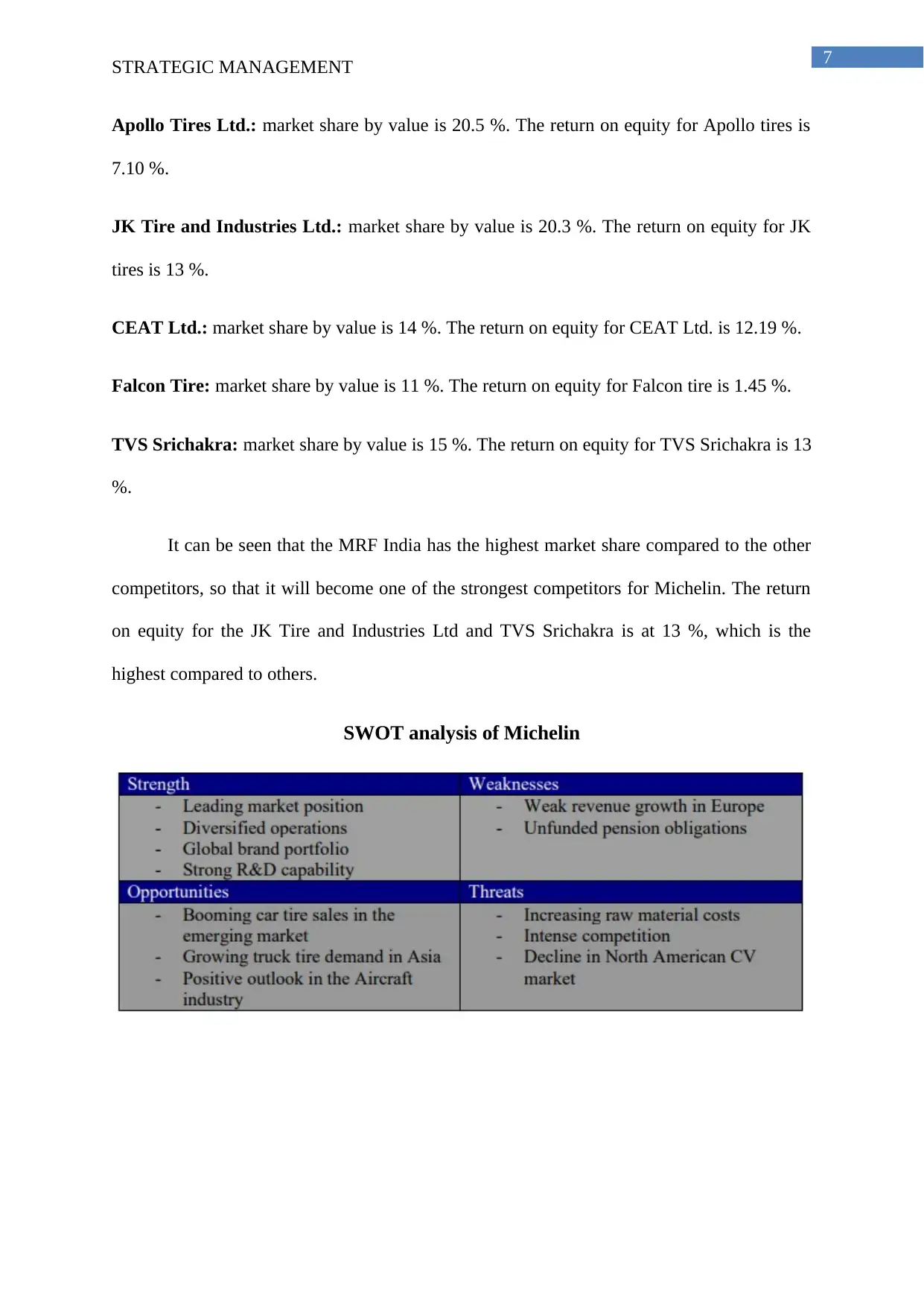
It can be seen that the MRF India has the highest market share compared to the other
competitors, so that it will become one of the strongest competitors for Michelin. The return
on equity for the JK Tire and Industries Ltd and TVS Srichakra is at 13 %, which is the
highest compared to others.
SWOT analysis of Michelin
STRATEGIC MANAGEMENT
Apollo Tires Ltd.: market share by value is 20.5 %. The return on equity for Apollo tires is
7.10 %.
JK Tire and Industries Ltd.: market share by value is 20.3 %. The return on equity for JK
tires is 13 %.
CEAT Ltd.: market share by value is 14 %. The return on equity for CEAT Ltd. is 12.19 %.
Falcon Tire: market share by value is 11 %. The return on equity for Falcon tire is 1.45 %.
TVS Srichakra: market share by value is 15 %. The return on equity for TVS Srichakra is 13
%.
It can be seen that the MRF India has the highest market share compared to the other
competitors, so that it will become one of the strongest competitors for Michelin. The return
on equity for the JK Tire and Industries Ltd and TVS Srichakra is at 13 %, which is the
highest compared to others.
SWOT analysis of Michelin
8
STRATEGIC MANAGEMENT
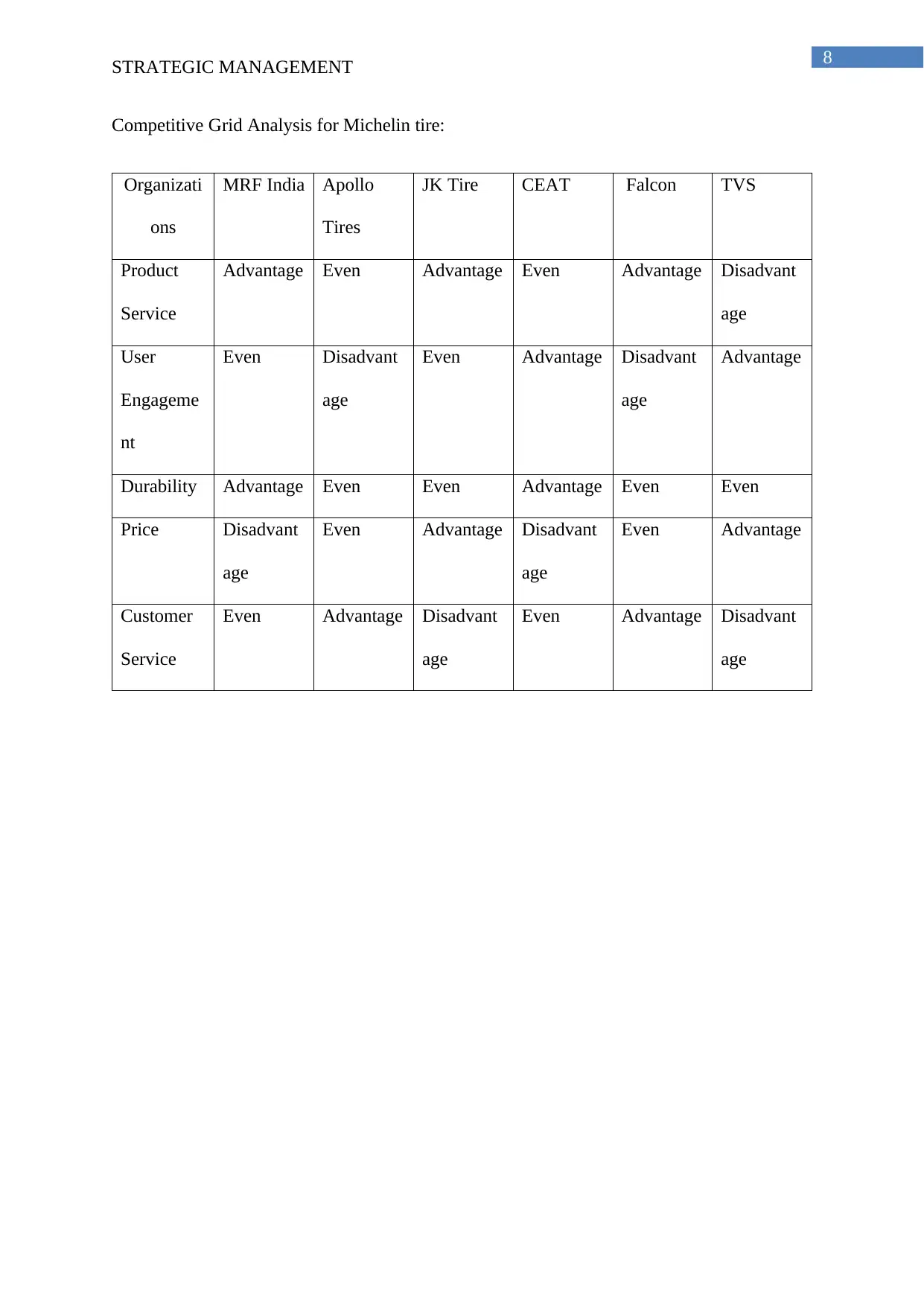
Competitive Grid Analysis for Michelin tire:
Organizati
ons
MRF India Apollo
Tires
JK Tire CEAT Falcon TVS
Product
Service
Advantage Even Advantage Even Advantage Disadvant
age
User
Engageme
nt
Even Disadvant
age
Even Advantage Disadvant
age
Advantage
Durability Advantage Even Even Advantage Even Even
Price Disadvant
age
Even Advantage Disadvant
age
Even Advantage
Customer
Service
Even Advantage Disadvant
age
Even Advantage Disadvant
age
STRATEGIC MANAGEMENT
Competitive Grid Analysis for Michelin tire:
Organizati
ons
MRF India Apollo
Tires
JK Tire CEAT Falcon TVS
Product
Service
Advantage Even Advantage Even Advantage Disadvant
age
User
Engageme
nt
Even Disadvant
age
Even Advantage Disadvant
age
Advantage
Durability Advantage Even Even Advantage Even Even
Price Disadvant
age
Even Advantage Disadvant
age
Even Advantage
Customer
Service
Even Advantage Disadvant
age
Even Advantage Disadvant
age
⊘ This is a preview!⊘
Do you want full access?
Subscribe today to unlock all pages.
Trusted by 1+ million students worldwide
9
STRATEGIC MANAGEMENT
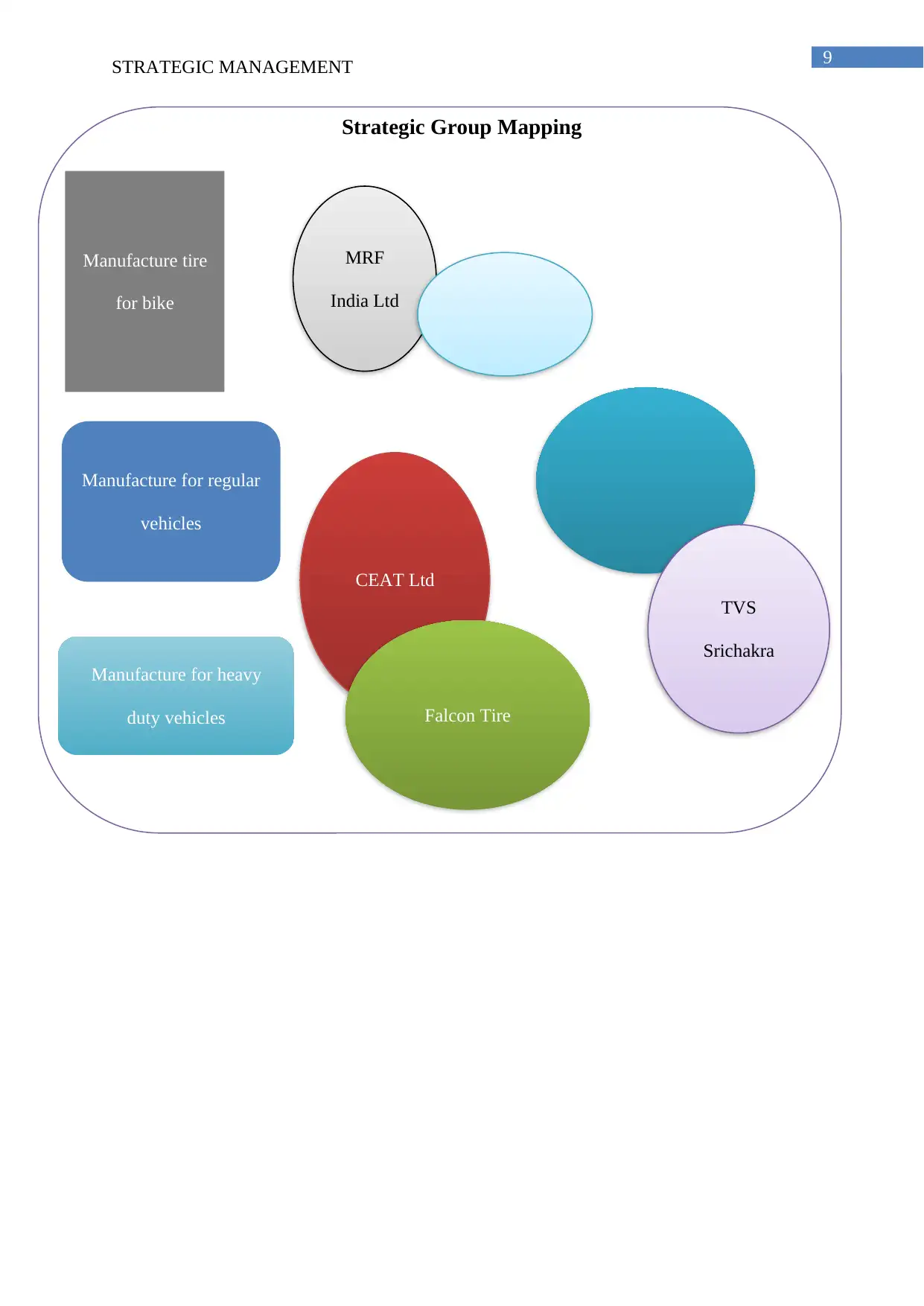
Strategic Group Mapping
MRF
India Ltd
CEAT Ltd
Falcon Tire
TVS
Srichakra
Manufacture tire
for bike
Manufacture for regular
vehicles
Manufacture for heavy
duty vehicles
STRATEGIC MANAGEMENT
Strategic Group Mapping
MRF
India Ltd
CEAT Ltd
Falcon Tire
TVS
Srichakra
Manufacture tire
for bike
Manufacture for regular
vehicles
Manufacture for heavy
duty vehicles
Paraphrase This Document
Need a fresh take? Get an instant paraphrase of this document with our AI Paraphraser
10
STRATEGIC MANAGEMENT
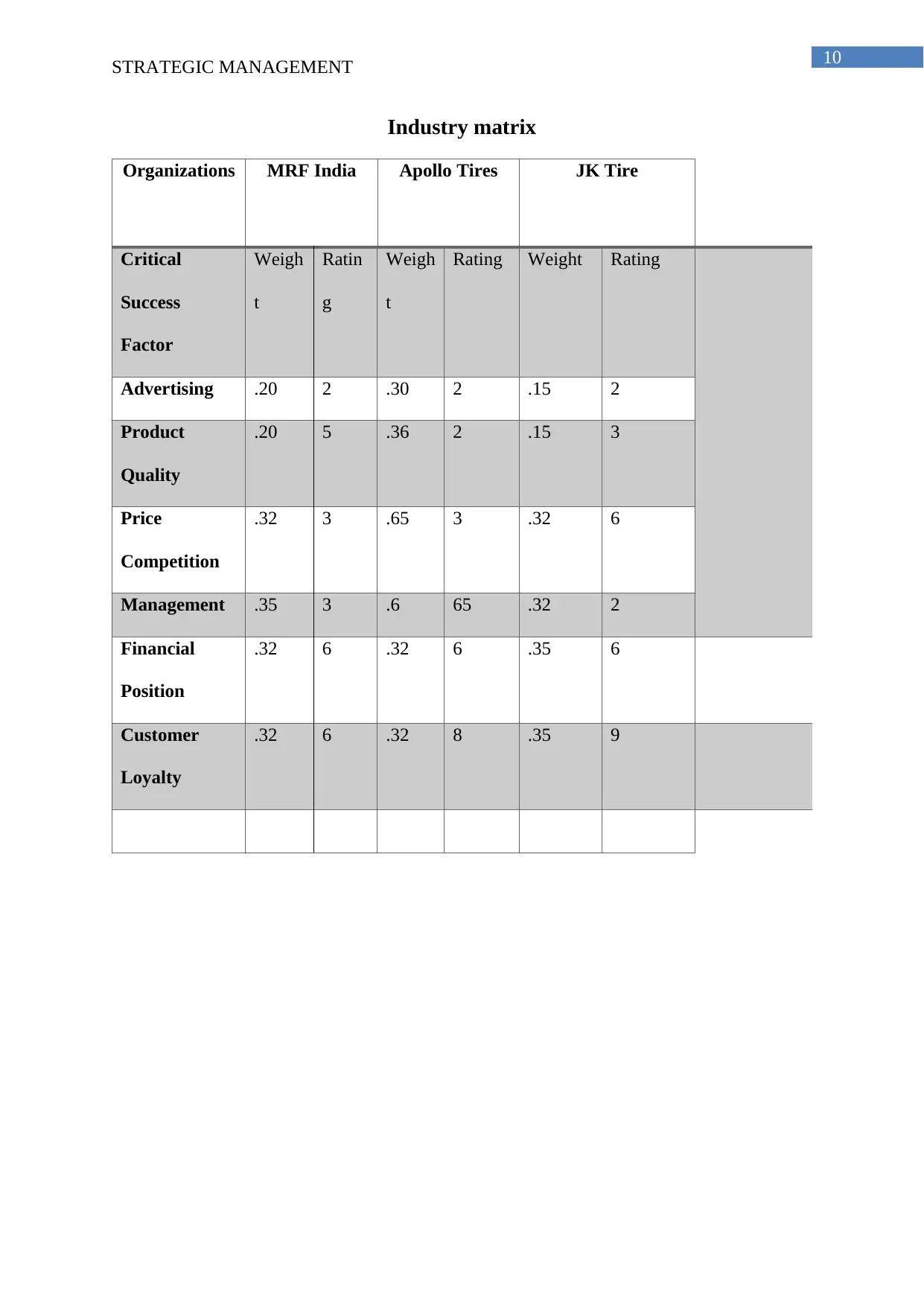
Industry matrix
Organizations MRF India Apollo Tires JK Tire
Critical
Success
Factor
Weigh
t
Ratin
g
Weigh
t
Rating Weight Rating
Advertising .20 2 .30 2 .15 2
Product
Quality
.20 5 .36 2 .15 3
Price
Competition
.32 3 .65 3 .32 6
Management .35 3 .6 65 .32 2
Financial
Position
.32 6 .32 6 .35 6
Customer
Loyalty
.32 6 .32 8 .35 9
STRATEGIC MANAGEMENT
Industry matrix
Organizations MRF India Apollo Tires JK Tire
Critical
Success
Factor
Weigh
t
Ratin
g
Weigh
t
Rating Weight Rating
Advertising .20 2 .30 2 .15 2
Product
Quality
.20 5 .36 2 .15 3
Price
Competition
.32 3 .65 3 .32 6
Management .35 3 .6 65 .32 2
Financial
Position
.32 6 .32 6 .35 6
Customer
Loyalty
.32 6 .32 8 .35 9
11
STRATEGIC MANAGEMENT
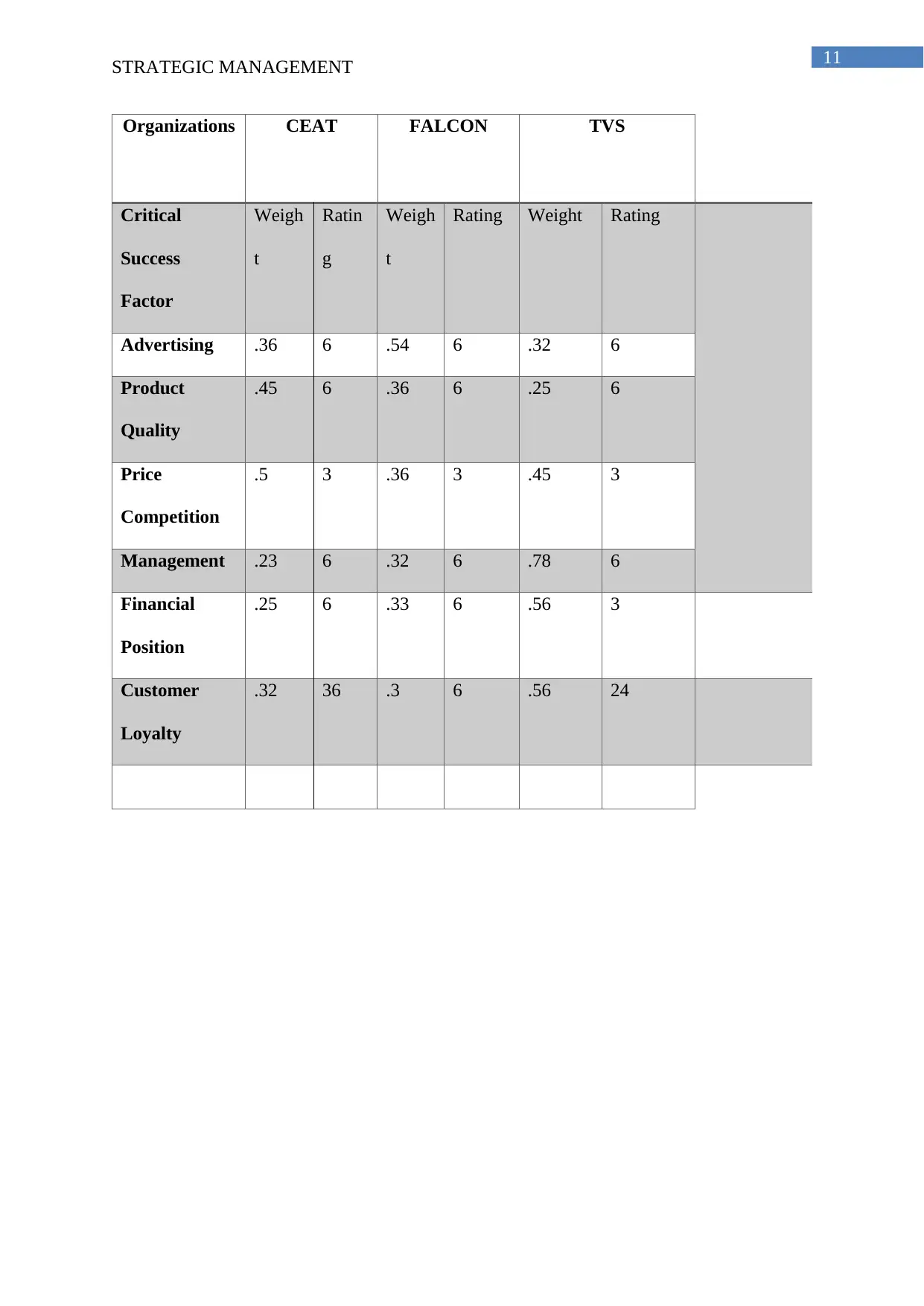
Organizations CEAT FALCON TVS
Critical
Success
Factor
Weigh
t
Ratin
g
Weigh
t
Rating Weight Rating
Advertising .36 6 .54 6 .32 6
Product
Quality
.45 6 .36 6 .25 6
Price
Competition
.5 3 .36 3 .45 3
Management .23 6 .32 6 .78 6
Financial
Position
.25 6 .33 6 .56 3
Customer
Loyalty
.32 36 .3 6 .56 24
STRATEGIC MANAGEMENT
Organizations CEAT FALCON TVS
Critical
Success
Factor
Weigh
t
Ratin
g
Weigh
t
Rating Weight Rating
Advertising .36 6 .54 6 .32 6
Product
Quality
.45 6 .36 6 .25 6
Price
Competition
.5 3 .36 3 .45 3
Management .23 6 .32 6 .78 6
Financial
Position
.25 6 .33 6 .56 3
Customer
Loyalty
.32 36 .3 6 .56 24
⊘ This is a preview!⊘
Do you want full access?
Subscribe today to unlock all pages.
Trusted by 1+ million students worldwide

1 out of 14


Related Documents


Your All-in-One AI-Powered Toolkit for Academic Success.
+13062052269
info@desklib.com
Available 24*7 on WhatsApp / Email
![[object Object]](/_next/static/media/star-bottom.7253800d.svg)
Unlock your academic potential
Copyright © 2020–2026 A2Z Services. All Rights Reserved. Developed and managed by ZUCOL.