Econ 721, Microeconomic Theory I, Assignment 1: Uncertainty Problems

Verified

Added on  2022/10/14

|5
|644
|297
Homework Assignment
AI Summary
This document presents a detailed solution to Assignment 1 for Econ 721: Microeconomic Theory I. The solution addresses several key concepts in microeconomics, including expected utility, risk aversion, and portfolio choice under uncertainty. The assignment explores the preferences of a decision-maker across different lotteries and examines whether these preferences can be represented by an expected utility function. The solution demonstrates the application of stochastic dominance to compare probability distributions and analyzes the investment decisions of a risk-averse investor with decreasing relative risk aversion. Furthermore, the assignment delves into asset pricing and portfolio optimization, demonstrating the conditions under which an investor will allocate wealth into risky assets and the effects of changes in wealth on savings. The solution includes mathematical derivations and explanations to support the conclusions, providing a comprehensive understanding of the underlying economic principles.
Document Page
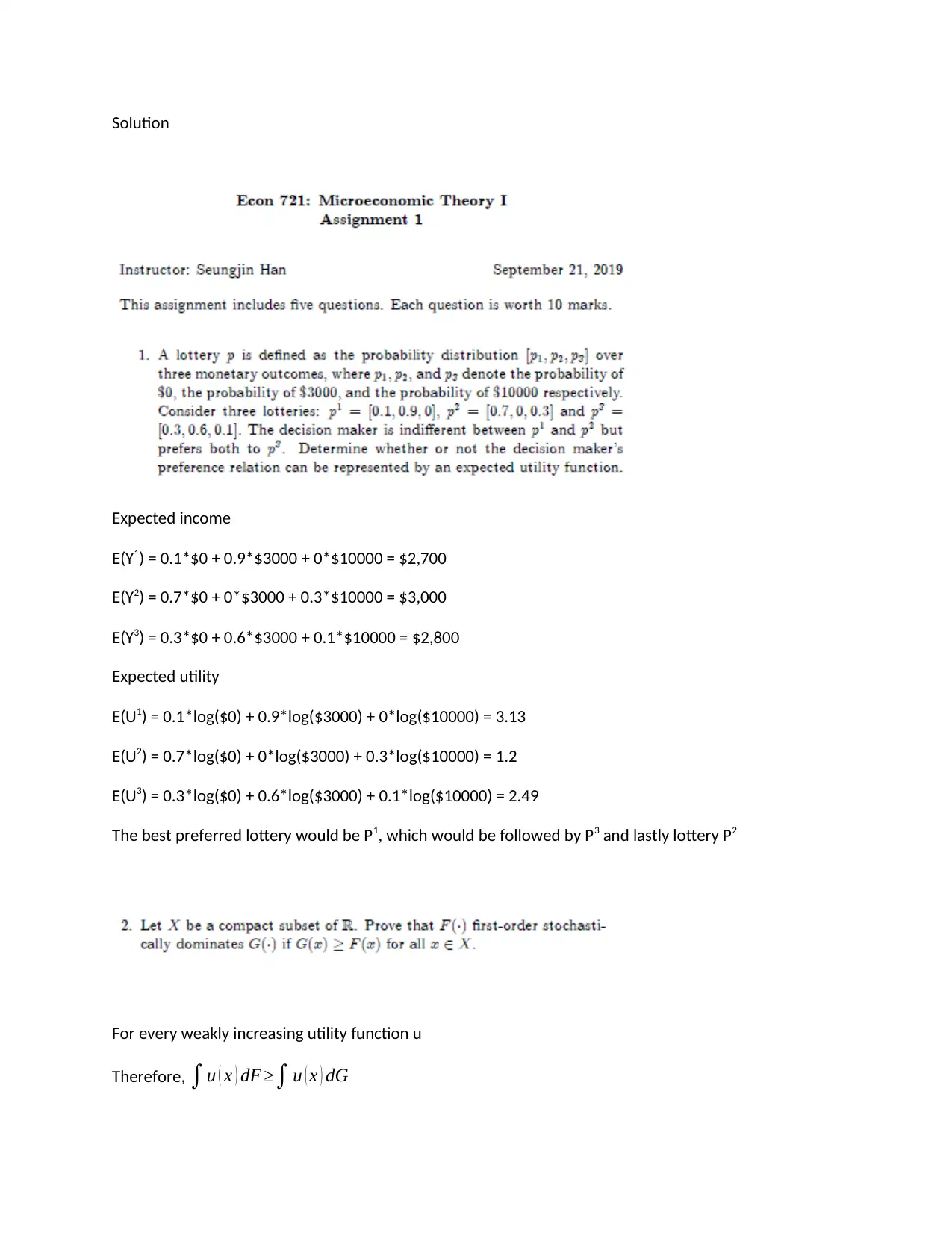
Solution
Expected income
E(Y1) = 0.1*$0 + 0.9*$3000 + 0*$10000 = $2,700
E(Y2) = 0.7*$0 + 0*$3000 + 0.3*$10000 = $3,000
E(Y3) = 0.3*$0 + 0.6*$3000 + 0.1*$10000 = $2,800
Expected utility
E(U1) = 0.1*log($0) + 0.9*log($3000) + 0*log($10000) = 3.13
E(U2) = 0.7*log($0) + 0*log($3000) + 0.3*log($10000) = 1.2
E(U3) = 0.3*log($0) + 0.6*log($3000) + 0.1*log($10000) = 2.49
The best preferred lottery would be P1, which would be followed by P3 and lastly lottery P2
For every weakly increasing utility function u
Therefore, u ( x ) dF u ( x ) dG
tabler-icon-diamond-filled.svg

Paraphrase This Document

Need a fresh take? Get an instant paraphrase of this document with our AI Paraphraser
Document Page
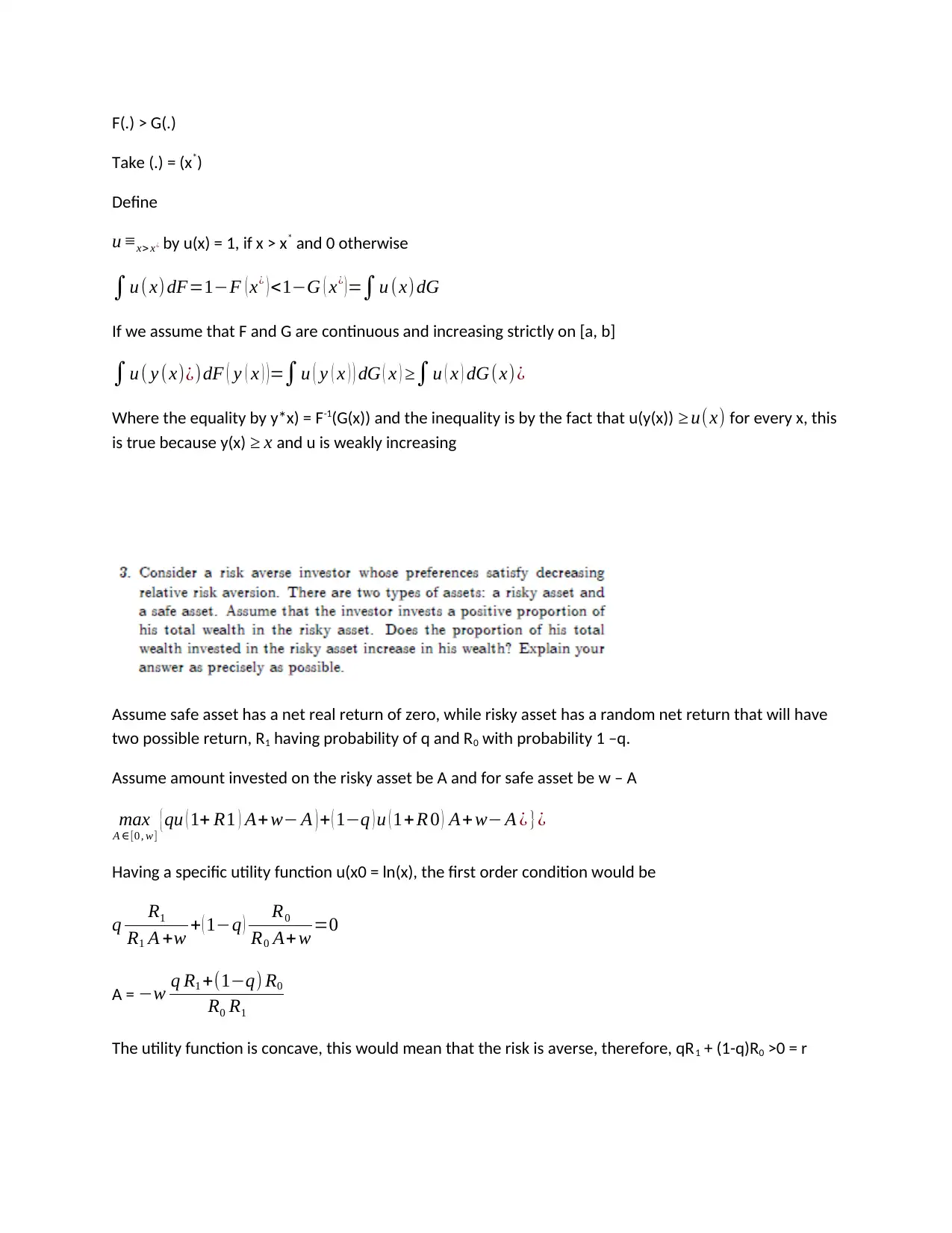
F(.) > G(.)
Take (.) = (x*)
Define
u x> x¿ by u(x) = 1, if x > x* and 0 otherwise
u ( x) dF=1F ( x¿ ) <1G ( x¿ ) =u (x) dG
If we assume that F and G are continuous and increasing strictly on [a, b]
u ( y (x)¿)dF ( y ( x ) ) =u ( y ( x ) ) dG ( x ) u ( x ) dG (x)¿
Where the equality by y*x) = F-1(G(x)) and the inequality is by the fact that u(y(x)) u(x) for every x, this
is true because y(x) x and u is weakly increasing
Assume safe asset has a net real return of zero, while risky asset has a random net return that will have
two possible return, R1 having probability of q and R0 with probability 1 –q.
Assume amount invested on the risky asset be A and for safe asset be w – A
max
A [0 , w]
{qu ( 1+ R1 ) A+ w A ) + ( 1q ) u ( 1+ R 0 ) A+ w A ¿ }¿
Having a specific utility function u(x0 = ln(x), the first order condition would be
q R1
R1 A +w + ( 1q ) R0
R0 A+ w =0
A = w q R1 +(1q) R0
R0 R1
The utility function is concave, this would mean that the risk is averse, therefore, qR1 + (1-q)R0 >0 = r
Document Page
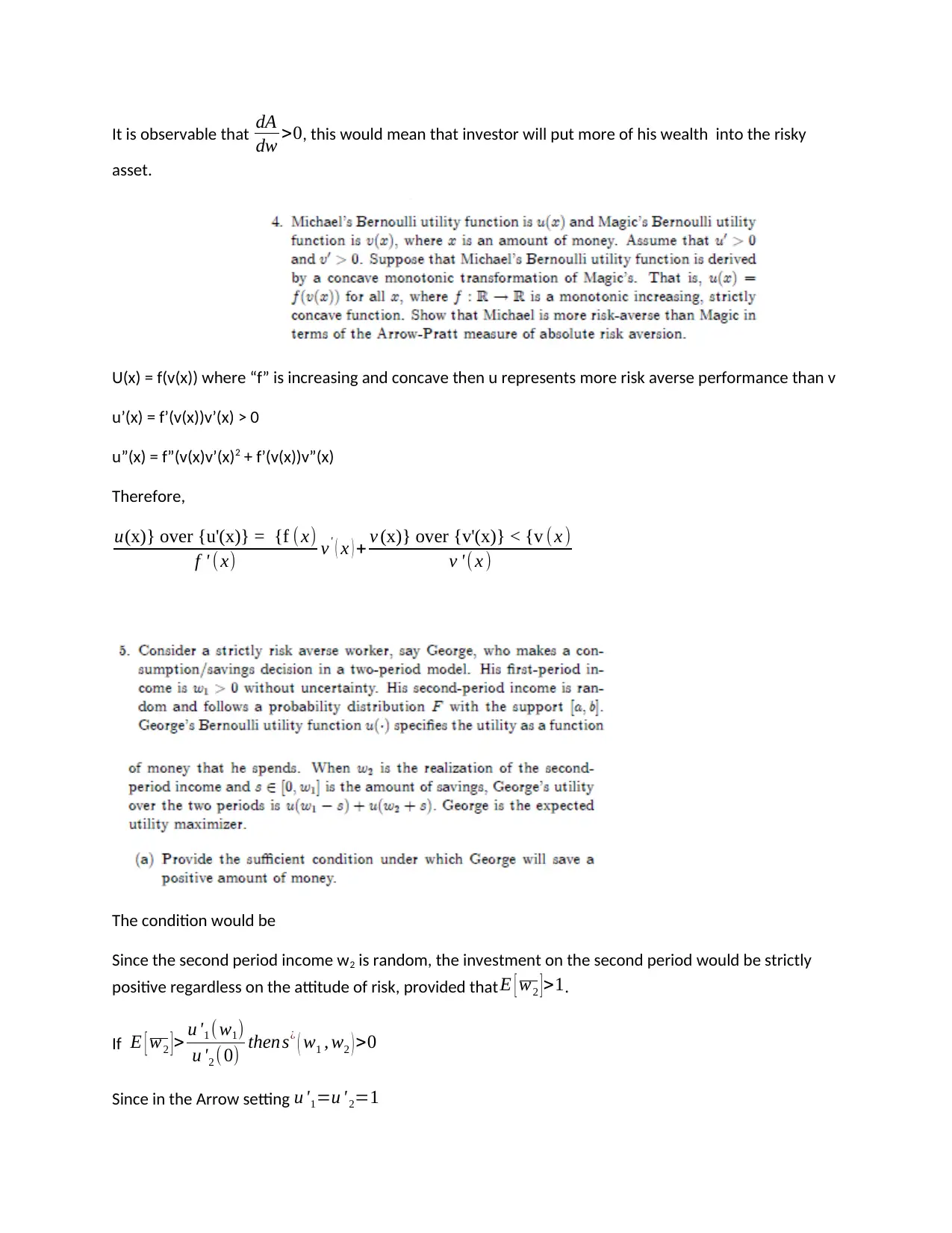
It is observable that dA
dw >0, this would mean that investor will put more of his wealth into the risky
asset.
U(x) = f(v(x)) where “f” is increasing and concave then u represents more risk averse performance than v
u’(x) = f’(v(x))v’(x) > 0
u”(x) = f”(v(x)v’(x)2 + f’(v(x))v”(x)
Therefore,
u(x)} over {u'(x)} = {f ( x)
f ' ( x) v' ( x ) + v (x)} over {v'(x)} < {v ( x )
v ' ( x )
The condition would be
Since the second period income w2 is random, the investment on the second period would be strictly
positive regardless on the attitude of risk, provided that E [ w2 ]>1.
If E [ w2 ] > u '1 ( w1)
u '2 (0) thens¿
( w1 , w2 ) >0
Since in the Arrow setting u '1=u ' 2=1
Document Page
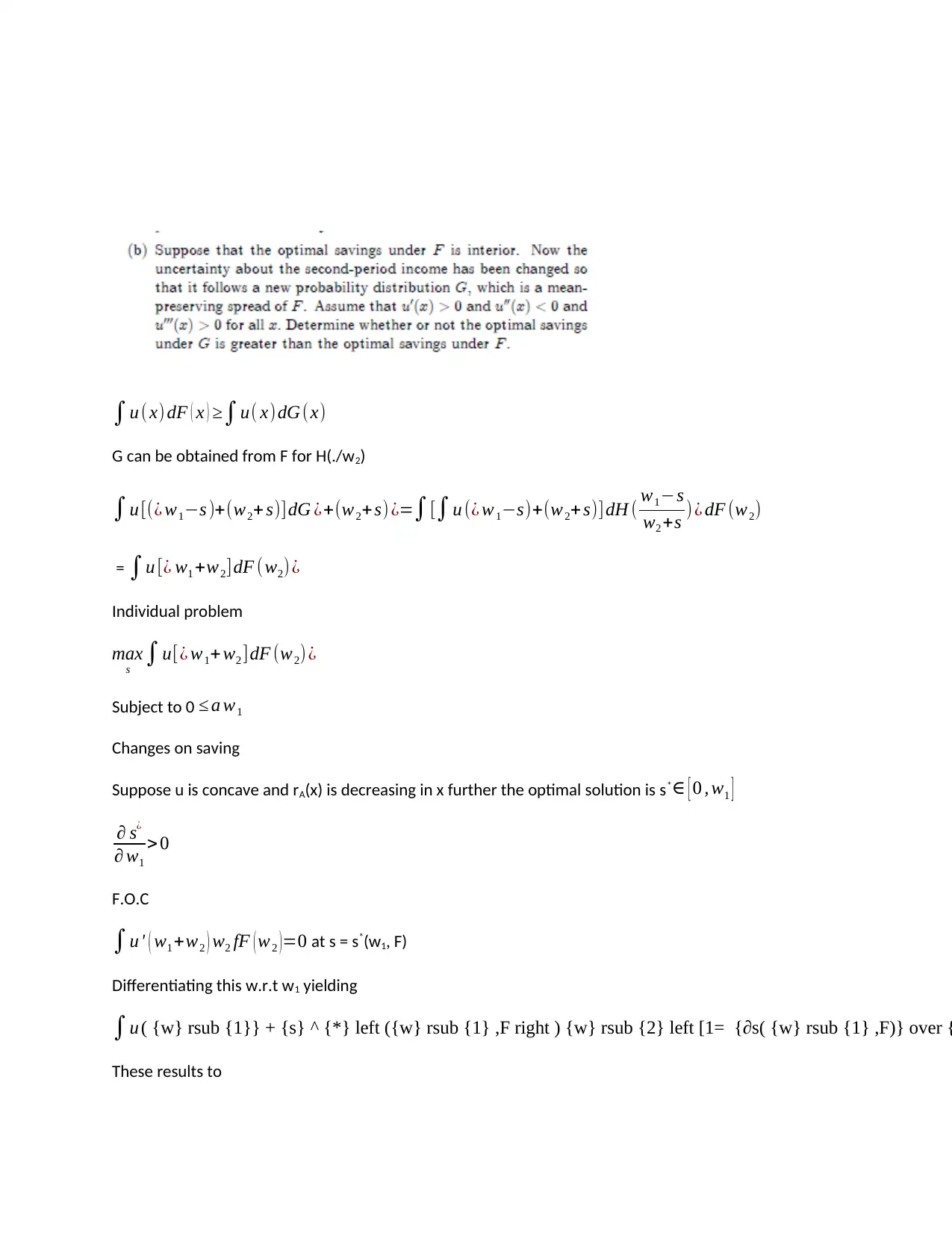
u ( x) dF ( x ) u( x)dG(x)
G can be obtained from F for H(./w2)
u [(¿ w1s )+(w2+ s)]dG ¿+(w2+ s) ¿=[u (¿ w1s)+(w2+ s)] dH ( w1s
w2 +s ) ¿ dF (w2)
= u [¿ w1 +w2]dF (w2) ¿
Individual problem
max
s u[¿ w1+w2 ]dF (w2) ¿
Subject to 0 a w1
Changes on saving
Suppose u is concave and rA(x) is decreasing in x further the optimal solution is s* [ 0 , w1 ]
s¿
w1
> 0
F.O.C
u ' ( w1 +w2 ) w2 fF ( w2 )=0 at s = s*(w1, F)
Differentiating this w.r.t w1 yielding
u ( {w} rsub {1}} + {s} ^ {*} left ({w} rsub {1} ,F right ) {w} rsub {2} left [1= {∂s( {w} rsub {1} ,F)} over {
These results to
tabler-icon-diamond-filled.svg

Paraphrase This Document

Need a fresh take? Get an instant paraphrase of this document with our AI Paraphraser
Document Page
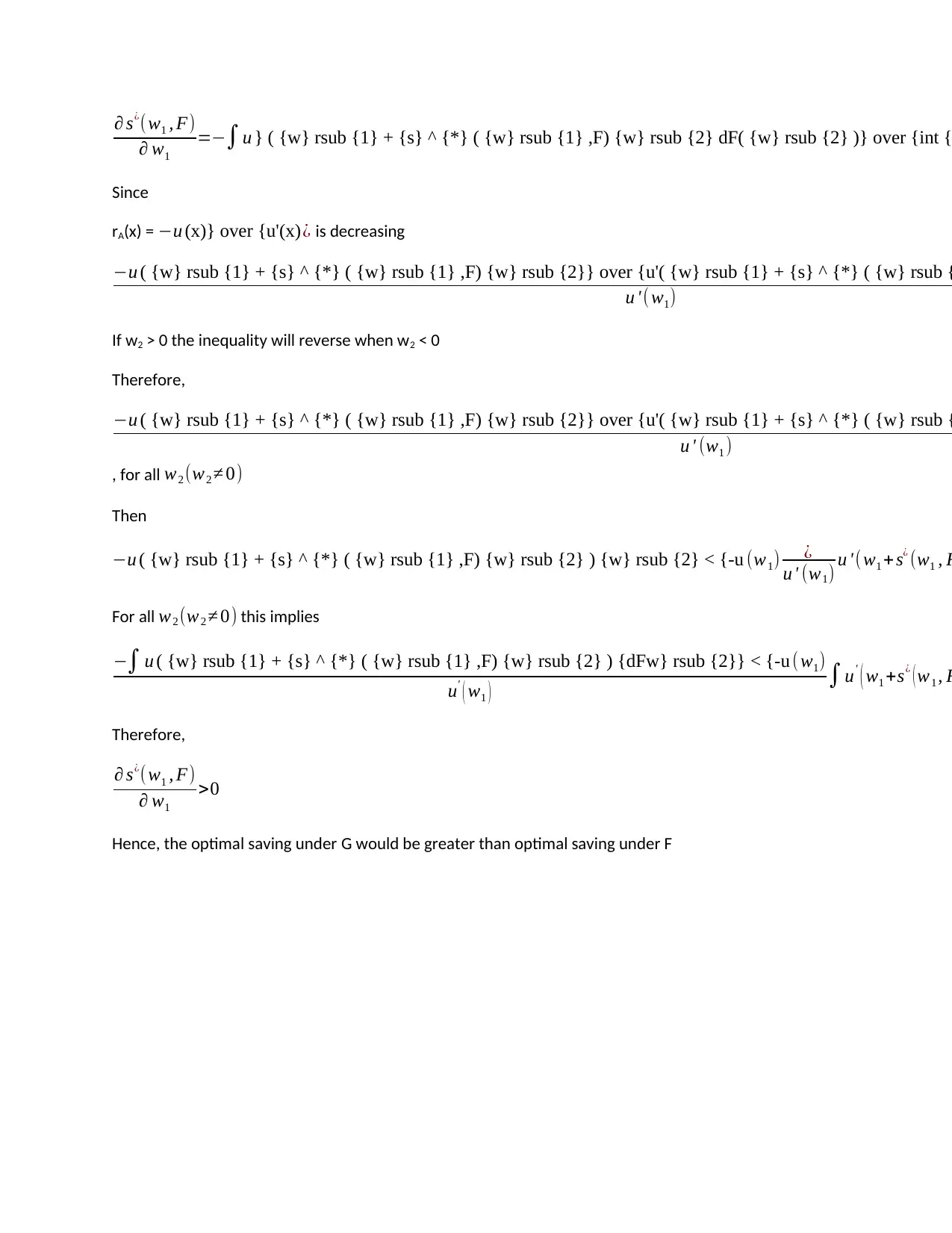
s¿(w1 , F)
w1
=u } ( {w} rsub {1} + {s} ^ {*} ( {w} rsub {1} ,F) {w} rsub {2} dF( {w} rsub {2} )} over {int {
Since
rA(x) = u (x)} over {u'(x)¿ is decreasing
u ( {w} rsub {1} + {s} ^ {*} ( {w} rsub {1} ,F) {w} rsub {2}} over {u'( {w} rsub {1} + {s} ^ {*} ( {w} rsub {
u '( w1)
If w2 > 0 the inequality will reverse when w2 < 0
Therefore,
u ( {w} rsub {1} + {s} ^ {*} ( {w} rsub {1} ,F) {w} rsub {2}} over {u'( {w} rsub {1} + {s} ^ {*} ( {w} rsub {
u ' (w1 )
, for all w2 (w2 0)
Then
u ( {w} rsub {1} + {s} ^ {*} ( {w} rsub {1} ,F) {w} rsub {2} ) {w} rsub {2} < {-u (w1) ¿
u ' (w1) u ' (w1 +s¿ (w1 , F
For all w2 (w2 0) this implies
u ( {w} rsub {1} + {s} ^ {*} ( {w} rsub {1} ,F) {w} rsub {2} ) {dFw} rsub {2}} < {-u ( w1)
u'
( w1 ) u'
( w1 +s¿ ( w1 , F
Therefore,
s¿(w1 , F)
w1
>0
Hence, the optimal saving under G would be greater than optimal saving under F
chevron_up_icon
1 out of 5
circle_padding
hide_on_mobile
zoom_out_icon
[object Object]