Food Microbiology: Analysis of Food Products and Microbial Profiles
VerifiedAdded on 2023/06/10
|21
|4661
|253
Homework Assignment
AI Summary
This assignment solution delves into the core concepts of food microbiology, providing a comprehensive overview of practical methodologies used in the analysis of food products. It begins by detailing various culture techniques, including sample collection, dilution, pour plating, incubation, and colony counting, and their significance in establishing a microbiological profile. The solution then examines MacConkey agar, explaining its composition, uses, and the appearance of coliforms. It also explores the differences between selective, differential, and enriched media. Furthermore, the assignment addresses the implications of a product recall due to potential Salmonella contamination, outlining the effects of Salmonella on human health and associated complications. The solution includes detailed protocols for Gram staining, specifically applied to yogurt samples, and concludes with a discussion of notifiable diseases, focusing on Campylobacter.
Running Head: MICROBIOLOGY OF FOOD PRODUCTS
0
Food Microbiology
Student details
0
Food Microbiology
Student details

Paraphrase This Document
Need a fresh take? Get an instant paraphrase of this document with our AI Paraphraser
MICROBIOLOGY OF FOOD PRODUCTS 1
Table of Contents
Answer one: Practical methodology......................................................................................................1
Steps involved in culture media technique.........................................................................................1
Answer second......................................................................................................................................3
1. Macconkey agar.........................................................................................................................3
2. The appearance of coliform.......................................................................................................5
3. Difference between types of Media...............................................................................................5
Answer three.........................................................................................................................................6
The significance of statement............................................................................................................6
Effects of salmonella on human health..............................................................................................7
Answer four...........................................................................................................................................8
A) Gram staining method for yogurt...........................................................................................8
B) Gram staining involves three simple processes....................................................................10
Answer five..........................................................................................................................................11
Notifiable disease............................................................................................................................11
Report the notifiable disease...........................................................................................................12
Answer six...........................................................................................................................................13
Campylobacter.................................................................................................................................13
References...........................................................................................................................................16
Table of Contents
Answer one: Practical methodology......................................................................................................1
Steps involved in culture media technique.........................................................................................1
Answer second......................................................................................................................................3
1. Macconkey agar.........................................................................................................................3
2. The appearance of coliform.......................................................................................................5
3. Difference between types of Media...............................................................................................5
Answer three.........................................................................................................................................6
The significance of statement............................................................................................................6
Effects of salmonella on human health..............................................................................................7
Answer four...........................................................................................................................................8
A) Gram staining method for yogurt...........................................................................................8
B) Gram staining involves three simple processes....................................................................10
Answer five..........................................................................................................................................11
Notifiable disease............................................................................................................................11
Report the notifiable disease...........................................................................................................12
Answer six...........................................................................................................................................13
Campylobacter.................................................................................................................................13
References...........................................................................................................................................16
MICROBIOLOGY OF FOOD PRODUCTS 2
Answer one: Practical methodology
There are various practical methodologies can be used for microbial examination or analysis
of foods for example indicator organism’s method, direct examination, culture techniques,
enumeration method, laboratory accreditation, and rapid methods to detect specific micro-
organism and toxin. The culture techniques provide the opportunity to grow microbial sample
in a liquid or on a solid surface. Agar is the polysaccharide with various beneficial properties
produced by a species of red algae. Different properties of agar include the ability to form the
gel at the concentration or 1 to 2 percent. Such gel is able to stabilize on the high-temperature
process in boiling water bath to melt. It stability to the microbial hydrolysis is another
property of agar.
Various types of agar can be used for culture techniques such as plate count agar,
MacConkey Broth, lactose broth, glucose agar, blood agar and sucrose agar (Parija, 2014).
The main purpose of the media such as nutrient agar, plate count agar, malt extract agar and
the dextrose agar for fungi is to provide the nutrition for the growth of microorganisms (Liu,
2018). Culture media techniques provide both qualitative and the quantitative results of
microorganisms. This information not only provides data about the presence and absence of
microorganism but also provide the information of the number of the organisms.
Steps involved in culture media technique
For Yoghurt
Sample collection
The food sample containing salmonella should be mixed to make sure the homogeneity
before taking the specific amount. The food sample should be pre-enriched at a sample to
Answer one: Practical methodology
There are various practical methodologies can be used for microbial examination or analysis
of foods for example indicator organism’s method, direct examination, culture techniques,
enumeration method, laboratory accreditation, and rapid methods to detect specific micro-
organism and toxin. The culture techniques provide the opportunity to grow microbial sample
in a liquid or on a solid surface. Agar is the polysaccharide with various beneficial properties
produced by a species of red algae. Different properties of agar include the ability to form the
gel at the concentration or 1 to 2 percent. Such gel is able to stabilize on the high-temperature
process in boiling water bath to melt. It stability to the microbial hydrolysis is another
property of agar.
Various types of agar can be used for culture techniques such as plate count agar,
MacConkey Broth, lactose broth, glucose agar, blood agar and sucrose agar (Parija, 2014).
The main purpose of the media such as nutrient agar, plate count agar, malt extract agar and
the dextrose agar for fungi is to provide the nutrition for the growth of microorganisms (Liu,
2018). Culture media techniques provide both qualitative and the quantitative results of
microorganisms. This information not only provides data about the presence and absence of
microorganism but also provide the information of the number of the organisms.
Steps involved in culture media technique
For Yoghurt
Sample collection
The food sample containing salmonella should be mixed to make sure the homogeneity
before taking the specific amount. The food sample should be pre-enriched at a sample to
⊘ This is a preview!⊘
Do you want full access?
Subscribe today to unlock all pages.

Trusted by 1+ million students worldwide
MICROBIOLOGY OF FOOD PRODUCTS 3
broth ratio of 1:9 dilutions. The sample should be kept favorable environment. The sample
collected for analysis can be the raw or finished product (Andrew and Hammack, 2018).
Dilution
If the count is expected to be higher than 2.5* 103 per ml, than the decimal dilution should be
prepared as:
Shaking the dilution and fresh sterile pipette should be used for each dilution. Pipette one ml
of homogenate into a glass tube containing 9 ml of the diluent. One ml is transferred from the
first dilution to the second dilution tube, which contains 9 ml of the diluent. This will be
repeated to third, fourth, fifth and more glass tubes until the expected dilution is obtained.
Pour plating
All the Petri plates should be labeled with sample number, date, dilution and other necessary
information. One ml of food homogenate pipetted into a petri dish in duplicate. Ten to twelve
ml of agar poured into each Petri plate. The media and the dilution should be mixed gently by
swirling, clockwise and anticlockwise. The prepared media with dilution is then allowed to
set.
Incubation
The prepared dishes are then incubated in an incubator, inverted at 35 degrees or at the
desired temperature.
Count colonies
After incubation, bacterial colonies grown on culture median Petri dishes can be counted
which are between 30 to 300.
Calculation
broth ratio of 1:9 dilutions. The sample should be kept favorable environment. The sample
collected for analysis can be the raw or finished product (Andrew and Hammack, 2018).
Dilution
If the count is expected to be higher than 2.5* 103 per ml, than the decimal dilution should be
prepared as:
Shaking the dilution and fresh sterile pipette should be used for each dilution. Pipette one ml
of homogenate into a glass tube containing 9 ml of the diluent. One ml is transferred from the
first dilution to the second dilution tube, which contains 9 ml of the diluent. This will be
repeated to third, fourth, fifth and more glass tubes until the expected dilution is obtained.
Pour plating
All the Petri plates should be labeled with sample number, date, dilution and other necessary
information. One ml of food homogenate pipetted into a petri dish in duplicate. Ten to twelve
ml of agar poured into each Petri plate. The media and the dilution should be mixed gently by
swirling, clockwise and anticlockwise. The prepared media with dilution is then allowed to
set.
Incubation
The prepared dishes are then incubated in an incubator, inverted at 35 degrees or at the
desired temperature.
Count colonies
After incubation, bacterial colonies grown on culture median Petri dishes can be counted
which are between 30 to 300.
Calculation
Paraphrase This Document
Need a fresh take? Get an instant paraphrase of this document with our AI Paraphraser
MICROBIOLOGY OF FOOD PRODUCTS 4
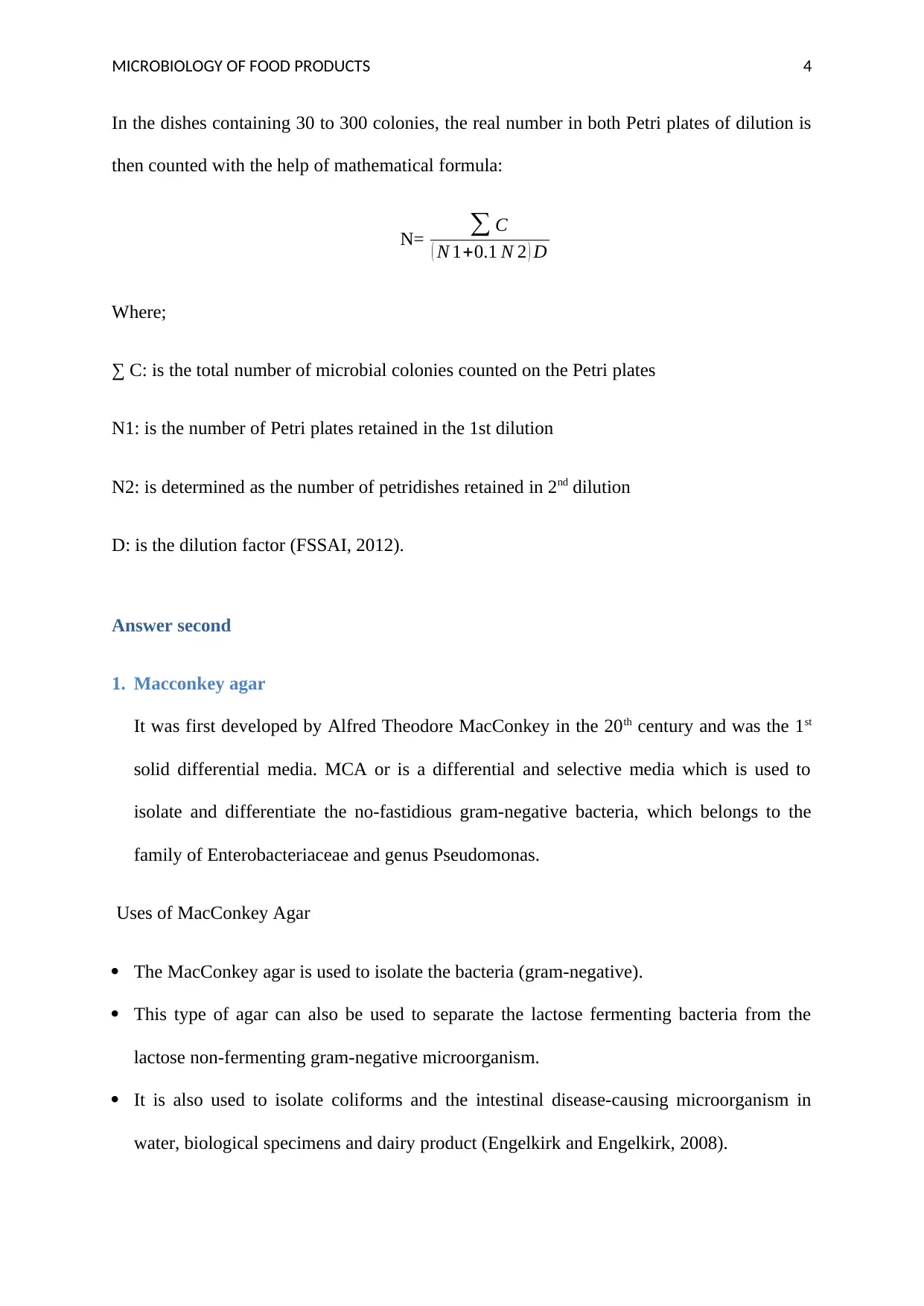
In the dishes containing 30 to 300 colonies, the real number in both Petri plates of dilution is
then counted with the help of mathematical formula:
N= ∑ C
( N 1+0.1 N 2 ) D
Where;
∑ C: is the total number of microbial colonies counted on the Petri plates
N1: is the number of Petri plates retained in the 1st dilution
N2: is determined as the number of petridishes retained in 2nd dilution
D: is the dilution factor (FSSAI, 2012).
Answer second
1. Macconkey agar
It was first developed by Alfred Theodore MacConkey in the 20th century and was the 1st
solid differential media. MCA or is a differential and selective media which is used to
isolate and differentiate the no-fastidious gram-negative bacteria, which belongs to the
family of Enterobacteriaceae and genus Pseudomonas.
Uses of MacConkey Agar
The MacConkey agar is used to isolate the bacteria (gram-negative).
This type of agar can also be used to separate the lactose fermenting bacteria from the
lactose non-fermenting gram-negative microorganism.
It is also used to isolate coliforms and the intestinal disease-causing microorganism in
water, biological specimens and dairy product (Engelkirk and Engelkirk, 2008).
In the dishes containing 30 to 300 colonies, the real number in both Petri plates of dilution is
then counted with the help of mathematical formula:
N= ∑ C
( N 1+0.1 N 2 ) D
Where;
∑ C: is the total number of microbial colonies counted on the Petri plates
N1: is the number of Petri plates retained in the 1st dilution
N2: is determined as the number of petridishes retained in 2nd dilution
D: is the dilution factor (FSSAI, 2012).
Answer second
1. Macconkey agar
It was first developed by Alfred Theodore MacConkey in the 20th century and was the 1st
solid differential media. MCA or is a differential and selective media which is used to
isolate and differentiate the no-fastidious gram-negative bacteria, which belongs to the
family of Enterobacteriaceae and genus Pseudomonas.
Uses of MacConkey Agar
The MacConkey agar is used to isolate the bacteria (gram-negative).
This type of agar can also be used to separate the lactose fermenting bacteria from the
lactose non-fermenting gram-negative microorganism.
It is also used to isolate coliforms and the intestinal disease-causing microorganism in
water, biological specimens and dairy product (Engelkirk and Engelkirk, 2008).
MICROBIOLOGY OF FOOD PRODUCTS 5
Components of MacConkey Agar
Peptone
Lactose
Bile salts
NaCl
Neutral red
Agar
pH 7.4 ± 0.2 (Atlas, 2010).
Peptone
Peptones are the excellent sources of amino acids, proteins, and peptides in growth media.
This mixture of amino acids and protein can be obtained from natural products such as milk,
plants and animal tissue. Peptones provide the important nutrients, nitrogenous factors, and
vitamins that are required for the growth of the microorganism.
Lactose
Lactose is the disaccharides or sugar composed of galactose and glucose. The scientific
formula for lactose is C12H22011. In MacConkey agar, lactose monohydrate is a fermentable
source of carbohydrates. It helps to distinguish between the lactose fermenters and non-
fermenters. This feature of lactose helps the medium to be selective for lactose fermenters.
Bile Salts
Bile salts are the primary component of bile. In MacConkey Agar, It helps the agar media to
be highly selective for gram-negative bacteria and prevent the growth of gram-positive
microorganism.
Components of MacConkey Agar
Peptone
Lactose
Bile salts
NaCl
Neutral red
Agar
pH 7.4 ± 0.2 (Atlas, 2010).
Peptone
Peptones are the excellent sources of amino acids, proteins, and peptides in growth media.
This mixture of amino acids and protein can be obtained from natural products such as milk,
plants and animal tissue. Peptones provide the important nutrients, nitrogenous factors, and
vitamins that are required for the growth of the microorganism.
Lactose
Lactose is the disaccharides or sugar composed of galactose and glucose. The scientific
formula for lactose is C12H22011. In MacConkey agar, lactose monohydrate is a fermentable
source of carbohydrates. It helps to distinguish between the lactose fermenters and non-
fermenters. This feature of lactose helps the medium to be selective for lactose fermenters.
Bile Salts
Bile salts are the primary component of bile. In MacConkey Agar, It helps the agar media to
be highly selective for gram-negative bacteria and prevent the growth of gram-positive
microorganism.
⊘ This is a preview!⊘
Do you want full access?
Subscribe today to unlock all pages.
Trusted by 1+ million students worldwide
MICROBIOLOGY OF FOOD PRODUCTS 6
Sodium chloride
Sodium chloride is an ionic compound also known as salt. It is a metal halide, which
composed of sodium and chloride. The molecular formula of sodium chloride is NaCl. This
component of MacConkey agar maintains the osmotic regulation in the culture medium.
Neutral red
Lactose-fermenting bacteria may cause the pH to drop in media that can be detected by the
neutral red component. Neutral red is the indicator of pH that changes in red at the pH below
6.8 and appears as colorless at any pH more than 6.8. The absorbance of neutral red on agar
by bacteria results in pink to red colonies.
Agar
Agar is used as the solidifying agent in MacConkey agar. On the solid media, the colonies of
bacteria can be seen easily (Batra, 2018).
pH 7.4 ± 0.2
Change in pH is essential to the identification type of bacteria in a culture media.
2. Appearance of coliform
Coliform appearance on the media is Red.
3. Difference between types of Media
Selective Media
This type of media is used to identify a specific group of bacteria. The chemical components
used in the culture media prevent the colonization of one type of microbe (bacteria) and
promote the growth of another. The examples of selective media are Mannitol Salt Agar,
MacConkey and Eosin Methylene Blue Agar.
Sodium chloride
Sodium chloride is an ionic compound also known as salt. It is a metal halide, which
composed of sodium and chloride. The molecular formula of sodium chloride is NaCl. This
component of MacConkey agar maintains the osmotic regulation in the culture medium.
Neutral red
Lactose-fermenting bacteria may cause the pH to drop in media that can be detected by the
neutral red component. Neutral red is the indicator of pH that changes in red at the pH below
6.8 and appears as colorless at any pH more than 6.8. The absorbance of neutral red on agar
by bacteria results in pink to red colonies.
Agar
Agar is used as the solidifying agent in MacConkey agar. On the solid media, the colonies of
bacteria can be seen easily (Batra, 2018).
pH 7.4 ± 0.2
Change in pH is essential to the identification type of bacteria in a culture media.
2. Appearance of coliform
Coliform appearance on the media is Red.
3. Difference between types of Media
Selective Media
This type of media is used to identify a specific group of bacteria. The chemical components
used in the culture media prevent the colonization of one type of microbe (bacteria) and
promote the growth of another. The examples of selective media are Mannitol Salt Agar,
MacConkey and Eosin Methylene Blue Agar.
Paraphrase This Document
Need a fresh take? Get an instant paraphrase of this document with our AI Paraphraser
MICROBIOLOGY OF FOOD PRODUCTS 7
Differential media
It distinguishes among the groups of microorganisms that biologically and morphologically
related. The chemical compounds of this media produce a change in the appearance of
microbial growth. Examples: EMB, MSA, and Macconkey (Semmelweis, 2014).
Enriched Media
This culture media is supplemented with the high amount of nutritious material like serum,
yeast extract, and blood for microbial cultivation.
A basic principle of this media is to control the nutrients and the culture conditions
(temperature, light, pH and air supply) for the specific type of species (Vanmeter, Hubert, and
Vanmeter, 2013).
Answer three
The significance of the statement
The TRS wholesale Co ltd recalls the product TRS turmeric powder because they found that
the product might contain bacterial species salmonella.
Salmonella is a rod-shaped bacterium of family Enterobacteriaceae commonly found in
human’s intestinal tract. The salmonella infection is the foodborne disease that caused by the
consumption of eggs, raw meats, and contaminated dairy products. Particularly in the United
States, nearly 19000 people are affected by salmonella food poisoning every year. The
salmonella associated food poisoning includes the symptoms like diarrhea, abdominal pain,
nausea, and vomiting.
The company has mentioned that only TRS turmeric powder is assumed affected and no other
product.
Differential media
It distinguishes among the groups of microorganisms that biologically and morphologically
related. The chemical compounds of this media produce a change in the appearance of
microbial growth. Examples: EMB, MSA, and Macconkey (Semmelweis, 2014).
Enriched Media
This culture media is supplemented with the high amount of nutritious material like serum,
yeast extract, and blood for microbial cultivation.
A basic principle of this media is to control the nutrients and the culture conditions
(temperature, light, pH and air supply) for the specific type of species (Vanmeter, Hubert, and
Vanmeter, 2013).
Answer three
The significance of the statement
The TRS wholesale Co ltd recalls the product TRS turmeric powder because they found that
the product might contain bacterial species salmonella.
Salmonella is a rod-shaped bacterium of family Enterobacteriaceae commonly found in
human’s intestinal tract. The salmonella infection is the foodborne disease that caused by the
consumption of eggs, raw meats, and contaminated dairy products. Particularly in the United
States, nearly 19000 people are affected by salmonella food poisoning every year. The
salmonella associated food poisoning includes the symptoms like diarrhea, abdominal pain,
nausea, and vomiting.
The company has mentioned that only TRS turmeric powder is assumed affected and no other
product.
MICROBIOLOGY OF FOOD PRODUCTS 8
Effects of salmonella on human health
Salmonella infection is the 2nd most common infection in the United States. In 2009 more
than 7000 cases have been confirmed.it is the major health global health concern accounting
for 155,000 deaths per year (Eng et al. 2015). The salmonella associated infection occurs
when an individual eats foods that contaminated with faces of animals. Most of the infection
caused by salmonella occurs due to eating foods such as eggs, poultry, and meat. Salmonella
can also infect other foods such as raw milk, raw meats, and contaminated water.
It can various health issues in humans such as cramps, fever, abdominal pain, and diarrhea.
The typical symptom caused due to salmonella infection appears between 6 to 72 hours of
consuming contaminated eatables. It lasts for three to seven days without treatment. The
additional symptoms of this type of infections are bloody diarrhea, vomiting, headache and
boy aches (Mayoclinic, 2018).
Fever
The typhoidal salmonella may also cause typhoid fever, this type of infection is rare and
caused by a species of salmonella called Salmonella typhi, humans are the only carrier of this
type of infection. The typhoid is a fever of 105 F, includes symptoms like weakness, pain,
coughing, lethargy, nosebleeds, enlarged organs, and delirium. Typhoid fever is the life-
threatening disease may lead to death if remain untreated (Crump, 2010).
Other complications associated with salmonella infection
Salmonella poisoning related complications mostly affect young children and the people 65
years old or more. Reactive arthritis is the possible complication of this type of infection
Effects of salmonella on human health
Salmonella infection is the 2nd most common infection in the United States. In 2009 more
than 7000 cases have been confirmed.it is the major health global health concern accounting
for 155,000 deaths per year (Eng et al. 2015). The salmonella associated infection occurs
when an individual eats foods that contaminated with faces of animals. Most of the infection
caused by salmonella occurs due to eating foods such as eggs, poultry, and meat. Salmonella
can also infect other foods such as raw milk, raw meats, and contaminated water.
It can various health issues in humans such as cramps, fever, abdominal pain, and diarrhea.
The typical symptom caused due to salmonella infection appears between 6 to 72 hours of
consuming contaminated eatables. It lasts for three to seven days without treatment. The
additional symptoms of this type of infections are bloody diarrhea, vomiting, headache and
boy aches (Mayoclinic, 2018).
Fever
The typhoidal salmonella may also cause typhoid fever, this type of infection is rare and
caused by a species of salmonella called Salmonella typhi, humans are the only carrier of this
type of infection. The typhoid is a fever of 105 F, includes symptoms like weakness, pain,
coughing, lethargy, nosebleeds, enlarged organs, and delirium. Typhoid fever is the life-
threatening disease may lead to death if remain untreated (Crump, 2010).
Other complications associated with salmonella infection
Salmonella poisoning related complications mostly affect young children and the people 65
years old or more. Reactive arthritis is the possible complication of this type of infection
⊘ This is a preview!⊘
Do you want full access?
Subscribe today to unlock all pages.
Trusted by 1+ million students worldwide
MICROBIOLOGY OF FOOD PRODUCTS 9
Reactive arthritis can occur in 2 to 15 percent of salmonella patient. The symptoms of this
disorder include Inflammation of eyes, bone joints, or urinary tract and reproductive organs.
In humans, the symptoms of reactive arthritis occur eighteen days after the infection.
Focal infection: this type of infection occurs when the bacteria reaches top body tissue and
cause illness like arthritis or endocarditis. It is also caused by a typhoidal salmonella (Clerk,
2018).
Answer four
A) Gram staining method for yogurt
1. Smear preparation: A very thin smear of the sample is prepared on a glass slide, heat
fix and allows it to cool.
2. The heat fixed smear is then flooded with the crystal violet reagent for one minute.
3. The glass slide is then washed in tap water for two seconds.
4. After that, the slide is flooded with gram iodine and wait for one minute.
5. The iodine-flooded slide is then washed under running tap water for two minutes.
6. The decolorization agent Acetone- alcohol is then applied on the slide.
7. After applying decolorizing agent on the slide for 10 to 15 seconds, safranin is
flooded on that glass slide and left to dry for thirty seconds to one minute.
8. The dried slide is then washed under running tap water until there is no color appears
in an effluent. After that blot, dry the slide with absorbent paper.
9. Oil immersion is then applied on the slide and observe under the microscope for
results (Bruckner, 2016).
Results
The gram-negative microbe or bacteria in a sample appeared as pink/red.
Reactive arthritis can occur in 2 to 15 percent of salmonella patient. The symptoms of this
disorder include Inflammation of eyes, bone joints, or urinary tract and reproductive organs.
In humans, the symptoms of reactive arthritis occur eighteen days after the infection.
Focal infection: this type of infection occurs when the bacteria reaches top body tissue and
cause illness like arthritis or endocarditis. It is also caused by a typhoidal salmonella (Clerk,
2018).
Answer four
A) Gram staining method for yogurt
1. Smear preparation: A very thin smear of the sample is prepared on a glass slide, heat
fix and allows it to cool.
2. The heat fixed smear is then flooded with the crystal violet reagent for one minute.
3. The glass slide is then washed in tap water for two seconds.
4. After that, the slide is flooded with gram iodine and wait for one minute.
5. The iodine-flooded slide is then washed under running tap water for two minutes.
6. The decolorization agent Acetone- alcohol is then applied on the slide.
7. After applying decolorizing agent on the slide for 10 to 15 seconds, safranin is
flooded on that glass slide and left to dry for thirty seconds to one minute.
8. The dried slide is then washed under running tap water until there is no color appears
in an effluent. After that blot, dry the slide with absorbent paper.
9. Oil immersion is then applied on the slide and observe under the microscope for
results (Bruckner, 2016).
Results
The gram-negative microbe or bacteria in a sample appeared as pink/red.
Paraphrase This Document
Need a fresh take? Get an instant paraphrase of this document with our AI Paraphraser
MICROBIOLOGY OF FOOD PRODUCTS 10
The gram-positive bacteria are appeared as blue/ purple.
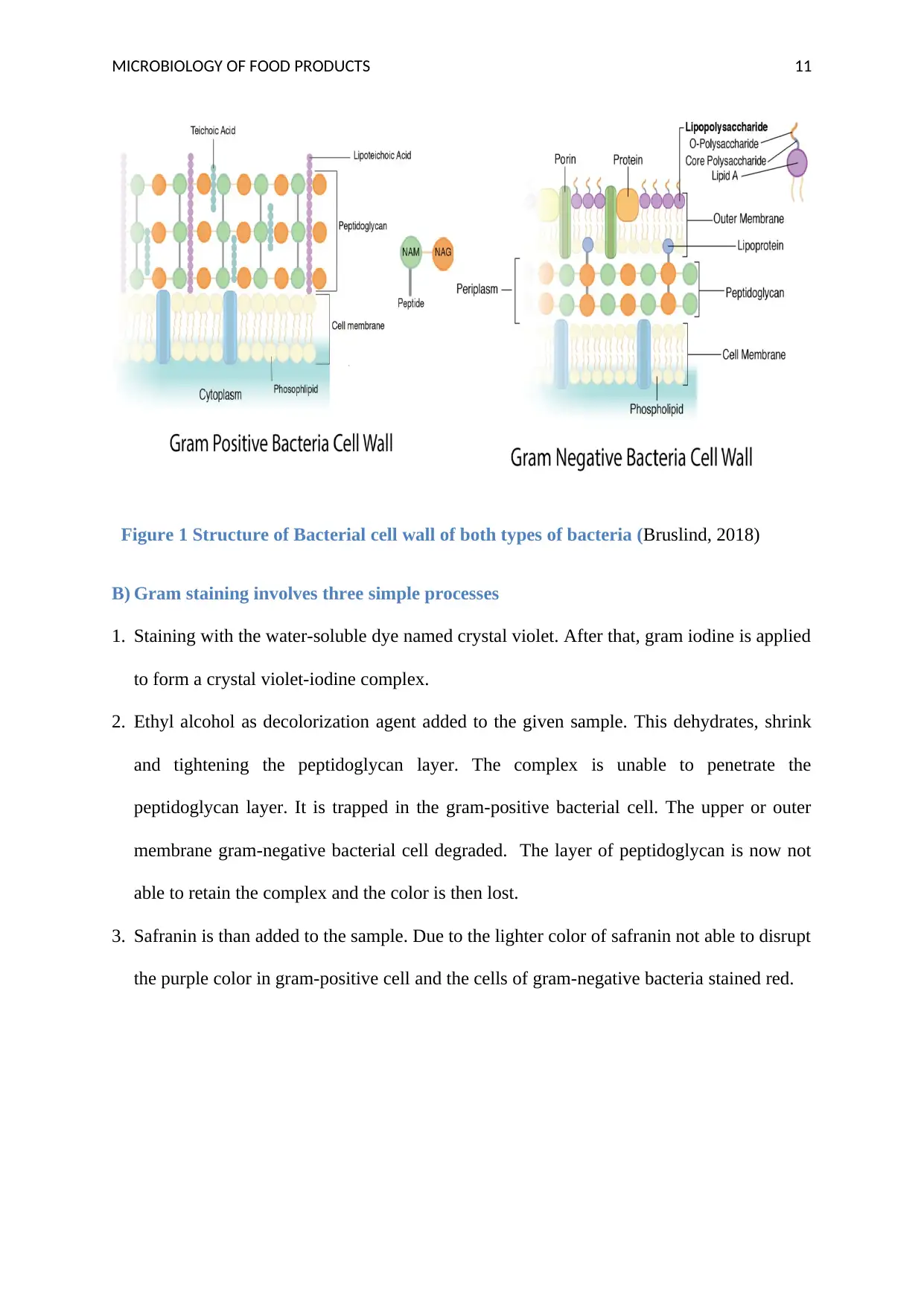
A) Structure of bacterial cell wall
The layers of a cell envelope found between the cytoplasmic membrane and capsule are
known as the cell wall. The main function of these call walls is to provide rigidity and
integrity to the cell. These layers are composed of peptidoglycan and teichoic acid.
1. Peptidoglycan: it is 20 to 80 nanometre in thick and forms nearly 90 percent of the total
dry weight of bacteria. These are the polymers of NAM (N-acetylmuramic acid) and NAG
(N- acetylglucosamine). Long strands of peptidoglycan attached with NAM. These
polymers are more highly cross-linked in case of gram-positive cells than the gram-
negative bacterial cell. This peptidoglycan is the target of antimicrobial drugs such as
penicillin, which cleaves the NAM_NAG bond.
2. Polysaccharides: the lipoteichoic acids or LTA are found in gram-positive bacteria only.
These polysaccharides are present in entire peptidoglycan later. These call wall structure
can serve as the antigenic determinants.
3. Lipopolysaccharides (LPS): these structures are found in gram-negative bacteria only.
Lipopolysaccharides are composed of lipid A that attaches LPS to the outer layer. These
polysaccharides appear on the cell surface and serve as the antigenic determinant.
4. Porins: porins are the Transmembrane proteins made of a trimer with three subunits. The
main function of these proteins is to transfer molecule across the membrane (Saltmann and
Holst, 2013).
The gram-positive bacteria are appeared as blue/ purple.
A) Structure of bacterial cell wall
The layers of a cell envelope found between the cytoplasmic membrane and capsule are
known as the cell wall. The main function of these call walls is to provide rigidity and
integrity to the cell. These layers are composed of peptidoglycan and teichoic acid.
1. Peptidoglycan: it is 20 to 80 nanometre in thick and forms nearly 90 percent of the total
dry weight of bacteria. These are the polymers of NAM (N-acetylmuramic acid) and NAG
(N- acetylglucosamine). Long strands of peptidoglycan attached with NAM. These
polymers are more highly cross-linked in case of gram-positive cells than the gram-
negative bacterial cell. This peptidoglycan is the target of antimicrobial drugs such as
penicillin, which cleaves the NAM_NAG bond.
2. Polysaccharides: the lipoteichoic acids or LTA are found in gram-positive bacteria only.
These polysaccharides are present in entire peptidoglycan later. These call wall structure
can serve as the antigenic determinants.
3. Lipopolysaccharides (LPS): these structures are found in gram-negative bacteria only.
Lipopolysaccharides are composed of lipid A that attaches LPS to the outer layer. These
polysaccharides appear on the cell surface and serve as the antigenic determinant.
4. Porins: porins are the Transmembrane proteins made of a trimer with three subunits. The
main function of these proteins is to transfer molecule across the membrane (Saltmann and
Holst, 2013).
MICROBIOLOGY OF FOOD PRODUCTS 11
Figure 1 Structure of Bacterial cell wall of both types of bacteria (Bruslind, 2018)
B) Gram staining involves three simple processes
1. Staining with the water-soluble dye named crystal violet. After that, gram iodine is applied
to form a crystal violet-iodine complex.
2. Ethyl alcohol as decolorization agent added to the given sample. This dehydrates, shrink
and tightening the peptidoglycan layer. The complex is unable to penetrate the
peptidoglycan layer. It is trapped in the gram-positive bacterial cell. The upper or outer
membrane gram-negative bacterial cell degraded. The layer of peptidoglycan is now not
able to retain the complex and the color is then lost.
3. Safranin is than added to the sample. Due to the lighter color of safranin not able to disrupt
the purple color in gram-positive cell and the cells of gram-negative bacteria stained red.
Figure 1 Structure of Bacterial cell wall of both types of bacteria (Bruslind, 2018)
B) Gram staining involves three simple processes
1. Staining with the water-soluble dye named crystal violet. After that, gram iodine is applied
to form a crystal violet-iodine complex.
2. Ethyl alcohol as decolorization agent added to the given sample. This dehydrates, shrink
and tightening the peptidoglycan layer. The complex is unable to penetrate the
peptidoglycan layer. It is trapped in the gram-positive bacterial cell. The upper or outer
membrane gram-negative bacterial cell degraded. The layer of peptidoglycan is now not
able to retain the complex and the color is then lost.
3. Safranin is than added to the sample. Due to the lighter color of safranin not able to disrupt
the purple color in gram-positive cell and the cells of gram-negative bacteria stained red.
⊘ This is a preview!⊘
Do you want full access?
Subscribe today to unlock all pages.
Trusted by 1+ million students worldwide

1 out of 21


Your All-in-One AI-Powered Toolkit for Academic Success.
+13062052269
info@desklib.com
Available 24*7 on WhatsApp / Email
![[object Object]](/_next/static/media/star-bottom.7253800d.svg)
Unlock your academic potential
Copyright © 2020–2025 A2Z Services. All Rights Reserved. Developed and managed by ZUCOL.