Research Methods in Bioscience: Mobile Device Contamination Study
VerifiedAdded on 2021/05/31
|15
|3168
|156
Report
AI Summary
This report investigates the potential of mobile phones and other electronic devices as sources of microbial contamination. The study poses the research question: "Do mobile phones and other related electronic devices act as a potential source of microbial contamination?" The aims and objectives are to explore the contamination potential of mobile phones, assess the relationship between mobile phone usage and contamination severity, analyze factors influencing contamination, and evaluate the impact of mobile phone usage on infectious diseases. The methodology involves a cross-sectional study design, collecting samples from participants' mobile devices and testing for bacterial contamination using sterile swabs, agar plates, and various laboratory techniques including Gram staining, and antibiotic sensitivity tests. Statistical analysis will be performed using SPSS. The report discusses the background and rationale, including the prevalence of mobile device usage and the potential for these devices to harbor and transmit microorganisms, highlighting the importance of hygiene practices. Expected outcomes include identifying the types and levels of microbial contamination on mobile devices and assessing the associated risks.
Running head: RESEARCH METHODS FOR BIOSCIENCE
Research methods for bioscience
Name of the student:
Name of the university:
Author note:
Research methods for bioscience
Name of the student:
Name of the university:
Author note:

Paraphrase This Document
Need a fresh take? Get an instant paraphrase of this document with our AI Paraphraser
1
RESEARCH METHODS FOR BIOSCIENCE
Table of Contents
Introduction:....................................................................................................................................2
Background and rationale:...........................................................................................................2
Research question:.......................................................................................................................5
Aims and objectives:....................................................................................................................5
Null hypothesis:...........................................................................................................................5
Methodology....................................................................................................................................7
Research design...........................................................................................................................7
Materials and participants............................................................................................................8
Methods.......................................................................................................................................9
Expected outcomes..........................................................................................................................9
References......................................................................................................................................11
Appendix........................................................................................................................................14
RESEARCH METHODS FOR BIOSCIENCE
Table of Contents
Introduction:....................................................................................................................................2
Background and rationale:...........................................................................................................2
Research question:.......................................................................................................................5
Aims and objectives:....................................................................................................................5
Null hypothesis:...........................................................................................................................5
Methodology....................................................................................................................................7
Research design...........................................................................................................................7
Materials and participants............................................................................................................8
Methods.......................................................................................................................................9
Expected outcomes..........................................................................................................................9
References......................................................................................................................................11
Appendix........................................................................................................................................14
2
RESEARCH METHODS FOR BIOSCIENCE
Introduction:
Background and rationale:
Microbial contamination can be defined as the accidental or non-intended introduction of
the different types of microbes such as bacteria, yeast, mould, fungi, virus, prions, protozoa or
their toxins and by-products. According to the Walia, Manchanda and Narang (2014), the
microbes are ubiquitous in nature and hence the risk of microbial contamination is ever-present.
It has to be mentioned in this context that the exposure to microorganisms or their byproducts is
mostly facilitated by inhalation and contact with the mucous membrane. In everyday life, there
can be a variety of transmission points which can lead to microbial contamination based on the
different settings. For instance, there can be various different sources of contamination such as
utility based contamination, equipment based contamination, facility based contamination,
material based contamination and personnel based contamination. On a more elaborative note, it
can be stated that germs can be spread via a number of different resources such as contaminated
air causing airborne contamination, outer skin of the personnel for contact based contamination,
and manufacturing processes which can lead to a variety of different contaminations. According
to the Verani, Bigazzi and Carducci (2014), it has to be mentioned that even a sneeze can
produce close to 1 million bacteria. With respect to the mechanism of contamination of the
different microbes, there are two basic types of contamination. The first type of contamination is
the direct contamination, which is facilitated by microbial components and poorly maintained
HVAC systems. The second type of contamination is the cross contamination which is the type
of contamination that constitutes the majority of microbial spread in the household setting.
RESEARCH METHODS FOR BIOSCIENCE
Introduction:
Background and rationale:
Microbial contamination can be defined as the accidental or non-intended introduction of
the different types of microbes such as bacteria, yeast, mould, fungi, virus, prions, protozoa or
their toxins and by-products. According to the Walia, Manchanda and Narang (2014), the
microbes are ubiquitous in nature and hence the risk of microbial contamination is ever-present.
It has to be mentioned in this context that the exposure to microorganisms or their byproducts is
mostly facilitated by inhalation and contact with the mucous membrane. In everyday life, there
can be a variety of transmission points which can lead to microbial contamination based on the
different settings. For instance, there can be various different sources of contamination such as
utility based contamination, equipment based contamination, facility based contamination,
material based contamination and personnel based contamination. On a more elaborative note, it
can be stated that germs can be spread via a number of different resources such as contaminated
air causing airborne contamination, outer skin of the personnel for contact based contamination,
and manufacturing processes which can lead to a variety of different contaminations. According
to the Verani, Bigazzi and Carducci (2014), it has to be mentioned that even a sneeze can
produce close to 1 million bacteria. With respect to the mechanism of contamination of the
different microbes, there are two basic types of contamination. The first type of contamination is
the direct contamination, which is facilitated by microbial components and poorly maintained
HVAC systems. The second type of contamination is the cross contamination which is the type
of contamination that constitutes the majority of microbial spread in the household setting.
⊘ This is a preview!⊘
Do you want full access?
Subscribe today to unlock all pages.

Trusted by 1+ million students worldwide
3
RESEARCH METHODS FOR BIOSCIENCE
Another very important aspect of microbial contamination in the day to day life is
through the washrooms. According to the Jeon, Chun and Kim (2013), the infection prevention
behaviors instilled in the different populations is limited to covering mouths when coughing or
sneezing, hand hygiene and wiping down the germ surfaces such as desks, however the personal
hygiene habits have not been able to extend to the washroom even now. The washroom or the
toilet seat most evidently can serve as a reservoir of germs or microbes which can cause a variety
of different communicable diseases. On a more elaborative note, there is a mircobiom residing in
the toilet seat and every time a particular individual is flushing the toilet with the lid open the
bacteria sprays into the air contaminating it significantly. As per the article by the Gov.uk
(2018), one of the most dangerous infectious pathogen found in the toilet seat had been
Clostridium difficile, which is a notorious bacteria responsible for causing watery diarrhea, ever,
nausea, and abdominal pain, the researchers are of the opinion that this particular pathogen is
able to be spewed up up to 10 inches above the toilet seats and as a result can contaminate the
air, the other nearby surfaces and the skin of the occupant using the toilet seat. The washroom
germs are not only contaminating the skin of the occupant it can also transfer to everything the
person touches including washroom supplies, materials, and even the doors and doorknobs (Pal
et al. 2013).
Another very common of the present day tech savvy generation is to take their smart
devices such as the smart phones, ipads, tablets to the washroom, and hence the contaminated
air, skin and surfaces of the washroom can then contaminate the touch screen device. These
smartphones or tablets are carried by the user for the entire day and if the touch-screen devices
are not cleaned properly or sterilized it can lead to various infectious diseases by contaminating
everything it comes in contact with. According to the statistical data revealed that the
RESEARCH METHODS FOR BIOSCIENCE
Another very important aspect of microbial contamination in the day to day life is
through the washrooms. According to the Jeon, Chun and Kim (2013), the infection prevention
behaviors instilled in the different populations is limited to covering mouths when coughing or
sneezing, hand hygiene and wiping down the germ surfaces such as desks, however the personal
hygiene habits have not been able to extend to the washroom even now. The washroom or the
toilet seat most evidently can serve as a reservoir of germs or microbes which can cause a variety
of different communicable diseases. On a more elaborative note, there is a mircobiom residing in
the toilet seat and every time a particular individual is flushing the toilet with the lid open the
bacteria sprays into the air contaminating it significantly. As per the article by the Gov.uk
(2018), one of the most dangerous infectious pathogen found in the toilet seat had been
Clostridium difficile, which is a notorious bacteria responsible for causing watery diarrhea, ever,
nausea, and abdominal pain, the researchers are of the opinion that this particular pathogen is
able to be spewed up up to 10 inches above the toilet seats and as a result can contaminate the
air, the other nearby surfaces and the skin of the occupant using the toilet seat. The washroom
germs are not only contaminating the skin of the occupant it can also transfer to everything the
person touches including washroom supplies, materials, and even the doors and doorknobs (Pal
et al. 2013).
Another very common of the present day tech savvy generation is to take their smart
devices such as the smart phones, ipads, tablets to the washroom, and hence the contaminated
air, skin and surfaces of the washroom can then contaminate the touch screen device. These
smartphones or tablets are carried by the user for the entire day and if the touch-screen devices
are not cleaned properly or sterilized it can lead to various infectious diseases by contaminating
everything it comes in contact with. According to the statistical data revealed that the
Paraphrase This Document
Need a fresh take? Get an instant paraphrase of this document with our AI Paraphraser
4
RESEARCH METHODS FOR BIOSCIENCE
contamination rates of the United kingdom, the survey data has discovered the fact that on
among 6 mobile phones used by the UK dwellers have been found to be heavily contaminated
with fecal matter and microbes (Gov.uk 2018). The research study articulated by the Queen
Mary’s school of Biological and Chemical Sciences and the London school of Hygiene and
Tropical Medicine that focused on the 12 cities of the United Kingdom revealed that the most
common bacteria found had been Escherechia coli, a pathogen of fecal orgin indicating at poor
hygiene of the Britons. 95 per cent of people said they washed their hands with soap where
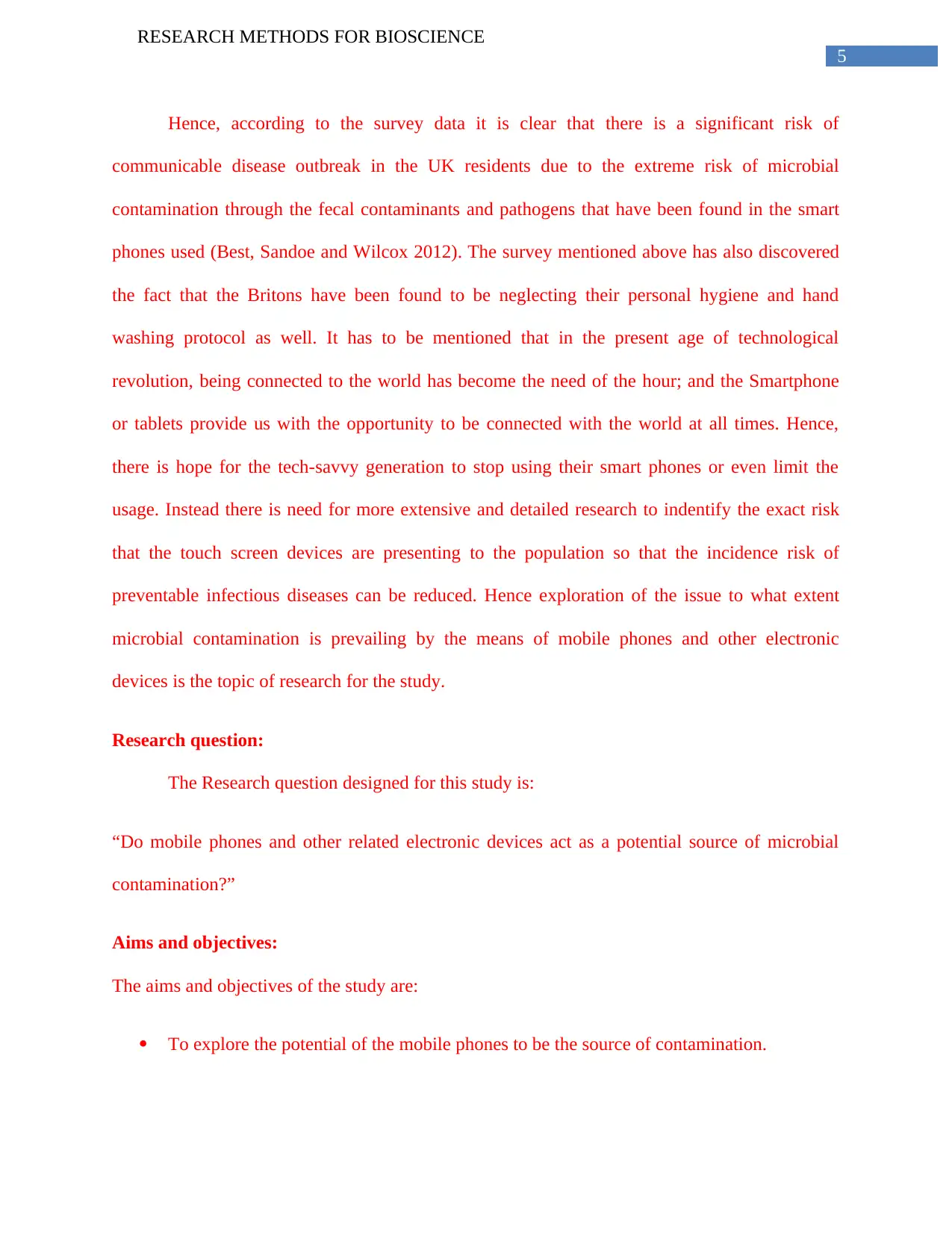
possible, 92 per cent of phones and 82 per cent of hands had bacteria on them. Disturbingly, 16
per cent of hands and 16 per cent of phones were found to be contaminated with E. coli, bacteria
of a fecal origin (Qmul.ac.uk 2018). Hence, it can be easily stated that the contamination from
the washrooms or the toilet seat and can lead to severe infections such as food poisoning and
diarrhea. Other common pathogens that contaminate the cell phones include MRSA, Bacillus
spp, Viridans streptococci, etc.
(Jeon, Chun and Kim 2013)
RESEARCH METHODS FOR BIOSCIENCE
contamination rates of the United kingdom, the survey data has discovered the fact that on
among 6 mobile phones used by the UK dwellers have been found to be heavily contaminated
with fecal matter and microbes (Gov.uk 2018). The research study articulated by the Queen
Mary’s school of Biological and Chemical Sciences and the London school of Hygiene and
Tropical Medicine that focused on the 12 cities of the United Kingdom revealed that the most
common bacteria found had been Escherechia coli, a pathogen of fecal orgin indicating at poor
hygiene of the Britons. 95 per cent of people said they washed their hands with soap where
possible, 92 per cent of phones and 82 per cent of hands had bacteria on them. Disturbingly, 16
per cent of hands and 16 per cent of phones were found to be contaminated with E. coli, bacteria
of a fecal origin (Qmul.ac.uk 2018). Hence, it can be easily stated that the contamination from
the washrooms or the toilet seat and can lead to severe infections such as food poisoning and
diarrhea. Other common pathogens that contaminate the cell phones include MRSA, Bacillus
spp, Viridans streptococci, etc.
(Jeon, Chun and Kim 2013)
5
RESEARCH METHODS FOR BIOSCIENCE
Hence, according to the survey data it is clear that there is a significant risk of
communicable disease outbreak in the UK residents due to the extreme risk of microbial
contamination through the fecal contaminants and pathogens that have been found in the smart
phones used (Best, Sandoe and Wilcox 2012). The survey mentioned above has also discovered
the fact that the Britons have been found to be neglecting their personal hygiene and hand
washing protocol as well. It has to be mentioned that in the present age of technological
revolution, being connected to the world has become the need of the hour; and the Smartphone
or tablets provide us with the opportunity to be connected with the world at all times. Hence,
there is hope for the tech-savvy generation to stop using their smart phones or even limit the
usage. Instead there is need for more extensive and detailed research to indentify the exact risk
that the touch screen devices are presenting to the population so that the incidence risk of
preventable infectious diseases can be reduced. Hence exploration of the issue to what extent
microbial contamination is prevailing by the means of mobile phones and other electronic
devices is the topic of research for the study.
Research question:
The Research question designed for this study is:
“Do mobile phones and other related electronic devices act as a potential source of microbial
contamination?”
Aims and objectives:
The aims and objectives of the study are:
To explore the potential of the mobile phones to be the source of contamination.
RESEARCH METHODS FOR BIOSCIENCE
Hence, according to the survey data it is clear that there is a significant risk of
communicable disease outbreak in the UK residents due to the extreme risk of microbial
contamination through the fecal contaminants and pathogens that have been found in the smart
phones used (Best, Sandoe and Wilcox 2012). The survey mentioned above has also discovered
the fact that the Britons have been found to be neglecting their personal hygiene and hand
washing protocol as well. It has to be mentioned that in the present age of technological
revolution, being connected to the world has become the need of the hour; and the Smartphone
or tablets provide us with the opportunity to be connected with the world at all times. Hence,
there is hope for the tech-savvy generation to stop using their smart phones or even limit the
usage. Instead there is need for more extensive and detailed research to indentify the exact risk
that the touch screen devices are presenting to the population so that the incidence risk of
preventable infectious diseases can be reduced. Hence exploration of the issue to what extent
microbial contamination is prevailing by the means of mobile phones and other electronic
devices is the topic of research for the study.
Research question:
The Research question designed for this study is:
“Do mobile phones and other related electronic devices act as a potential source of microbial
contamination?”
Aims and objectives:
The aims and objectives of the study are:
To explore the potential of the mobile phones to be the source of contamination.
⊘ This is a preview!⊘
Do you want full access?
Subscribe today to unlock all pages.
Trusted by 1+ million students worldwide
6
RESEARCH METHODS FOR BIOSCIENCE
To explore the level of mobile phone usage and its relation to the extent and severity of
the contamination risk by the smart phones
Analyze the different external and internal factors associated with the usage rate and its
relation to contamination severity
To evaluate the impact of mobile phone usage in facilitating infectious diseases by the
contaminated surfaces such as the touch screen.
Null hypothesis:
The null hypothesis for the project is:
Mobile phones and similar electronic devices are not a potential source of bacterial
contamination.
Methodology
Research design
The study will be designed in a way that helped to investigate the presence of bacterial
contamination in touch screen phones, iPad, and tablets in the laboratory setting. The study will
be a cross-sectional that will focus on observational data from a representative subset of a
population, at a specific time period. The basic rationale of the study can be attributed to the fact
that approximately 75% individuals, all around the world have an access to touch screen
electronic devices, specifically mobile phones and tablets (Kamis et al. 2015). They have
increasingly become an important means of communication, globally, owing to their easy access,
economical standards and user-friendly techniques. Regardless of the huge achievements of these
touch screen devices in the current scenario, there is no denying the fact that the electronic
RESEARCH METHODS FOR BIOSCIENCE
To explore the level of mobile phone usage and its relation to the extent and severity of
the contamination risk by the smart phones
Analyze the different external and internal factors associated with the usage rate and its
relation to contamination severity
To evaluate the impact of mobile phone usage in facilitating infectious diseases by the
contaminated surfaces such as the touch screen.
Null hypothesis:
The null hypothesis for the project is:
Mobile phones and similar electronic devices are not a potential source of bacterial
contamination.
Methodology
Research design
The study will be designed in a way that helped to investigate the presence of bacterial
contamination in touch screen phones, iPad, and tablets in the laboratory setting. The study will
be a cross-sectional that will focus on observational data from a representative subset of a
population, at a specific time period. The basic rationale of the study can be attributed to the fact
that approximately 75% individuals, all around the world have an access to touch screen
electronic devices, specifically mobile phones and tablets (Kamis et al. 2015). They have
increasingly become an important means of communication, globally, owing to their easy access,
economical standards and user-friendly techniques. Regardless of the huge achievements of these
touch screen devices in the current scenario, there is no denying the fact that the electronic
Paraphrase This Document
Need a fresh take? Get an instant paraphrase of this document with our AI Paraphraser
7
RESEARCH METHODS FOR BIOSCIENCE
devices create several health hazards. Furthermore, these devices are most commonly used in
places and environment that has high presence of bacteria. Touch screen devices are frequently
used in research and medical laboratories during several activities that encompass collection of
sample, their processing and microorganism culture (Selim and Abaza 2015).
Unlike the hands that can be easily disinfected, with the use of alcohol-based hand rubs
(ABHRs), available across all medical facilities, hospitals and laboratories touch screen devices
are most often cumbersome to clean. Efforts are seldom taken to disinfect them. This increases
the potential of these devices for acquiring contamination with several bacterial agents. Hence,
this increases the likelihood of the mobiles and tablets to get contaminated by a range of
microorganisms, some of which might have a pathogenic nature (Pal et al. 2013). Furthermore,
the microorganisms present on the devices might also have drug-resistant properties, which in
turn would make the laboratory members more susceptible to suffering from a range of bacterial
and viral diseases (Lee et al. 2013). This forms the foundation of the cross-sectional research that
is intended to be conducted across a laboratory setting. The mobile phones, tablets and other
touch screen devices are the independent variables in this research as their number and selection
can be controlled or changed, within the laboratory setting. On the other hand, the measurable
contamination of these devices will act as the dependent variable.
Materials and participants
The cross-sectional study will be conducted over a period of 5 months (from July-
November). The mobile phones, tablets and iPads will be taken from 50 participants that include
me, my friends, family members, and professors, who will be randomly selected. Selection
criteria will include individuals who always carry their electronic devices with them. These
electronic devices will then be tested for bacterial contamination. A detailed informed consent
RESEARCH METHODS FOR BIOSCIENCE
devices create several health hazards. Furthermore, these devices are most commonly used in
places and environment that has high presence of bacteria. Touch screen devices are frequently
used in research and medical laboratories during several activities that encompass collection of
sample, their processing and microorganism culture (Selim and Abaza 2015).
Unlike the hands that can be easily disinfected, with the use of alcohol-based hand rubs
(ABHRs), available across all medical facilities, hospitals and laboratories touch screen devices
are most often cumbersome to clean. Efforts are seldom taken to disinfect them. This increases
the potential of these devices for acquiring contamination with several bacterial agents. Hence,
this increases the likelihood of the mobiles and tablets to get contaminated by a range of
microorganisms, some of which might have a pathogenic nature (Pal et al. 2013). Furthermore,
the microorganisms present on the devices might also have drug-resistant properties, which in
turn would make the laboratory members more susceptible to suffering from a range of bacterial
and viral diseases (Lee et al. 2013). This forms the foundation of the cross-sectional research that
is intended to be conducted across a laboratory setting. The mobile phones, tablets and other
touch screen devices are the independent variables in this research as their number and selection
can be controlled or changed, within the laboratory setting. On the other hand, the measurable
contamination of these devices will act as the dependent variable.
Materials and participants
The cross-sectional study will be conducted over a period of 5 months (from July-
November). The mobile phones, tablets and iPads will be taken from 50 participants that include
me, my friends, family members, and professors, who will be randomly selected. Selection
criteria will include individuals who always carry their electronic devices with them. These
electronic devices will then be tested for bacterial contamination. A detailed informed consent
8
RESEARCH METHODS FOR BIOSCIENCE
form will be provided to each recruited participants that will contain exhaustive information
about the purpose and probable benefits of the study. Following obtaining their informed
consent, the enrolled participants will be provided with self-administered questionnaire that will
cover specific questions on their demographic data. Questions will also be put regarding the
frequency and pattern of use of the devices, in addition to the hygiene practices that are followed.
Sterile cotton swabs, peptone water tubes, agar plates, and Quebec colony counters, used for the
experiment need not be purchased for the experiment. The materials for double disk diffusion
method and Kirby-Bauer antibiotic sensitivity test will be purchased for conduction of the
research.
Methods
The touch screen devices will be aseptically collected with the use of sterile cotton
swabs. Each swab will be will be moistened with the use of sterile peptone water. This will be
wiped over the keys, screen, back panel, mouthpiece, and earpiece. All swabs will be streaked by
SS method over surface of Blood- MacConkey agar plates. The cotton end of the swabs will be
rinsed, followed by soaking in peptone water. The agar plates will be anaerobically incubated for
24hours at 37°C. The colonies isolated from the plates using SS method will be measured and
counted in the form of organism/device. Quebec colony counter will be used to test the CFU/ml.
The bacteria isolated will be tested for Gram staining and microscopically examined. Agar
diffusion procedure will also be used to detect the antibiotic sensitivity of the bacteria that has
been isolated. This will be performed by using the Kirby-Bauer antibiotic sensitivity test. The
double disc diffusion procedure will be used testing the Gram negative isolates, for ESBL
(extended spectrum beta-lactamase). Statistical analysis of the measurements will be conducted
with the use of the SPSS version 21.0 software. Furthermore, the association between the types
RESEARCH METHODS FOR BIOSCIENCE
form will be provided to each recruited participants that will contain exhaustive information
about the purpose and probable benefits of the study. Following obtaining their informed
consent, the enrolled participants will be provided with self-administered questionnaire that will
cover specific questions on their demographic data. Questions will also be put regarding the
frequency and pattern of use of the devices, in addition to the hygiene practices that are followed.
Sterile cotton swabs, peptone water tubes, agar plates, and Quebec colony counters, used for the
experiment need not be purchased for the experiment. The materials for double disk diffusion
method and Kirby-Bauer antibiotic sensitivity test will be purchased for conduction of the
research.
Methods
The touch screen devices will be aseptically collected with the use of sterile cotton
swabs. Each swab will be will be moistened with the use of sterile peptone water. This will be
wiped over the keys, screen, back panel, mouthpiece, and earpiece. All swabs will be streaked by
SS method over surface of Blood- MacConkey agar plates. The cotton end of the swabs will be
rinsed, followed by soaking in peptone water. The agar plates will be anaerobically incubated for
24hours at 37°C. The colonies isolated from the plates using SS method will be measured and
counted in the form of organism/device. Quebec colony counter will be used to test the CFU/ml.
The bacteria isolated will be tested for Gram staining and microscopically examined. Agar
diffusion procedure will also be used to detect the antibiotic sensitivity of the bacteria that has
been isolated. This will be performed by using the Kirby-Bauer antibiotic sensitivity test. The
double disc diffusion procedure will be used testing the Gram negative isolates, for ESBL
(extended spectrum beta-lactamase). Statistical analysis of the measurements will be conducted
with the use of the SPSS version 21.0 software. Furthermore, the association between the types
⊘ This is a preview!⊘
Do you want full access?
Subscribe today to unlock all pages.
Trusted by 1+ million students worldwide
9
RESEARCH METHODS FOR BIOSCIENCE
of bacteria recovered (CFU) with the kind of touch screen interface will be evaluated with the
Fisher’s exact test. Significant independent factors will be analysed with the help of a
multivariate analysis.
Expected outcomes
A huge rate of microbial contamination is expected in all the touch screen devices that
will be selected for the study. Microbial contamination is expected to be higher for
Staphylococci, Enterococcus spp., Streptococcus spp., Escherichia coli, and methicillin-resistant
Staphylococcus aureus. No statistically significant differences are expected to occur in the rates
of bacterial contamination, in all mobile phones, tablets and iPads taken from the 120
participants, based on department, gender, or frequency of use of these touch screen devices.
However, lower rates of contamination might be observed in the touch screen devices owned by
people who frequently practiced hand hygiene practices. This can be correlated with the
questionnaire that will be duly filled in by the participants. Further outcomes might indicate
presence of higher number of bacteria in mobiles and tablets that were never cleaned by the
owners, compared to those that were recorded to get cleaned at times. Statistically significant
results are also expected in the isolates between the PP method and SS method. The
microorganisms isolated from the touch screen devices are also expected display high sensitivity
towards ampicillin and methicillin.
The importance of the research in laboratory setting can be attributed to the fact that
screening all touch screen devices for bacterial contamination, on a regular basis is crucial in
healthcare and research laboratory settings. This will facilitate the use of appropriate hand
hygiene practices and will lead to a successful implementation of infection control measures,
RESEARCH METHODS FOR BIOSCIENCE
of bacteria recovered (CFU) with the kind of touch screen interface will be evaluated with the
Fisher’s exact test. Significant independent factors will be analysed with the help of a
multivariate analysis.
Expected outcomes
A huge rate of microbial contamination is expected in all the touch screen devices that
will be selected for the study. Microbial contamination is expected to be higher for
Staphylococci, Enterococcus spp., Streptococcus spp., Escherichia coli, and methicillin-resistant
Staphylococcus aureus. No statistically significant differences are expected to occur in the rates
of bacterial contamination, in all mobile phones, tablets and iPads taken from the 120
participants, based on department, gender, or frequency of use of these touch screen devices.
However, lower rates of contamination might be observed in the touch screen devices owned by
people who frequently practiced hand hygiene practices. This can be correlated with the
questionnaire that will be duly filled in by the participants. Further outcomes might indicate
presence of higher number of bacteria in mobiles and tablets that were never cleaned by the
owners, compared to those that were recorded to get cleaned at times. Statistically significant
results are also expected in the isolates between the PP method and SS method. The
microorganisms isolated from the touch screen devices are also expected display high sensitivity
towards ampicillin and methicillin.
The importance of the research in laboratory setting can be attributed to the fact that
screening all touch screen devices for bacterial contamination, on a regular basis is crucial in
healthcare and research laboratory settings. This will facilitate the use of appropriate hand
hygiene practices and will lead to a successful implementation of infection control measures,
Paraphrase This Document
Need a fresh take? Get an instant paraphrase of this document with our AI Paraphraser
10
RESEARCH METHODS FOR BIOSCIENCE
thereby preventing the spread of harmful pathogens through these electronic devices, and
reducing rates of nosocomial infections.
RESEARCH METHODS FOR BIOSCIENCE
thereby preventing the spread of harmful pathogens through these electronic devices, and
reducing rates of nosocomial infections.
11
RESEARCH METHODS FOR BIOSCIENCE
References
Best, E.L., Sandoe, J.A.T. and Wilcox, M.H., 2012. Potential for aerosolization of Clostridium
difficile after flushing toilets: the role of toilet lids in reducing environmental contamination
risk. Journal of Hospital Infection, 80(1), pp.1-5.
Gov.uk. (2018). Health protection: Infectious diseases - GOV.UK. [online] Available at:
https://www.gov.uk/topic/health-protection/infectious-diseases [Accessed 24 May 2018].
Jeon, Y.S., Chun, J. and Kim, B.S., 2013. Identification of household bacterial community and
analysis of species shared with human microbiome. Current microbiology, 67(5), pp.557-563.
Kamis, K., Janevic, M.R., Marinec, N., Jantz, R., Valverde, H. and Piette, J.D., 2015. A study of
mobile phone use among patients with noncommunicable diseases in La Paz, Bolivia:
implications for mHealth research and development. Globalization and health, 11(1), p.30.
Lee, Y.J., Yoo, C.G., Lee, C.T., Chung, H.S., Kim, Y.W., Han, S.K. and Yim, J.J., 2013.
Contamination rates between smart cell phones and non‐smart cell phones of healthcare
workers. Journal of hospital medicine, 8(3), pp.144-147.
Miko, B.A., Cohen, B., Haxall, K., Conway, L., Kelly, N., Stare, D., Tropiano, C., Gilman, A.,
Seward Jr, S.L. and Larson, E., 2013. Personal and household hygiene, environmental
contamination, and health in undergraduate residence halls in New York City, 2011. PloS
one, 8(11), p.e81460.
Pal, P., Roy, A., Moore, G., Muzslay, M., Lee, E., Alder, S., Wilson, P., Powles, T., Wilson, P.
and Kelly, J., 2013. Keypad mobile phones are associated with a significant increased risk of
RESEARCH METHODS FOR BIOSCIENCE
References
Best, E.L., Sandoe, J.A.T. and Wilcox, M.H., 2012. Potential for aerosolization of Clostridium
difficile after flushing toilets: the role of toilet lids in reducing environmental contamination
risk. Journal of Hospital Infection, 80(1), pp.1-5.
Gov.uk. (2018). Health protection: Infectious diseases - GOV.UK. [online] Available at:
https://www.gov.uk/topic/health-protection/infectious-diseases [Accessed 24 May 2018].
Jeon, Y.S., Chun, J. and Kim, B.S., 2013. Identification of household bacterial community and
analysis of species shared with human microbiome. Current microbiology, 67(5), pp.557-563.
Kamis, K., Janevic, M.R., Marinec, N., Jantz, R., Valverde, H. and Piette, J.D., 2015. A study of
mobile phone use among patients with noncommunicable diseases in La Paz, Bolivia:
implications for mHealth research and development. Globalization and health, 11(1), p.30.
Lee, Y.J., Yoo, C.G., Lee, C.T., Chung, H.S., Kim, Y.W., Han, S.K. and Yim, J.J., 2013.
Contamination rates between smart cell phones and non‐smart cell phones of healthcare
workers. Journal of hospital medicine, 8(3), pp.144-147.
Miko, B.A., Cohen, B., Haxall, K., Conway, L., Kelly, N., Stare, D., Tropiano, C., Gilman, A.,
Seward Jr, S.L. and Larson, E., 2013. Personal and household hygiene, environmental
contamination, and health in undergraduate residence halls in New York City, 2011. PloS
one, 8(11), p.e81460.
Pal, P., Roy, A., Moore, G., Muzslay, M., Lee, E., Alder, S., Wilson, P., Powles, T., Wilson, P.
and Kelly, J., 2013. Keypad mobile phones are associated with a significant increased risk of
⊘ This is a preview!⊘
Do you want full access?
Subscribe today to unlock all pages.
Trusted by 1+ million students worldwide

1 out of 15


Related Documents


Your All-in-One AI-Powered Toolkit for Academic Success.
+13062052269
info@desklib.com
Available 24*7 on WhatsApp / Email
![[object Object]](/_next/static/media/star-bottom.7253800d.svg)
Unlock your academic potential
Copyright © 2020–2026 A2Z Services. All Rights Reserved. Developed and managed by ZUCOL.