Eco-Friendly Microbial Method for Mitigating Soil Liquefaction
VerifiedAdded on 2023/03/23
|13
|3257
|66
Report
AI Summary
This report comprehensively examines the microbial method as an eco-friendly and efficient approach to mitigate soil liquefaction. It defines soil liquefaction and its causes, emphasizing the damage it inflicts on infrastructure. The report reviews existing mitigation methods, highlighting their limitations, especially in terms of cost and environmental impact. The core of the report focuses on the microbial method, detailing bioclogging, biocementation, and biogas generation. Bioclogging involves using microbial biomass to clog pore spaces, reducing water infiltration. Biocementation utilizes urea hydrolysis to generate calcium carbonate, binding soil particles and increasing shear strength. Biogas is generated through microbial processes to minimize soil saturation. The report evaluates these techniques, citing research and laboratory experiments that demonstrate the effectiveness of the microbial method. It also discusses the need for further research to optimize the application of this method. The report concludes by emphasizing the potential of the microbial method as a promising and sustainable solution for soil liquefaction mitigation, while acknowledging the need for further investigation and industrial implementation.
Microbial Method 1
METHOD OF MITIGATING SOIL LIQUEFACTION
By Name
Course
Instructor
Institution
Location
Date
METHOD OF MITIGATING SOIL LIQUEFACTION
By Name
Course
Instructor
Institution
Location
Date

Paraphrase This Document
Need a fresh take? Get an instant paraphrase of this document with our AI Paraphraser
Microbial Method 2
ABSTRACT
The traditional methods of mitigating soil liquefaction can be costly for large-scale applications.
Research to determine the most cost-effective and eco-friendly method of mitigating soil
liquefaction is presented in this paper. The most eco-friendly and efficient mitigation of
liquefaction discussed in this research is the microbial method. Soil liquefaction can be defined
as an unexpected loss in strength in very loose to loose granular soils as a result of shaking of
ground followed by fast pore pressure increase. The combination of bioclogging and
biosaturation method is to generate biogas in the soil to minimize the level of saturation of sand
and sustain the desaturation of immobilizing bubbles of gases through the microbial process. The
biogas is generated through the process of denitrification and bioclogging is fro, a microbial
induced CaCo3 process.
ABSTRACT
The traditional methods of mitigating soil liquefaction can be costly for large-scale applications.
Research to determine the most cost-effective and eco-friendly method of mitigating soil
liquefaction is presented in this paper. The most eco-friendly and efficient mitigation of
liquefaction discussed in this research is the microbial method. Soil liquefaction can be defined
as an unexpected loss in strength in very loose to loose granular soils as a result of shaking of
ground followed by fast pore pressure increase. The combination of bioclogging and
biosaturation method is to generate biogas in the soil to minimize the level of saturation of sand
and sustain the desaturation of immobilizing bubbles of gases through the microbial process. The
biogas is generated through the process of denitrification and bioclogging is fro, a microbial
induced CaCo3 process.
Microbial Method 3
1. INTRODUCTION
This research paper is about the assessment of the most eco-friendly and efficient method of
mitigating soil liquefaction. Soil liquefaction can be defined as an unexpected loss in strength in
very loose to loose granular soils as a result of shaking of ground followed by fast pore pressure
increase. The shaking of the ground, which is normally as a result of significant horizontal
excitation and shearing of the very loose to loose soils or earthquakes, causes momentarily
dislodgement of the precarious contact of grain to the grain of the specific soil grains. The rapid
increase in the pressure of porewater usually accompany the shaking of the ground because of
the dislodgement, the weight superimposed on the ground is transferred momentarily to the
porewater since the soil loses its strength as a result of contact of grain to grain.
Liquefaction of soil and its related ground displacements resulting from the shaking caused by an
earthquake are the primary causes of damage in loose granular soils that are saturated. Numerous
failures induced by liquefaction of infrastructure facilities, buildings, and foundations like earth
dams, port facilities, and railway or highway embankments have been reported globally during
different earthquakes (Schenke, et al., 2013). Numerous liquefaction mitigation method existing
like cement mixing and compaction is normally too expensive to be used in a wide geographical
area. The most eco-friendly and efficient mitigation of liquefaction discussed in this research is
the microbial method.
2. LITERATURE REVIEW
2.1 Soil Liquefaction
Liquefaction is the state when the sandy soil that is saturated looses its shear strength because of
the consequent minimization of effective stresses and increased pore pressure. The term
1. INTRODUCTION
This research paper is about the assessment of the most eco-friendly and efficient method of
mitigating soil liquefaction. Soil liquefaction can be defined as an unexpected loss in strength in
very loose to loose granular soils as a result of shaking of ground followed by fast pore pressure
increase. The shaking of the ground, which is normally as a result of significant horizontal
excitation and shearing of the very loose to loose soils or earthquakes, causes momentarily
dislodgement of the precarious contact of grain to the grain of the specific soil grains. The rapid
increase in the pressure of porewater usually accompany the shaking of the ground because of
the dislodgement, the weight superimposed on the ground is transferred momentarily to the
porewater since the soil loses its strength as a result of contact of grain to grain.
Liquefaction of soil and its related ground displacements resulting from the shaking caused by an
earthquake are the primary causes of damage in loose granular soils that are saturated. Numerous
failures induced by liquefaction of infrastructure facilities, buildings, and foundations like earth
dams, port facilities, and railway or highway embankments have been reported globally during
different earthquakes (Schenke, et al., 2013). Numerous liquefaction mitigation method existing
like cement mixing and compaction is normally too expensive to be used in a wide geographical
area. The most eco-friendly and efficient mitigation of liquefaction discussed in this research is
the microbial method.
2. LITERATURE REVIEW
2.1 Soil Liquefaction
Liquefaction is the state when the sandy soil that is saturated looses its shear strength because of
the consequent minimization of effective stresses and increased pore pressure. The term
⊘ This is a preview!⊘
Do you want full access?
Subscribe today to unlock all pages.

Trusted by 1+ million students worldwide
Microbial Method 4
liquefaction was first used in 1936 to explain the massive failures of soil at Fort Peck Dam in
1936 and later gathered global attention in the 1960s after massive magnitude earthquakes
caused damage on structures through ground failure in Niigata, Alaska, and Anchorage. The
structure of the cohesionless oil tends to become more compact as a consequence of the cyclic
stresses applied but with a resulting minimization of the effective stresses on the soil grains and
stresses transfer to the porewater. In the event of an earthquake, the application of induced cyclic
shear stresses by the shear wave propagation result into the contraction of loose sand resulting
into the pressure of pore water (Kheirbek-Saoud & Fleureau, 2012).
The development of high pressure of water pore results in upward water flow may change the
sand into a liquefied state which is referred to as liquefaction. The liquefaction affects
transportation systems, utilities, and structures are dangerous in case appropriate measures of risk
mitigation are not adopted. Numerous methods that reduce liquefaction effects on buildings
include tying together independent footing with grade beams, application of caissons or end
bearing piles with high lateral capacities, and additional ductility to allow larger deformations.
Ground improvements through in-situ can also improve the performance during cyclic loadings,
minimizing ground displacement and liquefaction (Jakka, et al., 2010).
2.2 Mitigation Methods of Soil Liquefaction
The improvement of the soil can be attained through sand reinforcement, drainage, dewatering,
solidification, and densification. The implementation of these methods may result in partial or
full liquefaction elimination potential depending on the quantity of deformation that the building
can tolerate and the forces likely to the experienced. The selection of the suitable method of soil
improvement depends on numerous factors such as the extent of area covered, required depth,
the magnitude of improvement attainable by a specific approach, level of improvement required,
liquefaction was first used in 1936 to explain the massive failures of soil at Fort Peck Dam in
1936 and later gathered global attention in the 1960s after massive magnitude earthquakes
caused damage on structures through ground failure in Niigata, Alaska, and Anchorage. The
structure of the cohesionless oil tends to become more compact as a consequence of the cyclic
stresses applied but with a resulting minimization of the effective stresses on the soil grains and
stresses transfer to the porewater. In the event of an earthquake, the application of induced cyclic
shear stresses by the shear wave propagation result into the contraction of loose sand resulting
into the pressure of pore water (Kheirbek-Saoud & Fleureau, 2012).
The development of high pressure of water pore results in upward water flow may change the
sand into a liquefied state which is referred to as liquefaction. The liquefaction affects
transportation systems, utilities, and structures are dangerous in case appropriate measures of risk
mitigation are not adopted. Numerous methods that reduce liquefaction effects on buildings
include tying together independent footing with grade beams, application of caissons or end
bearing piles with high lateral capacities, and additional ductility to allow larger deformations.
Ground improvements through in-situ can also improve the performance during cyclic loadings,
minimizing ground displacement and liquefaction (Jakka, et al., 2010).
2.2 Mitigation Methods of Soil Liquefaction
The improvement of the soil can be attained through sand reinforcement, drainage, dewatering,
solidification, and densification. The implementation of these methods may result in partial or
full liquefaction elimination potential depending on the quantity of deformation that the building
can tolerate and the forces likely to the experienced. The selection of the suitable method of soil
improvement depends on numerous factors such as the extent of area covered, required depth,
the magnitude of improvement attainable by a specific approach, level of improvement required,
Paraphrase This Document
Need a fresh take? Get an instant paraphrase of this document with our AI Paraphraser
Microbial Method 5
types of soil, the efficiency of the method, and effects on the environment (Huang & Zhuoqiang,
2014).
2.3 Microbial Method
There are generally a million bacteria cells in a millilitre of fresh water and 40 million bacteria
cells in one gram of soil. An understanding of the biological principles will result in geotechnical
solutions, enhanced understanding of the soil behaviour, and improved soil characterization. The
fast rate of microorganisms and great microbial diversity are responsible for the universal
presence in the geo-environment (Huang & Zhuoqiang, 2014). The natural soil capacity may
provide suitable and innovative solutions to soil liquefaction. This method of soil improvement is
distinct from the conventional improvement of soil. It involves a spontaneously biological
process to execute and manage chemical and physical reactions and hence change the
engineering soil properties (Jian, et al., 2016).
2.3.1 Biocementation
Biological clogging or bioclogging is the clogging of pore spaces in the soil through microbial
biomass. The microbial biomass prevents the water pathway in the space, making a specific
thickness of the impermeable soil layer, and it minimizes the rate of water infiltration
remarkably. In the state where water infiltration is required at a suitable rate, bioclogging may be
difficult and countermeasures like regular drying of the soil are taken. Four categories of
microorganisms are presently involved in the process, organisms, organisms utilizing acids,
sulfate-reducing bacteria, and photosynthetic organisms and involved in the hydrolysis of urea,
nitrate reduction, ammonification of amino acids.
types of soil, the efficiency of the method, and effects on the environment (Huang & Zhuoqiang,
2014).
2.3 Microbial Method
There are generally a million bacteria cells in a millilitre of fresh water and 40 million bacteria
cells in one gram of soil. An understanding of the biological principles will result in geotechnical
solutions, enhanced understanding of the soil behaviour, and improved soil characterization. The
fast rate of microorganisms and great microbial diversity are responsible for the universal
presence in the geo-environment (Huang & Zhuoqiang, 2014). The natural soil capacity may
provide suitable and innovative solutions to soil liquefaction. This method of soil improvement is
distinct from the conventional improvement of soil. It involves a spontaneously biological
process to execute and manage chemical and physical reactions and hence change the
engineering soil properties (Jian, et al., 2016).
2.3.1 Biocementation
Biological clogging or bioclogging is the clogging of pore spaces in the soil through microbial
biomass. The microbial biomass prevents the water pathway in the space, making a specific
thickness of the impermeable soil layer, and it minimizes the rate of water infiltration
remarkably. In the state where water infiltration is required at a suitable rate, bioclogging may be
difficult and countermeasures like regular drying of the soil are taken. Four categories of
microorganisms are presently involved in the process, organisms, organisms utilizing acids,
sulfate-reducing bacteria, and photosynthetic organisms and involved in the hydrolysis of urea,
nitrate reduction, ammonification of amino acids.
Microbial Method 6
By using urea in the process of hydrolysis, calcium carbonate is generated and crystallized on the
ground surface which can bind together the particles to reduce the permeability and increase the
shear strength. The hydrolyzing process by the use of urea produced CaCo3 and crystallized on
the soil surface which can bind the particles of soil together to increase the shear strength and fill
the pores between soil particles to minimize the permeability and soil liquefaction
(Iamchaturapatr & Piriyakul, 2014).
The hydrolyzing process or urea and other processes of microbiology control the flow of water
through the soil and strengthen the soil which is commonly known as biocementation. The
biocementation process provided some advantages over the traditional cement, namely low
carbon emission and eco-friendly. The two major applications of biocement process are to
control the seepage through the soil and improve the stiffness and strength of the soil (Ivanov, et
al., 2013).
2.3.2 Biosealing and Bioclogging
The void size between the particles of soil will be the first emerging concept relates to clogging,
particularly when clogging is as a result of biological activities. Because of the low permeability
and tiny pore voids in clay, the nutrients and bacteria transportation and greatly limited.
Appropriate microorganisms could be used in the soil to accumulate and form insoluble bacterial
lime or bacterial biomass which further enhances attachment of other particles and
microorganisms, hence developing a biofilm that can influence the physical properties of soil
such as its permeability. Some of the uses of bioclogging include immobilization of soil
pollutants, increasing the resistance of boreholes on fields, increasing the bearing capability of
soil surface, soil stabilization in land reclamation, producing strong filling material from soft
soil, enhancing the stability of soil, and mitigating soil liquefaction (Zhong, et al., 2013).
By using urea in the process of hydrolysis, calcium carbonate is generated and crystallized on the
ground surface which can bind together the particles to reduce the permeability and increase the
shear strength. The hydrolyzing process by the use of urea produced CaCo3 and crystallized on
the soil surface which can bind the particles of soil together to increase the shear strength and fill
the pores between soil particles to minimize the permeability and soil liquefaction
(Iamchaturapatr & Piriyakul, 2014).
The hydrolyzing process or urea and other processes of microbiology control the flow of water
through the soil and strengthen the soil which is commonly known as biocementation. The
biocementation process provided some advantages over the traditional cement, namely low
carbon emission and eco-friendly. The two major applications of biocement process are to
control the seepage through the soil and improve the stiffness and strength of the soil (Ivanov, et
al., 2013).
2.3.2 Biosealing and Bioclogging
The void size between the particles of soil will be the first emerging concept relates to clogging,
particularly when clogging is as a result of biological activities. Because of the low permeability
and tiny pore voids in clay, the nutrients and bacteria transportation and greatly limited.
Appropriate microorganisms could be used in the soil to accumulate and form insoluble bacterial
lime or bacterial biomass which further enhances attachment of other particles and
microorganisms, hence developing a biofilm that can influence the physical properties of soil
such as its permeability. Some of the uses of bioclogging include immobilization of soil
pollutants, increasing the resistance of boreholes on fields, increasing the bearing capability of
soil surface, soil stabilization in land reclamation, producing strong filling material from soft
soil, enhancing the stability of soil, and mitigating soil liquefaction (Zhong, et al., 2013).
⊘ This is a preview!⊘
Do you want full access?
Subscribe today to unlock all pages.
Trusted by 1+ million students worldwide
Microbial Method 7
2.3.3 Biogas
Biogas is normally generated through the breakdown of inorganic or organic matter through
microbial processes such as fermentation with biodegradable materials or anaerobic digestion
with anaerobic bacteria. Biogas can be applied to minimize the liquefaction capability of soil by
making it unsaturated slightly using gas. The easiest way of introducing nitrogen gas into the soil
to assist in fermentation is to directly inject air since dry contains a huge quantity of air. Loose
saturated sands are normally susceptible to soil liquefaction through earthquakes. Research
shows that there can be an improvement in the liquefaction resistance and undrained shear
strength of loose saturated sand by reducing the degree of saturation. The degree of saturation is
minimized by the production of oxygen gas from the sodium perborate hydrolysis in soil pores.
3. EVALUATION
The microbial process application in the soil liquefaction mitigation has been attracting huge
attention in the past years. Major research has been done on biogas, biofilm or bioclogging, and
biocementation approach as ways of soil improvement. The mechanism behind this technique
includes filling channels and voids in the soil and binding soil particles with crystals and
biomass. Extensive research is still needed for effective application of microbial process in the
field and for better understanding of this method. The microbial method of soil liquefaction as a
promising and emerging area of research has attracted large initiatives already from both
industrial professionals and scientific researchers. Numerous findings mentioned above actually
denotes a promising future in this soil liquefaction method (Newcomer, et al., 2016).
Despite considerable positive and exciting achievements realized in this method, there is still a
vast chance for improvement. Successful file tests of bioclogging have been done in Austria and
2.3.3 Biogas
Biogas is normally generated through the breakdown of inorganic or organic matter through
microbial processes such as fermentation with biodegradable materials or anaerobic digestion
with anaerobic bacteria. Biogas can be applied to minimize the liquefaction capability of soil by
making it unsaturated slightly using gas. The easiest way of introducing nitrogen gas into the soil
to assist in fermentation is to directly inject air since dry contains a huge quantity of air. Loose
saturated sands are normally susceptible to soil liquefaction through earthquakes. Research
shows that there can be an improvement in the liquefaction resistance and undrained shear
strength of loose saturated sand by reducing the degree of saturation. The degree of saturation is
minimized by the production of oxygen gas from the sodium perborate hydrolysis in soil pores.
3. EVALUATION
The microbial process application in the soil liquefaction mitigation has been attracting huge
attention in the past years. Major research has been done on biogas, biofilm or bioclogging, and
biocementation approach as ways of soil improvement. The mechanism behind this technique
includes filling channels and voids in the soil and binding soil particles with crystals and
biomass. Extensive research is still needed for effective application of microbial process in the
field and for better understanding of this method. The microbial method of soil liquefaction as a
promising and emerging area of research has attracted large initiatives already from both
industrial professionals and scientific researchers. Numerous findings mentioned above actually
denotes a promising future in this soil liquefaction method (Newcomer, et al., 2016).
Despite considerable positive and exciting achievements realized in this method, there is still a
vast chance for improvement. Successful file tests of bioclogging have been done in Austria and
Paraphrase This Document
Need a fresh take? Get an instant paraphrase of this document with our AI Paraphraser
Microbial Method 8
the Netherlands with the aim of minimizing the leakage through water-retaining structures. The
implementation of the microbial method into industry will take considerable duration due to the
need of solving some of the questions raised during research such as how to reduce the cycles of
microbial treatments for economic reasons and to deliver sources of calcium and bacteria to the
depth desired for biogrouting successfully. The fast development of the microbial method of
mitigating soil liquefaction has produced exciting advances in the geotechnology (Mostafa &
Geel, 2015).
The positive results of the research done of the microbial process lay a steady foundation for
future studies. There is need of integrating experimentation, numerical modelling, and analytical
work on major areas such as verification of soil mechanical properties in the stage of post-
treatment, development of reliable and economic monitoring technique, management of
treatment byproducts, and optimization of the bio-geo application process (Junfang & Holden,
2015).
From the laboratory experiments, numerous research has shown that when gas is present in the
pore fluids or voids, the mechanical response of the soil will be affected during cyclic and
monotonic loading. Recently, the tests of fundamental soil mechanics like triaxial tests have
shown that the inclusion of gas bubbles in the sand that is saturated can substantially minimize
its susceptibility for liquefaction. Some trials in the field have already been implemented in
Japan and positive results were attained. Despite numerous available methods of injecting gas
bubbles into saturated soil such as sand compaction pile method, using chemical reagent, water
electrolysis, and direct air injection, there are still some drawbacks associated with each
approach. By considering the uniformity of the gas bubble distribution and the energy
the Netherlands with the aim of minimizing the leakage through water-retaining structures. The
implementation of the microbial method into industry will take considerable duration due to the
need of solving some of the questions raised during research such as how to reduce the cycles of
microbial treatments for economic reasons and to deliver sources of calcium and bacteria to the
depth desired for biogrouting successfully. The fast development of the microbial method of
mitigating soil liquefaction has produced exciting advances in the geotechnology (Mostafa &
Geel, 2015).
The positive results of the research done of the microbial process lay a steady foundation for
future studies. There is need of integrating experimentation, numerical modelling, and analytical
work on major areas such as verification of soil mechanical properties in the stage of post-
treatment, development of reliable and economic monitoring technique, management of
treatment byproducts, and optimization of the bio-geo application process (Junfang & Holden,
2015).
From the laboratory experiments, numerous research has shown that when gas is present in the
pore fluids or voids, the mechanical response of the soil will be affected during cyclic and
monotonic loading. Recently, the tests of fundamental soil mechanics like triaxial tests have
shown that the inclusion of gas bubbles in the sand that is saturated can substantially minimize
its susceptibility for liquefaction. Some trials in the field have already been implemented in
Japan and positive results were attained. Despite numerous available methods of injecting gas
bubbles into saturated soil such as sand compaction pile method, using chemical reagent, water
electrolysis, and direct air injection, there are still some drawbacks associated with each
approach. By considering the uniformity of the gas bubble distribution and the energy
Microbial Method 9
consumption, the biogas generated from activities of microbial treatment is a promising
candidate for the purposes of desaturation (Ledesma-Amaro, et al., 2013).
The shear strength is one of the most significant properties of soil in engineering. Results from
laboratory test show a significant increase in the strength of soil after introducing calcium
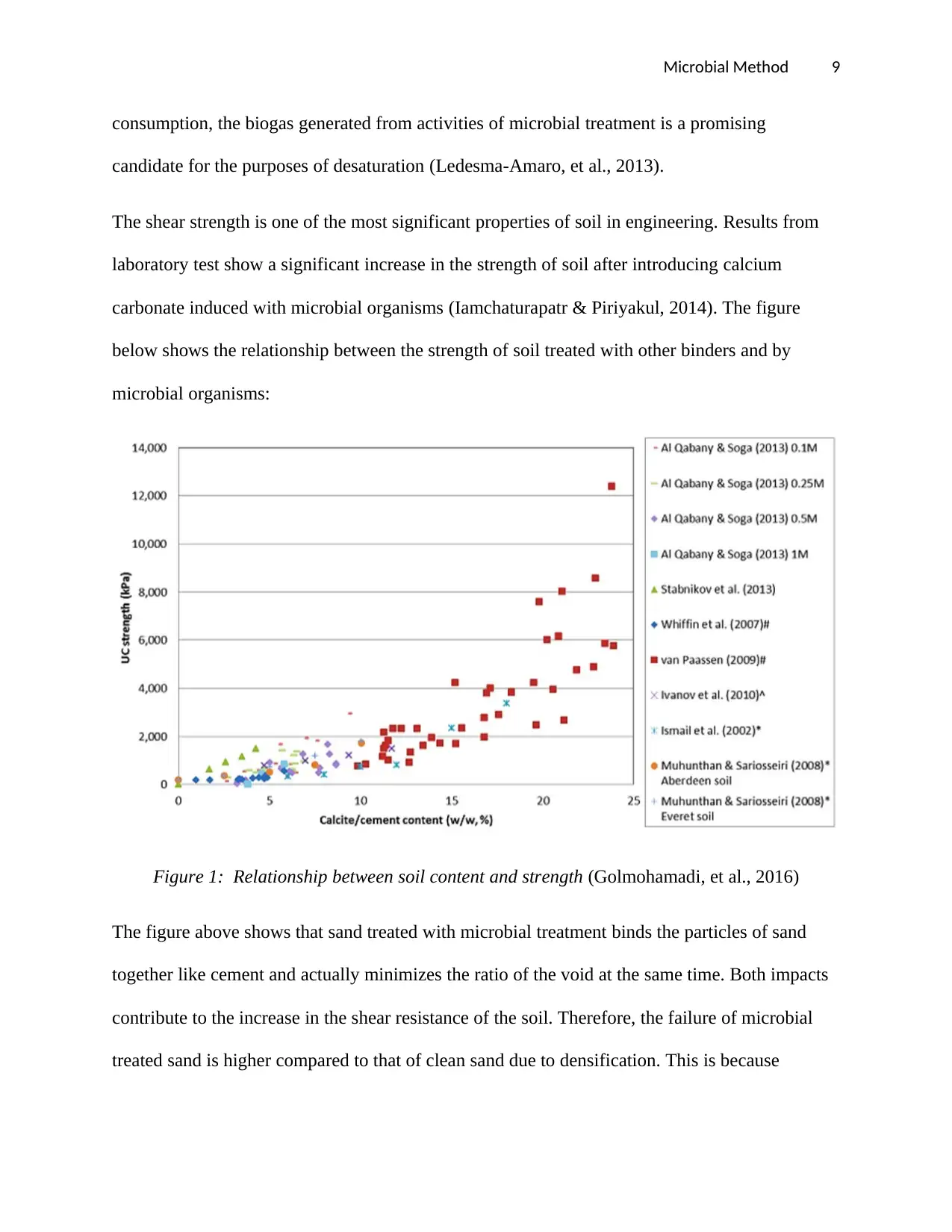
carbonate induced with microbial organisms (Iamchaturapatr & Piriyakul, 2014). The figure
below shows the relationship between the strength of soil treated with other binders and by
microbial organisms:
Figure 1: Relationship between soil content and strength (Golmohamadi, et al., 2016)
The figure above shows that sand treated with microbial treatment binds the particles of sand
together like cement and actually minimizes the ratio of the void at the same time. Both impacts
contribute to the increase in the shear resistance of the soil. Therefore, the failure of microbial
treated sand is higher compared to that of clean sand due to densification. This is because
consumption, the biogas generated from activities of microbial treatment is a promising
candidate for the purposes of desaturation (Ledesma-Amaro, et al., 2013).
The shear strength is one of the most significant properties of soil in engineering. Results from
laboratory test show a significant increase in the strength of soil after introducing calcium
carbonate induced with microbial organisms (Iamchaturapatr & Piriyakul, 2014). The figure
below shows the relationship between the strength of soil treated with other binders and by
microbial organisms:
Figure 1: Relationship between soil content and strength (Golmohamadi, et al., 2016)
The figure above shows that sand treated with microbial treatment binds the particles of sand
together like cement and actually minimizes the ratio of the void at the same time. Both impacts
contribute to the increase in the shear resistance of the soil. Therefore, the failure of microbial
treated sand is higher compared to that of clean sand due to densification. This is because
⊘ This is a preview!⊘
Do you want full access?
Subscribe today to unlock all pages.
Trusted by 1+ million students worldwide
Microbial Method 10
microbial treated sand minimized both the ground settlement and pore pressure generation at all
levels (Maleki, et al., 2016).
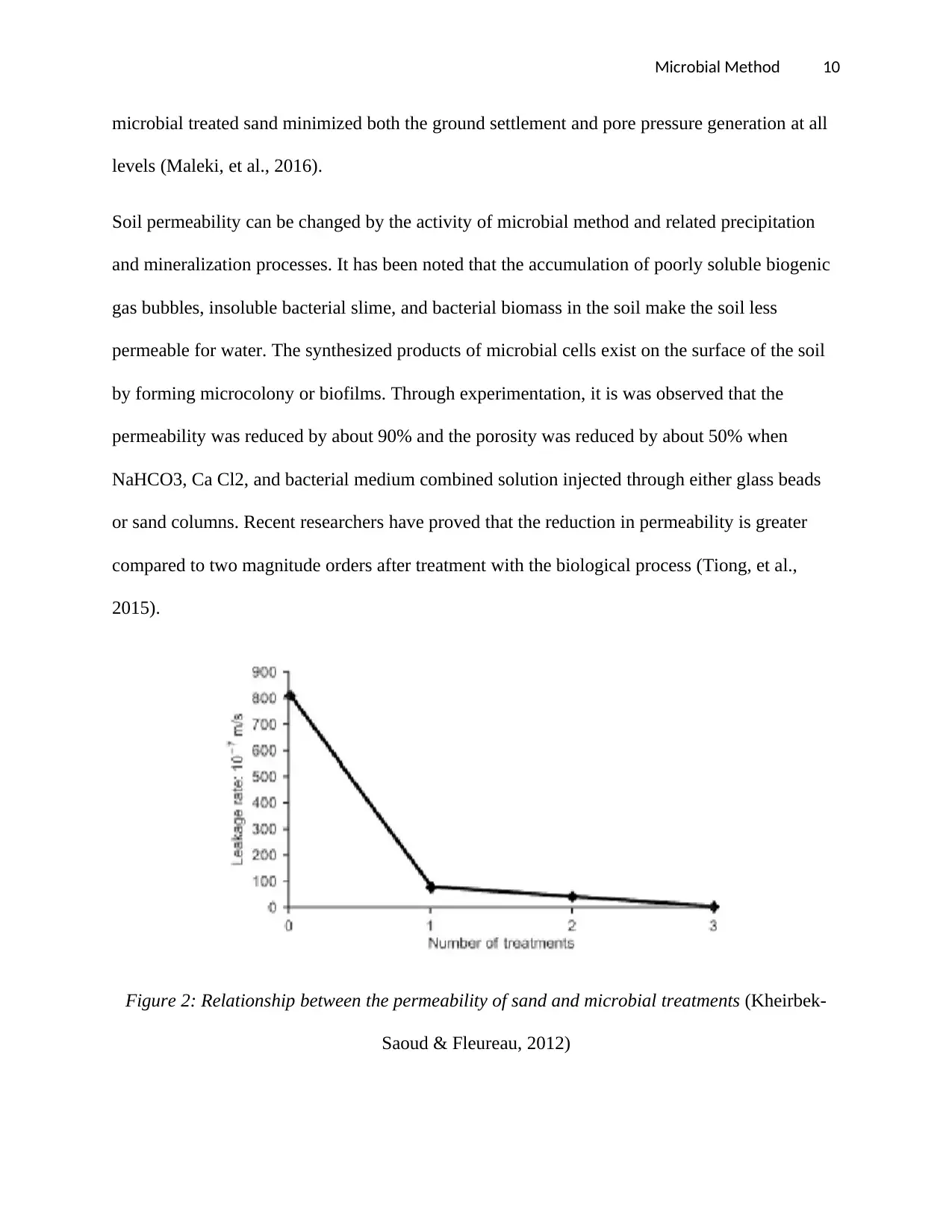
Soil permeability can be changed by the activity of microbial method and related precipitation
and mineralization processes. It has been noted that the accumulation of poorly soluble biogenic
gas bubbles, insoluble bacterial slime, and bacterial biomass in the soil make the soil less
permeable for water. The synthesized products of microbial cells exist on the surface of the soil
by forming microcolony or biofilms. Through experimentation, it is was observed that the
permeability was reduced by about 90% and the porosity was reduced by about 50% when
NaHCO3, Ca Cl2, and bacterial medium combined solution injected through either glass beads
or sand columns. Recent researchers have proved that the reduction in permeability is greater
compared to two magnitude orders after treatment with the biological process (Tiong, et al.,
2015).
Figure 2: Relationship between the permeability of sand and microbial treatments (Kheirbek-
Saoud & Fleureau, 2012)
microbial treated sand minimized both the ground settlement and pore pressure generation at all
levels (Maleki, et al., 2016).
Soil permeability can be changed by the activity of microbial method and related precipitation
and mineralization processes. It has been noted that the accumulation of poorly soluble biogenic
gas bubbles, insoluble bacterial slime, and bacterial biomass in the soil make the soil less
permeable for water. The synthesized products of microbial cells exist on the surface of the soil
by forming microcolony or biofilms. Through experimentation, it is was observed that the
permeability was reduced by about 90% and the porosity was reduced by about 50% when
NaHCO3, Ca Cl2, and bacterial medium combined solution injected through either glass beads
or sand columns. Recent researchers have proved that the reduction in permeability is greater
compared to two magnitude orders after treatment with the biological process (Tiong, et al.,
2015).
Figure 2: Relationship between the permeability of sand and microbial treatments (Kheirbek-
Saoud & Fleureau, 2012)
Paraphrase This Document
Need a fresh take? Get an instant paraphrase of this document with our AI Paraphraser
Microbial Method 11
It is reasonable to consider that a layer that is impermeable either within the soil or on the surface
can be formed artificially through suitable treatment. Nevertheless, it should be noted that the
permeability may be the same throughout the entire area or treating the soil. However, the
permeability of sand that is partially saturated is expected to be lower compared to the sand that
is fully saturated as well as relates to other aspects like saturation degree. In this research, it is
proposed that a combination of biogas generation together with bioclogging should be done to
promote the degree of saturation and the stability of the gas bubbles (Mostafa & Geel, 2015).
An experiment on Cementation and bioclogging using the process of microbial treatment to
investigate the effectiveness trapping the bubbles of biogas after the process of microbial
denitrification using the effect of bioclogging under a seepage flow condition.
4. CONCLUSION
Liquefaction is the state when the sandy soil that is saturated looses its shear strength because of
the consequent minimization of effective stresses and increased pore pressure. The improvement
of the soil can be attained through sand reinforcement, drainage, dewatering, solidification, and
densification. The most eco-friendly and efficient mitigation of liquefaction discussed in this
research is the microbial method. It involves a spontaneously biological process to execute and
manage chemical and physical reactions and hence change the engineering soil properties. Soil
permeability can be changed by the activity of microbial method and related precipitation and
mineralization processes. It has been noted that the accumulation of poorly soluble biogenic gas
bubbles, insoluble bacterial slime, and bacterial biomass in the soil make the soil less permeable
for water.
It is reasonable to consider that a layer that is impermeable either within the soil or on the surface
can be formed artificially through suitable treatment. Nevertheless, it should be noted that the
permeability may be the same throughout the entire area or treating the soil. However, the
permeability of sand that is partially saturated is expected to be lower compared to the sand that
is fully saturated as well as relates to other aspects like saturation degree. In this research, it is
proposed that a combination of biogas generation together with bioclogging should be done to
promote the degree of saturation and the stability of the gas bubbles (Mostafa & Geel, 2015).
An experiment on Cementation and bioclogging using the process of microbial treatment to
investigate the effectiveness trapping the bubbles of biogas after the process of microbial
denitrification using the effect of bioclogging under a seepage flow condition.
4. CONCLUSION
Liquefaction is the state when the sandy soil that is saturated looses its shear strength because of
the consequent minimization of effective stresses and increased pore pressure. The improvement
of the soil can be attained through sand reinforcement, drainage, dewatering, solidification, and
densification. The most eco-friendly and efficient mitigation of liquefaction discussed in this
research is the microbial method. It involves a spontaneously biological process to execute and
manage chemical and physical reactions and hence change the engineering soil properties. Soil
permeability can be changed by the activity of microbial method and related precipitation and
mineralization processes. It has been noted that the accumulation of poorly soluble biogenic gas
bubbles, insoluble bacterial slime, and bacterial biomass in the soil make the soil less permeable
for water.
Microbial Method 12
5. REFERENCES
Golmohamadi, S., Mohsenzadeh, A. & HajialiluMaleki, M., 2016. Effects of Biocementation Method on
Direct Shear Stress and Unconfined Compressive Stress of Sand. Indian Journal of Science and
Technology, Volume 9.
Huang, Y. & Zhuoqiang, W., 2014. Recent developments of soil improvement methods for seismic
liquefaction mitigation. Natural Hazards, Volume 76, pp. 1927-1938.
Huang, Y. & Zhuoqiang, W., 2014. Recent developments of soil improvement methods for seismic
liquefaction mitigation. Natural Hazards, Volume 76, pp. 1927-1938.
Iamchaturapatr, J. & Piriyakul, K., 2014. Effect of Urease Dosages in Biocementation Process for
Improving Strength of Sandy Soil. Advanced Materials Research, Volume 931, pp. 698-702.
Ivanov, V., Naeimi, M. & Stabnikov, V., 2013. Optimization of calcium-based bioclogging and
biocementation of sand. Acta Geotechnica, Volume 9, pp. 277-285.
Jakka, R., Datta, M. & Ramana, G., 2010. Liquefaction behaviour of loose and compacted pond ash. Soil
Dynamics and Earthquake Engineering, Volume 30, pp. 580-590.
Jian, L., Han-Long, L. & Yu-Feng, G., 2016. Microbial soil desaturation for the mitigation of earthquake
liquefaction. Japanese Geotechnical Society Special Publication, Volume 2, pp. 784-787.
Junfang, C. & Holden, N., 2015. The relationship between soil microbial activity and microbial biomass,
soil structure and grassland management. Soil and Tillage Research, Volume 146, pp. 32-38.
Kheirbek-Saoud, S. & Fleureau, J.-M., 2012. Liquefaction and post-liquefaction behaviour of a soft
natural clayey soil. Geomechanics and Engineering, Volume 4, pp. 121-134.
Ledesma-Amaro, R., Jiménez, A., Santos, M. & Revuelta, J., 2013. Biotechnological production of feed
nucleotides by microbial strain improvement. Process Biochemistry, Volume 48, pp. 1263-1270.
Maleki, M., Ebrahimi, S. & Hosseini, M., 2016. Improvement in soil grouting by biocementation through
injection method. Asia-Pacific Journal of Chemical Engineering, Volume 11, pp. 930-938.
Mostafa, M. & Geel, V., 2015. Impact of Bioclogging on Peat vs. Sand Biofilters. Vadose Zone Journal,
Volume 14.
Newcomer, M. et al., 2016. Simulating bioclogging effects on dynamic riverbed permeability and
infiltration. Water Resources Research, Volume 52, pp. 2883-2900.
Schenke, M., Markert, B. & Ehlers, W., 2013. Liquefaction in fluid-saturated soils. PAMM, Volume 13, pp.
145-146.
5. REFERENCES
Golmohamadi, S., Mohsenzadeh, A. & HajialiluMaleki, M., 2016. Effects of Biocementation Method on
Direct Shear Stress and Unconfined Compressive Stress of Sand. Indian Journal of Science and
Technology, Volume 9.
Huang, Y. & Zhuoqiang, W., 2014. Recent developments of soil improvement methods for seismic
liquefaction mitigation. Natural Hazards, Volume 76, pp. 1927-1938.
Huang, Y. & Zhuoqiang, W., 2014. Recent developments of soil improvement methods for seismic
liquefaction mitigation. Natural Hazards, Volume 76, pp. 1927-1938.
Iamchaturapatr, J. & Piriyakul, K., 2014. Effect of Urease Dosages in Biocementation Process for
Improving Strength of Sandy Soil. Advanced Materials Research, Volume 931, pp. 698-702.
Ivanov, V., Naeimi, M. & Stabnikov, V., 2013. Optimization of calcium-based bioclogging and
biocementation of sand. Acta Geotechnica, Volume 9, pp. 277-285.
Jakka, R., Datta, M. & Ramana, G., 2010. Liquefaction behaviour of loose and compacted pond ash. Soil
Dynamics and Earthquake Engineering, Volume 30, pp. 580-590.
Jian, L., Han-Long, L. & Yu-Feng, G., 2016. Microbial soil desaturation for the mitigation of earthquake
liquefaction. Japanese Geotechnical Society Special Publication, Volume 2, pp. 784-787.
Junfang, C. & Holden, N., 2015. The relationship between soil microbial activity and microbial biomass,
soil structure and grassland management. Soil and Tillage Research, Volume 146, pp. 32-38.
Kheirbek-Saoud, S. & Fleureau, J.-M., 2012. Liquefaction and post-liquefaction behaviour of a soft
natural clayey soil. Geomechanics and Engineering, Volume 4, pp. 121-134.
Ledesma-Amaro, R., Jiménez, A., Santos, M. & Revuelta, J., 2013. Biotechnological production of feed
nucleotides by microbial strain improvement. Process Biochemistry, Volume 48, pp. 1263-1270.
Maleki, M., Ebrahimi, S. & Hosseini, M., 2016. Improvement in soil grouting by biocementation through
injection method. Asia-Pacific Journal of Chemical Engineering, Volume 11, pp. 930-938.
Mostafa, M. & Geel, V., 2015. Impact of Bioclogging on Peat vs. Sand Biofilters. Vadose Zone Journal,
Volume 14.
Newcomer, M. et al., 2016. Simulating bioclogging effects on dynamic riverbed permeability and
infiltration. Water Resources Research, Volume 52, pp. 2883-2900.
Schenke, M., Markert, B. & Ehlers, W., 2013. Liquefaction in fluid-saturated soils. PAMM, Volume 13, pp.
145-146.
⊘ This is a preview!⊘
Do you want full access?
Subscribe today to unlock all pages.
Trusted by 1+ million students worldwide

1 out of 13


Your All-in-One AI-Powered Toolkit for Academic Success.
+13062052269
info@desklib.com
Available 24*7 on WhatsApp / Email
![[object Object]](/_next/static/media/star-bottom.7253800d.svg)
Unlock your academic potential
Copyright © 2020–2026 A2Z Services. All Rights Reserved. Developed and managed by ZUCOL.