Microbiological Techniques: Isolation and Identification of Bacteria
VerifiedAdded on 2020/04/15
|12
|2057
|120
Practical Assignment
AI Summary
This assignment presents a comprehensive analysis of microbiological techniques, encompassing CFU/ml calculations, Gram staining, and the use of various culture media for bacterial identification. The student's report details the membrane filtration and spread plate techniques for determining bacterial counts, along with explanations for plate count expressions and potential errors. The assignment then delves into Gram staining, explaining the differential staining process and its relevance to bacterial cell wall composition, concluding with the identification of the cultured organism as Gram-positive cocci. Further, the report analyzes enrichment media and identifies the organism as Staphylococcus aureus based on its growth characteristics on blood agar, Baird Parker agar, MacConkey agar, Mannitol salt agar, and XLD agar. The student also discusses the Analytical Profile Index (API) 20E test and provides a critical evaluation of the media used, concluding that some media were unnecessary given the initial Gram-staining results. The report is well-structured, providing detailed explanations and referencing relevant literature.
Running head: MICROBIOLOGICAL TECHNIQUES
MICROBIOLOGICAL TECHNIQUES
Name of the Student
Name of the University
Author Note
MICROBIOLOGICAL TECHNIQUES
Name of the Student
Name of the University
Author Note

Paraphrase This Document
Need a fresh take? Get an instant paraphrase of this document with our AI Paraphraser
1MICROBIOLOGICAL TECHNIQUES
Contents
Task 1...............................................................................................................................................3
Answer 1a....................................................................................................................................3
Answer 1b....................................................................................................................................4
Answer 1c....................................................................................................................................4
Task 2...............................................................................................................................................5
Answer 2a....................................................................................................................................5
Answer 2b....................................................................................................................................5
Answer 2c....................................................................................................................................6
Task 3...............................................................................................................................................6
Answer 3a....................................................................................................................................6
Answer 3b....................................................................................................................................6
Answer 3c....................................................................................................................................7
Blood agar................................................................................................................................7
Baird Parker agar.....................................................................................................................7
Cetrimide agar.........................................................................................................................7
MacConkey agar......................................................................................................................8
Mannitol salt agar....................................................................................................................8
XLD agar.................................................................................................................................8
Answer 3d....................................................................................................................................9
Contents
Task 1...............................................................................................................................................3
Answer 1a....................................................................................................................................3
Answer 1b....................................................................................................................................4
Answer 1c....................................................................................................................................4
Task 2...............................................................................................................................................5
Answer 2a....................................................................................................................................5
Answer 2b....................................................................................................................................5
Answer 2c....................................................................................................................................6
Task 3...............................................................................................................................................6
Answer 3a....................................................................................................................................6
Answer 3b....................................................................................................................................6
Answer 3c....................................................................................................................................7
Blood agar................................................................................................................................7
Baird Parker agar.....................................................................................................................7
Cetrimide agar.........................................................................................................................7
MacConkey agar......................................................................................................................8
Mannitol salt agar....................................................................................................................8
XLD agar.................................................................................................................................8
Answer 3d....................................................................................................................................9

2MICROBIOLOGICAL TECHNIQUES
Answer 3e....................................................................................................................................9
Reference List................................................................................................................................10
Answer 3e....................................................................................................................................9
Reference List................................................................................................................................10
⊘ This is a preview!⊘
Do you want full access?
Subscribe today to unlock all pages.

Trusted by 1+ million students worldwide
3MICROBIOLOGICAL TECHNIQUES
Task 1
Answer 1a
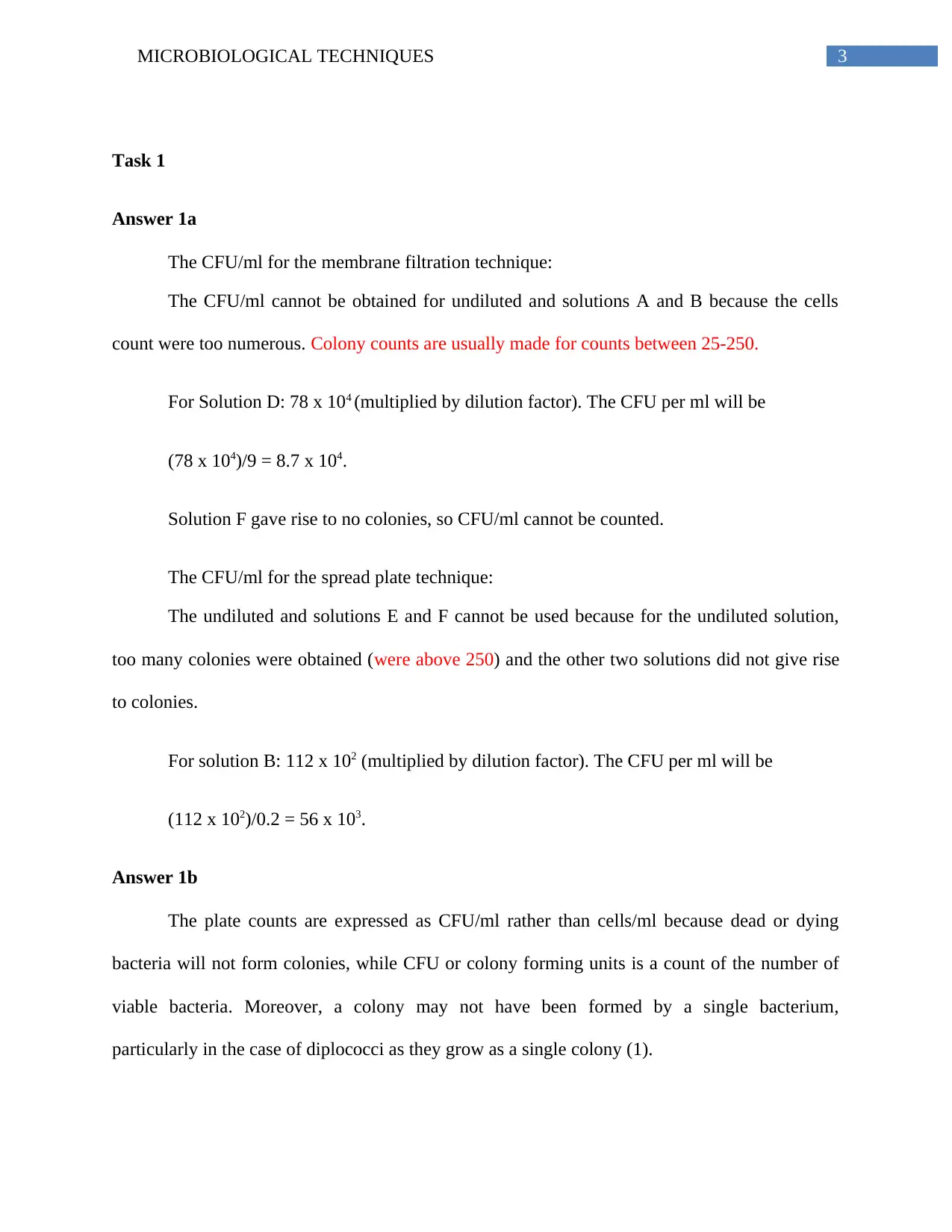
The CFU/ml for the membrane filtration technique:
The CFU/ml cannot be obtained for undiluted and solutions A and B because the cells
count were too numerous. Colony counts are usually made for counts between 25-250.
For Solution D: 78 x 104 (multiplied by dilution factor). The CFU per ml will be
(78 x 104)/9 = 8.7 x 10⁴.
Solution F gave rise to no colonies, so CFU/ml cannot be counted.
The CFU/ml for the spread plate technique:
The undiluted and solutions E and F cannot be used because for the undiluted solution,
too many colonies were obtained (were above 250) and the other two solutions did not give rise
to colonies.
For solution B: 112 x 102 (multiplied by dilution factor). The CFU per ml will be
(112 x 102)/0.2 = 56 x 103.
Answer 1b
The plate counts are expressed as CFU/ml rather than cells/ml because dead or dying
bacteria will not form colonies, while CFU or colony forming units is a count of the number of
viable bacteria. Moreover, a colony may not have been formed by a single bacterium,
particularly in the case of diplococci as they grow as a single colony (1).
Task 1
Answer 1a
The CFU/ml for the membrane filtration technique:
The CFU/ml cannot be obtained for undiluted and solutions A and B because the cells
count were too numerous. Colony counts are usually made for counts between 25-250.
For Solution D: 78 x 104 (multiplied by dilution factor). The CFU per ml will be
(78 x 104)/9 = 8.7 x 10⁴.
Solution F gave rise to no colonies, so CFU/ml cannot be counted.
The CFU/ml for the spread plate technique:
The undiluted and solutions E and F cannot be used because for the undiluted solution,
too many colonies were obtained (were above 250) and the other two solutions did not give rise
to colonies.
For solution B: 112 x 102 (multiplied by dilution factor). The CFU per ml will be
(112 x 102)/0.2 = 56 x 103.
Answer 1b
The plate counts are expressed as CFU/ml rather than cells/ml because dead or dying
bacteria will not form colonies, while CFU or colony forming units is a count of the number of
viable bacteria. Moreover, a colony may not have been formed by a single bacterium,
particularly in the case of diplococci as they grow as a single colony (1).
Paraphrase This Document
Need a fresh take? Get an instant paraphrase of this document with our AI Paraphraser
4MICROBIOLOGICAL TECHNIQUES
Answer 1c
One error can be that if the dilutions are not made properly, it can give rise to a large
number of colonies, which will be difficult to count. Moreover, with each increase in dilution,
the culture becomes more diluted, thereby enabling efficient quantitation of the number of
bacterial cells. Next, if the dilutions are not mixed properly, then the bacterial cells will remain
clumped together and there will not be any uniform distribution of bacteria, which will affect the
subsequent dilution steps. Another error can be the forceps and filter unit were not sterile, which
can give rise to contaminations. Forceps should be made sterile by heating it in bunsen burner
before and after placing the filter on the membrane as well as the plate. These errors can be
avoided by carrying out proper dilutions, proper mixing of the dilutions and the use of filter units
and forceps.
Other errors include that when the volume of the sample is less than 20ml, then 10ml of
sterile solution needs to be added to the filter unit prior to the application of vacuum. The
dilution solution helps to distribute the bacteria uniformly on the membrane filter. Another error
can be the absence of a vacuum system. The vacuum helps to draw the liquid culture completely
through the filter unit, thereby trapping the bacteria in the membrane filter. Improper spreading
in spread plate technique can result in clumps of bacterial growth on culture media instead of
single isolated colonies, thereby affecting proper quantification. Use of Bunsen burners during
plating is good as it will prevent contamination of the medium.
Answer 1c
One error can be that if the dilutions are not made properly, it can give rise to a large
number of colonies, which will be difficult to count. Moreover, with each increase in dilution,
the culture becomes more diluted, thereby enabling efficient quantitation of the number of
bacterial cells. Next, if the dilutions are not mixed properly, then the bacterial cells will remain
clumped together and there will not be any uniform distribution of bacteria, which will affect the
subsequent dilution steps. Another error can be the forceps and filter unit were not sterile, which
can give rise to contaminations. Forceps should be made sterile by heating it in bunsen burner
before and after placing the filter on the membrane as well as the plate. These errors can be
avoided by carrying out proper dilutions, proper mixing of the dilutions and the use of filter units
and forceps.
Other errors include that when the volume of the sample is less than 20ml, then 10ml of
sterile solution needs to be added to the filter unit prior to the application of vacuum. The
dilution solution helps to distribute the bacteria uniformly on the membrane filter. Another error
can be the absence of a vacuum system. The vacuum helps to draw the liquid culture completely
through the filter unit, thereby trapping the bacteria in the membrane filter. Improper spreading
in spread plate technique can result in clumps of bacterial growth on culture media instead of
single isolated colonies, thereby affecting proper quantification. Use of Bunsen burners during
plating is good as it will prevent contamination of the medium.
5MICROBIOLOGICAL TECHNIQUES
Task 2
Answer 2a
After the Gram-staining, it can be said that the organism is Gram-positive. In Gram-
staining, Crystal violet is used, followed by the use of Safranin. Gram-positive organisms retain
the color of crystal violet, while Gram-negative organisms lose the crystal violet color after
ethanol washing. Gram-negative organisms take the color of the counter stain safranin and
appear red or pink. But, the microorganism stained appears blue or purple, indicating that the
organism is Gram-positive.
Answer 2b
The difference in the cell wall composition of the Gram-positive and Gram-negative
bacteria gives rise to the differences in color observed after the Gram-staining procedure. Gram-
positive bacterial cells consist of more peptidoglycan along with teichoic acid and less amount of
lipid, while Gram-negative bacterial cells contain more lipid and less amount of peptidoglycan.
Upon treatment with a decolorizing agent like ethanol, the lipid of the Gram-negative bacterial
cells solubilizes, resulting in creation of large pores through which the crystal violet-iodine (CV-
I) complex gets extracted, thereby the cells become colorless and when stained with the
counterstain safranin, appears red or pink. Gram-positive bacterial cells contain less amount of
lipid and as a result it retains the crystal violet-iodine complex and appears blue or purple (2).
Answer 2c
Yes, the Gram-stain results show that the culture is a pure culture. The cells are of the
same morphology (spherical) and all appear blue or purple. Gram-staining did not reveal the
Task 2
Answer 2a
After the Gram-staining, it can be said that the organism is Gram-positive. In Gram-
staining, Crystal violet is used, followed by the use of Safranin. Gram-positive organisms retain
the color of crystal violet, while Gram-negative organisms lose the crystal violet color after
ethanol washing. Gram-negative organisms take the color of the counter stain safranin and
appear red or pink. But, the microorganism stained appears blue or purple, indicating that the
organism is Gram-positive.
Answer 2b
The difference in the cell wall composition of the Gram-positive and Gram-negative
bacteria gives rise to the differences in color observed after the Gram-staining procedure. Gram-
positive bacterial cells consist of more peptidoglycan along with teichoic acid and less amount of
lipid, while Gram-negative bacterial cells contain more lipid and less amount of peptidoglycan.
Upon treatment with a decolorizing agent like ethanol, the lipid of the Gram-negative bacterial
cells solubilizes, resulting in creation of large pores through which the crystal violet-iodine (CV-
I) complex gets extracted, thereby the cells become colorless and when stained with the
counterstain safranin, appears red or pink. Gram-positive bacterial cells contain less amount of
lipid and as a result it retains the crystal violet-iodine complex and appears blue or purple (2).
Answer 2c
Yes, the Gram-stain results show that the culture is a pure culture. The cells are of the
same morphology (spherical) and all appear blue or purple. Gram-staining did not reveal the
⊘ This is a preview!⊘
Do you want full access?
Subscribe today to unlock all pages.
Trusted by 1+ million students worldwide
6MICROBIOLOGICAL TECHNIQUES
presence of any rod shaped bacteria (bacillus), neither any Gram-negative bacteria (appears red
or pink). The unknown contaminant is some Gram-positive cocci.
Task 3
Answer 3a
Enrichment media contains all the essential nutrients required to enable the growth of a
large number of microorganisms, including the fastidious microorganisms. This type of medium
helps in harvesting most of the microorganisms present in a specimen (3).
Answer 3b
From both Gram-staining and growth observed in culture media, it can be inferred that
the organism is Staphylococcus aureus. This is because it is a gram-positive cocci and showed
growth on blood agar (golden yellow colonies), baird parker agar (black colonies with a clear
zone around the colonies) and mannitol salt agar (yellow colonies).
Answer 3c
Blood agar
Staphylococcus aureus produces golden yellow colonies on blood agar medium.
Staphylococcus aureus causes complete lysis of the red blood cells present in the medium. This
is called beta-hemolysis. The area around the colonies appear transparent or lightened (yellow)
(4). Similar type of colonies was also obtained in case of this culture and thus the organism is
Staphylococcus aureus.
presence of any rod shaped bacteria (bacillus), neither any Gram-negative bacteria (appears red
or pink). The unknown contaminant is some Gram-positive cocci.
Task 3
Answer 3a
Enrichment media contains all the essential nutrients required to enable the growth of a
large number of microorganisms, including the fastidious microorganisms. This type of medium
helps in harvesting most of the microorganisms present in a specimen (3).
Answer 3b
From both Gram-staining and growth observed in culture media, it can be inferred that
the organism is Staphylococcus aureus. This is because it is a gram-positive cocci and showed
growth on blood agar (golden yellow colonies), baird parker agar (black colonies with a clear
zone around the colonies) and mannitol salt agar (yellow colonies).
Answer 3c
Blood agar
Staphylococcus aureus produces golden yellow colonies on blood agar medium.
Staphylococcus aureus causes complete lysis of the red blood cells present in the medium. This
is called beta-hemolysis. The area around the colonies appear transparent or lightened (yellow)
(4). Similar type of colonies was also obtained in case of this culture and thus the organism is
Staphylococcus aureus.
Paraphrase This Document
Need a fresh take? Get an instant paraphrase of this document with our AI Paraphraser
7MICROBIOLOGICAL TECHNIQUES
Baird Parker agar
It is a selective medium use for the isolation and subsequent differentiation of coagulase
positive Staphylococci, particularly Staphylococcus aureus. It reduces the potassium tellurite
present in the medium to metallic tellurium, thereby giving rise to black colonies. Coagulase
positive Staphylococci proteolyzes the egg yolk emulsion present in the medium, resulting in the
production of clear zones around the colonies (5). Similar type of colonies was also obtained in
case of this culture and thus the organism is Staphylococcus aureus.
Cetrimide agar
This medium consists of cetrimide, which inhibits the growth of a large number of
microorganisms other than Pseudomonas aeruginosa. The colonies appear blue-green to green
and fluoresces under 254nm wavelength ultraviolet light (6). No growth was observed in this
culture medium and thus the organism is not Pseudomonas aeruginosa.
MacConkey agar
MacConkey agar is a selective as well as a differentiation medium used for the isolation
and differentiation of microorganisms belonging to the Enterobacteriaceae family and also the
genus Pseudomonas. It is also used for differentiation of lactose fermenting from lactose non-
fermenting gram-negative bacteria. Crystal violet and bile salts inhibits the growth of Gram-
positive bacteria (7). No growth was observed in this medium, thus the organism is not
Escherichia coli or Pseudomonas aeruginosa. Staphylococcus aureus also did not grow as this
medium inhibits growth of Gram positive bacteria.
Baird Parker agar
It is a selective medium use for the isolation and subsequent differentiation of coagulase
positive Staphylococci, particularly Staphylococcus aureus. It reduces the potassium tellurite
present in the medium to metallic tellurium, thereby giving rise to black colonies. Coagulase
positive Staphylococci proteolyzes the egg yolk emulsion present in the medium, resulting in the
production of clear zones around the colonies (5). Similar type of colonies was also obtained in
case of this culture and thus the organism is Staphylococcus aureus.
Cetrimide agar
This medium consists of cetrimide, which inhibits the growth of a large number of
microorganisms other than Pseudomonas aeruginosa. The colonies appear blue-green to green
and fluoresces under 254nm wavelength ultraviolet light (6). No growth was observed in this
culture medium and thus the organism is not Pseudomonas aeruginosa.
MacConkey agar
MacConkey agar is a selective as well as a differentiation medium used for the isolation
and differentiation of microorganisms belonging to the Enterobacteriaceae family and also the
genus Pseudomonas. It is also used for differentiation of lactose fermenting from lactose non-
fermenting gram-negative bacteria. Crystal violet and bile salts inhibits the growth of Gram-
positive bacteria (7). No growth was observed in this medium, thus the organism is not
Escherichia coli or Pseudomonas aeruginosa. Staphylococcus aureus also did not grow as this
medium inhibits growth of Gram positive bacteria.
8MICROBIOLOGICAL TECHNIQUES
Mannitol salt agar
Mannitol salt agar contains 7.5% sodium chloride, which helps in the growth of the
microorganisms that can tolerate high salt concentrations. Staphylococcus aureus can ferment the
mannitol present in the medium. Escherichia coli does not grow in this medium. Staphylococcus
aureus produces yellow colonies with a yellow halo (8). Growth was observed, so it is
Staphylococcus aureus.
XLD agar
XLD agar is a selective agar medium used for the isolation of Shigella and Salmonella.
Sodium deoxycholate inhibits the growth of gram-positive bacteria. Fermentation of lactose,
xylose and sucrose produces acid causing the medium to change from red to yellow color.
Bacteria that causes decarboxylation of lysine to cadaverine causes the appearance of red color
around the colonies due to pH increase. Hydrogen sulfide production due to the presence of
sodium thiosulfate and ferric ammonium citrate, results in the appearance of black centered
colonies (9). No growth was observed, so the organism is neither Shigella nor Salmonella.
Answer 3d
Analytical Profile Index (API) 20E is a biochemical panel that can be used for the
identification of Gram-positive bacteria and differentiating it from Gram-negative bacteria (10).
Moreover, Staphyloccus aureus gives positive results in DNAse test and gives rise to clear zones
surrounding the colony.
Mannitol salt agar
Mannitol salt agar contains 7.5% sodium chloride, which helps in the growth of the
microorganisms that can tolerate high salt concentrations. Staphylococcus aureus can ferment the
mannitol present in the medium. Escherichia coli does not grow in this medium. Staphylococcus
aureus produces yellow colonies with a yellow halo (8). Growth was observed, so it is
Staphylococcus aureus.
XLD agar
XLD agar is a selective agar medium used for the isolation of Shigella and Salmonella.
Sodium deoxycholate inhibits the growth of gram-positive bacteria. Fermentation of lactose,
xylose and sucrose produces acid causing the medium to change from red to yellow color.
Bacteria that causes decarboxylation of lysine to cadaverine causes the appearance of red color
around the colonies due to pH increase. Hydrogen sulfide production due to the presence of
sodium thiosulfate and ferric ammonium citrate, results in the appearance of black centered
colonies (9). No growth was observed, so the organism is neither Shigella nor Salmonella.
Answer 3d
Analytical Profile Index (API) 20E is a biochemical panel that can be used for the
identification of Gram-positive bacteria and differentiating it from Gram-negative bacteria (10).
Moreover, Staphyloccus aureus gives positive results in DNAse test and gives rise to clear zones
surrounding the colony.
⊘ This is a preview!⊘
Do you want full access?
Subscribe today to unlock all pages.
Trusted by 1+ million students worldwide
9MICROBIOLOGICAL TECHNIQUES
Answer 3e
No, it was not appropriate to use all the media, because gram-staining revealed the
presence of gram-positive cocci and media like XLD, MacConkey and Cetrimide agar inhibits
the growth of Gram-positive bacteria. So, the use of these media was not required.
Answer 3e
No, it was not appropriate to use all the media, because gram-staining revealed the
presence of gram-positive cocci and media like XLD, MacConkey and Cetrimide agar inhibits
the growth of Gram-positive bacteria. So, the use of these media was not required.
Paraphrase This Document
Need a fresh take? Get an instant paraphrase of this document with our AI Paraphraser
10MICROBIOLOGICAL TECHNIQUES
Reference List
1. Harrigan WF, McCance ME. Laboratory methods in microbiology. Academic press;
2014 Jun 28.
2. Brown S, Santa Maria Jr JP, Walker S. Wall teichoic acids of gram-positive bacteria.
Annual review of microbiology. 2013 Sep 8;67:313-36.
3. Yhiler NY, Bassey EB, Useh MF. Evaluation of the Performance of Two Selective
Enrichment Media and Two Selective Plating Media for the Detection of Salmonella
from Primary Poultry Production, According to ISO 6579: 2002. Open Journal of
Medical Microbiology. 2015 Aug 13;5(03):128.
4. Spanu V, Spanu C, Virdis S, Cossu F, Scarano C, De Santis EP. Virulence factors and
genetic variability of Staphylococcus aureus strains isolated from raw sheep's milk
cheese. International journal of food microbiology. 2012 Feb 1;153(1):53-7.
5. Pollitt EJ, West SA, Crusz SA, Burton-Chellew MN, Diggle SP. Cooperation, quorum
sensing, and evolution of virulence in Staphylococcus aureus. Infection and immunity.
2014 Mar 1;82(3):1045-51.
6. McConoughey SJ, Howlin RP, Wiseman J, Stoodley P, Calhoun JH. Comparing PMMA
and calcium sulfate as carriers for the local delivery of antibiotics to infected surgical
sites. Journal of Biomedical Materials Research Part B: Applied Biomaterials. 2015 May
1;103(4):870-7.
7. Thomas CP, Moore LS, Elamin N, Doumith M, Zhang J, Maharjan S, Warner M, Perry
C, Turton JF, Johnstone C, Jepson A. Early (2008–2010) hospital outbreak of Klebsiella
pneumoniae producing OXA-48 carbapenemase in the UK. International journal of
antimicrobial agents. 2013 Dec 31;42(6):531-6.
Reference List
1. Harrigan WF, McCance ME. Laboratory methods in microbiology. Academic press;
2014 Jun 28.
2. Brown S, Santa Maria Jr JP, Walker S. Wall teichoic acids of gram-positive bacteria.
Annual review of microbiology. 2013 Sep 8;67:313-36.
3. Yhiler NY, Bassey EB, Useh MF. Evaluation of the Performance of Two Selective
Enrichment Media and Two Selective Plating Media for the Detection of Salmonella
from Primary Poultry Production, According to ISO 6579: 2002. Open Journal of
Medical Microbiology. 2015 Aug 13;5(03):128.
4. Spanu V, Spanu C, Virdis S, Cossu F, Scarano C, De Santis EP. Virulence factors and
genetic variability of Staphylococcus aureus strains isolated from raw sheep's milk
cheese. International journal of food microbiology. 2012 Feb 1;153(1):53-7.
5. Pollitt EJ, West SA, Crusz SA, Burton-Chellew MN, Diggle SP. Cooperation, quorum
sensing, and evolution of virulence in Staphylococcus aureus. Infection and immunity.
2014 Mar 1;82(3):1045-51.
6. McConoughey SJ, Howlin RP, Wiseman J, Stoodley P, Calhoun JH. Comparing PMMA
and calcium sulfate as carriers for the local delivery of antibiotics to infected surgical
sites. Journal of Biomedical Materials Research Part B: Applied Biomaterials. 2015 May
1;103(4):870-7.
7. Thomas CP, Moore LS, Elamin N, Doumith M, Zhang J, Maharjan S, Warner M, Perry
C, Turton JF, Johnstone C, Jepson A. Early (2008–2010) hospital outbreak of Klebsiella
pneumoniae producing OXA-48 carbapenemase in the UK. International journal of
antimicrobial agents. 2013 Dec 31;42(6):531-6.
11MICROBIOLOGICAL TECHNIQUES
8. Eriksson J, Espinosa-Gongora C, Stamphøj I, Larsen AR, Guardabassi L. Carriage
frequency, diversity and methicillin resistance of Staphylococcus aureus in Danish small
ruminants. Veterinary microbiology. 2013 Apr 12;163(1):110-5.
9. Ziuzina D, Patil S, Cullen PJ, Keener KM, Bourke P. Atmospheric cold plasma
inactivation of Escherichia coli, Salmonella enterica serovar Typhimurium and Listeria
monocytogenes inoculated on fresh produce. Food microbiology. 2014 Sep 30;42:109-16.
10. Delrio.dcccd.edu. Cite a Website - Cite This For Me [Internet]. Delrio.dcccd.edu. 2017
[cited 18 November 2017]. Available from:
http://delrio.dcccd.edu/jreynolds/microbiology/2420/files/API%20%20RAPID
%2020E.pdf
8. Eriksson J, Espinosa-Gongora C, Stamphøj I, Larsen AR, Guardabassi L. Carriage
frequency, diversity and methicillin resistance of Staphylococcus aureus in Danish small
ruminants. Veterinary microbiology. 2013 Apr 12;163(1):110-5.
9. Ziuzina D, Patil S, Cullen PJ, Keener KM, Bourke P. Atmospheric cold plasma
inactivation of Escherichia coli, Salmonella enterica serovar Typhimurium and Listeria
monocytogenes inoculated on fresh produce. Food microbiology. 2014 Sep 30;42:109-16.
10. Delrio.dcccd.edu. Cite a Website - Cite This For Me [Internet]. Delrio.dcccd.edu. 2017
[cited 18 November 2017]. Available from:
http://delrio.dcccd.edu/jreynolds/microbiology/2420/files/API%20%20RAPID
%2020E.pdf
⊘ This is a preview!⊘
Do you want full access?
Subscribe today to unlock all pages.
Trusted by 1+ million students worldwide

1 out of 12


Your All-in-One AI-Powered Toolkit for Academic Success.
+13062052269
info@desklib.com
Available 24*7 on WhatsApp / Email
![[object Object]](/_next/static/media/star-bottom.7253800d.svg)
Unlock your academic potential
Copyright © 2020–2026 A2Z Services. All Rights Reserved. Developed and managed by ZUCOL.