Microbiology Assignment - Course Name - Semester 1 - University Name

Verified

Added on  2022/09/05

|3
|471
|15
Homework Assignment
AI Summary
This document provides a comprehensive solution to a microbiology assignment, addressing various key concepts. It covers cellular respiration, including the roles of NADH, FADH2, and ATP production in the electron transport chain and the Krebs cycle. The assignment also explores methods for measuring microbial growth, such as direct and indirect methods, and explains the use of logarithmic scales in cell counting. Furthermore, the document discusses the preparation of blood agar, the function of autoclaves, and the role of enzymes in chemical reactions. It also explains the effects of hypotonic and hypertonic solutions on cells, the importance of pH in bacterial cultures, and the production of ATP from glucose. Finally, the assignment covers the use of blood agar plates for detecting pathogenic streptococci and the selective properties of Mannitol Salt Agar for Staphylococcus aureus.
Document Page
Running head: MICROBIOLOGY
Microbiology Question/Answers
Name of the Student
Name of the University
Author Note
tabler-icon-diamond-filled.svg

Paraphrase This Document

Need a fresh take? Get an instant paraphrase of this document with our AI Paraphraser
Document Page
MICROBIOLOGY
Answers
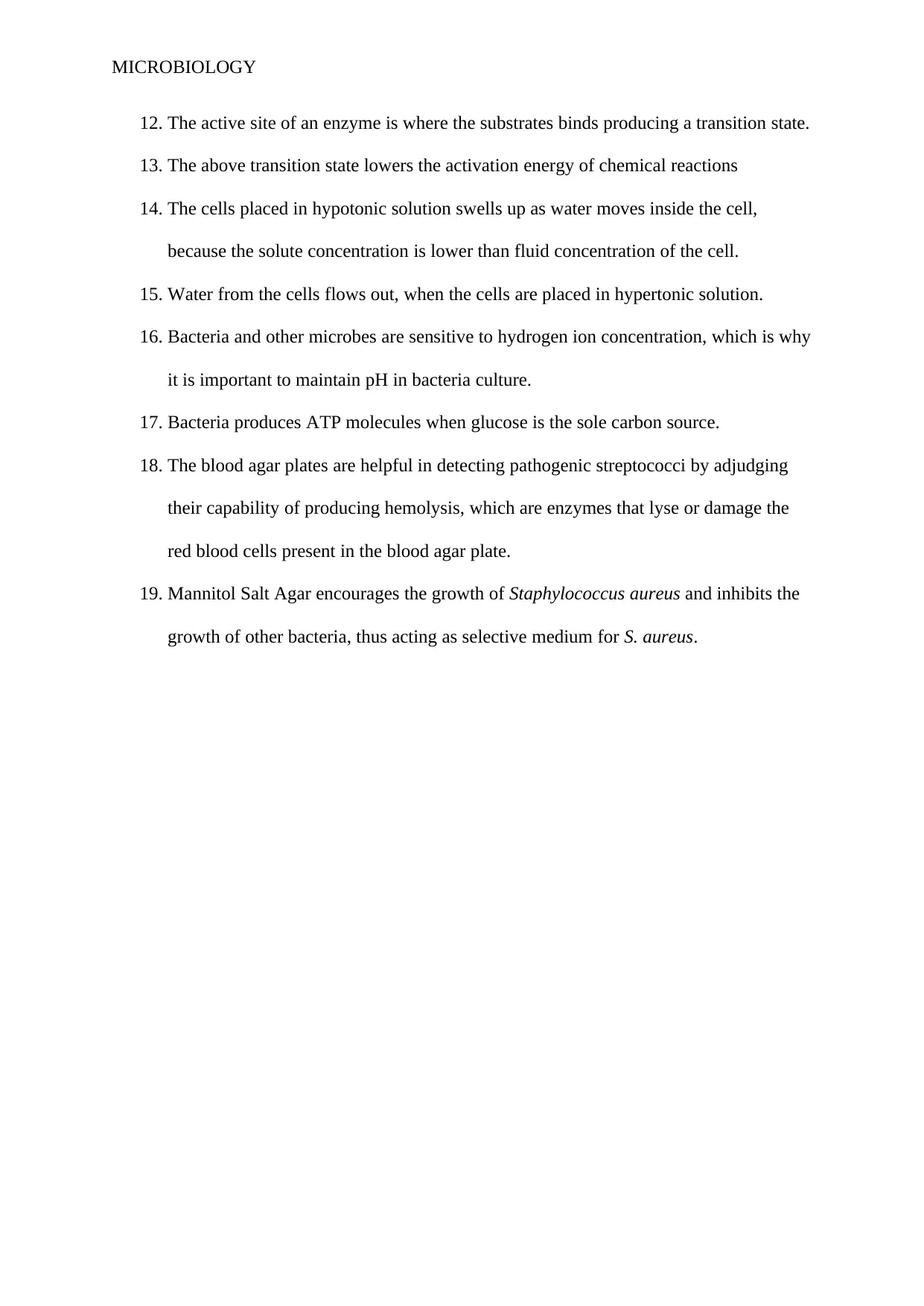
1. In glycolysis, two electron carriers are produced (NADH from NAD+) and in Krebs
cycle, eight electron carriers are produced (two FADH2 and six NADH).
2. Electrons gets transported in the electron transport chain, from FADH2 and NADH to
molecular oxygen.
3. The electrons come from FADH2 and NADH electron carriers.
4. The ATP synthase is activated with increasing proton potential, which is created
electron transport chain’s action in mitochondria.
5. Three ATP molecules are produced from a single NADH.
6. Two ATP molecules are produced from a single FADH2.
7. The direct method of counting involves the standard plat count measurements and
serial dilution, where he cell noses are correlated by the weight of the microbial cells.
The cells are then stained and counted with the help of a microscope. In the indirect
method of counting, the microbial growth is measure by either measuring the turbidity
of microbial sample in spectrophotometer or the dry cell mass. Statistical approach is
undertaken to measure the microbial growth pattern.
8. With logarithms, the relative magnitude of data does not change and as the cell count
and growth occurs very rapidly to increase to billions, logarithmic functions are suited
to count such number of cells.
9. When inhibitor concentration is high, the concentration of product is reduced.
10. No, blood agar cannot be prepared by filtration because the whole red blood cells will
not pass through the filter.
11. The steam in autoclave is forced with additional pressures, which are significantly
higher than atmospheric pressure and this enables the steam to reach high
temperature.
Document Page
MICROBIOLOGY
12. The active site of an enzyme is where the substrates binds producing a transition state.
13. The above transition state lowers the activation energy of chemical reactions
14. The cells placed in hypotonic solution swells up as water moves inside the cell,
because the solute concentration is lower than fluid concentration of the cell.
15. Water from the cells flows out, when the cells are placed in hypertonic solution.
16. Bacteria and other microbes are sensitive to hydrogen ion concentration, which is why
it is important to maintain pH in bacteria culture.
17. Bacteria produces ATP molecules when glucose is the sole carbon source.
18. The blood agar plates are helpful in detecting pathogenic streptococci by adjudging
their capability of producing hemolysis, which are enzymes that lyse or damage the
red blood cells present in the blood agar plate.
19. Mannitol Salt Agar encourages the growth of Staphylococcus aureus and inhibits the
growth of other bacteria, thus acting as selective medium for S. aureus.
chevron_up_icon
1 out of 3
circle_padding
hide_on_mobile
zoom_out_icon
[object Object]