Macquarie University ECON111 Microeconomic Principles Assignment
VerifiedAdded on 2022/12/23
|11
|2737
|60
Homework Assignment
AI Summary
This assignment solution analyzes microeconomic principles through the lens of Operation Barga, a land reform initiative in West Bengal, India. The document explores the economic incentives created by the policy, contrasting consequentialist and deontological ethical frameworks to evaluate its justification. It delves into Pareto improvement and efficiency, assessing how Operation Barga affected resource allocation and farmer outcomes. Furthermore, the solution incorporates graphical analysis of a farmer's production choices under different scenarios, comparing independent farming and sharecropping arrangements to demonstrate the impact of the policy on productivity and welfare. The assignment covers key economic concepts such as utility maximization, production possibility frontiers, and the implications of contractual arrangements on economic efficiency and individual decision-making, providing a comprehensive understanding of microeconomic theory in a real-world context.
Running head: Microeconomic Principles
Microeconomic Principles
Name of the Student
Name of the University
Student ID
Microeconomic Principles
Name of the Student
Name of the University
Student ID

Paraphrase This Document
Need a fresh take? Get an instant paraphrase of this document with our AI Paraphraser
1Microeconomic Principles
Table of Contents
Answer 1..........................................................................................................................................2
Answer 2..........................................................................................................................................2
Answer 3..........................................................................................................................................3
Answer 4..........................................................................................................................................4
Answer 5..........................................................................................................................................5
Answer 6..........................................................................................................................................6
Answer 7..........................................................................................................................................7
Answer 8..........................................................................................................................................8
References......................................................................................................................................10
Table of Contents
Answer 1..........................................................................................................................................2
Answer 2..........................................................................................................................................2
Answer 3..........................................................................................................................................3
Answer 4..........................................................................................................................................4
Answer 5..........................................................................................................................................5
Answer 6..........................................................................................................................................6
Answer 7..........................................................................................................................................7
Answer 8..........................................................................................................................................8
References......................................................................................................................................10
2Microeconomic Principles
Answer 1
Economic incentives include different types of policies that encourages people to get
motivation to perform better such that over productivity if individual increase and thereby
income increases as well. In most of the cases, in an economy government provides various kind
of incentives in the form of tax exemption, subsidy and loan support to motivate individuals in
order to increase the productivity of the economy (Rode, Gómez-Baggethun and Krause 2015).
Similarly, in the case Bargadars in West Bengal in India the new law enabled them to keep up to
75% of the produced crop, which was not possible under the previous system and the Bargadars
had to pay a large amount of crop to the land owner (Ganguly 2015). Thus, due to this the
Bargadars were able to earn more by selling the 75% share of the production. Hence, this created
incentive for them to produce more (Datta and Sen 2018). Apart from that, the prohibited the
landowners from removing the Bargadars if they had achieved their quota of 25% of crop as
payment. Thus, these laws worked as motivation for the Bargadars to increase their production.
As a result the regional productivity increased by 28% that made the Operation Barga successful.
Answer 2
Consequentialism is an ethical concept that states the any work or action that result in
some good outcome is ethically right and acceptable (Burgess 2019). For example if human
resource department of a company pays an employee salary in advance due to monetary
requirement for medical reasons violating the salary policies of the company which is unethical
according to deontology concept of ethics, however, the action leads to welfare of the employee.
Thus, the outcome is positive and it satisfies the concept of consequentialism. Moreover, to find
the justification of implementation of Operation Barga from consequentialist perspective the
evaluation of the policy needs to be done. It is necessary to critically look at the outcome of the
Answer 1
Economic incentives include different types of policies that encourages people to get
motivation to perform better such that over productivity if individual increase and thereby
income increases as well. In most of the cases, in an economy government provides various kind
of incentives in the form of tax exemption, subsidy and loan support to motivate individuals in
order to increase the productivity of the economy (Rode, Gómez-Baggethun and Krause 2015).
Similarly, in the case Bargadars in West Bengal in India the new law enabled them to keep up to
75% of the produced crop, which was not possible under the previous system and the Bargadars
had to pay a large amount of crop to the land owner (Ganguly 2015). Thus, due to this the
Bargadars were able to earn more by selling the 75% share of the production. Hence, this created
incentive for them to produce more (Datta and Sen 2018). Apart from that, the prohibited the
landowners from removing the Bargadars if they had achieved their quota of 25% of crop as
payment. Thus, these laws worked as motivation for the Bargadars to increase their production.
As a result the regional productivity increased by 28% that made the Operation Barga successful.
Answer 2
Consequentialism is an ethical concept that states the any work or action that result in
some good outcome is ethically right and acceptable (Burgess 2019). For example if human
resource department of a company pays an employee salary in advance due to monetary
requirement for medical reasons violating the salary policies of the company which is unethical
according to deontology concept of ethics, however, the action leads to welfare of the employee.
Thus, the outcome is positive and it satisfies the concept of consequentialism. Moreover, to find
the justification of implementation of Operation Barga from consequentialist perspective the
evaluation of the policy needs to be done. It is necessary to critically look at the outcome of the
⊘ This is a preview!⊘
Do you want full access?
Subscribe today to unlock all pages.

Trusted by 1+ million students worldwide
3Microeconomic Principles
policy and discuss its relevance with the consequentialism ethical framework. The Operation
Barga was introduced with the objective of improving the condition of the Bargadars and
mitigate their instances of exploitation by the land owners. The policy disallowed the landowners
from removing the Bargadars from lands until the payment of 25% of the produce was being
made. Thus, the policy interfered and restricted land owners from exercising its right one the
land. It causes the violation of deontology (Ananth 2016). On the other hand, the implementation
of the policy resulted in positive outcome because it benefitted the Bargadars by increasing their
portion of crop share that resulted in increased income and also protected them from eviction by
the landowners. Hence, whatever be the cost of the policy it led to positive and desirable
outcome. Thus, the policy satisfies the ethical concept of consequentialism. Hence, under
consequential ethical frame work the introduction of the Operation Barga is justified.
Answer 3
Deontological ethical framework is a kind of normative ethical framework. It states that
every action should be taken based on the certain rules or regulations that means outcome of the
action is irrelevant as long as the action taken is right as per the rules. It is suggest that individual
is morally correct he or she follows the rules and regulations (Holyoak and Powell 2016). For
example, if under rule it is stated that a thief must be punished with death sentence irrespective
of the reasons of action that compelled the person to steal, then under deontology the most
suitable moral action would be death sentence for the thief. The outcome that is death of a person
does not matter in this case. Hence, in the case of the Operation Barga the steps that were taken
by the then government of West Bengal were not ethical under the ethical frame work of
deontology. The laws enacted under the Operation Barga reduced the right of the landowners and
they was not able to take free decisions regarding removal of Bargadars. Additionally, the
policy and discuss its relevance with the consequentialism ethical framework. The Operation
Barga was introduced with the objective of improving the condition of the Bargadars and
mitigate their instances of exploitation by the land owners. The policy disallowed the landowners
from removing the Bargadars from lands until the payment of 25% of the produce was being
made. Thus, the policy interfered and restricted land owners from exercising its right one the
land. It causes the violation of deontology (Ananth 2016). On the other hand, the implementation
of the policy resulted in positive outcome because it benefitted the Bargadars by increasing their
portion of crop share that resulted in increased income and also protected them from eviction by
the landowners. Hence, whatever be the cost of the policy it led to positive and desirable
outcome. Thus, the policy satisfies the ethical concept of consequentialism. Hence, under
consequential ethical frame work the introduction of the Operation Barga is justified.
Answer 3
Deontological ethical framework is a kind of normative ethical framework. It states that
every action should be taken based on the certain rules or regulations that means outcome of the
action is irrelevant as long as the action taken is right as per the rules. It is suggest that individual
is morally correct he or she follows the rules and regulations (Holyoak and Powell 2016). For
example, if under rule it is stated that a thief must be punished with death sentence irrespective
of the reasons of action that compelled the person to steal, then under deontology the most
suitable moral action would be death sentence for the thief. The outcome that is death of a person
does not matter in this case. Hence, in the case of the Operation Barga the steps that were taken
by the then government of West Bengal were not ethical under the ethical frame work of
deontology. The laws enacted under the Operation Barga reduced the right of the landowners and
they was not able to take free decisions regarding removal of Bargadars. Additionally, the
Paraphrase This Document
Need a fresh take? Get an instant paraphrase of this document with our AI Paraphraser
4Microeconomic Principles
landowners were not also able to negotiate about their share of crops out of the total production.
It was fixed by the government. Thus, the policy of Operation Barga reduced the right of the
landowners on their land, which is ethically wrong according to deontology (Schwartz 2019).
Operation Barga might have improved the condition of the Bargadars that is it led to a better
outcome but taking land from the landowners with the use of governmental decree is a unethical
policy because the landowners had complete right on their land according to the law. Hence,
violation of law or existing rule to implement the Operation Barga was a wrong action that raises
the question of unethical practice by the government. Therefore, it can be said that according to
the deontology ethical framework Operation Barga was an unethical policy.
Answer 4
In theory of economic pareto improvement means reallocation of resources between two
individuals such that the reallocation improves the condition of the one without affecting or
worsening off the condition of the other (Pang, Deng and Chiu 2015). For example, if there is a
certain amount of wealth that is being taken from a rich person and given to a poor person such
that the amount that has been take n from the rich person does not affect the person’s welfare but
on the other hand better off the economic condition of the poor person. Therefore, this gives rise
to pareto improvement condition. Considering the case of Operation Barga it can be observed
that the policy improve the condition of the Bargadars as it increases their share of crop and
thereby increased their level of income (Alva and Manjunath 2019). The policy however does
not affect the condition of the landowners as they are still getting 25% share of crop just by
giving the land for farming, which would otherwise remain unproductive. Thus, the policy of
Operation Barga creates pareto improvement for the Bargadars.
landowners were not also able to negotiate about their share of crops out of the total production.
It was fixed by the government. Thus, the policy of Operation Barga reduced the right of the
landowners on their land, which is ethically wrong according to deontology (Schwartz 2019).
Operation Barga might have improved the condition of the Bargadars that is it led to a better
outcome but taking land from the landowners with the use of governmental decree is a unethical
policy because the landowners had complete right on their land according to the law. Hence,
violation of law or existing rule to implement the Operation Barga was a wrong action that raises
the question of unethical practice by the government. Therefore, it can be said that according to
the deontology ethical framework Operation Barga was an unethical policy.
Answer 4
In theory of economic pareto improvement means reallocation of resources between two
individuals such that the reallocation improves the condition of the one without affecting or
worsening off the condition of the other (Pang, Deng and Chiu 2015). For example, if there is a
certain amount of wealth that is being taken from a rich person and given to a poor person such
that the amount that has been take n from the rich person does not affect the person’s welfare but
on the other hand better off the economic condition of the poor person. Therefore, this gives rise
to pareto improvement condition. Considering the case of Operation Barga it can be observed
that the policy improve the condition of the Bargadars as it increases their share of crop and
thereby increased their level of income (Alva and Manjunath 2019). The policy however does
not affect the condition of the landowners as they are still getting 25% share of crop just by
giving the land for farming, which would otherwise remain unproductive. Thus, the policy of
Operation Barga creates pareto improvement for the Bargadars.
5Microeconomic Principles
IC2
IC1
3
4
Rice
production
Optimal Choice
Answer 5
According to theory of economics pareto efficiency is the state of allocation of resources
that gives the optimal allocation beyond which any allocation in favour of any individual leads to
loss of the other individual. Thus, under pareto efficient condition no improvement is possible
without making one person worse off. Thus, pareto efficient condition is the most optimal point
on allocation frontier (Xiao et al. 2017). The Operation Barga is based on the theory of pareto
efficiency. The allocation of the produced crop was not fair earlier in the case of Bargadars. Due
to this reason the earning of the Bargadars were too low during the initial period. Thus, it
compromised the position of the Bargadars as they were not receiving the deserving amount they
were supposed to get in return of their work. Thus, the previous allocation was an inefficient one
causing unfair allocation of resources. However, pareto efficiency does not concern about the
equality of allocation. It can be justified from the pareto efficient allocation that occurred after
implementation of Operation Barga. The policy improved the condition of the Bargadars as their
share in total crop produce increased and a fairer situation occurred (Johnson 2017). The
condition of landowners had not worsened as they were still getting 25% of the total producing
just by giving the land to the Bargdars (Lin and Zhang 2018). Thus, the pareto efficient condition
does not actually provides the condition of fairness and equality but of efficient allocation
because after Operation Barga the production of the agricultural production had increased by
28% due to this pareto efficient allocation.
Answer 6
IC2
IC1
3
4
Rice
production
Optimal Choice
Answer 5
According to theory of economics pareto efficiency is the state of allocation of resources
that gives the optimal allocation beyond which any allocation in favour of any individual leads to
loss of the other individual. Thus, under pareto efficient condition no improvement is possible
without making one person worse off. Thus, pareto efficient condition is the most optimal point
on allocation frontier (Xiao et al. 2017). The Operation Barga is based on the theory of pareto
efficiency. The allocation of the produced crop was not fair earlier in the case of Bargadars. Due
to this reason the earning of the Bargadars were too low during the initial period. Thus, it
compromised the position of the Bargadars as they were not receiving the deserving amount they
were supposed to get in return of their work. Thus, the previous allocation was an inefficient one
causing unfair allocation of resources. However, pareto efficiency does not concern about the
equality of allocation. It can be justified from the pareto efficient allocation that occurred after
implementation of Operation Barga. The policy improved the condition of the Bargadars as their
share in total crop produce increased and a fairer situation occurred (Johnson 2017). The
condition of landowners had not worsened as they were still getting 25% of the total producing
just by giving the land to the Bargdars (Lin and Zhang 2018). Thus, the pareto efficient condition
does not actually provides the condition of fairness and equality but of efficient allocation
because after Operation Barga the production of the agricultural production had increased by
28% due to this pareto efficient allocation.
Answer 6
⊘ This is a preview!⊘
Do you want full access?
Subscribe today to unlock all pages.
Trusted by 1+ million students worldwide
6Microeconomic Principles
16 24 Free hours
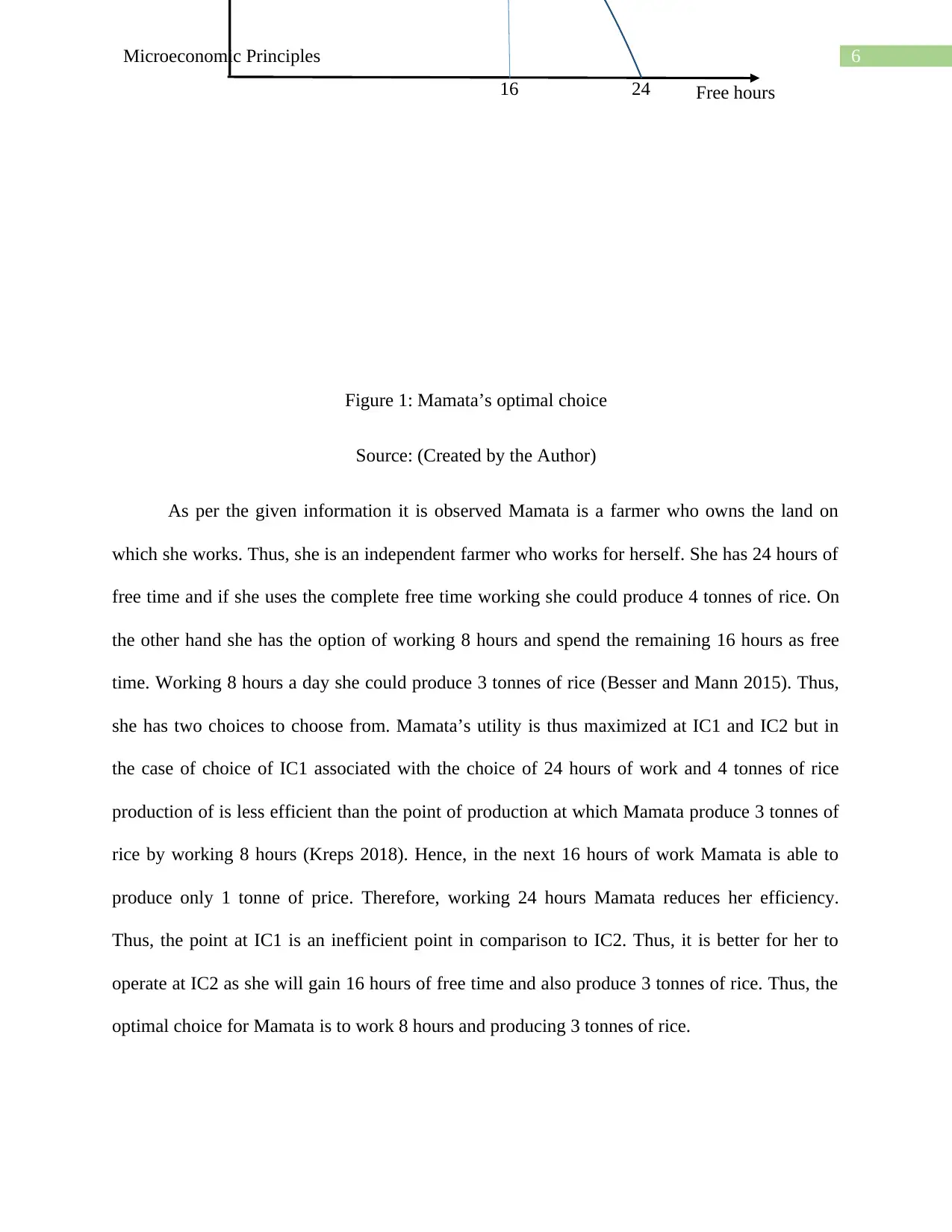
Figure 1: Mamata’s optimal choice
Source: (Created by the Author)
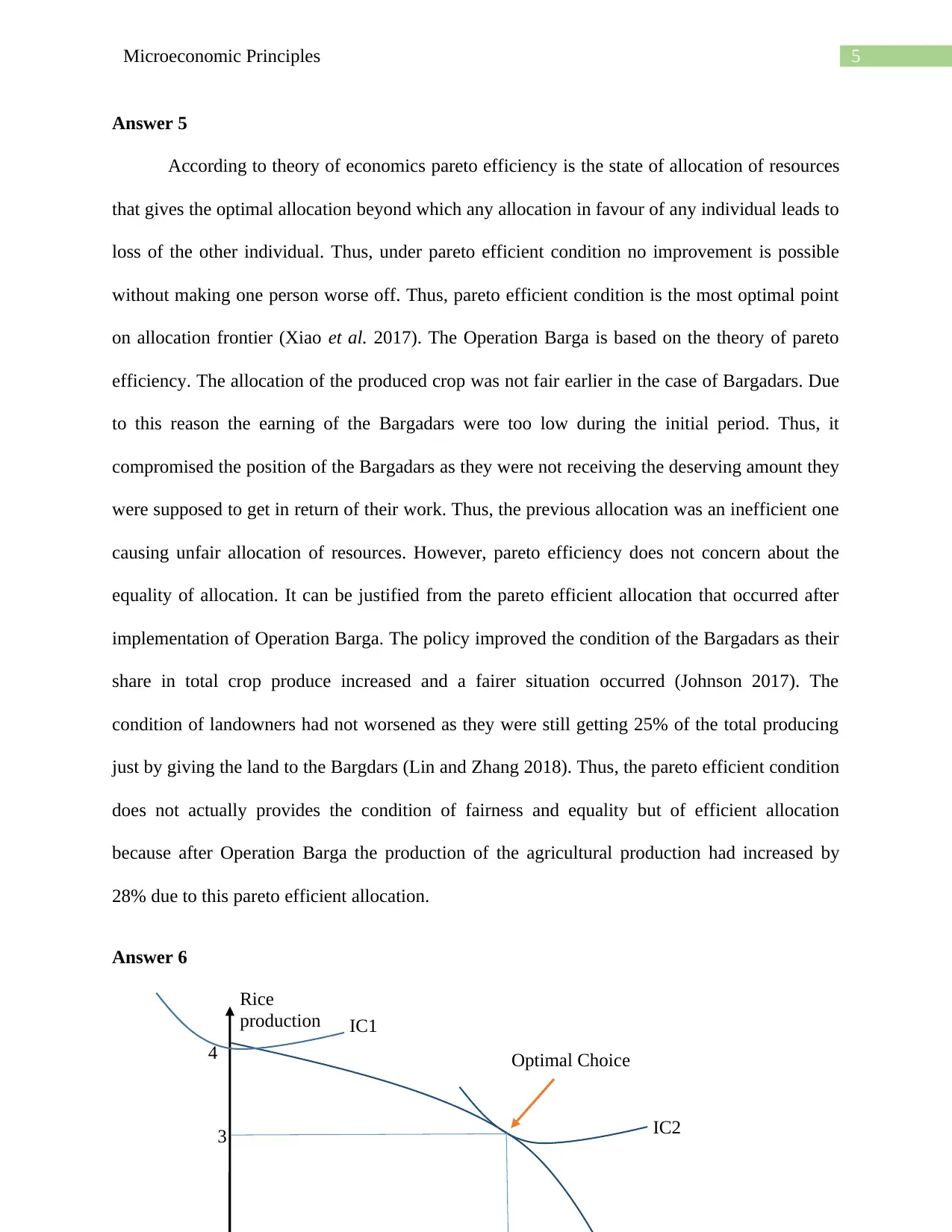
As per the given information it is observed Mamata is a farmer who owns the land on
which she works. Thus, she is an independent farmer who works for herself. She has 24 hours of
free time and if she uses the complete free time working she could produce 4 tonnes of rice. On
the other hand she has the option of working 8 hours and spend the remaining 16 hours as free
time. Working 8 hours a day she could produce 3 tonnes of rice (Besser and Mann 2015). Thus,
she has two choices to choose from. Mamata’s utility is thus maximized at IC1 and IC2 but in
the case of choice of IC1 associated with the choice of 24 hours of work and 4 tonnes of rice
production of is less efficient than the point of production at which Mamata produce 3 tonnes of
rice by working 8 hours (Kreps 2018). Hence, in the next 16 hours of work Mamata is able to
produce only 1 tonne of price. Therefore, working 24 hours Mamata reduces her efficiency.
Thus, the point at IC1 is an inefficient point in comparison to IC2. Thus, it is better for her to
operate at IC2 as she will gain 16 hours of free time and also produce 3 tonnes of rice. Thus, the
optimal choice for Mamata is to work 8 hours and producing 3 tonnes of rice.
16 24 Free hours
Figure 1: Mamata’s optimal choice
Source: (Created by the Author)
As per the given information it is observed Mamata is a farmer who owns the land on
which she works. Thus, she is an independent farmer who works for herself. She has 24 hours of
free time and if she uses the complete free time working she could produce 4 tonnes of rice. On
the other hand she has the option of working 8 hours and spend the remaining 16 hours as free
time. Working 8 hours a day she could produce 3 tonnes of rice (Besser and Mann 2015). Thus,
she has two choices to choose from. Mamata’s utility is thus maximized at IC1 and IC2 but in
the case of choice of IC1 associated with the choice of 24 hours of work and 4 tonnes of rice
production of is less efficient than the point of production at which Mamata produce 3 tonnes of
rice by working 8 hours (Kreps 2018). Hence, in the next 16 hours of work Mamata is able to
produce only 1 tonne of price. Therefore, working 24 hours Mamata reduces her efficiency.
Thus, the point at IC1 is an inefficient point in comparison to IC2. Thus, it is better for her to
operate at IC2 as she will gain 16 hours of free time and also produce 3 tonnes of rice. Thus, the
optimal choice for Mamata is to work 8 hours and producing 3 tonnes of rice.
Paraphrase This Document
Need a fresh take? Get an instant paraphrase of this document with our AI Paraphraser
7Microeconomic Principles
IC4
2.25
IC3
3
IC2
IC1
3
4
16 24 Free hours
Rice
production
Optimal Choice
Answer 7
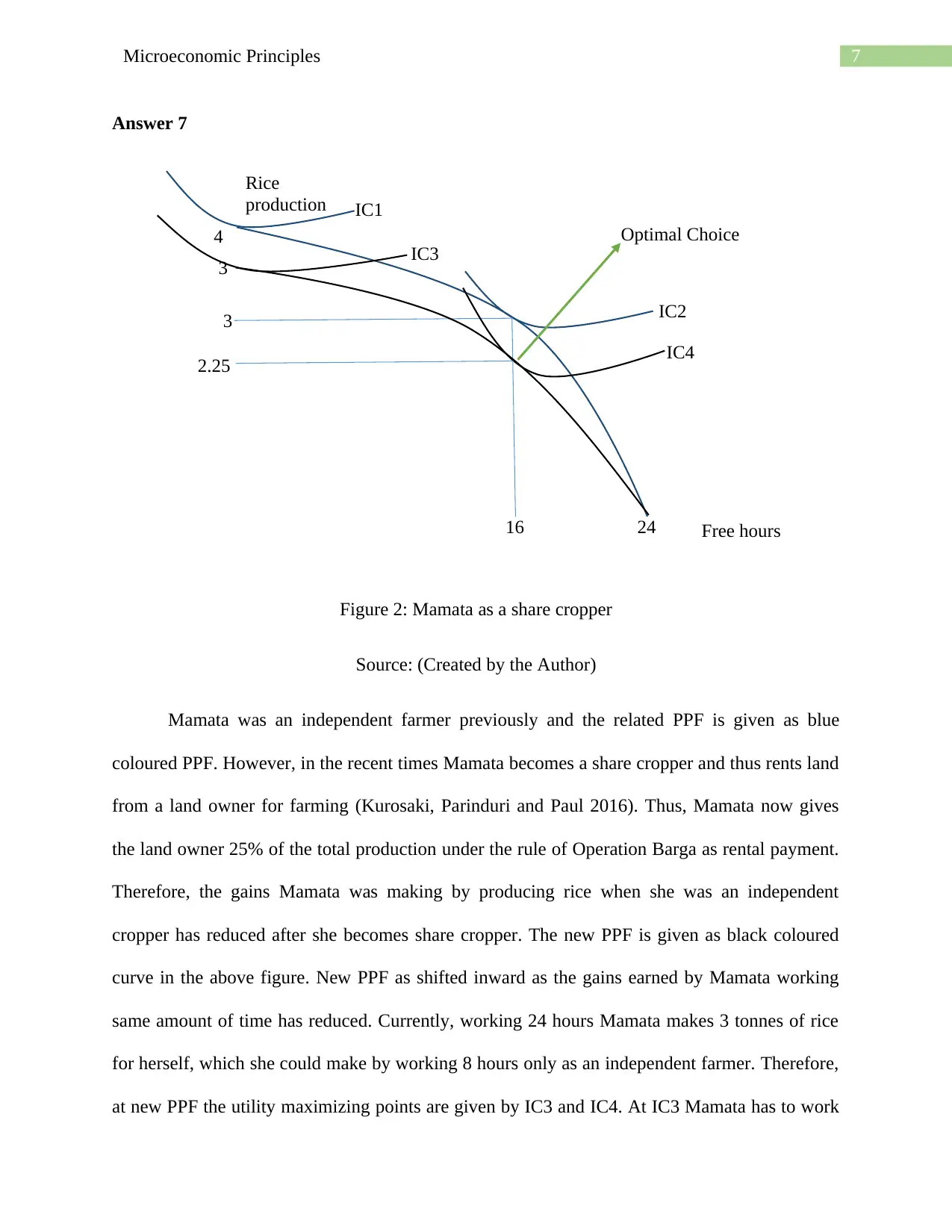
Figure 2: Mamata as a share cropper
Source: (Created by the Author)
Mamata was an independent farmer previously and the related PPF is given as blue
coloured PPF. However, in the recent times Mamata becomes a share cropper and thus rents land
from a land owner for farming (Kurosaki, Parinduri and Paul 2016). Thus, Mamata now gives
the land owner 25% of the total production under the rule of Operation Barga as rental payment.
Therefore, the gains Mamata was making by producing rice when she was an independent
cropper has reduced after she becomes share cropper. The new PPF is given as black coloured
curve in the above figure. New PPF as shifted inward as the gains earned by Mamata working
same amount of time has reduced. Currently, working 24 hours Mamata makes 3 tonnes of rice
for herself, which she could make by working 8 hours only as an independent farmer. Therefore,
at new PPF the utility maximizing points are given by IC3 and IC4. At IC3 Mamata has to work
IC4
2.25
IC3
3
IC2
IC1
3
4
16 24 Free hours
Rice
production
Optimal Choice
Answer 7
Figure 2: Mamata as a share cropper
Source: (Created by the Author)
Mamata was an independent farmer previously and the related PPF is given as blue
coloured PPF. However, in the recent times Mamata becomes a share cropper and thus rents land
from a land owner for farming (Kurosaki, Parinduri and Paul 2016). Thus, Mamata now gives
the land owner 25% of the total production under the rule of Operation Barga as rental payment.
Therefore, the gains Mamata was making by producing rice when she was an independent
cropper has reduced after she becomes share cropper. The new PPF is given as black coloured
curve in the above figure. New PPF as shifted inward as the gains earned by Mamata working
same amount of time has reduced. Currently, working 24 hours Mamata makes 3 tonnes of rice
for herself, which she could make by working 8 hours only as an independent farmer. Therefore,
at new PPF the utility maximizing points are given by IC3 and IC4. At IC3 Mamata has to work
8Microeconomic Principles
24 hours to earn 3 tonnes of rice whereas at IC4 she has to work 8 hours for 2.25 tonnes of rice.
Hence, it is evident that efficiency of Mamata is much more while she is operating at IC4.
Therefore by operating at IC4 Mamata will be able to earn 2.25 tonnes of rice and 16 hours of
free time. It is thus the most efficient point between the two points. Therefore, the optimal choice
of Mamata is the point of operation that gives IC4.
Assumptions that were used in this case are as follows:
Efficiency of Mamata decreases with increasing working hours
Mamata cannot work as independent farmer anymore
No technological improvement will occur in the sector
Mamata cannot engage in any other profession
Mamata only knows rice cultivation
Answer 8
In question 6, the Mamata worked as an independent farmer and in question 7 she worked
as share cropper. It is observed from the models that as a share cropper the earnings of Mamata
decreases and the points of operation and even the optimal point is inefficient in comparison to
the point of operation at PPF concerning independent farming(Väth, Gobien and Kirk 2019).
This happens because both points at share cropping PPF are inside the PPF of independent
farming. Thus, it is clear from the comparison of both the models that model in question 6 gives
fairer outcome that the model in question 7. Thus, by observing the PPF in both the models and
points of operation it is easier for the economics to evaluate and understand that independent
farmer model is fairer as per generated outcome.
24 hours to earn 3 tonnes of rice whereas at IC4 she has to work 8 hours for 2.25 tonnes of rice.
Hence, it is evident that efficiency of Mamata is much more while she is operating at IC4.
Therefore by operating at IC4 Mamata will be able to earn 2.25 tonnes of rice and 16 hours of
free time. It is thus the most efficient point between the two points. Therefore, the optimal choice
of Mamata is the point of operation that gives IC4.
Assumptions that were used in this case are as follows:
Efficiency of Mamata decreases with increasing working hours
Mamata cannot work as independent farmer anymore
No technological improvement will occur in the sector
Mamata cannot engage in any other profession
Mamata only knows rice cultivation
Answer 8
In question 6, the Mamata worked as an independent farmer and in question 7 she worked
as share cropper. It is observed from the models that as a share cropper the earnings of Mamata
decreases and the points of operation and even the optimal point is inefficient in comparison to
the point of operation at PPF concerning independent farming(Väth, Gobien and Kirk 2019).
This happens because both points at share cropping PPF are inside the PPF of independent
farming. Thus, it is clear from the comparison of both the models that model in question 6 gives
fairer outcome that the model in question 7. Thus, by observing the PPF in both the models and
points of operation it is easier for the economics to evaluate and understand that independent
farmer model is fairer as per generated outcome.
⊘ This is a preview!⊘
Do you want full access?
Subscribe today to unlock all pages.
Trusted by 1+ million students worldwide
9Microeconomic Principles
References
Alva, S. and Manjunath, V., 2019. Strategy-proof Pareto-improvement. Journal of Economic
Theory, 181, pp.121-142.
Ananth, V.K., 2016. Singur Case and the Idea of Justice. Economic and Political Weekly, 51(38),
pp.14-17.
Besser, T. and Mann, S., 2015. Which farm characteristics influence work satisfaction? An
analysis of two agricultural systems. Agricultural Systems, 141, pp.107-112.
Burgess, J.T., 2019. Principles and Concepts in Information Ethics. Foundations of Information
Ethics, p.1.
Datta, P.K. and Sen, P., 2018. LAND REFORMS IN AN INDIAN STATE: LESSONS FROM
THE EXPERIENCES OF IMPLEMENTATION. Journal of Asian Rural Studies, 2(1), pp.1-15.
Ganguly, S., 2015. An Eclectic Demystification of Operation Barga. Available at SSRN 2673311.
Holyoak, K.J. and Powell, D., 2016. Deontological coherence: A framework for commonsense
moral reasoning. Psychological Bulletin, 142(11), p.1179.
Johnson, M., 2017. Wicksell on Pareto: Efficiency, Welfare, and Distribution. Welfare, and
Distribution (March 2, 2017).
Kreps, D., 2018. Notes on the Theory of Choice. Routledge.
Kurosaki, T., Parinduri, R. and Paul, S., 2016. Evaluating Efficiency Gains from Tenancy
Reform Targeting a Heterogeneous Group of Sharecroppers: Evidence from India.
References
Alva, S. and Manjunath, V., 2019. Strategy-proof Pareto-improvement. Journal of Economic
Theory, 181, pp.121-142.
Ananth, V.K., 2016. Singur Case and the Idea of Justice. Economic and Political Weekly, 51(38),
pp.14-17.
Besser, T. and Mann, S., 2015. Which farm characteristics influence work satisfaction? An
analysis of two agricultural systems. Agricultural Systems, 141, pp.107-112.
Burgess, J.T., 2019. Principles and Concepts in Information Ethics. Foundations of Information
Ethics, p.1.
Datta, P.K. and Sen, P., 2018. LAND REFORMS IN AN INDIAN STATE: LESSONS FROM
THE EXPERIENCES OF IMPLEMENTATION. Journal of Asian Rural Studies, 2(1), pp.1-15.
Ganguly, S., 2015. An Eclectic Demystification of Operation Barga. Available at SSRN 2673311.
Holyoak, K.J. and Powell, D., 2016. Deontological coherence: A framework for commonsense
moral reasoning. Psychological Bulletin, 142(11), p.1179.
Johnson, M., 2017. Wicksell on Pareto: Efficiency, Welfare, and Distribution. Welfare, and
Distribution (March 2, 2017).
Kreps, D., 2018. Notes on the Theory of Choice. Routledge.
Kurosaki, T., Parinduri, R. and Paul, S., 2016. Evaluating Efficiency Gains from Tenancy
Reform Targeting a Heterogeneous Group of Sharecroppers: Evidence from India.
Paraphrase This Document
Need a fresh take? Get an instant paraphrase of this document with our AI Paraphraser
10Microeconomic Principles
Lin, Y. and Zhang, W., 2018. Necessary/sufficient conditions for pareto optimum in cooperative
difference game. Optimal Control Applications and Methods, 39(2), pp.1043-1060.
Pang, R.Z., Deng, Z.Q. and Chiu, Y.H., 2015. Pareto improvement through a reallocation of
carbon emission quotas. Renewable and Sustainable Energy Reviews, 50, pp.419-430.
Rode, J., Gómez-Baggethun, E. and Krause, T., 2015. Motivation crowding by economic
incentives in conservation policy: A review of the empirical evidence. Ecological
Economics, 117, pp.270-282.
Schwartz, G., 2019. The ethics of omission. Think, 18(51), pp.117-121.
Väth, S.J., Gobien, S. and Kirk, M., 2019. Socio-economic well-being, contract farming and
property rights: Evidence from Ghana. Land use policy, 81, pp.878-888.
Xiao, L., Min, Z., Yongfeng, Z., Zhaoquan, G., Yiqun, L. and Shaoping, M., 2017, August.
Fairness-aware group recommendation with pareto-efficiency. In Proceedings of the Eleventh
ACM Conference on Recommender Systems (pp. 107-115). ACM.
Lin, Y. and Zhang, W., 2018. Necessary/sufficient conditions for pareto optimum in cooperative
difference game. Optimal Control Applications and Methods, 39(2), pp.1043-1060.
Pang, R.Z., Deng, Z.Q. and Chiu, Y.H., 2015. Pareto improvement through a reallocation of
carbon emission quotas. Renewable and Sustainable Energy Reviews, 50, pp.419-430.
Rode, J., Gómez-Baggethun, E. and Krause, T., 2015. Motivation crowding by economic
incentives in conservation policy: A review of the empirical evidence. Ecological
Economics, 117, pp.270-282.
Schwartz, G., 2019. The ethics of omission. Think, 18(51), pp.117-121.
Väth, S.J., Gobien, S. and Kirk, M., 2019. Socio-economic well-being, contract farming and
property rights: Evidence from Ghana. Land use policy, 81, pp.878-888.
Xiao, L., Min, Z., Yongfeng, Z., Zhaoquan, G., Yiqun, L. and Shaoping, M., 2017, August.
Fairness-aware group recommendation with pareto-efficiency. In Proceedings of the Eleventh
ACM Conference on Recommender Systems (pp. 107-115). ACM.

1 out of 11


Related Documents


Your All-in-One AI-Powered Toolkit for Academic Success.
+13062052269
info@desklib.com
Available 24*7 on WhatsApp / Email
![[object Object]](/_next/static/media/star-bottom.7253800d.svg)
Unlock your academic potential
Copyright © 2020–2026 A2Z Services. All Rights Reserved. Developed and managed by ZUCOL.