Microeconomics Assignment: Game Theory, Market Analysis, and Collusion
VerifiedAdded on 2022/09/21
|5
|922
|31
Homework Assignment
AI Summary
This microeconomics assignment solution addresses various concepts within the field. It begins with a payoff matrix analysis, illustrating revenue gains for firms considering R&D investments. The solution then presents a game theory scenario involving Nimbus, Inc. and Cleansweep, Inc., analyzing their strategic choices regarding R&D spending and the resulting profit outcomes. The assignment further explores market structures, differentiating between oligopoly and monopolistic competition, highlighting their key characteristics and the impact of firm actions. The solution also examines the concept of collusion in a duopoly, comparing industry profits with the Nash Equilibrium. Finally, it defines a natural oligopoly and discusses its emergence in specific market sectors. The assignment is supported by relevant references.

MICROECONOMICS
Paraphrase This Document
Need a fresh take? Get an instant paraphrase of this document with our AI Paraphraser

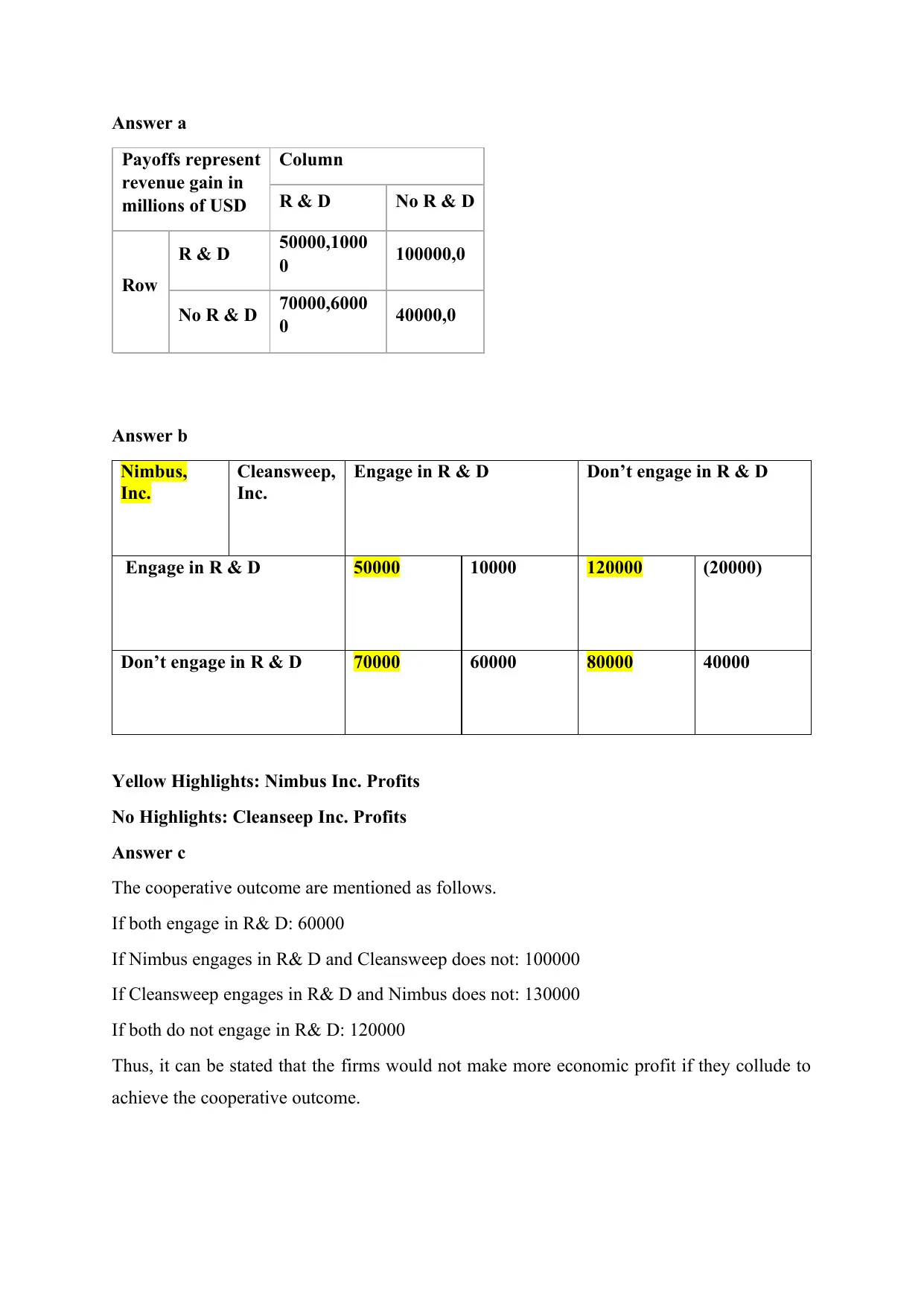
Answer a
Payoffs represent
revenue gain in
millions of USD
Column
R & D No R & D
Row
R & D 50000,1000
0 100000,0
No R & D 70000,6000
0 40000,0
Answer b
Nimbus,
Inc.
Cleansweep,
Inc.
Engage in R & D Don’t engage in R & D
Engage in R & D 50000 10000 120000 (20000)
Don’t engage in R & D 70000 60000 80000 40000
Yellow Highlights: Nimbus Inc. Profits
No Highlights: Cleanseep Inc. Profits
Answer c
The cooperative outcome are mentioned as follows.
If both engage in R& D: 60000
If Nimbus engages in R& D and Cleansweep does not: 100000
If Cleansweep engages in R& D and Nimbus does not: 130000
If both do not engage in R& D: 120000
Thus, it can be stated that the firms would not make more economic profit if they collude to
achieve the cooperative outcome.
Payoffs represent
revenue gain in
millions of USD
Column
R & D No R & D
Row
R & D 50000,1000
0 100000,0
No R & D 70000,6000
0 40000,0
Answer b
Nimbus,
Inc.
Cleansweep,
Inc.
Engage in R & D Don’t engage in R & D
Engage in R & D 50000 10000 120000 (20000)
Don’t engage in R & D 70000 60000 80000 40000
Yellow Highlights: Nimbus Inc. Profits
No Highlights: Cleanseep Inc. Profits
Answer c
The cooperative outcome are mentioned as follows.
If both engage in R& D: 60000
If Nimbus engages in R& D and Cleansweep does not: 100000
If Cleansweep engages in R& D and Nimbus does not: 130000
If both do not engage in R& D: 120000
Thus, it can be stated that the firms would not make more economic profit if they collude to
achieve the cooperative outcome.

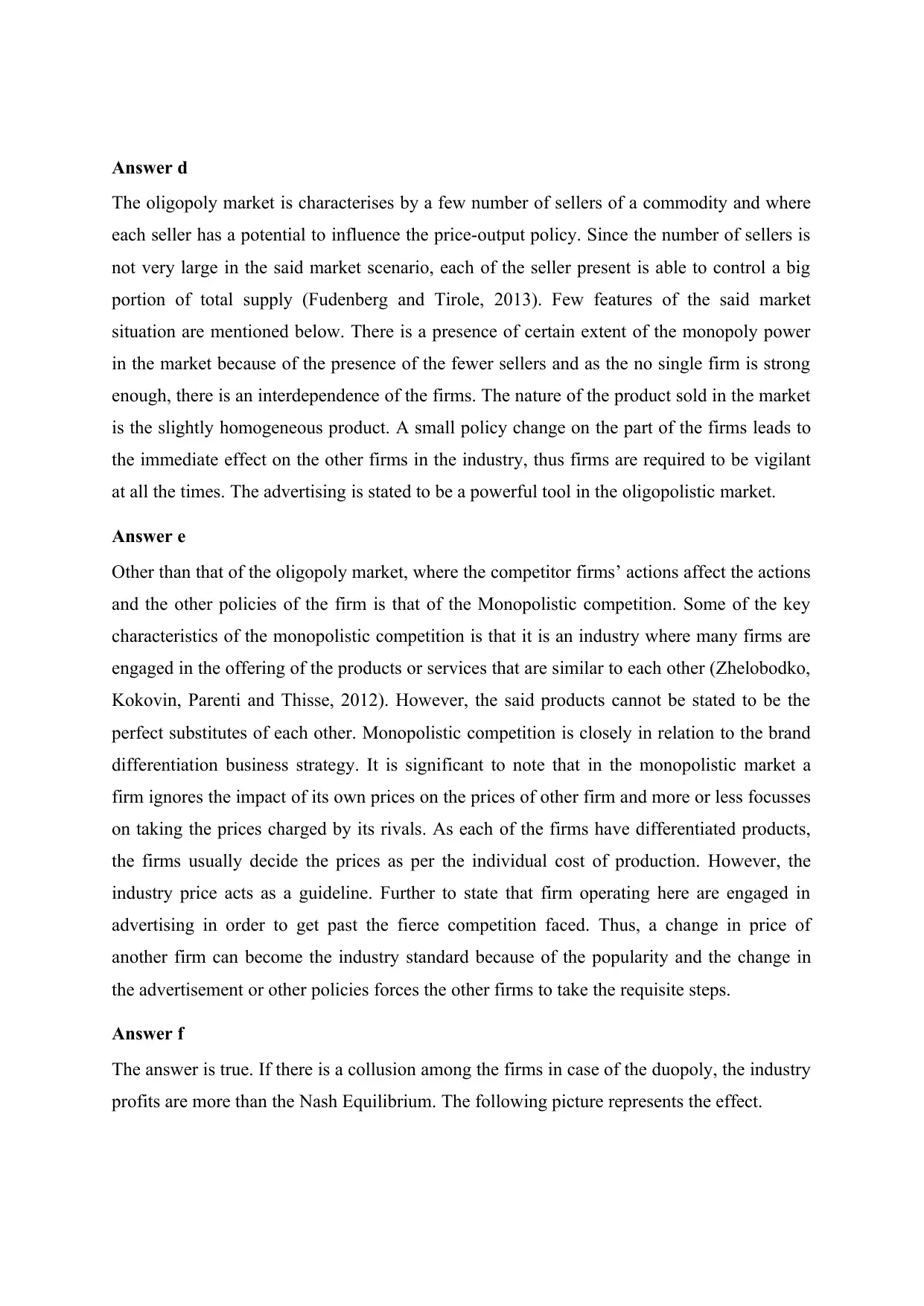
Answer d
The oligopoly market is characterises by a few number of sellers of a commodity and where
each seller has a potential to influence the price-output policy. Since the number of sellers is
not very large in the said market scenario, each of the seller present is able to control a big
portion of total supply (Fudenberg and Tirole, 2013). Few features of the said market
situation are mentioned below. There is a presence of certain extent of the monopoly power
in the market because of the presence of the fewer sellers and as the no single firm is strong
enough, there is an interdependence of the firms. The nature of the product sold in the market
is the slightly homogeneous product. A small policy change on the part of the firms leads to
the immediate effect on the other firms in the industry, thus firms are required to be vigilant
at all the times. The advertising is stated to be a powerful tool in the oligopolistic market.
Answer e
Other than that of the oligopoly market, where the competitor firms’ actions affect the actions
and the other policies of the firm is that of the Monopolistic competition. Some of the key
characteristics of the monopolistic competition is that it is an industry where many firms are
engaged in the offering of the products or services that are similar to each other (Zhelobodko,
Kokovin, Parenti and Thisse, 2012). However, the said products cannot be stated to be the
perfect substitutes of each other. Monopolistic competition is closely in relation to the brand
differentiation business strategy. It is significant to note that in the monopolistic market a
firm ignores the impact of its own prices on the prices of other firm and more or less focusses
on taking the prices charged by its rivals. As each of the firms have differentiated products,
the firms usually decide the prices as per the individual cost of production. However, the
industry price acts as a guideline. Further to state that firm operating here are engaged in
advertising in order to get past the fierce competition faced. Thus, a change in price of
another firm can become the industry standard because of the popularity and the change in
the advertisement or other policies forces the other firms to take the requisite steps.
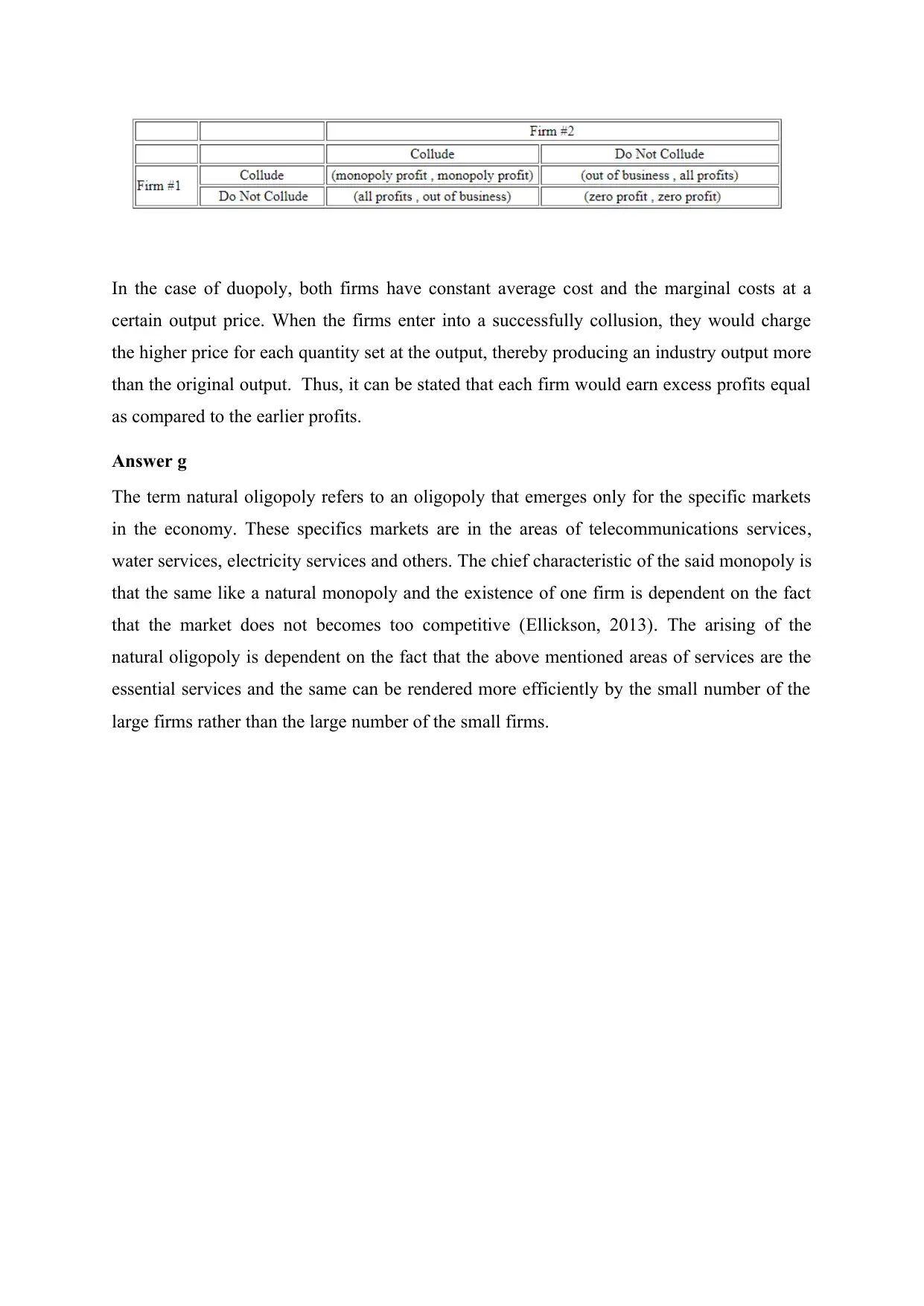
Answer f
The answer is true. If there is a collusion among the firms in case of the duopoly, the industry
profits are more than the Nash Equilibrium. The following picture represents the effect.
The oligopoly market is characterises by a few number of sellers of a commodity and where
each seller has a potential to influence the price-output policy. Since the number of sellers is
not very large in the said market scenario, each of the seller present is able to control a big
portion of total supply (Fudenberg and Tirole, 2013). Few features of the said market
situation are mentioned below. There is a presence of certain extent of the monopoly power
in the market because of the presence of the fewer sellers and as the no single firm is strong
enough, there is an interdependence of the firms. The nature of the product sold in the market
is the slightly homogeneous product. A small policy change on the part of the firms leads to
the immediate effect on the other firms in the industry, thus firms are required to be vigilant
at all the times. The advertising is stated to be a powerful tool in the oligopolistic market.
Answer e
Other than that of the oligopoly market, where the competitor firms’ actions affect the actions
and the other policies of the firm is that of the Monopolistic competition. Some of the key
characteristics of the monopolistic competition is that it is an industry where many firms are
engaged in the offering of the products or services that are similar to each other (Zhelobodko,
Kokovin, Parenti and Thisse, 2012). However, the said products cannot be stated to be the
perfect substitutes of each other. Monopolistic competition is closely in relation to the brand
differentiation business strategy. It is significant to note that in the monopolistic market a
firm ignores the impact of its own prices on the prices of other firm and more or less focusses
on taking the prices charged by its rivals. As each of the firms have differentiated products,
the firms usually decide the prices as per the individual cost of production. However, the
industry price acts as a guideline. Further to state that firm operating here are engaged in
advertising in order to get past the fierce competition faced. Thus, a change in price of
another firm can become the industry standard because of the popularity and the change in
the advertisement or other policies forces the other firms to take the requisite steps.
Answer f
The answer is true. If there is a collusion among the firms in case of the duopoly, the industry
profits are more than the Nash Equilibrium. The following picture represents the effect.
⊘ This is a preview!⊘
Do you want full access?
Subscribe today to unlock all pages.

Trusted by 1+ million students worldwide

In the case of duopoly, both firms have constant average cost and the marginal costs at a
certain output price. When the firms enter into a successfully collusion, they would charge
the higher price for each quantity set at the output, thereby producing an industry output more
than the original output. Thus, it can be stated that each firm would earn excess profits equal
as compared to the earlier profits.
Answer g
The term natural oligopoly refers to an oligopoly that emerges only for the specific markets
in the economy. These specifics markets are in the areas of telecommunications services,
water services, electricity services and others. The chief characteristic of the said monopoly is
that the same like a natural monopoly and the existence of one firm is dependent on the fact
that the market does not becomes too competitive (Ellickson, 2013). The arising of the
natural oligopoly is dependent on the fact that the above mentioned areas of services are the
essential services and the same can be rendered more efficiently by the small number of the
large firms rather than the large number of the small firms.
certain output price. When the firms enter into a successfully collusion, they would charge
the higher price for each quantity set at the output, thereby producing an industry output more
than the original output. Thus, it can be stated that each firm would earn excess profits equal
as compared to the earlier profits.
Answer g
The term natural oligopoly refers to an oligopoly that emerges only for the specific markets
in the economy. These specifics markets are in the areas of telecommunications services,
water services, electricity services and others. The chief characteristic of the said monopoly is
that the same like a natural monopoly and the existence of one firm is dependent on the fact
that the market does not becomes too competitive (Ellickson, 2013). The arising of the
natural oligopoly is dependent on the fact that the above mentioned areas of services are the
essential services and the same can be rendered more efficiently by the small number of the
large firms rather than the large number of the small firms.
Paraphrase This Document
Need a fresh take? Get an instant paraphrase of this document with our AI Paraphraser

References
Ellickson, P. B. (2013) Supermarkets as a natural oligopoly. Economic Inquiry, 51(2), pp.
1142-1154.
Fudenberg, D., & Tirole, J. (2013) Dynamic models of oligopoly. UK: Routledge.
Zhelobodko, E., Kokovin, S., Parenti, M. and Thisse, J. F. (2012) Monopolistic competition:
Beyond the constant elasticity of substitution. Econometrica, 80(6), pp. 2765-2784.
Ellickson, P. B. (2013) Supermarkets as a natural oligopoly. Economic Inquiry, 51(2), pp.
1142-1154.
Fudenberg, D., & Tirole, J. (2013) Dynamic models of oligopoly. UK: Routledge.
Zhelobodko, E., Kokovin, S., Parenti, M. and Thisse, J. F. (2012) Monopolistic competition:
Beyond the constant elasticity of substitution. Econometrica, 80(6), pp. 2765-2784.
1 out of 5
Related Documents
Your All-in-One AI-Powered Toolkit for Academic Success.
+13062052269
info@desklib.com
Available 24*7 on WhatsApp / Email
Unlock your academic potential
Copyright © 2020–2025 A2Z Services. All Rights Reserved. Developed and managed by ZUCOL.