Microfluidics Report: Manufacturing, Applications, and Outlook
VerifiedAdded on 2023/06/03
|12
|1670
|210
Report
AI Summary
This report provides a comprehensive overview of microfluidics, beginning with an introduction to the technology and its fundamental principles. It delves into the microfabrication processes, differentiating between cleanroom and non-cleanroom technologies, essential for creating microfluidic devices. The report highlights the utilization of microfluidic technology for colorimetric detection, particularly through the use of UPADs (Paper-based microfluidic analytical devices). Furthermore, it explores the diverse application areas of microfluidics, including healthcare (lab-on-a-chip devices), environmental monitoring, and consumer devices. The report also discusses the future scope of microfluidics, emphasizing its potential for advancements in cell biology and chemical synthesis. The conclusion summarizes the key aspects of the technology and its impact on various sectors, emphasizing its role in manipulating and controlling fluids at a micro-scale.

Running head: MICROFLUIDICS
MICROFLUIDICS
Name of student:
Name of university:
Author’s note:
MICROFLUIDICS
Name of student:
Name of university:
Author’s note:

Paraphrase This Document
Need a fresh take? Get an instant paraphrase of this document with our AI Paraphraser
1MICROFLUIDICS
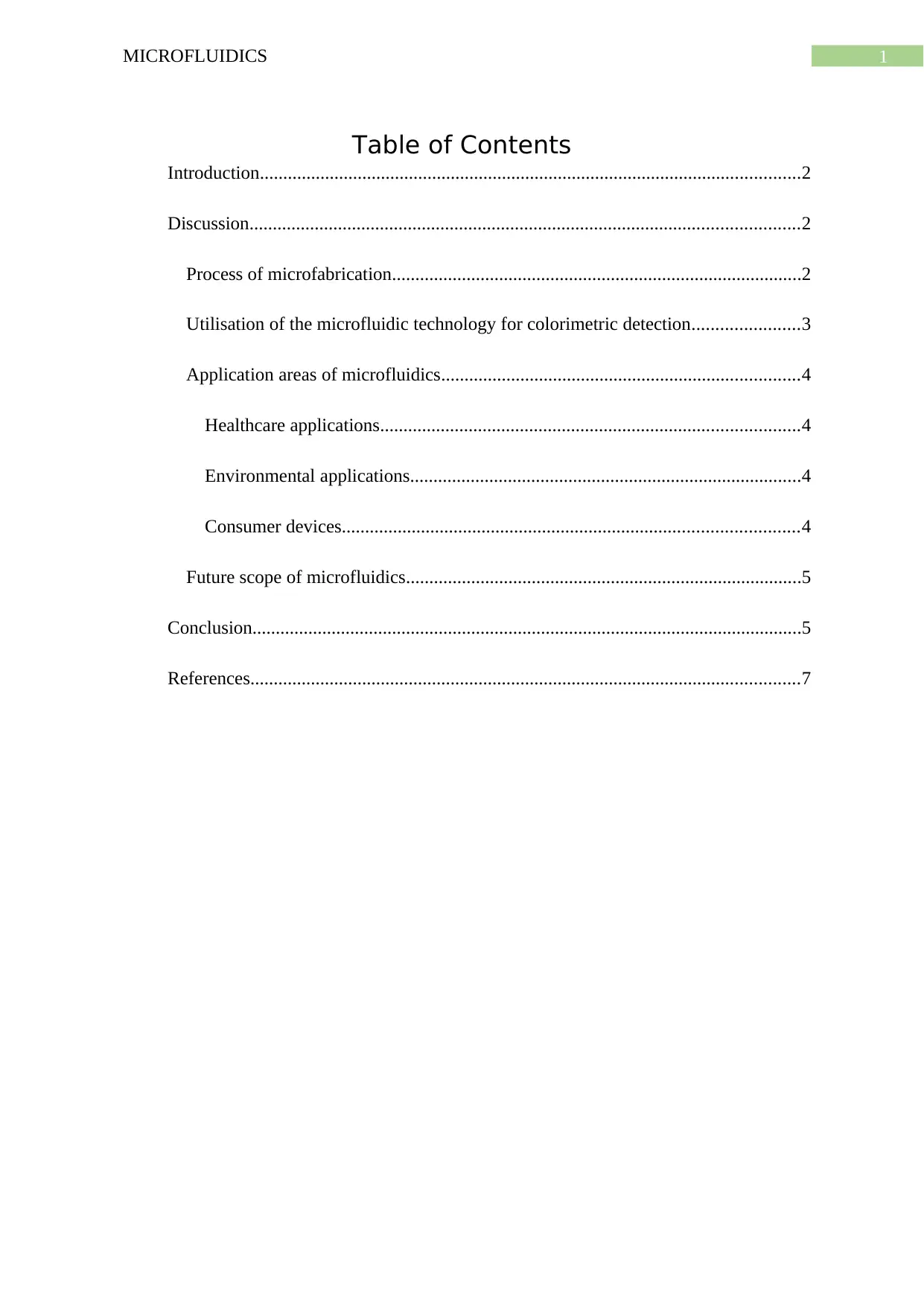
Table of Contents
Introduction....................................................................................................................2
Discussion......................................................................................................................2
Process of microfabrication........................................................................................2
Utilisation of the microfluidic technology for colorimetric detection.......................3
Application areas of microfluidics.............................................................................4
Healthcare applications..........................................................................................4
Environmental applications....................................................................................4
Consumer devices..................................................................................................4
Future scope of microfluidics.....................................................................................5
Conclusion......................................................................................................................5
References......................................................................................................................7
Table of Contents
Introduction....................................................................................................................2
Discussion......................................................................................................................2
Process of microfabrication........................................................................................2
Utilisation of the microfluidic technology for colorimetric detection.......................3
Application areas of microfluidics.............................................................................4
Healthcare applications..........................................................................................4
Environmental applications....................................................................................4
Consumer devices..................................................................................................4
Future scope of microfluidics.....................................................................................5
Conclusion......................................................................................................................5
References......................................................................................................................7
2MICROFLUIDICS
Introduction
This report aims to discuss the topic, Microfluidics. A brief introduction of
microfluidics is discussed in this report. The process of Microfabrication with the
technologies of cleanroom and non-cleanroom is briefly discussed in this report. The
platform on which the technology can be used for the detection of colorimetric is stated in
this report. The areas of application, where the technology can affect the most is stated in this
report. The future scope of the technology is briefly discussed in this report.
The term microfluidics concerns with the manipulation, exact control, and behaviour
of the fluids, which are geometrically restricted to a sub-millimetre and commonly a tiny
scale at which the governance of the mass transport is conducted by capillary penetration.
This technology is applicable in several fields such as biotechnology, nanotechnology,
engineering, physics, biochemistry, and chemistry, along with the practical applications in the
system design where the low volume of fluids are administered for achieving automation,
multiplexing, and screening with high-throughput [4].
Discussion
Process of microfabrication
The process of microfabrication is the method of manufacturing miniature
arrangements of scales of micrometre and smaller [5]. The earliest process of
microfabrication are considered to be utilised for fabrication of integrated circuit, which are
also known as the fabrication of semiconductor devices or semiconductor manufacturing.
Basically, the process of microfabrication is a combination of technologies that are
used for creating microdevices. For the method of fabricating a microdevice, several
processes should be performed sequentially and constantly. These processes includes
Introduction
This report aims to discuss the topic, Microfluidics. A brief introduction of
microfluidics is discussed in this report. The process of Microfabrication with the
technologies of cleanroom and non-cleanroom is briefly discussed in this report. The
platform on which the technology can be used for the detection of colorimetric is stated in
this report. The areas of application, where the technology can affect the most is stated in this
report. The future scope of the technology is briefly discussed in this report.
The term microfluidics concerns with the manipulation, exact control, and behaviour
of the fluids, which are geometrically restricted to a sub-millimetre and commonly a tiny
scale at which the governance of the mass transport is conducted by capillary penetration.
This technology is applicable in several fields such as biotechnology, nanotechnology,
engineering, physics, biochemistry, and chemistry, along with the practical applications in the
system design where the low volume of fluids are administered for achieving automation,
multiplexing, and screening with high-throughput [4].
Discussion
Process of microfabrication
The process of microfabrication is the method of manufacturing miniature
arrangements of scales of micrometre and smaller [5]. The earliest process of
microfabrication are considered to be utilised for fabrication of integrated circuit, which are
also known as the fabrication of semiconductor devices or semiconductor manufacturing.
Basically, the process of microfabrication is a combination of technologies that are
used for creating microdevices. For the method of fabricating a microdevice, several
processes should be performed sequentially and constantly. These processes includes
⊘ This is a preview!⊘
Do you want full access?
Subscribe today to unlock all pages.

Trusted by 1+ million students worldwide
3MICROFLUIDICS
depositing a film, patterning the film with the required micro features and removal of the
required portions of the film. The metrology of thin film is commonly utilised in all the steps
of processes, for ensuring the structure of the film contains the intended characteristics in the
terms of thickness, refractive index, and extinction coefficient, to obtain required behaviour
of device. The process of micro fabrication is executed in the cleanrooms, where the filtering
of the air from the contamination of particle has been done and the factors such as electrical
disturbances, temperature, humidity, and vibrations are checked and maintained properly.
The involvement of smoke, bacteria, dust, or cells, that are micrometres in size can cause the
destruction of functionality of the microfabricated devices [1]. The cleanrooms offers passive
cleanliness, still the wafers are actively cleaned prior each step. RCA-1 clean in the solution
of ammonia-peroxide removes the particles and organic contamination. The RCA-2 cleaning
in the mixture of hydrogen chloride-peroxide eliminates the metallic impurities. The mixture
of sulphuric acid-peroxide eliminates the organics.
Utilisation of the microfluidic technology for colorimetric detection
The technology of microfluidics is utilised for colorimetric detection with the help of
the platform of UPADs [2]. The UPADs or Paper-based microfluidic analytical devices are
growing to be an essential tool in the area of analysis because of the striking inactive
movements of the analyte minus any external forces because of phenomenon of capillary.
The techniques that are utilised in the designing of patterns of microfluidic are cost efficient,
the requirement of sample is less, rapid analysis and environmentally benign. The application
of UPADs with the intricate methods of fabrication have emerged in recent times in various
fields such as diagnostics, biological, food safety, environmental analysis, electrochemical
and colorimetric detections. In the recent years, the colorimetric detection has gained much
value because of the increased efficiency of rapid detection, the naked eye detection, lower
cost, applications in remote area, easily operable, and increased stability after detection [3].
depositing a film, patterning the film with the required micro features and removal of the
required portions of the film. The metrology of thin film is commonly utilised in all the steps
of processes, for ensuring the structure of the film contains the intended characteristics in the
terms of thickness, refractive index, and extinction coefficient, to obtain required behaviour
of device. The process of micro fabrication is executed in the cleanrooms, where the filtering
of the air from the contamination of particle has been done and the factors such as electrical
disturbances, temperature, humidity, and vibrations are checked and maintained properly.
The involvement of smoke, bacteria, dust, or cells, that are micrometres in size can cause the
destruction of functionality of the microfabricated devices [1]. The cleanrooms offers passive
cleanliness, still the wafers are actively cleaned prior each step. RCA-1 clean in the solution
of ammonia-peroxide removes the particles and organic contamination. The RCA-2 cleaning
in the mixture of hydrogen chloride-peroxide eliminates the metallic impurities. The mixture
of sulphuric acid-peroxide eliminates the organics.
Utilisation of the microfluidic technology for colorimetric detection
The technology of microfluidics is utilised for colorimetric detection with the help of
the platform of UPADs [2]. The UPADs or Paper-based microfluidic analytical devices are
growing to be an essential tool in the area of analysis because of the striking inactive
movements of the analyte minus any external forces because of phenomenon of capillary.
The techniques that are utilised in the designing of patterns of microfluidic are cost efficient,
the requirement of sample is less, rapid analysis and environmentally benign. The application
of UPADs with the intricate methods of fabrication have emerged in recent times in various
fields such as diagnostics, biological, food safety, environmental analysis, electrochemical
and colorimetric detections. In the recent years, the colorimetric detection has gained much
value because of the increased efficiency of rapid detection, the naked eye detection, lower
cost, applications in remote area, easily operable, and increased stability after detection [3].
Paraphrase This Document
Need a fresh take? Get an instant paraphrase of this document with our AI Paraphraser

4MICROFLUIDICS
The UPADS are used for colorimetric detection of several target analytes that includes toxic
ions and biomolecules. It is denoted with the passive movement of the solution of the analyte
for testing zones with the help of capillary action and therefore reacting with the exact loaded
reagents that are followed by the noticeable changes in the colour.
Application areas of microfluidics
Healthcare applications
The microfluidics devices are the small chips that can perform chemical analysis of
the extremely small volumes of fluids like blood. Devices of lab-on-a-chip, which utilises
microfluidics, are growing to be increased cost-efficient method of disease detection and
several other uses that ranges from treatment to monitoring. The global market of
microfluidics is focussed by the requirement of analysis of low-volume sample and high
outcome methodologies of screening and it has been fuelled with the implementation of
modern technologies like lab-on-chip and the IVDs (in vitro diagnostics) [8].
Environmental applications
In the recent times, numerous groups have been successful in identifying the utility of
microfluidic devices for utilising in environmental aspects. The microfluidic devices provides
numerous advantages and in several cases, these devices are ideal for environmental analysis.
The challenges that are faced in environmental monitoring, that includes the handling
capability of complex and severely variable sample matrices that leads to the continued
research and growth.
Consumer devices
The recent development in the affordable technologies of 3D printing has impacted
the markets of fabricated consumers products. Between the several materials and the
utilisation of these materials in the microfluidic devices, the integrated nanofibres has the
The UPADS are used for colorimetric detection of several target analytes that includes toxic
ions and biomolecules. It is denoted with the passive movement of the solution of the analyte
for testing zones with the help of capillary action and therefore reacting with the exact loaded
reagents that are followed by the noticeable changes in the colour.
Application areas of microfluidics
Healthcare applications
The microfluidics devices are the small chips that can perform chemical analysis of
the extremely small volumes of fluids like blood. Devices of lab-on-a-chip, which utilises
microfluidics, are growing to be increased cost-efficient method of disease detection and
several other uses that ranges from treatment to monitoring. The global market of
microfluidics is focussed by the requirement of analysis of low-volume sample and high
outcome methodologies of screening and it has been fuelled with the implementation of
modern technologies like lab-on-chip and the IVDs (in vitro diagnostics) [8].
Environmental applications
In the recent times, numerous groups have been successful in identifying the utility of
microfluidic devices for utilising in environmental aspects. The microfluidic devices provides
numerous advantages and in several cases, these devices are ideal for environmental analysis.
The challenges that are faced in environmental monitoring, that includes the handling
capability of complex and severely variable sample matrices that leads to the continued
research and growth.
Consumer devices
The recent development in the affordable technologies of 3D printing has impacted
the markets of fabricated consumers products. Between the several materials and the
utilisation of these materials in the microfluidic devices, the integrated nanofibres has the

5MICROFLUIDICS
ability of achieving interesting applications because of the high surface-areas and the surfaces
that are easy to functionalise. Till now, these devices have been established operative fibres,
scaffolds and concentrators within the microfluidic devices [6].
Future scope of microfluidics
The technology, microfluidics provide a great future aspect. It offers several
capabilities in the control of the concentrations of the molecules in time and space. The sector
of cell biology is considered to be most impacted by the technology and it can be a new tool
for conducting the experiments that were otherwise difficult to conduct [7]. The sector of
chemical synthesis is an area that is considered to be effected by this technological
advancement where the systems of microfluidic could fit naturally and it can be useful to
develop new strategies.
Conclusion
Hence, it can be concluded that the introduction of microfluidics in the recent times
has led to major development in many sectors. The term microfluidics concerns with the
manipulation, exact control, and behaviour of the fluids, which are geometrically restricted to
a sub-millimetre and commonly a tiny scale at which the governance of the mass transport is
conducted by capillary penetration. The process of microfabrication is the method of
manufacturing miniature arrangements of scales of micrometre and smaller. The earliest
process of microfabrication are considered to be utilised for fabrication of integrated circuit,
which are also known as the fabrication of semiconductor devices or semiconductor
manufacturing. Basically, the process of microfabrication is a combination of technologies
that are used for creating microdevices. For the method of fabricating a microdevice, several
processes should be performed sequentially and constantly. The technology of microfluidics
is utilised for colorimetric detection with the help of the platform of UPADs. The
ability of achieving interesting applications because of the high surface-areas and the surfaces
that are easy to functionalise. Till now, these devices have been established operative fibres,
scaffolds and concentrators within the microfluidic devices [6].
Future scope of microfluidics
The technology, microfluidics provide a great future aspect. It offers several
capabilities in the control of the concentrations of the molecules in time and space. The sector
of cell biology is considered to be most impacted by the technology and it can be a new tool
for conducting the experiments that were otherwise difficult to conduct [7]. The sector of
chemical synthesis is an area that is considered to be effected by this technological
advancement where the systems of microfluidic could fit naturally and it can be useful to
develop new strategies.
Conclusion
Hence, it can be concluded that the introduction of microfluidics in the recent times
has led to major development in many sectors. The term microfluidics concerns with the
manipulation, exact control, and behaviour of the fluids, which are geometrically restricted to
a sub-millimetre and commonly a tiny scale at which the governance of the mass transport is
conducted by capillary penetration. The process of microfabrication is the method of
manufacturing miniature arrangements of scales of micrometre and smaller. The earliest
process of microfabrication are considered to be utilised for fabrication of integrated circuit,
which are also known as the fabrication of semiconductor devices or semiconductor
manufacturing. Basically, the process of microfabrication is a combination of technologies
that are used for creating microdevices. For the method of fabricating a microdevice, several
processes should be performed sequentially and constantly. The technology of microfluidics
is utilised for colorimetric detection with the help of the platform of UPADs. The
⊘ This is a preview!⊘
Do you want full access?
Subscribe today to unlock all pages.
Trusted by 1+ million students worldwide

6MICROFLUIDICS
microfluidics devices are the small chips that can perform chemical analysis of the extremely
small volumes of fluids like blood. The recent development in the affordable technologies of
3D printing has impacted the markets of fabricated consumers products. The technology,
microfluidics provide a great future aspect. It offers several capabilities in the control of the
concentrations of the molecules in time and space.
microfluidics devices are the small chips that can perform chemical analysis of the extremely
small volumes of fluids like blood. The recent development in the affordable technologies of
3D printing has impacted the markets of fabricated consumers products. The technology,
microfluidics provide a great future aspect. It offers several capabilities in the control of the
concentrations of the molecules in time and space.
Paraphrase This Document
Need a fresh take? Get an instant paraphrase of this document with our AI Paraphraser

7MICROFLUIDICS
References
[1] Sackmann, Eric K., Anna L. Fulton, and David J. Beebe. "The present and future role
of microfluidics in biomedical research." Nature 507.7491 (2014): 181.
[2] Johnston, I. D., et al. "Mechanical characterization of bulk Sylgard 184 for
microfluidics and microengineering." Journal of Micromechanics and
Microengineering 24.3 (2014): 035017.
[3] Mazutis, Linas, et al. "Single-cell analysis and sorting using droplet-based
microfluidics." Nature protocols 8.5 (2013): 870.
[4] Ho, Chee Meng Benjamin, et al. "3D printed microfluidics for biological
applications." Lab on a Chip 15.18 (2015): 3627-3637.
[5] Yeo, Leslie Y., and James R. Friend. "Surface acoustic wave microfluidics." Annual
review of fluid mechanics 46 (2014): 379-406.
[6] Bhattacharjee, Nirveek, et al. "The upcoming 3D-printing revolution in
microfluidics." Lab on a Chip 16.10 (2016): 1720-1742.
[7] Palleau, Etienne, et al. "Self‐healing stretchable wires for reconfigurable circuit
wiring and 3D microfluidics." Advanced Materials 25.11 (2013): 1589-1592.
[8] Zhang, Jun, et al. "Fundamentals and applications of inertial microfluidics: a
review." Lab on a Chip 16.1 (2016): 10-34.
References
[1] Sackmann, Eric K., Anna L. Fulton, and David J. Beebe. "The present and future role
of microfluidics in biomedical research." Nature 507.7491 (2014): 181.
[2] Johnston, I. D., et al. "Mechanical characterization of bulk Sylgard 184 for
microfluidics and microengineering." Journal of Micromechanics and
Microengineering 24.3 (2014): 035017.
[3] Mazutis, Linas, et al. "Single-cell analysis and sorting using droplet-based
microfluidics." Nature protocols 8.5 (2013): 870.
[4] Ho, Chee Meng Benjamin, et al. "3D printed microfluidics for biological
applications." Lab on a Chip 15.18 (2015): 3627-3637.
[5] Yeo, Leslie Y., and James R. Friend. "Surface acoustic wave microfluidics." Annual
review of fluid mechanics 46 (2014): 379-406.
[6] Bhattacharjee, Nirveek, et al. "The upcoming 3D-printing revolution in
microfluidics." Lab on a Chip 16.10 (2016): 1720-1742.
[7] Palleau, Etienne, et al. "Self‐healing stretchable wires for reconfigurable circuit
wiring and 3D microfluidics." Advanced Materials 25.11 (2013): 1589-1592.
[8] Zhang, Jun, et al. "Fundamentals and applications of inertial microfluidics: a
review." Lab on a Chip 16.1 (2016): 10-34.

8MICROFLUIDICS
⊘ This is a preview!⊘
Do you want full access?
Subscribe today to unlock all pages.
Trusted by 1+ million students worldwide

9MICROFLUIDICS
Paraphrase This Document
Need a fresh take? Get an instant paraphrase of this document with our AI Paraphraser

10MICROFLUIDICS

11MICROFLUIDICS
⊘ This is a preview!⊘
Do you want full access?
Subscribe today to unlock all pages.
Trusted by 1+ million students worldwide

1 out of 12


Your All-in-One AI-Powered Toolkit for Academic Success.
+13062052269
info@desklib.com
Available 24*7 on WhatsApp / Email
![[object Object]](/_next/static/media/star-bottom.7253800d.svg)
Unlock your academic potential
Copyright © 2020–2026 A2Z Services. All Rights Reserved. Developed and managed by ZUCOL.