University Essay: Plant and Soil Interactions & Nutritional Content
VerifiedAdded on 2022/11/26
|18
|4827
|237
Essay
AI Summary
This essay delves into the critical role of plant and soil interactions in boosting the nutritional content of plant-based foods, focusing on enhancing micronutrient bioavailability. It explores the significance of zinc, iron, and selenium, highlighting how soil conditions, such as pH levels and the presence of other nutrients like nitrogen and phosphorus, influence the uptake of these essential elements. The discussion covers strategies to improve soil availability of these micronutrients, including the application of fertilizers, seed fortification, and foliar fertilization. The essay further examines the distinctions between soil and foliar-based fertilization methods, and strategies to regulate nutrient uptake by plant tissues. The study also emphasizes the effects of nitrogen and phosphorus on the bioavailability of micronutrients and discusses the need for monitoring and adjusting soil pH to ensure optimal plant growth and enhanced nutritional value in plant-based foods. The role of selenium in plant health and its response to environmental stresses is also covered.
Running head: PLANT AND SOIL INTERACTIONS
THE ROLE OF PLANT AND SOIL INTERACTIONS IN ENHANCING
NUTRITIONAL CONTENT OF PLANT-BASED FOODS.
Name of the Student:
Name of the University:
Author note:
THE ROLE OF PLANT AND SOIL INTERACTIONS IN ENHANCING
NUTRITIONAL CONTENT OF PLANT-BASED FOODS.
Name of the Student:
Name of the University:
Author note:

Paraphrase This Document
Need a fresh take? Get an instant paraphrase of this document with our AI Paraphraser
1PLANT AND SOIL INTERACTIONS
Introduction
For ensuring optimum growth and development in plants, the uptake and utilization of
essential nutrients from the soil by plant tissues. It is worthwhile to note that plants often
encounter considerable difficulties in the ingestion and metabolism of such nutrients from the
soil for the purpose of ensuring maintenance of basic life processes as well as for the growth and
development of their vegetative tissues and parts – considering their lack of abilities to be mobile
as compared to other organisms who can engage in foraging and acquisition of food (Cavagnaro
2016).
A lack of adequate absorption of essential macro and micro nutrients from the soil result
in an emergence of state of deficiency and poor nutritional status in the plant. If left unmitigated,
such as state of malnutrition in the plant can result in development of hindrances in the normal
growth processes of the plant resulting in symptoms like stunting, yellowing of leaves and
additional fatal consequences like death (Jacoby et al. 2017). Such deficits in the growth and
development of the plant will grossly affect the total production resulting in reduced crop yields
and scarcity in terms of plant food sources. Prolonged lack of mitigation of the issues pertaining
to the disruptions in interactions between the soil and the plant and the associated disturbances
on overall crop yields can contribute to global losses in terms of biodiversity and ecological
systems considering the fact that plants are a key determinant in the maintenance of the integrity
between food chains, food webs and overall nutritional status of organisms (Luo et al. 2015).
The following paragraphs of the essay aims to shed light on soil-plant interactions
influencing micronutrient content in plant-based foods. The essay will focus on the strategies
with which availability of essential micronutrients like zinc, iron and selenium can be enhanced
Introduction
For ensuring optimum growth and development in plants, the uptake and utilization of
essential nutrients from the soil by plant tissues. It is worthwhile to note that plants often
encounter considerable difficulties in the ingestion and metabolism of such nutrients from the
soil for the purpose of ensuring maintenance of basic life processes as well as for the growth and
development of their vegetative tissues and parts – considering their lack of abilities to be mobile
as compared to other organisms who can engage in foraging and acquisition of food (Cavagnaro
2016).
A lack of adequate absorption of essential macro and micro nutrients from the soil result
in an emergence of state of deficiency and poor nutritional status in the plant. If left unmitigated,
such as state of malnutrition in the plant can result in development of hindrances in the normal
growth processes of the plant resulting in symptoms like stunting, yellowing of leaves and
additional fatal consequences like death (Jacoby et al. 2017). Such deficits in the growth and
development of the plant will grossly affect the total production resulting in reduced crop yields
and scarcity in terms of plant food sources. Prolonged lack of mitigation of the issues pertaining
to the disruptions in interactions between the soil and the plant and the associated disturbances
on overall crop yields can contribute to global losses in terms of biodiversity and ecological
systems considering the fact that plants are a key determinant in the maintenance of the integrity
between food chains, food webs and overall nutritional status of organisms (Luo et al. 2015).
The following paragraphs of the essay aims to shed light on soil-plant interactions
influencing micronutrient content in plant-based foods. The essay will focus on the strategies
with which availability of essential micronutrients like zinc, iron and selenium can be enhanced
2PLANT AND SOIL INTERACTIONS
in soil, followed by a discussion in the distinctions between soil and foliar based fertilization.
Lastly, the essay will aim to discuss on strategies aimed at regulation of uptake of nutrients
acquired from the soil by the plant tissues.
Discussion
Soil Availability of Micronutrients
Zinc
Plants require a number of micronutrients for ensuring optimum growth and
development. A key micronutrient salient for plant tissue proliferation is zinc which aids in the
genetic maturation and RNA-DNA differentiation in plants hence contributing to the
development of plant roots, shoots and buds for flowers (Saha et al. 2017). Issues in nutrient
uptake due to plant immobility coupled with inadequate concentration of zinc in the soils, affects
soil bioavailability of zinc which further results in deficiency symptoms in plants such as leaf
yellowing (chlorosis), leaf tissue death (necrosis), leaf bronzing (bronze color spots in the
chlorosis affected areas), leaf rosetting, dwarfing, malformation and stunting (Candan, Cakmak
and Ozturk 2018). Additionally, the same may be affected in terms of zinc acquisition for
individuals dependant on consumption of plant based foods resulting in micronutrient
deficiencies in terms of disrupted immune functioning, impairment in growth and disruption in
terms of sexual development (Pascual 2016).
Hence, to address such concerns, there is a need to increase bioavailability of zinc for
plants from soil. A number of factors contribute to reduced bioavailability of zinc in plants of
which, low zinc content in the soil, high levels of soil pH and increased levels of phosphorus.
in soil, followed by a discussion in the distinctions between soil and foliar based fertilization.
Lastly, the essay will aim to discuss on strategies aimed at regulation of uptake of nutrients
acquired from the soil by the plant tissues.
Discussion
Soil Availability of Micronutrients
Zinc
Plants require a number of micronutrients for ensuring optimum growth and
development. A key micronutrient salient for plant tissue proliferation is zinc which aids in the
genetic maturation and RNA-DNA differentiation in plants hence contributing to the
development of plant roots, shoots and buds for flowers (Saha et al. 2017). Issues in nutrient
uptake due to plant immobility coupled with inadequate concentration of zinc in the soils, affects
soil bioavailability of zinc which further results in deficiency symptoms in plants such as leaf
yellowing (chlorosis), leaf tissue death (necrosis), leaf bronzing (bronze color spots in the
chlorosis affected areas), leaf rosetting, dwarfing, malformation and stunting (Candan, Cakmak
and Ozturk 2018). Additionally, the same may be affected in terms of zinc acquisition for
individuals dependant on consumption of plant based foods resulting in micronutrient
deficiencies in terms of disrupted immune functioning, impairment in growth and disruption in
terms of sexual development (Pascual 2016).
Hence, to address such concerns, there is a need to increase bioavailability of zinc for
plants from soil. A number of factors contribute to reduced bioavailability of zinc in plants of
which, low zinc content in the soil, high levels of soil pH and increased levels of phosphorus.
⊘ This is a preview!⊘
Do you want full access?
Subscribe today to unlock all pages.

Trusted by 1+ million students worldwide
3PLANT AND SOIL INTERACTIONS
Considering the same, enriching soils heavily with fertilizers containing zinc, has been
postulated a key method for enhancing the bioavailability of zinc in soils. Such strategies include
application of zinc oxide and zinc sulphate at the rate of 5 to 100 kg per hectare of agricultural
soils based on type of plant and soil and rate of deficiency occurring (Gupta, Ram and Kumar
2016). Care has to be taken however, to ensure monitoring of soil pH prior to application of the
same since a prevalence of alkalinity in the soil can contribute to reduced absorption (Sharma et
al. 2013). Additional strategies which may increase availability and absorption of zinc in the
plants include fortifying the seeds with zinc or dipping the roots of the seedling in fertilizer
solutions of zinc. Alternatively, zinc supplied through foliar fertilizers may also prove to be
beneficial and included application of zinc chelates or sulphates (Vigani et al. 2018).
Likewise, enhancing the availability and uptake of nitrogen in the soil, another key
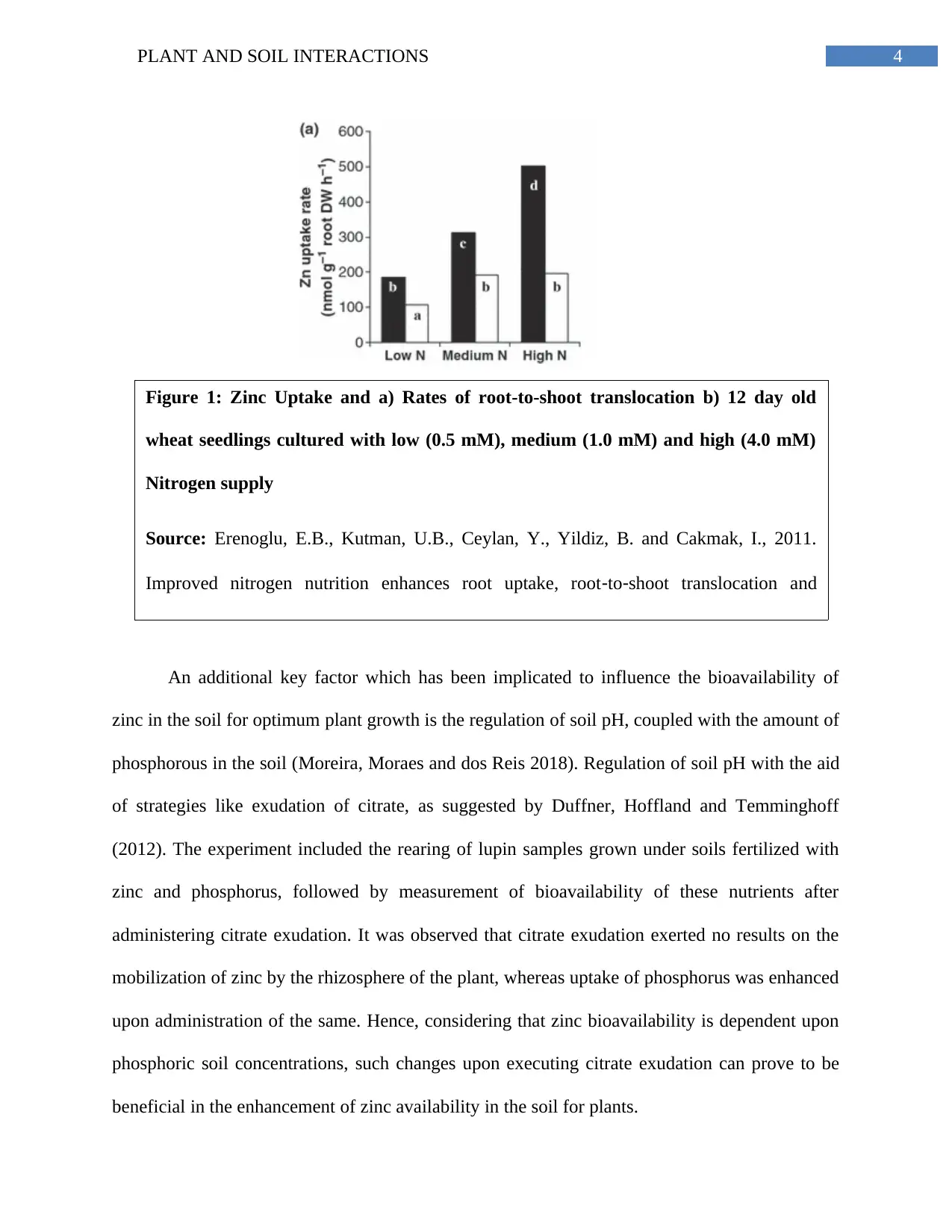
nutrient, has been proven to improve the availability of zinc to plants. Eerenoglu et al. (2010),
conducted nutrient solution based experiments where seedlings were supplied nitrogen and zinc
with the aid of foliar fertilization. The variations in the translocation of zinc across the roots and
shoots of the plant in response to varied nitrogen supplies was evaluated at both stages of
vegetation and generation. It was observed that in response to increasing the supply of nitrogen,
the uptake of zinc by the roots of the seedlings was multiplied thrice where translocation of zinc
between roots and shoots was multiplied up to eight times. Hence, this proves the enhancing the
supply of nitrogen may prove be beneficial in increasing the bioavailability of zinc in plants.
Considering the same, enriching soils heavily with fertilizers containing zinc, has been
postulated a key method for enhancing the bioavailability of zinc in soils. Such strategies include
application of zinc oxide and zinc sulphate at the rate of 5 to 100 kg per hectare of agricultural
soils based on type of plant and soil and rate of deficiency occurring (Gupta, Ram and Kumar
2016). Care has to be taken however, to ensure monitoring of soil pH prior to application of the
same since a prevalence of alkalinity in the soil can contribute to reduced absorption (Sharma et
al. 2013). Additional strategies which may increase availability and absorption of zinc in the
plants include fortifying the seeds with zinc or dipping the roots of the seedling in fertilizer
solutions of zinc. Alternatively, zinc supplied through foliar fertilizers may also prove to be
beneficial and included application of zinc chelates or sulphates (Vigani et al. 2018).
Likewise, enhancing the availability and uptake of nitrogen in the soil, another key
nutrient, has been proven to improve the availability of zinc to plants. Eerenoglu et al. (2010),
conducted nutrient solution based experiments where seedlings were supplied nitrogen and zinc
with the aid of foliar fertilization. The variations in the translocation of zinc across the roots and
shoots of the plant in response to varied nitrogen supplies was evaluated at both stages of
vegetation and generation. It was observed that in response to increasing the supply of nitrogen,
the uptake of zinc by the roots of the seedlings was multiplied thrice where translocation of zinc
between roots and shoots was multiplied up to eight times. Hence, this proves the enhancing the
supply of nitrogen may prove be beneficial in increasing the bioavailability of zinc in plants.
Paraphrase This Document
Need a fresh take? Get an instant paraphrase of this document with our AI Paraphraser
4PLANT AND SOIL INTERACTIONS
An additional key factor which has been implicated to influence the bioavailability of
zinc in the soil for optimum plant growth is the regulation of soil pH, coupled with the amount of
phosphorous in the soil (Moreira, Moraes and dos Reis 2018). Regulation of soil pH with the aid
of strategies like exudation of citrate, as suggested by Duffner, Hoffland and Temminghoff
(2012). The experiment included the rearing of lupin samples grown under soils fertilized with
zinc and phosphorus, followed by measurement of bioavailability of these nutrients after
administering citrate exudation. It was observed that citrate exudation exerted no results on the
mobilization of zinc by the rhizosphere of the plant, whereas uptake of phosphorus was enhanced
upon administration of the same. Hence, considering that zinc bioavailability is dependent upon
phosphoric soil concentrations, such changes upon executing citrate exudation can prove to be
beneficial in the enhancement of zinc availability in the soil for plants.
Figure 1: Zinc Uptake and a) Rates of root-to-shoot translocation b) 12 day old
wheat seedlings cultured with low (0.5 mM), medium (1.0 mM) and high (4.0 mM)
Nitrogen supply
Source: Erenoglu, E.B., Kutman, U.B., Ceylan, Y., Yildiz, B. and Cakmak, I., 2011.
Improved nitrogen nutrition enhances root uptake, root‐to‐shoot translocation and
remobilization of zinc (65Zn) in wheat. New Phytologist, 189(2), pp.438-448.
An additional key factor which has been implicated to influence the bioavailability of
zinc in the soil for optimum plant growth is the regulation of soil pH, coupled with the amount of
phosphorous in the soil (Moreira, Moraes and dos Reis 2018). Regulation of soil pH with the aid
of strategies like exudation of citrate, as suggested by Duffner, Hoffland and Temminghoff
(2012). The experiment included the rearing of lupin samples grown under soils fertilized with
zinc and phosphorus, followed by measurement of bioavailability of these nutrients after
administering citrate exudation. It was observed that citrate exudation exerted no results on the
mobilization of zinc by the rhizosphere of the plant, whereas uptake of phosphorus was enhanced
upon administration of the same. Hence, considering that zinc bioavailability is dependent upon
phosphoric soil concentrations, such changes upon executing citrate exudation can prove to be
beneficial in the enhancement of zinc availability in the soil for plants.
Figure 1: Zinc Uptake and a) Rates of root-to-shoot translocation b) 12 day old
wheat seedlings cultured with low (0.5 mM), medium (1.0 mM) and high (4.0 mM)
Nitrogen supply
Source: Erenoglu, E.B., Kutman, U.B., Ceylan, Y., Yildiz, B. and Cakmak, I., 2011.
Improved nitrogen nutrition enhances root uptake, root‐to‐shoot translocation and
remobilization of zinc (65Zn) in wheat. New Phytologist, 189(2), pp.438-448.
5PLANT AND SOIL INTERACTIONS
Iron
Another key nutrient which is required to conveyed to plant tissues for optimum
functioning growth and development in iron. Iron is required by plants for the maintenance of
vital processes for sustenance such as functioning of enzymes, production of chlorophyll, fixing
of iron and metabolic process underlying nutrient absorption. Deficiency of iron in plants results
in detrimental growth effects accompanied by losses in leaves, stunted plant growth coupled with
chlorosis of leaves characterize by unsightly yellowing of leaves (Rajnak et al. 2018).
Additionally, iron absorption upon consumption of plant based foods is generally hindered in
humans due to the presence of anti-nutrients such as phytates, oxalates and tannins, which in turn
may result in adequate iron consumption and iron deficiency especially among consumers
dependent on consumption of plant based food sources. Hence, to combat such effects, the need
of the hour is to enhance the bioavailability of iron in soils to further enhance iron content in
plant based foods (Lucena and Hernandez-Apaolaza 2017).
A number of factor contribute to the reduced bioavailability of iron in soils. These
include prevalence of a high pH or high rates of alkalinity in the soil, high amount of clay in
soils, presence of a soil which is excessively wet or compacted and high amount of phosphorous
in the soil. Hence, to increase iron availability and hence adequate iron content in plant foods,
farmers should first aim to increase the level of acidity in the soil which can be done by addition
of sphagnum peat, usage of acidic fertilizers such as ammonium and incorporation of sulphur
elemental flowers in the soil. Further, to reduce the level of clay in the soil, and hence, iron
bioavailability, addition of organic compost and peat moss may prove to be beneficial (Murgia
and Morandini 2017). Further, processes of irrigation, to ensure drainage of excessive moisture
content in wet soils, coupled with provision of iron based fertilizers through soil and foliar
Iron
Another key nutrient which is required to conveyed to plant tissues for optimum
functioning growth and development in iron. Iron is required by plants for the maintenance of
vital processes for sustenance such as functioning of enzymes, production of chlorophyll, fixing
of iron and metabolic process underlying nutrient absorption. Deficiency of iron in plants results
in detrimental growth effects accompanied by losses in leaves, stunted plant growth coupled with
chlorosis of leaves characterize by unsightly yellowing of leaves (Rajnak et al. 2018).
Additionally, iron absorption upon consumption of plant based foods is generally hindered in
humans due to the presence of anti-nutrients such as phytates, oxalates and tannins, which in turn
may result in adequate iron consumption and iron deficiency especially among consumers
dependent on consumption of plant based food sources. Hence, to combat such effects, the need
of the hour is to enhance the bioavailability of iron in soils to further enhance iron content in
plant based foods (Lucena and Hernandez-Apaolaza 2017).
A number of factor contribute to the reduced bioavailability of iron in soils. These
include prevalence of a high pH or high rates of alkalinity in the soil, high amount of clay in
soils, presence of a soil which is excessively wet or compacted and high amount of phosphorous
in the soil. Hence, to increase iron availability and hence adequate iron content in plant foods,
farmers should first aim to increase the level of acidity in the soil which can be done by addition
of sphagnum peat, usage of acidic fertilizers such as ammonium and incorporation of sulphur
elemental flowers in the soil. Further, to reduce the level of clay in the soil, and hence, iron
bioavailability, addition of organic compost and peat moss may prove to be beneficial (Murgia
and Morandini 2017). Further, processes of irrigation, to ensure drainage of excessive moisture
content in wet soils, coupled with provision of iron based fertilizers through soil and foliar
⊘ This is a preview!⊘
Do you want full access?
Subscribe today to unlock all pages.
Trusted by 1+ million students worldwide
6PLANT AND SOIL INTERACTIONS
mechanisms have been implicated to yield beneficial effects in the availability of iron in the soil
and hence its increased nutrient content in plant based foods. Likewise, as observed in zinc,
addition of a fertilizer high in phosphorus resulting in highly phosphoric soils further inhibit
availability of iron in the soil. Hence, to combat the same, the farmer must aim to administer
fertilizers which are low in phosphorus (Briat, Dubos and Gaymard 2015).
As observed from zinc, enhancing nitrogenous supply in the soil may be beneficial in the
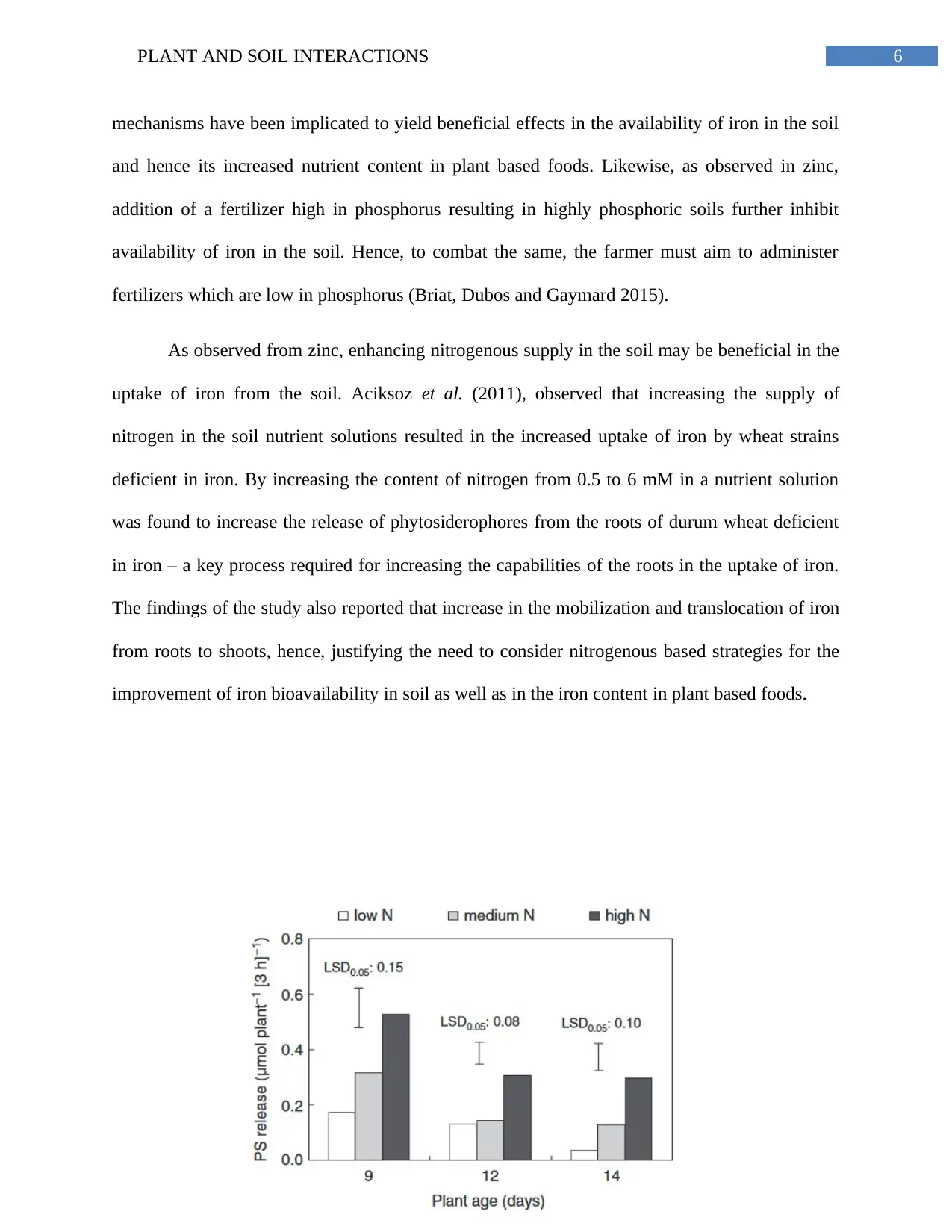
uptake of iron from the soil. Aciksoz et al. (2011), observed that increasing the supply of
nitrogen in the soil nutrient solutions resulted in the increased uptake of iron by wheat strains
deficient in iron. By increasing the content of nitrogen from 0.5 to 6 mM in a nutrient solution
was found to increase the release of phytosiderophores from the roots of durum wheat deficient
in iron – a key process required for increasing the capabilities of the roots in the uptake of iron.
The findings of the study also reported that increase in the mobilization and translocation of iron
from roots to shoots, hence, justifying the need to consider nitrogenous based strategies for the
improvement of iron bioavailability in soil as well as in the iron content in plant based foods.
mechanisms have been implicated to yield beneficial effects in the availability of iron in the soil
and hence its increased nutrient content in plant based foods. Likewise, as observed in zinc,
addition of a fertilizer high in phosphorus resulting in highly phosphoric soils further inhibit
availability of iron in the soil. Hence, to combat the same, the farmer must aim to administer
fertilizers which are low in phosphorus (Briat, Dubos and Gaymard 2015).
As observed from zinc, enhancing nitrogenous supply in the soil may be beneficial in the
uptake of iron from the soil. Aciksoz et al. (2011), observed that increasing the supply of
nitrogen in the soil nutrient solutions resulted in the increased uptake of iron by wheat strains
deficient in iron. By increasing the content of nitrogen from 0.5 to 6 mM in a nutrient solution
was found to increase the release of phytosiderophores from the roots of durum wheat deficient
in iron – a key process required for increasing the capabilities of the roots in the uptake of iron.
The findings of the study also reported that increase in the mobilization and translocation of iron
from roots to shoots, hence, justifying the need to consider nitrogenous based strategies for the
improvement of iron bioavailability in soil as well as in the iron content in plant based foods.
Paraphrase This Document
Need a fresh take? Get an instant paraphrase of this document with our AI Paraphraser
7PLANT AND SOIL INTERACTIONS
Selenium
Selenium is an additional micronutrient which has been generally overlooked but
nevertheless is considered essential for the growth and development of plants. Selenium plays a
key role in the mitigation of the negative effects of environmental stresses in plants (Gupta and
Gupta 2017). Additionally, selenium plays a key role in regulation of the processes of
photosynthesis, as well as in the formation of structures associated with the chloroplast and
cellular membranes of the plant tissues. It has been implicated that plants receiving an adequate
uptake of selenium from the soil are equipped better to combat environmental fluctuations such
as temperature changes, damaging weather and calamities like droughts (Pilon-Smits 2015). The
ability of selenium to combat the effects of environmental stresses can be observed in the study
Figure 2: Consequences of enhancing supply of nitrogen on the release of phytosiderophores from
the roots of wheat plants deficient in Iron
Source: Aciksoz, S.B., Ozturk, L., Gokmen, O.O., Römheld, V. and Cakmak, I., 2011. Effect of
nitrogen on root release of phytosiderophores and root uptake of Fe (III)‐phytosiderophore in Fe‐
deficient wheat plants. Physiologia plantarum, 142(3), pp.287-296.
Selenium
Selenium is an additional micronutrient which has been generally overlooked but
nevertheless is considered essential for the growth and development of plants. Selenium plays a
key role in the mitigation of the negative effects of environmental stresses in plants (Gupta and
Gupta 2017). Additionally, selenium plays a key role in regulation of the processes of
photosynthesis, as well as in the formation of structures associated with the chloroplast and
cellular membranes of the plant tissues. It has been implicated that plants receiving an adequate
uptake of selenium from the soil are equipped better to combat environmental fluctuations such
as temperature changes, damaging weather and calamities like droughts (Pilon-Smits 2015). The
ability of selenium to combat the effects of environmental stresses can be observed in the study
Figure 2: Consequences of enhancing supply of nitrogen on the release of phytosiderophores from
the roots of wheat plants deficient in Iron
Source: Aciksoz, S.B., Ozturk, L., Gokmen, O.O., Römheld, V. and Cakmak, I., 2011. Effect of
nitrogen on root release of phytosiderophores and root uptake of Fe (III)‐phytosiderophore in Fe‐
deficient wheat plants. Physiologia plantarum, 142(3), pp.287-296.
8PLANT AND SOIL INTERACTIONS
by Bocchini et al. (2018), which examined the effects of fortification of soil with selenium to
combat water and environmental stresses. The study comprised of growing maize plants in soil
fortified with 150 mg of sodium selenite. The increased fertilization resulted in changes in the
form of increments in concentrations of potassium, choline and nitrogen metabolic processes –
metabolic alterations indicative of resistance of the plant towards stressful conditions like
shortage of water. Such changes have been implicated to be due selenium regulated changes in
genes such as sorbitol dehydrogenase (responsible for osmolyte regulation during droughts),
phytoene synthase (responsible for maintenance of antioxidants like carotenoids in leaves) and
alcohol dehydrogenase (responsible for biochemical changes in the adaptation to environmental
stresses).
While deficiency in selenium is uncommon, selenium toxicity is a common symptom
observed in plants and can be detected in the form of stunted growth, yellowing or chlorosis of
the leaves, withering, drying and untimely death. Hence, selenium levels in the soil and thus its
uptake by the plants must be closely monitored to avoid the possibilities of any deficiencies or
any harmful consequences associated due to toxicities. Hence, to ensure corrected levels of
selenium in the soil, administration of fertilizers containing selenium has been proven to be
helpful (Schiavon and Pilon‐Smits 2017). Usage of foliar sprays and seeds pelleted with
selenium are additional alternatives which have been proven to be beneficial. However,
monitoring the content of selenium in the soil with the help of a soil test is recommended to
ensure avoidance of any form of toxicity. The optimum standards of selenium which must be
maintained is 200 mg/kg – any amount higher than this is indicative of toxicity which must be
corrected immediately. Lower levels are indicative of deficiency. If deficient levels of selenium
by Bocchini et al. (2018), which examined the effects of fortification of soil with selenium to
combat water and environmental stresses. The study comprised of growing maize plants in soil
fortified with 150 mg of sodium selenite. The increased fertilization resulted in changes in the
form of increments in concentrations of potassium, choline and nitrogen metabolic processes –
metabolic alterations indicative of resistance of the plant towards stressful conditions like
shortage of water. Such changes have been implicated to be due selenium regulated changes in
genes such as sorbitol dehydrogenase (responsible for osmolyte regulation during droughts),
phytoene synthase (responsible for maintenance of antioxidants like carotenoids in leaves) and
alcohol dehydrogenase (responsible for biochemical changes in the adaptation to environmental
stresses).
While deficiency in selenium is uncommon, selenium toxicity is a common symptom
observed in plants and can be detected in the form of stunted growth, yellowing or chlorosis of
the leaves, withering, drying and untimely death. Hence, selenium levels in the soil and thus its
uptake by the plants must be closely monitored to avoid the possibilities of any deficiencies or
any harmful consequences associated due to toxicities. Hence, to ensure corrected levels of
selenium in the soil, administration of fertilizers containing selenium has been proven to be
helpful (Schiavon and Pilon‐Smits 2017). Usage of foliar sprays and seeds pelleted with
selenium are additional alternatives which have been proven to be beneficial. However,
monitoring the content of selenium in the soil with the help of a soil test is recommended to
ensure avoidance of any form of toxicity. The optimum standards of selenium which must be
maintained is 200 mg/kg – any amount higher than this is indicative of toxicity which must be
corrected immediately. Lower levels are indicative of deficiency. If deficient levels of selenium
⊘ This is a preview!⊘
Do you want full access?
Subscribe today to unlock all pages.
Trusted by 1+ million students worldwide
9PLANT AND SOIL INTERACTIONS
are continued to be observed in soils, alteration of its pH can be additional methods useful for
correction of the same (Malagoli, Schiavon and Pilon-Smits 2015).
The regulation of selenium also find special use in the promotion of additional growth
factors and improved nutrient uptake processes in plants (Yasin et al. 2015). Such observations
were reported in the study by Durán et al. (2014), which revealed that strains of bacteria isolated
from wheat plants supplemented with selenium were found to exhibit high tolerance to toxic
selenium levels as well as possess processes of growth promotion such as mineralization of
phytates and production of siderophore and auxin. The obtained bacteria also inhibited the
growth of Gaeumannomyces graminis mycelia respectively.
Figure 3: Growth of Gaeumannomyces graminis mycelia a) without endophytic bacteria b) in presence of
Acinetobacter sp. c) in presence of Klebsiella sp. and d) in media supplemented with sodium selenite
Source: Durán, P., Acuña, J.J., Jorquera, M.A., Azcón, R., Paredes, C., Rengel, Z. and de la Luz Mora, M.,
2014. Endophytic bacteria from selenium-supplemented wheat plants could be useful for plant-growth
promotion, biofortification and Gaeumannomyces graminis biocontrol in wheat production. Biology and
fertility of soils, 50(6), pp.983-990.
are continued to be observed in soils, alteration of its pH can be additional methods useful for
correction of the same (Malagoli, Schiavon and Pilon-Smits 2015).
The regulation of selenium also find special use in the promotion of additional growth
factors and improved nutrient uptake processes in plants (Yasin et al. 2015). Such observations
were reported in the study by Durán et al. (2014), which revealed that strains of bacteria isolated
from wheat plants supplemented with selenium were found to exhibit high tolerance to toxic
selenium levels as well as possess processes of growth promotion such as mineralization of
phytates and production of siderophore and auxin. The obtained bacteria also inhibited the
growth of Gaeumannomyces graminis mycelia respectively.
Figure 3: Growth of Gaeumannomyces graminis mycelia a) without endophytic bacteria b) in presence of
Acinetobacter sp. c) in presence of Klebsiella sp. and d) in media supplemented with sodium selenite
Source: Durán, P., Acuña, J.J., Jorquera, M.A., Azcón, R., Paredes, C., Rengel, Z. and de la Luz Mora, M.,
2014. Endophytic bacteria from selenium-supplemented wheat plants could be useful for plant-growth
promotion, biofortification and Gaeumannomyces graminis biocontrol in wheat production. Biology and
fertility of soils, 50(6), pp.983-990.
Paraphrase This Document
Need a fresh take? Get an instant paraphrase of this document with our AI Paraphraser
10PLANT AND SOIL INTERACTIONS
Soil vs. Foliar Fertilization
Novel methods fertilization which has proven to be beneficial in increasing
bioavailability of nutrients in the soil is the application of foliar fertilizers. Foliar feeding or
methods of fertilizers involves direct application of the fertilizer to the leaves of the plant. Such
processes have been implicated to be beneficial in the uptake of nutrients like zinc and iron
which generally encounter disruption in mobilization in the soil. Foliar feeding has been proven
to be beneficial in the correction of nutrient deficiencies and quicker uptake of nutrients by
plants as compared to soil fertilizers (Davarpanah et al. 2018).
However, foliar feeding may still be disadvantageous as compared to soil fertilizers in
terms of several aspects. The roots of the plant are primarily suited for nutrient absorption which
is why not all nutrients may be absorbed efficiently by the waxy cuticles of the leaves and hence
may require frequent or excessive application resulting in losses (Zhu, Schlossberg and Bryant
2016). Further, some nutrients may not possess adequate mobility capabilities to travel from the
leaves to others parts of the plant. While addition of wetting agents to foliar fertilizers may
considerably enhance nutrient penetration and mobility, it is recommended that a combination of
soil and foliar fertilizers are used to ensure optimum nutrient bioavailability and nutrient content
(Kahraman 2017). As researched by Boldrin et al. (2013), application of selenite and selenate
through foliar and soil applications encouraged greater yields of grains in rice. However,
Doolette et al. (2018) examined that zinc foliar fertilizers, that is, zinc sulphate and zinc EDTA,
underwent rapid mobility in leaves within the first 3 to 12 hours, but displayed delayed mobility
within the next 12 to 24 hours hence necessitating future research for enhanced understanding of
the mechanisms of actions of foliar fertilizers.
Soil vs. Foliar Fertilization
Novel methods fertilization which has proven to be beneficial in increasing
bioavailability of nutrients in the soil is the application of foliar fertilizers. Foliar feeding or
methods of fertilizers involves direct application of the fertilizer to the leaves of the plant. Such
processes have been implicated to be beneficial in the uptake of nutrients like zinc and iron
which generally encounter disruption in mobilization in the soil. Foliar feeding has been proven
to be beneficial in the correction of nutrient deficiencies and quicker uptake of nutrients by
plants as compared to soil fertilizers (Davarpanah et al. 2018).
However, foliar feeding may still be disadvantageous as compared to soil fertilizers in
terms of several aspects. The roots of the plant are primarily suited for nutrient absorption which
is why not all nutrients may be absorbed efficiently by the waxy cuticles of the leaves and hence
may require frequent or excessive application resulting in losses (Zhu, Schlossberg and Bryant
2016). Further, some nutrients may not possess adequate mobility capabilities to travel from the
leaves to others parts of the plant. While addition of wetting agents to foliar fertilizers may
considerably enhance nutrient penetration and mobility, it is recommended that a combination of
soil and foliar fertilizers are used to ensure optimum nutrient bioavailability and nutrient content
(Kahraman 2017). As researched by Boldrin et al. (2013), application of selenite and selenate
through foliar and soil applications encouraged greater yields of grains in rice. However,
Doolette et al. (2018) examined that zinc foliar fertilizers, that is, zinc sulphate and zinc EDTA,
underwent rapid mobility in leaves within the first 3 to 12 hours, but displayed delayed mobility
within the next 12 to 24 hours hence necessitating future research for enhanced understanding of
the mechanisms of actions of foliar fertilizers.
11PLANT AND SOIL INTERACTIONS
Soil Nutrient Acquisition and Regulation of Nutrient Transport
In addition to all the above methods for enhancing bioavailability of nutrients in the soil
as well as the plants, farmers may combine strategies of enriching nutrient content of soil along
with strategies aimed improving the transportation of nutrients in plants. A key method of
ensuring the same would involve practice of traditional strategies like crop rotation which will
involve growing dissimilar crops like legumes and cereals in certain parts of the year followed
by alternating with other crops of choice (Sumner 2018). Such rotational agricultural strategies
improve the content and uptake of nitrogen from the plant and soil, resulting in increased
acquisition of nutrients. Such strategies also ensure eradication of pathogenic strains and wastes
in soil which may accumulate due to mono-cropping hence resulting increased nutrient transport
and uptake the plant (Shrestha et al. 2015).
Table 1: Four Bed Cropping Rotation Example (Source: Sustainable Gardening Australia
2019)
Season One Season Two Season Three Season Four
Figure 4: Distribution of Zinc in leaves after administration of foliar zinc fertilizers
Source: Doolette, C.L., Read, T.L., Li, C., Scheckel, K.G., Donner, E., Kopittke, P.M., Schjoerring,
J.K. and Lombi, E., 2018. Foliar application of zinc sulphate and zinc EDTA to wheat leaves:
differences in mobility, distribution, and speciation. Journal of experimental botany, 69(18), pp.4469-
4481.
Soil Nutrient Acquisition and Regulation of Nutrient Transport
In addition to all the above methods for enhancing bioavailability of nutrients in the soil
as well as the plants, farmers may combine strategies of enriching nutrient content of soil along
with strategies aimed improving the transportation of nutrients in plants. A key method of
ensuring the same would involve practice of traditional strategies like crop rotation which will
involve growing dissimilar crops like legumes and cereals in certain parts of the year followed
by alternating with other crops of choice (Sumner 2018). Such rotational agricultural strategies
improve the content and uptake of nitrogen from the plant and soil, resulting in increased
acquisition of nutrients. Such strategies also ensure eradication of pathogenic strains and wastes
in soil which may accumulate due to mono-cropping hence resulting increased nutrient transport
and uptake the plant (Shrestha et al. 2015).
Table 1: Four Bed Cropping Rotation Example (Source: Sustainable Gardening Australia
2019)
Season One Season Two Season Three Season Four
Figure 4: Distribution of Zinc in leaves after administration of foliar zinc fertilizers
Source: Doolette, C.L., Read, T.L., Li, C., Scheckel, K.G., Donner, E., Kopittke, P.M., Schjoerring,
J.K. and Lombi, E., 2018. Foliar application of zinc sulphate and zinc EDTA to wheat leaves:
differences in mobility, distribution, and speciation. Journal of experimental botany, 69(18), pp.4469-
4481.
⊘ This is a preview!⊘
Do you want full access?
Subscribe today to unlock all pages.
Trusted by 1+ million students worldwide

1 out of 18


Related Documents


Your All-in-One AI-Powered Toolkit for Academic Success.
+13062052269
info@desklib.com
Available 24*7 on WhatsApp / Email
![[object Object]](/_next/static/media/star-bottom.7253800d.svg)
Unlock your academic potential
Copyright © 2020–2025 A2Z Services. All Rights Reserved. Developed and managed by ZUCOL.