Economic Analysis of Micro-plastic Pollution from Tyre Wear and Tear
VerifiedAdded on 2021/02/20
|11
|3271
|37
Report
AI Summary
This report delves into the economic aspects of micro-plastic pollution stemming from tyre wear and tear. It begins with an overview of the issue, highlighting tyres as a significant source of micro-plastics in the environment, discussing the composition of tyres and road surfaces, and the subsequent pollution of water bodies and potential threats to aquatic life, human health, and the economy. The report then applies economic theory, specifically externalities, to analyze the effects of tyre wear and tear on the economic efficiency of travel car consumption. It examines private and external costs, market failures, and the impact on social costs. Furthermore, the report critically analyzes economic policy solutions, such as emission taxes and promoting renewable initiatives, and evaluates innovations like eco-tyres and porous asphalt. The conclusion emphasizes the significance of tyre wear as a major source of micro-plastic pollution, the governmental efforts and industrial innovations implemented to reduce it, and the ongoing challenges in quantifying and mitigating the emissions. The report emphasizes the need for collaborative action from governments, industries, and consumers to address the environmental consequences of micro-plastic pollution.

Economics

Paraphrase This Document
Need a fresh take? Get an instant paraphrase of this document with our AI Paraphraser
Table of Contents
INTRODUCTION...........................................................................................................................1
TASK 1............................................................................................................................................1
An overview of issues related to micro-plastic from wear and tear of tyres..........................1
TASK 2............................................................................................................................................3
Economic theory to analyse the effect of tyre wear and tear on economic efficiency of travel
car consumption......................................................................................................................3
TASK 3............................................................................................................................................3
a) Critical analysis of an economic policy solution................................................................3
b) Critical analysis of reduction in micro-plastic pollution on wear and tear of tyres...........3
CONCLUSION................................................................................................................................5
REFERENCES................................................................................................................................6
INTRODUCTION...........................................................................................................................1
TASK 1............................................................................................................................................1
An overview of issues related to micro-plastic from wear and tear of tyres..........................1
TASK 2............................................................................................................................................3
Economic theory to analyse the effect of tyre wear and tear on economic efficiency of travel
car consumption......................................................................................................................3
TASK 3............................................................................................................................................3
a) Critical analysis of an economic policy solution................................................................3
b) Critical analysis of reduction in micro-plastic pollution on wear and tear of tyres...........3
CONCLUSION................................................................................................................................5
REFERENCES................................................................................................................................6
INTRODUCTION
At present, plastic debris is recognised as the most emerging potential threat for marine
life, natural environment and humans (Aithal and Aithal, 2016). To understand role of economics
to control plastic pollution and bring awareness for renewable energy supplies, an economical
research is conducted under present report. It includes an investigation via economical theory on
the presence and concentration of micro and macro plastic in ecosystem, include marine life. It
mainly focuses on wear and tear of tyres with potential economic costs, that borne by both
society and individuals. Furthermore, an economic policy solution that reduce the micro-plastic
solution from tyre wear and tear is also being critically analysed.
TASK 1
An overview of issues related to micro-plastic from wear and tear of tyres
According to Pieter Jan Kole and et. al. (2017), it has been analysed that wear and tear of
tyres considered as a stealthy source of micro-plastic in the ecosystem. Due to growing and
widespread global production of thermoplastic, it is estimated that one truckload of plastic dump
every minute into marine every minute (Tran, Pilard and Pasetto, 2015). As compared with other
sources of micro-plastic like artificial turf (12 to 50%), airplane tyres (2%), brake wear (8%) etc.
emission from car tyres (100%) is substantially high (Wear and Tear of Tyres: A Stealthy Source
of Microplastics in the Environment. 2017).
1
Illustration 1: Amount of Tyre wear in Netherlands
At present, plastic debris is recognised as the most emerging potential threat for marine
life, natural environment and humans (Aithal and Aithal, 2016). To understand role of economics
to control plastic pollution and bring awareness for renewable energy supplies, an economical
research is conducted under present report. It includes an investigation via economical theory on
the presence and concentration of micro and macro plastic in ecosystem, include marine life. It
mainly focuses on wear and tear of tyres with potential economic costs, that borne by both
society and individuals. Furthermore, an economic policy solution that reduce the micro-plastic
solution from tyre wear and tear is also being critically analysed.
TASK 1
An overview of issues related to micro-plastic from wear and tear of tyres
According to Pieter Jan Kole and et. al. (2017), it has been analysed that wear and tear of
tyres considered as a stealthy source of micro-plastic in the ecosystem. Due to growing and
widespread global production of thermoplastic, it is estimated that one truckload of plastic dump
every minute into marine every minute (Tran, Pilard and Pasetto, 2015). As compared with other
sources of micro-plastic like artificial turf (12 to 50%), airplane tyres (2%), brake wear (8%) etc.
emission from car tyres (100%) is substantially high (Wear and Tear of Tyres: A Stealthy Source
of Microplastics in the Environment. 2017).
1
Illustration 1: Amount of Tyre wear in Netherlands
⊘ This is a preview!⊘
Do you want full access?
Subscribe today to unlock all pages.

Trusted by 1+ million students worldwide
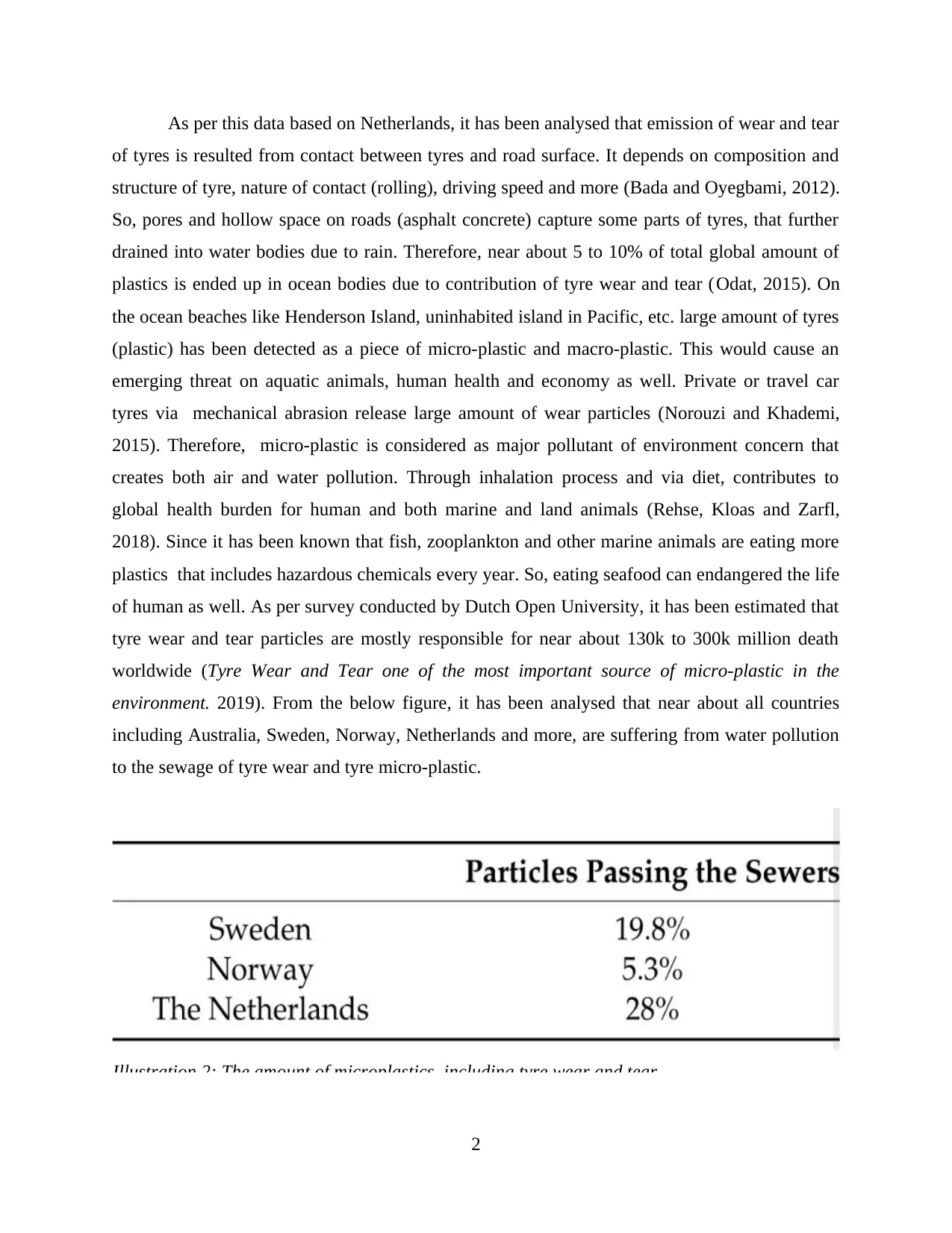
As per this data based on Netherlands, it has been analysed that emission of wear and tear
of tyres is resulted from contact between tyres and road surface. It depends on composition and
structure of tyre, nature of contact (rolling), driving speed and more (Bada and Oyegbami, 2012).
So, pores and hollow space on roads (asphalt concrete) capture some parts of tyres, that further
drained into water bodies due to rain. Therefore, near about 5 to 10% of total global amount of
plastics is ended up in ocean bodies due to contribution of tyre wear and tear (Odat, 2015). On
the ocean beaches like Henderson Island, uninhabited island in Pacific, etc. large amount of tyres
(plastic) has been detected as a piece of micro-plastic and macro-plastic. This would cause an
emerging threat on aquatic animals, human health and economy as well. Private or travel car
tyres via mechanical abrasion release large amount of wear particles (Norouzi and Khademi,
2015). Therefore, micro-plastic is considered as major pollutant of environment concern that
creates both air and water pollution. Through inhalation process and via diet, contributes to
global health burden for human and both marine and land animals (Rehse, Kloas and Zarfl,
2018). Since it has been known that fish, zooplankton and other marine animals are eating more
plastics that includes hazardous chemicals every year. So, eating seafood can endangered the life
of human as well. As per survey conducted by Dutch Open University, it has been estimated that
tyre wear and tear particles are mostly responsible for near about 130k to 300k million death
worldwide (Tyre Wear and Tear one of the most important source of micro-plastic in the
environment. 2019). From the below figure, it has been analysed that near about all countries
including Australia, Sweden, Norway, Netherlands and more, are suffering from water pollution
to the sewage of tyre wear and tyre micro-plastic.
2
Illustration 2: The amount of microplastics, including tyre wear and tear
of tyres is resulted from contact between tyres and road surface. It depends on composition and
structure of tyre, nature of contact (rolling), driving speed and more (Bada and Oyegbami, 2012).
So, pores and hollow space on roads (asphalt concrete) capture some parts of tyres, that further
drained into water bodies due to rain. Therefore, near about 5 to 10% of total global amount of
plastics is ended up in ocean bodies due to contribution of tyre wear and tear (Odat, 2015). On
the ocean beaches like Henderson Island, uninhabited island in Pacific, etc. large amount of tyres
(plastic) has been detected as a piece of micro-plastic and macro-plastic. This would cause an
emerging threat on aquatic animals, human health and economy as well. Private or travel car
tyres via mechanical abrasion release large amount of wear particles (Norouzi and Khademi,
2015). Therefore, micro-plastic is considered as major pollutant of environment concern that
creates both air and water pollution. Through inhalation process and via diet, contributes to
global health burden for human and both marine and land animals (Rehse, Kloas and Zarfl,
2018). Since it has been known that fish, zooplankton and other marine animals are eating more
plastics that includes hazardous chemicals every year. So, eating seafood can endangered the life
of human as well. As per survey conducted by Dutch Open University, it has been estimated that
tyre wear and tear particles are mostly responsible for near about 130k to 300k million death
worldwide (Tyre Wear and Tear one of the most important source of micro-plastic in the
environment. 2019). From the below figure, it has been analysed that near about all countries
including Australia, Sweden, Norway, Netherlands and more, are suffering from water pollution
to the sewage of tyre wear and tyre micro-plastic.
2
Illustration 2: The amount of microplastics, including tyre wear and tear
Paraphrase This Document
Need a fresh take? Get an instant paraphrase of this document with our AI Paraphraser
TASK 2
Economic theory to analyse the effect of tyre wear and tear on economic efficiency of travel car
consumption
To analyse the impact of wear and tear of tyres on economic efficiency of travel car
consumption, economical externalities of production can be used. This theory shows the
efficiencies in production and overall economic efficiencies, by involving marginal rates of
substitution (MRS) and Marginal rates of production. These externalities could be either positive
i.e. external benefits or negative that involve costs. But in case of production of tyres, due to
wear and tear such as micro-plastic, it impacts negatively to riverside residents and aquatic
animals. It is can be illustrated by below diagram -
As per optimal quantity qefficient , the price would be pefficient but the MPC could be c0. Under
this case, within presence of externalities, the social optimal level of output qefficient is given by
condition MPB = MSB (Marginal private benefits is equal to Marginal social benefits). On the
other hand, MSC curve i.e. marginal social cost would be greater than MPC marginal private
cost and therefore, curve of MSC would lie above MPC as shown in figure. The optimal output
here is qefficient with the price pefficient . While, dead weight loss shows the excess burden or
inefficiency in allocation. So, it shows high loss of economic efficiencies which is mainly occur
due to free market equilibrium for tyres is not achieved. Private cost hereby includes the cost that
a firm pays for producing a commodity. In context with tyres, private costs includes capital,
labour cost, price of materials and other inputs that automobile company pays for manufacturing
it. On the other hand, external cost includes costs to society that people pays due to a firm's
action. In this regard, wear and tear of tyres causes a number of polluted issues. The wear and
tear of tyres releases plastic pollution, that flows in water bodies by rain and also polluted air in
the form of tiny particles that causes lung cancer and other respiratory issues. So, society pays
for it to prevent themselves from harmful causes of pollution. These external costs added to
private costs for determining social costs that arising from consumption or production of tyres.
This will lead to cause market failure as well, because social cost is greater than private cost,
which reflect that production of tyres is negatively imposed on society. The key point here as per
the given economical theory is that if automotive industry avoid pay for external costs then cost
3
Economic theory to analyse the effect of tyre wear and tear on economic efficiency of travel car
consumption
To analyse the impact of wear and tear of tyres on economic efficiency of travel car
consumption, economical externalities of production can be used. This theory shows the
efficiencies in production and overall economic efficiencies, by involving marginal rates of
substitution (MRS) and Marginal rates of production. These externalities could be either positive
i.e. external benefits or negative that involve costs. But in case of production of tyres, due to
wear and tear such as micro-plastic, it impacts negatively to riverside residents and aquatic
animals. It is can be illustrated by below diagram -
As per optimal quantity qefficient , the price would be pefficient but the MPC could be c0. Under
this case, within presence of externalities, the social optimal level of output qefficient is given by
condition MPB = MSB (Marginal private benefits is equal to Marginal social benefits). On the
other hand, MSC curve i.e. marginal social cost would be greater than MPC marginal private
cost and therefore, curve of MSC would lie above MPC as shown in figure. The optimal output
here is qefficient with the price pefficient . While, dead weight loss shows the excess burden or
inefficiency in allocation. So, it shows high loss of economic efficiencies which is mainly occur
due to free market equilibrium for tyres is not achieved. Private cost hereby includes the cost that
a firm pays for producing a commodity. In context with tyres, private costs includes capital,
labour cost, price of materials and other inputs that automobile company pays for manufacturing
it. On the other hand, external cost includes costs to society that people pays due to a firm's
action. In this regard, wear and tear of tyres causes a number of polluted issues. The wear and
tear of tyres releases plastic pollution, that flows in water bodies by rain and also polluted air in
the form of tiny particles that causes lung cancer and other respiratory issues. So, society pays
for it to prevent themselves from harmful causes of pollution. These external costs added to
private costs for determining social costs that arising from consumption or production of tyres.
This will lead to cause market failure as well, because social cost is greater than private cost,
which reflect that production of tyres is negatively imposed on society. The key point here as per
the given economical theory is that if automotive industry avoid pay for external costs then cost
3
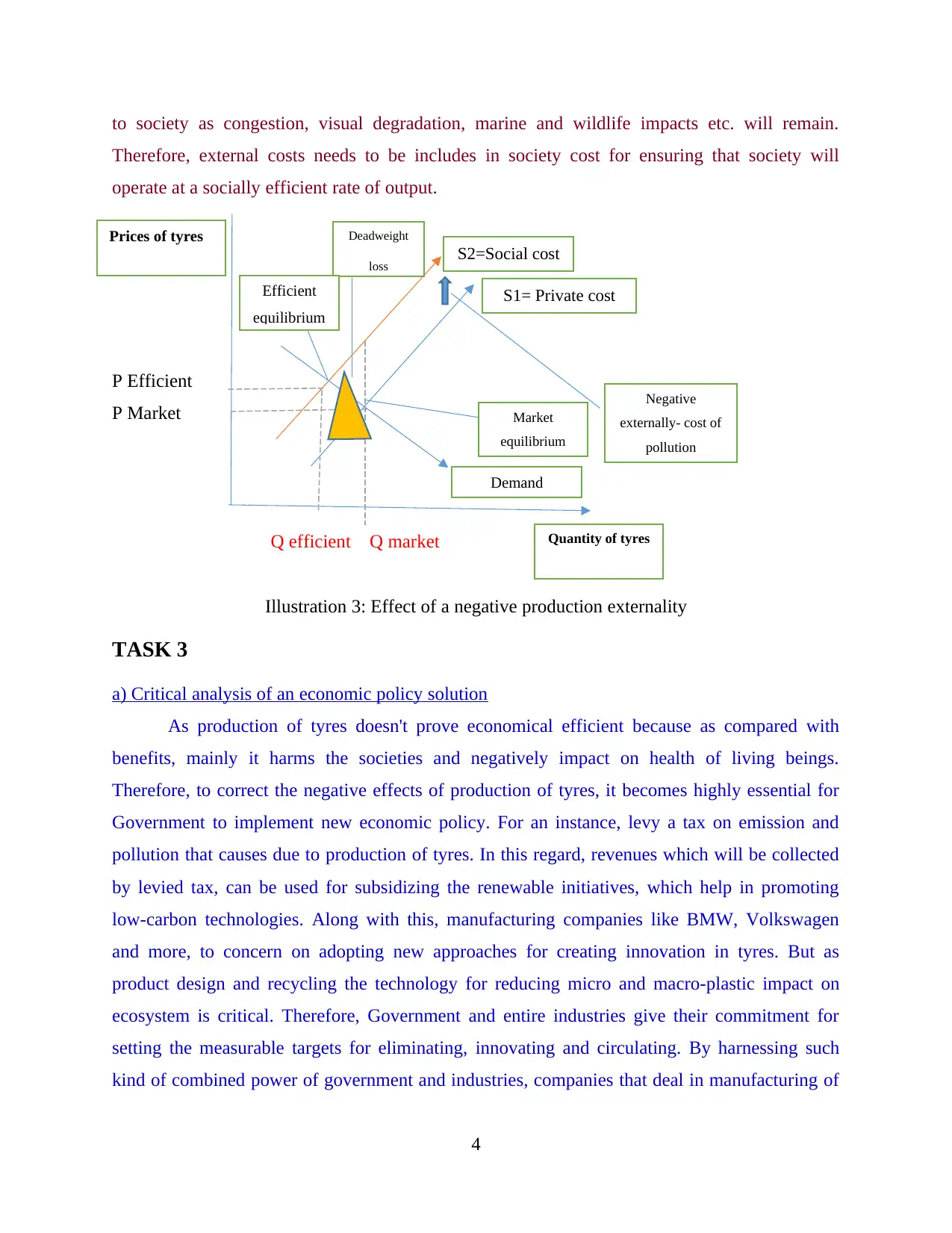
to society as congestion, visual degradation, marine and wildlife impacts etc. will remain.
Therefore, external costs needs to be includes in society cost for ensuring that society will
operate at a socially efficient rate of output.
P Efficient
P Market
Q efficient Q market
Illustration 3: Effect of a negative production externality
TASK 3
a) Critical analysis of an economic policy solution
As production of tyres doesn't prove economical efficient because as compared with
benefits, mainly it harms the societies and negatively impact on health of living beings.
Therefore, to correct the negative effects of production of tyres, it becomes highly essential for
Government to implement new economic policy. For an instance, levy a tax on emission and
pollution that causes due to production of tyres. In this regard, revenues which will be collected
by levied tax, can be used for subsidizing the renewable initiatives, which help in promoting
low-carbon technologies. Along with this, manufacturing companies like BMW, Volkswagen
and more, to concern on adopting new approaches for creating innovation in tyres. But as
product design and recycling the technology for reducing micro and macro-plastic impact on
ecosystem is critical. Therefore, Government and entire industries give their commitment for
setting the measurable targets for eliminating, innovating and circulating. By harnessing such
kind of combined power of government and industries, companies that deal in manufacturing of
4
S2=Social cost
S1= Private cost
Negative
externally- cost of
pollution
Market
equilibrium
Demand
Deadweight
loss
Prices of tyres
Quantity of tyres
Efficient
equilibrium
Therefore, external costs needs to be includes in society cost for ensuring that society will
operate at a socially efficient rate of output.
P Efficient
P Market
Q efficient Q market
Illustration 3: Effect of a negative production externality
TASK 3
a) Critical analysis of an economic policy solution
As production of tyres doesn't prove economical efficient because as compared with
benefits, mainly it harms the societies and negatively impact on health of living beings.
Therefore, to correct the negative effects of production of tyres, it becomes highly essential for
Government to implement new economic policy. For an instance, levy a tax on emission and
pollution that causes due to production of tyres. In this regard, revenues which will be collected
by levied tax, can be used for subsidizing the renewable initiatives, which help in promoting
low-carbon technologies. Along with this, manufacturing companies like BMW, Volkswagen
and more, to concern on adopting new approaches for creating innovation in tyres. But as
product design and recycling the technology for reducing micro and macro-plastic impact on
ecosystem is critical. Therefore, Government and entire industries give their commitment for
setting the measurable targets for eliminating, innovating and circulating. By harnessing such
kind of combined power of government and industries, companies that deal in manufacturing of
4
S2=Social cost
S1= Private cost
Negative
externally- cost of
pollution
Market
equilibrium
Demand
Deadweight
loss
Prices of tyres
Quantity of tyres
Efficient
equilibrium
⊘ This is a preview!⊘
Do you want full access?
Subscribe today to unlock all pages.
Trusted by 1+ million students worldwide
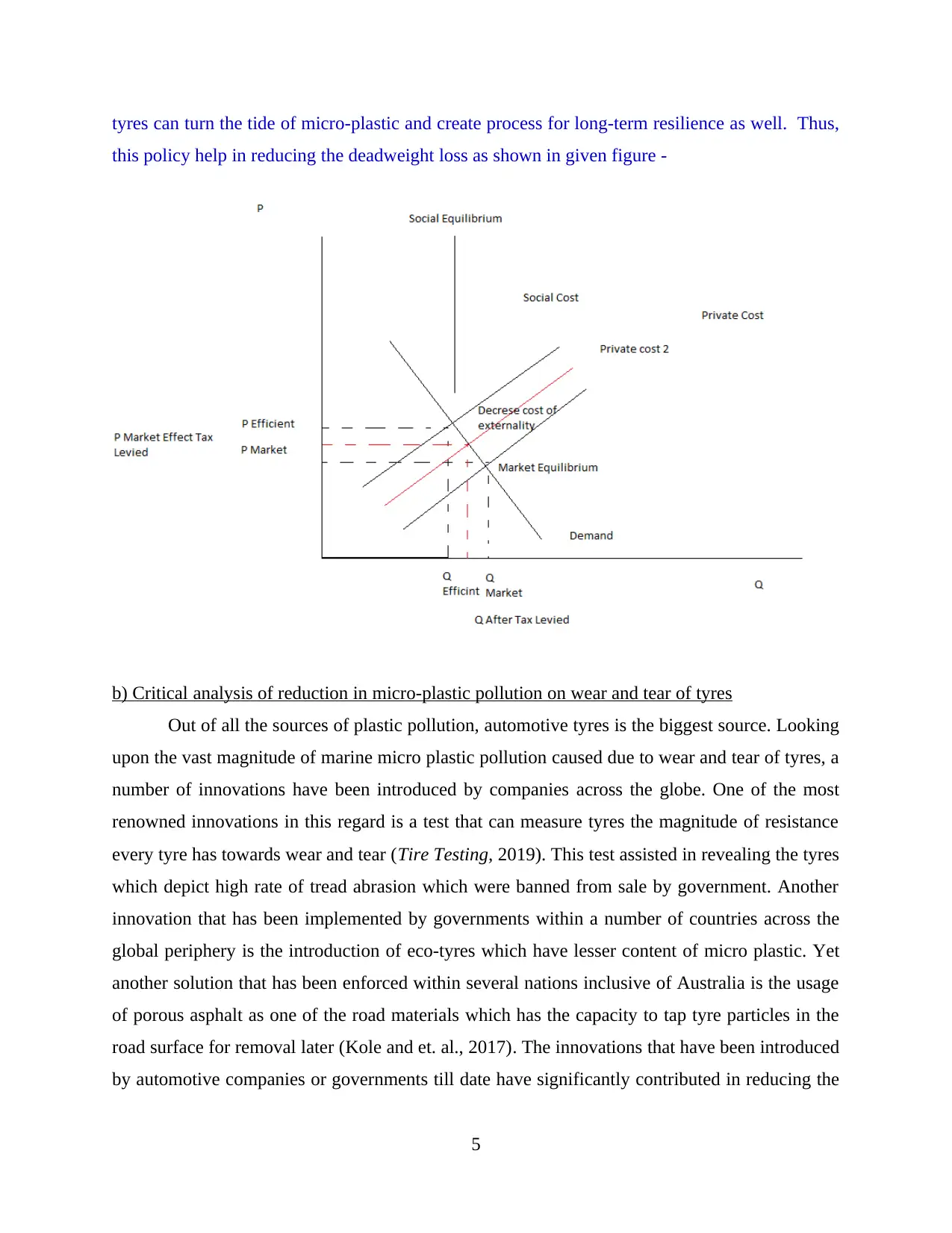
tyres can turn the tide of micro-plastic and create process for long-term resilience as well. Thus,
this policy help in reducing the deadweight loss as shown in given figure -
b) Critical analysis of reduction in micro-plastic pollution on wear and tear of tyres
Out of all the sources of plastic pollution, automotive tyres is the biggest source. Looking
upon the vast magnitude of marine micro plastic pollution caused due to wear and tear of tyres, a
number of innovations have been introduced by companies across the globe. One of the most
renowned innovations in this regard is a test that can measure tyres the magnitude of resistance
every tyre has towards wear and tear (Tire Testing, 2019). This test assisted in revealing the tyres
which depict high rate of tread abrasion which were banned from sale by government. Another
innovation that has been implemented by governments within a number of countries across the
global periphery is the introduction of eco-tyres which have lesser content of micro plastic. Yet
another solution that has been enforced within several nations inclusive of Australia is the usage
of porous asphalt as one of the road materials which has the capacity to tap tyre particles in the
road surface for removal later (Kole and et. al., 2017). The innovations that have been introduced
by automotive companies or governments till date have significantly contributed in reducing the
5
this policy help in reducing the deadweight loss as shown in given figure -
b) Critical analysis of reduction in micro-plastic pollution on wear and tear of tyres
Out of all the sources of plastic pollution, automotive tyres is the biggest source. Looking
upon the vast magnitude of marine micro plastic pollution caused due to wear and tear of tyres, a
number of innovations have been introduced by companies across the globe. One of the most
renowned innovations in this regard is a test that can measure tyres the magnitude of resistance
every tyre has towards wear and tear (Tire Testing, 2019). This test assisted in revealing the tyres
which depict high rate of tread abrasion which were banned from sale by government. Another
innovation that has been implemented by governments within a number of countries across the
global periphery is the introduction of eco-tyres which have lesser content of micro plastic. Yet
another solution that has been enforced within several nations inclusive of Australia is the usage
of porous asphalt as one of the road materials which has the capacity to tap tyre particles in the
road surface for removal later (Kole and et. al., 2017). The innovations that have been introduced
by automotive companies or governments till date have significantly contributed in reducing the
5
Paraphrase This Document
Need a fresh take? Get an instant paraphrase of this document with our AI Paraphraser
level of micro plastic pollution. However, the biggest critique of applying such situation in
every part of the world is that it makes use of such technologies which are quite lucrative and
expensive to be affordable for the political system of a nation or for any middle class person
(Karakurt, 2015). To deal with micro plastic pollution caused as a result of wear and tear of
tyres, the government has launched a project named SAPEA. It stands for Science Advice for
Policy by European Academies and has been acknowledged to be an integral part of the
European Commission’s Scientific Advice Mechanism (Yisa, Jacob and Onoyima, 2012). By
combining its efforts with the Group of Chief Scientific Advisors, this project is aimed at
provision of independent scientific advices for aiding the decision making of government
regarding micro plastic pollution. With the launch of this project, several nations across the
global periphery are together marching towards developing an economy whereby there is lesser
harm posed to the environment or marine life (Chhabra and Marik, 2014). Apart from this, it can
be analysed that SAPEA has lead to a significant decrease in micro plastic pollution, thereby
striving to be beneficial for all the economies present within the world. This inflates the
economic efficiency outcome for countries such as Australia which have been affected by the
marine pollution which takes place due to micro plastic released owing to wear and tear of tyres.
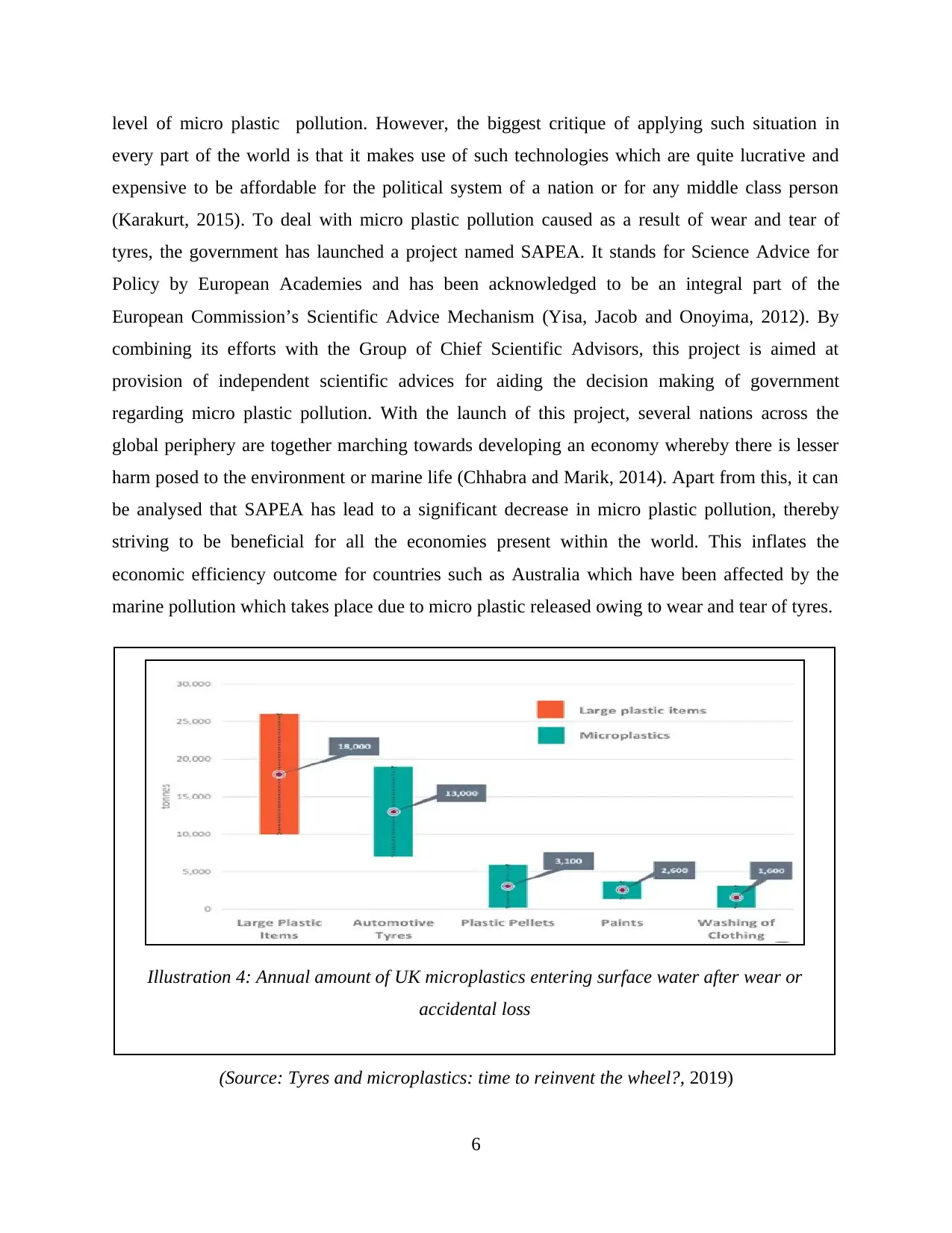
(Source: Tyres and microplastics: time to reinvent the wheel?, 2019)
6
Illustration 4: Annual amount of UK microplastics entering surface water after wear or
accidental loss
every part of the world is that it makes use of such technologies which are quite lucrative and
expensive to be affordable for the political system of a nation or for any middle class person
(Karakurt, 2015). To deal with micro plastic pollution caused as a result of wear and tear of
tyres, the government has launched a project named SAPEA. It stands for Science Advice for
Policy by European Academies and has been acknowledged to be an integral part of the
European Commission’s Scientific Advice Mechanism (Yisa, Jacob and Onoyima, 2012). By
combining its efforts with the Group of Chief Scientific Advisors, this project is aimed at
provision of independent scientific advices for aiding the decision making of government
regarding micro plastic pollution. With the launch of this project, several nations across the
global periphery are together marching towards developing an economy whereby there is lesser
harm posed to the environment or marine life (Chhabra and Marik, 2014). Apart from this, it can
be analysed that SAPEA has lead to a significant decrease in micro plastic pollution, thereby
striving to be beneficial for all the economies present within the world. This inflates the
economic efficiency outcome for countries such as Australia which have been affected by the
marine pollution which takes place due to micro plastic released owing to wear and tear of tyres.
(Source: Tyres and microplastics: time to reinvent the wheel?, 2019)
6
Illustration 4: Annual amount of UK microplastics entering surface water after wear or
accidental loss
CONCLUSION
On the basis of the above discussion, it can be said that the wear and tear of tyre is a
major source of micro plastic pollution that pollutes the marine water in a significant manner.
Also, it can be analysed that governments across the world are taking steps to reduce micro
plastic pollution with the help of a number of policies as well as projects such as SAPEA
(Science Advice for Policy by European Academies). These significantly contribute towards
decreasing the extent of micro plastic pollution into the environment. Further, a number of
innovations have been launched into market in order to combat with this issue. Such innovations
are inclusive of tyre testing, eco-tyres, use of porous asphalt as one of the road materials etc.
These help in reducing the detrimental impact of wear and tear of tyres.
Through this assignment, it has evaluated that potential adverse effect of wear and tear of
tyres, along with pathways are largely known. But it is tough to reduce the same due to
associated risks that shows a scientific challenge. To quantify the emission of such tyres with
ambient air and runoff, government of every nation has taken many initiatives by implementing a
number of economical policies. Together with government, industries and consumers are also
undertook the quickly actions to reduce the pollution, that done due to micro-plastic in
environment. Thus, it can also be concluded that tyre wear and tear refers to a stealthy source of
micro-plastics that pollutes environment. It can also be addressed effectively in terms of bringing
awareness, closing the knowledge gaps and framing the creative solutions.
7
On the basis of the above discussion, it can be said that the wear and tear of tyre is a
major source of micro plastic pollution that pollutes the marine water in a significant manner.
Also, it can be analysed that governments across the world are taking steps to reduce micro
plastic pollution with the help of a number of policies as well as projects such as SAPEA
(Science Advice for Policy by European Academies). These significantly contribute towards
decreasing the extent of micro plastic pollution into the environment. Further, a number of
innovations have been launched into market in order to combat with this issue. Such innovations
are inclusive of tyre testing, eco-tyres, use of porous asphalt as one of the road materials etc.
These help in reducing the detrimental impact of wear and tear of tyres.
Through this assignment, it has evaluated that potential adverse effect of wear and tear of
tyres, along with pathways are largely known. But it is tough to reduce the same due to
associated risks that shows a scientific challenge. To quantify the emission of such tyres with
ambient air and runoff, government of every nation has taken many initiatives by implementing a
number of economical policies. Together with government, industries and consumers are also
undertook the quickly actions to reduce the pollution, that done due to micro-plastic in
environment. Thus, it can also be concluded that tyre wear and tear refers to a stealthy source of
micro-plastics that pollutes environment. It can also be addressed effectively in terms of bringing
awareness, closing the knowledge gaps and framing the creative solutions.
7
⊘ This is a preview!⊘
Do you want full access?
Subscribe today to unlock all pages.
Trusted by 1+ million students worldwide
REFERENCES
Books and Journals
Kole, P. J. & et. al. (2017). Wear and tear of tyres: a stealthy source of microplastics in the
environment. International journal of environmental research and public health.
14(10). 1265.
Chhabra, R. S., & Marik, S. (2014). Review Literature On The Use Of Waste Plastics And Waste
Rubber Tyres In Pavement. International Journal Of Core Engineering & Management
(IJCEM).
Guo, G., Wu, F., Xie, F., & Zhang, R. (2012). Spatial distribution and pollution assessment of
heavy metals in urban soils from southwest China. Journal of Environmental
Sciences. 24(3). 410-418.
Gawande, A., Zamare, G., Renge, V. C., Tayde, S., & Bharsakale, G. (2012). An overview on
waste plastic utilization in asphalting of roads. Journal of Engineering Research and
Studies, 3(2), 01-05.
Akan, J. C., Audu, S. I., Audu, Z. M., & Ogugbuaja, V. O. (2013). Assessment of heavy metals,
pH, organic matter and organic carbon in roadside soils in Makurdi Metropolis, Benue
State, Nigeria. Journal of Environmental Protection, 4(06), 618.
Yisa, J., Jacob, J. O., & Onoyima, C. C. (2012). Assessment of toxic levels of some heavy metals
in road deposited sediments in Suleja, Nigeria. American Journal of chemistry, 2(2), 34-
37.
Onoyima, C. C., Jacob, J. O., & Yisa, J. (2011). Identification of sources of heavy metals
pollution in road deposited sediments using multivariate statistical analysis. Journal of
Emerging Trends in Engineering and Applied Sciences, 2(4), 658-663.
Khan, A. B., & Kathi, S. (2014). Evaluation of heavy metal and total petroleum hydrocarbon
contamination of roadside surface soil. International Journal of Environmental Science
and Technology, 11(8), 2259-2270.
Bada, B. S., & Oyegbami, O. T. (2012). Heavy metals concentrations in roadside dust of
different traffic density. Journal of Environment and Earth Science, 2(8), 54-59.
Al-Anbari, R., Al Obaidy, A. H. M., & Ali, F. H. A. (2015). Manuscript Info
Abstract. International Journal, 3(2), 104-110.
Muhamad-Darus, F., Nasir, R. A., Sumari, S. M., Ismail, Z. S., & Omar, N. A. (2017). Nursery
schools: Characterization of heavy metal content in indoor dust. Asian Journal of
Environment-Behaviour Studies, 2(5), 63-70.
Norouzi, S., & Khademi, H. (2015). Source identification of heavy metals in atmospheric dust
using Platanus orientalis L. leaves as bioindicator. Eurasian Journal of Soil
Science, 4(3), 144-152.
Rehse, S., Kloas, W., & Zarfl, C. (2018). Microplastics reduce short-term effects of
environmental contaminants. Part I: Effects of bisphenol a on freshwater zooplankton
are lower in presence of polyamide particles. International journal of environmental
research and public health, 15(2), 280.
Odat, S. (2015). Application of geoaccumulation index and enrichment factors on the assessment
of heavy metal pollution along Irbid/zarqa highway-Jordan. Journal of Applied
Sciences, 15(11), 1318-1321.
8
Books and Journals
Kole, P. J. & et. al. (2017). Wear and tear of tyres: a stealthy source of microplastics in the
environment. International journal of environmental research and public health.
14(10). 1265.
Chhabra, R. S., & Marik, S. (2014). Review Literature On The Use Of Waste Plastics And Waste
Rubber Tyres In Pavement. International Journal Of Core Engineering & Management
(IJCEM).
Guo, G., Wu, F., Xie, F., & Zhang, R. (2012). Spatial distribution and pollution assessment of
heavy metals in urban soils from southwest China. Journal of Environmental
Sciences. 24(3). 410-418.
Gawande, A., Zamare, G., Renge, V. C., Tayde, S., & Bharsakale, G. (2012). An overview on
waste plastic utilization in asphalting of roads. Journal of Engineering Research and
Studies, 3(2), 01-05.
Akan, J. C., Audu, S. I., Audu, Z. M., & Ogugbuaja, V. O. (2013). Assessment of heavy metals,
pH, organic matter and organic carbon in roadside soils in Makurdi Metropolis, Benue
State, Nigeria. Journal of Environmental Protection, 4(06), 618.
Yisa, J., Jacob, J. O., & Onoyima, C. C. (2012). Assessment of toxic levels of some heavy metals
in road deposited sediments in Suleja, Nigeria. American Journal of chemistry, 2(2), 34-
37.
Onoyima, C. C., Jacob, J. O., & Yisa, J. (2011). Identification of sources of heavy metals
pollution in road deposited sediments using multivariate statistical analysis. Journal of
Emerging Trends in Engineering and Applied Sciences, 2(4), 658-663.
Khan, A. B., & Kathi, S. (2014). Evaluation of heavy metal and total petroleum hydrocarbon
contamination of roadside surface soil. International Journal of Environmental Science
and Technology, 11(8), 2259-2270.
Bada, B. S., & Oyegbami, O. T. (2012). Heavy metals concentrations in roadside dust of
different traffic density. Journal of Environment and Earth Science, 2(8), 54-59.
Al-Anbari, R., Al Obaidy, A. H. M., & Ali, F. H. A. (2015). Manuscript Info
Abstract. International Journal, 3(2), 104-110.
Muhamad-Darus, F., Nasir, R. A., Sumari, S. M., Ismail, Z. S., & Omar, N. A. (2017). Nursery
schools: Characterization of heavy metal content in indoor dust. Asian Journal of
Environment-Behaviour Studies, 2(5), 63-70.
Norouzi, S., & Khademi, H. (2015). Source identification of heavy metals in atmospheric dust
using Platanus orientalis L. leaves as bioindicator. Eurasian Journal of Soil
Science, 4(3), 144-152.
Rehse, S., Kloas, W., & Zarfl, C. (2018). Microplastics reduce short-term effects of
environmental contaminants. Part I: Effects of bisphenol a on freshwater zooplankton
are lower in presence of polyamide particles. International journal of environmental
research and public health, 15(2), 280.
Odat, S. (2015). Application of geoaccumulation index and enrichment factors on the assessment
of heavy metal pollution along Irbid/zarqa highway-Jordan. Journal of Applied
Sciences, 15(11), 1318-1321.
8
Paraphrase This Document
Need a fresh take? Get an instant paraphrase of this document with our AI Paraphraser
Aithal, P. S., & Aithal, S. (2016). Nanotechnological Innovations & Business Environment for
Indian Automobile Sector: A Futuristic Approach. International Journal of Scientific
Research and Modern Education (IJSRME), 1(1), 296-30.
Karakurt, C. (2015). Microstructure properties of waste tire rubber composites: an
overview. Journal of Material Cycles and Waste Management, 17(3), 422-433.
Tran, T. K. N., Pilard, J. F., & Pasetto, P. (2015). Recycling waste tires: Generation of functional
oligomers and description of their use in the synthesis of polyurethane foams. Journal
of Applied Polymer Science, 132(1).
Online
Wear and Tear of Tyres: A Stealthy Source of Microplastics in the Environment. (2017). [Online]
Available Through:<https://www.ncbi.nlm.nih.gov/pmc/articles/PMC5664766/>.
Car tires and brakes spew harmful micro-plastics. (2018). [Online] Available
Through:<https://www.sciencenewsforstudents.org/article/car-tires-and-brakes-spew-
harmful-microplastics>.
Tyre Wear and Tear one of the most important source of micro-plastic in the environment.
(2019). [Online] Available
Through:<https://www.plasticsoupfoundation.org/en/2019/06/tyre-wear-and-tear-one-
of-the-most-important-sources-of-microplastics-in-the-environment/>.
Tire Testing. 2019. [Online]. Available Through:<https://www.smithersrapra.com/testing-
services/by-sector/automotive/tire-testing>.
Tyres and microplastics: time to reinvent the wheel?. 2019. [Online]. Available Through:
<https://friendsoftheearth.uk/plastics/tyres-and-microplastics-time-reinvent-wheel>.
9
Indian Automobile Sector: A Futuristic Approach. International Journal of Scientific
Research and Modern Education (IJSRME), 1(1), 296-30.
Karakurt, C. (2015). Microstructure properties of waste tire rubber composites: an
overview. Journal of Material Cycles and Waste Management, 17(3), 422-433.
Tran, T. K. N., Pilard, J. F., & Pasetto, P. (2015). Recycling waste tires: Generation of functional
oligomers and description of their use in the synthesis of polyurethane foams. Journal
of Applied Polymer Science, 132(1).
Online
Wear and Tear of Tyres: A Stealthy Source of Microplastics in the Environment. (2017). [Online]
Available Through:<https://www.ncbi.nlm.nih.gov/pmc/articles/PMC5664766/>.
Car tires and brakes spew harmful micro-plastics. (2018). [Online] Available
Through:<https://www.sciencenewsforstudents.org/article/car-tires-and-brakes-spew-
harmful-microplastics>.
Tyre Wear and Tear one of the most important source of micro-plastic in the environment.
(2019). [Online] Available
Through:<https://www.plasticsoupfoundation.org/en/2019/06/tyre-wear-and-tear-one-
of-the-most-important-sources-of-microplastics-in-the-environment/>.
Tire Testing. 2019. [Online]. Available Through:<https://www.smithersrapra.com/testing-
services/by-sector/automotive/tire-testing>.
Tyres and microplastics: time to reinvent the wheel?. 2019. [Online]. Available Through:
<https://friendsoftheearth.uk/plastics/tyres-and-microplastics-time-reinvent-wheel>.
9

1 out of 11


Your All-in-One AI-Powered Toolkit for Academic Success.
+13062052269
info@desklib.com
Available 24*7 on WhatsApp / Email
![[object Object]](/_next/static/media/star-bottom.7253800d.svg)
Unlock your academic potential
Copyright © 2020–2026 A2Z Services. All Rights Reserved. Developed and managed by ZUCOL.