Macroeconomic Impact: Failure of Microsoft's Smartphone Business
VerifiedAdded on 2020/02/24
|26
|6742
|202
Case Study
AI Summary
This case study examines the failure of Microsoft's smartphone business, delving into the macroeconomic factors that contributed to its demise. It analyzes the strategic decisions, including the acquisition of Nokia, and the subsequent challenges posed by competitors like Google and Apple. The paper explores the impact of the PEST (Political, Economic, Social, and Technological) factors on Microsoft's market performance, highlighting the company's inability to compete with the Android operating system and Apple's iPhone. The study also discusses Microsoft's responses to the failure, including restructuring and the resignation of key personnel. Ultimately, the case emphasizes the influence of the external environment on business success, even for large multinational corporations.
Running head: FAILURE OF MICROSOFT’S SMART PHONE BUSINESS
Failure of Microsoft’s Smart Phone Business
Name of the Student:
Name of the University:
Author Note:
Failure of Microsoft’s Smart Phone Business
Name of the Student:
Name of the University:
Author Note:

Paraphrase This Document
Need a fresh take? Get an instant paraphrase of this document with our AI Paraphraser
1
FAILURE OF MICROSOFT’S SMART PHONE BUSINESS
Executive Summary:
The paper delves into the impact of macroeconomic environment towards bringing about
failure or even closure of business. A company is totally dependent on the macroeconomic
environmental factors and the success of its business venture is impacted by the environment.
This fact holds true even for the biggest and one of the most revered information technology
companies in the Microsoft. The company tried to capture the smart phone market but failed.
The paper delves into the factors which led to the failure of Microsoft and relates them to the
macroenvironmental elements. It also mentions how Microsoft responded to this failure and
restructured its organisational operations. The paper clearly shows one thing-no organisation can
control the market environment, not even the biggest multinational companies like Microsoft.
The external environment on the other hand has full control over the organisations and can be
instrumental to bring about success, failure or even closure of their business ventures.
FAILURE OF MICROSOFT’S SMART PHONE BUSINESS
Executive Summary:
The paper delves into the impact of macroeconomic environment towards bringing about
failure or even closure of business. A company is totally dependent on the macroeconomic
environmental factors and the success of its business venture is impacted by the environment.
This fact holds true even for the biggest and one of the most revered information technology
companies in the Microsoft. The company tried to capture the smart phone market but failed.
The paper delves into the factors which led to the failure of Microsoft and relates them to the
macroenvironmental elements. It also mentions how Microsoft responded to this failure and
restructured its organisational operations. The paper clearly shows one thing-no organisation can
control the market environment, not even the biggest multinational companies like Microsoft.
The external environment on the other hand has full control over the organisations and can be
instrumental to bring about success, failure or even closure of their business ventures.
2
FAILURE OF MICROSOFT’S SMART PHONE BUSINESS
Table of Contents
Introduction:....................................................................................................................................2
Background information: Microsoft and its smart phone failure....................................................2
Factors which led to failure and closure of the Microsoft smart phone business:...........................4
Lack of decision making by Steve Ballmer, its then CEO:.........................................................4
The dominance of Google:..........................................................................................................4
Stiff competition of Nokia:..........................................................................................................5
Changing customer preferences:..................................................................................................5
Failure of Microsoft to compete with Apple:..............................................................................6
Macroeconomic environment in which Microsoft operates (PEST):..............................................6
Political:.......................................................................................................................................7
Economic factors:........................................................................................................................8
Social:..........................................................................................................................................9
Technological:.............................................................................................................................9
Environmental factors leading to failure and closure of Microsoft smart phone company:.........11
Political:.....................................................................................................................................12
Economic:..................................................................................................................................13
Social:........................................................................................................................................13
Technological:...........................................................................................................................14
Response by Microsoft to its smart phone business failure:..........................................................15
FAILURE OF MICROSOFT’S SMART PHONE BUSINESS
Table of Contents
Introduction:....................................................................................................................................2
Background information: Microsoft and its smart phone failure....................................................2
Factors which led to failure and closure of the Microsoft smart phone business:...........................4
Lack of decision making by Steve Ballmer, its then CEO:.........................................................4
The dominance of Google:..........................................................................................................4
Stiff competition of Nokia:..........................................................................................................5
Changing customer preferences:..................................................................................................5
Failure of Microsoft to compete with Apple:..............................................................................6
Macroeconomic environment in which Microsoft operates (PEST):..............................................6
Political:.......................................................................................................................................7
Economic factors:........................................................................................................................8
Social:..........................................................................................................................................9
Technological:.............................................................................................................................9
Environmental factors leading to failure and closure of Microsoft smart phone company:.........11
Political:.....................................................................................................................................12
Economic:..................................................................................................................................13
Social:........................................................................................................................................13
Technological:...........................................................................................................................14
Response by Microsoft to its smart phone business failure:..........................................................15
⊘ This is a preview!⊘
Do you want full access?
Subscribe today to unlock all pages.

Trusted by 1+ million students worldwide
3
FAILURE OF MICROSOFT’S SMART PHONE BUSINESS
Writing off Nokia:.....................................................................................................................15
Resignation of Steve Ballmer:...................................................................................................15
Layoffs of 25000 Nokia employees:..........................................................................................16
Conclusion:................................................................................................................................16
Recommendations: Alternative solutions for Microsoft:..............................................................17
Making Android smart phones:.................................................................................................17
Re-employ sacked employees:..................................................................................................17
References:....................................................................................................................................19
FAILURE OF MICROSOFT’S SMART PHONE BUSINESS
Writing off Nokia:.....................................................................................................................15
Resignation of Steve Ballmer:...................................................................................................15
Layoffs of 25000 Nokia employees:..........................................................................................16
Conclusion:................................................................................................................................16
Recommendations: Alternative solutions for Microsoft:..............................................................17
Making Android smart phones:.................................................................................................17
Re-employ sacked employees:..................................................................................................17
References:....................................................................................................................................19
Paraphrase This Document
Need a fresh take? Get an instant paraphrase of this document with our AI Paraphraser
4
FAILURE OF MICROSOFT’S SMART PHONE BUSINESS
Introduction:
The paper is a case study of the environmental factors which lead prominent business
organisations to incur significant losses or even closure due to business failure. The case study is
based on the failure of Microsoft to takeover Nokia and capitalise smart phone market which led
to the strategic withdrawal of the former from the international market including one of its
biggest market, Australia. The paper before initiating a discussion on the business failure of the
IT giant, introduces Microsoft as a company, then its ambitious entry into the smart phone
market and subsequent failure. The study is divided into four primary parts which help delving
deep into the smart phone debacle of Microsoft. The first section identifies and analyses the
factors which led to the failure of Microsoft in the smart phone market. This section recognises
various factors like rise of Android, its acceptance in the society and Nokia’s late entry owing to
inappropriate decision making at the apex level. The second section discusses the macro
environmental factors which are capable of impacting business organisations like Microsoft but
remain out of their control. The third section explains the reasons of failure of the ambitious
project in the light of the external market factors. The final section outlines the response of
Microsoft to the failure including the much required restructuring.
Background information: Microsoft and its smart phone failure
Microsoft is an American multinational company headquartered in Washington which
was founded by Paul Allen and Bill Gates in 1975. The company has a strong presence in North
America, Europe, South America, Australia and Asia. Products of Microsoft include hardware,
software, internet security services, skype, enterprise solution, internet explorer and cloud
computing(microsoft.com, 2017). The customer segment of Microsoft consists of software
FAILURE OF MICROSOFT’S SMART PHONE BUSINESS
Introduction:
The paper is a case study of the environmental factors which lead prominent business
organisations to incur significant losses or even closure due to business failure. The case study is
based on the failure of Microsoft to takeover Nokia and capitalise smart phone market which led
to the strategic withdrawal of the former from the international market including one of its
biggest market, Australia. The paper before initiating a discussion on the business failure of the
IT giant, introduces Microsoft as a company, then its ambitious entry into the smart phone
market and subsequent failure. The study is divided into four primary parts which help delving
deep into the smart phone debacle of Microsoft. The first section identifies and analyses the
factors which led to the failure of Microsoft in the smart phone market. This section recognises
various factors like rise of Android, its acceptance in the society and Nokia’s late entry owing to
inappropriate decision making at the apex level. The second section discusses the macro
environmental factors which are capable of impacting business organisations like Microsoft but
remain out of their control. The third section explains the reasons of failure of the ambitious
project in the light of the external market factors. The final section outlines the response of
Microsoft to the failure including the much required restructuring.
Background information: Microsoft and its smart phone failure
Microsoft is an American multinational company headquartered in Washington which
was founded by Paul Allen and Bill Gates in 1975. The company has a strong presence in North
America, Europe, South America, Australia and Asia. Products of Microsoft include hardware,
software, internet security services, skype, enterprise solution, internet explorer and cloud
computing(microsoft.com, 2017). The customer segment of Microsoft consists of software
5
FAILURE OF MICROSOFT’S SMART PHONE BUSINESS
business organisations, business organisations, IT developers and students and educators.
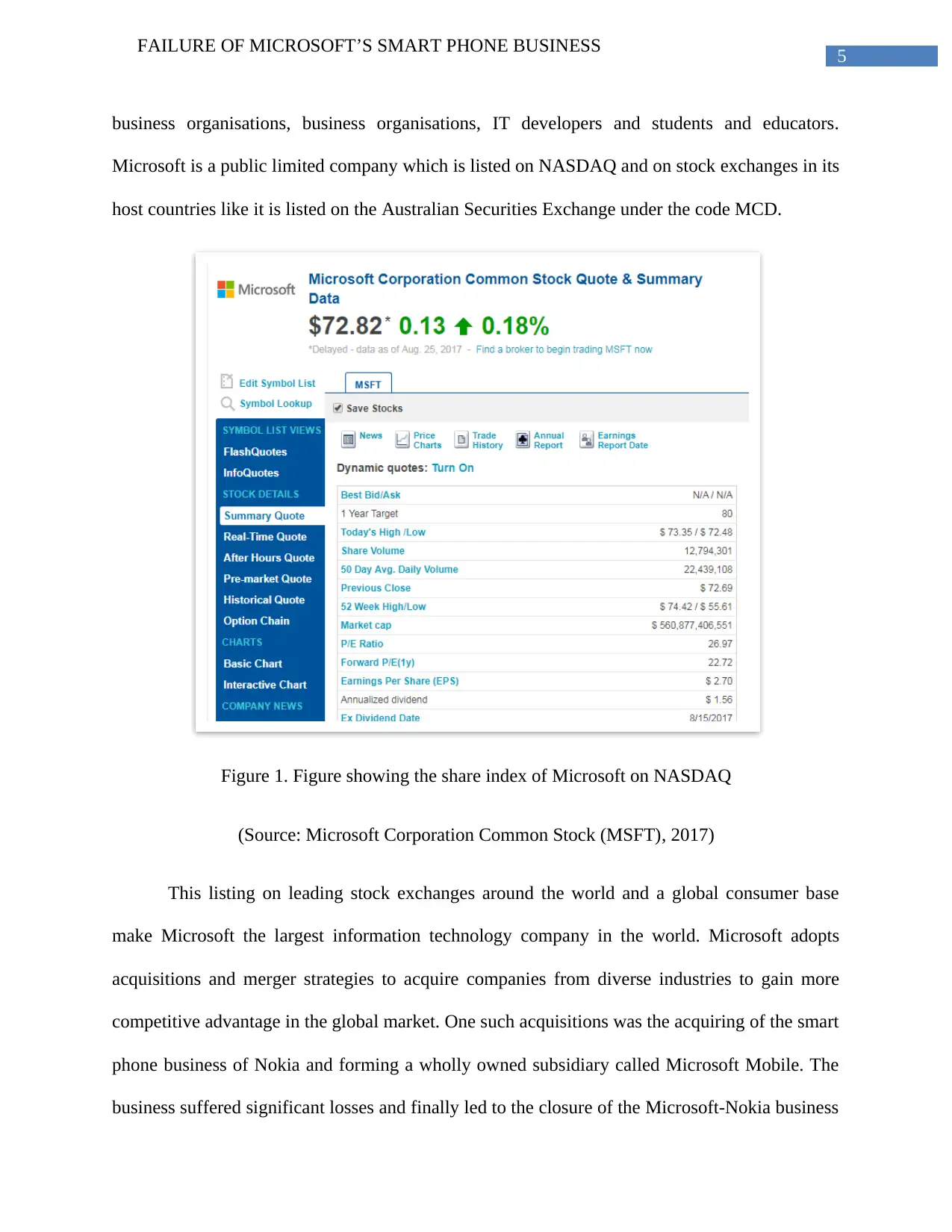
Microsoft is a public limited company which is listed on NASDAQ and on stock exchanges in its
host countries like it is listed on the Australian Securities Exchange under the code MCD.
Figure 1. Figure showing the share index of Microsoft on NASDAQ
(Source: Microsoft Corporation Common Stock (MSFT), 2017)
This listing on leading stock exchanges around the world and a global consumer base
make Microsoft the largest information technology company in the world. Microsoft adopts
acquisitions and merger strategies to acquire companies from diverse industries to gain more
competitive advantage in the global market. One such acquisitions was the acquiring of the smart
phone business of Nokia and forming a wholly owned subsidiary called Microsoft Mobile. The
business suffered significant losses and finally led to the closure of the Microsoft-Nokia business
FAILURE OF MICROSOFT’S SMART PHONE BUSINESS
business organisations, business organisations, IT developers and students and educators.
Microsoft is a public limited company which is listed on NASDAQ and on stock exchanges in its
host countries like it is listed on the Australian Securities Exchange under the code MCD.
Figure 1. Figure showing the share index of Microsoft on NASDAQ
(Source: Microsoft Corporation Common Stock (MSFT), 2017)
This listing on leading stock exchanges around the world and a global consumer base
make Microsoft the largest information technology company in the world. Microsoft adopts
acquisitions and merger strategies to acquire companies from diverse industries to gain more
competitive advantage in the global market. One such acquisitions was the acquiring of the smart
phone business of Nokia and forming a wholly owned subsidiary called Microsoft Mobile. The
business suffered significant losses and finally led to the closure of the Microsoft-Nokia business
⊘ This is a preview!⊘
Do you want full access?
Subscribe today to unlock all pages.
Trusted by 1+ million students worldwide
6
FAILURE OF MICROSOFT’S SMART PHONE BUSINESS
venture. The business venture by the two multinational companies to rule the smart phone
market fell through due macroeconomic environmental factors beyond the control of Microsoft
like emergence of Google’s Android smart phones which overthrew Microsoft’s Windows OS.
The failure had serious implications on Microsoft and its business like Steve Ballmer, the CEO
held responsible for the debacle had to resign and the share price of Microsoft fell
drastically(Day, 2017). Microsoft had to ultimately withdraw from the smart phone market and
lose its profitable markets like Australia to its competitors like Apple. The last handset the
company sold in Australia was Lumia 650 to capture Australian smart phone market but failed to
holds its ground. Australia is dominated by Android phones and is a big market for smart phones
running on Android platform(Turner, 2017).
Factors which led to failure and closure of the Microsoft smart phone business:
Lack of decision making by Steve Ballmer, its then CEO:
Steve Ballmer, the then CEO of Microsoft did not respond the shift in the market towards
smart phones which was growing. This gave opportunities to its strong competitors like Google
and Apple enter the smart phone market and capture leading positions. When Microsoft entered
the smart phone market Google’s Android was all ready dominating it and major mobile phones
were running on Android platform. Thus, the failure of the apex management of Microsoft to
capitalise on the booming mobile technology and smart phone market prevented the company
from dominating the market(Thompson, 2017). Thus, faulty and late decision of Steve Ballmer
resulted in failure Microsoft to overthrow or even compete with Google’s Android platform. This
showed initial signs of the faulty acquisition of Nokia’s smart phone business by Microsoft under
the leadership of Steve Ballmer.
FAILURE OF MICROSOFT’S SMART PHONE BUSINESS
venture. The business venture by the two multinational companies to rule the smart phone
market fell through due macroeconomic environmental factors beyond the control of Microsoft
like emergence of Google’s Android smart phones which overthrew Microsoft’s Windows OS.
The failure had serious implications on Microsoft and its business like Steve Ballmer, the CEO
held responsible for the debacle had to resign and the share price of Microsoft fell
drastically(Day, 2017). Microsoft had to ultimately withdraw from the smart phone market and
lose its profitable markets like Australia to its competitors like Apple. The last handset the
company sold in Australia was Lumia 650 to capture Australian smart phone market but failed to
holds its ground. Australia is dominated by Android phones and is a big market for smart phones
running on Android platform(Turner, 2017).
Factors which led to failure and closure of the Microsoft smart phone business:
Lack of decision making by Steve Ballmer, its then CEO:
Steve Ballmer, the then CEO of Microsoft did not respond the shift in the market towards
smart phones which was growing. This gave opportunities to its strong competitors like Google
and Apple enter the smart phone market and capture leading positions. When Microsoft entered
the smart phone market Google’s Android was all ready dominating it and major mobile phones
were running on Android platform. Thus, the failure of the apex management of Microsoft to
capitalise on the booming mobile technology and smart phone market prevented the company
from dominating the market(Thompson, 2017). Thus, faulty and late decision of Steve Ballmer
resulted in failure Microsoft to overthrow or even compete with Google’s Android platform. This
showed initial signs of the faulty acquisition of Nokia’s smart phone business by Microsoft under
the leadership of Steve Ballmer.
Paraphrase This Document
Need a fresh take? Get an instant paraphrase of this document with our AI Paraphraser
7
FAILURE OF MICROSOFT’S SMART PHONE BUSINESS
The dominance of Google:
Google dominated the smart phone market with its Android platform which was used by
the major mobile smart phone companies. Google outsourced its mobile operating systems to
device and software makers which lowered its cost of production. This allowed Google to offer
Android phones at lower prices and gain cost leadership in the smart phone OS market. Android
owned by Google allowed all the applications to use its platform which the Windows IOS did
not(Rankin, 2017). The Nokia smart phones using Windows IOS were as a result not able to
compete with its strong competitors like Samsung running on Android platforms. Thus, the
incapability of Windows platform to support a wide range of applications compared to Android
led to low demand of the Widows smart phones by Microsoft. This falling demand in the society
for Windows OS led to failure of the smart phone business of Microsoft which caused losses
around $ 950 million. The big markets like Australia are dominated by smart phones like
Samsung and Sony which run Android platform. Apple and Samsung are two toughest
competitors trying to command the market of the country (news.com.au, 2017).
The strong competitors of Nokia like Samsung use Android platform which allowed more
applications to run compared to Windows phones. Thus, the consumers of smart phones
preferred Android smart phones like Samsung. Thus, Nokia lost its market to its competitors due
to its inability to meet customers’ demands(Yoffie & Cusumano, 2015).
Changing customer preferences:
The customers using smart phones are technologically aware and demand applications on
their smart phones. The target customer segments of the smart phones are the middle and the
upper class customer who are capable of buying technologically advanced phones. These
customers are more aware about the advancements in the telecommunication market. The
FAILURE OF MICROSOFT’S SMART PHONE BUSINESS
The dominance of Google:
Google dominated the smart phone market with its Android platform which was used by
the major mobile smart phone companies. Google outsourced its mobile operating systems to
device and software makers which lowered its cost of production. This allowed Google to offer
Android phones at lower prices and gain cost leadership in the smart phone OS market. Android
owned by Google allowed all the applications to use its platform which the Windows IOS did
not(Rankin, 2017). The Nokia smart phones using Windows IOS were as a result not able to
compete with its strong competitors like Samsung running on Android platforms. Thus, the
incapability of Windows platform to support a wide range of applications compared to Android
led to low demand of the Widows smart phones by Microsoft. This falling demand in the society
for Windows OS led to failure of the smart phone business of Microsoft which caused losses
around $ 950 million. The big markets like Australia are dominated by smart phones like
Samsung and Sony which run Android platform. Apple and Samsung are two toughest
competitors trying to command the market of the country (news.com.au, 2017).
The strong competitors of Nokia like Samsung use Android platform which allowed more
applications to run compared to Windows phones. Thus, the consumers of smart phones
preferred Android smart phones like Samsung. Thus, Nokia lost its market to its competitors due
to its inability to meet customers’ demands(Yoffie & Cusumano, 2015).
Changing customer preferences:
The customers using smart phones are technologically aware and demand applications on
their smart phones. The target customer segments of the smart phones are the middle and the
upper class customer who are capable of buying technologically advanced phones. These
customers are more aware about the advancements in the telecommunication market. The
8
FAILURE OF MICROSOFT’S SMART PHONE BUSINESS
Android platforms allow running of all applications compared to the limited applications on the
Windows platform. This limitation of Windows to run multiple applications led to the Microsoft
smart phones failing to meet the growing demands of the smart phone customers. This led to fall
in the demands for Windows smart phones which resulted in the fall of sales of Microsoft smart
phones(Lee & Yazdanifard, 2015). Thus, it can be inferred from the discussion that fall its sales
of Windows smart phone proved to a strong reason for failure and closure of Microsoft Mobile,
the smart phone manufacturing subsidiary of Microsoft.
Failure of Microsoft to compete with Apple:
Microsoft with its Windows phone and Nokia hardware failed to compete with the
Apple’s iPhone. The iPhones by Apple and running on Apple IOS are among the leading brands
sought after by smart phone users. Microsoft invested a lot of capital to market its Windows
phones but failed to compete with Apple’s. The falling demand, resultant fall in sales, falling
revenue and increasing promotional cost to push up falling sales eroded the capital of the
Windows Smart Phone company. Thus, the failure of Microsoft to compete with Apple to a great
extent was responsible for the failure of the Windows phone business(Forbes Welcome, 2017).
Macroeconomic environment in which Microsoft operates (PEST):
The above discussion shows that Microsoft operates in an extremely dynamic
macroeconomic environment. The macroeconomic environment in which Microsoft operates is
extremely competitive and has strong players like Google and Apple. The technological
advancements, the development of marketing strategies and expansion strategies of these
competitors have strong impact on Microsoft. Their strategies affect Microsoft’s market
performances and are even capable to leading to failure of its business ventures like Windows
FAILURE OF MICROSOFT’S SMART PHONE BUSINESS
Android platforms allow running of all applications compared to the limited applications on the
Windows platform. This limitation of Windows to run multiple applications led to the Microsoft
smart phones failing to meet the growing demands of the smart phone customers. This led to fall
in the demands for Windows smart phones which resulted in the fall of sales of Microsoft smart
phones(Lee & Yazdanifard, 2015). Thus, it can be inferred from the discussion that fall its sales
of Windows smart phone proved to a strong reason for failure and closure of Microsoft Mobile,
the smart phone manufacturing subsidiary of Microsoft.
Failure of Microsoft to compete with Apple:
Microsoft with its Windows phone and Nokia hardware failed to compete with the
Apple’s iPhone. The iPhones by Apple and running on Apple IOS are among the leading brands
sought after by smart phone users. Microsoft invested a lot of capital to market its Windows
phones but failed to compete with Apple’s. The falling demand, resultant fall in sales, falling
revenue and increasing promotional cost to push up falling sales eroded the capital of the
Windows Smart Phone company. Thus, the failure of Microsoft to compete with Apple to a great
extent was responsible for the failure of the Windows phone business(Forbes Welcome, 2017).
Macroeconomic environment in which Microsoft operates (PEST):
The above discussion shows that Microsoft operates in an extremely dynamic
macroeconomic environment. The macroeconomic environment in which Microsoft operates is
extremely competitive and has strong players like Google and Apple. The technological
advancements, the development of marketing strategies and expansion strategies of these
competitors have strong impact on Microsoft. Their strategies affect Microsoft’s market
performances and are even capable to leading to failure of its business ventures like Windows
⊘ This is a preview!⊘
Do you want full access?
Subscribe today to unlock all pages.
Trusted by 1+ million students worldwide
9
FAILURE OF MICROSOFT’S SMART PHONE BUSINESS
phone. It must also be noted that Microsoft has no control over the macroeconomic factors like
aggressive strategies of the competitors or changing customer preferences(Liu & Huang, 2016).
The following are the macroeconomic factors under whose influence Microsoft operates:
Political:
The political factors impacting Microsoft are government laws, policies, international
laws and diplomatic bilateral ties. Microsoft is a leading information technology which is present
in all the major market economies in the world like North America, South America, Europe,
Australia and Asia. The home country of Microsoft, the United States of America is a politically
stable country which promotes its business development. The company must follow the
government laws, policies and directions the government of the US to operate in the
country(Thow et al., 2015). Microsoft makes the use of the diplomatic bilateral ties the US has
with the major market economies in the world like the United Kingdom, Canada, India and
China. The bilateral trade agreements of the United States of America with the international
bodies like the Transatlantic Trade and Investment Partnership(TTIP) with the European Union.
Microsoft is working with several big organisations in its host countries like the government and
armed forces of Bulgaria. It can also be pointed out that the strong bilateral ties the USA has
internationally allows Microsoft to expand its business in the foreign countries, cater to a global
base of customers and generate huge profits(European Union., 2017).. It must also be pointed
that this global expansion brings Microsoft under the influences of the laws and policies of the
host governments. Political factors like bilateral trade agreements promote expansion of business
of Microsoft but these factors are also capable of hampering the business of Microsoft. For
example, souring tensions between the home country(the USA) and a host country can force
Microsoft to withdraw from the country. These factors causes heavy business losses Microsoft
FAILURE OF MICROSOFT’S SMART PHONE BUSINESS
phone. It must also be noted that Microsoft has no control over the macroeconomic factors like
aggressive strategies of the competitors or changing customer preferences(Liu & Huang, 2016).
The following are the macroeconomic factors under whose influence Microsoft operates:
Political:
The political factors impacting Microsoft are government laws, policies, international
laws and diplomatic bilateral ties. Microsoft is a leading information technology which is present
in all the major market economies in the world like North America, South America, Europe,
Australia and Asia. The home country of Microsoft, the United States of America is a politically
stable country which promotes its business development. The company must follow the
government laws, policies and directions the government of the US to operate in the
country(Thow et al., 2015). Microsoft makes the use of the diplomatic bilateral ties the US has
with the major market economies in the world like the United Kingdom, Canada, India and
China. The bilateral trade agreements of the United States of America with the international
bodies like the Transatlantic Trade and Investment Partnership(TTIP) with the European Union.
Microsoft is working with several big organisations in its host countries like the government and
armed forces of Bulgaria. It can also be pointed out that the strong bilateral ties the USA has
internationally allows Microsoft to expand its business in the foreign countries, cater to a global
base of customers and generate huge profits(European Union., 2017).. It must also be pointed
that this global expansion brings Microsoft under the influences of the laws and policies of the
host governments. Political factors like bilateral trade agreements promote expansion of business
of Microsoft but these factors are also capable of hampering the business of Microsoft. For
example, souring tensions between the home country(the USA) and a host country can force
Microsoft to withdraw from the country. These factors causes heavy business losses Microsoft
Paraphrase This Document
Need a fresh take? Get an instant paraphrase of this document with our AI Paraphraser
10
FAILURE OF MICROSOFT’S SMART PHONE BUSINESS
but the company has no control over the happenings. The other political threats to Microsoft are
terrorism, instability in the governments and domestic violence. This analysis shows that
political factors play a very significant roles on the success of business operations of Microsoft
but the company has no control over the political factors(Gilpin, 2016). It is required to abide by
the directives and laws formed by the political bodies irrespective of the outcomes on its
business.
Economic factors:
The economic factors impacting Microsoft consists of factors relating to the economic
conditions both in the home country and the host countries. The home country of Microsoft, the
United States of America is the world’s largest economy and experiences the highest GDP in the
world of over $ 18 trillion. The average population of the United States of America earns high
income which means they have more disposable income to purchase expensive gadgets like
smart phones. This high disposable income among the people in America provide opportunities
to the smart phone companies like Microsoft market and sell smart phones. The easily available
technology, strong ancillary industry producing hardwares for smart phones and skilled technical
labour promote large scale production of smart phones(Deresky, 2017). It must also be pointed
out that Microsoft is a global employer and employs human resources in all its host countries.
This necessitates the company to follow labour laws and to exploit the human resources of other
countries ethically. The emergence of developing markets like India and Brazil characterised by
increasing per capaita income provide Microsoft with new markets to sell its high end smart
phones and accessories. This expanding market and consumer base to sell Windows phone has
allowed the company to earn huge profits. The second economic influence acting on Microsoft is
the available of capital. Microsoft and its subsidiaries are listed on all the major stock exchanges
FAILURE OF MICROSOFT’S SMART PHONE BUSINESS
but the company has no control over the happenings. The other political threats to Microsoft are
terrorism, instability in the governments and domestic violence. This analysis shows that
political factors play a very significant roles on the success of business operations of Microsoft
but the company has no control over the political factors(Gilpin, 2016). It is required to abide by
the directives and laws formed by the political bodies irrespective of the outcomes on its
business.
Economic factors:
The economic factors impacting Microsoft consists of factors relating to the economic
conditions both in the home country and the host countries. The home country of Microsoft, the
United States of America is the world’s largest economy and experiences the highest GDP in the
world of over $ 18 trillion. The average population of the United States of America earns high
income which means they have more disposable income to purchase expensive gadgets like
smart phones. This high disposable income among the people in America provide opportunities
to the smart phone companies like Microsoft market and sell smart phones. The easily available
technology, strong ancillary industry producing hardwares for smart phones and skilled technical
labour promote large scale production of smart phones(Deresky, 2017). It must also be pointed
out that Microsoft is a global employer and employs human resources in all its host countries.
This necessitates the company to follow labour laws and to exploit the human resources of other
countries ethically. The emergence of developing markets like India and Brazil characterised by
increasing per capaita income provide Microsoft with new markets to sell its high end smart
phones and accessories. This expanding market and consumer base to sell Windows phone has
allowed the company to earn huge profits. The second economic influence acting on Microsoft is
the available of capital. Microsoft and its subsidiaries are listed on all the major stock exchanges
11
FAILURE OF MICROSOFT’S SMART PHONE BUSINESS
in the world(Grubel, 2014). This means that the company is able to raise capital by floating
shares from a global population of investing. The company also has tie-ups with the financial
institutions like banks and share trading houses in both its home and host countries. These global
bases of investors and tie-ups with financial institutions ensure steady flow of capital to market
smart phones. Thus it implies that economic factors like availability of capital and high per
capital income act as drivers for the smart phone business Microsoft and result in high
production. However, economic factors like inflation, intervention of trade unions and changing
exchange rate impact the production of Microsoft smart phones negatively. For example, the
trade unions in all the both the home and host countries compel Microsoft to raise the wages of
the employees(Markusen, 2013). This increase in wages raises the cost of production of
Microsoft phones which in turn raises their market prices. It must also be noted that Microsoft
has no control over the economic factors and can incorporate these factors in its strategies.
Social:
The social factors like preferences of consumers, their disposable income and lifestyle
impact Microsoft’s smart phone business but the company has no control over them. For
example, the lifestyle of the consumers impact the sale of products like Windows phones and the
consequent revenue generation of Microsoft. This is because smart phones are expensive
lifestyle products which target the middle and the upper class consumers. The increase in income
of the consumers increases the amount of disposable income which they can spend to buy smart
phones. The growing preferences among consumers for high end smart phones promote the sale
of smart phones(Sarwar & Soomro, 2013). Thus, this shows that social factors are responsible
for growing demands for smart phones which allow Microsoft to sell its smart phone products.
FAILURE OF MICROSOFT’S SMART PHONE BUSINESS
in the world(Grubel, 2014). This means that the company is able to raise capital by floating
shares from a global population of investing. The company also has tie-ups with the financial
institutions like banks and share trading houses in both its home and host countries. These global
bases of investors and tie-ups with financial institutions ensure steady flow of capital to market
smart phones. Thus it implies that economic factors like availability of capital and high per
capital income act as drivers for the smart phone business Microsoft and result in high
production. However, economic factors like inflation, intervention of trade unions and changing
exchange rate impact the production of Microsoft smart phones negatively. For example, the
trade unions in all the both the home and host countries compel Microsoft to raise the wages of
the employees(Markusen, 2013). This increase in wages raises the cost of production of
Microsoft phones which in turn raises their market prices. It must also be noted that Microsoft
has no control over the economic factors and can incorporate these factors in its strategies.
Social:
The social factors like preferences of consumers, their disposable income and lifestyle
impact Microsoft’s smart phone business but the company has no control over them. For
example, the lifestyle of the consumers impact the sale of products like Windows phones and the
consequent revenue generation of Microsoft. This is because smart phones are expensive
lifestyle products which target the middle and the upper class consumers. The increase in income
of the consumers increases the amount of disposable income which they can spend to buy smart
phones. The growing preferences among consumers for high end smart phones promote the sale
of smart phones(Sarwar & Soomro, 2013). Thus, this shows that social factors are responsible
for growing demands for smart phones which allow Microsoft to sell its smart phone products.
⊘ This is a preview!⊘
Do you want full access?
Subscribe today to unlock all pages.
Trusted by 1+ million students worldwide

1 out of 26


Related Documents


Your All-in-One AI-Powered Toolkit for Academic Success.
+13062052269
info@desklib.com
Available 24*7 on WhatsApp / Email
![[object Object]](/_next/static/media/star-bottom.7253800d.svg)
Unlock your academic potential
Copyright © 2020–2026 A2Z Services. All Rights Reserved. Developed and managed by ZUCOL.