University Project: MIE377 Financial Optimization Models Project

Verified

Added on  2022/09/06

|5
|1018
|23
Project
AI Summary
This project report presents a financial model developed using data from 20 U.S. stocks and a market risk-free rate, employing Conditional Value at Risk (CVaR) and Monte Carlo simulation methods. The methodology includes an explanation of CVaR for risk assessment and portfolio optimization, alongside the Monte Carlo method for statistical problem-solving and data sampling. The report details the application of these methods in MATLAB, providing a plot of asset prices and a conclusion summarizing the financial modeling process. The report also includes references to relevant literature on stochastic optimization and portfolio selection. This project was completed for the MIE377 course, replacing the final exam and Project 2.

Document Page
MIE377 - Financial Optimization Models
Financial modelling
Student Name –
Student ID –
tabler-icon-diamond-filled.svg

Paraphrase This Document

Need a fresh take? Get an instant paraphrase of this document with our AI Paraphraser
Document Page
Contents
Introduction :.........................................................................................................................................3
Methodology :.......................................................................................................................................3
Conditional value at risk(CVaR)..........................................................................................................3
Monte Carlo simulation.....................................................................................................................3
Results :.................................................................................................................................................4
Conclusion :...........................................................................................................................................5
References :...........................................................................................................................................5
Document Page
Introduction :
Here, the financial modelling has been done by using the data given. The cVAR and Monte
Carlo Methods have been used to design the financial model.
Data : The data represents the adjusted closing prices for 20 U.S. stocks for the market and
the market risk – free rate. The file ‘AssetPrices.csv’ contains the columns A to U with the
first column as date. There are 134 rows. The file ‘RiskFree.csv’ contains the columns A to B
with the first column as date. There are 133 rows.
Methodology :
Conditional value at risk(CVaR)
The CVaR helps to measure the risk assessment. It helps to quantify a portfolio for
investment on the basis of the tale risk involved. It can be calculated by finding the weighted
average of the extreme loss for tale of the return distribution. It is very useful to optimize the
portfolio. It helps to manage the risk effectively.
CVaR is a statistical tool which can help in calculating the financial risk level of a firm or a
portfolio for investment in a given time. It represents the loss which is expected in the worst
case scenario. The factors which affect the CVaR value involve all the assumptions made
about the distribution pattern of returns, cut-off levels , data periodicity volatility etc. For the
determination of cVaR , VaR is found and then the values which lie beyond VaR are
averaged. If an investment is safe then the CVaR is not very significant. But in case of
investments which are volatile. The CVaR value is very high. CVaR allows to construct
better modals which are efficient as far as the risk factors are concerned and is preferred.
Monte Carlo simulation
In the Monte Carlo method the data is sampled in a random fashion. It is used for providing
solution to statistical problems. Simulation is a good way of demonstrating a method in a
virtual manner. By using Monte Carlo simulation a large number of data samples are created
and the results are produced by repetition. It is very helpful method to consider the various
assumed values for the risk factors in case of any investment or portfolio. The large number
of cases generated, take into account all the possibilities which increases the certainty of the
results. The method provides good flexibility. The model can be easily customised and can be
used for comparing the future results. In case of financial modelling, the result generated
Document Page
provides a range of NPVs (net present values). The results can help user in estimating the
probability of a positive NPV.
The method can also be used for the determination of the expected value. The various factors
may be changing like the degree of risk, correlation between assets, distribution of other
factors like savings etc. The method can be used in case of option pricing which uses many
randomly generated paths for price of the asset. Any pay off linked is provided as a discount
on the present value and the option price is obtained as their average. For managing a
portfolio, Monte Carlo simulation method is very effective. It can help in determination of the
size of portfolio needed when a person retires. The benefit of this method is that it can factor
a range of values for several inputs. The drawback of the method is that it does not take into
consideration factors like financial crises or behavioural factors. Also the values assumed
must be good. Multivariate model is used in this method which takes into consideration all
the possibilities.
Results :
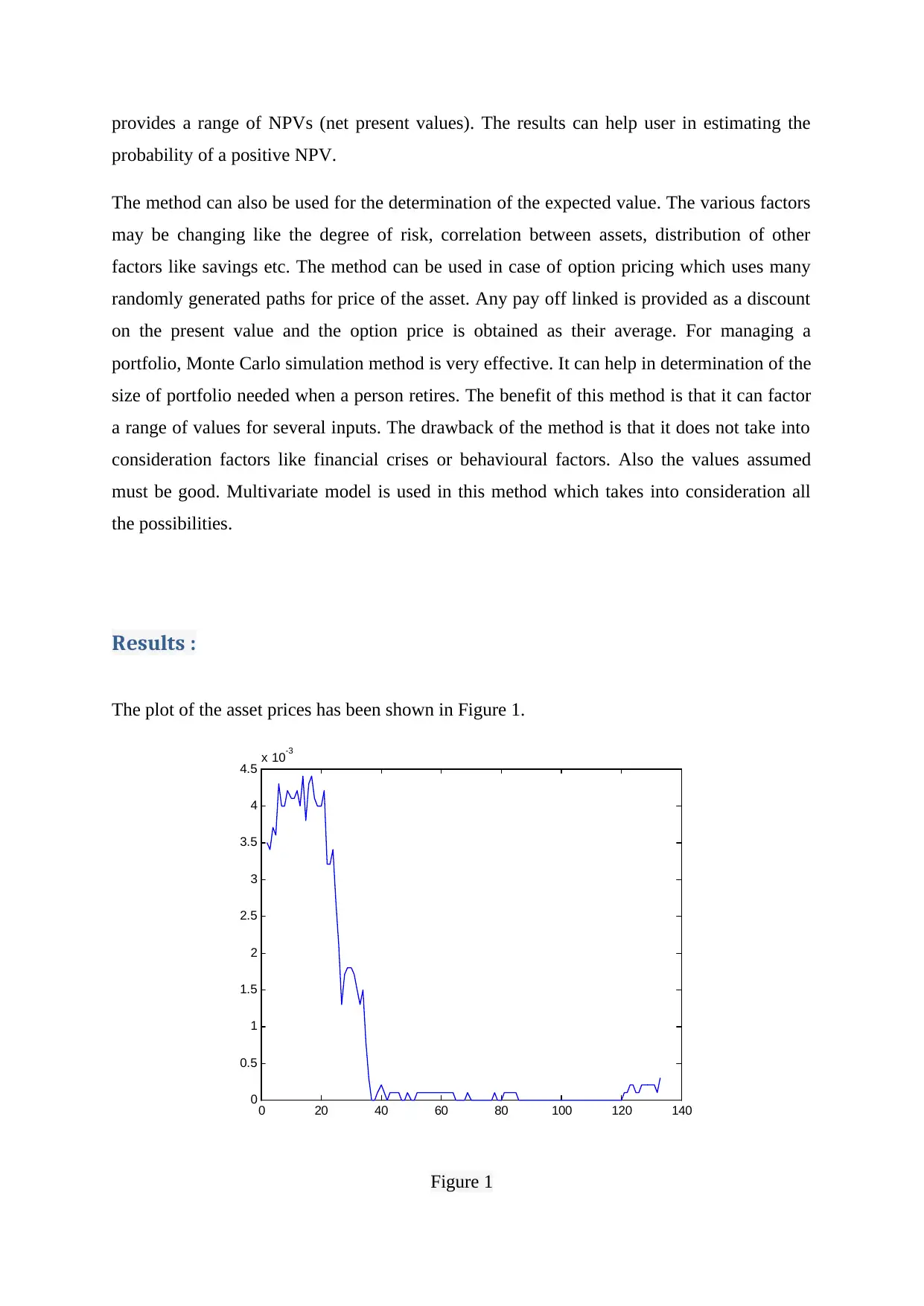
The plot of the asset prices has been shown in Figure 1.
0 20 40 60 80 100 120 140
0
0.5
1
1.5
2
2.5
3
3.5
4
4.5 x 10⁻³
Figure 1
tabler-icon-diamond-filled.svg

Paraphrase This Document

Need a fresh take? Get an instant paraphrase of this document with our AI Paraphraser
Document Page
Conclusion :
Here, the financial modelling has been done by using the data given. The cVAR and Monte
Carlo Methods have been used to design the financial model. The software used is Matlab.
References :
[1] Ziemba, William T., and Raymond G. Vickson, eds. Stochastic optimization models in
finance. Academic Press, 2014.
[2] Geyer, Alois, Michael Hanke, and Alex Weissensteiner. "Scenario tree generation and
multi-asset financial optimization problems." Operations Research Letters 41.5 (2013): 494-
498.
[3] Gupta, Pankaj, Mukesh Kumar Mehlawat, and Anand Saxena. "Hybrid optimization
models of portfolio selection involving financial and ethical considerations." Knowledge-
Based Systems 37 (2013): 318-337.
[4] Pennanen, Teemu. "Convex duality in stochastic optimization and mathematical [1]
finance." Mathematics of Operations Research 36.2 (2011): 340-362.
[5] Pennanen, Teemu. "Introduction to convex optimization in financial
markets." Mathematical programming 134.1 (2012): 157-186.
[6] Ponsich, Antonin, Antonio Lopez Jaimes, and Carlos A. Coello Coello. "A survey on
multiobjective evolutionary algorithms for the solution of the portfolio optimization problem
and other finance and economics applications." IEEE Transactions on Evolutionary
Computation 17.3 (2012): 321-344.
[7] Pan, Wen-Tsao. "A new fruit fly optimization algorithm: taking the financial distress
model as an example." Knowledge-Based Systems 26 (2012): 69-74.
[8] Sawik, Bartosz. "Bi-criteria portfolio optimization models with percentile and symmetric
risk measures by mathematical programming." Przeglad Elektrotechniczny 88.10B (2012):
176-180.
chevron_up_icon
1 out of 5
circle_padding
hide_on_mobile
zoom_out_icon
[object Object]