Comparative Study: Migrant Entrepreneurship Across Two Centuries
VerifiedAdded on 2020/04/07
|14
|4288
|53
Report
AI Summary
This report provides a comprehensive analysis of migrant entrepreneurship, comparing and contrasting the experiences of entrepreneurs in the 19th and 21st centuries. The study examines the motivations, challenges, and successes of migrant entrepreneurs, highlighting the similarities and differences in their business practices, access to resources, and the impact of technological advancements and cultural contexts. The report utilizes case studies of entrepreneurs from both centuries to illustrate key points, such as the role of infrastructure, networking, and financial support in shaping entrepreneurial outcomes. Furthermore, it explores the benefits that migrant entrepreneurs bring to host countries, including job creation and increased tax revenue. The analysis covers factors like innovation, intellectual property, and the evolving landscape of business in the modern era, providing insights into the changing dynamics of entrepreneurship across different historical periods.
MIGRANT ENTREPRENEURSHIP 1
MIGRANT ENTREPRENEURSHIP IN THE 19TH AND 21ST CENTURY
By
Jeremy Low Jian Ming
S3617521
MIGRANT ENTREPRENEURSHIP IN THE 19TH AND 21ST CENTURY
By
Jeremy Low Jian Ming
S3617521

Paraphrase This Document
Need a fresh take? Get an instant paraphrase of this document with our AI Paraphraser
MIGRANT ENTREPRENEURSHIP 2
Executive Summary
There are several reasons that make people emigrate from their motherland to a new land.
Depending on why they left their country, it will determine their goal in the foreign land.
Some people leave to start businesses in the new land, others for education, to start a new
life among other reasons (Nathan 2014). This paper analyses the migrant entrepreneurs in
both the 19th and 21st centuries. There are great differences and similarities in entrepreneurial
activities in both centuries, though the goals and objectives remaining similar. In this paper,
two entrepreneurs representing the 19th and 21st centuries, were used in the analysis of the
differences and similarities of migrant entrepreneurs in these centuries. From the analysis
done, we are able to find that migrant entrepreneur of the 19th century had a lot of challenges
with some of the challenges being; poor infrastructure, poor networking, poor financial
support and many others (Busse 2011). The 21st-century migrant entrepreneurs are at a
better place of being successful as they incur little of these challenges. This study will
provide the benefits that come along with migrant entrepreneurs in the host countries. They
are able to boost the economy of the hosts by the provision of job opportunities and by
increasing government revenue through paying taxes.
Executive Summary
There are several reasons that make people emigrate from their motherland to a new land.
Depending on why they left their country, it will determine their goal in the foreign land.
Some people leave to start businesses in the new land, others for education, to start a new
life among other reasons (Nathan 2014). This paper analyses the migrant entrepreneurs in
both the 19th and 21st centuries. There are great differences and similarities in entrepreneurial
activities in both centuries, though the goals and objectives remaining similar. In this paper,
two entrepreneurs representing the 19th and 21st centuries, were used in the analysis of the
differences and similarities of migrant entrepreneurs in these centuries. From the analysis
done, we are able to find that migrant entrepreneur of the 19th century had a lot of challenges
with some of the challenges being; poor infrastructure, poor networking, poor financial
support and many others (Busse 2011). The 21st-century migrant entrepreneurs are at a
better place of being successful as they incur little of these challenges. This study will
provide the benefits that come along with migrant entrepreneurs in the host countries. They
are able to boost the economy of the hosts by the provision of job opportunities and by
increasing government revenue through paying taxes.
MIGRANT ENTREPRENEURSHIP 3
Migrant Entrepreneurs in the 19th and 21st century
Introduction
Immigration has been and remains to be a concern in countries like the United
States. Increased number of immigrants in the UK or the US have negative implication in
that they are able to drain the economy of the country (Rath et al. 2016). Many people, who
have not researched on the economic implications of migrants, bring up the facts of migrants
draining the country economically. When well researched, findings show that the highest
percentage of United States’ economy relies on the entrepreneurial activities of the
migrants; this is contrary to the majority’s opinion (Crush & Ramachandran 2016).
As defined by Isla and Rialp (2013), migrant entrepreneurs are foreign-born
individuals who get their way into a foreign land with an entrepreneurial mindset,
establishing and owning businesses within the foreign land. They are creative enough to
come up with unique business ideas, which stand out leading, to the expansion of the
economic activities. The establishment of these businesses the economy of the host country
is boosted. Migrant entrepreneurs make new products and services available to the host
country, (Nathan 2014). Most migrants have one characteristic in common, the
entrepreneurial characteristics supported by the cross-cultural experiences. Migrants come
from different cultures, and once they get into a new culture, they are able to introduce or
fill the available business gaps. The gaps filled by the entrepreneurial migrant are unique
and rarely can the host fill them, (Vandor & Franke 2016).
In many years, migrant entrepreneurship has been changing. There is a great
difference in the entrepreneurship of 19th century and that of the 21st century. This paper
analyses various differences and similarities in the migrant entrepreneurs in both the
centuries. It also gives the challenges faced by both entrepreneurs represented in the
different centuries and how they addressed their challenges.
Migrant Entrepreneurs in the 19th and 21st century
Introduction
Immigration has been and remains to be a concern in countries like the United
States. Increased number of immigrants in the UK or the US have negative implication in
that they are able to drain the economy of the country (Rath et al. 2016). Many people, who
have not researched on the economic implications of migrants, bring up the facts of migrants
draining the country economically. When well researched, findings show that the highest
percentage of United States’ economy relies on the entrepreneurial activities of the
migrants; this is contrary to the majority’s opinion (Crush & Ramachandran 2016).
As defined by Isla and Rialp (2013), migrant entrepreneurs are foreign-born
individuals who get their way into a foreign land with an entrepreneurial mindset,
establishing and owning businesses within the foreign land. They are creative enough to
come up with unique business ideas, which stand out leading, to the expansion of the
economic activities. The establishment of these businesses the economy of the host country
is boosted. Migrant entrepreneurs make new products and services available to the host
country, (Nathan 2014). Most migrants have one characteristic in common, the
entrepreneurial characteristics supported by the cross-cultural experiences. Migrants come
from different cultures, and once they get into a new culture, they are able to introduce or
fill the available business gaps. The gaps filled by the entrepreneurial migrant are unique
and rarely can the host fill them, (Vandor & Franke 2016).
In many years, migrant entrepreneurship has been changing. There is a great
difference in the entrepreneurship of 19th century and that of the 21st century. This paper
analyses various differences and similarities in the migrant entrepreneurs in both the
centuries. It also gives the challenges faced by both entrepreneurs represented in the
different centuries and how they addressed their challenges.
⊘ This is a preview!⊘
Do you want full access?
Subscribe today to unlock all pages.

Trusted by 1+ million students worldwide
MIGRANT ENTREPRENEURSHIP 4
Similarities and Differences in Migrant Entrepreneurs in both the 19th and 21st
Century
Migrant entrepreneurs are known historically for their continuous and well-
established social and economic innovations. These entrepreneurs are able to identify a
particular business gap and fill it. In both the 19th and 21st century, these entrepreneurs had a
goal and vision that they want to achieve. In both cases, the entrepreneurs had business ideas
to be materialized. For instance, entrepreneurs in the 19th century were able to follow their
dreams of wealth, success and personal fulfillment; this is also evident in the 21st-century
entrepreneurs. The 19th-century entrepreneurs were able to create a goal and work tirelessly
taking risks, managing costs and ensuring that they give back to the community. In the 21st
century, we see the same happening. Entrepreneurs are risk-takers and they work
passionately and tirelessly to achieve the set goals, (Busse 2011).
Comparing the historical experiences of both the migrant entrepreneurs in both
centuries, one factor stands out clearly. Most of the migrants move out of their country to
host country to exploit the available resources that are not in their original land. For
instance, the most successful businessmen in the 19th century who were migrants moved out
of their country due to economic constraints. They moved to America, which was
economically ahead of their country to exploit the available resources. Migrant
entrepreneurs in both the century have a cultural difference with their host countries. The
cultural difference existing between the migrants and the host country provides the business
ideas for the migrants. (Bhachu, 2017). For example, the richest man and a successful
German- American entrepreneur in the 19th century, Claus Spreckels, moved out of
Germany to America and he identified many business gaps that were unfilled, due to
cultural differences. This enabled him to run top in the establishments. In the 21st century,
entrepreneurs are also being driven by similar experiences. The desire to exploit once the
Similarities and Differences in Migrant Entrepreneurs in both the 19th and 21st
Century
Migrant entrepreneurs are known historically for their continuous and well-
established social and economic innovations. These entrepreneurs are able to identify a
particular business gap and fill it. In both the 19th and 21st century, these entrepreneurs had a
goal and vision that they want to achieve. In both cases, the entrepreneurs had business ideas
to be materialized. For instance, entrepreneurs in the 19th century were able to follow their
dreams of wealth, success and personal fulfillment; this is also evident in the 21st-century
entrepreneurs. The 19th-century entrepreneurs were able to create a goal and work tirelessly
taking risks, managing costs and ensuring that they give back to the community. In the 21st
century, we see the same happening. Entrepreneurs are risk-takers and they work
passionately and tirelessly to achieve the set goals, (Busse 2011).
Comparing the historical experiences of both the migrant entrepreneurs in both
centuries, one factor stands out clearly. Most of the migrants move out of their country to
host country to exploit the available resources that are not in their original land. For
instance, the most successful businessmen in the 19th century who were migrants moved out
of their country due to economic constraints. They moved to America, which was
economically ahead of their country to exploit the available resources. Migrant
entrepreneurs in both the century have a cultural difference with their host countries. The
cultural difference existing between the migrants and the host country provides the business
ideas for the migrants. (Bhachu, 2017). For example, the richest man and a successful
German- American entrepreneur in the 19th century, Claus Spreckels, moved out of
Germany to America and he identified many business gaps that were unfilled, due to
cultural differences. This enabled him to run top in the establishments. In the 21st century,
entrepreneurs are also being driven by similar experiences. The desire to exploit once the
Paraphrase This Document
Need a fresh take? Get an instant paraphrase of this document with our AI Paraphraser
MIGRANT ENTREPRENEURSHIP 5
comfort zone becomes unbearable. Due to the excessive competitions within motherlands,
most people opt to have their business established in other countries.
In order to be successful, family and ethnic networks are important in making one
economically stable in the host country. Most of the entrepreneurs entered the host country
using family connections and were helped to build a good foundation. The ethnic solidarity
in the form of loans, cooperation, advice, information and extended families are seen to be
very important for success in the host country (Brettell & Hollifield 2014). Without these,
one would have to undergo a lot of struggle to achieve the same. Currently, it also takes
family connections to enter the United States legally for permanent residence and to get the
prerequisites such as ID for performing business activities (Brettell & Hollifield 2014). .
This makes it difficult for migrant entrepreneurs who make their way in the host country
with no one of the same ethnic background or family around to help them. Migrant
entrepreneurs of the 21st century are able to get good reception in the host country due to the
revised immigration policies. Opportunities for jobs are equally given to migrants as to the
host citizens (Brettell & Hollifield 2014). This has made it possible for entrepreneurs to
develop and establish in different host countries.
The entrepreneur in both the 19th and 21st Centuries possessed similar values such as
strong personality traits; they were determined, ambitious, focused to success, risk takers,
good managers of cash and ready to deliver to the community (Khan 2015). Innovation
being the center of entrepreneurship has more relevance now than in the 19th century. Back
then, entrepreneurs such as Claus majored on bridging social challenges such as poor
communication, poor transport, processing of foods as value addition, inventing better tools
and farming techniques among others. The 21st century entrepreneur has to have deeper
understanding of technology, use technology in driving business processes and cut costs
(Boyles 2012). Entrepreneurs have to learn the market, understand the challenges of the 21st
comfort zone becomes unbearable. Due to the excessive competitions within motherlands,
most people opt to have their business established in other countries.
In order to be successful, family and ethnic networks are important in making one
economically stable in the host country. Most of the entrepreneurs entered the host country
using family connections and were helped to build a good foundation. The ethnic solidarity
in the form of loans, cooperation, advice, information and extended families are seen to be
very important for success in the host country (Brettell & Hollifield 2014). Without these,
one would have to undergo a lot of struggle to achieve the same. Currently, it also takes
family connections to enter the United States legally for permanent residence and to get the
prerequisites such as ID for performing business activities (Brettell & Hollifield 2014). .
This makes it difficult for migrant entrepreneurs who make their way in the host country
with no one of the same ethnic background or family around to help them. Migrant
entrepreneurs of the 21st century are able to get good reception in the host country due to the
revised immigration policies. Opportunities for jobs are equally given to migrants as to the
host citizens (Brettell & Hollifield 2014). This has made it possible for entrepreneurs to
develop and establish in different host countries.
The entrepreneur in both the 19th and 21st Centuries possessed similar values such as
strong personality traits; they were determined, ambitious, focused to success, risk takers,
good managers of cash and ready to deliver to the community (Khan 2015). Innovation
being the center of entrepreneurship has more relevance now than in the 19th century. Back
then, entrepreneurs such as Claus majored on bridging social challenges such as poor
communication, poor transport, processing of foods as value addition, inventing better tools
and farming techniques among others. The 21st century entrepreneur has to have deeper
understanding of technology, use technology in driving business processes and cut costs
(Boyles 2012). Entrepreneurs have to learn the market, understand the challenges of the 21st
MIGRANT ENTREPRENEURSHIP 6
century customer and use these challenges to create a business idea (Boyles 2012).
Innovation between migrant entrepreneurs in the 21st and 19th century are quite different.
The major differences that exist between the migrant entrepreneurs in the 19th
century and those in the 21st century are the already developed transport systems and
technology in this century. Initially, the entrepreneurs had difficulties in the transportation
of various goods from one country to another due to poor infrastructure. The only available
means was shipping that was expensive and time-consuming. Today, many entrepreneurs
are enjoying the well-developed infrastructures. Technology advancement that was laid by
initial investors made it easy for 21st-century entrepreneurs. In the 19th century, the
technology was poor creating a tedious time for the entrepreneurs (Khan 2015).
The migrant entrepreneurs both in the 19th century and 21st century had unique
challenges to deal with. Some of the challenges experienced in the 19th century and the 21st
century are similar with others being totally different. In the 19th century, there was a
challenge of an inadequate transport system. Entrepreneurs had difficult times in
transporting raw materials from one country to another since the transport system was poor.
They incurred a lot of expenses on the entrepreneur minimizing the profit margin (Boyd
2017). Development of infrastructure thereafter helped to ease the cost of transportation.
Entrepreneurs like Claus Spreckels identified this business idea and developed the improved
shipping systems that are important for the transportation of goods and materials.
Poor networking systems in the 19th century were an additional challenge to poor
transport. There was no internet and the internet applications that would help to ease the
work of data collection, data storage, and analysis. Entrepreneurs were forced to handle this
manually, which became a challenge to innovations (Keenan 2017). In the present times,
entrepreneurs have the advantage of using the internet for networking, advertising their
businesses, interacting with customers and even selling their products online (Schneider &
century customer and use these challenges to create a business idea (Boyles 2012).
Innovation between migrant entrepreneurs in the 21st and 19th century are quite different.
The major differences that exist between the migrant entrepreneurs in the 19th
century and those in the 21st century are the already developed transport systems and
technology in this century. Initially, the entrepreneurs had difficulties in the transportation
of various goods from one country to another due to poor infrastructure. The only available
means was shipping that was expensive and time-consuming. Today, many entrepreneurs
are enjoying the well-developed infrastructures. Technology advancement that was laid by
initial investors made it easy for 21st-century entrepreneurs. In the 19th century, the
technology was poor creating a tedious time for the entrepreneurs (Khan 2015).
The migrant entrepreneurs both in the 19th century and 21st century had unique
challenges to deal with. Some of the challenges experienced in the 19th century and the 21st
century are similar with others being totally different. In the 19th century, there was a
challenge of an inadequate transport system. Entrepreneurs had difficult times in
transporting raw materials from one country to another since the transport system was poor.
They incurred a lot of expenses on the entrepreneur minimizing the profit margin (Boyd
2017). Development of infrastructure thereafter helped to ease the cost of transportation.
Entrepreneurs like Claus Spreckels identified this business idea and developed the improved
shipping systems that are important for the transportation of goods and materials.
Poor networking systems in the 19th century were an additional challenge to poor
transport. There was no internet and the internet applications that would help to ease the
work of data collection, data storage, and analysis. Entrepreneurs were forced to handle this
manually, which became a challenge to innovations (Keenan 2017). In the present times,
entrepreneurs have the advantage of using the internet for networking, advertising their
businesses, interacting with customers and even selling their products online (Schneider &
⊘ This is a preview!⊘
Do you want full access?
Subscribe today to unlock all pages.
Trusted by 1+ million students worldwide
MIGRANT ENTREPRENEURSHIP 7
Aguiar 2016). There is internet where everyone is able to access and do more research on
the business idea.
In the 19th century, most of the migrant entrepreneurs had to support themselves
financially. There were no financial firms that were willing and ready to offer loans except
to the well-established entrepreneurs like Claus Speckles. This made it difficult for most
entrepreneurs to access finance (Haltiwanger et al. 2016). The 21st century is full of
opportunities where entrepreneurs can get capital to start and sustain their startups. Venture
capitalists and angel investors are now more common. Apart from choosing to finance a
viable startup to a tune of almost $1,000,000 for a stake in one’s company, they offer advice
and mentorship to modern day entrepreneurs until their ventures are stable (Wong, Bhatia &
Freeman 2009). The huge number of financial institutions makes it easier to finance a
startup in this dispensation. Entrepreneurs though find it difficult accessing loans from
banks and other financial institutions when they do not have the favorable credit history to
access big loans (Jones et al. 2014).
In this paper, the data used are secondary data that was obtained from two articles.
One of the articles represents a migrant entrepreneur in the 19th century with the other
representing a migrant entrepreneur in the 21st century. ‘Claus Spreckels: A Biographical
Case Study of Nineteenth-Century “American Immigrant Entrepreneurship” is the article
used in understanding the migrant entrepreneurial in the 19th century. For the 21st century, a
case study with the name the Empire of giggle. These two articles were used to study the
differences and similarities between the two characters in mind. Generally, the two helped
us draw a conclusion on the topic under study. Generally, the two helped us draw a
conclusion on the topic under study.
From the study of the two articles, various factors are seen to be similar in both the
19th and the 21st century. From both studies we get to understand that there was a particular
Aguiar 2016). There is internet where everyone is able to access and do more research on
the business idea.
In the 19th century, most of the migrant entrepreneurs had to support themselves
financially. There were no financial firms that were willing and ready to offer loans except
to the well-established entrepreneurs like Claus Speckles. This made it difficult for most
entrepreneurs to access finance (Haltiwanger et al. 2016). The 21st century is full of
opportunities where entrepreneurs can get capital to start and sustain their startups. Venture
capitalists and angel investors are now more common. Apart from choosing to finance a
viable startup to a tune of almost $1,000,000 for a stake in one’s company, they offer advice
and mentorship to modern day entrepreneurs until their ventures are stable (Wong, Bhatia &
Freeman 2009). The huge number of financial institutions makes it easier to finance a
startup in this dispensation. Entrepreneurs though find it difficult accessing loans from
banks and other financial institutions when they do not have the favorable credit history to
access big loans (Jones et al. 2014).
In this paper, the data used are secondary data that was obtained from two articles.
One of the articles represents a migrant entrepreneur in the 19th century with the other
representing a migrant entrepreneur in the 21st century. ‘Claus Spreckels: A Biographical
Case Study of Nineteenth-Century “American Immigrant Entrepreneurship” is the article
used in understanding the migrant entrepreneurial in the 19th century. For the 21st century, a
case study with the name the Empire of giggle. These two articles were used to study the
differences and similarities between the two characters in mind. Generally, the two helped
us draw a conclusion on the topic under study. Generally, the two helped us draw a
conclusion on the topic under study.
From the study of the two articles, various factors are seen to be similar in both the
19th and the 21st century. From both studies we get to understand that there was a particular
Paraphrase This Document
Need a fresh take? Get an instant paraphrase of this document with our AI Paraphraser
MIGRANT ENTREPRENEURSHIP 8
reason behind their emigration, self-motivation and determination have been seen to be
driving the two, cultural differences was the center for their businesses ideas. Family and
ethical networking are also shown to be essential for the success of the enterprise. There
were many areas of considering that were studied to help understand the similarities and
differences in the two case studies. The following are some of the factors considered:
Intellectual property, innovation, and knowledge are important as far as completion
is concerned. Intellectual property will help most of the entrepreneurs to be ahead of their
competitors. They are able to protect their businesses and give room for more developments.
Competitors cannot import or export the products without your knowledge. It also helps one
secure loans and credit cards from, financial institutions (Hovenkamp & Carrier 2016).
Combined with innovation and knowledge, entrepreneurs are able to be innovative enough
to capture the available market. They have to think beyond the nose to ensure customer
satisfaction. For this to happen, then full knowledge and understanding of the market,
financial abilities, competitor knowledge is necessary (Block et al. 2013). The use of these
factors is seen in the case study of Claus Speckles where he is always alert on his
competitor’s never giving them room to defeat him. He goes further to spend time getting
knowledge on one of his business ideas making the idea and the actual results blossom.
Ethnicity, culture, network and seed capital have been shown in the two scenarios.
Ethnicity network is important in that it gives one advantage over an opportunity that one
who has no ethnic relations around (Hogberg et al. 2016). The culture of an individual will
also determine the kind of business ideas generated. Individuals from less disadvantageous
countries may think shallowly as compared to their fellows from a well-established country.
Full understanding of culture can help one identify business idea. Proper networking is
important, both family networks, and the communication networks as it helps in giving
stability to an idea making it stand (Ryan et al. 2015). This is evident when Claus gets to
reason behind their emigration, self-motivation and determination have been seen to be
driving the two, cultural differences was the center for their businesses ideas. Family and
ethical networking are also shown to be essential for the success of the enterprise. There
were many areas of considering that were studied to help understand the similarities and
differences in the two case studies. The following are some of the factors considered:
Intellectual property, innovation, and knowledge are important as far as completion
is concerned. Intellectual property will help most of the entrepreneurs to be ahead of their
competitors. They are able to protect their businesses and give room for more developments.
Competitors cannot import or export the products without your knowledge. It also helps one
secure loans and credit cards from, financial institutions (Hovenkamp & Carrier 2016).
Combined with innovation and knowledge, entrepreneurs are able to be innovative enough
to capture the available market. They have to think beyond the nose to ensure customer
satisfaction. For this to happen, then full knowledge and understanding of the market,
financial abilities, competitor knowledge is necessary (Block et al. 2013). The use of these
factors is seen in the case study of Claus Speckles where he is always alert on his
competitor’s never giving them room to defeat him. He goes further to spend time getting
knowledge on one of his business ideas making the idea and the actual results blossom.
Ethnicity, culture, network and seed capital have been shown in the two scenarios.
Ethnicity network is important in that it gives one advantage over an opportunity that one
who has no ethnic relations around (Hogberg et al. 2016). The culture of an individual will
also determine the kind of business ideas generated. Individuals from less disadvantageous
countries may think shallowly as compared to their fellows from a well-established country.
Full understanding of culture can help one identify business idea. Proper networking is
important, both family networks, and the communication networks as it helps in giving
stability to an idea making it stand (Ryan et al. 2015). This is evident when Claus gets to
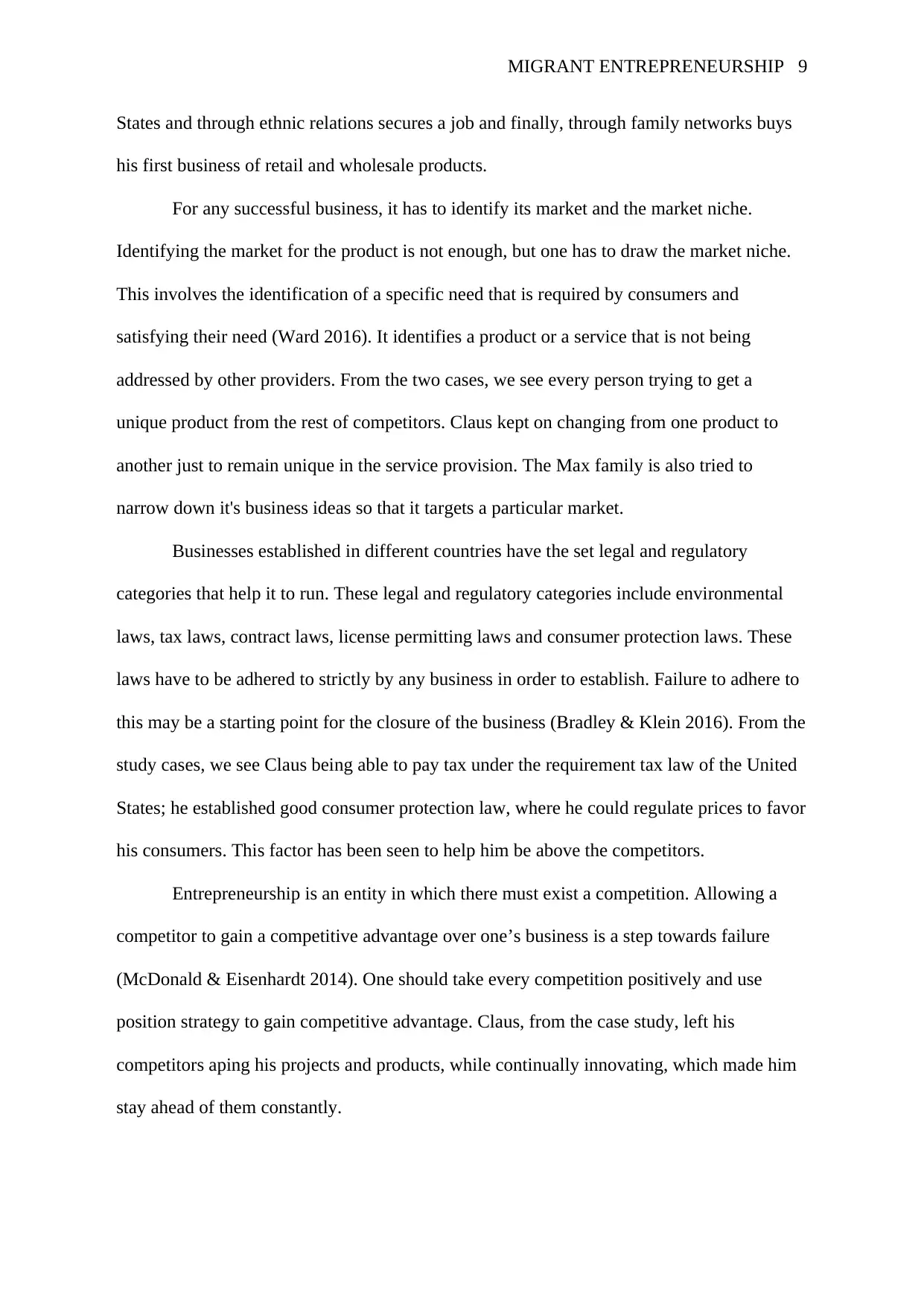
MIGRANT ENTREPRENEURSHIP 9
States and through ethnic relations secures a job and finally, through family networks buys
his first business of retail and wholesale products.
For any successful business, it has to identify its market and the market niche.
Identifying the market for the product is not enough, but one has to draw the market niche.
This involves the identification of a specific need that is required by consumers and
satisfying their need (Ward 2016). It identifies a product or a service that is not being
addressed by other providers. From the two cases, we see every person trying to get a
unique product from the rest of competitors. Claus kept on changing from one product to
another just to remain unique in the service provision. The Max family is also tried to
narrow down it's business ideas so that it targets a particular market.
Businesses established in different countries have the set legal and regulatory
categories that help it to run. These legal and regulatory categories include environmental
laws, tax laws, contract laws, license permitting laws and consumer protection laws. These
laws have to be adhered to strictly by any business in order to establish. Failure to adhere to
this may be a starting point for the closure of the business (Bradley & Klein 2016). From the
study cases, we see Claus being able to pay tax under the requirement tax law of the United
States; he established good consumer protection law, where he could regulate prices to favor
his consumers. This factor has been seen to help him be above the competitors.
Entrepreneurship is an entity in which there must exist a competition. Allowing a
competitor to gain a competitive advantage over one’s business is a step towards failure
(McDonald & Eisenhardt 2014). One should take every competition positively and use
position strategy to gain competitive advantage. Claus, from the case study, left his
competitors aping his projects and products, while continually innovating, which made him
stay ahead of them constantly.
States and through ethnic relations secures a job and finally, through family networks buys
his first business of retail and wholesale products.
For any successful business, it has to identify its market and the market niche.
Identifying the market for the product is not enough, but one has to draw the market niche.
This involves the identification of a specific need that is required by consumers and
satisfying their need (Ward 2016). It identifies a product or a service that is not being
addressed by other providers. From the two cases, we see every person trying to get a
unique product from the rest of competitors. Claus kept on changing from one product to
another just to remain unique in the service provision. The Max family is also tried to
narrow down it's business ideas so that it targets a particular market.
Businesses established in different countries have the set legal and regulatory
categories that help it to run. These legal and regulatory categories include environmental
laws, tax laws, contract laws, license permitting laws and consumer protection laws. These
laws have to be adhered to strictly by any business in order to establish. Failure to adhere to
this may be a starting point for the closure of the business (Bradley & Klein 2016). From the
study cases, we see Claus being able to pay tax under the requirement tax law of the United
States; he established good consumer protection law, where he could regulate prices to favor
his consumers. This factor has been seen to help him be above the competitors.
Entrepreneurship is an entity in which there must exist a competition. Allowing a
competitor to gain a competitive advantage over one’s business is a step towards failure
(McDonald & Eisenhardt 2014). One should take every competition positively and use
position strategy to gain competitive advantage. Claus, from the case study, left his
competitors aping his projects and products, while continually innovating, which made him
stay ahead of them constantly.
⊘ This is a preview!⊘
Do you want full access?
Subscribe today to unlock all pages.
Trusted by 1+ million students worldwide
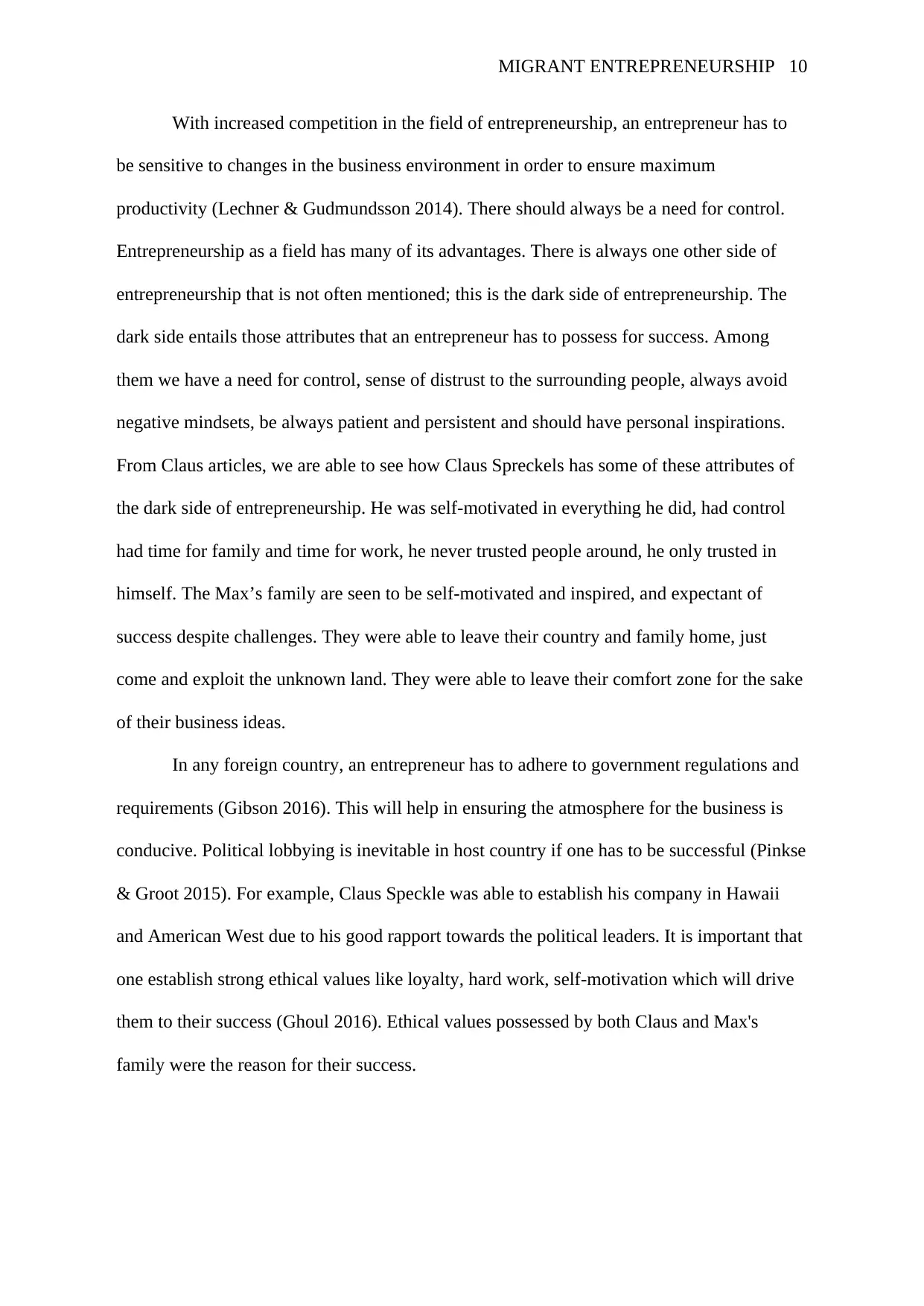
MIGRANT ENTREPRENEURSHIP 10
With increased competition in the field of entrepreneurship, an entrepreneur has to
be sensitive to changes in the business environment in order to ensure maximum
productivity (Lechner & Gudmundsson 2014). There should always be a need for control.
Entrepreneurship as a field has many of its advantages. There is always one other side of
entrepreneurship that is not often mentioned; this is the dark side of entrepreneurship. The
dark side entails those attributes that an entrepreneur has to possess for success. Among
them we have a need for control, sense of distrust to the surrounding people, always avoid
negative mindsets, be always patient and persistent and should have personal inspirations.
From Claus articles, we are able to see how Claus Spreckels has some of these attributes of
the dark side of entrepreneurship. He was self-motivated in everything he did, had control
had time for family and time for work, he never trusted people around, he only trusted in
himself. The Max’s family are seen to be self-motivated and inspired, and expectant of
success despite challenges. They were able to leave their country and family home, just
come and exploit the unknown land. They were able to leave their comfort zone for the sake
of their business ideas.
In any foreign country, an entrepreneur has to adhere to government regulations and
requirements (Gibson 2016). This will help in ensuring the atmosphere for the business is
conducive. Political lobbying is inevitable in host country if one has to be successful (Pinkse
& Groot 2015). For example, Claus Speckle was able to establish his company in Hawaii
and American West due to his good rapport towards the political leaders. It is important that
one establish strong ethical values like loyalty, hard work, self-motivation which will drive
them to their success (Ghoul 2016). Ethical values possessed by both Claus and Max's
family were the reason for their success.
With increased competition in the field of entrepreneurship, an entrepreneur has to
be sensitive to changes in the business environment in order to ensure maximum
productivity (Lechner & Gudmundsson 2014). There should always be a need for control.
Entrepreneurship as a field has many of its advantages. There is always one other side of
entrepreneurship that is not often mentioned; this is the dark side of entrepreneurship. The
dark side entails those attributes that an entrepreneur has to possess for success. Among
them we have a need for control, sense of distrust to the surrounding people, always avoid
negative mindsets, be always patient and persistent and should have personal inspirations.
From Claus articles, we are able to see how Claus Spreckels has some of these attributes of
the dark side of entrepreneurship. He was self-motivated in everything he did, had control
had time for family and time for work, he never trusted people around, he only trusted in
himself. The Max’s family are seen to be self-motivated and inspired, and expectant of
success despite challenges. They were able to leave their country and family home, just
come and exploit the unknown land. They were able to leave their comfort zone for the sake
of their business ideas.
In any foreign country, an entrepreneur has to adhere to government regulations and
requirements (Gibson 2016). This will help in ensuring the atmosphere for the business is
conducive. Political lobbying is inevitable in host country if one has to be successful (Pinkse
& Groot 2015). For example, Claus Speckle was able to establish his company in Hawaii
and American West due to his good rapport towards the political leaders. It is important that
one establish strong ethical values like loyalty, hard work, self-motivation which will drive
them to their success (Ghoul 2016). Ethical values possessed by both Claus and Max's
family were the reason for their success.
Paraphrase This Document
Need a fresh take? Get an instant paraphrase of this document with our AI Paraphraser
MIGRANT ENTREPRENEURSHIP 11
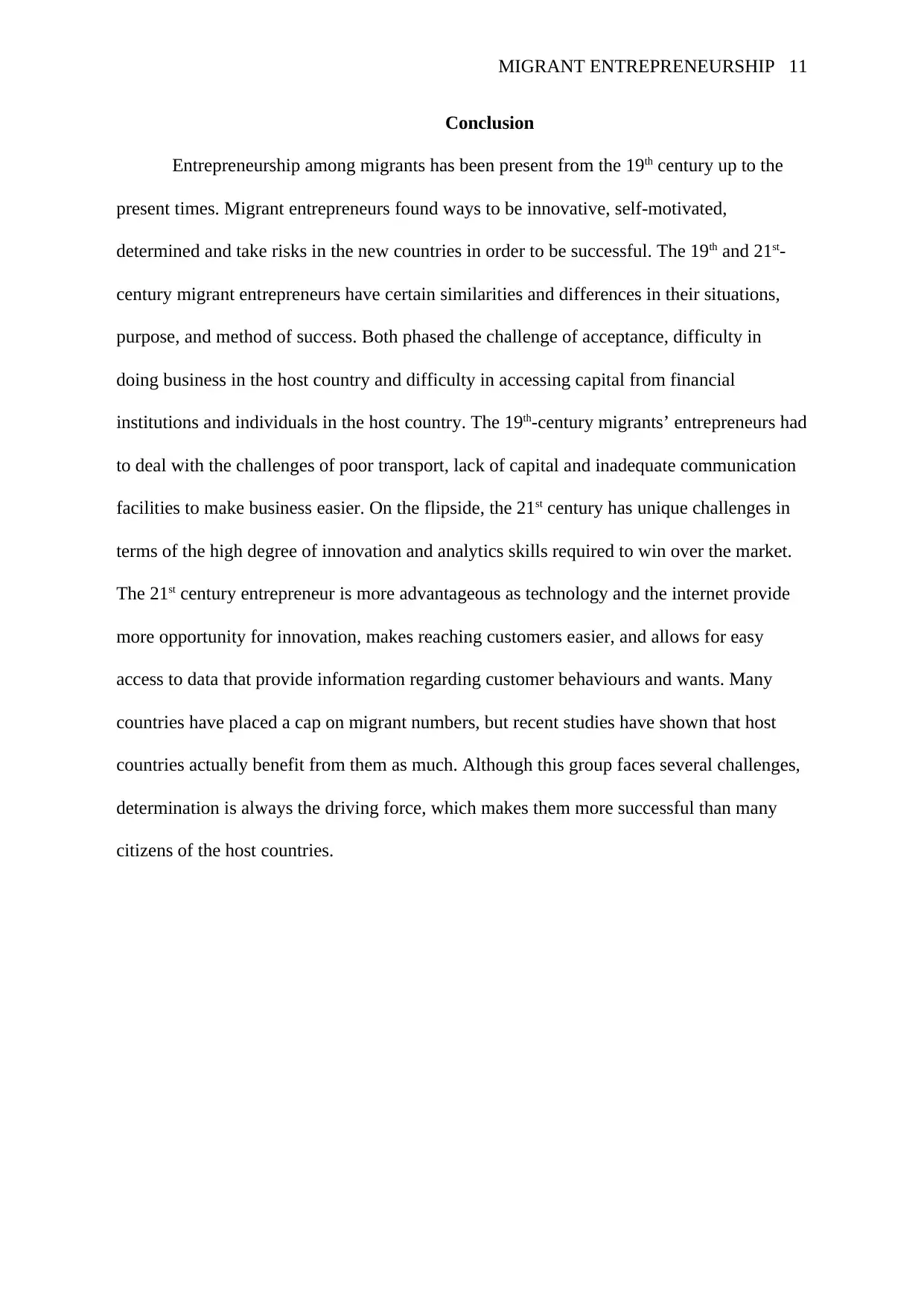
Conclusion
Entrepreneurship among migrants has been present from the 19th century up to the
present times. Migrant entrepreneurs found ways to be innovative, self-motivated,
determined and take risks in the new countries in order to be successful. The 19th and 21st-
century migrant entrepreneurs have certain similarities and differences in their situations,
purpose, and method of success. Both phased the challenge of acceptance, difficulty in
doing business in the host country and difficulty in accessing capital from financial
institutions and individuals in the host country. The 19th-century migrants’ entrepreneurs had
to deal with the challenges of poor transport, lack of capital and inadequate communication
facilities to make business easier. On the flipside, the 21st century has unique challenges in
terms of the high degree of innovation and analytics skills required to win over the market.
The 21st century entrepreneur is more advantageous as technology and the internet provide
more opportunity for innovation, makes reaching customers easier, and allows for easy
access to data that provide information regarding customer behaviours and wants. Many
countries have placed a cap on migrant numbers, but recent studies have shown that host
countries actually benefit from them as much. Although this group faces several challenges,
determination is always the driving force, which makes them more successful than many
citizens of the host countries.
Conclusion
Entrepreneurship among migrants has been present from the 19th century up to the
present times. Migrant entrepreneurs found ways to be innovative, self-motivated,
determined and take risks in the new countries in order to be successful. The 19th and 21st-
century migrant entrepreneurs have certain similarities and differences in their situations,
purpose, and method of success. Both phased the challenge of acceptance, difficulty in
doing business in the host country and difficulty in accessing capital from financial
institutions and individuals in the host country. The 19th-century migrants’ entrepreneurs had
to deal with the challenges of poor transport, lack of capital and inadequate communication
facilities to make business easier. On the flipside, the 21st century has unique challenges in
terms of the high degree of innovation and analytics skills required to win over the market.
The 21st century entrepreneur is more advantageous as technology and the internet provide
more opportunity for innovation, makes reaching customers easier, and allows for easy
access to data that provide information regarding customer behaviours and wants. Many
countries have placed a cap on migrant numbers, but recent studies have shown that host
countries actually benefit from them as much. Although this group faces several challenges,
determination is always the driving force, which makes them more successful than many
citizens of the host countries.
MIGRANT ENTREPRENEURSHIP 12
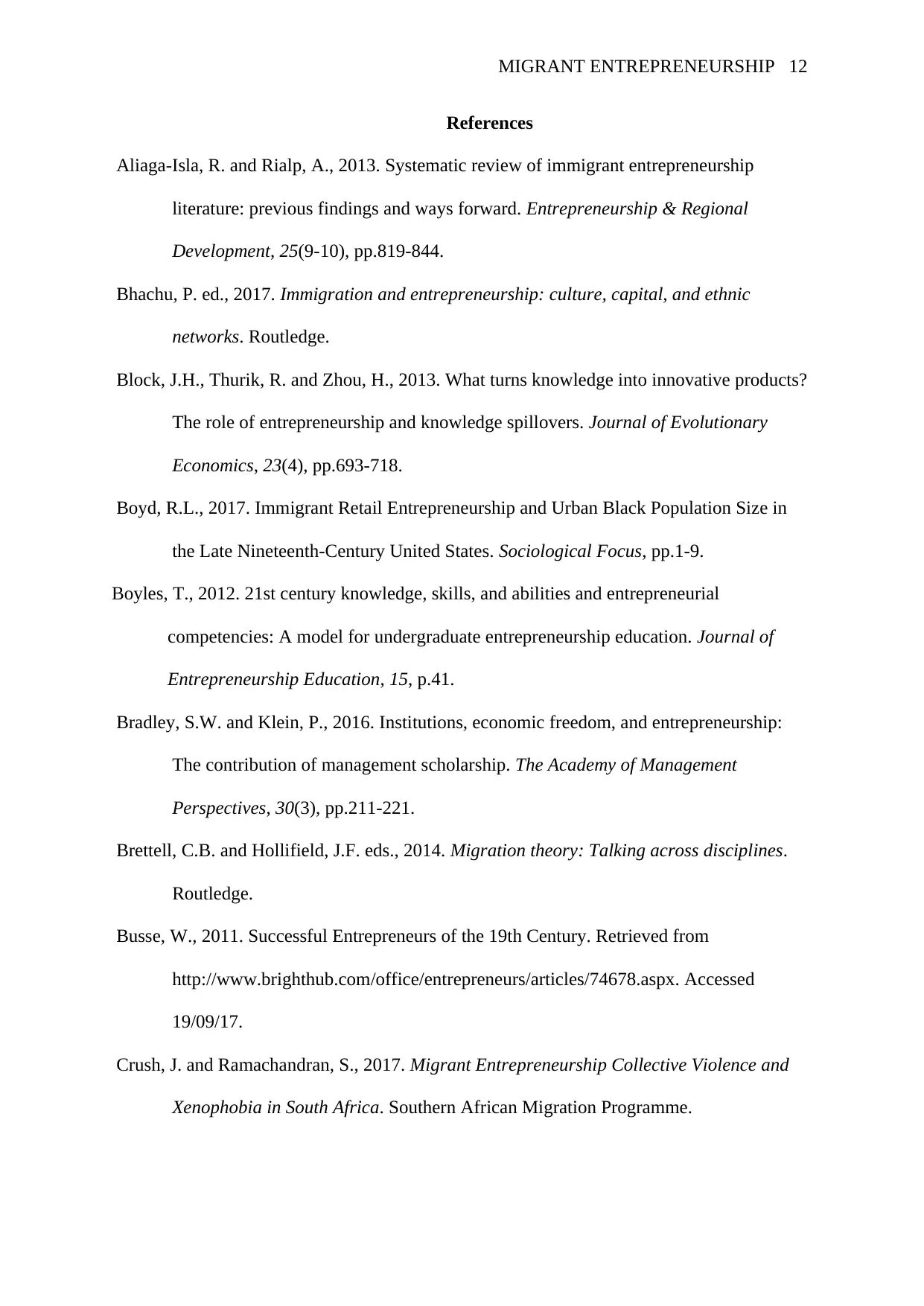
References
Aliaga-Isla, R. and Rialp, A., 2013. Systematic review of immigrant entrepreneurship
literature: previous findings and ways forward. Entrepreneurship & Regional
Development, 25(9-10), pp.819-844.
Bhachu, P. ed., 2017. Immigration and entrepreneurship: culture, capital, and ethnic
networks. Routledge.
Block, J.H., Thurik, R. and Zhou, H., 2013. What turns knowledge into innovative products?
The role of entrepreneurship and knowledge spillovers. Journal of Evolutionary
Economics, 23(4), pp.693-718.
Boyd, R.L., 2017. Immigrant Retail Entrepreneurship and Urban Black Population Size in
the Late Nineteenth-Century United States. Sociological Focus, pp.1-9.
Boyles, T., 2012. 21st century knowledge, skills, and abilities and entrepreneurial
competencies: A model for undergraduate entrepreneurship education. Journal of
Entrepreneurship Education, 15, p.41.
Bradley, S.W. and Klein, P., 2016. Institutions, economic freedom, and entrepreneurship:
The contribution of management scholarship. The Academy of Management
Perspectives, 30(3), pp.211-221.
Brettell, C.B. and Hollifield, J.F. eds., 2014. Migration theory: Talking across disciplines.
Routledge.
Busse, W., 2011. Successful Entrepreneurs of the 19th Century. Retrieved from
http://www.brighthub.com/office/entrepreneurs/articles/74678.aspx. Accessed
19/09/17.
Crush, J. and Ramachandran, S., 2017. Migrant Entrepreneurship Collective Violence and
Xenophobia in South Africa. Southern African Migration Programme.
References
Aliaga-Isla, R. and Rialp, A., 2013. Systematic review of immigrant entrepreneurship
literature: previous findings and ways forward. Entrepreneurship & Regional
Development, 25(9-10), pp.819-844.
Bhachu, P. ed., 2017. Immigration and entrepreneurship: culture, capital, and ethnic
networks. Routledge.
Block, J.H., Thurik, R. and Zhou, H., 2013. What turns knowledge into innovative products?
The role of entrepreneurship and knowledge spillovers. Journal of Evolutionary
Economics, 23(4), pp.693-718.
Boyd, R.L., 2017. Immigrant Retail Entrepreneurship and Urban Black Population Size in
the Late Nineteenth-Century United States. Sociological Focus, pp.1-9.
Boyles, T., 2012. 21st century knowledge, skills, and abilities and entrepreneurial
competencies: A model for undergraduate entrepreneurship education. Journal of
Entrepreneurship Education, 15, p.41.
Bradley, S.W. and Klein, P., 2016. Institutions, economic freedom, and entrepreneurship:
The contribution of management scholarship. The Academy of Management
Perspectives, 30(3), pp.211-221.
Brettell, C.B. and Hollifield, J.F. eds., 2014. Migration theory: Talking across disciplines.
Routledge.
Busse, W., 2011. Successful Entrepreneurs of the 19th Century. Retrieved from
http://www.brighthub.com/office/entrepreneurs/articles/74678.aspx. Accessed
19/09/17.
Crush, J. and Ramachandran, S., 2017. Migrant Entrepreneurship Collective Violence and
Xenophobia in South Africa. Southern African Migration Programme.
⊘ This is a preview!⊘
Do you want full access?
Subscribe today to unlock all pages.
Trusted by 1+ million students worldwide

1 out of 14


Your All-in-One AI-Powered Toolkit for Academic Success.
+13062052269
info@desklib.com
Available 24*7 on WhatsApp / Email
![[object Object]](/_next/static/media/star-bottom.7253800d.svg)
Unlock your academic potential
Copyright © 2020–2026 A2Z Services. All Rights Reserved. Developed and managed by ZUCOL.