Analyzing the Impact of Migrant Numbers on the UK Economy
VerifiedAdded on 2023/01/11
|9
|2469
|41
Essay
AI Summary
This essay examines the multifaceted impact of immigration on the UK economy. It delves into the circular flow of income, analyzing how migrant contributions affect national income, output, and expenditure. The essay explores the impact of immigration on the Gross Domestic Product (GDP), discussing how increased manpower and skilled labor influence economic growth and per capita income. Furthermore, it investigates the effects of immigration on unemployment rates and the labor market, considering wage dynamics, employment opportunities for both native-born and immigrant workers, and the overall productivity of the workforce. The essay utilizes economic theories and empirical evidence to provide a comprehensive overview of the positive and negative aspects of immigration's influence on the UK's economic landscape.
How number of migrants can
possibly affect UK Economy
possibly affect UK Economy

Paraphrase This Document
Need a fresh take? Get an instant paraphrase of this document with our AI Paraphraser
Table of Contents
INTRODUCTION...........................................................................................................................1
MAIN BODY...................................................................................................................................1
Impact of immigration on circular flow of income................................................................1
Impact of immigration on Gross Domestic Production (GDP)..............................................3
Impact of immigration on unemployment..............................................................................5
Impact of immigration on labour market................................................................................5
CONCLUSION................................................................................................................................6
REFERENCES................................................................................................................................7
INTRODUCTION...........................................................................................................................1
MAIN BODY...................................................................................................................................1
Impact of immigration on circular flow of income................................................................1
Impact of immigration on Gross Domestic Production (GDP)..............................................3
Impact of immigration on unemployment..............................................................................5
Impact of immigration on labour market................................................................................5
CONCLUSION................................................................................................................................6
REFERENCES................................................................................................................................7
INTRODUCTION
Immigration can be referred to as the terminology for international mobility of people from
their place of birth onto a selected nation for the purpose of earning a livelihood in the long run.
This tends to highly place impact over the labour market through the supply of a set of workers
within some sectors (Doyle, 2018). With the increment in the demand of immigrant labourers, all
the sectors avail the benefit of coming up with innovative as well as unique ideas together with
specialised initiatives for converting them into effective production. The present report seeks to
present an essay upon the positive as well as negative aspects of the impact of the number of
migrants upon the economy of United Kingdom. In this relation, primary emphasis is placed
upon facets of an economy like circular flow of income, unemployment, gross domestic product
and labour market.
MAIN BODY
Impact of immigration on circular flow of income
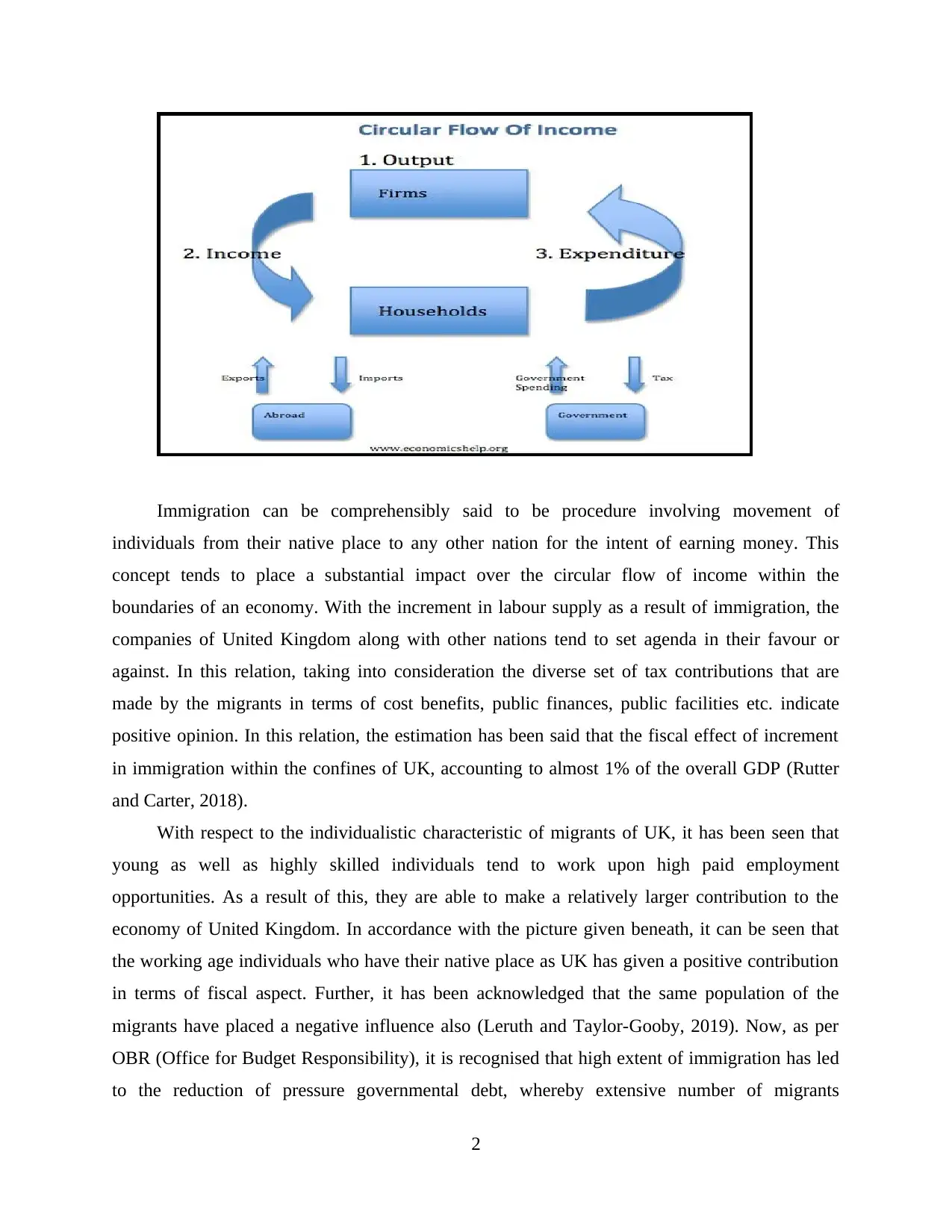
National income, output along with expenditure generated as a result of execution of a
number of activities, together regarded as the most crucial elements of the economy of a nation.
In this relation, national outcome can be referred to as the total output value which is generated
by the set of firms, altogether (Konitzer and et. al., 2019). On the other hand, national income is
acknowledged to be the aggregate income which is received by individuals of any nation. For an
instance, the wage rates provided by the companies to its labour force for production of output is
called national income, that is acknowledged to flow via sectors towards the households. In the
same manner, national expenditure can be comprehensibly said to be the overall capital spent
upon the production as well as distribution of goods as well as services. This tends to encompass
labour cost along with the overall amount incurred by the households over purchase of products,
thus this represents the flow of income via the households towards the companies. So, all such
factors exhibit the manner in which income flow within the confines of a closed economy,
without any kind of interference on the part of government.
1
Immigration can be referred to as the terminology for international mobility of people from
their place of birth onto a selected nation for the purpose of earning a livelihood in the long run.
This tends to highly place impact over the labour market through the supply of a set of workers
within some sectors (Doyle, 2018). With the increment in the demand of immigrant labourers, all
the sectors avail the benefit of coming up with innovative as well as unique ideas together with
specialised initiatives for converting them into effective production. The present report seeks to
present an essay upon the positive as well as negative aspects of the impact of the number of
migrants upon the economy of United Kingdom. In this relation, primary emphasis is placed
upon facets of an economy like circular flow of income, unemployment, gross domestic product
and labour market.
MAIN BODY
Impact of immigration on circular flow of income
National income, output along with expenditure generated as a result of execution of a
number of activities, together regarded as the most crucial elements of the economy of a nation.
In this relation, national outcome can be referred to as the total output value which is generated
by the set of firms, altogether (Konitzer and et. al., 2019). On the other hand, national income is
acknowledged to be the aggregate income which is received by individuals of any nation. For an
instance, the wage rates provided by the companies to its labour force for production of output is
called national income, that is acknowledged to flow via sectors towards the households. In the
same manner, national expenditure can be comprehensibly said to be the overall capital spent
upon the production as well as distribution of goods as well as services. This tends to encompass
labour cost along with the overall amount incurred by the households over purchase of products,
thus this represents the flow of income via the households towards the companies. So, all such
factors exhibit the manner in which income flow within the confines of a closed economy,
without any kind of interference on the part of government.
1
⊘ This is a preview!⊘
Do you want full access?
Subscribe today to unlock all pages.

Trusted by 1+ million students worldwide
Immigration can be comprehensibly said to be procedure involving movement of
individuals from their native place to any other nation for the intent of earning money. This
concept tends to place a substantial impact over the circular flow of income within the
boundaries of an economy. With the increment in labour supply as a result of immigration, the
companies of United Kingdom along with other nations tend to set agenda in their favour or
against. In this relation, taking into consideration the diverse set of tax contributions that are
made by the migrants in terms of cost benefits, public finances, public facilities etc. indicate
positive opinion. In this relation, the estimation has been said that the fiscal effect of increment
in immigration within the confines of UK, accounting to almost 1% of the overall GDP (Rutter
and Carter, 2018).
With respect to the individualistic characteristic of migrants of UK, it has been seen that
young as well as highly skilled individuals tend to work upon high paid employment
opportunities. As a result of this, they are able to make a relatively larger contribution to the
economy of United Kingdom. In accordance with the picture given beneath, it can be seen that
the working age individuals who have their native place as UK has given a positive contribution
in terms of fiscal aspect. Further, it has been acknowledged that the same population of the
migrants have placed a negative influence also (Leruth and Taylor-Gooby, 2019). Now, as per
OBR (Office for Budget Responsibility), it is recognised that high extent of immigration has led
to the reduction of pressure governmental debt, whereby extensive number of migrants
2
individuals from their native place to any other nation for the intent of earning money. This
concept tends to place a substantial impact over the circular flow of income within the
boundaries of an economy. With the increment in labour supply as a result of immigration, the
companies of United Kingdom along with other nations tend to set agenda in their favour or
against. In this relation, taking into consideration the diverse set of tax contributions that are
made by the migrants in terms of cost benefits, public finances, public facilities etc. indicate
positive opinion. In this relation, the estimation has been said that the fiscal effect of increment
in immigration within the confines of UK, accounting to almost 1% of the overall GDP (Rutter
and Carter, 2018).
With respect to the individualistic characteristic of migrants of UK, it has been seen that
young as well as highly skilled individuals tend to work upon high paid employment
opportunities. As a result of this, they are able to make a relatively larger contribution to the
economy of United Kingdom. In accordance with the picture given beneath, it can be seen that
the working age individuals who have their native place as UK has given a positive contribution
in terms of fiscal aspect. Further, it has been acknowledged that the same population of the
migrants have placed a negative influence also (Leruth and Taylor-Gooby, 2019). Now, as per
OBR (Office for Budget Responsibility), it is recognised that high extent of immigration has led
to the reduction of pressure governmental debt, whereby extensive number of migrants
2
Paraphrase This Document
Need a fresh take? Get an instant paraphrase of this document with our AI Paraphraser
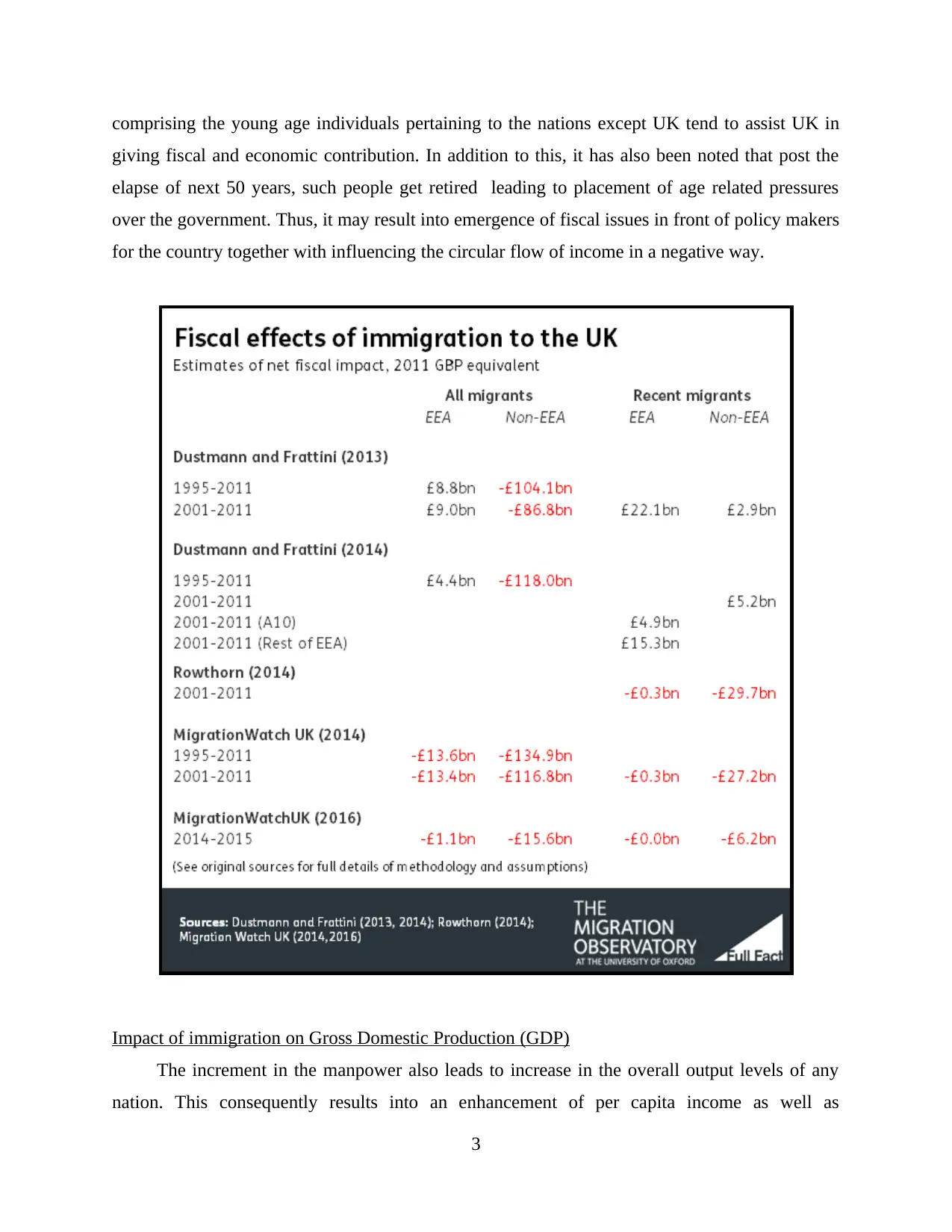
comprising the young age individuals pertaining to the nations except UK tend to assist UK in
giving fiscal and economic contribution. In addition to this, it has also been noted that post the
elapse of next 50 years, such people get retired leading to placement of age related pressures
over the government. Thus, it may result into emergence of fiscal issues in front of policy makers
for the country together with influencing the circular flow of income in a negative way.
Impact of immigration on Gross Domestic Production (GDP)
The increment in the manpower also leads to increase in the overall output levels of any
nation. This consequently results into an enhancement of per capita income as well as
3
giving fiscal and economic contribution. In addition to this, it has also been noted that post the
elapse of next 50 years, such people get retired leading to placement of age related pressures
over the government. Thus, it may result into emergence of fiscal issues in front of policy makers
for the country together with influencing the circular flow of income in a negative way.
Impact of immigration on Gross Domestic Production (GDP)
The increment in the manpower also leads to increase in the overall output levels of any
nation. This consequently results into an enhancement of per capita income as well as
3
acceleration of economic growth (Lomax, Wohland, Rees and Norman, 2020). Thus, in technical
terms, it is estimated that immigration not just provides assistance in supply of worker but also
the acceleration of economy of a country through the provision of contribution within facilitating
an increment in production of offerings to fulfil the demands and needs of customers. With
respect to the marketplace of United Kingdom, several economists have together put forth the
premise that in an instance whereby continuous incoming of migrants does not take place from
last 3 decade, then the economy of the respective nation would be worse than the present state.
Since such a time period, the rate of immigrants has encountered an increment of two times as
opposed to people having UK as their native place.
Majority of the immigrants are acknowledged to be educated and visit the nation for the
purpose of attaining qualified jobs, however they leave such nation prior to the time of their
retirement for sustaining the remaining part of their lives at their native location or any other
place. Thus, this factor has a substantial impact over the fiscal policies, where give more
relatively in public finances, than receive benefits. They are also propelled as most productive
ones, which help industries especially that trade at international level, to meet higher demands of
people by offering innovative and fast supply of goods or services. It has further claimed that
immigrants cover near about 8% of UK-born population but contribute 10% to increase GDP
(Valentino and et. al., 2019).
In accordance with a recent survey conducted by Government Actuaries Department
(GAD), it is estimated as per the principal projections i.e. 130k per year net migration in the time
period between 2003 and 2031, this migration within the boundaries of United Kingdom will add
approx. 5.2 million to the total population of the country of which around 3.8 million individuals
would pertain to the working age group (McLaren, Boomgaarden and Vliegenthart, 2018). Thus,
this condition equals to the average compound growth rate of more than 0.34%. This means that
increment of 0.3% in immigrations would imply that they contribute only 0.34% for enhancing
the GDP growth on an annual basis. This tends to indicate benefit for the economy as per head
per annum, equals to approx. 0.04%, with working ones 7 per head on an annual basis. So, this
outcome reflects that neither extra infrastructural costs nor the congestion costs are something
which can be seen as the positive impacts of immigration. However, it is further claimed that
nearly 15% of the trend growth of the respective nation is dependent over immigration which
approximates 2.75% (0.4 is 15% of 2.75). Thus, on the basis of the discussion executed over the
4
terms, it is estimated that immigration not just provides assistance in supply of worker but also
the acceleration of economy of a country through the provision of contribution within facilitating
an increment in production of offerings to fulfil the demands and needs of customers. With
respect to the marketplace of United Kingdom, several economists have together put forth the
premise that in an instance whereby continuous incoming of migrants does not take place from
last 3 decade, then the economy of the respective nation would be worse than the present state.
Since such a time period, the rate of immigrants has encountered an increment of two times as
opposed to people having UK as their native place.
Majority of the immigrants are acknowledged to be educated and visit the nation for the
purpose of attaining qualified jobs, however they leave such nation prior to the time of their
retirement for sustaining the remaining part of their lives at their native location or any other
place. Thus, this factor has a substantial impact over the fiscal policies, where give more
relatively in public finances, than receive benefits. They are also propelled as most productive
ones, which help industries especially that trade at international level, to meet higher demands of
people by offering innovative and fast supply of goods or services. It has further claimed that
immigrants cover near about 8% of UK-born population but contribute 10% to increase GDP
(Valentino and et. al., 2019).
In accordance with a recent survey conducted by Government Actuaries Department
(GAD), it is estimated as per the principal projections i.e. 130k per year net migration in the time
period between 2003 and 2031, this migration within the boundaries of United Kingdom will add
approx. 5.2 million to the total population of the country of which around 3.8 million individuals
would pertain to the working age group (McLaren, Boomgaarden and Vliegenthart, 2018). Thus,
this condition equals to the average compound growth rate of more than 0.34%. This means that
increment of 0.3% in immigrations would imply that they contribute only 0.34% for enhancing
the GDP growth on an annual basis. This tends to indicate benefit for the economy as per head
per annum, equals to approx. 0.04%, with working ones 7 per head on an annual basis. So, this
outcome reflects that neither extra infrastructural costs nor the congestion costs are something
which can be seen as the positive impacts of immigration. However, it is further claimed that
nearly 15% of the trend growth of the respective nation is dependent over immigration which
approximates 2.75% (0.4 is 15% of 2.75). Thus, on the basis of the discussion executed over the
4
⊘ This is a preview!⊘
Do you want full access?
Subscribe today to unlock all pages.
Trusted by 1+ million students worldwide
subject matter, it can be said that GDP of UK has enhanced as a result of immigration
(Ottaviano, Peri and Wright, 2018).
Impact of immigration on unemployment
Even though immigration of people from different nations is providing range of benefits to
the businesses but at the same time it increases unemployment rate within their own nations. This
is so because these immigrants agrees to work at low wage rate in order to get job in UK which
is ultimately snatching opportunity from localise people of UK as they are not getting good jobs
with higher pay scale in their own country only. From the views expressed by Britain economist,
it has been analysed that increasing movement of people from one place to another directly leads
to globalisation which enforces businesses to generate job for the people worldwide in the name
of workplace diversity (Blinder and Jeannet, 2018). It has also been analysed that with the
motive of increasing production rate businesses are approaching immigrant labours as they
agrees to work at low wage rate which is ultimately affecting job of localise people as they are
losing their job at constant basis.
Impact of immigration on labour market
Immigration of labour market has been influenced by wages as well as employment
outcome. It has also been seen that these immigrants has higher knowledge as well as quality
skills which ultimately helps them out in maximising their productivity in the rapid manner. This
simply results in the increase labour market productivity. In addition to this, it can be further said
that main of UK businesses is to maximize their productivity along with the higher quality by
simply making use of labours from the international markets. On the basis of viewpoints
expressed by several economists, it has also been said that impact of labour market over the
population of UK can be seen in negative form. This potential negative impact over UK
population can be acknowledged in the form of employment generation and wages. Away with
this, it has been determined that constantly developing consequences related to the immigration
are acknowledged as the higher in the firm of enhancing productivity as well as growth of the
same sector (Valentino and et. al., 2019). It can be said that constantly increasing productivity of
the company helps it in improvising its performance which ultimately leads to attainment of their
domestic as well as international objectives. This is so because these businesses are able to
mould their products and services as per the core requirement of different customers which
ultimately satisfies them at extensive level and also influences them to make purchase from the
5
(Ottaviano, Peri and Wright, 2018).
Impact of immigration on unemployment
Even though immigration of people from different nations is providing range of benefits to
the businesses but at the same time it increases unemployment rate within their own nations. This
is so because these immigrants agrees to work at low wage rate in order to get job in UK which
is ultimately snatching opportunity from localise people of UK as they are not getting good jobs
with higher pay scale in their own country only. From the views expressed by Britain economist,
it has been analysed that increasing movement of people from one place to another directly leads
to globalisation which enforces businesses to generate job for the people worldwide in the name
of workplace diversity (Blinder and Jeannet, 2018). It has also been analysed that with the
motive of increasing production rate businesses are approaching immigrant labours as they
agrees to work at low wage rate which is ultimately affecting job of localise people as they are
losing their job at constant basis.
Impact of immigration on labour market
Immigration of labour market has been influenced by wages as well as employment
outcome. It has also been seen that these immigrants has higher knowledge as well as quality
skills which ultimately helps them out in maximising their productivity in the rapid manner. This
simply results in the increase labour market productivity. In addition to this, it can be further said
that main of UK businesses is to maximize their productivity along with the higher quality by
simply making use of labours from the international markets. On the basis of viewpoints
expressed by several economists, it has also been said that impact of labour market over the
population of UK can be seen in negative form. This potential negative impact over UK
population can be acknowledged in the form of employment generation and wages. Away with
this, it has been determined that constantly developing consequences related to the immigration
are acknowledged as the higher in the firm of enhancing productivity as well as growth of the
same sector (Valentino and et. al., 2019). It can be said that constantly increasing productivity of
the company helps it in improvising its performance which ultimately leads to attainment of their
domestic as well as international objectives. This is so because these businesses are able to
mould their products and services as per the core requirement of different customers which
ultimately satisfies them at extensive level and also influences them to make purchase from the
5
Paraphrase This Document
Need a fresh take? Get an instant paraphrase of this document with our AI Paraphraser
same company at constant basis. This ultimately increases their sales performance as well as
profitability in the rapid manner. Apart from this, it can be said that effective skills as well as
knowledge acquired by immigrants directly helps UK businesses in bringing innovations in their
product and services with the support efforts placed by these immigrants in the form of business
ideas and efforts placed by them. This also results in the gaining of competitive advantage at
marketplace with the effective support of skilled human capital in rightful manner.
CONCLUSION
On the basis of above discussion, it can be said that there are positive as well as negative
aspects linked to immigration within a country. The positive impacts in this relation comprise of
development of skill set as well as competency levels of local workers. Besides this, the negative
impacts include reduction in employment for semi skilled or unskilled individuals creating
challenge for the policy makers to render jobs to them. Furthermore, it has been acknowledged
that immigration has also led to increment in GDP of UK. Along with this, it has also been
analysed that impact of immigrant on labour market can be seen in the form of increasing
opportunity to the localise people of UK to develop their skills as well as knowledge with
immigrants which will ultimately improvises their performance in appropriate manner. With the
analysis of the overall discussion it can be said that overall impact of immigration on labour
market is positive.
6
profitability in the rapid manner. Apart from this, it can be said that effective skills as well as
knowledge acquired by immigrants directly helps UK businesses in bringing innovations in their
product and services with the support efforts placed by these immigrants in the form of business
ideas and efforts placed by them. This also results in the gaining of competitive advantage at
marketplace with the effective support of skilled human capital in rightful manner.
CONCLUSION
On the basis of above discussion, it can be said that there are positive as well as negative
aspects linked to immigration within a country. The positive impacts in this relation comprise of
development of skill set as well as competency levels of local workers. Besides this, the negative
impacts include reduction in employment for semi skilled or unskilled individuals creating
challenge for the policy makers to render jobs to them. Furthermore, it has been acknowledged
that immigration has also led to increment in GDP of UK. Along with this, it has also been
analysed that impact of immigrant on labour market can be seen in the form of increasing
opportunity to the localise people of UK to develop their skills as well as knowledge with
immigrants which will ultimately improvises their performance in appropriate manner. With the
analysis of the overall discussion it can be said that overall impact of immigration on labour
market is positive.
6
REFERENCES
Books and Journals
Blinder, S. and Jeannet, A. M., 2018. The ‘illegal’and the skilled: effects of media portrayals on
perceptions of immigrants in Britain. Journal of Ethnic and Migration Studies. 44(9).
pp.1444-1462.
Doyle, C., 2018. Housing in UK New Immigration Destinations: Planning, houses of multiple
occupation and the challenges of uncertainty. Journal of Rural Studies. 64. pp.276-288.
Konitzer, T. B. and et. al., 2019. Ethnocentrism versus group-specific stereotyping in
immigration opinion: cross-national evidence on the distinctiveness of immigrant
groups. Journal of Ethnic and Migration Studies. 45(7). pp.1051-1074.
Leruth, B. and Taylor-Gooby, P., 2019. Does political discourse matter? Comparing party
positions and public attitudes on immigration in England. Politics. 39(2). pp.154-169.
Lomax, N., Wohland, P., Rees, P. and Norman, P., 2020. The impacts of international migration
on the UK’s ethnic populations. Journal of Ethnic and Migration Studies. 46(1). pp.177-
199.
McLaren, L., Boomgaarden, H. and Vliegenthart, R., 2018. News coverage and public concern
about immigration in Britain. International Journal of Public Opinion Research. 30(2).
pp.173-193.
Ottaviano, G. I., Peri, G. and Wright, G. C., 2018. Immigration, trade and productivity in
services: Evidence from UK firms. Journal of International Economics. 112. pp.88-108.
Rutter, J. and Carter, R., 2018. National Conversation on Immigration. British Future.
Valentino, N. A. and et. al., 2019. Economic and cultural drivers of immigrant support
worldwide. British Journal of Political Science. 49(4). pp.1201-1226.
7
Books and Journals
Blinder, S. and Jeannet, A. M., 2018. The ‘illegal’and the skilled: effects of media portrayals on
perceptions of immigrants in Britain. Journal of Ethnic and Migration Studies. 44(9).
pp.1444-1462.
Doyle, C., 2018. Housing in UK New Immigration Destinations: Planning, houses of multiple
occupation and the challenges of uncertainty. Journal of Rural Studies. 64. pp.276-288.
Konitzer, T. B. and et. al., 2019. Ethnocentrism versus group-specific stereotyping in
immigration opinion: cross-national evidence on the distinctiveness of immigrant
groups. Journal of Ethnic and Migration Studies. 45(7). pp.1051-1074.
Leruth, B. and Taylor-Gooby, P., 2019. Does political discourse matter? Comparing party
positions and public attitudes on immigration in England. Politics. 39(2). pp.154-169.
Lomax, N., Wohland, P., Rees, P. and Norman, P., 2020. The impacts of international migration
on the UK’s ethnic populations. Journal of Ethnic and Migration Studies. 46(1). pp.177-
199.
McLaren, L., Boomgaarden, H. and Vliegenthart, R., 2018. News coverage and public concern
about immigration in Britain. International Journal of Public Opinion Research. 30(2).
pp.173-193.
Ottaviano, G. I., Peri, G. and Wright, G. C., 2018. Immigration, trade and productivity in
services: Evidence from UK firms. Journal of International Economics. 112. pp.88-108.
Rutter, J. and Carter, R., 2018. National Conversation on Immigration. British Future.
Valentino, N. A. and et. al., 2019. Economic and cultural drivers of immigrant support
worldwide. British Journal of Political Science. 49(4). pp.1201-1226.
7
⊘ This is a preview!⊘
Do you want full access?
Subscribe today to unlock all pages.
Trusted by 1+ million students worldwide

1 out of 9


Related Documents


Your All-in-One AI-Powered Toolkit for Academic Success.
+13062052269
info@desklib.com
Available 24*7 on WhatsApp / Email
![[object Object]](/_next/static/media/star-bottom.7253800d.svg)
Unlock your academic potential
Copyright © 2020–2026 A2Z Services. All Rights Reserved. Developed and managed by ZUCOL.