Macau's Migrant Workers: Labor, Globalization & Inequality

Verified

Added on  2023/05/29

|4
|733
|56
Essay
AI Summary
This essay examines the social and economic conditions of migrant workers in Macau, focusing on the impact of labor globalization and the resulting social inequalities. It highlights the significant role migrant workers play in Macau's economy, particularly in the hospitality and construction sectors, while also addressing the discriminatory practices they face from local residents. The essay discusses how labor globalization, while creating opportunities, often leads to lower wages for unskilled migrant workers, exacerbating social inequality. It emphasizes the need for the Macau government to foster a more inclusive environment, address disputes between local and migrant workers, and implement strategies to balance the benefits of labor globalization with the need for social equity. The study uses research to explain the issues, and the references help to support the arguments and suggestions that are provided.
Document Page
Running head: SOCIOLOGY 0
SOCIOLOGY
Name of Student
Institution Affiliation
0
tabler-icon-diamond-filled.svg

Paraphrase This Document

Need a fresh take? Get an instant paraphrase of this document with our AI Paraphraser
Document Page
SOCIOLOGY 1
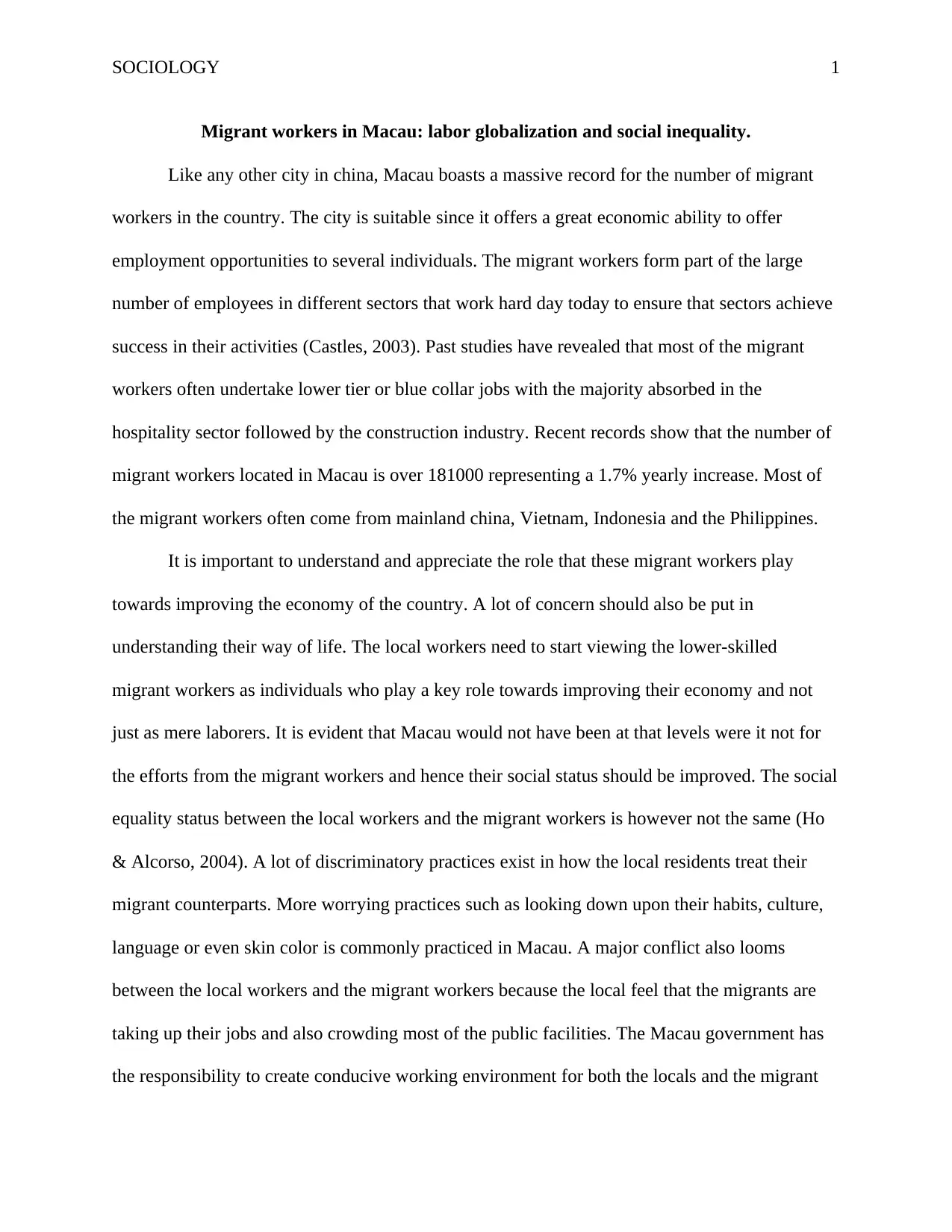
Migrant workers in Macau: labor globalization and social inequality.
Like any other city in china, Macau boasts a massive record for the number of migrant
workers in the country. The city is suitable since it offers a great economic ability to offer
employment opportunities to several individuals. The migrant workers form part of the large
number of employees in different sectors that work hard day today to ensure that sectors achieve
success in their activities (Castles, 2003). Past studies have revealed that most of the migrant
workers often undertake lower tier or blue collar jobs with the majority absorbed in the
hospitality sector followed by the construction industry. Recent records show that the number of
migrant workers located in Macau is over 181000 representing a 1.7% yearly increase. Most of
the migrant workers often come from mainland china, Vietnam, Indonesia and the Philippines.
It is important to understand and appreciate the role that these migrant workers play
towards improving the economy of the country. A lot of concern should also be put in
understanding their way of life. The local workers need to start viewing the lower-skilled
migrant workers as individuals who play a key role towards improving their economy and not
just as mere laborers. It is evident that Macau would not have been at that levels were it not for
the efforts from the migrant workers and hence their social status should be improved. The social
equality status between the local workers and the migrant workers is however not the same (Ho
& Alcorso, 2004). A lot of discriminatory practices exist in how the local residents treat their
migrant counterparts. More worrying practices such as looking down upon their habits, culture,
language or even skin color is commonly practiced in Macau. A major conflict also looms
between the local workers and the migrant workers because the local feel that the migrants are
taking up their jobs and also crowding most of the public facilities. The Macau government has
the responsibility to create conducive working environment for both the locals and the migrant
Document Page
SOCIOLOGY 2
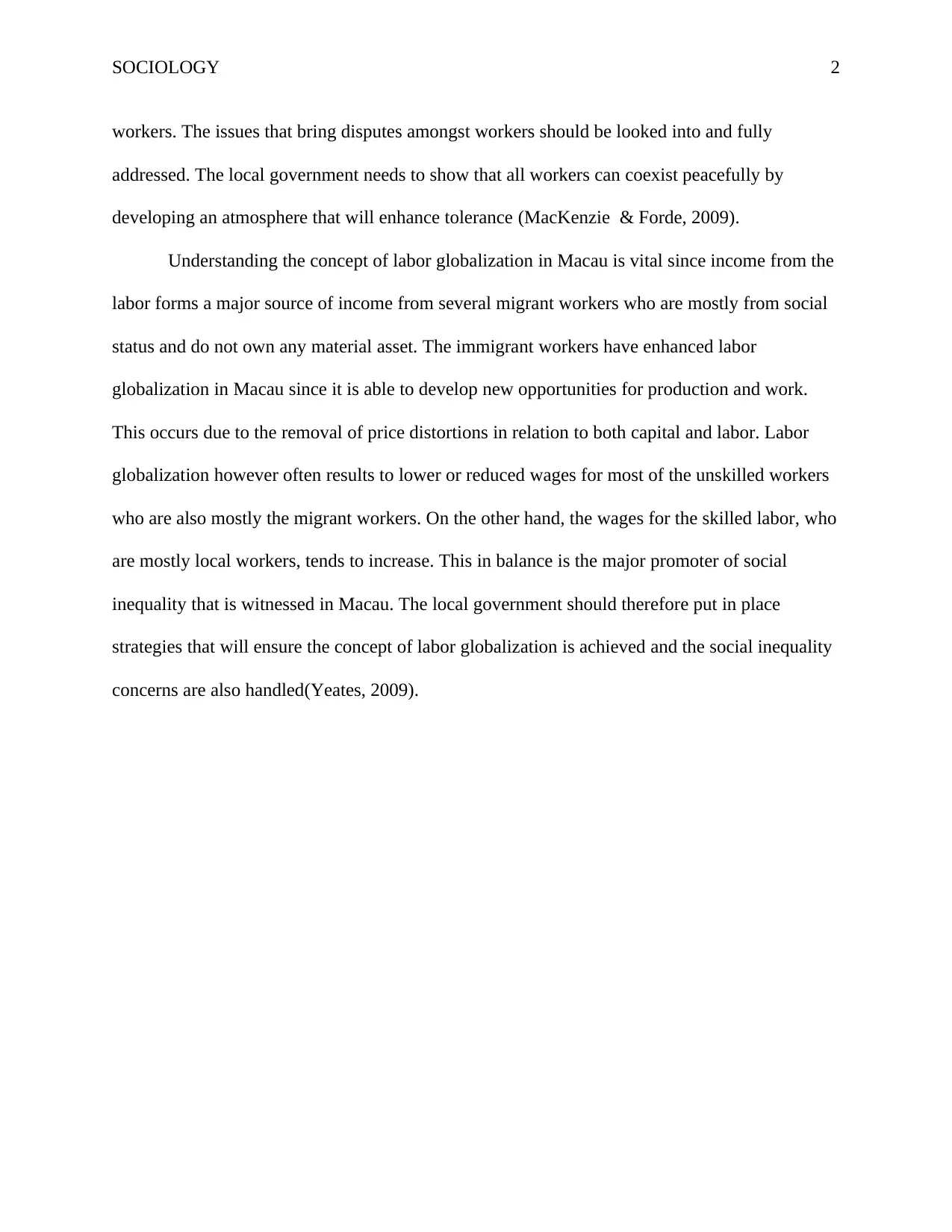
workers. The issues that bring disputes amongst workers should be looked into and fully
addressed. The local government needs to show that all workers can coexist peacefully by
developing an atmosphere that will enhance tolerance (MacKenzie & Forde, 2009).
Understanding the concept of labor globalization in Macau is vital since income from the
labor forms a major source of income from several migrant workers who are mostly from social
status and do not own any material asset. The immigrant workers have enhanced labor
globalization in Macau since it is able to develop new opportunities for production and work.
This occurs due to the removal of price distortions in relation to both capital and labor. Labor
globalization however often results to lower or reduced wages for most of the unskilled workers
who are also mostly the migrant workers. On the other hand, the wages for the skilled labor, who
are mostly local workers, tends to increase. This in balance is the major promoter of social
inequality that is witnessed in Macau. The local government should therefore put in place
strategies that will ensure the concept of labor globalization is achieved and the social inequality
concerns are also handled(Yeates, 2009).
Document Page
SOCIOLOGY 3
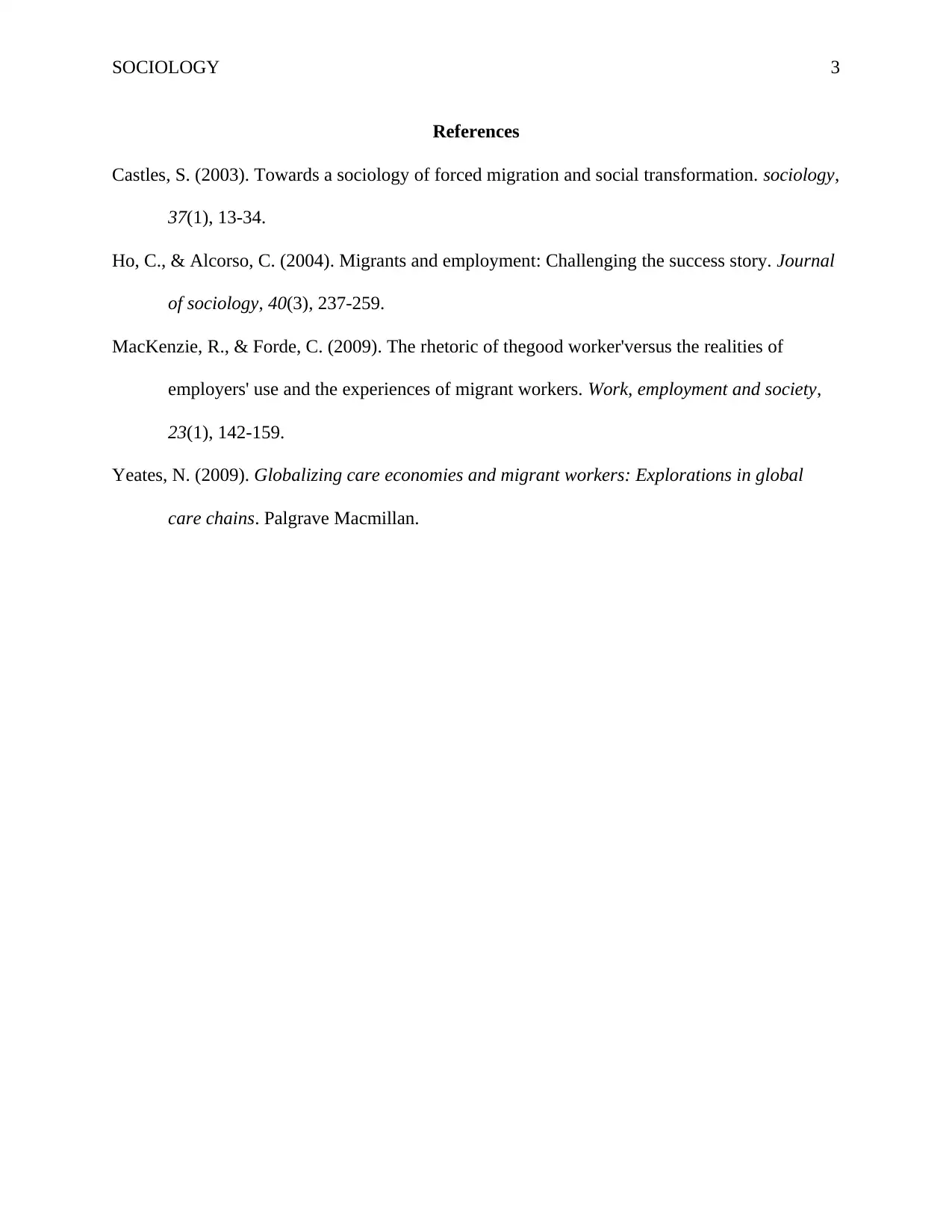
References
Castles, S. (2003). Towards a sociology of forced migration and social transformation. sociology,
37(1), 13-34.
Ho, C., & Alcorso, C. (2004). Migrants and employment: Challenging the success story. Journal
of sociology, 40(3), 237-259.
MacKenzie, R., & Forde, C. (2009). The rhetoric of thegood worker'versus the realities of
employers' use and the experiences of migrant workers. Work, employment and society,
23(1), 142-159.
Yeates, N. (2009). Globalizing care economies and migrant workers: Explorations in global
care chains. Palgrave Macmillan.
chevron_up_icon
1 out of 4
circle_padding
hide_on_mobile
zoom_out_icon
[object Object]