Millennials in the Workplace: Motivation, Knowledge, and Strategies
VerifiedAdded on 2019/12/03
|10
|3838
|140
Report
AI Summary
This report delves into the dynamics of the millennial generation within the workplace, contrasting them with Generation X. It explores the unique needs, expectations, and motivations of millennials, highlighting their preference for work-life balance, flexible working arrangements, and opportunities for career development. The report examines various motivational theories, with a focus on Maslow's hierarchy of needs, and how it can be applied to engage millennial employees. Furthermore, it differentiates between tacit and explicit knowledge, referencing the works of Polanyi and Nonaka, and suggests strategies for managers to effectively extract and leverage the tacit knowledge of millennial employees. The report concludes by emphasizing the importance of creating a contemporary working environment that fosters motivation and employee retention among millennials.
MILLENNIAL AT WORK

Paraphrase This Document
Need a fresh take? Get an instant paraphrase of this document with our AI Paraphraser
The millennial generation refers to the generation of children who are born between 1982 and
2002. They differ from generation X because of the reason that there behavioural traits have decreased
over the last fifteen years which consist of drug use, teen pregnancy and youth violence (De Vernal,
Van Nieuwenhove and Hillaire-Marcel, 2014). In the present study, researcher aims at evaluating
different aspects about millennial's in which, they are different from generation X has been focused.
Along with this, it also focuses on factors that motivates the millennial's and the justifications.
Thereafter, with the help of studies made by Polanyi and Nonaka, investigator explains the terms tacit
and explicit knowledge. Lastly, methods and approaches that managers of the firm during the period of
70s and 80s can undertake in order to release the tacit knowledge of millennial needs to be considered.
In this context, investigator evaluates how the contemporary working environment can motivate and
retain the millennial's at work.
Millennial's can be referred to the millennial generation or the generation Y. However, they are
the demographic cohort following of Generation X (Abraham and Harrington, 2015). There are several
authors and scholars that have proposed different dates for the period of millennial thus, it is difficult to
determine the precise dates when the generation starts and ends but most of them are in the opinion of
years ranging from early 1980s to the early 2000s. The origin of word Millennial is derived by the
authors named as William Strauss and Neil Howe when they published Millennial's in Generation: The
History of America's Future, 1584 to 2069. Both the authors are widely credited in order to name the
Millennial (Phillips and Trainor, 2014). On the other hand, Generation X is commonly abbreviated to
Gen X which is the generation born after the western Post-World War II Baby Born. However, various
demographers and commentators use birth dates ranging from early 1960s to the early 1980s.
Furthermore, Gen X is often characterised by the high level of scepticism and they arguably are the
best educated generation with 29% of them obtaining bachelor’s degree or higher. This helps them in
bringing stability to their life and growing maturity.
There are several factors of Gen Y or millennial and Gen Y which differentiate them from each
other and helps the people to understand them appropriately and smartly (Larkin, 2014).
2002. They differ from generation X because of the reason that there behavioural traits have decreased
over the last fifteen years which consist of drug use, teen pregnancy and youth violence (De Vernal,
Van Nieuwenhove and Hillaire-Marcel, 2014). In the present study, researcher aims at evaluating
different aspects about millennial's in which, they are different from generation X has been focused.
Along with this, it also focuses on factors that motivates the millennial's and the justifications.
Thereafter, with the help of studies made by Polanyi and Nonaka, investigator explains the terms tacit
and explicit knowledge. Lastly, methods and approaches that managers of the firm during the period of
70s and 80s can undertake in order to release the tacit knowledge of millennial needs to be considered.
In this context, investigator evaluates how the contemporary working environment can motivate and
retain the millennial's at work.
Millennial's can be referred to the millennial generation or the generation Y. However, they are
the demographic cohort following of Generation X (Abraham and Harrington, 2015). There are several
authors and scholars that have proposed different dates for the period of millennial thus, it is difficult to
determine the precise dates when the generation starts and ends but most of them are in the opinion of
years ranging from early 1980s to the early 2000s. The origin of word Millennial is derived by the
authors named as William Strauss and Neil Howe when they published Millennial's in Generation: The
History of America's Future, 1584 to 2069. Both the authors are widely credited in order to name the
Millennial (Phillips and Trainor, 2014). On the other hand, Generation X is commonly abbreviated to
Gen X which is the generation born after the western Post-World War II Baby Born. However, various
demographers and commentators use birth dates ranging from early 1960s to the early 1980s.
Furthermore, Gen X is often characterised by the high level of scepticism and they arguably are the
best educated generation with 29% of them obtaining bachelor’s degree or higher. This helps them in
bringing stability to their life and growing maturity.
There are several factors of Gen Y or millennial and Gen Y which differentiate them from each
other and helps the people to understand them appropriately and smartly (Larkin, 2014).
Generation Y or Millennial Generation X
This generation refers to the people born in 80s
and 90s (Acar, 2014).
This generation refers to the people of the 60s and
70s.
Millennial generation are known as Peter Pan
generation because their childhood was so good
that they have the tendency to delay adulthood.
As an individual, Gen X is known for being
philosophical and misanthropical and it is because
of the reason they came of the age just after
experiencing the Cold War (Lederer and et.al,
2014).
In case of economic diversity or recession or
climate change, Gen Y will not blame the past but
they will focus on mitigating the issues by looking
forward (Aad and et.al, 2014).
While Gen X focuses on fixing the mistakes that
their ancestors made so that they can live a safe
and secure life.
Difference in needs and expectations of Generation Millennial and Generation X at work can be
illustrated with the help of studies made by different authors and scholars. Millennial have different
concepts about their personal and professional life. However, their motive is work to live rather than
live to work. Despite of this, they understand the fact that money and work are not all they want. But
Millennial are more concern about the life style, good work, life balance, flexible working, feeling
value and adding value to the workplace (Patrick, 2014). In comparison to Generation X, millennial's
expected more from their employer and they are more demanding than the previous generation.
However, the trending needs and expectations of millennial's are challenging and interesting
work, high salary, career development opportunities, job security, good work life balance etc. On the
other hand, Generation X is more pragmatic and practical in nature as they want to experience the
things by doing them personally at the workplace (Arnett and Wittmann, 2014). Along with this, they
tend to pretend casual working nature, like friendly working environment, wants flexibility and
freedom to work in an effective manner. Millennial experiment more new things, makes new rules and
regulations, while Gen Y takes employability more seriously. Henceforth, these are few differing needs
and wants of Gen X and Millennials.
Motivation in general terms can be defined as the needs, desire, wants or drives within
individual. However, it refers to the process of challenging the people to work and accomplish the
objectives (Schoenherr, T., Griffith, D. A. Chandra, 2014). In context to business, motivation is one of
the most significant aspects that have to be carried out in a suitable manner so that willingness amongst
This generation refers to the people born in 80s
and 90s (Acar, 2014).
This generation refers to the people of the 60s and
70s.
Millennial generation are known as Peter Pan
generation because their childhood was so good
that they have the tendency to delay adulthood.
As an individual, Gen X is known for being
philosophical and misanthropical and it is because
of the reason they came of the age just after
experiencing the Cold War (Lederer and et.al,
2014).
In case of economic diversity or recession or
climate change, Gen Y will not blame the past but
they will focus on mitigating the issues by looking
forward (Aad and et.al, 2014).
While Gen X focuses on fixing the mistakes that
their ancestors made so that they can live a safe
and secure life.
Difference in needs and expectations of Generation Millennial and Generation X at work can be
illustrated with the help of studies made by different authors and scholars. Millennial have different
concepts about their personal and professional life. However, their motive is work to live rather than
live to work. Despite of this, they understand the fact that money and work are not all they want. But
Millennial are more concern about the life style, good work, life balance, flexible working, feeling
value and adding value to the workplace (Patrick, 2014). In comparison to Generation X, millennial's
expected more from their employer and they are more demanding than the previous generation.
However, the trending needs and expectations of millennial's are challenging and interesting
work, high salary, career development opportunities, job security, good work life balance etc. On the
other hand, Generation X is more pragmatic and practical in nature as they want to experience the
things by doing them personally at the workplace (Arnett and Wittmann, 2014). Along with this, they
tend to pretend casual working nature, like friendly working environment, wants flexibility and
freedom to work in an effective manner. Millennial experiment more new things, makes new rules and
regulations, while Gen Y takes employability more seriously. Henceforth, these are few differing needs
and wants of Gen X and Millennials.
Motivation in general terms can be defined as the needs, desire, wants or drives within
individual. However, it refers to the process of challenging the people to work and accomplish the
objectives (Schoenherr, T., Griffith, D. A. Chandra, 2014). In context to business, motivation is one of
the most significant aspects that have to be carried out in a suitable manner so that willingness amongst
⊘ This is a preview!⊘
Do you want full access?
Subscribe today to unlock all pages.

Trusted by 1+ million students worldwide
the employees to perform can be developed as well as they can be encouraged to enhance their skills
and abilities to set different benchmark. According to Aboagye-Nimo and et.al, (2015), motivation is
the internal and external factors that stimulate desire and energy within people at workplace to
continually interested and committed towards the job, role or subject in order to attain desired goals
and objectives. Similar to this Sheng and et.al, (2015), defines different types of motivational theories
that assist top level management of business enterprise to motivate or encourage subordinates and other
people to work in effective and efficient manner and generate desired results and outcomes for the firm.
As per the view of Ayu (2015), it is essential for the management to remember that millennial's
in their organisation can be incredible assets to the company, if managers take time to understand them
and accordingly acts with them. In this context it is crucial for the companies to motivate the millennial
employees within the firm so that they can be encouraged to carry out work in the best possible manner
and generate desire results which they are capable of (Cousins and et.al, 2014). Furthermore, in
comparison to previous generation, millennial are highly educated, most technological advanced,
possess different work values and want to learn new things and develop their skills.
In order to motivate the millennial employees at the workplace the most suitable motivational
theory would be Maslow's hierarchy of need theory. This theory in psychology is proposed by Abraham
Maslow in his 1943 paper “A Theory of Human Motivation” (Baltag, Renne and Smets, 2014). The
main purpose behind this theory is to define different needs of different people at different level.
However, according to Maslow's hierarchy need theory, desire and wants of Millennial individuals are
categorized in five different segments such as: Self actualisation, esteem, belongingness, safety and
physiological needs.
and abilities to set different benchmark. According to Aboagye-Nimo and et.al, (2015), motivation is
the internal and external factors that stimulate desire and energy within people at workplace to
continually interested and committed towards the job, role or subject in order to attain desired goals
and objectives. Similar to this Sheng and et.al, (2015), defines different types of motivational theories
that assist top level management of business enterprise to motivate or encourage subordinates and other
people to work in effective and efficient manner and generate desired results and outcomes for the firm.
As per the view of Ayu (2015), it is essential for the management to remember that millennial's
in their organisation can be incredible assets to the company, if managers take time to understand them
and accordingly acts with them. In this context it is crucial for the companies to motivate the millennial
employees within the firm so that they can be encouraged to carry out work in the best possible manner
and generate desire results which they are capable of (Cousins and et.al, 2014). Furthermore, in
comparison to previous generation, millennial are highly educated, most technological advanced,
possess different work values and want to learn new things and develop their skills.
In order to motivate the millennial employees at the workplace the most suitable motivational
theory would be Maslow's hierarchy of need theory. This theory in psychology is proposed by Abraham
Maslow in his 1943 paper “A Theory of Human Motivation” (Baltag, Renne and Smets, 2014). The
main purpose behind this theory is to define different needs of different people at different level.
However, according to Maslow's hierarchy need theory, desire and wants of Millennial individuals are
categorized in five different segments such as: Self actualisation, esteem, belongingness, safety and
physiological needs.
Paraphrase This Document
Need a fresh take? Get an instant paraphrase of this document with our AI Paraphraser
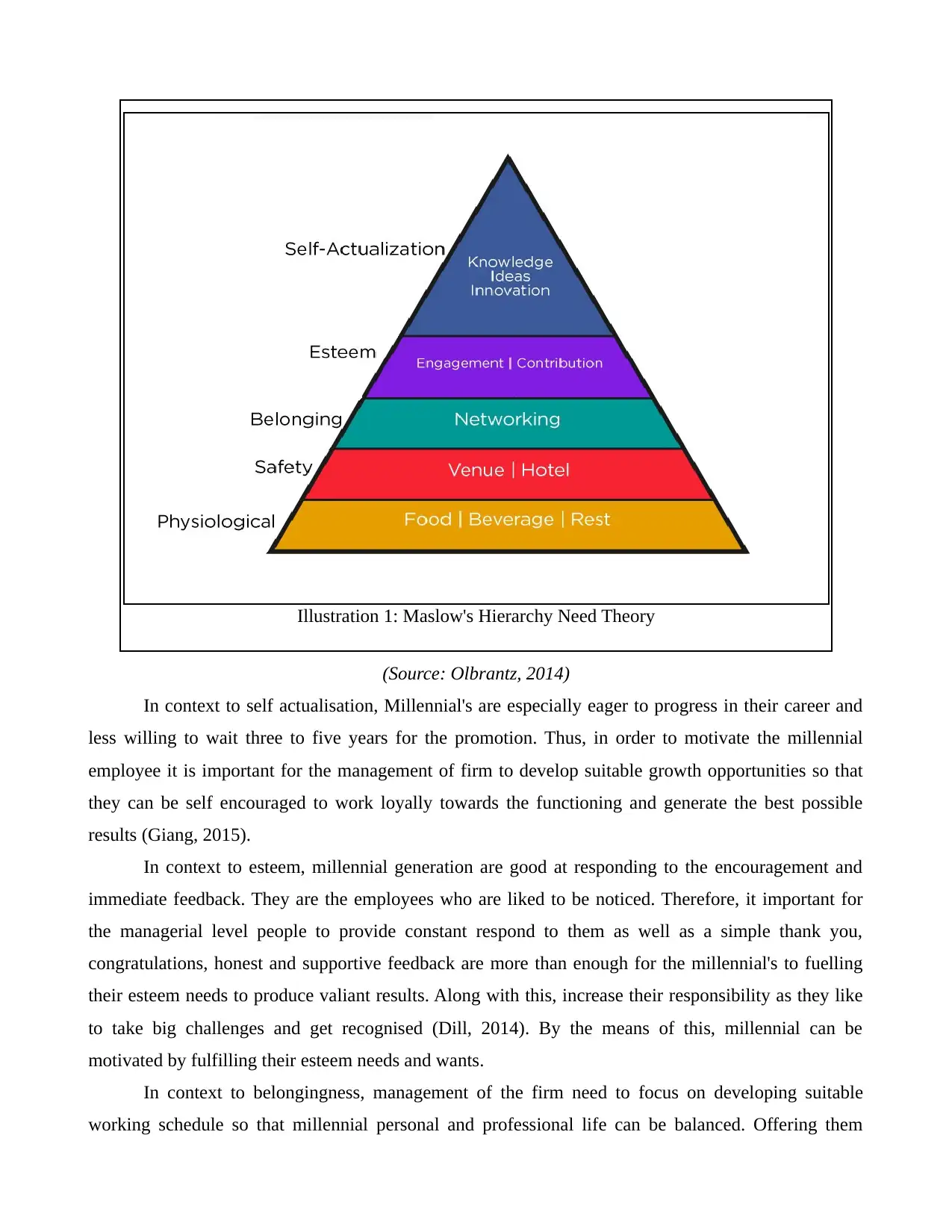
(Source: Olbrantz, 2014)
In context to self actualisation, Millennial's are especially eager to progress in their career and
less willing to wait three to five years for the promotion. Thus, in order to motivate the millennial
employee it is important for the management of firm to develop suitable growth opportunities so that
they can be self encouraged to work loyally towards the functioning and generate the best possible
results (Giang, 2015).
In context to esteem, millennial generation are good at responding to the encouragement and
immediate feedback. They are the employees who are liked to be noticed. Therefore, it important for
the managerial level people to provide constant respond to them as well as a simple thank you,
congratulations, honest and supportive feedback are more than enough for the millennial's to fuelling
their esteem needs to produce valiant results. Along with this, increase their responsibility as they like
to take big challenges and get recognised (Dill, 2014). By the means of this, millennial can be
motivated by fulfilling their esteem needs and wants.
In context to belongingness, management of the firm need to focus on developing suitable
working schedule so that millennial personal and professional life can be balanced. Offering them
Illustration 1: Maslow's Hierarchy Need Theory
In context to self actualisation, Millennial's are especially eager to progress in their career and
less willing to wait three to five years for the promotion. Thus, in order to motivate the millennial
employee it is important for the management of firm to develop suitable growth opportunities so that
they can be self encouraged to work loyally towards the functioning and generate the best possible
results (Giang, 2015).
In context to esteem, millennial generation are good at responding to the encouragement and
immediate feedback. They are the employees who are liked to be noticed. Therefore, it important for
the managerial level people to provide constant respond to them as well as a simple thank you,
congratulations, honest and supportive feedback are more than enough for the millennial's to fuelling
their esteem needs to produce valiant results. Along with this, increase their responsibility as they like
to take big challenges and get recognised (Dill, 2014). By the means of this, millennial can be
motivated by fulfilling their esteem needs and wants.
In context to belongingness, management of the firm need to focus on developing suitable
working schedule so that millennial personal and professional life can be balanced. Offering them
Illustration 1: Maslow's Hierarchy Need Theory
flexibility to work adequately as well as spare time for their friends and family. However, work life
balance is one of the most significant drivers of employee retention among the millennials. This tech-
savvy generation is essentially able to work anytime from anywhere with an internet connection. Thus,
encouraging them to work flexibly will help in meeting their belongingness needs and which leads to
motivate them to generate desired results for the firm (Thielfoldt and Scheef, 2004).
In context to safety, Millennial always focused on taking risks and experimenting new things so
that they can generate desired results and outcomes. But not like the previous generation, still
millennials are also concern about the work safety and job security. Hence, it is important for the
managerial level people to provide them better working environment as well as assurance to job
security so that they can constantly take risk by promoting innovation and creativity within the
approach of business enterprise to generate desired results and outcomes (Halsall, 2012).
Lastly, physiological needs, according to the survey, roughly 33% of millennials will place
mobile flexibility over salary when considering a job offer. As they are the one who changes jobs more
often than any other generation in order to satisfy their physiological needs. However, in context to
corporate physiological needs, management should provide them better salary, timely hikes, bonuses
and incentives so that they can be motivated to retain for the long term.
In general knowledge management can be defined as the understanding of different forms that
knowledge can exist in and accordingly distinguishing between different types of knowledge. However,
over the centuries, authors and scholars had made many attempts to classify the knowledge. In context
to business and knowledge management, only two types of knowledge are usually defined such as:
explicit and tacit (Schofield, 2014).
Tacit knowledge in general terms can be defined as the kind of knowledge that is difficult to
transfer to another person by the means of writing it down or verbalizing it. In other words, it is integral
to the consciousness of the person which is acquired largely through association with other people. The
concept of tacit knowledge is introduced by Michael Polanyi in his 1966 book “The Tacit Dimension”
which indeed is also known as informal knowledge. In the study of Wellman (2009), tacit knowledge is
also regarded as being the most value source of knowledge and the most likely to overcome all the gaps
and loopholes within the company. Supporting to this fact Gamble and Blackwell (2001) states that,
lack of focusing on tacit knowledge can directly reduced the capabilities of the employees with regard
to innovation and sustaining competitiveness (Goudreau, 2013). Furthermore, using the reference by
Polanyi (1966), it is difficult to imagine the article that would accurately convey how one reads the
facial expression. However, it would be rather near impossible to convey gestures and expressions.
Further, author defines that tacit knowledge is found in the minds of human stakeholders which consist
balance is one of the most significant drivers of employee retention among the millennials. This tech-
savvy generation is essentially able to work anytime from anywhere with an internet connection. Thus,
encouraging them to work flexibly will help in meeting their belongingness needs and which leads to
motivate them to generate desired results for the firm (Thielfoldt and Scheef, 2004).
In context to safety, Millennial always focused on taking risks and experimenting new things so
that they can generate desired results and outcomes. But not like the previous generation, still
millennials are also concern about the work safety and job security. Hence, it is important for the
managerial level people to provide them better working environment as well as assurance to job
security so that they can constantly take risk by promoting innovation and creativity within the
approach of business enterprise to generate desired results and outcomes (Halsall, 2012).
Lastly, physiological needs, according to the survey, roughly 33% of millennials will place
mobile flexibility over salary when considering a job offer. As they are the one who changes jobs more
often than any other generation in order to satisfy their physiological needs. However, in context to
corporate physiological needs, management should provide them better salary, timely hikes, bonuses
and incentives so that they can be motivated to retain for the long term.
In general knowledge management can be defined as the understanding of different forms that
knowledge can exist in and accordingly distinguishing between different types of knowledge. However,
over the centuries, authors and scholars had made many attempts to classify the knowledge. In context
to business and knowledge management, only two types of knowledge are usually defined such as:
explicit and tacit (Schofield, 2014).
Tacit knowledge in general terms can be defined as the kind of knowledge that is difficult to
transfer to another person by the means of writing it down or verbalizing it. In other words, it is integral
to the consciousness of the person which is acquired largely through association with other people. The
concept of tacit knowledge is introduced by Michael Polanyi in his 1966 book “The Tacit Dimension”
which indeed is also known as informal knowledge. In the study of Wellman (2009), tacit knowledge is
also regarded as being the most value source of knowledge and the most likely to overcome all the gaps
and loopholes within the company. Supporting to this fact Gamble and Blackwell (2001) states that,
lack of focusing on tacit knowledge can directly reduced the capabilities of the employees with regard
to innovation and sustaining competitiveness (Goudreau, 2013). Furthermore, using the reference by
Polanyi (1966), it is difficult to imagine the article that would accurately convey how one reads the
facial expression. However, it would be rather near impossible to convey gestures and expressions.
Further, author defines that tacit knowledge is found in the minds of human stakeholders which consist
⊘ This is a preview!⊘
Do you want full access?
Subscribe today to unlock all pages.
Trusted by 1+ million students worldwide
of cultural beliefs, values, attitudes, mental models etc. Along with this, dependency upon the skills,
capabilities and expertise needs to be reviewed.
According to Nonaka, explicit knowledge can be defined as the formalized and codified
knowledge that can be easy to understand. However, it is fairly easy to identify, store and retrieve. This
is the type of knowledge that is easily managed by the knowledge management system which is
effective at facilitating the storage, retrieval, and modification of documents and texts. In context
managerial perspective, the biggest advantage with this type of knowledge is that it is similar to
information which can be easily communicated and shared between the employees. Further, it is a
formal and systematic knowledge. According to Botha (2008), explicit knowledge is found in database,
memos, notes and documents etc (Lederer and et.al, 2014).
According to Polanyi and Nonaka, there are certain differences between explicit and tacit
knowledge that an individual possess. As per their views, tactic is the knowledge that people carry in
their minds and it is difficult for the other people to access. At times, individual does not understand the
importance of knowledge he/she might possess and the valuable it can be if they share with others. On
the other hand of it, explicit knowledge is that which can be documented or codified and can be
transferred easily to others (Arnett and Wittmann, 2014). Millennial always uses explicit way of
sharing or acquiring the knowledge so that they can easily understand as well as easily make other what
they are trying to say.
There are several methods that managers can adopt in order to release their millennials from
tacit knowledge to explicit knowledge. Looking at the present corporate market, level of competition is
increasing on the data to day basis. Thus, it becomes important for the managerial level people to
motivate their employees so that they can work effectively and generate results and outcomes for the
firm. In context to millennials there are three different ways through the means of which millennials
needs at workplace can be satisfied and they can be motivated to retain within the corporation. Firstly,
manager should provide them career advancement. However, it is the most significant reason behind
which Gen Y employees leaves the job, is a lack of career opportunities (Baltag, Renne and Smets,
2014). It is the duty of senior managers to ensure that they are driven with wide range of growing
opportunities so that they can be retained. As studied above, millennials are not the one who wants to
waste several years to find out where their career is headed as they want to make the most of every
opportunity available to them. In case, if management is unable to provide adequate amount of career
development opportunity than millennial can be de-motivated and will not work effectively for the
better functioning of the firm (Thielfoldt and Scheef, 2004). Along with this, it can lead to a situation
where managerial people will be unable to retain them for future.
capabilities and expertise needs to be reviewed.
According to Nonaka, explicit knowledge can be defined as the formalized and codified
knowledge that can be easy to understand. However, it is fairly easy to identify, store and retrieve. This
is the type of knowledge that is easily managed by the knowledge management system which is
effective at facilitating the storage, retrieval, and modification of documents and texts. In context
managerial perspective, the biggest advantage with this type of knowledge is that it is similar to
information which can be easily communicated and shared between the employees. Further, it is a
formal and systematic knowledge. According to Botha (2008), explicit knowledge is found in database,
memos, notes and documents etc (Lederer and et.al, 2014).
According to Polanyi and Nonaka, there are certain differences between explicit and tacit
knowledge that an individual possess. As per their views, tactic is the knowledge that people carry in
their minds and it is difficult for the other people to access. At times, individual does not understand the
importance of knowledge he/she might possess and the valuable it can be if they share with others. On
the other hand of it, explicit knowledge is that which can be documented or codified and can be
transferred easily to others (Arnett and Wittmann, 2014). Millennial always uses explicit way of
sharing or acquiring the knowledge so that they can easily understand as well as easily make other what
they are trying to say.
There are several methods that managers can adopt in order to release their millennials from
tacit knowledge to explicit knowledge. Looking at the present corporate market, level of competition is
increasing on the data to day basis. Thus, it becomes important for the managerial level people to
motivate their employees so that they can work effectively and generate results and outcomes for the
firm. In context to millennials there are three different ways through the means of which millennials
needs at workplace can be satisfied and they can be motivated to retain within the corporation. Firstly,
manager should provide them career advancement. However, it is the most significant reason behind
which Gen Y employees leaves the job, is a lack of career opportunities (Baltag, Renne and Smets,
2014). It is the duty of senior managers to ensure that they are driven with wide range of growing
opportunities so that they can be retained. As studied above, millennials are not the one who wants to
waste several years to find out where their career is headed as they want to make the most of every
opportunity available to them. In case, if management is unable to provide adequate amount of career
development opportunity than millennial can be de-motivated and will not work effectively for the
better functioning of the firm (Thielfoldt and Scheef, 2004). Along with this, it can lead to a situation
where managerial people will be unable to retain them for future.
Paraphrase This Document
Need a fresh take? Get an instant paraphrase of this document with our AI Paraphraser
Secondly, Millennial Generation has the need to solve the problems of the and if companies
want to retain the talent in their functioning than it is important to clearly communicate long term
company goals with their hard working inspired workers. By the means of this, management can
involve millennial employees within the decision making process as well as encourage them to carry
out according to the needs and wants of current trends and environment. Apart from this, clearly
defining goals and objectives helps millennial employees in understanding the significance behind the
projects and assist them in generating desired results and outcomes.
Lastly, in order to motivate millennial employees and retain them for long periods it is essential
for the managers to allow them to work on passion projects. In young people it has often been seen
that, they quit their jobs because they doesn't get the opportunity to work on their own passionate
projects. Therefore, company those employ a decent number of millennial employees should promote
and support this approach and develop independent entrepreneurial program so that employees can be
highly motivated and retained for good period of time (Goudreau, 2013).
In conclusion to the above essay it has been observed that, millennials are the tech-savvy people
who are highly depended upon the technological aspects to carry out different tasks and operations. By
the means of this report, researcher is able to evaluate that Maslow's hierarchy need theory can help
managers of the firm to motivate the employees from Millennial generation (Halsall, 2012). Thereafter,
different between tacit and explicit knowledge has been focused and lastly various methods have been
identified through the help of managers can easily motivate and retain millennial employees for long
period.
want to retain the talent in their functioning than it is important to clearly communicate long term
company goals with their hard working inspired workers. By the means of this, management can
involve millennial employees within the decision making process as well as encourage them to carry
out according to the needs and wants of current trends and environment. Apart from this, clearly
defining goals and objectives helps millennial employees in understanding the significance behind the
projects and assist them in generating desired results and outcomes.
Lastly, in order to motivate millennial employees and retain them for long periods it is essential
for the managers to allow them to work on passion projects. In young people it has often been seen
that, they quit their jobs because they doesn't get the opportunity to work on their own passionate
projects. Therefore, company those employ a decent number of millennial employees should promote
and support this approach and develop independent entrepreneurial program so that employees can be
highly motivated and retained for good period of time (Goudreau, 2013).
In conclusion to the above essay it has been observed that, millennials are the tech-savvy people
who are highly depended upon the technological aspects to carry out different tasks and operations. By
the means of this report, researcher is able to evaluate that Maslow's hierarchy need theory can help
managers of the firm to motivate the employees from Millennial generation (Halsall, 2012). Thereafter,
different between tacit and explicit knowledge has been focused and lastly various methods have been
identified through the help of managers can easily motivate and retain millennial employees for long
period.
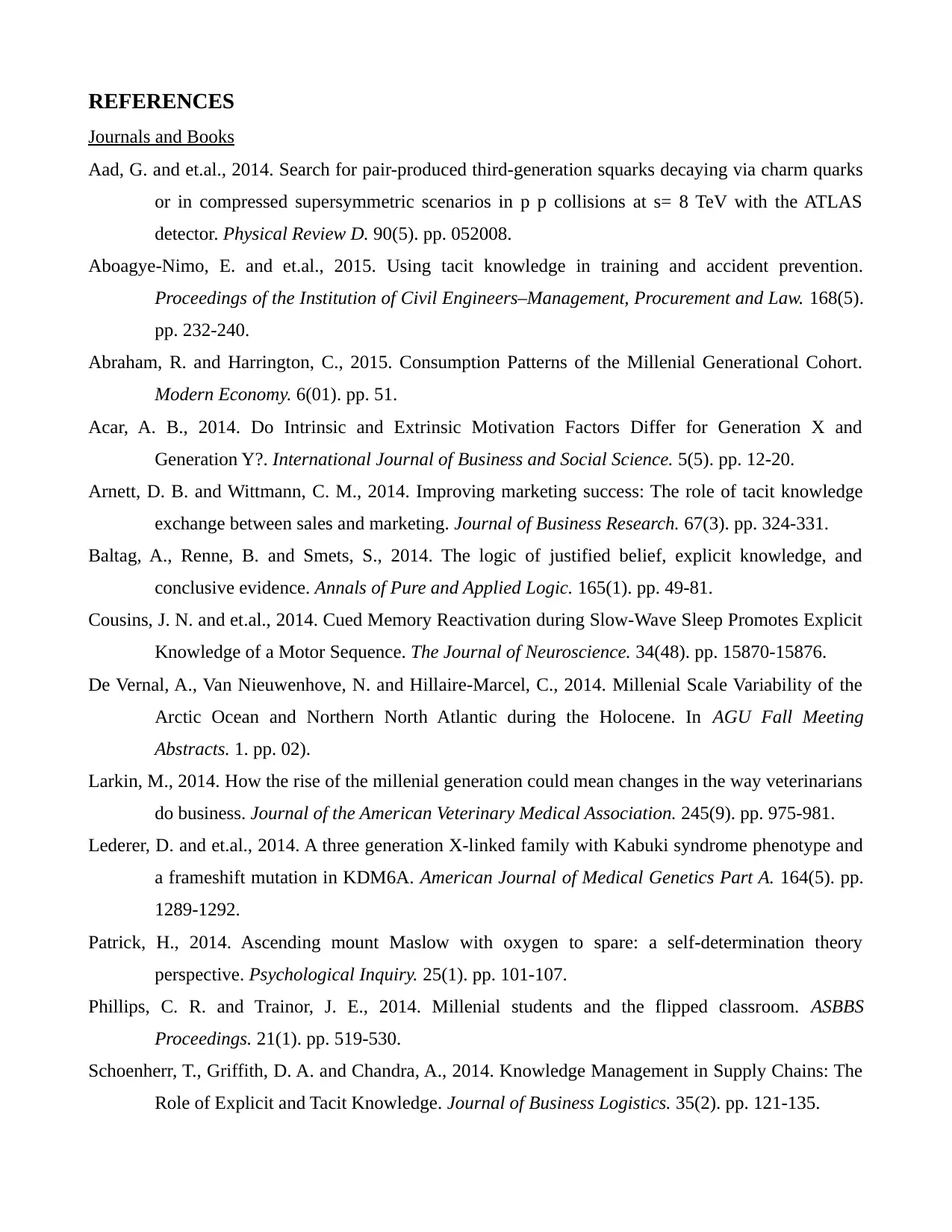
REFERENCES
Journals and Books
Aad, G. and et.al., 2014. Search for pair-produced third-generation squarks decaying via charm quarks
or in compressed supersymmetric scenarios in p p collisions at s= 8 TeV with the ATLAS
detector. Physical Review D. 90(5). pp. 052008.
Aboagye-Nimo, E. and et.al., 2015. Using tacit knowledge in training and accident prevention.
Proceedings of the Institution of Civil Engineers–Management, Procurement and Law. 168(5).
pp. 232-240.
Abraham, R. and Harrington, C., 2015. Consumption Patterns of the Millenial Generational Cohort.
Modern Economy. 6(01). pp. 51.
Acar, A. B., 2014. Do Intrinsic and Extrinsic Motivation Factors Differ for Generation X and
Generation Y?. International Journal of Business and Social Science. 5(5). pp. 12-20.
Arnett, D. B. and Wittmann, C. M., 2014. Improving marketing success: The role of tacit knowledge
exchange between sales and marketing. Journal of Business Research. 67(3). pp. 324-331.
Baltag, A., Renne, B. and Smets, S., 2014. The logic of justified belief, explicit knowledge, and
conclusive evidence. Annals of Pure and Applied Logic. 165(1). pp. 49-81.
Cousins, J. N. and et.al., 2014. Cued Memory Reactivation during Slow-Wave Sleep Promotes Explicit
Knowledge of a Motor Sequence. The Journal of Neuroscience. 34(48). pp. 15870-15876.
De Vernal, A., Van Nieuwenhove, N. and Hillaire-Marcel, C., 2014. Millenial Scale Variability of the
Arctic Ocean and Northern North Atlantic during the Holocene. In AGU Fall Meeting
Abstracts. 1. pp. 02).
Larkin, M., 2014. How the rise of the millenial generation could mean changes in the way veterinarians
do business. Journal of the American Veterinary Medical Association. 245(9). pp. 975-981.
Lederer, D. and et.al., 2014. A three generation X‐linked family with Kabuki syndrome phenotype and
a frameshift mutation in KDM6A. American Journal of Medical Genetics Part A. 164(5). pp.
1289-1292.
Patrick, H., 2014. Ascending mount Maslow with oxygen to spare: a self-determination theory
perspective. Psychological Inquiry. 25(1). pp. 101-107.
Phillips, C. R. and Trainor, J. E., 2014. Millenial students and the flipped classroom. ASBBS
Proceedings. 21(1). pp. 519-530.
Schoenherr, T., Griffith, D. A. and Chandra, A., 2014. Knowledge Management in Supply Chains: The
Role of Explicit and Tacit Knowledge. Journal of Business Logistics. 35(2). pp. 121-135.
Journals and Books
Aad, G. and et.al., 2014. Search for pair-produced third-generation squarks decaying via charm quarks
or in compressed supersymmetric scenarios in p p collisions at s= 8 TeV with the ATLAS
detector. Physical Review D. 90(5). pp. 052008.
Aboagye-Nimo, E. and et.al., 2015. Using tacit knowledge in training and accident prevention.
Proceedings of the Institution of Civil Engineers–Management, Procurement and Law. 168(5).
pp. 232-240.
Abraham, R. and Harrington, C., 2015. Consumption Patterns of the Millenial Generational Cohort.
Modern Economy. 6(01). pp. 51.
Acar, A. B., 2014. Do Intrinsic and Extrinsic Motivation Factors Differ for Generation X and
Generation Y?. International Journal of Business and Social Science. 5(5). pp. 12-20.
Arnett, D. B. and Wittmann, C. M., 2014. Improving marketing success: The role of tacit knowledge
exchange between sales and marketing. Journal of Business Research. 67(3). pp. 324-331.
Baltag, A., Renne, B. and Smets, S., 2014. The logic of justified belief, explicit knowledge, and
conclusive evidence. Annals of Pure and Applied Logic. 165(1). pp. 49-81.
Cousins, J. N. and et.al., 2014. Cued Memory Reactivation during Slow-Wave Sleep Promotes Explicit
Knowledge of a Motor Sequence. The Journal of Neuroscience. 34(48). pp. 15870-15876.
De Vernal, A., Van Nieuwenhove, N. and Hillaire-Marcel, C., 2014. Millenial Scale Variability of the
Arctic Ocean and Northern North Atlantic during the Holocene. In AGU Fall Meeting
Abstracts. 1. pp. 02).
Larkin, M., 2014. How the rise of the millenial generation could mean changes in the way veterinarians
do business. Journal of the American Veterinary Medical Association. 245(9). pp. 975-981.
Lederer, D. and et.al., 2014. A three generation X‐linked family with Kabuki syndrome phenotype and
a frameshift mutation in KDM6A. American Journal of Medical Genetics Part A. 164(5). pp.
1289-1292.
Patrick, H., 2014. Ascending mount Maslow with oxygen to spare: a self-determination theory
perspective. Psychological Inquiry. 25(1). pp. 101-107.
Phillips, C. R. and Trainor, J. E., 2014. Millenial students and the flipped classroom. ASBBS
Proceedings. 21(1). pp. 519-530.
Schoenherr, T., Griffith, D. A. and Chandra, A., 2014. Knowledge Management in Supply Chains: The
Role of Explicit and Tacit Knowledge. Journal of Business Logistics. 35(2). pp. 121-135.
⊘ This is a preview!⊘
Do you want full access?
Subscribe today to unlock all pages.
Trusted by 1+ million students worldwide
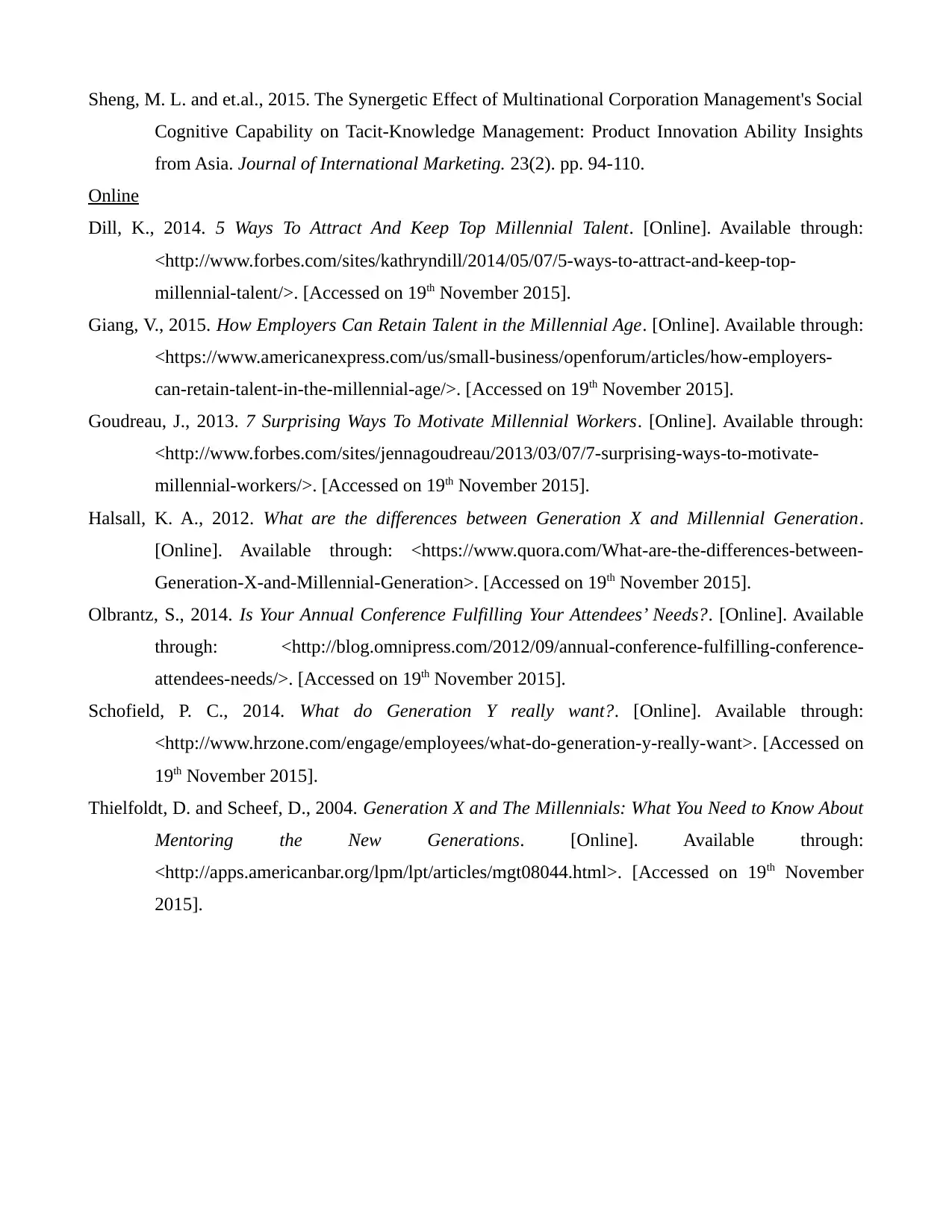
Sheng, M. L. and et.al., 2015. The Synergetic Effect of Multinational Corporation Management's Social
Cognitive Capability on Tacit-Knowledge Management: Product Innovation Ability Insights
from Asia. Journal of International Marketing. 23(2). pp. 94-110.
Online
Dill, K., 2014. 5 Ways To Attract And Keep Top Millennial Talent. [Online]. Available through:
<http://www.forbes.com/sites/kathryndill/2014/05/07/5-ways-to-attract-and-keep-top-
millennial-talent/>. [Accessed on 19th November 2015].
Giang, V., 2015. How Employers Can Retain Talent in the Millennial Age. [Online]. Available through:
<https://www.americanexpress.com/us/small-business/openforum/articles/how-employers-
can-retain-talent-in-the-millennial-age/>. [Accessed on 19th November 2015].
Goudreau, J., 2013. 7 Surprising Ways To Motivate Millennial Workers. [Online]. Available through:
<http://www.forbes.com/sites/jennagoudreau/2013/03/07/7-surprising-ways-to-motivate-
millennial-workers/>. [Accessed on 19th November 2015].
Halsall, K. A., 2012. What are the differences between Generation X and Millennial Generation.
[Online]. Available through: <https://www.quora.com/What-are-the-differences-between-
Generation-X-and-Millennial-Generation>. [Accessed on 19th November 2015].
Olbrantz, S., 2014. Is Your Annual Conference Fulfilling Your Attendees’ Needs?. [Online]. Available
through: <http://blog.omnipress.com/2012/09/annual-conference-fulfilling-conference-
attendees-needs/>. [Accessed on 19th November 2015].
Schofield, P. C., 2014. What do Generation Y really want?. [Online]. Available through:
<http://www.hrzone.com/engage/employees/what-do-generation-y-really-want>. [Accessed on
19th November 2015].
Thielfoldt, D. and Scheef, D., 2004. Generation X and The Millennials: What You Need to Know About
Mentoring the New Generations. [Online]. Available through:
<http://apps.americanbar.org/lpm/lpt/articles/mgt08044.html>. [Accessed on 19th November
2015].
Cognitive Capability on Tacit-Knowledge Management: Product Innovation Ability Insights
from Asia. Journal of International Marketing. 23(2). pp. 94-110.
Online
Dill, K., 2014. 5 Ways To Attract And Keep Top Millennial Talent. [Online]. Available through:
<http://www.forbes.com/sites/kathryndill/2014/05/07/5-ways-to-attract-and-keep-top-
millennial-talent/>. [Accessed on 19th November 2015].
Giang, V., 2015. How Employers Can Retain Talent in the Millennial Age. [Online]. Available through:
<https://www.americanexpress.com/us/small-business/openforum/articles/how-employers-
can-retain-talent-in-the-millennial-age/>. [Accessed on 19th November 2015].
Goudreau, J., 2013. 7 Surprising Ways To Motivate Millennial Workers. [Online]. Available through:
<http://www.forbes.com/sites/jennagoudreau/2013/03/07/7-surprising-ways-to-motivate-
millennial-workers/>. [Accessed on 19th November 2015].
Halsall, K. A., 2012. What are the differences between Generation X and Millennial Generation.
[Online]. Available through: <https://www.quora.com/What-are-the-differences-between-
Generation-X-and-Millennial-Generation>. [Accessed on 19th November 2015].
Olbrantz, S., 2014. Is Your Annual Conference Fulfilling Your Attendees’ Needs?. [Online]. Available
through: <http://blog.omnipress.com/2012/09/annual-conference-fulfilling-conference-
attendees-needs/>. [Accessed on 19th November 2015].
Schofield, P. C., 2014. What do Generation Y really want?. [Online]. Available through:
<http://www.hrzone.com/engage/employees/what-do-generation-y-really-want>. [Accessed on
19th November 2015].
Thielfoldt, D. and Scheef, D., 2004. Generation X and The Millennials: What You Need to Know About
Mentoring the New Generations. [Online]. Available through:
<http://apps.americanbar.org/lpm/lpt/articles/mgt08044.html>. [Accessed on 19th November
2015].

1 out of 10


Related Documents


Your All-in-One AI-Powered Toolkit for Academic Success.
+13062052269
info@desklib.com
Available 24*7 on WhatsApp / Email
![[object Object]](/_next/static/media/star-bottom.7253800d.svg)
Unlock your academic potential
Copyright © 2020–2026 A2Z Services. All Rights Reserved. Developed and managed by ZUCOL.